A Reading of Edgar Allan Poe’s “The Raven” in 100 Celebrity Voices
For every august personage who’s taken a crack Edgar Allan Poe’s evergreen poem, “The Raven,” there are thousands more who haven’t.
Humorist Jordan Monsell is doing what he can to close that gap, providing a sampling of 100 mostly male, mostly white, mostly human celebrity voices. It’s a solo recitation, but vocally a collaborative one, with a fair number of animated characters making their way into the credits, too.
He certainly knows how to cast outside the box. Traditional Poe interpreters such as Vincent Price and John Astin bring some well established creep cred to the enterprise. Monsell picks Christopher Walken and Christopher Lee already have existing takes on this classic, and Anthony Hopkins and Willem Dafoe are welcome additions.
But what to make of Jerry Seinfeld, Pee-Wee Herman, Johnny Cash… and even poetry lover Bill Murray? Manic and much missed Robin Williams may offer a clue. What good is having an arsenal of impressions if you’re not willing to roll them out in rapid succession?
While some of Monsell’s impersonations (cough, David Bowie) fall a bit short of the mark, others will have you regretting that no one had the forethought to record Don Knotts or JFK reciting the poem in its entirety.
The titles offer a bit of a misnomer. In many instances, it’s not really the performers but their best known characters being aped. While there may not be too great a vocal divide between playwright Wallace Shawn and Vizzini in The Princess Bride, The Dude is not Jeff Bridges, any more than Captain Jack Sparrow is Johnny Depp.
The project seems likely to play best with nerdy adolescent boys… which could be good news for teachers looking to get reluctant readers onboard. Show it on the classroom Smart Board, and be prepared to have mini-teach-ins on Katharine Hepburn, Walter Matthau, the late great Robert Shaw, and other big names whose day has passed. Shrek, Gollum, and Harry Potter’s house elf, Dobby, are on hand to keep the references from feeling too moldy.
The specter of Poe gets the coveted final word, a balm to the ears after the triple assault of Christian Bale’s Batman, Mad Max’s Tom Hardy, and Heath Ledger’s Joker. (It may be a matter of taste. You’ll hear no complaint from these quarters with regard to Mickey Mouse, Bert Lahr’s Cowardly Lion, or The Simpson’s Krusty the Klown, wonderfully unctuous.)
The breakneck audio patchwork approach doesn’t do much for reading comprehension, but could lead to a lively middle school discussion on what constitutes a successful performance. Who served the text best? Readers?
Furthermore, who’s missing? What voice would you add to the Monsell’s roll call, below?
Morgan Freeman
Kermit the Frog
Johnny Cash
Ringo Starr
David Bowie
Rick Moranis
Gary Oldman
Peter Lorre
Adam Sandler
Don Knotts
William Shatner
George Takei
Michael Dorn
Daffy Duck
Ricky Gervais
Foghorn Leghorn
Liam Neeson
Nicholas Cage
John Travolta
Anthony Hopkins
Rod Serling
Cookie Monster
Jay Baruchel
Jeff Bridges
Johnny Depp
Archer
Dr. Phil
Gollum
Mandy Patinkin
Wallace Shawn
Billy Crystal
Owen Wilson
Dustin Hoffman
Krusty the Klown
Apu
Christian Bale
Michael Caine
Tom Hardy
Heath Ledger
Mickey Mouse
John Wayne
Jerry Seinfeld
Phil Hartman
Goofy
Al Pacino
Marlon Brando
Jack Lemmon
Walter Matthau
Christopher Walken
Rowlf the Dog
John Cleese
Robin Williams
Katharine Hepburn
Woody Allen
Matthew McConaughey
Cowardly Lion
Jimmy Stewart
John C. Reilly
James Mason
Sylvester Stallone
Arnold Schwarzenegger
Stewie
Daniel Day Lewis
Maggie Smith
Alan Rickman
Dobby
Jack Nicholson
Christoph Waltz
Bill Murray
Dan Aykroyd
Sean Connery
Bill Cosby
Christopher Lloyd
Droopy Dog
Kevin Spacey
Harrison Ford
Ronald Reagan
JFK
Bill Clinton
Keanu Reeves
Ian McKellen
Paul Giamatti
Sebastian
Stan Lee
Jeff Goldblum
Hugh Grant
Kenneth Branagh
Larry the Cable Guy
Pee-Wee Herman
Shrek
Donkey
Charlton Heston
Michael Keaton
Homer Simpson
Yoda
Willem Dafoe
Bruce Willis
Robert Shaw
Christopher Lee
Edgar Allan Poe
Related Content:
Ayun Halliday is an author, illustrator, theater maker and Chief Primatologist of the East Village Inky zine. Follow her @AyunHalliday.
Read More...Who Painted the First Abstract Painting?: Wassily Kandinsky? Hilma af Klint? Or Another Contender?
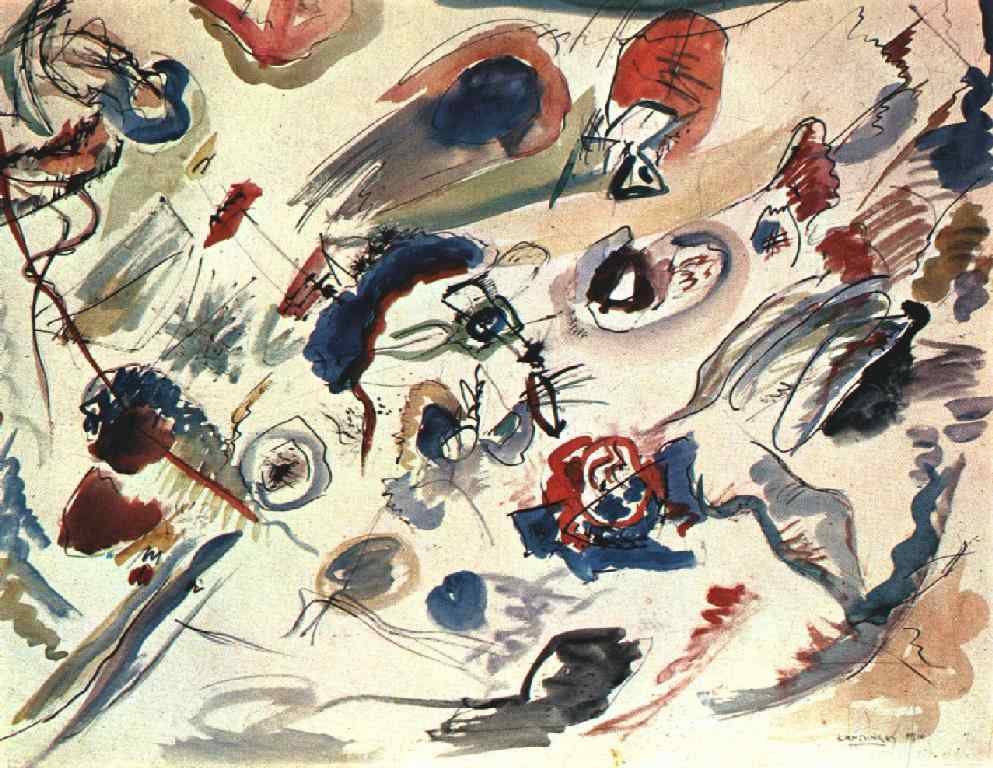
Kandinsky, Untitled, 1910
Many painters today concentrate on producing abstract work — and a fair few of those have only ever produced abstract work. But look not so very far back in human history, and you’ll find that to paint meant to paint representatively, to replicate on canvas the likenesses of the actual people, places, and things out there in the world. Humanity, of course didn’t evolve with its representational art skills pre-installed: though some cave paintings do recognizably depict men and beasts, many strike us today as what we would call abstract, or at least abstracted. So which modern artists can lay claim to having rediscovered abstraction first?
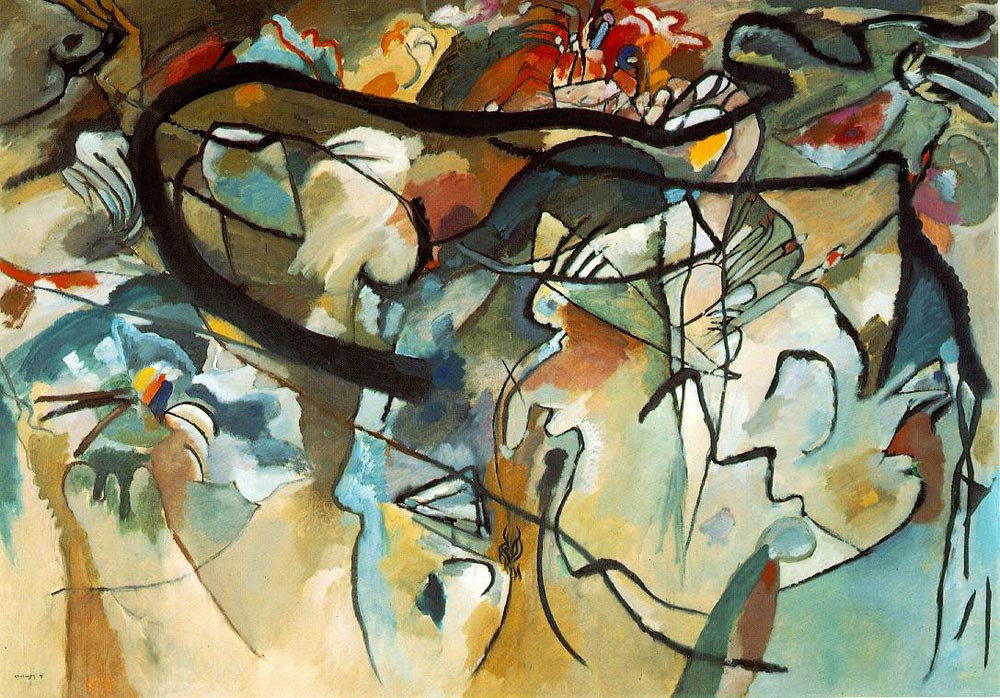
Kandinsky, Composition V, 1911
If you’ve studied any art history, you might well name the early 20th-century Russian painter Wassily Kandinsky (whose first abstract watercolor from 1910 appears at the top of the post). But “while Kandinsky is today hailed as the father of abstract painting,” writes Artsy’s Abigail Cain, “he was by no means the only player in the development of non-representational painting,” though “his work Komposition V did, admittedly, jumpstart public interest in abstract painting.”
First exhibited in Munich in December 1911, “this monumental work was just barely representational” and also “the first such work to be put on display,” inspiring the art world not just to take abstraction seriously but to see it as the future.
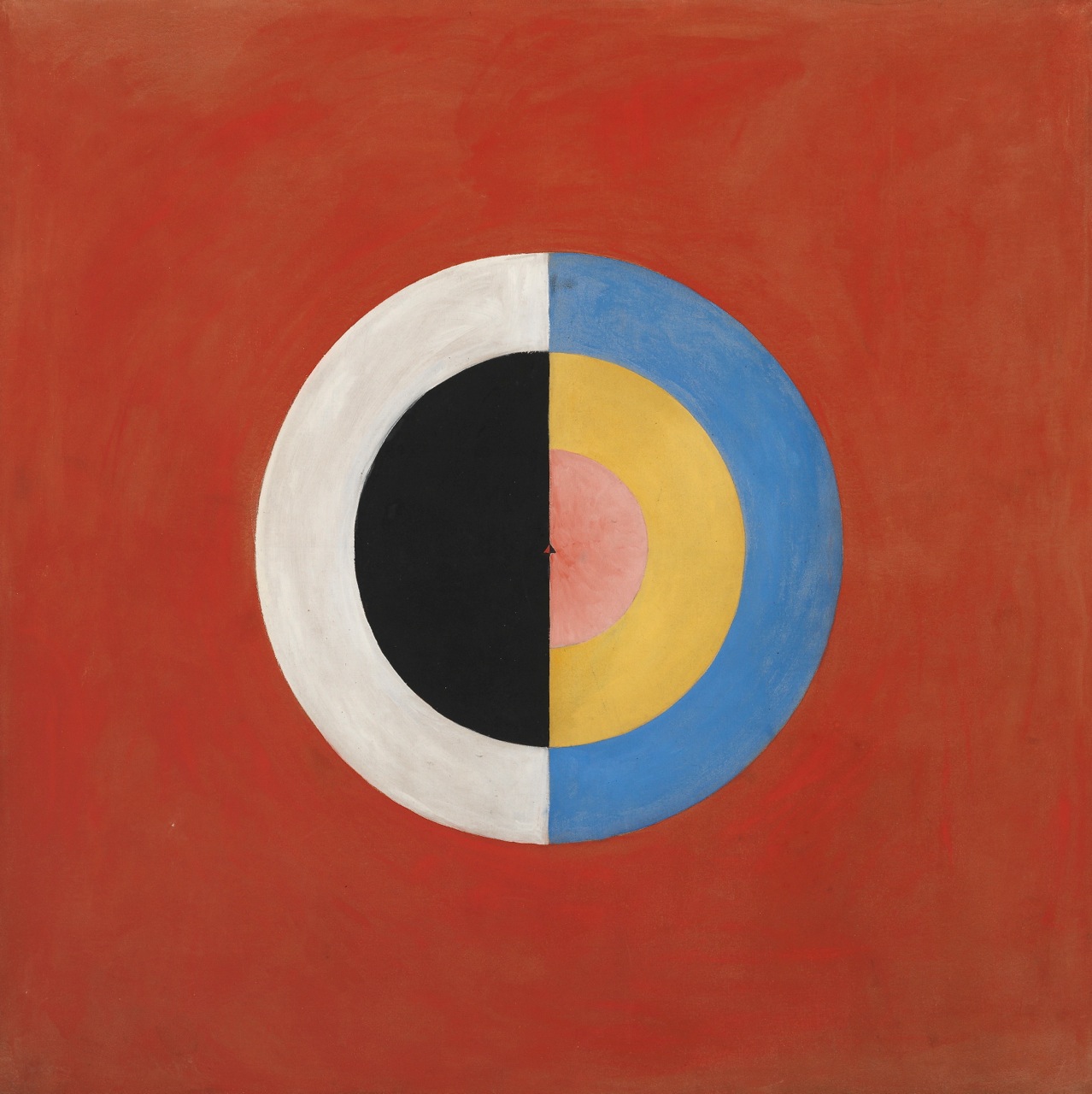
Hilma af Klint, Svanen, 1915
Kandinsky, inspired by Goethe’s Theory of Colors, had already given the subject of abstraction no small amount of thought. He’d first written a manifesto defining abstract art a few years earlier, titling it On the Spiritual in Art, a title that would have resonated with Hilma af Klint, a painter who might have actually gone abstract first. “Af Klint, who was born in Stockholm, showed an early interest in nature, mathematics and art, and she began studying at the Royal Swedish Academy of Fine Arts in 1882,” writes the New York Times’ Natalia Rachlin. She made her name as a landscape and portrait painter after graduation, but at the same time “also continued a more private pursuit: she had begun showing an interest in the occult and attending séances as early as 1879, at the age of 17.”
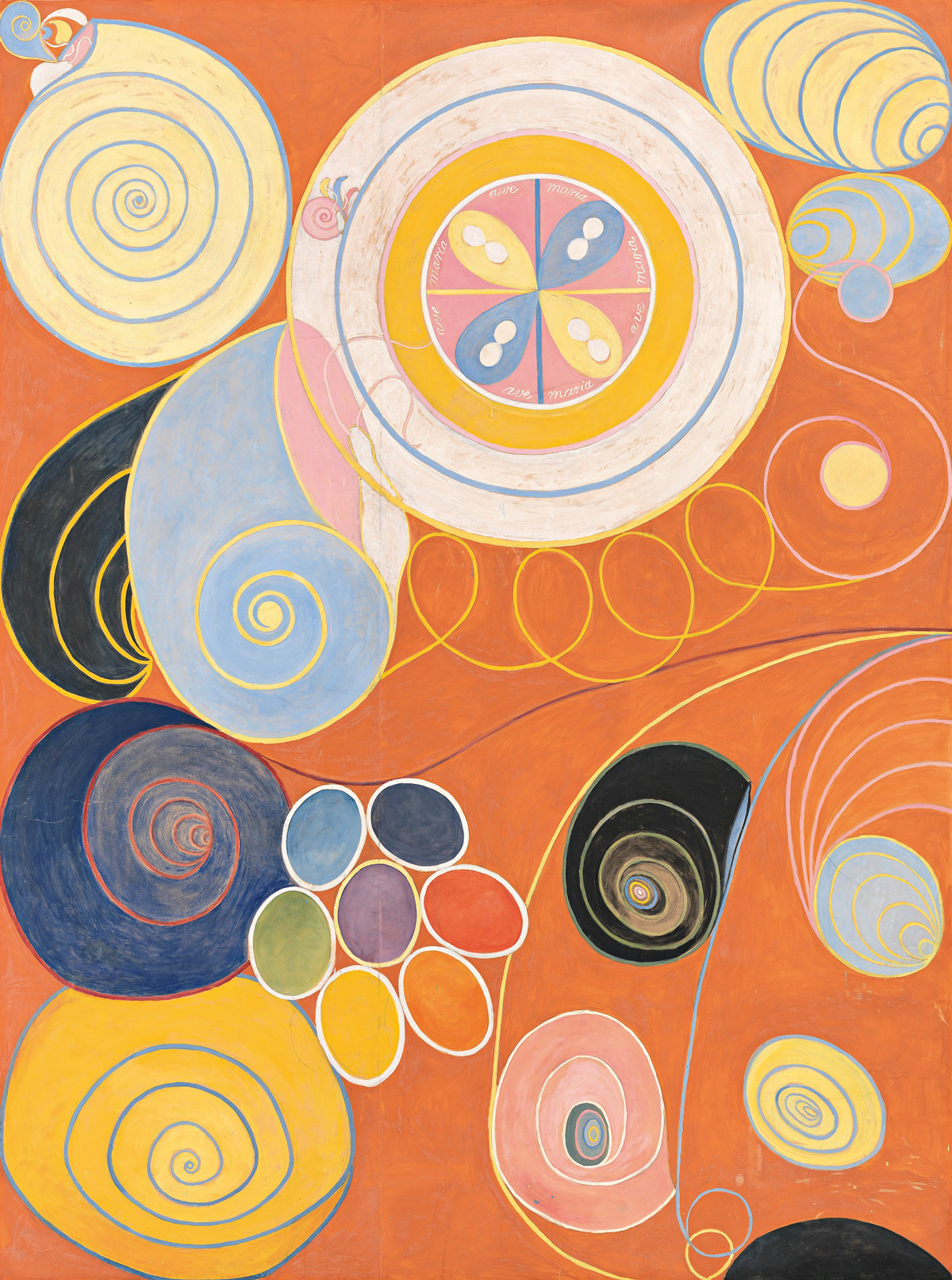
Hilma af Klint, ‘Staggering’: The Ten Largest, Youth, 1907.
Af Klint’s “curiosity about the spiritual realm soon developed into a lifelong interest in spiritism, theosophy and anthroposophy,” and during one séance she heard a spirit tell her to “make paintings that would represent the immortal aspects of man. This proved to be the turning point in af Klint’s work: from the naturalistic to the abstract, from portrayals of physical reality to conveying the invisible.” She went on to produce the 193 abstract Paintings for the Temple. The exhibitions of her representational work continued, but she kept the rest private, and in her will “even asked that her abstract paintings not be shown in public until at least twenty years after her death, noting that audiences were not yet capable of understanding her work.”
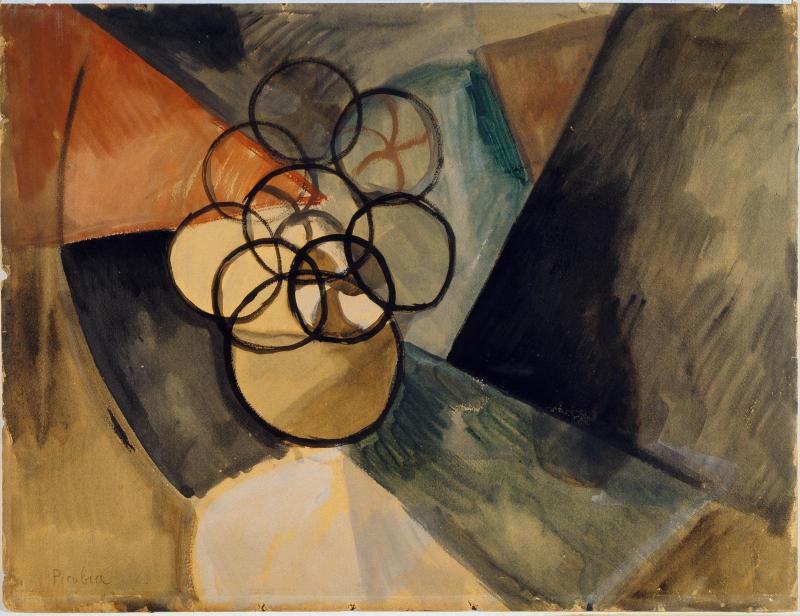
Francis Picabia, Caoutchouc, 1909.
Both Kandinsky and Af Klint look like plausible candidates for the first abstract painter — it just depends on how you define the beginning of abstraction — but they’re hardly the only ones. Cain also brings up the Czech-born, Paris-based artist František Kupka, or his colleague in the French avant-garde Francis Picabia, whose 1909 watercolor Caoutchouc (Rubber), pictured just above, came before Kandinsky had painted an abstract image or even completed any writing on the subject. Still, some objectors note that “the work still retains some semblance of form, reminiscent of a bouquet of flowers.” These questions of purity, innovation, and especially originality do get complicated. As Clive James once said, “It’s very hard to be totally inventive, so I’m not terribly interested in originality. Vitality is all I care about” — a quality that all these works exude still today.
Related Content:
Time Travel Back to 1926 and Watch Wassily Kandinsky Make Art in Some Rare Vintage Video
The MoMA Teaches You How to Paint Like Pollock, Rothko, de Kooning & Other Abstract Painters
Free Course: An Introduction to the Art of the Italian Renaissance
Based in Seoul, Colin Marshall writes and broadcasts on cities and culture. He’s at work on the book The Stateless City: a Walk through 21st-Century Los Angeles, the video series The City in Cinema, the crowdfunded journalism project Where Is the City of the Future?, and the Los Angeles Review of Books’ Korea Blog. Follow him on Twitter at @colinmarshall or on Facebook.
Read More...Hear Classic Readings of Poe’s “The Raven” by Vincent Price, James Earl Jones, Christopher Walken, Neil Gaiman, Stan Lee & More
It can seem that the writing of literature and the theory of literature occupy separate great houses, Game of Thrones-style, or even separate countries held apart by a great sea. Perhaps they war with each other, perhaps they studiously ignore each other or obliquely interact at tournaments with acronymic names like MLA and AWP. Like Thomas Pynchon’s characterization of the political right and left, scholars and writers represent opposing poles, the hothouse and the street. That rare beast, the academic poet, can seem like something of a unicorn, or dragon.
…Or like the ominous talking raven in Edgar Allan Poe’s most famous of poems.
The divide between theory and practice is a recent development, a product of state budgeting, political brinksmanship, the relentless publishing mills of academia that force scholars to find a pigeonhole and stay there.… In days past, poets and scholar/theorists frequently occupied the same place at the same time—Wallace Stevens, T.S. Eliot, Samuel Taylor Coleridge, Percy Shelley, and, of course, Poe, whose perennially popular “The Raven” serves as a point-by-point illustration for his theory of composition just as thoroughly as Eliot’s great works bear out his notion of the “objective correlative.”
Poe’s object, the titular creature, is an “archetypal symbol,” writes Dana Gioia, in a poem that aims for what its author calls a “unity of effect.” In his 1846 essay “The Philosophy of Composition,” Poe the poet/theorist tells us in great detail how “The Raven” satisfies all of his other criteria for literature as well, such as achieving its intent in a single sitting, using a repeated refrain, and so on.
Should we have any doubt about how much Poe wanted us to see the poem as the deliberate outcome of a conceptual scheme, we find him three years later, in 1849, the year of his death, delivering a lecture on the “Poetic Principle,” and concluding with a reading of “The Raven.”
John Moncure Daniel of the Richmond Semi-Weekly Examiner remarked after attending one of these talks that “the attention of many in this city is now directed to this singular performance.” At that point, Poe, who hardly made a dime from “The Raven,” had to suffer the indignity of having all of his work go out of print during his brief, unhappy lifetime. Moncure and the Examiner thereby furnished readers “with the only correct copy ever published,” previous appearances, it seems, having contained punctuation errors.
Nonetheless, for all of Poe’s pedantry and penury, “The Raven“ ‘s first appearances made him semi-famous. His readings were a sensation, and it’s a sure bet that his audiences came to hear him read the poem, not deliver a lecture on its principles. Oh, for some proto-Edison in the room with an early recording device. What would it be like to hear the mournful, grief-stricken, alcoholic genius—master of the macabre and inventor of the detective story—intone the raven’s enigmatic “Nevermore”?
While Poe’s speaking voice has receded irretrievably into history, his poetic voice may live close to forever. So mesmerizing are his meter and diction that many great actors known especially for their voices have become possessed by “The Raven.”
Likely when we think of the poem, what first comes to the mind’s ear is the voice of Vincent Price, or James Earl Jones, Christopher Lee, or Christopher Walken, all of whom have given “The Raven” its due.
And so have many other notables, such as the great Stan Lee, Poe successor Neil Gaiman, original Gomez Addams actor John Astin, and venerable Beat poet/scholar Anne Waldman (listen here). You will find those recitations here at this round-up of notable “Raven” readings, and if this somehow doesn’t satiate you, then check out Lou Reed’s take on the poem, the Grateful Dead’s musical tribute, “Raven Space,” or a reading in 100 different celebrity impressions.
Finally, we would be remiss not to mention The Simpsons’ James Earl Jones-narrated parody, a worthy teaching tool for distracted young visual learners. Is it a shame that we now think of “The Raven” as a Halloween yarn fit for the Treehouse of Horror or any number of enjoyable exercises in spooky oratory—rather than the theoretical thought experiment its author seemed to intend? Does Poe rotisserie in his grave as Homer snores in a wingback chair? Probably. But as the author told us himself at length, the poem works! It still never fails to excite our morbid curiosity, enchant our gothic sensibility, and maybe send a chill or two down the spine. Maybe we never really needed Poe to explain it to us.
You can find other literary readings in our collection, 1,000 Free Audio Books: Download Great Books for Free.
Related Content:
When Charles Dickens & Edgar Allan Poe Met, and Dickens’ Pet Raven Inspired Poe’s Poem “The Raven”
7 Tips from Edgar Allan Poe on How to Write Vivid Stories and Poems
Download The Complete Works of Edgar Allan Poe on His Birthday
Josh Jones is a writer and musician based in Durham, NC. Follow him at @jdmagness
Read More...Watch Werner Herzog’s Very First Film, Herakles, Made When He Was Only 19-Years-Old (1962)
Rebellious dwarfs, crazed conquistadors, delusional tycoons, wood-carving ski jumpers: Werner Herzog scholars who attempt to find a pattern in the filmmaker’s choices of subject matter are virtually guaranteed an interesting search, if an ultimately futile one. But they must all start in the same place: Herzog’s very first film Herakles, which mashes up the spectacles of body building, auto racing, and destruction. It does all that in nine minutes to a soundtrack of saxophone jazz, and with frequent references to the titular hero of myth, whom you may know better by his Roman name of Hercules.
“Would he clean the Augean stables?” ask Herakles’ subtitles over footage of one young German man showing off his well-shaped torso. “Would he dispose of the Lernaean Hydra?” they ask of another as he strikes a pose.
Between clips of these bodybuilders performing their labors and questions about whether they could perform those of Hercules, we see militaristic marches, falling bombs, heaps of rubble, and a 1955 racecar crash at Le Mans that killed 83 people. All this juxtaposition tempts us to ask what message the nineteen-year-old Herzog wanted to deliver, but, as in all his subsequent work, he surely wanted less to make an articulable point than to explore the possibilities of cinema itself.
More recently, in Paul Cronin’s interview book Herzog on Herzog, the filmmaker looks back on “my first blunder, Herakles” and finds it “rather stupid and pointless, though at the time it was an important test for me. It taught me about editing together very diverse material that would not normally sit comfortably as a whole,” and in a sense prepared him for an entire cinematic career of very diverse material that would not normally sit comfortably as a whole. “For me it was fascinating to edit material together that had such separate and individual lives. The film was some kind of an apprenticeship for me. I just felt it would be better to make a film than go to film school” — of the non-rogue variety, anyway.
Related Content:
Werner Herzog Teaches His First Online Course on Filmmaking
Werner Herzog’s Rogue Film School: Apply & Learn the Art of Guerilla Filmmaking & Lock-Picking
Portrait Werner Herzog: The Director’s Autobiographical Short Film from 1986
Based in Seoul, Colin Marshall writes and broadcasts on cities and culture. He’s at work on the book The Stateless City: a Walk through 21st-Century Los Angeles, the video series The City in Cinema, the crowdfunded journalism project Where Is the City of the Future?, and the Los Angeles Review of Books’ Korea Blog. Follow him on Twitter at @colinmarshall or on Facebook.
Read More...The Top 100 American Films of All Time, According to 62 International Film Critics
Entertainment first, and art second? Hasn’t that always been the American way when it comes to film? And is that how the rest of the world sees it, especially considering France’s love of Jerry Lewis, Germany’s obsession with David Hasselhoff, and China taking Nicholas Cage’s career choices more seriously than he does himself?
In this list of The 100 Greatest American Films, the BBC polled 62 international film critics to see what they thought were the United States’ enduring contributions to cinema culture. The films only needed to be funded by American companies—the directors could be from other countries. (If not, about a third of these choices would be disqualified. Five are by Hitchcock alone.)
As for other favorite directors, Spielberg gets five (although the highest entry, Jaws, comes in at 38) and Billy Wilder gets five, with The Apartment the highest ranked at 24. The most popular decade for film is the 1970s, the top two being Coppola’s first two Godfather films. (It would be interesting to know the median age of these 62 critics, just to see if their formative years align with the decade.)
Of the 100, here’s the Top 10:
10. The Godfather Part II (Francis Ford Coppola, 1974)
9. Casablanca (Michael Curtiz, 1942)
8. Psycho (Alfred Hitchcock, 1960)
7. Singin’ in the Rain (Stanley Donen and Gene Kelly, 1952)
6. Sunrise (F.W. Murnau, 1927)
5. The Searchers (John Ford, 1956)
4. 2001: A Space Odyssey (Stanley Kubrick, 1968)
3. Vertigo (Alfred Hitchcock, 1958)
2. The Godfather (Francis Ford Coppola, 1972)
1. Citizen Kane (Orson Welles, 1941)
Comparing this list to BFI’s 2012 list of the Top 100 films of all time, there isn’t much difference in the top spots. And, in the years to come, I suspect those top four films will switch places occasionally but never really leave.
Instead, the surprises come further down the list. Gone with the Wind used to be considered a classic, no doubt bolstered by its box office success at the time. But its politics have weakened its position, and, along with Birth of a Nation, it might not last another decade on such lists. On the flip side, black filmmakers have four films on the list and women directors only one (Meshes of the Afternoon one of the best experimental films of all time).
Other interesting choices include The Lion King (the only animated film on the list), Sternberg’s The Shanghai Gesture, and Minnelli’s The Band Wagon (one of two musicals by the director on the list). What films would you like to see added or taken away? Is this a fair assessment of America’s worth? Let us know in the comments.
Above, you can watch a somewhat idiosyncratic presentations of the films on the BBC list.
Related Content:
The 100 Funniest Films of All Time, According to 253 Film Critics from 52 Countries
The 10 Greatest Films of All Time According to 358 Filmmakers
The 10 Greatest Films of All Time According to 846 Film Critics
Ted Mills is a freelance writer on the arts who currently hosts the FunkZone Podcast. You can also follow him on Twitter at @tedmills, read his other arts writing at tedmills.com and/or watch his films here.
Read More...The Addams Family Dance to The Ramones’ “Blitzkrieg Bop”
In the spirit of Andrew Sullivan’s Mental Health Break, we give you this: The Addams Family Dancing to The Ramones’ 1976 track, “Blitzkrieg Bop.” For a brief moment, forget the hurricanes, the threat of nuclear war, the fires burning in LA, Montana, Washington, DC and the hearts of white supremacists. Breathe in. Breathe out. And repeat after me. “Hey Ho.…..Let’s go!”
If you would like to support the mission of Open Culture, consider making a donation to our site. It’s hard to rely 100% on ads, and your contributions will help us continue providing the best free cultural and educational materials to learners everywhere. You can contribute through PayPal, Patreon, and Venmo (@openculture). Thanks!
Related Content:
John Astin, From The Addams Family, Recites “The Raven” as Edgar Allan Poe
The Ramones’ First Press Release: We’re Part Musicians, Dentists & Degenerates (1975)
Hear Joey Ramone Sing a Piece by John Cage Adapted from James Joyce’s Finnegans Wake
Read More...Watch John Lennon’s Last Live Performance (1975): “Imagine,” “Stand By Me” & More
After each heartbreaking loss of a musical icon this past year and a half, we have turned to their greatest moments onstage, not necessarily their last, because their final shows weren’t always all that memorable. Declining health, bad recordings… and not every gig is a good one even in the best of times and with the best of performers. But when it comes to John Lennon’s last public appearance, I like to think he might have left the stage exactly the way he wanted to, as a rocker, a provocateur, and a pisstaker in a candy-apple red jumpsuit, backed by a nine-piece miming band of bald men in black leather with masks painted on the back of their heads.
Credited as “John Lennon, Etc.,” the band’s true name, given to them by Lennon himself, is abbreviated on their bass drum: B.O.M.F., or “Brothers of Mother Fuckers.” It was Lennon’s send off to his own career as much as it was a Salute to Sir Lew, as the program was called. Just a few months later Sean was born, and Lennon declared he would retire to raise his son. At the time of his tragic death five years later, he had begun recording again, releasing Double Fantasy and planning a second double album, Milk and Honey. But we never got to see him perform those songs.
The honoree for Lennon’s last gig was Sir Lew Grade, “a powerful media mogul,” notes Dangerous Minds, “with roots in cabaret and variety shows.” A man known as much for his ruthlessness in business as for his Charleston, which he performed on tabletops whenever the mood struck him. In 1969 Grade bought up the rights to over a hundred Lennon and McCartney songs, after some very tense negotiations. Lennon sued Grade in 1974 and settled out of court, and Grade remained the co-publisher of all of his new songs.
As part of the settlement, Lennon recorded his album of covers of classic rock ‘n’ roll songs, appropriately titled Rock ‘n’ Roll. When he appeared at the tribute concert for Sir Lew at the Hilton Hotel in New York—on the bill with Julie Andrews, Tom Jones, and Peter Sellers—he played Little Richard’s “Slippin’ and Slidin,” and Ben E. King’s “Stand by Me” for “a “who’s who of the old Hollywood elite,” including Lauren Bacall, Kirk Douglas, Gene Kelly, and Orson Welles. The show, recorded for TV broadcast, cut his rendition of “Stand by Me” (hear the audio above), but they did air his final song, “Imagine,” which turned out to be the last song he ever sang live onstage (top).
Lennon is in very good form, and seemingly in good spirits. The year previous, he’d scored a number one hit with “Whatever Gets You Thru the Night.” According at least to Paul McCartney and Lennon’s girlfriend May Pang, he had even considered reuniting the Beatles. In November of 1974, Lennon joined Elton John onstage at Madison Square Garden for rollicking versions of “I Saw Her Standing There,” “Lucy in the Sky with Diamonds,” and “Whatever Gets You Thru the Night” on which Elton had played in the studio. You can see a recreation of that performance above. It was technically Lennon’s last live concert appearance.
His final appearance on stage, on the other hand, while it might have been an odd way to say goodbye, whether he meant to do so or not, may not be what we revisit when we revisit Lennon. Why did he agree to do a tribute concert “for a man he had been embroiled in lawsuits with?” With a stage show that many have thought was deliberately designed to antagonize the honoree? We’ll never know. But I’m grateful that his final live song was one that still speaks to us of hope and possibility. Maybe bowing to censors, Lennon changes “Imagine”’s controversial line about religion. Instead, he sings, “Nothing to kill or die for, no immigration, too,” referring both to his troubles with the U.S. immigration authorities and to the borderless world the song projects. “Imagine there’s no countries… Imagine all the people sharing all the world.”
Related Content:
The Night John Lennon & Yoko Ono Jammed with Frank Zappa at the Fillmore East (1971)
John Lennon’s Solo Albums Now Streaming for Free on Spotify
Josh Jones is a writer and musician based in Durham, NC. Follow him at @jdmagness
Read More...Trigonometry Discovered on a 3700-Year-Old Ancient Babylonian Tablet
One presumption of television shows like Ancient Aliens and books like Chariots of the Gods is that ancient people—particularly non-western people—couldn’t possibly have constructed the elaborate infrastructure and monumental architecture and statuary they did without the help of extra-terrestrials. The idea is intriguing, giving us the hugely ambitious sci-fi fantasies woven into Ridley Scott’s revived Alien franchise. It is also insulting in its level of disbelief about the capabilities of ancient Egyptians, Mesopotamians, South Americans, South Sea Islanders, etc.
We assume the Greeks perfected geometry, for example, and refer to the Pythagorean theorem, although this principle was probably well-known to ancient Indians. Since at least the 1940s, mathematicians have also known that the “Pythagorean triples”—integer solutions to the theorem—appeared 1000 years before Pythagoras on a Babylonian tablet called Plimpton 322. Dating back to sometime between 1822 and 1762 B.C. and discovered in southern Iraq in the early 1900s, the tablet has recently been re-examined by mathematicians Daniel Mansfield and Norman Wildberger of Australia’s University of New South Wales and found to contain even more ancient mathematical wisdom, “a trigonometric table, which is 3,000 years ahead of its time.”
In a paper published in Historia Mathematica the two conclude that Plimpton 322’s Babylonian creators detailed a “novel kind of trigonometry,” 1000 years before Pythagoras and Greek astronomer Hipparchus, who has typically received credit for trigonometry’s discovery. In the video above, Mansfield introduces the unique properties of this “scientific marvel of the ancient world,” an enigma that has “puzzled mathematicians,” he writes in his article, “for more than 70 years.” Mansfield is confident that his research will fundamentally change the way we understand scientific history. He may be overly optimistic about the cultural forces that shape historical narratives, and he is not without his scholarly critics either.
Eleanor Robson, an expert on Mesopotamia at University College London has not published a formal critique, but she did take to Twitter to register her dissent, writing, “for any historical document, you need to be able to read the language & know the historical context to make sense of it. Maths is no exception.” The trigonometry hypothesis, she writes in a follow-up tweet, is “tediously wrong.” Mansfield and Wildberger may not be experts in ancient Mesopotamian language and culture, it’s true, but Robson is also not a mathematician. “The strongest argument” in the Australian researchers’ favor, writes Kenneth Chang at The New York Times, is that “the table works for trigonomic calculations.” As Mansfield says, “you don’t make a trigonomic table by accident.”
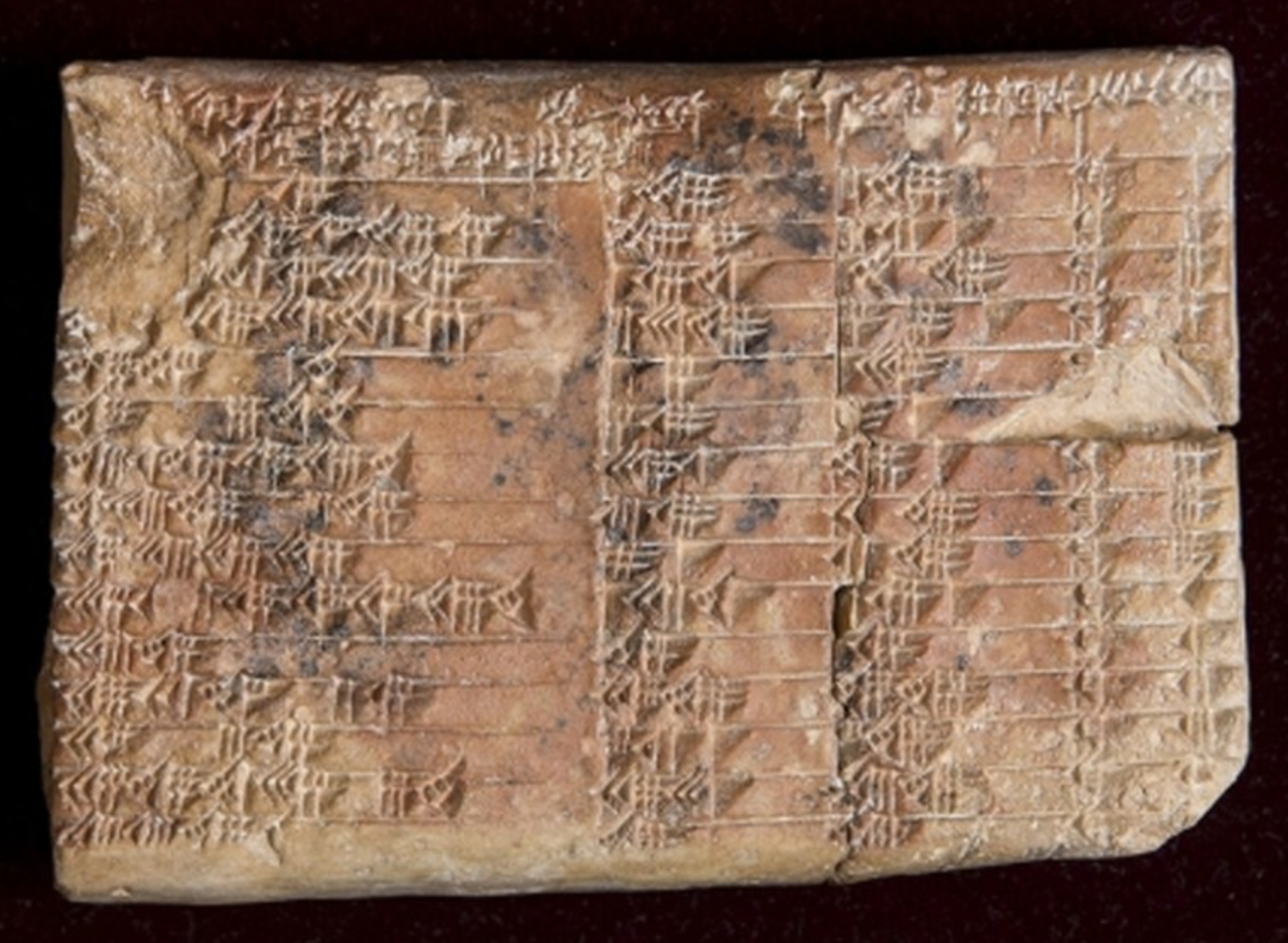
Plimpton 322 uses ratios rather than angles and circles. “But when you arrange it such a way so that you can use any known ratio of a triangle to find the other side of a triangle,” says Mansfield, “then it becomes trigonometry. That’s what we can use this fragment for.” As for what the ancient Babylonians used it for, we can only speculate. Robson and others have proposed that the tablet was a teaching guide. Mansfield believes “Plimpton 322 was a powerful tool that could have been used for surveying fields or making architectural calculations to build palaces, temples or step pyramids.”
Whatever its ancient use, Mansfield thinks the tablet “has great relevance for our modern world… practical applications in surveying, computer graphics and education.” Given the possibilities, Plimpton 322 might serve as “a rare example of the ancient world teaching us something new,” should we choose to learn it. That knowledge probably did not originate in outer space.
Related Content:
How the Ancient Greeks Shaped Modern Mathematics: A Short, Animated Introduction
Hear The Epic of Gilgamesh Read in the Original Akkadian and Enjoy the Sounds of Mesopotamia
Josh Jones is a writer and musician based in Durham, NC. Follow him at @jdmagness
Read More...When Albert Einstein Championed the Creation of a One World Government (1945)
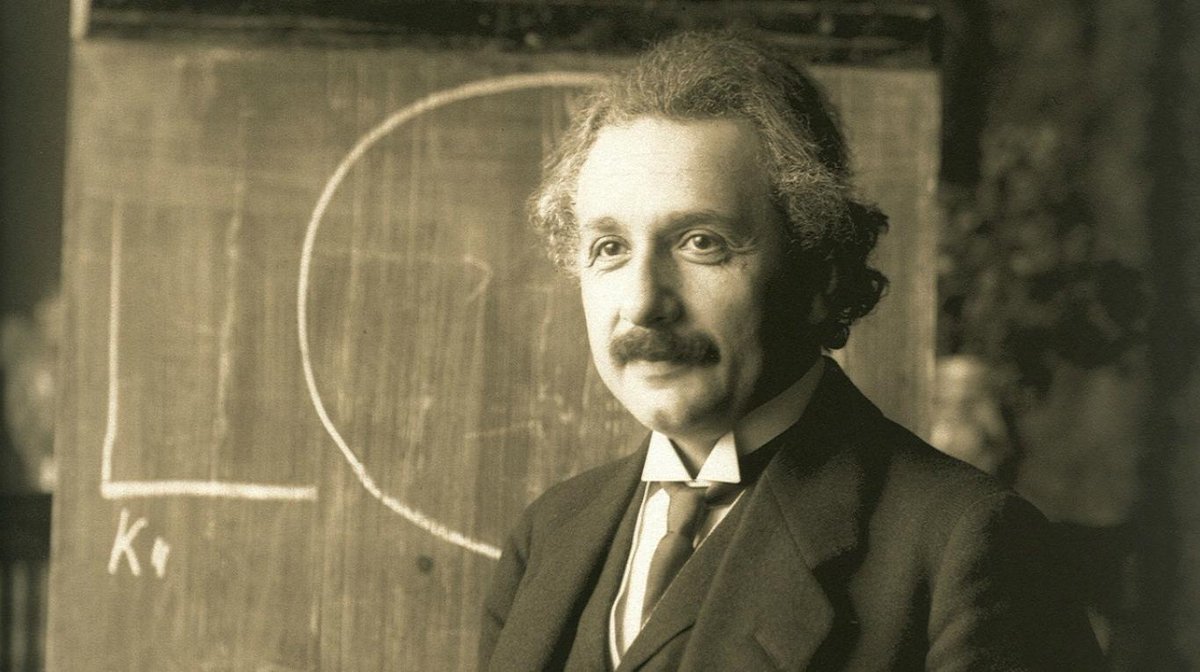
Image by Ferdinand Schmutzer, via Wikimedia Commons
The concept of one-world government has long been a staple of violent apocalyptic prophecy and conspiracy theories involving various popes, the UN, FEMA, the Illuminati, and lizard people. In the real world, one-world government has been a goal of the global Comintern and many of the corporate oligarchs who triumphed over the Soviets in the Cold War. For good reason, perhaps—with the exception of sci-fi utopias like Gene Roddenberry’s Star Trek—we generally tend to think of global government as a threatening idea. But that has not always been the case, or least it wasn’t for Albert Einstein who proposed global governance after the dropping of atomic bombs on Hiroshima and Nagasaki.
Einstein’s role in the development of those weapons may have been minimal, according to the physicist himself (the truth is a little more complicated). But he later expressed regret, or at least a total rethinking of the issue, in his many interviews, letters, and speeches. In 1952, for example, Einstein wrote a short essay called “On My Participation in the Atom Bomb Project” in which he recommended that all nations “abolish war by common action” and referred to the pacifist example of Gandhi, “the greatest political genius of our time.”
Five years earlier, we find Einstein in a less than hopeful mood. In a 1947 open letter to the General Assembly of the United Nations, he laments that “since the victory over the Axis powers… no appreciable progress has been made either toward the prevention of war or toward agreement in specific fields such as control of atomic energy and economic cooperation.” The solution as he saw it required a “modification of the traditional concept of national sovereignty.” It’s a clause that might have launched a thousand militia manifestoes. Einstein elaborates:
For as long as atomic energy and armaments are considered a vital part of national security no nation will give more than lip service to international treaties. Security is indivisible. It can be reached only when necessary guarantees of law and enforcement obtain everywhere, so that military security is no longer the problem of any single state. There is no compromise possible between preparation for war, on the one hand, and preparation of a world society based on law and order on the other.
So far this sounds not simply like a one-world government but like a one-world police state. But Einstein’s proposal gets a much more comprehensive treatment in an earlier Atlantic Monthly editorial published in 1945. Here, he admits that many of his ideas are “abstractions” and lays out a scheme to ostensibly protect against global totalitarianism.
Membership in a supranational security system should not, in my opinion, be based on any arbitrary democratic standards. The one requirement from all should be that the representatives to supranational organization—assembly and council—must be elected by the people in each member country through a secret ballot. These representatives must represent the people rather than any government—which would enhance the pacific nature of the organization.
The greatest obstacle to a global government was not, Einstein thought, U.S. mistrust, but Russian unwillingness. After making every effort to induce the Soviets to join, he writes in his UN letter, other nations should band together to form a “partial world Government… comprising at least two-thirds of the major industrial and economic areas of the world.” This body “should make it clear from the beginning that its doors remain wide open to any non-member.”
Einstein corresponded with many people on the issue of one-world government, recommending in one letter that a “permanent world court” be established to “constrain the executive branch of world government from overstepping its mandate which, in the beginning, should be limited to the prevention of war and war-provoking developments.” He does not foresee the problem of an executive who seizes power through nefarious means and ignores institutional checks on power and privilege. As for the not-insignificant matter of the economy, he writes that “the freedom of each country to develop economic, political and cultural institutions of its own choice must be guaranteed at the outset.”
Ideological conflicts over economics seemed to him “quite irrational,” as he wrote in his Atlantic editorial. “Whether the economic life of America should be dominated by relatively few individuals, as it is, or these individuals should be controlled by the state, may be important, but it is not important enough to justify all the feelings that are stirred up over it.” Like any honest intellectual, Einstein reserved the right to change his mind. By 1949 he had come to see socialism as a necessary antidote to the “grave evils of capitalism”—the gravest of which, he wrote, is “an oligarchy of private capital the enormous power of which cannot be effectively checked even by a democratically organized political society”—even one, presumably, with global legislative reach.
Related Content:
Albert Einstein Expresses His Admiration for Mahatma Gandhi, in Letter and Audio
Josh Jones is a writer and musician based in Durham, NC. Follow him at @jdmagness
Read More...The 38 States of America: Geography Professor Creates a Bold Modern Map of America (1973)
Unless you belong to an older generation, you probably can’t remember the last time the map of the United States underwent any major change. For decades, the boundaries have remained pretty fixed. And yet the map, as we know it, shouldn’t necessarily be considered set in stone.
If billionaire Tim Draper has his way, California voters will decide in 2018 whether California, the home to nearly 40 million people, should be divided into three states called “Northern California,” “Southern California,” and plain “California.” His argument being that California has become too large to govern, and that power should be moved toward smaller, more locally governed entities. Meanwhile, on a parallel track, another group is pushing for California to leave the union altogether. Right there, we have two initiatives that could change the map as we know it.
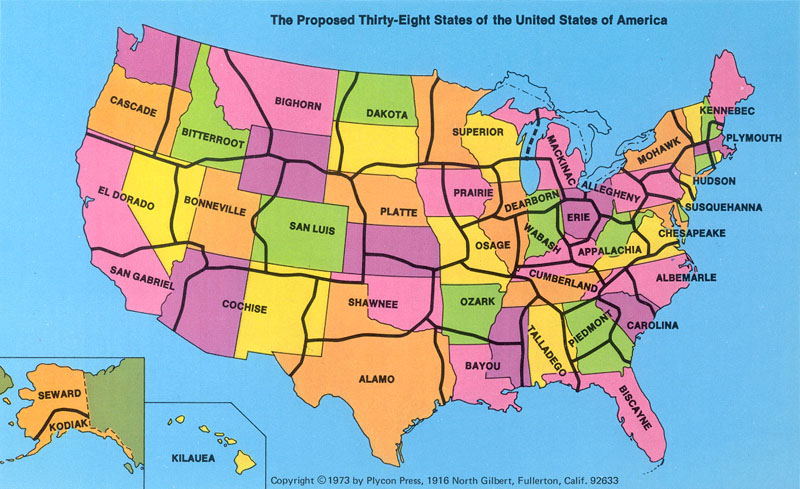
And then there was the time when, back in 1973, George Etzel Pearcy, a California State University geography professor, proposed re-drawing the map of the nation, reducing the number of states to 38, and giving each state a different name. In his creative reworking of things, California would be split into two states–“El Dorado” and “San Gabriel”. Texas would divide into “Alamo” and also “Shawnee” (along with remnants of Oklahoma). And the Dakotas would fuse into one big “Dakota.” In case you’re wondering, Pearcy chose the names by polling geography students.
The logic behind the new map was explained in a 1975 edition of The People’s Almanac.
Why the need for a new map? Pearcy states that many of the early surveys that drew up our boundaries were done while the areas were scarcely populated. Thus, it was convenient to determine boundaries by using the land’s physical features, such as rivers and mountain ranges, or by using a simple system of latitude and longitude.… The practicality of old established State lines is questionable in light of America’s ever-growing cities and the increasing mobility of its citizens. Metropolitan New York, for example, stretches into 2 adjacent States. Other city populations which cross State lines are Washington, D.C., St. Louis, Chicago, and Kansas City. The “straddling” of State lines causes economic and political problems. Who should pay for a rapid transit system in St. Louis? Only those citizens within the boundaries of Missouri, or all residents of St. Louis’s metropolitan area, including those who reach over into the State of Illinois?…
When Pearcy realigned the U.S., he gave high priority to population density, location of cities, lines of transportation, land relief, and size and shape of individual States. Whenever possible lines are located in less populated areas. In the West, the desert, semidesert, or mountainous areas provided an easy method for division. In the East, however, where areas of scarce population are harder to determine, Pearcy drew lines “trying to avoid the thicker clusters of settlement.” Each major city which fell into the “straddling” category is neatly tucked within the boundaries of a new State. Pearcy tried to place a major metropolitan area in the center of each State. St. Louis is in the center of the State of Osage, Chicago is centered in the State of Dearborn. When this method proved impossible, as with coastal Los Angeles, the city is still located so as to be easily accessible from all parts of the State…
According to Rob Lammle, writing in Mental Floss, Pearcy initially got support from “economists, geographers, and even a few politicians.” But the proposal–mainly outlined in a book called A 38 State U.S.A.–eventually withered in Washington, the place where ideas, both good and bad, go to die.
Below you can watch an animation showing how US map has changed in 200 years.
If you would like to support the mission of Open Culture, consider making a donation to our site. It’s hard to rely 100% on ads, and your contributions will help us continue providing the best free cultural and educational materials to learners everywhere. You can contribute through PayPal, Patreon, and Venmo (@openculture). Thanks!
Related Content:
The History of Cartography, the “Most Ambitious Overview of Map Making Ever,” Now Free Online
New York Public Library Puts 20,000 Hi-Res Maps Online & Makes Them Free to Download and Use
Read More...Support Us
We're hoping to rely on loyal readers, rather than erratic ads. Please click the Donate button and support Open Culture. You can use Paypal, Venmo, Patreon, even Crypto! We thank you!

About Us

Open Culture scours the web for the best educational media. We find the free courses and audio books you need, the language lessons & educational videos you want, and plenty of enlightenment in between.
Advertise With Us

FREE UPDATES!
GET OUR DAILY EMAIL
Get the best cultural and educational resources on the web curated for you in a daily email. We never spam. Unsubscribe at any time.
FOLLOW ON SOCIAL MEDIA

Open Culture editor Dan Colman scours the web for the best educational media. He finds the free courses and audio books you need, the language lessons & movies you want, and plenty of enlightenment in between.
Advertise With Us


