The CIA Assesses the Power of French Post-Modern Philosophers: Read a Newly Declassified CIA Report from 1985

We might assume that philosophy is an ivory tower discipline that has little effect on the unlovely operations of government, driven as they are by the concerns of middle class wallets, upper class stock portfolios, and the ever-present problem of poverty. But we would be wrong. In times when presidents, cabinet members, or senators have been thoughtful and well-read, the ideas of thinkers like Francis Fukuyama, Leo Strauss, Jurgen Habermas, and John Rawls—a favorite of the previous president—have exercised considerable sway. Few philosophers have been as historically influential as the German thinker Carl Schmitt, though in a thoroughly destructive way. Then there’s John Locke, Jean-Jacques Rousseau, Thomas Hobbes, Aristotle… even Socrates, who made himself a thorn in the side of the powerful.
But when it comes to the mostly French school of thinkers we associate with postmodernism—Michel Foucault, Roland Barthes, the Jacques Lacan and Derrida, and many others—such influence is far less direct. The work of these writers has been often dismissed as frivolous and inconsequential, speaking a language no one understands to out of touch coastal elites on the left edge of the spectrum. Perhaps this is so in the United States, where power is often theorized but rarely radically critiqued in mainstream publications. But it has not been so in France. At least not according to the CIA, who closely monitored the effects of French philosophy on the country’s domestic and foreign policy during their long-running culture war against Communism and “anti-Americanism,” and who, in 1985, compiled a research paper to document their investigations. (See a sample page above.)
Recently made available to the public in a “sanitized copy” through a Freedom of Information Act request, the document, titled “France: Defection of the Leftist Intellectuals,” shows itself surprisingly approving of the political direction post-structuralist thinkers had taken. Villanova University professor of philosophy and author of Radical History and the Politics of Art Gabriel Rockhill summarizes the tenor of the agency’s assessment in the L.A. Review of Books’ Philosophical Salon:
…the undercover cultural warriors applaud what they see as a double movement that has contributed to the intelligentsia shifting its critical focus away from the US and toward the USSR. On the left, there was a gradual intellectual disaffection with Stalinism and Marxism, a progressive withdrawal of radical intellectuals from public debate, and a theoretical move away from socialism and the socialist party. Further to the right, the ideological opportunists referred to as the New Philosophers and the New Right intellectuals launched a high-profile media smear campaign against Marxism.
The “spirit of anti-Marxism and anti-Sovietism,” write the agents in their report, “will make it difficult for anyone to mobilize significant intellectual opposition to US policies.” The influence of “New Left intellectuals” over French culture and government was such, they surmised, that “President [Francois] Mitterrand’s notable coolness toward Moscow derives, at least in part, from this pervasive attitude.”
These observations stand in contrast to the previous generation of “left-leaning intellectuals of the immediate postwar period,” writes Rockhill, who “had been openly critical of US imperialism” and actively worked against the machinations of American operatives. Jean-Paul Sartre even played a role in “blowing the cover of the CIA station officer in Paris and dozens of undercover operatives,” and as a result was “closely monitored by the Agency and considered a very serious problem.” By the mid-eighties, the Agency stated, triumphantly, “there are no more Sartres, no more Gides.” The “last clique of Communist savants,” they write, “came under fire from their former proteges, but none had any stomach for fighting a rearguard defense of Marxism.” As such, the late Cold War period saw a “broader retreat from ideology among intellectuals of all political colors.”
A certain weariness had taken hold, brought about by the indefensible totalitarian abuses of the “cult of Stalinism” and the seeming inescapability of the Washington Consensus and the multinational corporatism engendered by it. By the time of Communism’s collapse, U.S. philosophers waxed apocalyptic, even as they celebrated the triumph of what Francis Fukuyama called “liberal democracy” over socialism. Fukuyama’s book The End of History and the Last Man made its startling thesis plain in the title. There would be no more revolutions. Harvard thinker Samuel Huntington declared it the era of “endism,” amidst a rash of hyperbolic arguments about “the end of art,” the “end of nature,” and so on. And, in France, in the years just prior to the fall of the Berlin wall, the previously vigorous philosophical left, the CIA believed, had “succumbed to a kind of listlessness.”
While the agency credited the diffidence of post-structuralist philosophers with swaying popular opinion away from socialism and “hardening public attitudes toward Marxism and the Soviet Union,” it also wrote that “their influence appears to be waning, and they are unlikely to have much direct impact on political affairs any time soon.” Is this true? If we take seriously critics of so-called “Identity Politics,” the answer is a resounding No. As those who closely identify postmodern philosophy with several recent waves of leftist thought and activism might argue, the CIA was shortsighted in its conclusions. Perhaps, bound to a Manichean view fostered by decades of Cold War maneuvering, they could not conceive of a politics that opposed both American and Soviet empire at once.
And yet, the retreat from ideology was hardly a retreat from politics. We might say, over thirty years since this curious research essay circulated among intelligence gatherers, that concepts like Foucault’s biopower or Derrida’s skeptical interrogations of identity have more currency and relevance than ever, even if we don’t always understand, or read, their work. But while the agency may not have foreseen the pervasive impact of postmodern thought, they never dismissed it as obscurantist or inconsequential sophistry. Their newly-released report, writes Rockhill, “should be a cogent reminder that if some presume that intellectuals are powerless, and that our political orientations do not matter, the organization that has been one of the most potent power brokers in contemporary world politics does not agree.”
Related Content:
How the CIA Secretly Funded Abstract Expressionism During the Cold War
Michel Foucault: Free Lectures on Truth, Discourse & The Self (UC Berkeley, 1980–1983)
Introduction to Political Philosophy: A Free Yale Course
Josh Jones is a writer and musician based in Durham, NC. Follow him at @jdmagness
Read More...How Arabic Translators Helped Preserve Greek Philosophy … and the Classical Tradition
In the ancient world, the language of philosophy—and therefore of science and medicine—was primarily Greek. “Even after the Roman conquest of the Mediterranean and the demise of paganism, philosophy was strongly associated with Hellenic culture,” writes philosophy professor and History of Philosophy without any Gaps host Peter Adamson. “The leading thinkers of the Roman world, such as Cicero and Seneca, were steeped in Greek literature.” And in the eastern empire, “the Greek-speaking Byzantines could continue to read Plato and Aristotle in the original.”
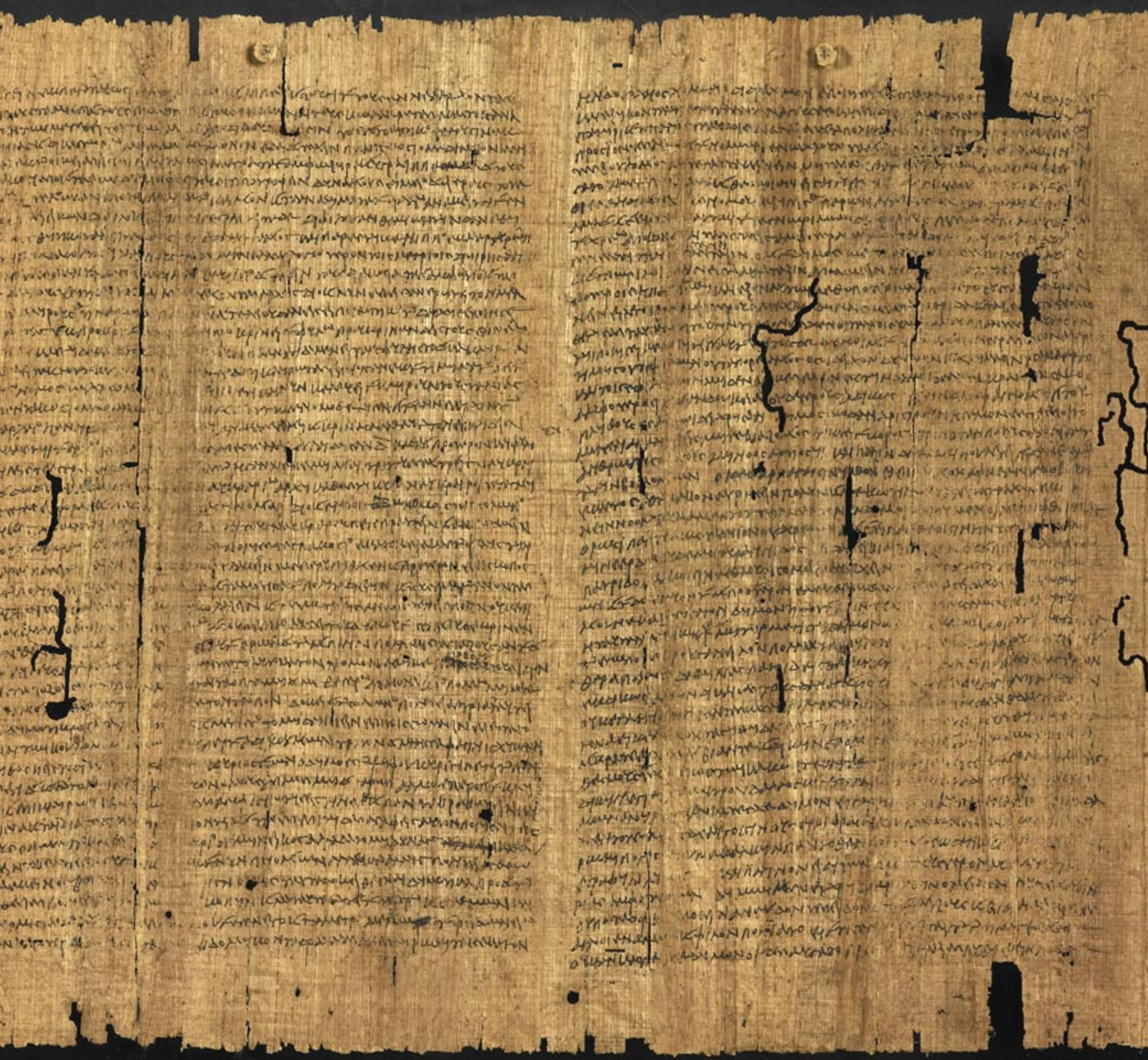
Greek thinkers also had significant influence in Egypt. During the building of the Library of Alexandria, “scholars copied and stored books that were borrowed, bought, and even stolen from other places in the Mediterranean,” writes Aileen Das, Professor of Mediterranean Studies at the University of Michigan. “The librarians gathered texts circulating under the names of Plato (d. 348/347 BCE), Aristotle and Hippocrates (c. 460–c. 370 BCE), and published them as collections.” The scroll above, part of an Aristotelian transcription of the Athenian constitution, was believed lost for hundreds of years until it was discovered in the 19th century in Egypt, in the original Greek. The text, writes the British Library, “has had a major impact in our knowledge of the development of Athenian democracy and the workings of the Athenian city-state in antiquity.”
Alexandria “rivalled Athens and Rome as the place to study philosophy and medicine in the Mediterranean,” and young men of means like the 6th century priest Sergius of Reshaina, doctor-in-chief in Northern Syria, traveled there to learn the tradition. Sergius “translated around 30 works of Galen [the Greek physician]” and other known and unknown philosophers and ancient scientists into Syriac. Later, as Syriac and Arabic came to dominate former Greek-speaking regions, the Greek texts became intense objects of focus for Islamic thinkers, and the caliphs spared no expense to have them translated and disseminated, often contracting with Christian and Jewish scholars to accomplish the task.
The transmission of Greek philosophy and medicine was an international phenomenon, which involved bilingual speakers from pagan, Christian, Muslim, and Jewish backgrounds. This movement spanned not only religious and linguistic but also geographical boundaries, for it occurred in cities as far apart as Baghdad in the East and Toledo in the West.
In Baghdad, especially, by the 10th century, “readers of Arabic,” writes Adamson, “had about the same degree of access to Aristotle that readers of English do today” thanks to a “well-funded translation movement that unfolded during the Abbasid caliphate, beginning in the second half of the eighth century.” The work done during the Abbasid period—from about 750 to 950—“generated a highly sophisticated scientific language and a massive amount of source material,” we learn in Harvard University Press’s The Classical Tradition. Such material “would feed scientific research for the following centuries, not only in the Islamic world but beyond it, in Greek and Latin Christendom and, within it, among the Jewish populations as well.”
Indeed this “Byzantine humanism,” as it’s called, “helped the classical tradition survive, at least to the large extent that it has.” As ancient texts and traditions disappeared in Europe during the so-called “Dark Ages,” Arabic and Syriac-speaking scholars and translators incorporated them into an Islamic philosophical tradition called falsafa. The motivations for fostering the study of Greek thought were complex. On the one hand, writes Adamson, the move was political; “the caliphs wanted to establish their own cultural hegemony,” in competition with Persians and Greek-speaking Byzantine Christians, “benighted as they were by the irrationalities of Christian theology.” On the other hand, “Muslim intellectuals also saw resources in the Greek texts for defending, and better understanding their own religion.”
One well-known figure from the period, al-Kindi, is thought to be the first philosopher to write in Arabic. He oversaw the translations of hundreds of texts by Christian scholars who read both Greek and Arabic, and he may also have added his own ideas to the works of Plotinus, for example, and other Greek thinkers. Like Thomas Aquinas a few hundred years later, al-Kindi attempted to “establish the identity of the first principle in Aristotle and Plotinus” as the theistic God. In this way, Islamic translations of Greek texts prepared the way for interpretations that “treat that principle as a Creator,” a central idea in Medieval scholastic philosophy and Catholic thought generally.
The translations by al-Kindi and his associates are grouped into what scholars call the “circle of al-Kindi,” which preserved and elaborated on Aristotle and the Neoplatonists. Thanks to al-Kindi’s “first set of translations,” notes the Stanford Encyclopedia of Philosophy, “learned Muslims became acquainted with Plato’s Demiurge and immortal soul; with Aristotle’s search for science and knowledge of the causes of all the phenomena on earth and in the heavens,” and many more ancient Greek metaphysical doctrines. Later translators working under physician and scientist Hunayn ibn Ishaq and his son “made available in Syriac and/or Arabic other works by Plato, Aristotle, Theophrastus, some philosophical writings by Galen,” and other Greek thinkers and scientists.
This tradition of translation, philosophical debate, and scientific discovery in Islamic societies continued into the 10th and 11th centuries, when Averroes, the “Islamic scholar who gave us modern philosophy,” wrote his commentary on the works of Aristotle. “For several centuries,” writes the University of Colorado’s Robert Pasnau, “a series of brilliant philosophers and scientists made Baghdad the intellectual center of the medieval world,” preserving ancient Greek knowledge and wisdom that may otherwise have disappeared. When it seems in our study of history that the light of the ancient philosophy was extinguished in Western Europe, we need only look to North Africa and the Near East to see that tradition, with its humanistic exchange of ideas, flourishing for centuries in a world closely connected by trade and empire.
Related Content:
Introduction to Ancient Greek History: A Free Online Course from Yale
Free Courses in Ancient History, Literature & Philosophy
Josh Jones is a writer and musician based in Durham, NC. Follow him at @jdmagness
Read More...See New York City in the 1930s and Now: A Side-by-Side Comparison of the Same Streets & Landmarks
The New Yorker has posted a very neat split-screen tour of the same streets in New York City, letting you see the Big Apple in the 1930s and today. Times Square, Central Park, the Brooklyn Bridge–they’re all on display. What a difference 80 years make.
Below you can find other historical videos and photos of NYC … and London and Berlin too. Enjoy.
If you would like to support the mission of Open Culture, consider making a donation to our site. It’s hard to rely 100% on ads, and your contributions will help us continue providing the best free cultural and educational materials to learners everywhere. You can contribute through PayPal, Patreon, and Venmo (@openculture). Thanks!
Related Content:
An Online Gallery of Over 900,000 Breathtaking Photos of Historic New York City
1905 Video Shows New York City Subway Traveling From 14th St. to 42nd Street
New York City: A Social History (A Free Online Course from N.Y.U.)
Berlin Street Scenes Beautifully Caught on Film (1900–1914)
1927 London Shown in Moving Color
Read More...Ennio Morricone’s Iconic Song, “The Ecstasy of Gold,” Spellbindingly Arranged for Theremin & Voice
You know Ennio Morricone’s “The Ecstasy Of Gold,” a musical composition first made famous in Sergio Leone’s 1966 spaghetti western The Good, the Bad and the Ugly. It has since been covered by everyone from Metallica, to Yo-Yo Ma. And now you can add German electronic musician Carolina Eyck to the list.
Above, watch Eyck take “The Ecstasy Of Gold” in new, intriguing directions, using a theremin and a voice looper. It’s pretty mesmerizing.
Below, watch Carolina’s introduction to the theremin. And down in the Relateds, find much more on the theremin, including vintage footage of Russian inventor Leon Theremin giving a demo of the newfangled electronic instrument.
If you would like to support the mission of Open Culture, consider making a donation to our site. It’s hard to rely 100% on ads, and your contributions will help us continue providing the best free cultural and educational materials to learners everywhere. You can contribute through PayPal, Patreon, and Venmo (@openculture). Thanks!
Related Content:
Beethoven’s Ode to Joy Played With 167 Theremins Placed Inside Matryoshka Dolls in Japan
“Somewhere Over the Rainbow” Played on a 1929 Theremin
Read More...A New Theme Park Based on Hayao Miyazaki’s My Neighbor Totoro Set to Open in 2020
Is a frame of reference necessary to appreciate Disney World? Can you enjoy a ride in a spinning teacup if you have no working knowledge of Alice in Wonderland? What sort of magic might the Magic Kingdom hold for those who’ve never heard of Cinderella or Peter Pan?
Now imagine if the theme park’s scope was narrowed to a single film.
You’ve got until 2020 to sneak in a viewing of the Hayao Miyazaki film, My Neighbor Totoro, before Ghibli Park, a 500-acre amusement park on the grounds of Japan’s 2005 World’s Fair site, opens.
To date, Miyazaki’s Studio Ghibli has produced more than a dozen feature-length animated films. That’s a lot of raw material for attractions.
Porco Rosso’s 1930s seaplanes have ride written all over them, and think of the Haunted Mansion-esque thrills that could be wrung from Spirited Away’s bathhouse.
How about a Jungle Cruise-style ramble through the countryside in Howl’s Moving Castle?
An underwater adventure with goldfish princess Ponyo?
Prepare for a very long wait if you’re joining the queue for those. It’s being reported that Ghibli Park will focus exclusively on a single film, 1988’s My Neighbor Totoro.
(Care to take a guess what its Mouse Ears will look like?)
The film’s theme of respect for the natural world is good news for the area’s existing flora. The governor of Japan’s Aichi Prefecture, where Ghibli Park is to be situated, has announced that it will be laid out in such a way as to preserve the trees.
Presumably the film’s iconic cat bus and fast growing camphor tree, above, will be powered by the greenest of energies.
Preview the sort of wonders in store by touring the lifesize house of My Neighbor Totoro’s human characters, Satsuki and Mei, below.
Related Content:
Hayao Miyazaki’s Masterpieces Spirited Away and Princess Mononoke Imagined as 8‑Bit Video Games
Software Used by Hayao Miyazaki’s Animation Studio Becomes Open Source & Free to Download
Hayao Miyazaki Picks His 50 Favorite Children’s Books
Ayun Halliday is an author, illustrator, theater maker and Chief Primatologist of the East Village Inky zine. She’ll be appearing onstage in New York City in Paul David Young’s Faust 3, opening later this week. Follow her @AyunHalliday.
Read More...Bob Dylan Potato Chips, Anyone?: What They’re Snacking on in China

They sound tasty. The rub? You have to travel to China to get them.
And now a question for any readers fluent in Chinese. Can you translate the text on the bag? We would be curious to know what’s the pitch for these chips. Feel free to put any translations in comments section below.
If you would like to support the mission of Open Culture, consider making a donation to our site. It’s hard to rely 100% on ads, and your contributions will help us continue providing the best free cultural and educational materials to learners everywhere. You can contribute through PayPal, Patreon, and Venmo (@openculture). Thanks!
Related Content:
Allen Ginsberg Teaches You How to Meditate with a Rock Song Featuring Bob Dylan on Bass
Two Legends Together: A Young Bob Dylan Talks and Plays on The Studs Terkel Program, 1963
Jeff Bridges Narrates a Brief History of Bob Dylan’s and The Band’s Basement Tapes
Read More...Cab Calloway Stars in “Minnie the Moocher,” a Trippy Betty Boop Cartoon That’s Ranked as the 20th Greatest Cartoon of All Time (1932)
The cast of Dave Fleischer’s 1932 cartoon, Minnie the Moocher, above, are a far cry from the candy-colored ponies and simpering dragons populating today’s cartoon universe.
There’s not much of a narrative, and the closest thing to a moral is an unspoken “don’t be cokey.”
Who cares?
The lyrics to bandleader Cab Calloway’s crossover hit were ample excuse to send a rebellious Betty Boop and her anthropomorphized pal, Bimbo, on a trippy jaunt through the underworld.
While there’s no evidence of Betty or Bimbo hitting the pipe, one wonders what the animators were smoking to come up with such an imaginative palette of ghouls.
The ghosts are prisoners sporting chain gang stripes.
A witch with an outsized head prefigures Miyazaki’s commanding old ladies.
A blank-socketed mama cat, leached dry by her equally eyeless kittens, conjures the sort of nightmare vision that appealed to Hieronymus Bosch.
The most benign presence is a phantasmagoric walrus, modeled on a rotoscoped Calloway. The Hi De Ho Man cut a far svelter presence in the flesh, as evidenced by the live action sequence that introduces the cartoon.
Betty’s home sweet home offers nearly as weird a landscape as the one she and Bimbo flee at film’s end.
Its many inorganic inhabitants would have felt right at home in PeeWee’s Playhouse, as would a self-sacrificing flowering plant, who succumbs to a sample of the hasenpfeffer Betty’s immigrant mother unsuccessfully urges on her. As for Betty’s father, Fleischer struck a blow for teenagers everywhere by having his head morph into a gramophone on which a broken record (or rather, cylinder) plays.
Minnie the Moocher was voted the 20th greatest cartoon of all time, in a 1994 survey of 1,ooo animation professionals. We hope you enjoy it now, as the animators did then, and audiences did way back in 1932.
Related Content:
The Harlem Jazz Singer Who Inspired Betty Boop: Meet the Original Boop-Oop-a-Doop, “Baby Esther”
Duke Ellington’s Symphony in Black, Starring a 19-Year-old Billie Holiday
Hear 2,000 Recordings of the Most Essential Jazz Songs: A Huge Playlist for Your Jazz Education
Bambi Meets Godzilla: #38 on the List of The 50 Greatest Cartoons of All Time
Ayun Halliday is an author, illustrator, theater maker and Chief Primatologist of the East Village Inky zine. She’ll be appearing onstage in New York City this June as one of the clowns in Paul David Young’s Faust 3. Follow her @AyunHalliday.
Read More...Manchester Benefit Concert Is Streaming Live Now
Just a quick fyi: The Manchester Benefit concert is happening now, and streaming live on YouTube. Coldplay, Pharrell Williams, Justin Bieber, Katy Perry, Miley Cyrus, Niall Horan, Usher, and Ariana Grande will all perform. Click play above to stream the live video feed.
If you would like to support the mission of Open Culture, consider making a donation to our site. It’s hard to rely 100% on ads, and your contributions will help us continue providing the best free cultural and educational materials to learners everywhere. You can contribute through PayPal, Patreon, and Venmo (@openculture). Thanks!
Read More...The Story of Habitat, the Very First Large-Scale Online Role-Playing Game (1986)
Long before World of Warcraft, before Everquest and Second Life, and even before Ultima Online, computer-gamers of the 1980s looking for an online world to explore with others of their kind could fire up their Commodore 64s, switch on their dial-up modems, and log into Habitat. Brought out for the Commodore online service Quantum Link by Lucasfilm Games (later known as the developer of such classic point-and-click adventure games as Maniac Mansion and The Secret of Monkey Island, now known as Lucasarts), Habitat debuted as the very first large-scale graphical virtual community, blazing a trail for all the massively multiplayer online role-playing games (or MMORPGs) so many of us spend so much of our time playing today.
Designed, in the words of creators Chip Morningstar and F. Randall Farmer, to “support a population of thousands of users in a single shared cyberspace,” Habitat presented “a real-time animated view into an online simulated world in which users can communicate, play games, go on adventures, fall in love, get married, get divorced, start businesses, found religions, wage wars, protest against them, and experiment with self-government.” All that happened and more within the service’s virtual reality during its pilot run from 1986 to 1988. The features both cautiously and recklessly implemented by Habitat’s developers, and the feedback they received from its users, laid down the template for all the more advanced graphical online worlds to come.
At the top of the post, you can watch Lucasfilm’s original Habitat promotional video promise a “strange new world where names can change as quickly as events, surprises lurk at every turn, and the keynotes of existence are fantasy and fun,” one where “thousands of avatars, each controlled by a different human, can converge to shape an imaginary society.” (All performed, the narrator notes, “with the cooperation of a huge mainframe computer in Virginia.”) The form this society eventually took impressed Habitat’s creators as much as anyone, as Farmer writes in his “Habitat Anecdotes” from 1988, an examination of the most memorable happenings and phenomena among its users.
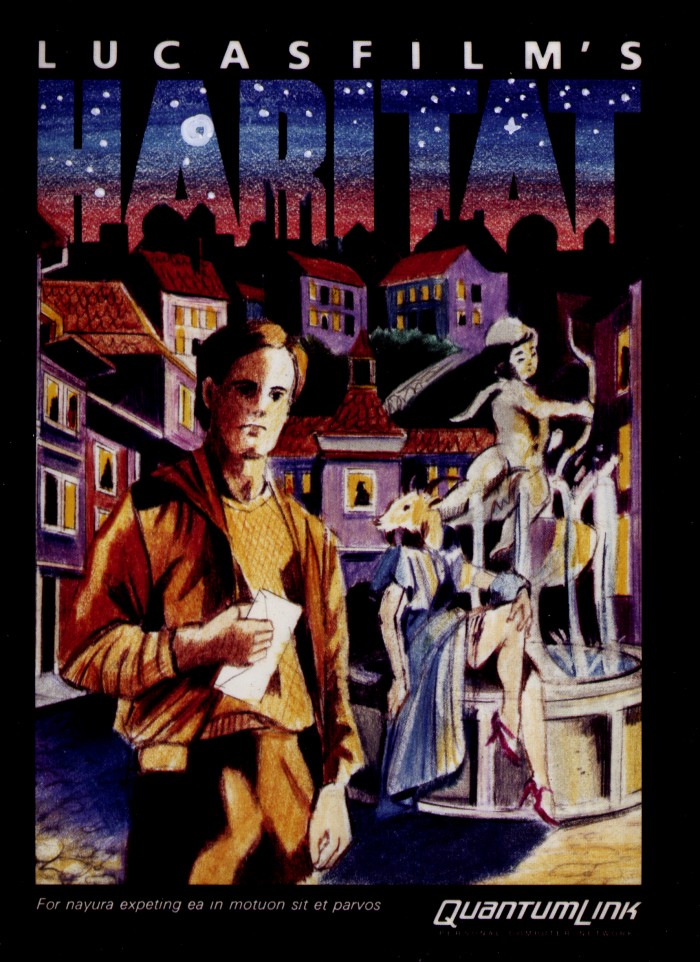
Farmer found he could group those users into five now-familiar categories: the Passives (who “want to ‘be entertained’ with no effort, like watching TV”), the Active (whose “biggest problem is overspending”), the Motivators (the most valuable users, for they “understand that Habitat is what they make of it”), the Caretakers (employees who “help the new users, control personal conflicts, record bugs” and so on), and the Geek Gods (the virtual world’s all-powerful administrators). Sometimes everyone got along smoothly, and sometimes — inevitably, given that everyone had to define the properties of this brand new medium even as they experienced it — they didn’t.
“At first, during early testing, we found out that people were taking stuff out of others’ hands and shooting people in their own homes,” Farmer writes. Later, a Greek Orthodox Minister opened Habitat’s first church, but “I had to eventually put a lock on the Church’s front door because every time he decorated (with flowers), someone would steal and pawn them while he was not logged in!” This citizen-governed virtual society eventually elected a sheriff from among its users, though the designers could never quite decide what powers to grant him. Other surprisingly “real world” institutions developed, including a newspaper whose user-publisher “tirelessly spent 20–40 hours a week composing a 20, 30, 40 or even 50 page tabloid containing the latest news, events, rumors, and even fictional articles.”
Though developing this then-advanced software for “the ludicrous Commodore 64” posed a serious technical challenge, write Farmer and Morningstar in their 1990 paper “The Lessons of Lucasfilm’s Habitat,” the real work began when the users logged on. All the avatars needed houses, “organized into towns and cities with associated traffic arteries and shopping and recreational areas” with “wilderness areas between the towns so that everyone would not be jammed together into the same place.” Most of all, they needed interesting places to visit, “and since they can’t all be in the same place at the same time, they needed a lot of interesting places to visit. [ … ] Each of those houses, towns, roads, shops, forests, theaters, arenas, and other places is a distinct entity that someone needs to design and create. Attempting to play the role of omniscient central planners, we were swamped.”
All this, the creators discovered, required them to stop thinking like the engineers and game designers they were, giving up all hope of rigorous central planning and world-building in favor of figuring out the tricker problem of how, “like the cruise director on an ocean voyage,” to make Habitat fun for everyone. Farmer faces that question again today, having launched the open-source NeoHabitat project earlier this year with the aim of reviving the Habitat world for the 21st century. As much progress as graphical multiplayer online games have made in the past thirty years, the conclusion Farmer and Morningstar reached after their experience creating the first one holds as true as ever: “Cyberspace may indeed change humanity, but only if it begins with humanity as it really is.”
Related Content:
Free: Play 2,400 Vintage Computer Games in Your Web Browser
Long Live Glitch! The Art & Code from the Game Now Released into the Public Domain
Based in Seoul, Colin Marshall writes and broadcasts on cities and culture. He’s at work on a book about Los Angeles, A Los Angeles Primer, the video series The City in Cinema, the crowdfunded journalism project Where Is the City of the Future?, and the Los Angeles Review of Books’ Korea Blog. Follow him on Twitter at @colinmarshall or on Facebook.
Read More...An Animated History of Tea
Self proclaimed tea geek, Shunan Teng’s knowledge of her chosen subject extends well beyond the proper way to serve and prepare her best-loved beverage.
Her recent TED-Ed lesson on the History of Tea, above, hints at centuries of bloodshed and mercenary trade practices, discreetly masked by Steff Lee’s benign animation.
Addiction, war, and child labor—the last, a grim ongoing reality…. Meditate on that the next time you’re enjoying a nice cup of Darjeeling, or better yet, matcha, a preparation whose Western buzz is starting to approximate that of the Tang dynasty.
Even die-hard coffee loyalists with little patience for the ritualistic niceties of tea culture can indulge in some fascinating trivia, from the invention of the clipper ship to the possible health benefits of eating rather than drinking those green leaves.
Test your TQ post-lesson with TED-Ed’s quiz, or this one from Tea Drunk, Teng’s authentic Manhattan tea house.
Related Content:
George Orwell Explains How to Make a Proper Cup of Tea
10 Golden Rules for Making the Perfect Cup of Tea (1941)
“The Virtues of Coffee” Explained in 1690 Ad: The Cure for Lethargy, Scurvy, Dropsy, Gout & More
Ayun Halliday is an author, illustrator, theater maker and Chief Primatologist of the East Village Inky zine. She’ll be appearing onstage in New York City this June as one of the clowns in Paul David Young’s Faust 3. Follow her @AyunHalliday.
Read More...Support Us
We're hoping to rely on loyal readers, rather than erratic ads. Please click the Donate button and support Open Culture. You can use Paypal, Venmo, Patreon, even Crypto! We thank you!

About Us

Open Culture scours the web for the best educational media. We find the free courses and audio books you need, the language lessons & educational videos you want, and plenty of enlightenment in between.
Advertise With Us

FREE UPDATES!
GET OUR DAILY EMAIL
Get the best cultural and educational resources on the web curated for you in a daily email. We never spam. Unsubscribe at any time.
FOLLOW ON SOCIAL MEDIA

Open Culture editor Dan Colman scours the web for the best educational media. He finds the free courses and audio books you need, the language lessons & movies you want, and plenty of enlightenment in between.
Advertise With Us

