The Library of Congress Makes 25 Million Records From Its Catalog Free to Download

Image by Carol Highsmith, via Wikimedia Commons
A quick fyi: According to Fortune, The Library of Congress announced that it “will make 25 million records from its catalog available for the public to download.” They add:
Prior to this, the records—which include books and serials, music and manuscripts, and maps and visual materials spanning from 1968 to 2014—have only been accessible through a paid subscription. These files will be available for free download on [the Library of Congress site] and are also available on data.gov.
This move helps free up the library’s digital assets, allowing social scientists, data analysts, developers, statisticians and everyone else to work with the data “to enhance learning and the formation of new knowledge.” The huge data sets will be available here.
If you would like to support the mission of Open Culture, consider making a donation to our site. It’s hard to rely 100% on ads, and your contributions will help us continue providing the best free cultural and educational materials to learners everywhere. You can contribute through PayPal, Patreon, and Venmo (@openculture). Thanks!
Related Content:
Library of Congress Releases Audio Archive of Interviews with Rock ‘n’ Roll Icons
Read More...membership
[s2Member-Pro-PayPal-Form level=“1” ccaps=”” desc=”$3 USD / Monthly (recurring charge, for ongoing access)” ps=“paypal” lc=”” cc=“USD” dg=“0” ns=“1” custom=“www.openculture.com” ta=“0” tp=“0” tt=“D” ra=“3” rp=“1” rt=“M” rr=“1” rrt=”” rra=“2” accept=“paypal,visa,mastercard,amex,discover,maestro,solo” accept_via_paypal=“paypal” coupon=”” accept_coupons=“0” default_country_code=”” captcha=“0” /]
Read More...Noel Coward’s “Alice (Is At It Again)” Gets Reimagined as a Very Modern Fairy Tale: A Short Film Starring Sarah Snook
English playwright, lyricist, actor and raconteur Noel Coward (1899 –1973) is still remembered for his plays such as the wife-after-death comedy Blithe Spirit and Private Lives; his playlet Still Life, which became the classic David Lean film Brief Encounter, and his scripting and co-direction of the WW2 morale-booster In Which We Serve, also directed by Lean, for which Coward won an Honorary Academy Award. However, he’s perhaps better known now more as an image of archetypal mid-20th century Englishness, replete with dressing-gown and cigarette-holder, and the hundreds of witty songs and poems he wrote, such as Mad Dogs and Englishman and Mrs Worthington, which he performed in cabaret in his distinctively clipped English manner to much acclaim in London and, latterly, in Las Vegas.
His 1946 song Alice (Is At It Again), written and then cut from his flop musical Pacific 1860, became a standard of his cabaret act and, with its suggestive lyrics, risqué subject matter and sly wit, is typical of his oeuvre. It’s thus a surprising choice perhaps by rising Australian actress Sarah Snook for the subject of her new short film Alice, co-devised with director Laura Scrivano, and the second film of The Passion, a new online series of performed poetry films coming out of Australia. The first film in the series, A Lovesong, starring Daniel Henshall (from AMC’s Turn: Washington Spies), featured T.S. Eliot’s modernist masterpiece The Love Song of J. Alfred Prufrock (watch it below), so Alice is a change both in style and tone for the series, but continues the project’s experimentation in rendering poetry on film for a digital audience.
Sarah, who won critical acclaim for her genderswitching role in the 2015 science-fiction thriller Predestination, found the Coward text in a bookshop in San Francisco, while sourcing a text for her film for the series.
Says Sarah:
(Director) Laura and I were interested in the ideas of femininity and how that is expressed, particularly in sexual or sensual terms. When I read the poem, I was charmed by it and excited by the potential and challenge of contemporizing it for The Passion. Coward’s themes are very much of the time and place of the original lyrics’ writing, as is his take on them, while our adaptation is an updating, an exploration of female sexuality and empowerment that Coward plays with, and the wildness and freedom of discovering that. Our Alice, who I think nods to Coward’s, is breaking out of the strictures of her background, and being free and true to herself.
Originally Alice, as read by Coward, would have been performed with a patter, a rhythm of its own, with a sense of irony and a lot of wit, and certainly in his very particular RP accent. It’s hard to escape that as it’s written so well and embedded so deeply into the lines, with a particular scansion, but I wanted to go against that somewhat, while retaining and respecting Coward’s sparkle and playfulness.
Alice is the second film of The Passion series, in which actors select a text which has a personal significance for them or strikes a particular chord, and then work closely in collaboration with director Laura Scrivano to develop it as a new performance piece for film. A third film is currently in development. More information about the series can be found at this website.
Dan Prichard is an online film and webseries producer, based in Sydney, whose work explores identity, place, and the space between film and performance in the digital arena. Visit his website and follow him on twitter @georgekaplan81
Read More...Stephen Wolfram’s Bestseller, A New Kind of Science, Now Free to Read/Download Online
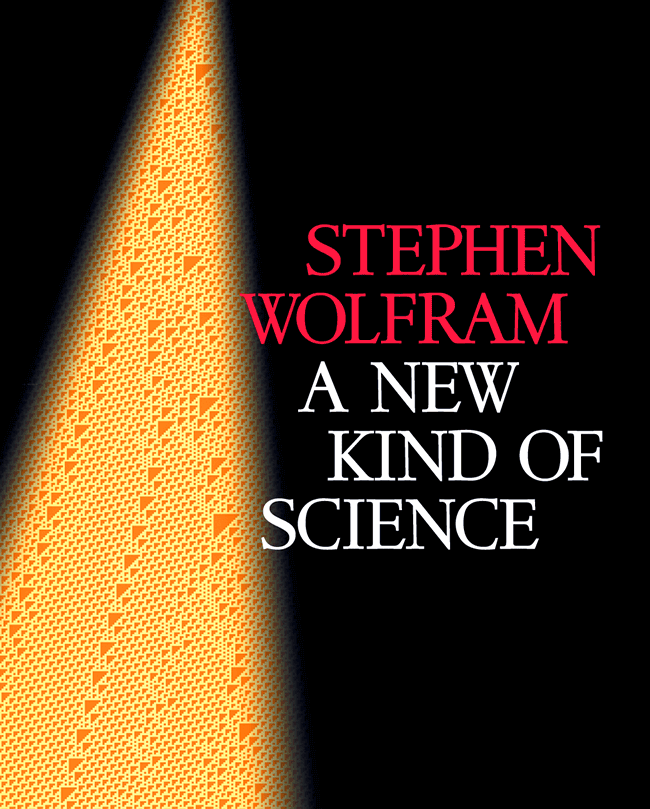
It’s been 15 years since computer scientist and physicist Stephen Wolfram published his bestselling book A New Kind of Science. And now Wolfram has put his book online. It’s available in its entirety, all 1,200 pages, including the superb graphics. Feel free to read the pages on the web. Or download them as PDFs.
It’s also worth reading Wolfram’s new blog post where, in announcing the new online edition, he revisits the intellectual contributions he made with the book.
The online edition of A New Kind of Science will be added to our collection, 800 Free eBooks for iPad, Kindle & Other Devices.
If you would like to support the mission of Open Culture, consider making a donation to our site. It’s hard to rely 100% on ads, and your contributions will help us continue providing the best free cultural and educational materials to learners everywhere. You can contribute through PayPal, Patreon, and Venmo (@openculture). Thanks!
Related Content:
200 Free Textbooks: A Meta Collection
Download 464 Free Art Books from The Metropolitan Museum of Art
John Grisham Is Letting You Download His New Novel as a Free eBook
Read More...The MC5 Performs at the 1968 Chicago Democratic National Convention, Right Before All Hell Breaks Loose
With some rare exceptions (Sid and Nancy, I’m Not There, maybe Walk the Line and Cadillac Records), biopics usually stumble badly when they try to recreate the personalities and atmospheres of famous musicians. For this reason I am grateful that no studio has yet attempted a narrative of one of my favorite bands, the not-quite-famous MC5. On the other hand, it’s hard to believe there’s no script in development somewhere. If there’s one band whose story—and music—deserves a wider audience, it’s this one. Sadly, guitarist Wayne Kramer has suppressed a very well-reviewed documentary that might do them as much justice as any film can.
Formed in Lincoln Park Michigan in 1964, the “Motor City 5” became synonymous with Detroit’s leftist political scene. They were also some of the most uncompromising garage rockers to emerge from the era, along with proto-punks The Stooges, with whom they often performed.
By the time of the infamous 1968 Democratic convention in Chicago—well-known for the brutal attacks of police against thousands of aggrieved protesters—the MC5 had become heavily influenced by Fred Hampton and Huey Newton. Under their manager John Sinclair, they became prominent representatives of the “White Panthers,” an anti-racist analogue of the Black Panthers formed on a suggestion of Newton’s.
In September of 1968, Sinclair would be indicted for taking part in the bombing a CIA office in Ann Arbor. But exactly one month prior, he presided over the MC5’s appearance at the riotous Chicago Democratic National Convention. The band was booked as part of Abbie Hoffman’s attempt to stage a “Festival of Life,” bringing 100,000 young people to the city “for five days of peace, love, and music,” writes the site Chicago ’68, to “redirect youth culture and music toward political ends.” Fittingly, perhaps, the MC5 was the only band that showed up after Hoffman and his Yippies failed to secure the permits. They played for less than an hour to a crowd of a few thousand. Kramer remembered the day in a 2008 interview:
There was no stage, there was no flatbed truck, there was no sound system, there were no porta-toilets, there was no electricity. We had to run an electrical cord from the hot dog stand to power our gear. We played on the ground in the middle of Lincoln Park in Chicago with the crowd all around us sitting on the ground, in the back standing. I’m going to guess there were maybe 3,000 young people there. And it was very tense. The Chicago police had been very aggressive and very intimidating all day, and even though it was a rock concert and we were the only band to play, it didn’t feel like a rock concert. There was a dark cloud over the day because we knew the likelihood of people being hurt was great.
The only film we seem to have of the event is silent surveillance footage at the top of the post. Further down, see clips of the rioting that ensued, with the band’s hit “Kick Out the Jams” played over it. And just below, see a video of them playing the song over a backdrop of riot footage. They released their debut album, Kick Out the Jams , the following year. It was an uneven collection of performances, but “when they got it right,” says Michael Hann, “they simply got it completely right.” It was certainly their philosophy to go all in. As Kramer described it, “You have to come early, and you have to stay late. The song doesn’t say, ‘Slide out the jams.” It doesn’t say, ‘Stroll out the jams.” It says, ‘Kick out the jams!’”
What I find fascinating about the emergence of the MC5 at this time in history is how great of a contrast they presented to the weary blues of the Rolling Stones, who became grimly linked in ’69 at Altamont with the cynical end of flower power. Despite their association with the violent spectacle of the DNC riots—another sign of the hippie apocalypse—the MC5 became the soundtrack for people power, and in a way bridged the R&B, garage rock, psychedelia, punk, and metal of the gritty 1970s to come. But addiction, political repression, and censorship killed the band a few years later. Lead singer Rob Tyner died in 1991, and guitarist Fred “Sonic” Smith, who married Patti Smith, passed away in 1994.
Kramer has carried on, and still tours (and gives lectures). When he revisited the DNC in 2008 for an unofficial performance and anti-war protest, he reflected on the politics of the day. “It will be helpful not to have to battle as hard as we have with the Bush administration,” he told The Huffington Post, “but Barack Obama cannot save us. It’s really a matter of people themselves taking action in their own neighborhoods, at their own jobs, in their own homes, with their own friends, their own co-workers, to move us into the future, a more just world.” The people power the MC5 represented lives on even into this grim era, and the band itself will always live in legend, if not—for good or ill—in cinema.
Related Content:
A Gallery of Visually Arresting Posters from the May 1968 Paris Uprising
New Jim Jarmusch Documentary on Iggy Pop & The Stooges Now Streaming Free on Amazon Prime
Josh Jones is a writer and musician based in Durham, NC. Follow him at @jdmagness
Read More...All 886 episodes of Mister Roger’s Neighborhood Streaming Online (for a Limited Time)
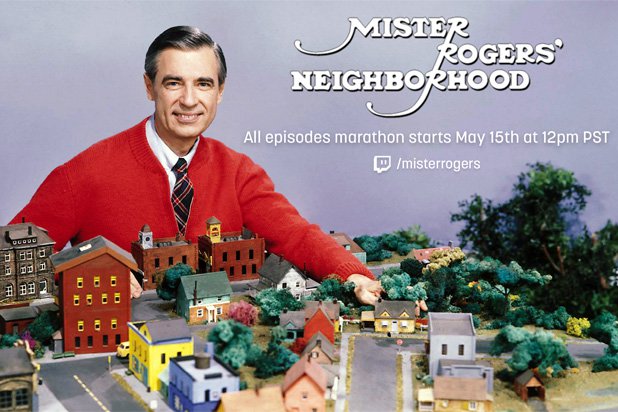
It’s a beautiful day in the neighborhood, kids. On Monday, at noon California time, Twitch will start a marathon airing of Mister Roger’s Neighborhood, streaming all 886 episodes of the classic children’s TV show. If you have 17 free days, you can watch the marathon from start to finish. During this time, Twitch will also be running a fundraiser for PBS, which faces stiff funding cuts if “He-Who-Must-Not-Be-Named” has his way.
Enjoy the epic broadcast, and don’t miss some classic Mister Rogers scenes in the Relateds below.
PBS has more information on the Twitch-PBS partnership here.
If you would like to support the mission of Open Culture, consider making a donation to our site. It’s hard to rely 100% on ads, and your contributions will help us continue providing the best free cultural and educational materials to learners everywhere. You can contribute through PayPal, Patreon, and Venmo (@openculture). Thanks!
Related Content:
Mr. Rogers Goes to Congress and Saves PBS: Heartwarming Video from 1969
Mr. Rogers Takes Breakdancing Lessons from a 12-Year-Old (1985)
Read More...How Baking, Cooking & Other Daily Activities Help Promote Happiness and Alleviate Depression and Anxiety

Image by Beth MacKenzie, via Flickr Commons
Most healthy people practice at least some form of what we call these days “self-care,” whether it be yoga, meditation, running, writing, art, music, therapy, coloring books, or what-have-you. And if you’re functioning tolerably well in the madness of our times, you’re probably dipping regularly into the well of at least one restorative discipline, in addition to whatever larger beliefs you may hold.
But perhaps you feel at loose ends—unable to find the time or money for yoga classes or painting, feeling too restless to sit motionless for half an hour or more a day.… The activities that sustain our psyches should not feel unattainable. One need not be a yogi, Zen monk, marathoner, or Impressionist to find regular fulfilment in life. Perhaps regular, ordinary activities have the power to make us just as happy.
Recent research suggests that tasks such as “knitting, crocheting and jam-making” can “work wonders for wellbeing,” writes Tom Ough at The Telegraph, as can other creative practices like “cooking, baking, performing music, painting, drawing, sketching, digital design and creative writing.” All may have profound effects on emotional health. This list might expand indefinitely to include any hands-on activity with measurable results, from woodworking to beekeeping.
A 2016 study of 658 students at New Zealand’s Otago University found that engaging in small creative pursuits on a daily basis produces enthusiasm and feelings of “flourishing”—“a mental health term describing happiness and meaning.” The results of, say, making a loaf of bread or a scarf, don’t simply benefit us in the moment, but carry over into the future. As the study’s lead author Tamlin Connor notes, “engaging in creative behaviour leads to increases in well-being the next day, and this increased well-being is likely to facilitate creative activity on the same day.”
The more we bake, the more we’ll want to bake, the happier we’ll feel.
Does focusing our attention on small, achievable daily tasks lead to the kind of metaphysical fulfilment most people seem to crave—what Viktor Frankl called “man’s search for meaning”? Not necessarily, no. “Recent research suggests,” notes Daisy Grewal at Scientific American, “that while happiness and a sense of meaning often overlap, they also diverge in important and surprising ways.” Frankl may not be wrong about the need for meaning, but even he admitted that seeking it out is not identical to the pursuit of happiness.
In a 2013 study published in The Journal of Positive Psychology, Roy Baumeister, Kathleen Vohs, Jennifer Aaker, and Emily Garbinsky found that happiness, “flourishing,” or emotional well-being correlate strongly with “satisfying one’s needs and wants” as well as with “being a giver rather than a taker.” Philosophy, politics, religion, and art may seek truth or coherence, but while “concerns with personal identity and expressing the self contributed to meaning,” they have little lasting effect on happiness, as many a philosopher, priest, or poet may tell you. On the other hand, while having comfortable economic means does measurably improve happiness, it does not contribute significantly to a sense of larger purpose (that which, Frankl argued strenuously, can save our lives in times of crisis).
Baumeister and his colleagues obtained their findings by surveying around 400 American adults over a period of three weeks, during which time the participants monitored a variety of daily activities. In one reading of the Otago University study, Daisy Meager at Vice focuses specially on baking as a means to ward off a “shitty mood.” It may be a matter of taste—some may prefer making sauces to cakes. The effects are the same, “a common cure,” writes Danny Lewis at Smithsonian, “for stress or feeling down.”
Meager points to work done by Julie Ohana, a “culinary therapist” who uses the kitchen to help patients combat “depression, anxiety, and other mental health issues.” Vice’s Jackson Connor describes his personal experience of how cooking “alleviates symptoms of stress and anxiety almost immediately,” as well as over time. And no less an authority than food theorist Michael Pollan makes the persuasive case for “how cooking can change your life” in the short animated video below (see his full talk at the RSA here).
Further arguing, however, for baking as a special form of “flourishing,” Julie Thomson at HuffPo describes the act as “a productive form of self-expression and communication” and consults with experts like Ohana and Donna Pincus, associate professor of psychological and brain sciences at Boston University, who told Thomson, “Baking has the benefit of allowing people creative expression.” People who may not be natural artists, writers, or musicians. Yet baking is also a kind of problem-solving as well as a creative act, and “actually requires a lot of full attention.”
You have to measure, focus physically on rolling out dough. If you’re focusing on smell and taste, on being present with what you’re creating, that act of mindfulness in that present moment can also have a result in stress reduction.
The reference to mindfulness is apt. (Go ahead and read about a course on “Breaditation,” make fun of it, then try it at home.) I know not a few people who swear they cannot meditate to save their lives, but who will happily spend a couple hours on a Saturday evening baking brioche or plates of cookies. But there’s more to it than the meditative absorption that comes from mindful activity. Baking, says Pincus—and cooking in general—is a form of altruism. “The nice thing about baking,” she ways, “is that you have such a tangible reward at the end and that can feel very beneficial to others.”
So the research suggests that—whatever activities one gravitates toward—finding happiness on a daily basis involves more than using Pinterest boards and magazines to craft a cozy, stylish new life. Though any sustained creative activity may do the trick, we approach closer to lasting happiness as well as greater fulfillment—to meaning—when we direct activity to a “connection with other people” through generosity.
Related Content:
How to Get Started with Yoga: Free Yoga Lessons on YouTube
Stream 18 Hours of Free Guided Meditations
Josh Jones is a writer and musician based in Durham, NC. Follow him at @jdmagness
Read More...Timelapse Film Shows How the British Library Digitized the World’s Largest Atlas, the 6‑Foot Tall “Klencke Atlas” from 1660
As a way of currying favor with a monarch, Johannes Klencke’s gift to Charles II (1630–1685) was one of the most audacious and beautiful objects ever offered. Klencke was a Dutch sugar merchant and knew that the king loved maps, and hoped that his gift would land him a favorable trading deal. (It did. He got knighted.)
The gift, the 1660 Klencke Atlas, is one of the world’s biggest books at nearly six feet tall and nearly seven and a half feet wide when open, and it contains 41 wall maps of various accuracy. We first posted about the Klencke Atlas back in 2015, where you can see a short BBC doc on the British Library’s care of the book. But only recently has the library been able to scan the maps so the public can now access them for free in high resolution.
The above video, which the British Library posted by way of Daniel Crouch Rare Books, shows a time-lapse of the multiple day shoot, which took several people, a very large room, several lights, and a specially designed stand to hold the heavy volume.
The public domain images are now part of the Library’s Picturing Places website, which holds many examples of rare maps, landscapes, and large scale technical drawings.
The book itself, as huge as it might be, is actually very fragile, so now the public and scholars can fully explore these maps at leisure while the original goes back into storage.
via Hyperallergic
Related Content:
Behold the Largest Atlas in the World: The Six-Foot Tall Klencke Atlas from 1660
Browse & Download 1,198 Free High Resolution Maps of U.S. National Parks
Ted Mills is a freelance writer on the arts who currently hosts the artist interview-based FunkZone Podcast and is the producer of KCRW’s Curious Coast. You can also follow him on Twitter at @tedmills, read his other arts writing at tedmills.com and/or watch his films here.
Read More...The Love Letters of Hannah Arendt and Martin Heidegger
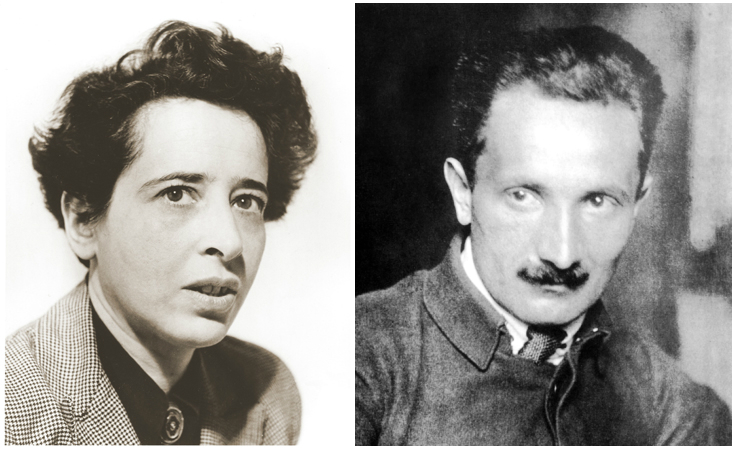
The notorious four-year affair between Hannah Arendt and Martin Heidegger has occasioned many a bitter academic debate, for reasons with which you may already be familiar. If not, Alan Ryan sums it up succinctly in a 1996 New York Review of Books essay:
She was a Jew who fled Germany in August 1933, a few months after Hitler’s assumption of power. He was elected Rector of the University of Freiburg in the spring of 1933, and in a notorious inaugural address hailed the presence of the brown-shirted storm-troopers in his audience, claimed that Hitler would restore the German people to spiritual health, and ended by giving the familiar stiff-armed Nazi salute to cries of “Sieg Heil.” The thought that these two were ever soulmates is hard to swallow.
Arendt went on to write The Origins of Totalitarianism and Eichmann in Jerusalem, in which she used the phrase “banality of evil” for the Nazi functionary on trial at Nuremberg. Heidegger refused to discuss his collaboration publicly and “remained silent about the extermination of the Jews, about the terrorism of Hitler’s regime.” But as we’ve learned from his recently published journals, the so-called Black Notebooks, he was privately a “convinced Nazi,” as Peter Gordon observes, who “did not awaken from his philosophical-political fantasies. They only grew more extreme.”
But indeed, Arendt and Heidegger were in love, during an affair that began when she was an 18-year-old student and he her married 36-year-old professor. Their letters show an illicit relationship developing from caution to infatuation. Heidegger waxed romantically philosophical:
.…we become what we love and yet remain ourselves. Then we want to thank the beloved, but find nothing that suffices.
We can only thank with our selves. Love transforms gratitude into loyalty to our selves and unconditional faith in the other. That is how love steadily intensifies its innermost secret.
But both of them knew the relationship could not last, and Heidegger suggested that moving on from him would be in her best interest as a young scholar. In 1929, Arendt met and became engaged to a German journalist and classmate in Heidegger’s seminar. She sent her professor a note on her wedding day which begins, “Do not forget me, and do not forget how much and how deeply I know that our love has become the blessing of my life.”
Before his Nazi appointment, Arendt wrote to her former lover and mentor in 1932 or 33 upon hearing rumors “about Heidegger’s sympathy with National Socialism.” (Her letter has been lost.) He replied with a number of excuses for specific acts—such as refusing to supervise Jewish students—and assured her of his feelings, but “nowhere in the letter is there any denial of Nazi sympathies,” writes Adam Kirsch at The New Yorker. The two met after the war in Freiburg, and Heidegger later sent Arendt a passionate, poetic letter in 1950, extolling the “exciting, still almost unspoken understanding” between them, “emerging from an affinity that was created so quickly, that comes from so far away, that has not been shaken by evil and confusion.”
Later, in a 1969 birthday tribute essay “Martin Heidegger at Eighty,” Arendt penned what has generally been taken as an exoneration of Heidegger. In it, she “compared Heidegger to Thales,” writes Gordon, “the ancient philosopher who grew so absorbed in contemplating the heavens that he stumbled into the well at his feet.” The truth is quite a bit more complicated than that, and quite a bit less lofty. But as Maria Popova eloquently writes, their relationship “exposes the complexity and contradiction of which the human spirit is woven, its threads nowhere more ragged than in love.” Read many more excerpts from their letters at Brain Pickings. And find complete letters collected in the volume, Letters: 1925–1975 — Martin Heidegger and Hannah Arendt.
via Brain Pickings
Related Content:
Heidegger’s “Black Notebooks” Suggest He Was a Serious Anti-Semite, Not Just a Naive Nazi
Martin Heidegger Talks Philosophy with a Buddhist Monk on German Television (1963)
Josh Jones is a writer and musician based in Durham, NC. Follow him at @jdmagness
Read More...John F. Kennedy Explains Why Artists & Poets Are Indispensable to American Democracy (October 26th, 1963)
The Greek word poesis did not confine itself to the literary arts. Most broadly speaking, the word meant “to make”—as in, to create anything, godlike, out of the stuff of ideas. But the English word “poetry” has always retained this grander sense, one very present for poets steeped in the classics, like Percy Shelley, who famously called poets the “unacknowledged legislators of the world” in his essay “A Defence of Poetry.” Shelley argued, “If no new poets should arise to create afresh the associations which have been thus disorganized, language will be dead to all the nobler purposes of human intercourse.”
It can feel at times, watching certain of our leaders speak, that language may be dying for “nobler purposes.” But certain poets would seek to convince us otherwise. As Walt Whitman wrote of his countrymen in an introduction to Leaves of Grass, “presidents shall not be their common referee so much as their poets shall.”
Whitman lived in a time that valued rhetorical skill in its leaders. So too did another of the country’s revered national poets, Robert Frost, who accepted the request of John F. Kennedy to serve as the first inaugural poet in 1961 with “his signature elegance of wit,” comments Maria Popova. Frost, 86 years old at the time, read his poem “The Gift Outright” from memory and offered Kennedy some full-throated advice on joining “poetry and power.”
Kennedy, an “arts patron in chief,” as the L.A. Times’ Mark Swed describes him, was so moved that two years later, after the poet’s death, he delivered an eloquent eulogy for Frost at Amherst College that picked up the poet’s theme, and acknowledged the power of poetry as equal to, and perhaps surpassing, that of politics. “Our national strength matters,” he began, “but the spirit which informs and controls our strength matters just as much.” That animating spirit for Kennedy was not religion, civil or supernatural, but art. Frost’s poetry, he said, “brought an unsparing instinct for reality to bear on the platitudes and pieties of society.”
His sense of the human tragedy fortified him against self-deception and easy consolation… it is hardly an accident that Robert Frost coupled poetry and power, for he saw poetry as the means of saving power from itself. When power leads men towards arrogance, poetry reminds him of his limitations. When power narrows the areas of man’s concern, poetry reminds him of the richness and diversity of his existence. When power corrupts, poetry cleanses. For art establishes the basic human truth which must serve as the touchstone of our judgment.
The tragedy of hubris and celebration of diversity, however, we can see not only in Frost, but in Shelley, Whitman, and perhaps every other great poet whose “personal vision… becomes the last champion of the individual mind and sensibility against an intrusive society and an officious state.” Kennedy’s short speech, with great clarity and concision, makes the case for using the country’s resources to “reward achievement in the arts as we reward achievement in business or statecraft.” But just as importantly, he argues against any kind of state imposition on an artist’s vision: “If art is to nourish the roots of our culture, society must set the artist free to follow his vision wherever it takes him. We must never forget that art is not a form of propaganda; it is a form of truth.”
You can hear Kennedy deliver the speech in the audio above, read a full transcript in English here and in 12 other languages here. In the audience at Amherst sat poet and critic Archibald MacLeish, who, in his “Ars Poetica,” had suggested that poetry should not be stripped of its sounds and images and turned into a didactic tool. Kennedy agrees. “In free society art is not a weapon and it does not belong to the spheres of polemic and ideology.” Yet poetry is not a luxury, but a necessity if a body politic is to flourish. “The nation which disdains the mission of art,” Kennedy warned, “invites the fate of Robert Frost’s hired man, the fate of having ‘nothing to look backward to with pride, and nothing to look forward to with hope.’”
Kennedy’s is a point of view, perhaps, that might get under a lot of people’s skin. It’s worth considering, as a less optimistic critic argued at the time, whether an overabundance of didactic political statements in art may be as culturally damaging as the absence of art in politics. Or whether art like Frost’s is ever “disinterested,” in Kennedy’s phrasing, or apolitical, or can operate independently as a check to power. Frost himself may express ambivalence in his embrace of “human tragedy.” But in his doubt he fulfills the poet’s role, entering into the kind of critical dialectic Kennedy claims for poetry and democracy.
Related Content:
Josh Jones is a writer and musician based in Durham, NC. Follow him at @jdmagness
Read More...Support Us
We're hoping to rely on loyal readers, rather than erratic ads. Please click the Donate button and support Open Culture. You can use Paypal, Venmo, Patreon, even Crypto! We thank you!

About Us

Open Culture scours the web for the best educational media. We find the free courses and audio books you need, the language lessons & educational videos you want, and plenty of enlightenment in between.
Advertise With Us

FREE UPDATES!
GET OUR DAILY EMAIL
Get the best cultural and educational resources on the web curated for you in a daily email. We never spam. Unsubscribe at any time.
FOLLOW ON SOCIAL MEDIA

Open Culture editor Dan Colman scours the web for the best educational media. He finds the free courses and audio books you need, the language lessons & movies you want, and plenty of enlightenment in between.
Advertise With Us


