Animated Stories Written by Tom Waits, Nick Cave & Other Artists, Read by Danny Devito, Zach Galifianakis & More
Ten years ago, Jeff Antebi, the founder of the record company Waxploitation, asked musicians and contemporary painters to collaborate on a collection of children’s stories for grown-ups. Today, you can find the fruits of their labor collected in a new, 350-page book project called Stories for Ways & Means. The book features tales by Tom Waits (above), Nick Cave, Bon Iver, The Pixies’ Frank Black and other artists. (Note: the stories contain “outre art, weird images, graphic displays of nasty stuff and cuss words.”) Also, you can now watch a series of short promo films where celebs like Danny Devito, Zach Galifianakis and Nick Offerman read items in the collection.
As a quick weekend treat, we’ve highlighted some of those readings on this page. More readings can be viewed here. Proceeds from Stories for Ways & Means (purchase a copy here) will support NGOs and nonprofits advancing children’s causes around the world, including Room to Read, Pencils of Promise, and 826 National.
Danny Devito Reads “Doug the Bug” by Frank Black
Zach Galifianakis Reads “Next Big Thing” by Gibby Haynes
“The Lonely Giant” by Nick Cave, Read by Andre Royo (aka Bubbles from The Wire)
“Wishing Well Fountain,” Written and Narrated by Alison Mosshart
If you would like to support the mission of Open Culture, consider making a donation to our site. It’s hard to rely 100% on ads, and your contributions will help us continue providing the best free cultural and educational materials to learners everywhere. You can contribute through PayPal, Patreon, and Venmo (@openculture). Thanks!
Related Content:
Tom Waits Reads Two Charles Bukowski Poems, “The Laughing Heart” and “Nirvana”
Tom Waits Makes a List of His Top 20 Favorite Albums of All Time
1,000 Free Audio Books: Download Great Books for Free Read More...Rick Wakeman’s Prog-Rock Opera Adaptation of George Orwell’s 1984
We’ve seen sales of George Orwell’s dystopian nightmare scenario 1984 peak in recent months. Millions of readers seek to understand the brave new world we live in through Orwell’s vision. Parallels abound. We might reasonably ascribe to the ruling party in the U.S. and its media apparatus the slogan “IGNORANCE IS STRENGTH.” But our experience of reality never fails to validate that old saw about truth and fiction. As Case Western Reserve professor of history John Broich writes, “2017 is stranger than Orwell imagined.”
The state doesn’t need a Ministry of Truth to censure the information that reaches us. We are simply overwhelmed with “alternative authorities and realities” who delegitimize the facts and accelerate “the decline in standards of evidence and reasoning in the US electorate.” A sad state of affairs. But in every decade since the publication of Orwell’s novel, critics, journalists, and pundits have seen evidence of his dire forecast. In the titular year itself, Manhattan College professor Edmond van den Bossche summed up the general tenor in The New York Times: “In our 1984… the warnings of George Orwell are more than ever relevant.”
Van den Bossche wrote of NATO and the UN. But he might have written about MTV and CNN— both in their infancy—who birthed 24-hour cable news and reality TV. What Orwell understood about state power, later thinkers like Guy DeBord, Roland Barthes, and Jean Baudrillard built careers writing about: the importance not only of surveillance, but also of spectacle that blurs the lines of truth and fiction as it overwhelms our senses. It’s largely this key theme, I’d argue, that has rendered 1984 so attractive to some of the most spectacular of musicians, including David Bowie—whose attempts to make an Orwell concept album formed part of his Diamond Dogs—and Rick Wakeman, the virtuoso prog-rock keyboardist of Yes fame.
After releasing as a solo artist such rock-literary adaptations as 1974’s Journey to the Center of the Earth and the following year’s The Myths and Legends of King Arthur and the Knights of the Round Table, Wakeman turned Orwell’s classic into a rock opera. The 1981 production is an extravaganza of musical excess, with lyrics and vocals by Tim Rice, riveting performances by Chaka Khan (above) and Wakeman’s former Yes bandmate Jon Anderson, and eclectic orchestral instrumentation woven in with Wakeman’s battery of keyboards and synthesizers. The record has become a fan favorite and Allmusic describes it as one of Wakeman’s “most well-rounded albums.”
The perfectionistic Wakeman himself looks back on his 1984 with embarrassment. “In retrospect, a mistake,” he has said. “The wrong album at the wrong time, with all the wrong people around at the time…. I formed the wrong band, (the worst I have ever had), the deal for the stage show fell through and all in all I listen back to the music with my head in my hands.” Luckily, we are not bound to respect an artist’s assessment of his work. Wakeman’s music and Rice’s lyrics take the leaden, gray world of Winston Smith and Julia and turn it into a carnival, moving from soaring ballads to rockers with the sneering vaudevillian satire of The Rocky Horror Picture Show. (See especially “The Proles,” above, the penultimate number before the final title track.)
Orwell’s novel is not what one would call an entertaining book; it is gloomy—though not without its own kind of dark humor—and its monochromatic tone was perfectly captured by Michael Radford’s 1984 film adaptation. But it heavily suggested the world to come, one constantly illuminated and obscured by mass media, with screens in every home and pocket, forever broadcasting some colorful distraction. In the videos above, you’ll see excerpts from the movie mixed with dazzling live performance footage of Wakeman and band playing their 1984 live, synced to the studio recordings, courtesy of Youtuber ROLT (Ronaldo Lopes Teixeira.) Watch his full project at the top of the post. The mash-up suitably shows how these very different interpretations—the more straightforwardly dour and the prog-rock operatic—somehow both do justice to Orwell’s prescient novel. Just above, you can hear Wakeman’s full album on Spotify (whose software you can download for free here).
Related Content:
George Orwell’s 1984 Staged as an Opera: Watch Scenes from the 2005 Production in London
Josh Jones is a writer and musician based in Durham, NC. Follow him at @jdmagness
Read More...Neil deGrasse Tyson Says This Short Film on Science in America Contains Perhaps the Most Important Words He’s Ever Spoken
Astrophysicist Neil deGrasse Tyson has won a reputation as a genial, yet pedantic nerd, a scientific gadfly whose point of view may nearly always be technically correct, but whose mode of delivery sometimes misses the point, like someone who explains a joke. His earnestness is endearing; it’s what makes him so relatable as a science educator. He’s wholeheartedly devoted to his subject, like his boyhood hero Carl Sagan, whose shoes Tyson did his best to fill in a remake of the classic Cosmos series. Tyson’s countrymen and women, however, have made his job a lot harder than they did in Sagan’s day, when ordinary Americans were hungry for scientific information.
The change has been decades in the making. Like Sagan, Tyson’s voice fills with awe as he contemplates the mysteries of nature and wonders of science, and with alarm as he comments on widespread American ignorance and hostility to critical inquiry and the scientific method. These attitudes have led us to a crisis point. Elected and appointed officials at the highest levels of government deny the facts of climate change and are actively gutting all efforts to combat it. The House of Representatives’ Committee on Science, Space, and Technology mocks climate science on social media even as NASA announces that the evidence is “unequivocal.”
How did this happen? Are we rapidly returning, as Sagan warned before his death, to an age of “superstition and darkness”? Tyson has recently addressed these questions with earnestness and urgency in a short video called “Science in America,” which you can watch above, “containing,” he wrote on Facebook, “what may be the most important words I have ever spoken.” He opens with a statement that echoes Sagan’s dire predictions: “It seems to me that people have lost the ability to judge what is true and what is not.” The problem is not simply an academic one, but a pressingly political one: “When you have people,” says Tyson, “who don’t know much about science, standing in denial of it, and rising to power, that is a recipe for the complete dismantling of our informed democracy.”
One must ask if the issue solely comes down to education. We are frequently reminded of how much denial is motivated and willful when, for example, a government official begins a completely unsupported claim with, “I’m not a scientist, but….” We know that fossil fuel companies like Exxon have known the facts about climate change for forty years, and have hidden or misrepresented them. But the problem is even more widespread. Evolutionary biology, vaccines, GMOs… the amount of misinformation and “alternative fact” in the public sphere has drowned out the voices of scientists. “That’s not the country I remember growing up in,” Tyson laments.
There are plenty of good philosophical reasons for skepticism, such as those raised by David Hume or by critical theorists and historians who point out the ways in which scientific research has been distorted and misused for some very dark, inhumane purposes. Yet critiques of methodology, philosophy, and ethics only strengthen the scientific enterprise, which—as Tyson passionately explains—thrives on vigorous and informed debate. We cannot afford to confuse thoughtful deliberation and honest reflection with specious reasoning and willful ignorance.
I imagine we’ll have a good laugh at creative redeployments of some classic Tyson harangues. (“This is science! It’s not something to toy with!”) And a good laugh sometimes feels like all we can do to relieve the tension. The real danger is that many people will dismiss his message as “politicizing” science rather than defending the very basis of its existence. We must agree on the basis of scientific truth, as discoverable through reason and evidence, Tyson warns, before we can even get to the political questions over climate change, vaccines, etc. Whether Americans can still do that has become an unsettlingly open question.
via Big Think
Related Content:
Neil deGrasse Tyson Remembers His First Meeting with Carl Sagan
Carl Sagan Issues a Chilling Warning to America in His Final Interview (1996)
Josh Jones is a writer and musician based in Durham, NC. Follow him at @jdmagness
Read More...The Day When Chivalry Officially Came to an End in 1363 AD: A Short Comedy Film
When did chivalry come to an end? Some would say it’s a matter of historical debate. But not for Jake Mahaffy. His short, funny film lets you see the embarrassing circumstances under which chivalry died, somewhere in a marsh in 1363. Enjoy.
If you would like to support the mission of Open Culture, consider making a donation to our site. It’s hard to rely 100% on ads, and your contributions will help us continue providing the best free cultural and educational materials to learners everywhere. You can contribute through PayPal, Patreon, and Venmo (@openculture). Thanks!
Related Content:
What’s It Like to Fight in 15th Century Armor?: A Surprising Demonstration
Yoda’s Long Lost Twin Found in a 14th Century Illuminated Manuscript
Wonderfully Weird & Ingenious Medieval Books
See The Guidonian Hand, the Medieval System for Reading Music, Get Brought Back to Life
Read More...Test Ad Page
Lorem ipsum dolor sit amet, consectetur adipiscing elit. Nunc vel elit vel tellus blandit imperdiet. Vestibulum ut ligula sit amet justo aliquam malesuada ac auctor dui. Vivamus quis odio malesuada, cursus tellus et, luctus lacus. Aliquam blandit venenatis dolor quis dapibus. Nam ut rutrum justo. Integer facilisis commodo molestie. Curabitur quis leo sed neque pellentesque commodo eget nec eros. Nullam sodales mattis nunc. Vivamus eu orci vulputate, rhoncus nulla et, aliquet odio. Nullam elit dolor, consectetur nec dolor ut, sagittis sagittis magna. Proin lectus felis, volutpat vitae orci sed, ornare scelerisque libero. Maecenas molestie feugiat augue, at suscipit dui dapibus eget. Phasellus a mauris sit amet elit aliquet mattis in a mauris. Suspendisse ac magna sapien. Suspendisse dictum libero ac quam pulvinar lacinia. Praesent eros neque, tempus sed augue id, tincidunt ultricies libero.
Lorem ipsum dolor sit amet, consectetur adipiscing elit. Nunc vel elit vel tellus blandit imperdiet. Vestibulum ut ligula sit amet justo aliquam malesuada ac auctor dui. Vivamus quis odio malesuada, cursus tellus et, luctus lacus. Aliquam blandit venenatis dolor quis dapibus. Nam ut rutrum justo. Integer facilisis commodo molestie. Curabitur quis leo sed neque pellentesque commodo eget nec eros. Nullam sodales mattis nunc. Vivamus eu orci vulputate, rhoncus nulla et, aliquet odio. Nullam elit dolor, consectetur nec dolor ut, sagittis sagittis magna. Proin lectus felis, volutpat vitae orci sed, ornare scelerisque libero. Maecenas molestie feugiat augue, at suscipit dui dapibus eget. Phasellus a mauris sit amet elit aliquet mattis in a mauris. Suspendisse ac magna sapien. Suspendisse dictum libero ac quam pulvinar lacinia. Praesent eros neque, tempus sed augue id, tincidunt ultricies libero.
Read More...Oscar-Winning Actress Viola Davis Reads the Children’s Story, Rent Party Jazz, for Jazz Appreciation Month
FYI: In honor of Jazz Appreciation Month, Viola Davis treats us to a reading of Rent Party Jazz, a children’s book written by William Miller and illustrated by Charlotte Riley-Webb. Here’s a quick synopsis of the story:
This story is set in New Orleans in the 1930s. Sonny and his mother are scraping by to pay their rent. Mama works in a fish canning factory, and Sonny works for the coal man before school each morning. When Mama loses her job, they no longer have enough money for the rent and fear that the landlord will turn them out. One day Sonny meets Smilin’ Jack, a jazz musician who is playing his trumpet in Jackson Square. Smilin’ Jack offers to play at a party at Sonny’s house to help raise money for the rent. The neighbors all come to sing and dance and before they leave, drop some coins in a bucket. Sonny learns how people can help one another “if they put their minds and hearts to it.”
For anyone not familiar with them, rent parties started in Harlem during the 1920s, when jazz musicians would play at a friend’s apartment to help them raise enough money to pay the rent. If you hop over to the website of Yale’s Beinecke Library, you can see a collection of rent cards that belonged to Langston Hughes.
This video comes from the Storyline Online Youtube Channel, sponsored by the SAG-AFTRA Foundation’s children’s literacy website. The channel features celebrated actors “reading children’s books alongside creatively produced illustrations, helping to inspire a love of reading in children.”
Viola Davis’ reading will be added to our collection, 1,000 Free Audio Books: Download Great Books for Free.
Related Content:
Watch Stars Read Classic Children’s Books: Betty White, James Earl Jones, Rita Moreno & Many More
Enter an Archive of 6,000 Historical Children’s Books, All Digitized and Free to Read Online
Read More...Sad 7‑Foot Tall Clown Sings “Pinball Wizard” in the Style of Johnny Cash, and Other Hits by Roy Orbison, Cheap Trick & More
Readers, are you overcome with the Friday Feels?
Puddles Pity Party, a 6’8” Pierrot from Atlanta, empathizes.
The ‘Sad Clown with the Golden Voice’ has taken to releasing emotionally-freighted covers on select Fridays.
There’s something about a giant sad singing clown that comforts us, let’s us know it’s ok to feel, to show our feelings. It’s a sad and beautiful world, and we’re all in it together, even when we’re totally alone.
So quoth Big Mike Geier, the founder and frontman of the band Kingsized, and the man behind Puddles’ white makeup and rickrack-trimmed clown suit.
Whatever he’s tapped into, it’s real. The New York Times’ Jason Zinnoman, in a slightly skeeved-out think piece on clowns last year, wrote:
What makes him transcend the trope is his vulnerability. When you first see him charging down the aisle, he’s an intimidating figure, but his body is actually not aggressive. It slumps, passively. When he asks for a hug, it looks as if he really needs it. He makes you feel bad for finding him off-putting, and then he belts out a lovely song.
Friday, March 3 found Puddles accompanying himself on a red guitar for “It’s a Heartache,” a hit for Bonnie Tyler and later, Rod Stewart. They both have their strengths, but Puddles is uniquely suited to tap into the heartache of ‘standing in the cold rain, feeling like a clown.”
A previous Friday Feel, Roy Orbison’s “Crying,” was a fan request. (Yes, he’s still taking them.)
The video for “She’s Gone Again”—previously covered by Don Ho—touches on Puddles’ obsession with actor Kevin Costner.
February 10’s Friday Feel brought new listeners to a younger artist, Brett Dennen. Puddles praised his “Heaven” as “beautiful and thoughtful song,” confessing that he “barely held it together on this one.” Also see Cheap Trick’s “I Want You to Want Me” down below.
The piece de resistance, wherein the lyrics of Pinball Wizard are sung to the tune of Folsom Prison Blues, is at the top of the page. It’s no great surprise that that one’s gone viral. Puddles is transparent, however, giving credit to the late Gregory Dean Smalley, an Atlanta-based songwriter who died of AIDS in the late 90s:
Back in 1994 or so, I saw (him) perform this mashup at the Star Community Bar. I was floored. Greg was a force of supernatural proportions and he is missed. Many people have done it prior to me doing it. I guess it was always meant to be.
You can listen to more of Puddles Pity Party on Spotify, or support the artist with a purchase on Google Play or iTunes. Subscribe to his youtube channel to stay abreast of future Friday Feels, or request a song.
Related Content:
Watch Stephen Sondheim Teach a Kid How to Sing “Send In the Clowns”
Johnny Cash & Joe Strummer Sing Bob Marley’s “Redemption Song” (2002)
Hear Johnny Cash Deliver Lincoln’s Gettysburg Address
Ayun Halliday is an author, illustrator, theater maker and Chief Primatologist of the East Village Inky zine. Follow her @AyunHalliday.
Read More...Ancient Maps that Changed the World: See World Maps from Ancient Greece, Babylon, Rome, and the Islamic World
One of the greatest challenges for writers and greatest joys for readers of fantasy and science fiction is what we call “world building,” the art of creating cities, countries, continents, planets, galaxies, and whole universes to people with warring factions and nomadic truth seekers. Such writing is the natural offspring of the Medieval travelogue, a genre once taken not as fantasy but fact, when sailors, crusaders, pilgrims, merchants, and mercenaries set out to chart, trade for, and convert, and conquer the world, and returned home with outlandish tales of glittering empires and people with faces in their chests or hopping around on a single foot so big they could use it to shade themselves.
One of the most famous of such chroniclers, Sir John Mandeville, may now be mostly forgotten, but for centuries his Travels was so popular with aspiring navigators and literary men like Shakespeare, Milton, and Keats that “until the Victorian era,” writes Giles Milton, it was he, “not Chaucer, who was known as ‘the father of English prose.’”
Mandeville, like Marco Polo half a century before him, may have been part adventurer, part charlatan, but in any case, both drew their itineraries, as did later navigators like Columbus and Walter Raleigh, from a very long tradition: the making of speculative world maps, which far predates the early Middle Ages of pilgrimage and thirst for Eastern spices and gold.
In the Western tradition, we can trace world mapmaking all the way back to 6th century B.C.E., Pre-Socratic thinker Anaximander, student of Thales, whom Aristotle regarded as the first Greek philosopher. We have no copy of the map, but we have some idea what it might have looked since Herodotus described it in detail, a circular known world sitting atop an earth the shape of a drum. (Anaximander was also an original speculative astronomer.) His map contained two continents, or halves, “Europe” and “Asia”—which included the known countries of North Africa. “Two relatively small strips of land north and south of the Mediterranean Sea,” with ten inhabited regions in total, that illustrate the very early dichotomizing of the world—in this case divided top to bottom rather than west and east.
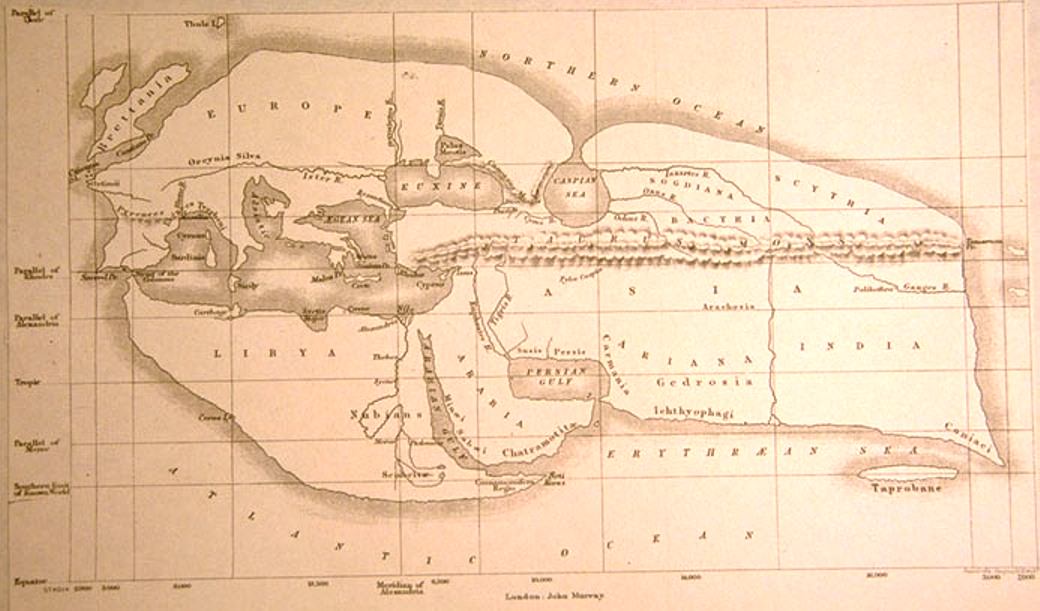
Anaximander may have been the first Greek geographer, but it is the 2nd century B.C.E. that Libyan-Greek scientist and philosopher Eratosthenes who has historically been given the title “Father of Geography” for his three-volume Geography, his discovery that the earth is round, and his accurate calculation of its circumference. Lost to history, Eratosthenes’ Geography has been pieced together from descriptions by Roman authors, as has his map of the world—at the top in a 19th-century reconstruction—showing a contiguous inhabited landmass resembling a lobster claw.
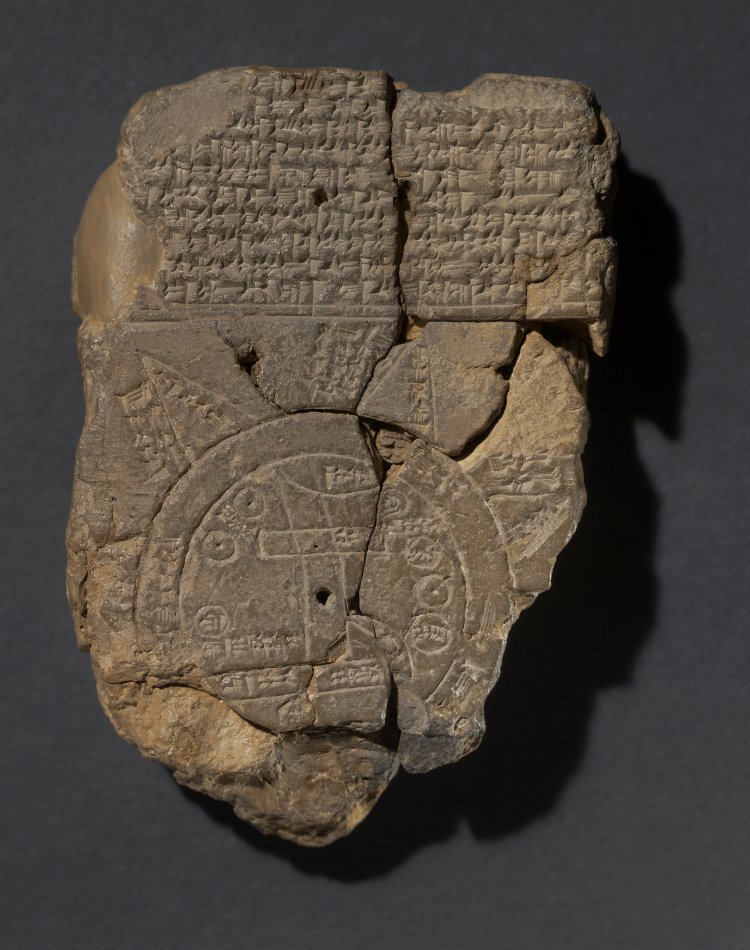
You’ll note that Eratosthenes drew primarily on Anaximander’s description of the world. In turn, his map had a significant influence on later Medieval geographers. A Babylonian world map, inscribed on a clay tablet around the time Anaximander imagined the world (and thought to be the earliest extant example of such a thing), may have influenced European map-making in the age of discovery as well. It depicts a flat, round world, with Babylon at the center (see the British Museum for a detailed translation and commentary of the map’s legend).
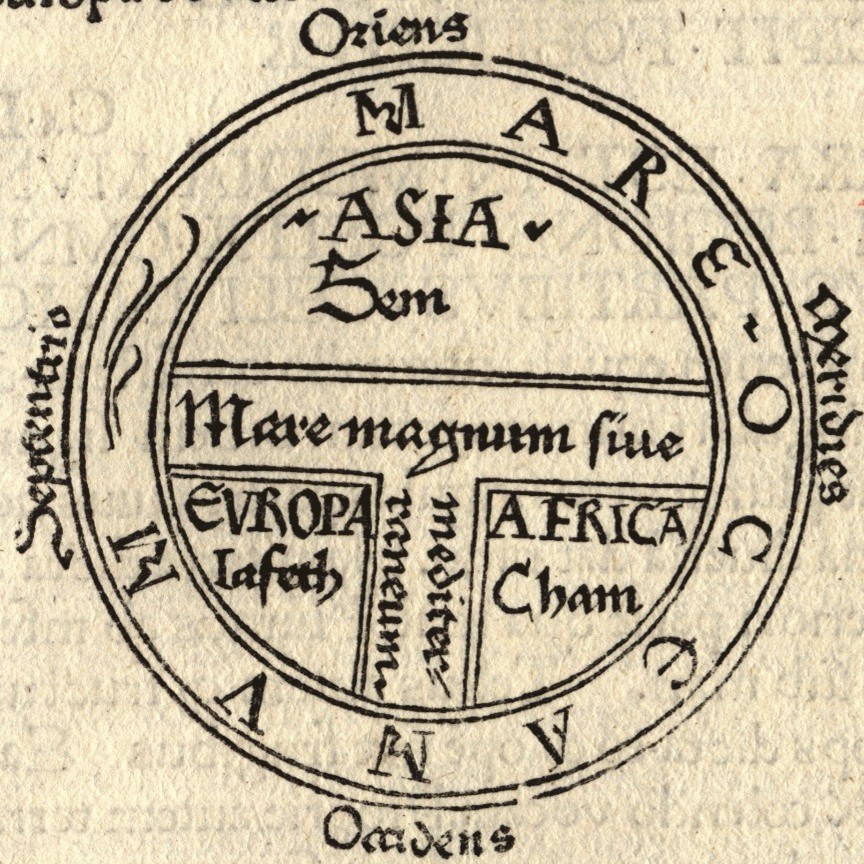
The Babylonian map is said to survive in the similar-looking “T and O map” (third image from top), representing the words orbis terrarium and originating from descriptions in 7th century C.E. Spanish scholar Isadora of Seville’s Etymologiae. The “T” is the Mediterranean and the “O” the ocean. In the version above, a recreation of an 8th century drawing, and every derivation thereafter, we see the three known continents, Asia, Europe, and Africa, with the holy city, Jerusalem, at the center. This map greatly informed early Medieval conceptions of the world, from crusaders to garrulous knights errant like Mandeville, and raconteur merchants like Polo, both of whom made quite an impression on Columbus and Raleigh, as did the circa 1300 map from Constantinople above, the oldest of many drawn from the thousands of coordinates in Roman geographer and astronomer Ptolemy’s Geographia.
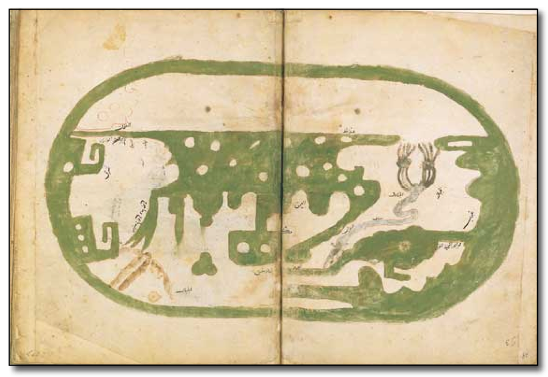
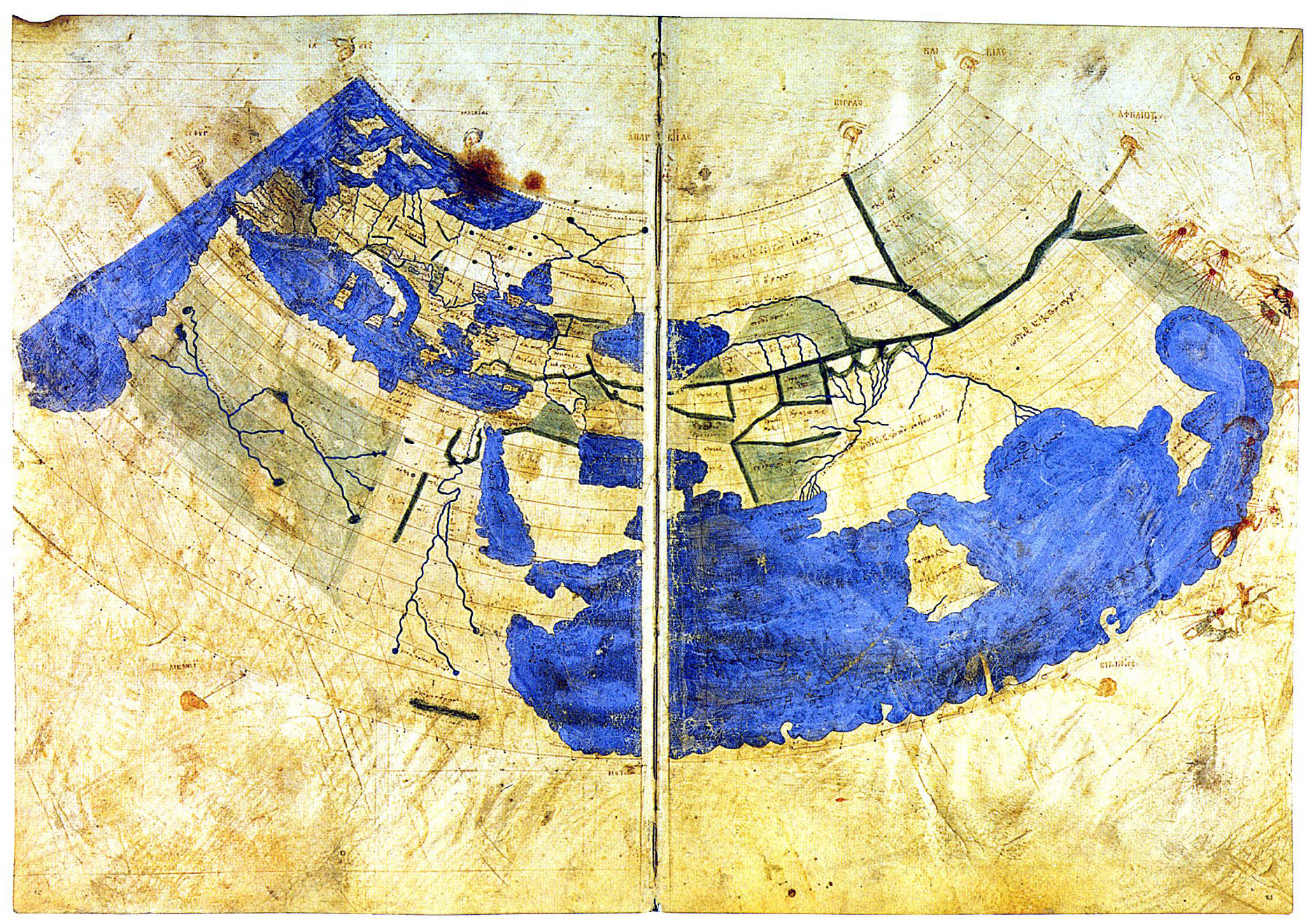
It wouldn’t be until 100 years after the translation of Ptolemy’s text from Greek to Latin in 1407 that his geographical precision became widely known. Until this, “all knowledge of these co-ordinates had been lost in the West,” writes the British Library. This would not be so in the East, however, where world maps like Ibn Hawqal’s, above from 980 C.E., show the influence of Ptolemy, already so long dominant in geography in the Islamic world that it was beginning to wane. Many more world maps survive from 11–12th century Britain, Turkey, and Sicily, from 16th century Korea, and from that wandering age of Columbus and Raleigh, beginning to increasingly resemble the world maps we’re familiar with today. (See a 15th century reconstruction of Ptolemy’s geography below.)
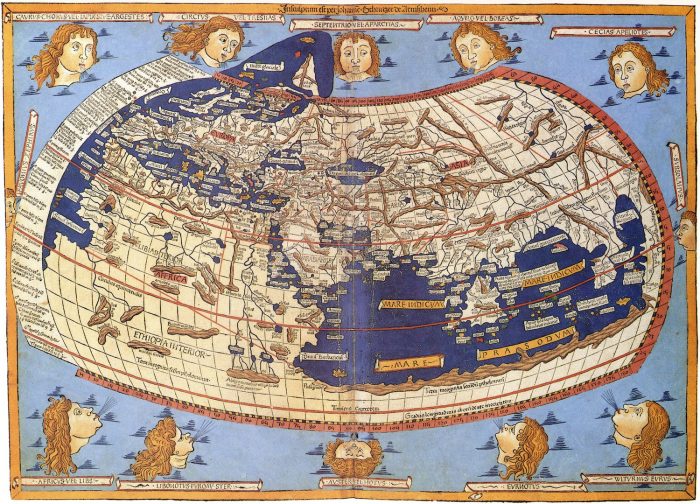
For most of recorded history, knowledge of the world from any one place in it was almost wholly or partly speculative and imaginative, often peopled with monsters and wonders. “All cultures have always believed that the map they valorize is real and true and objective and transparent,” as Jerry Brotton Professor at Queen Mary University of London tells Uri Friedman at The Atlantic. Columbus believed in his speculative maps, even when he ran into islands off the coast of continents charted on none of them. We are still conceptual prisoners—or consumers, users, readers, viewers, audiences—of maps, though we’ve physically plotted every corner of the globe. Perspectives cannot be rendered objective. No gods-eye views exist.
Nonetheless, several culturally formative projections of the world since Ptolemy’s Geography and well before it have changed the whole world, pointing to the power of human imagination and the legendarily imaginative, as well as legendarily brutal, acts of “world building” in real life.
Related Content:
Buckminster Fuller’s Map of the World: The Innovation that Revolutionized Map Design (1943)
“Every Country in the World”–Two Videos Tell You Curious Facts About 190+ Countries
Josh Jones is a writer and musician based in Durham, NC. Follow him at @jdmagness
Read More...Alejandro Jodorowsky’s Very First Film, La Cravate, Based on a Novella by Thomas Mann (1957)
Alejandro Jodorowsky may have redefined the film-viewing experience for a couple generations of art-house thrillseekers, but he didn’t start his creative journey in cinema. Decades before he sent his audiences on the mind-altering feature-length trips (whether or not they came prepared for them with their own mind-altering substances) like El Topo and The Holy Mountain, he wrote poetry, worked as a clown, founded and directed a theater troupe, and after relocating from his native Chile to France, studied mime and performed with Marcel Marceau. Only then had life prepared him to make his first film, 1957’s La Cravate.
Telling its story in vivid color but without words, the short (which also goes under such titles as Les têtes interverties, The Transposed Heads, and most sensationalistically The Severed Heads) draws on Jodorowsky and his collaborators’ skills developed in the performing arts to convert into cinematic mime Thomas Mann’s 1950 novella The Transposed Heads: A Legend of India. Novelist Rayo Casablanca quotes Jodorowsky describing the tale as one of “a woman who has an intellectual husband, who is very weak physically. She also has a muscular but idiotic lover. She cuts the heads off of the two men and interchanges them. She remains with the muscular body and the head of the intellectual. However, after a certain time, the body of the athlete is softened and the body of the intellectual becomes vigorous and muscular.”
Mann, in Jodorowsky’s reading, “wanted to thus say that it is the intellect which makes the body,” but for nearly fifty years, his own visual interpretation went unseen. Not long after its premiere at Rome’s Cinema Auteur Festival in 1957 it went missing, presumed lost, until the sole print’s rediscovery in a German attic in 2006. Finally, Jodorowsky’s fans could see not just his directorial debut but his first starring role onscreen, with a supporting cast that included the Belgian surreal humorist Raymond Devos. The film’s moral, writes Dangerous Minds’ Paul Gallagher, “is never to lose your head over unrequited love, but find someone who loves you as you are,” but as with all of Jodorowsky’s works, feel free to take from it whatever message finds its way into your head.
Related Content:
Alejandro Jodorowsky’s 82 Commandments for Living
Alejandro Jodorowsky Explains How Tarot Cards Can Give You Creative Inspiration
Based in Seoul, Colin Marshall writes and broadcasts on cities and culture. He’s at work on a book about Los Angeles, A Los Angeles Primer, the video series The City in Cinema, the crowdfunded journalism project Where Is the City of the Future?, and the Los Angeles Review of Books’ Korea Blog. Follow him on Twitter at @colinmarshall or on Facebook.
Read More...BritBox Now Streaming Now Streaming 550 Episodes Doctor Who and Many Other British TV Shows
Back in the day, Americans could watch an occasional British TV show on PBS or UHF. A little Benny Hill. Some Upstairs Downstairs, but not a whole lot more.
Those days of scarcity are now long gone. Last month, BBC Worldwide and ITV launched Britbox, a streaming service that features the biggest collection of British TV shows ever. And, according to Nerdist, that collection now includes 550 classic Doctor Who episodes, originally aired between 1963 and 1989. For those not familiar with Doctor Who, Den of Geek has a handy guide that will help you get started.
Britbox currently offers a one-week free trial. Ergo, you can start binge-watching some Doctor Who shows for the next 168 hours. After the free trial, the service costs $6.99 per month, and you can cancel, hassle free, whenever you want.
Other Britbox shows include Sherlock Holmes, EastEnders, Upstairs Downstairs, Blackadder, Bleak House, Inspector Morse, programs with Louis Theroux, A Stitch Through Time, and more.
If you would like to support the mission of Open Culture, consider making a donation to our site. It’s hard to rely 100% on ads, and your contributions will help us continue providing the best free cultural and educational materials to learners everywhere. You can contribute through PayPal, Patreon, and Venmo (@openculture). Thanks!
Related Content:
Read More...Support Us
We're hoping to rely on loyal readers, rather than erratic ads. Please click the Donate button and support Open Culture. You can use Paypal, Venmo, Patreon, even Crypto! We thank you!

About Us

Open Culture scours the web for the best educational media. We find the free courses and audio books you need, the language lessons & educational videos you want, and plenty of enlightenment in between.
Advertise With Us

FREE UPDATES!
GET OUR DAILY EMAIL
Get the best cultural and educational resources on the web curated for you in a daily email. We never spam. Unsubscribe at any time.
FOLLOW ON SOCIAL MEDIA

Open Culture editor Dan Colman scours the web for the best educational media. He finds the free courses and audio books you need, the language lessons & movies you want, and plenty of enlightenment in between.
Advertise With Us

