Meet the “Grammar Vigilante,” Hell-Bent on Fixing Grammatical Mistakes on England’s Storefront Signs
In the age of Banksy, anonymity, energy, and acting without permission combine to make a potent brew. Those whose work springs up in a public setting overnight, without prior announcement or transaction, are freely assumed to be passionate swashbucklers, brimming with talent and sly social commentary.
But what about an anonymous middle-aged man who roams the streets of Bristol, armed not with stencils and spray paint, but a sponge-tipped broom handle that allows him to correct the improper punctuation on local businesses’ awnings and out-of-reach signage?
The so-called “grammar vigilante,” above, became an Internet sensation after a BBC reporter trailed him on one of his nightly rounds, watching him apply adhesive-backed apostrophes where needed and eradicate incorrectly placed ones with blank, color-matched stickers.
While the manager of Cambridge Motors (formerly known as Cambridge Motor’s) hailed the unknown citizen who muscled his splintery wooden sign into compliance with the King’s English, elsewhere, the backlash has been brutal and swift.
The chairman of the Queen’s English Society shares the anonymous crusader’s pain, but frowns on his uncredited execution.
The Telegraph is one of several publications to have called him a “pedant.”
And the owner of Tux & Tails, whose website persists in describing the business as a “gentlemans outfitters,” is angry over what he says will be the cost of restoring a large vinyl sign, installed less than a year ago. “It looks like bird shit,” he declared to The Bristol Post.
On this side of the pond, Erin Brenner, an instructor in the University of California San Diego Extension’s Copyediting Certificate program, comes down hard in her Copyediting blog. In her opinion, there’s nothing to be gained from publicly shaming strangers for their punctuation boo boos:
It is not a kindness—it’s abhorrent behavior…It also gives the world a misguided idea about what professional editors, who are also passionate about language, do. We don’t go around slapping our authors’ wrists in public and telling them how wrong and stupid they are.
Those with reason to fear vigilante justice for their public punctuation should be advised that the web abounds with apostrophe usage videos, one of which is above.
Watch a longer segment on the Grammar Vigilante here.
Related Content:
“Weird Al” Yankovic Releases “Word Crimes,” a Grammar Nerd Parody of “Blurred Lines”
Cormac McCarthy’s Three Punctuation Rules, and How They All Go Back to James Joyce
Ayun Halliday is an author, illustrator, theater maker and Chief Primatologist of the East Village Inky zine. Follow her @AyunHalliday.
Read More...The Philosophy of The Matrix: From Plato and Descartes, to Eastern Philosophy
Do you take the red pill or the blue pill? The question, which at its heart has to do with either accepting or rejecting the illusions that constitute some or all of life as you know it, became part of the culture almost immediately after Morpheus, Lawrence Fishburne’s character in The Matrix, put it to Keanu Reeves’ protagonist Neo. That film, a career-making success for its directors the Wachowski sisters (then the Wachowski brothers), had its own elaborate vision of a false reality entrapping humanity as the actual one surrounds it, a vision made realizable by the finest late-1990s computer-generated special effects. But the ideas behind it, as this Film Radar video essay shows, go back a long way indeed.
The first and by far the most respected of the trilogy, The Matrix “largely interprets Plato’s Allegory of the Cave. Imagine a cave. Inside are people who were born and have spent their entire lives there, chained into a fixed position, only able to see the wall in front of them. As far as they know, this is the entire world.” The Wachowskis ask the same question Plato does: “How do we know what our reality really is?”
When they have Morpheus bring Neo out of his “cave” of everyday late-20th-century existence, they do it in a manner analogous to Plato’s Analogy of the Sun, in which “the sun is a metaphor for the nature of reality and knowledge concerning it,” and the eyes of the fearful few forced out of their cave need some time to adjust to it.
But when one “unplugs” from the illusion-generating Matrix of the title — a concept now in consideration again thanks to the popularity of the “simulation argument” — a longer journey toward that really-real reality still awaits. The second and third installments of the trilogy involve a dive into “religious philosophy from the East,” especially the idea of escape from the eternal soul’s reincarnation “into other physical forms in an infinite cycle where the soul is left to wander and suffer” by means of a spiritual quest for “enlightenment, by uniting body and mind with spirit.” This leads, inevitably, to self-sacrifice: by finally “allowing himself to die,” Neo “is reunited with spirit” and “becomes the true savior of humanity” — a narrative element not unknown in religious texts even outside the East.
These count as only “a few of the philosophical ideas the Wachowskis explore in the Matrix trilogy,” the others including Robert Nozick’s “Experience Machine,” Descartes’ “Great Deceiver,” and other concepts from Kant and Hume “questioning reality, causality, and free will, not to mention the obvious commentary on technology or a submissive society.” Of course, philosophical exploration in The Matrix involve countless flying — and gravity-defying — fists and bullets, much of it performed by characters clad in reflective sunglasses and black leather. Perhaps that datedness has prompted the recent announcement of a Matrix reboot: though the styles may change, if it happens, the ideas would no doubt remain recognizable to Plato himself.
Related Content:
Daniel Dennett and Cornel West Decode the Philosophy of The Matrix
The Matrix: What Went Into The Mix
Free Online Philosophy Courses
Based in Seoul, Colin Marshall writes and broadcasts on cities and culture. He’s at work on a book about Los Angeles, A Los Angeles Primer, the video series The City in Cinema, the crowdfunded journalism project Where Is the City of the Future?, and the Los Angeles Review of Books’ Korea Blog. Follow him on Twitter at @colinmarshall or on Facebook.
Read More...Hear the Prog-Rock Adaptation of H.G. Wells’ War of the Worlds: The 1978 Rock Opera That Sold 15 Million Copies Worldwide
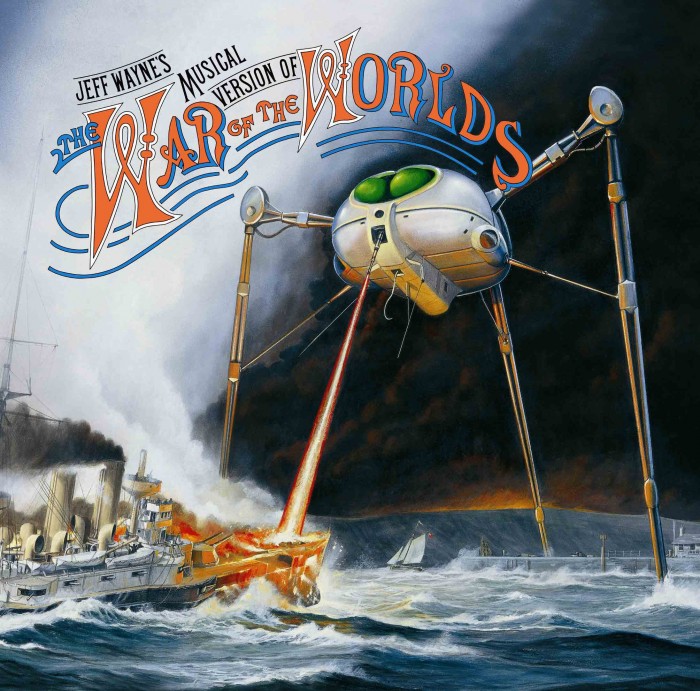
Since the 1950s at least, Americans have embraced science fiction of all kinds—from the high concepts of 2001 to the high kitsch of Barbarella—even if sometimes only among devoted cult fans. The Queen-scored Flash Gordon, for example, did not do well in U.S. theaters on its release in 1980, though it was a hit in the UK. But not long after, its iconic, pulsing theme song, with its operatic blasts, became an unmistakable callback to the final days of 70s rock opera’s glorious excesses.
And yet somehow, another equally bombastic sci-fi rock opera produced in 1978, Jeff Wayne’s musical adaptation of H.G. Wells’ War of the Worlds, has been denied proper cult status in the States. At the time of its release, U.S. audiences, primed by the previous year’s colossal hit, Star Wars, perhaps sought more swashbuckling fare, not prog-rock double concept albums based on classic novels. American indifference, however, in no way hindered the album’s popularity abroad.
According to its clunky website, Wayne’s adaptation, “is one of the best known and best-selling musical works of all time.” This is no empty boast; it had “sold approximately 15 million records around the world” by 2013 and in 2009 was named the 40th best-selling album ever. And for good reason! While you may never have heard of Wayne—he wrote music for TV commercials for much of his career, and once struck it big by producing David Essex’s 1973 hit “Rock On”—you know the “cast” of his War of the Worlds.
Richard Burton narrates, lending the proceedings the gravitas Orson Welles gave The Alan Parsons Project’s adaptation of Edgar Allan Poe (and, many years earlier, brought to his own infamous War of the Worlds adaptation). The songs prominently feature Thin Lizzy’s Phil Lynott and The Moody Blues’ Justin Hayward, both huge stars at the time, as well as David Essex, “musical theater vet Julie Covington,” writes Dangerous Minds’ Ron Kretsch, and “guitar ace and Sex Pistols demo producer Chris Spedding.”
Supplementing the album’s musical charms, and they are many, the original LP also came “packaged in a gatefold with a book containing the complete script and some awesome paintings, mostly by noted Lord of the Rings cover artist Geoff Taylor.” For many of us, Jeff Wayne’s War of the Worlds will seem like a lost masterpiece, a brilliantly kitschy sci-fi, prog-disco classic that never got its due. For fans, however, in “no less than 22 countries,” as the album’s site proclaims, where it charted, reaching number one in half of them, the strangely inspired rock opera may well be very familiar.
You can hear the complete double LP at the playlist above (or click here), along with two more “sides” of alternates, outtakes, and demos. (If you need Spotify, download it here.) One of the songs, Hayward’s “Forever Autumn,” above, was originally written for a “late-‘60s LEGO commercial,” but warranted inclusion because “Wayne simply wanted a ballad to be included.” The move is typical of his more is more production approach to War of the Worlds, and yet, somehow, it all comes together into an engrossing experience. For some reason, in 2012, Wayne decided to remake the album, with Liam Neeson taking on the narration duties. Judging by its Amazon reviews, the new version is just as beloved by many fans as the old.
Related Content:
Hear Orson Welles’ Iconic War of the Worlds Broadcast (1938)
The Very First Illustrations of H.G. Wells’ The War of the Worlds (1897)
The Great Leonard Nimoy Reads H.G. Wells’ Seminal Sci-Fi Novel The War of the Worlds
Josh Jones is a writer and musician based in Durham, NC. Follow him at @jdmagness
Read More...Watch 450 NPR Tiny Desk Concerts: Intimate Performances from The Pixies, Adele, Wilco, Yo-Yo Ma & Many More
In times past, happening upon just the right radio station, record store, or tape trading community were some of the few serendipitous ways of discovering new music. And in those days, one faithful curator of innovative new sounds, BBC DJ John Peel, never disappointed. Because of a law limiting the amount of recorded music radio could play, his name became synonymous with the hundreds of intimate performances punk, new wave, reggae, and other bands recorded live in his studio. While the “Peel Sessions” will forever live in legend (stream some here), the man himself passed away in 2004, and the musical landscape he helped create has changed irrevocably.
And yet, Peel’s animating spirit lives on, most especially in NPR’s Tiny Desk Concerts, live in-studio performances recorded “at the desk of All Songs Considered host Bob Boilen.” Since 2008, Boilen has invited established and up-and-coming artists alike to his desk, capturing loose, unguarded, stripped-down, performances that sound like they’re happening in your living room.
Guitarists unplug, drummers trade their sticks for brushes, and we not only get to listen to old and new favorites; we get to watch them—like the Pixies at the top—up close as well. This performance, from 2014, garnered “the largest crowd we’d ever assembled for a Tiny Desk Concert,” writes Boilen, and featured newest member Paz Lenchantin trading her bass for violin.
Where the Pixies usually fill arenas with their eerily-quiet-to-deafeningly-loud songs, the group further up, Dirty Dozen Band, can easily fill public squares, football fields, and parade routes without stacks of overdriven amps. Hearing them explode in Boilen’s office with their rambunctious funk is a real treat, as is the larger-than-life voice of Adele, above, scaled down to college coffeehouse levels of closeness.
Though Tiny Desk Concerts often showcase pop, hip-hop, folk, country, and indie stars—like Wilco, below—and even classical stars like Yo-Yo Ma, above, it just as often introduces us to musicians we’ve never heard, or seen, before, and gives us the chance to get to know them without the usual trappings of marketing and boilerplate PR, or loud, crowded clubs with bad acoustics and no visibility.
The current homepage features a handful of incredibly talented musicians you’re unlikely to run across in most major venues. At least for now. Had he lived to see Tiny Desk Concerts, and its preservation of a radio curatorial tradition, John Peel, I think, would have been proud. See more performances from The National, Susan Vega, Yusuf Islam/Cat Stevens, Steve Earle, and many, many more—450 concerts in all—at NPR Music on Youtube.
Related Content:
Hear a 9‑Hour Tribute to John Peel: A Collection of His Best “Peel Sessions”
Josh Jones is a writer and musician based in Durham, NC. Follow him at @jdmagness
Read More...A Farewell to Arms with Helen Hayes & Gary Cooper: The Oscar-Winning 1932 Film
A 1932 American pre-Code romance drama film directed by Frank Borzage, A Farewell to Arms stars Helen Hayes, Gary Cooper, and Adolphe Menjou. And it’s based on the Ernest Hemingway novel by the same name. The film won Academy Awards for Best Cinematography and Best Sound, and was also nominated for Best Picture and Best Art Direction. It entered the public domain (in the USA) in 1960.
Find A Farewell to Arms listed in our collection, 4,000+ Free Movies Online: Great Classics, Indies, Noir, Westerns, Documentaries & More.
If you would like to support the mission of Open Culture, consider making a donation to our site. It’s hard to rely 100% on ads, and your contributions will help us continue providing the best free cultural and educational materials to learners everywhere. You can contribute through PayPal, Patreon, and Venmo (@openculture). Thanks!
Read More...A Farewell To Arms: A Vintage Radio Drama (1948)
NBC University Theatre took to the radio airwaves from 1948 to 1950 and featured adaptations of classic novels. Incorporated into college home-study courses (for example at the University of Louisville and Washington State College), the radio show adapted such classics as Don Quixote, For Whom the Bell Tolls, and Great Expectations. Above you can hear a dramatized version of Ernest Hemingway’s 1929 novel, A Farewell to Arms.
This recording will be added to our collection, 1,000 Free Audio Books: Download Great Books for Free. You can learn more about NBC University Theatre and hear more audio plays via this post in our archive:
Looking for free, professionally-read audio books from Audible.com? Here’s a great, no-strings-attached deal. If you start a 30 day free trial with Audible.com, you can download two free audio books of your choice. Get more details on the offer here.
Read More...Hear Nirvana’s “Smells Like Teen Spirit” Shifted from Minor to Major Key, and Radiohead’s “Creep” Moved from Major to Minor
A few years ago, we shared a version of R.EM.’s 1991 alternative hit “Losing My Religion” as reworked from a minor to a major key through digital processing by Ukranian musician Oleg Berg and his daughter Diana. Many people thought the project a travesty and railed against its violation of R.E.M.’s emotional intent. But the stronger the reactions, the more they seemed to validate Berg’s tacit argument about the important differences between major and minor keys. We know that, in general, minor keys convey sadness, dread, or moody intensity, all familiar colors in the R.E.M. palate. Major keys, on the other hand—as in the band’s inexplicably bouncy “Shiny Happy People”—tend to evoke… shininess and happiness.
Why is this? Goldsmiths University Music Psychology Professor Vicky Williamson has an ambivalent explanation at the NME blog. Her answer: the association seems to be cultural but also, perhaps, biological. “Scientists have shown that the sound spectra—the profile of sound ingredients—that make up happy speech are more similar to happy music than sad music and vice versa.”
This thesis may reduce down to a “water is wet” observation. A more interesting way of thinking of it comes from Aristotle, who “suspected that the emotional impact of music was at least partly down to the way it mimicked our own vocalizations when we squeal for joy or cry out in anger.”
Do these expressions always correspond to major or minor scales or intervals? No. Emotions, like colors, have subtleties of shading, contrast, and hue. Williamson names some notable exceptions, like The Smiths’ “I Know It’s Over,” a song in a major key that is almost comically morbid and maudlin. These may serve to prove the rule, achieving their unsettling effect by playing with our expectations. In general, as you will learn from the video above from Minnesota Public Radio—in which a lumberjack explains the distinctions to an animated blue bird—major and minor keys, scales, intervals, and chords are “tools composers use to give their music a certain mood, atmosphere, and strength.”
If you were to ask for a song that contains these qualities in abundance, you might get in reply Nirvana’s “Smells Like Teen Spirit,” which, like Beethoven’s 9th Symphony or most classical opera, relies on exaggerated quiet-to-loud dynamics for its dramatic effect. But it also uses a minor key as an essential vehicle for its anxiety and rage. So important to the song is this element, in fact, that when shifted into a major key, as Berg has done at the top of the post, it sounds nearly incoherent. The clarity with which “Smells Like Teen Spirit” communicates angst and confusion evaporates, especially in the song’s verses. The digital artifacts of Berg’s processing become more evident here, perhaps because the change in key is so destructive to the melody.
Can we closely correlate this loss of melodic integrity to the critical importance the minor scale plays in this song in particular? I would assume so, but let’s look at the example of a similar type of moody, quiet-loud alt-rock song from around the same time period, Radiohead’s “Creep.” Here’s one of those exceptions, originally written in a major key, which may account for the pleasant, dreamlike quality of its verses. That quality doesn’t necessarily disappear when we hear the song rendered in a minor key. But the chorus, underneath the digital distortion, loses the sense of anguished triumph with which Thom Yorke imbued his defiant declaration of creepiness.
In the case of the original “Creep,” the G major key seems to push against our expectations, and gives a song about self-loathing an unsettling sweetness that is indeed kinda creepy. (And perhaps helped Prince to turn the song into a genuinely uplifting gospel hymn). What seems clear in the Nirvana and Radiohead examples is that the choice of key determines in large part not only our emotional responses to a song, but also our responses to deviations from the norm. But those norms are “mostly down to learned associations,” writes Williamson, “both ancient and modern.”
Perhaps she’s right. University of Toronto Music Psychologist Glenn Schellenberg has noticed that contemporary music has trended more toward minor keys in the past few decades, and that “people are responding positively to music that has these characteristics that are associated with negative emotions.” Does this mean we’re getting sadder? Schellenberg instead believes it’s because we associate minor scales with sophistication and major scales with “unambiguously happy-sounding music” like “The Wheels on the Bus” and other children’s songs. “The emotion of unambiguous happiness is less socially acceptable than it used to be,” notes NPR. “It’s too Brady Bunch, not enough Modern Family.”
Maybe we’ve grown cynical, but the trend allows brilliant rock composers like Radiohead’s Johnny Greenwood to do all sorts of odd, unsettling things with major and minor modulation. And it made “Shiny Happy People” stick out like a shockingly joyful sore thumb upon its release in 1991, though at the time the mope of grunge and 90s alt-rock had not yet dominated the airwaves. Now we rarely hear such earnest, “unambiguously happy-sounding” music these days outside of Sesame Street. Find more of Berg’s major-to-minor and vice versa reworkings at his Youtube channel.
Related Content:
R.E.M.’s “Losing My Religion” Reworked from Minor to Major Scale
Patti Smith’s Cover of Nirvana’s “Smells Like Teen Spirit” Strips the Song Down to its Heart
Josh Jones is a writer and musician based in Durham, NC. Follow him at @jdmagness
Read More...
David Lynch’s Twin Peaks Theme Song Gets the Seinfeld Treatment
And, by golly, it works…
Related Content:
Angelo Badalamenti Reveals How He and David Lynch Composed the Twin Peaks‘ “Love Theme”
Watch an Epic, 4‑Hour Video Essay on the Making & Mythology of David Lynch’s Twin Peaks
Twin Peaks Tarot Cards Now Available as 78-Card Deck
David Lynch’s Twin Peaks Title Sequence, Recreated in an Adorable Paper Animation
Read More...Steve Reich is Calling: A Minimalist Ringtone for the iPhone
What if minimalist composer Steve Reich got his hands on the iPhone’s familiar Marimba ringtone? That’s what the website Steve Reich is Calling imagines. Here’s how Jason Kottke describes the basic concept:
[Reich’s] 1967 piece Piano Phase featured a pair of pianists repetitively performing the same piece at two slightly different tempos, forming a continually evolving musical round. Seth Kranzler took this idea and made a Reich-like piece with two iPhones ringing at slightly different tempos.
From what I can tell, there’s not actually an official way to download the ringtone and make it your own–though it does appear that there are, indeed, ways to convert Youtube videos into ringtones. (Note: we haven’t tested these methods, so proceed cautiously.)
For anyone interested in taking a deeper dive–a much deeper dive–into Reich’s musical world, please see this post in our archive: Hear Steve Reich’s Minimalist Compositions in a 28-Hour Playlist: A Journey Through His Influential Recordings.
If you would like to support the mission of Open Culture, consider making a donation to our site. It’s hard to rely 100% on ads, and your contributions will help us continue providing the best free cultural and educational materials to learners everywhere. You can contribute through PayPal, Patreon, and Venmo (@openculture). Thanks!
Looking for free, professionally-read audio books from Audible.com? Here’s a great, no-strings-attached deal. If you start a 30 day free trial with Audible.com, you can download two free audio books of your choice. Get more details on the offer here.
Related Content:
The Music of Avant-Garde Composer John Cage Now Available in a Free Online Archive
Read More...
Support Us
We're hoping to rely on loyal readers, rather than erratic ads. Please click the Donate button and support Open Culture. You can use Paypal, Venmo, Patreon, even Crypto! We thank you!

About Us

Open Culture scours the web for the best educational media. We find the free courses and audio books you need, the language lessons & educational videos you want, and plenty of enlightenment in between.
Advertise With Us

FREE UPDATES!
GET OUR DAILY EMAIL
Get the best cultural and educational resources on the web curated for you in a daily email. We never spam. Unsubscribe at any time.
FOLLOW ON SOCIAL MEDIA

Open Culture editor Dan Colman scours the web for the best educational media. He finds the free courses and audio books you need, the language lessons & movies you want, and plenty of enlightenment in between.
Advertise With Us

