Matt Damon Reads Howard Zinn’s “The Problem is Civil Obedience,” a Call for Americans to Take Action
Say, for example, that a gang of obscenely rich mercenaries with questionable ties and histories had taken power with the intent to destroy institutions so they could loot the country, further impoverish and disempower the citizenry, and prosecute, imprison, and demonize dissidents and ethnic and religious minorities. Such a scenario would cry out, one might think, for civil action on a never-before-seen scale. Millions, one might imagine, would either storm the castle or refuse to obey the commands of their new rulers. We might describe this situation as a topsy-turvy turn of events, should, say, such an awful thing come to pass.
Topsy-turvy is exactly the phrase Howard Zinn used in his characterization of the U.S. during the Vietnam War, when he saw a situation like the one above, one that had also obtained, he said, in Hitler’s Germany and Stalin’s Russia.
“I start,” he said, opening a debate, in 1970, at Johns Hopkins University with philosopher Charles Frankel on the question of civil disobedience,
from the supposition that the world is topsy-turvy, that things are all wrong, that the wrong people are in jail and the wrong people are out of jail, that the wrong people are in power and the wrong people are out of power, that the wealth is distributed in this country and the world in such a way as not simply to require small reform but to require a drastic reallocation of wealth.
And with this preamble, which you can hear read by Matt Damon in the video above, the historian and activist began to make his case that civil disobedience “is not our problem…. Our problem is civil obedience.”
We recognize this for Nazi Germany. We know that the problem there was obedience, that the people obeyed Hitler. People obeyed; that was wrong. They should have challenged, and they should have resisted; and if we were only there, we would have showed them. Even in Stalin’s Russia we can understand that; people are obedient, all these herdlike people.
But “America is different” than other world empires, says Zinn, anticipating the usual claims of exceptionalism. No, he says, it isn’t. “It is not that special. It really isn’t.” Later in his speech, Zinn calls the “voting process” a “sham.”
Totalitarian states love voting. You get people to the polls and they register their approval. I know there is a difference—they have one party and we have two parties. We have one more party than they have, you see.
What is called for, he argued, is not a return to the past nor a rejiggering of the political machinery, but a political consciousness that recognizes common struggles across borders:
People in all countries need the spirit of disobedience to the state, which is not a metaphysical thing but a thing of force and wealth. And we need a kind of declaration of interdependence among people in all countries of the world who are striving for the same thing.
Damon’s reading took place during the 2012 performance in Voices of a People’s History, a now-yearly event that since 2003 has dramatized “the extraordinary history of ordinary people who built the movements that made the United States what it is today, ending slavery and Jim Crow, protesting war and the genocide of Native Americans, creating unions and the eight hour work day, advancing women’s rights and gay liberation, and struggling to right wrongs of the day.”
The words of Howard Zinn feature prominently in all these events, and “The Problem is Civil Obedience”—which was published as an essay two years after the 1970 debate—has proven a popular choice. In 2004 at the second Voices of a People’s History, Wallace Shawn (above) read the text, and Zinn himself was in attendance. Shawn is best known for his comic turns in Woody Allen’s Manhattan, Louis Malle’s My Dinner With Andre, and Rob Reiner’s The Princess Bride, and he can’t help but bring his wry humor to the reading simply by sounding like himself.
In another reading of Zinn’s speech, Grey’s Anatomy actor and outspoken activist Jesse Williams takes on the text, introduced by a recording of the 2004 introduction to Shawn’s reading. These three different readings from three very different actors and personalities all have one thing in common: their audiences all seem to recognize the situation Zinn described in 1970 as entirely relevant to their own in 2004, 2012, 2014, and… perhaps, also in 2017.
Read Zinn’s full remarks here and see new performances from this year’s Voices of a People’s History at their website.
You can find Zinn’s essay published in the collection: The Zinn Reader: Writings on Disobedience and Democracy.
Related Content:
Henry David Thoreau on When Civil Disobedience and Resistance Are Justified (1849)
Josh Jones is a writer and musician based in Durham, NC. Follow him at @jdmagness
Read More...How Did Beethoven Compose His 9th Symphony After He Went Completely Deaf?
You don’t need to know anything at all about classical music, nor have any liking for it even, to be deeply moved by that most famous of symphonies, Ludwig van Beethoven’s 9th—“perhaps the most iconic work of the Western musical tradition,” writes The Juilliard Journal in an article about its handwritten score. Commissioned in 1817, the sublime work was only completed in 1824. By that time, its composer was completely and totally deaf. At the first performance, Beethoven did not notice that the massive final choral movement had ended, and one of the musicians had to turn him around to acknowledge the audience.
This may seem, says researcher Natalya St. Clair in the TED-Ed video above, like some “cruel joke,” but it’s the truth. Beethoven was so deaf that some of the most interesting artifacts he left behind are the so-called “conversation books,” kept from 1818 onward to communicate with visitors who had to write down their questions and replies. How then might it have been possible for the composer to create such enduringly thrilling, rapturous works of aural art?
Using the delicate, melancholy “Moonlight Sonata” (which the composer wrote in 1801, when he could still hear), St. Clair attempts to show us how Beethoven used mathematical “patterns hidden beneath the beautiful sounds.” (In the short video below from documentary The Genius of Beethoven, see the onset of Beethoven’s hearing loss in a dramatic reading of his letters.) According to St. Clair’s theory, Beethoven composed by observing “the mathematical relationship between the pitch frequency of different notes,” though he did not write his symphonies in calculus. It’s left rather unclear how the composer’s supposed intuition of mathematics and pitch corresponds with his ability to express such a range of emotions through music.
We can learn more about Beethoven’s deafness and its biological relationship to his compositional style in the short video below with research fellow Edoardo Saccenti and his colleague Age Smilde from the Biosystems Data Analysis Group at Amsterdam’s Swammerdam Institute for Life Sciences. By counting the high and low frequencies in Beethoven’s complete string quartets, a task that took Saccenti many weeks, he and his team were able to show how three distinct compositional styles “correspond to stages in the progression of his deafness,” as they write in their paper (which you can download in PDF here).
The progression is unusual. As his condition worsened, Beethoven included fewer and fewer high frequency sounds in his compositions (giving cellists much more to do). By the time we get to 1824–26, “the years of the late string quartets and of complete deafness”—and of the completion of the 9th—the high notes have returned, due in part, Smilde says, to “the balance between an auditory feedback and the inner ear.” Beethoven’s reliance on his “inner ear” made his music “much and much richer.” How? As one violinist in the clip puts it, he was “given more freedom because he was not attached anymore to the physical sound, [he could] just use his imagination.”
For all of the compelling evidence presented here, whether Beethoven’s genius in his painful later years is attributable to his intuition of complex mathematical patterns or to the total free rein of his imaginative inner ear may in fact be undiscoverable. In any case, no amount of rational explanation can explain away our astonishment that the man who wrote the unfailingly powerful, awesomely dynamic “Ode to Joy” finale (conducted above by Leonard Bernstein), couldn’t actually hear any of the music.
Related Content:
Stream the Complete Works of Bach & Beethoven: 250 Free Hours of Music
Slavoj Žižek Examines the Perverse Ideology of Beethoven’s Ode to Joy
Beethoven’s Ode to Joy Played With 167 Theremins Placed Inside Matryoshka Dolls in Japan
Leonard Bernstein Conducts Beethoven’s 9th in a Classic 1979 Performance
Josh Jones is a writer and musician based in Durham, NC. Follow him at @jdmagness
Read More...The Fiction of the Science: A Meditation on How Artists & Storytellers Can Advance Technology
In elementary school, a playful teacher gave us an assignment. Everyone was to dream up some sort of amazing invention, then draw both a design and an advertisement for it.
It seemed most of my classmates were primed for a future in which sneakers would come equipped with fully operational, built-in wings.
I succumbed to peer pressure and turned in an ad showing a laughing, airborne boy, taunting an earthbound adult by dangling his be-winged sneaker-clad foot just a few inches out of reach.
My Fleet Foot was awarded a good grade, but I felt no passion for it. The invention that truly captured me was the one depicted in my favorite illustration from Patapoufs et Filifers, the funny French children’s book my father had passed down, about a war between fat and thin people. The thin characters were industrious and highly driven, but the fat ones knew how to live, lounging in feather beds beside wall spigots dispensing hot chocolate.
Those spigots were—then and now—a technological advancement I would love to see realized.
Robert Wong, are you listening?
In the Fiction of Science, the short film above, Wong, a graphic designer and Google Creative Lab’s VP, shows how storytelling can put the spurs to those with the training and know-how to usher these wild-sounding advancements into the real world.
Case in point, the cell phone.
Martin Cooper, an engineer at Motorola, is widely regarded as the father of the mobile phone, but when we take a broader view, the cell phone actually has two daddies: Cooper and Wah Ming Chang, the artist responsible for many of Star Trek’s iconic props, including the phaser, the tricorder and the communicator—a “portable transceiver device in use by Starfleet crews since the mid-22nd century.”
(Not surprisingly, Cooper was a huge Star Trek fan.)
Touch screens and 3D fabrications born of hand gestures are among the many creative fictions that have quickly become reality as science and art intermingle on movie sets and in the lab.
If you’re inspired to take an active part in this revolution, Google Creative Lab is currently taking applications for The Five, a one-year paid program for five lucky innovators, drawn from a pool of artists, designers, filmmakers, developers, and other talented, multi-dextrous makers.
Related Content:
Pixar’s 22 Rules of Storytelling
Learn Python: A Free Online Course from Google
John Berger (RIP) and Susan Sontag Take Us Inside the Art of Storytelling (1983)
Ayun Halliday is an author, illustrator, and theater maker whose play Zamboni Godot is playing in New York City through March 18. Follow her @AyunHalliday.
Read More...Watch The Strange Woman, the 1946 Noir Film Starring Hedy Lamarr
The Strange Woman is a noir film directed by Edgar G. Ulmer and starring Hedy Lamarr. In its original review of the film, The New York Times wrote:
Undoubtedly every actress this side of ten yearns for a tour de force and Hedy Lamarr, who plays the title role in “The Strange Woman” … can consider that yearning wholly realized. For the somber drama of a Suave sinner in Bangor, Me., of a century ago affords Miss Lamarr her meatiest assignment in years, a chance at large chunks of choice dialogue and an opportunity to wear a wardrobe that won’t go unnoticed by the ladies. But as a study of a singular distaff temperament set off by a coterie of ruined males, this adaptation of Ben Ames Williams’ best-selling novel of a few years back has a way of telegraphing its punches. A revealing dissection of a predatory femme fatale it nevertheless lacks motivation for some of its supporting players, pace and suspense to make it completely moving drama.
In its own write-up on the film, the website Film Noir of the Week calls The Strange Woman “a film unfairly neglected in the filmography of Edgar G. Ulmer. It also is the least talked about of the ‘trilogy’ of femme fatale ‘heroine’ pictures made in 1946, the other two being the famous Gilda and the infamous Decoy.”
Now in the public domain, you can watch The Strange Woman above. It’s also housed in our collection of 60+ Free Noir films, a subset of our collection, 4,000+ Free Movies Online: Great Classics, Indies, Noir, Westerns, Documentaries & More.
You’ll also find an another Edgar Ulmer noir film there, Detour.
If you would like to support the mission of Open Culture, consider making a donation to our site. It’s hard to rely 100% on ads, and your contributions will help us continue providing the best free cultural and educational materials to learners everywhere. You can contribute through PayPal, Patreon, and Venmo (@openculture). Thanks!
Read More...A Digital Archive of Modernist Magazines (1890 to 1922): Browse the Literary Magazines Where Modernism Began
The story of literary modernism in the English-speaking world is most often told through a small collection of Great Works of Art. These poems and novels appeared suddenly after the shock and carnage of World War I, as Europeans and Americans faced the psychological aftermath of mechanized modern combat and its senseless capacity for mass destruction. T.S. Eliot’s The Waste Land surveyed the wreckage of European culture and tradition, James Joyce’s Ulysses showed us history as a “nightmare” from which its protagonist is “trying to awake,” Virginia Woolf’s Jacob’s Room showed the modern self as nothing more than a collection of memories and perceptions, emptied of solid existence….
These so-called “high modernist” works all appeared in 1922, when “most scholars consider modernism to be fully fledged.” So writes the Modernist Journals Project (MJP), a joint effort by Brown University and the University of Tulsa, with a number of grants and awards from local sources and the National Endowment for the Humanities.
The project started small in 1996 and has since bloomed into a major resource for scholars and readers. As the MJP’s motto has it, modernism began not with the major works that have come to define it most; “modernism began in the magazines,” small publications with limited readerships that often piqued little interest outside their communities.
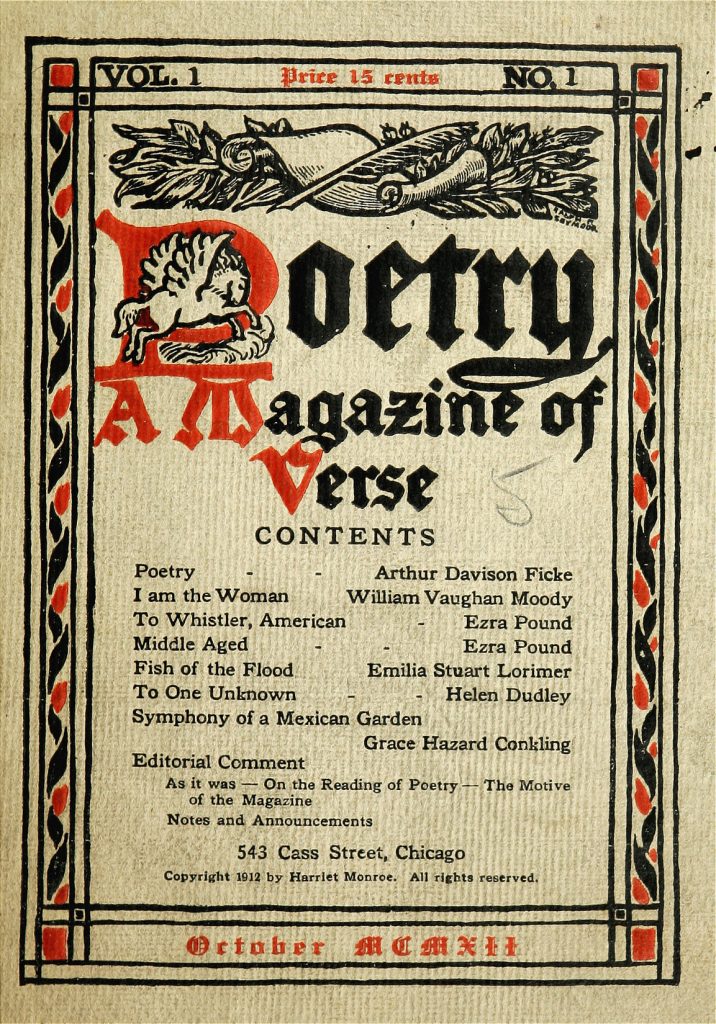
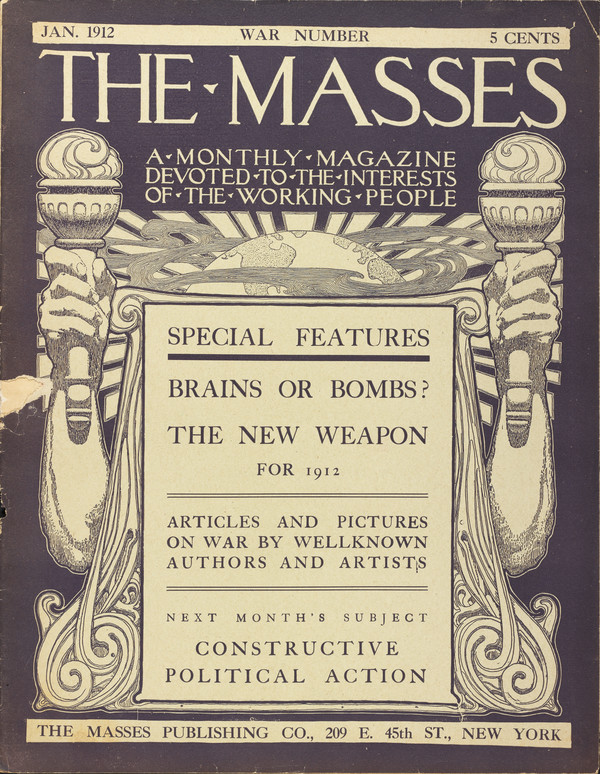
In many of these magazines, such as Harriet Monroe’s Poetry—still around today—we can see bridges between Victorian and modernist poetry. The first issue of Poetry from 1912 (top), for example, features famous Victorian poet William Vaughan Moody next to emerging literary dynamo Ezra Pound, who edited Eliot’s The Waste Land ten years later. Although the exponents of modernism are often divorced from a political context, many modernist writers appeared early in “little magazines” like The Masses, further up, “perhaps the most vibrant and innovative magazine of its day.”
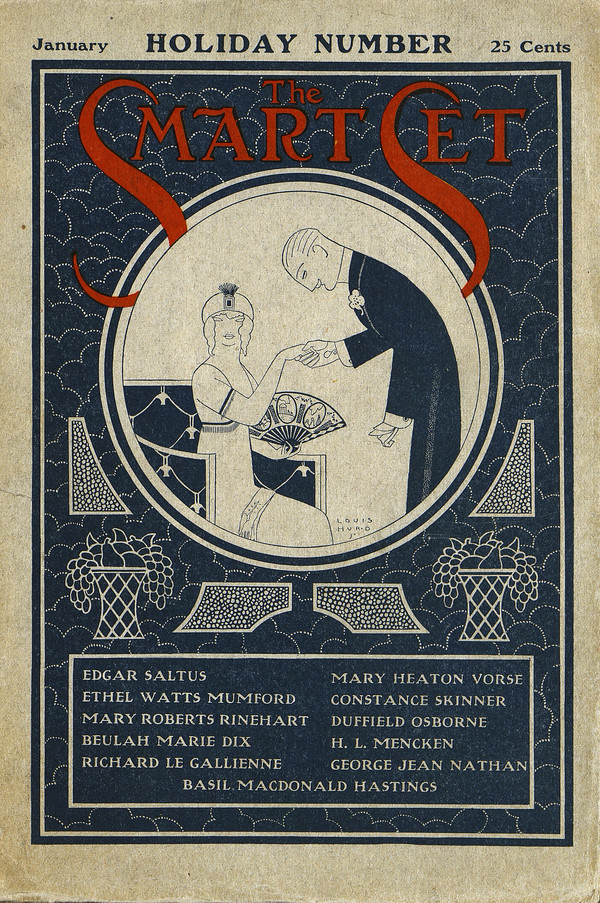
Founded in 1911 as an illustrated socialist monthly, The Masses’ policy was “to do as it Pleases and Conciliate Nobody, not even its Readers.” The magazine published Carl Sandburg, Louis Untermeyer, Amy Lowell, Upton Sinclair, and Sherwood Anderson, among many others. But modernism took root on varied terrain, such that at the same time as The Masses represented major literary change, so too did The Smart Set, founded in 1900 “as a magazine for and about New York’s social elite.” This magazine soon “evolved into something much more important—an expression of popular modernism,” publishing F. Scott Fitzgerald, Joseph Conrad, James Joyce and others.
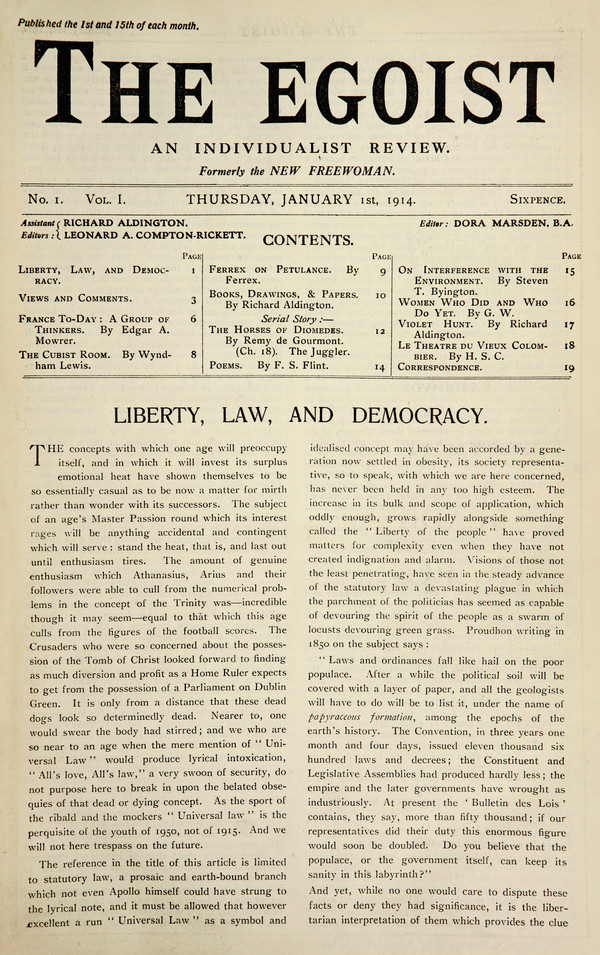
The editorship in 1913 of Willard Huntington Wright “established The Smart Set’s high literary credentials” with figures like Pound and W.B. Yeats. Wright “would up nearly bankrupting the journal” before H.L. Mencken and George Jean Nathan took over the following year. Next to The Smart Set in contemporary importance are magazines like The Egoist, which grew out of an earlier short-lived “weekly feminist review,” The Freewoman.
Begun in 1913 as The New Freewoman by Freewoman editor Dora Marsden, and later edited by Harriet Weaver, The Egoist is only one example of the crucial importance female editors and writers had in bringing literary modernism to fruition. The Egoist eventually took on Eliot as its literary editor and published his seminal essay “Tradition and the Individual Talent.”
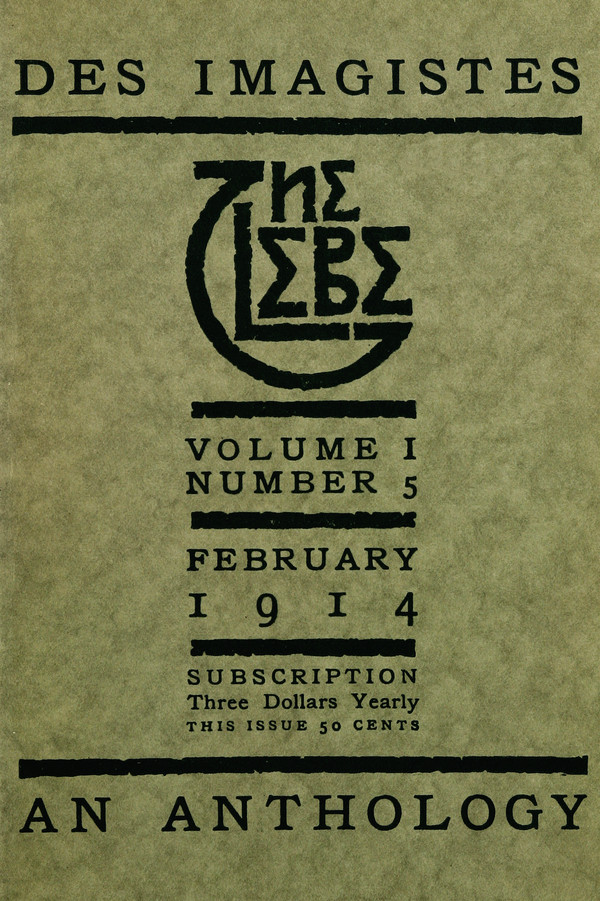
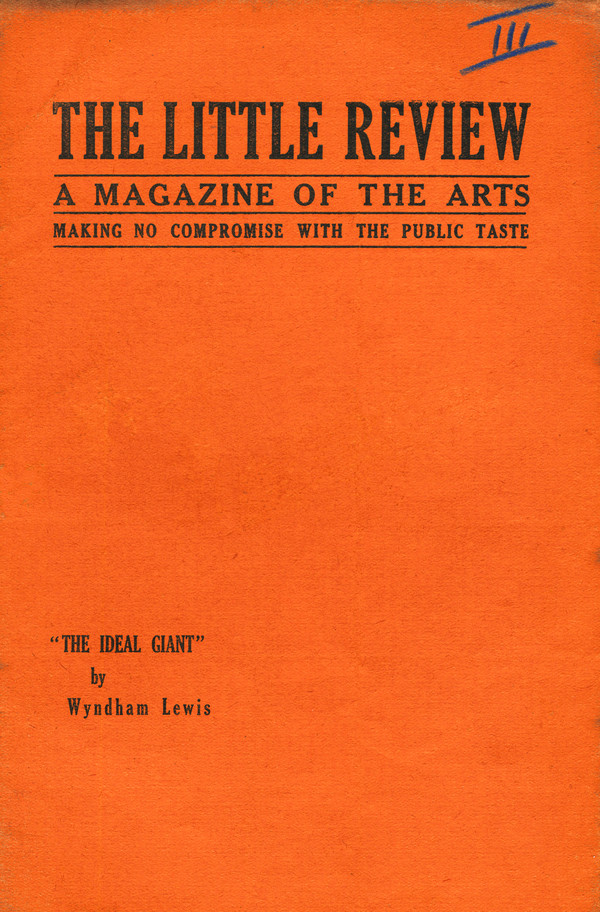
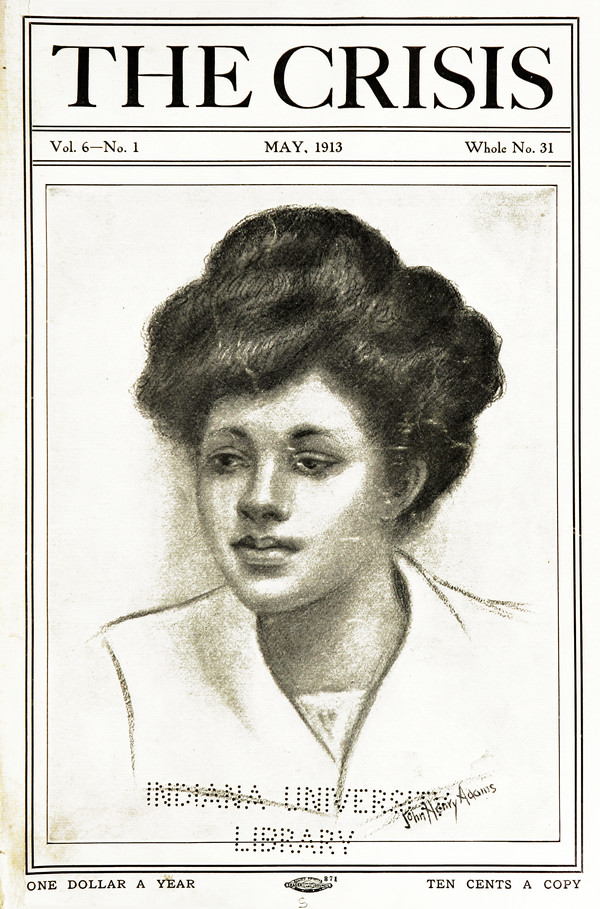
Other publications critical to the growth of modernist literature were The Little Review, Des Imagistes—a series of anthologies organized and edited by Pound—and the W.E.B. Du Bois-edited The Crisis, the NAACP’s official journal, which published work from Jessie Faucet, Charles Chesnutt, Countee Cullen, Langston Hughes, James Weldon Johnson, Jean Toomer, and many other figures central to the Harlem Renaissance. You’ll find dozens of issues of these and many other modernist journals from the period, represented as scanned images and PDFs at the Modernist Journals Project. At the MJP homepage, you also find biographies of the authors and artists who appear in these journals’ pages, as well as book excerpts and essays about the period of the “little magazines,” when the modernists who became famous in the twenties, and household names decades later, discovered new forms and created new literary communities.
Related Content:
Extensive Archive of Avant-Garde & Modernist Magazines (1890–1939) Now Available Online
Josh Jones is a writer and musician based in Durham, NC. Follow him at @jdmagness
Read More...Banksy Opens a Hotel with the Worst View in the World: Visit the Walled Off Hotel in Bethlehem
Quirky, artist-customized guest rooms equipped with wifi, fridge, and safes…
Leather couches and “an air of undeserved authority” in the communal areas…
VIPs who spring for the Presidential suite will enjoy access to a tiki bar, library, and Dead Sea minerals for use in a plunge bath spacious enough for four…
Sounds like the sort of hotel catering to well-heeled hipsters in San Francisco, Brooklyn, or Shoreditch…
…but Bethlehem?
The artist Banksy’s latest massive-scale project may never find its way onto Palestine’s official tourism site, but it’s no joke. The fully functioning hotel is set to open for online bookings on March 11.
Visitors should be prepared to put a $1000 deposit on their credit cards at check in, a security measure aimed at those who might be tempted to walk off with artwork by Sami Musa, Dominique Petrin, or the hotel’s famous founder.
Guests are also cautioned to contain their excitement about their upcoming stay when passing through customs at Tel Aviv airport, where travelers who blab about their intentions to visit the West Bank are often subjected to extra scrutiny. One wonders how many Tel Aviv TSA officers would get the appeal of staying in a hotel that boasts of its terrible views of the wall dividing Palestine from Israel.
The hotel’s proximity to the wall provides both its name and its raison‑d’etre. Banksy is marking the centenary of British control of Palestine by enticing visitors to educate themselves, using his customary humor and lack of polemic as the launching pad.
To that end, a museum and gallery on the premises will be open to the public, offering “a warm welcome to people from all sides of the conflict and across the world.” (The hotel’s FAQ counters the notion that the project is an anti-Semitic statement, issuing a zero-tolerance policy where fanaticism is concerned.)
One of the hotel’s most original amenities is its in-house graffiti supplies store, staffed by experts ready to dispense “local advice and guidance” to visitors eager to contribute to the Wall’s proliferating street art. (For inspiration, refer to Banky’s work from a 2015 trip to Gaza, below.)
Armchair travelers can check out Banksy’s Walled Off Hotel here.
The online reservations desk will open for business on March 11, the same day the gallery and museum open to the public.
Related Content:
Banksy Creates a Tiny Replica of The Great Sphinx Of Giza In Queens
Ayun Halliday is an author, illustrator, and theater maker. Her play Zamboni Godot is now playing in New York City. Follow her @AyunHalliday.
Read More...Stream 8,000 Vintage Afropop Recordings Digitized & Made Available by The British Library
Stability or cultural vitality: many nations seem as if they can only have one or the other. The Republic of Guinea, for instance, has endured quite a turbulent history, yet its musicians have also enjoyed roles as “pioneers in the creation of African popular music styles and as the voice of a new Africa.” That’s the view of the University of Melbourne’s Graeme Counsel, who over the past decade has made a series of trips to the Guinean capital of Conakry on a mission to preserve the great variety of music, part of the tradition now broadly labeled “Afropop,” recorded during the decades of state-sponsored cultural abundance after the country gained independence from France in 1958.
“Under the leadership of music lover President Ahmed Sékou Touré,” writes Hyperallergic’s Allison Meier, “the government was soon sending out guitars, saxophones, and brass instruments to 35 state-funded prefecture orchestras as part of a new authenticité policy.
This directive encouraged a cultural revival that mixed traditional sounds with contemporary music, particularly Cuban and Latin rhythms.” The effort had its own record label called Syliphone, which recorded and distributed this new Guinean music until the mid-1980s, and the powerful radio signal of Radiodiffusion Télévision Guinée (RTG) turned listeners on to it well beyond the new country’s borders.
Counsel, already a collector of Syliphone records, discovered during his PhD research in 2001 that the Guinean government still held a collection of that era’s music (though “a large part of the archive had been destroyed in 1985 when the RTG was bombed by Guinean artillery during an unsuccessful coup”). Applying for and receiving, ultimately, three rounds of funding from the British Library’s Endangered Archives Programme, he set about digitizing and cataloging the unexpectedly numerous and perhaps expectedly disorganized and poorly maintained reels of magnetic tape he found, working through bureaucratic hassles, coups d’état, and even a massacre.
“Nothing would deter me,” writes Counsel in a series of essays (part one, part two, part three) on the project, “not the authorities’ indifference towards the sound archive, not the recalcitrance of their attitudes, nor the tragedies of everyday life in Guinea. Nothing.” The fruits of his labors have now become available at the British Library’s online Syliphone archive, which boasts over 8,000 Guinean Afropop tracks recorded over 26 years. Meier names among the “legendary” music it makes available “the loose rhythms of the Bembeya Jazz National, the horn-heavy melodies of the Super Boiro Band, the Latin-influenced beats of Orchestre de la Paillote, and the all-women Cuban-infused les Amazones de Guinée.” Those musicians’ names may not ring a bell for you now, but a little time with the archive will guarantee a long-term inability to get their songs out of your head.
Find the 8,000 recordings here.
via Hyperallergic/Electronic Beats
Related Content:
New Documentary Brings You Inside Africa’s Little-Known Punk Rock Scene
The Alan Lomax Sound Archive Now Online: Features 17,000 Blues & Folk Recordings
Based in Seoul, Colin Marshall writes and broadcasts on cities and culture. He’s at work on a book about Los Angeles, A Los Angeles Primer, the video series The City in Cinema, the crowdfunded journalism project Where Is the City of the Future?, and the Los Angeles Review of Books’ Korea Blog. Follow him on Twitter at @colinmarshall or on Facebook.
Read More...Hear a Rare Poetry Reading by Captain Beefheart (1993)
When I find myself in times of musical trouble, Captain Beefheart comes to me. His Marcel Duchamp-meets-James Brown shtick goes places no other experimental prog-blues-jazz artist ever has—places of absurdist virtuosity where the gap between the artist and the mask disappears, where words and music have relationships that defy physical laws. Many have tried, but few have so well succeeded in the wild ambition to make surrealist verse cohere in songs that defy all traditional arrangements. For my experimental rock dime, no one has mastered the art so well as Beefheart and his Magic Band.
In fact, every musician, I believe, should sometimes ask themselves, “what would Captain Beefheart do?” But what about Beefheart’s relationship with the other arts? We probably know that the man also named Don Van Vliet was a prolific abstract painter throughout his career, the medium he chose for the last 28 years of his life after he hung up his saxophone in 1982. But did his “strange uncle of post-punk” musical sensibilities translate into poetry, a related but quite different art than that of even the most abstract songwriting?
Well, if Bob Dylan can win a Nobel Prize—and why not?—I see no reason why we can’t consider the work of Captain Beefheart literary art. And in addition to his extraordinary Dadaist songs, Beefheart penned restrained, masterfully imagistic poems with wry humor and crystalline intelligence. His work surely belongs in Alan Kaufman’s Outlaw Bible of American Poetry right next to that of Dylan, Tom Waits, Patti Smith, Tupac Shakur, Gil Scott-Heron, Jim Morrison, the Beats, and dozens more non-musical writers. But it seems that Beefheart’s literary genius has been mostly overlooked.
That’s unfortunate. In tense, vividly observed poems like “A Tin Peened Reindeer,” he approaches the elliptical mystery of Wallace Stevens and the baroque language of John Ashbery. Late songs like “The Thousandth and Tenth Day of the Human Totem Pole” condense the grotesque imaginary of Dali into a few staggering lines. Yet we don’t get a collection of Beefheart readings until 1993, when he appeared in a short documentary by Anton Corbijn called Some Yo Yo Stuff.
You can watch that film at the top of the post, and in the videos below it, hear Van Vliet read poems and song lyrics in recordings from his time with Corbijn. Both in the film and in the readings, it is evident that the multiple sclerosis that killed Beefheart in 2010 had rendered speech difficult for him. But with patient listening, we hear that his sparkling wit and absurdist genius remained at full strength, as in another, long 1993 interview with Dutch radio host Co De Kloet.
Beefheart earned a reputation as an autocratic-yet-capricious bandleader (recording a tongue-in-cheek spoken word piece on the subject in earlier years). But in interviews, he came across as humble, sweet-tempered, and gentle, and as an artist whose work was an authentic outgrowth of his personality. These qualities shine through in even the goofiest, most out-there poems and lyrics.
Further up, hear Beefheart read the poems and songs “Fallin’ Ditch,” “The Tired Plain,” “Skeleton Makes Good,” “Safe Sex Drill,” and “Gill,” and in the playlist below, he reads all of those plus his poem, “Tulip,” a short modernist gem reminiscent of both Ezra Pound and William Carlos Williams:
It could be
a tremendous black upside-down tulip
it could be
a black fishes’ tail
it could be a day, artistically crimped
and buoyant
in its taped together way
Captain Beefheart’s poems will be added to our collection, 1,000 Free Audio Books: Download Great Books for Free.
via Ubuweb
Related Content:
Captain Beefheart Issues His “Ten Commandments of Guitar Playing”
The Night Frank Zappa Jammed With Pink Floyd … and Captain Beefheart Too (Belgium, 1969)
Hear Patti Smith Read 12 Poems From Seventh Heaven, Her First Collection (1972)
Josh Jones is a writer and musician based in Durham, NC. Follow him at @jdmagness
Read More...Watch Earth, a Landmark of Soviet Cinema (1930)
Today we’re adding to our list of Free Movies a 1930 Soviet silent film by director Alexander Dovzhenko. It’s called Earth, and it’s the third installment in Dovzhenko’s “Ukraine Trilogy.”
When The Guardian created its list of the Top 10 Silent Movies of all time, it put Earth in the #9 slot. About the film writer Pamela Hutchinson said:
Earth, capped by that avowedly secular title, is a lyrical, carnal movie about birth, death, sex and rebellion. Officially, this Soviet-era Ukrainian silent is a paean to collective farming, crafted around a family drama, but its director, Alexander Dovzhenko, was a born renegade, for whom plots were far less important than poetry…
Earth is the final part of Dovzhenko’s silent trilogy (following the nationalist fantasy Zvenigora (1928) and the avant-garde anti-war film Arsenal (1929), and is brimming with exuberant youth, but haunted by the shadow of death.…
Sketched as tribute to the boons of collectivisation, but released as those schemes were falling out of favour, Earth was condemned on its home turf on political grounds. It was also snipped by censors who objected to the nudity, and the infamous scene in which farmers urinate into their tractor’s radiator. But while there was dismay and censure in the Soviet Union, critics elsewhere were overawed…
It’s the latter impression that endures. Dovzhenko’s symbolism is both rich and audacious. His scope comprises vast pastoral landscapes, and intimate fleshy nakedness. Perhaps its most celebrated sequence is the magnificent opening scene: the painful counterpoint between a dying man, his infant grandchildren and the bursting fruit of his orchard. This is living cinema, as refreshing and vital as the film’s own climactic downpour.
You can watch Earth above, and find it listed in our collection of Free Silent Films, a subset of our meta collection, 4,000+ Free Movies Online: Great Classics, Indies, Noir, Westerns, Documentaries & More.
If you would like to support the mission of Open Culture, consider making a donation to our site. It’s hard to rely 100% on ads, and your contributions will help us continue providing the best free cultural and educational materials to learners everywhere. You can contribute through PayPal, Patreon, and Venmo (@openculture). Thanks!
Related Content:
Watch Dziga Vertov’s A Man with a Movie Camera, Named the 8th Best Film Ever Made
Watch Soviet Avant-Garde Composers Create Synthesized Music with Hand-Drawn Animations (1934)
Eight Free Films by Dziga Vertov, Creator of Soviet Avant-Garde Documentaries
Read More...Support Us
We're hoping to rely on loyal readers, rather than erratic ads. Please click the Donate button and support Open Culture. You can use Paypal, Venmo, Patreon, even Crypto! We thank you!

About Us

Open Culture scours the web for the best educational media. We find the free courses and audio books you need, the language lessons & educational videos you want, and plenty of enlightenment in between.
Advertise With Us

FREE UPDATES!
GET OUR DAILY EMAIL
Get the best cultural and educational resources on the web curated for you in a daily email. We never spam. Unsubscribe at any time.
FOLLOW ON SOCIAL MEDIA

Open Culture editor Dan Colman scours the web for the best educational media. He finds the free courses and audio books you need, the language lessons & movies you want, and plenty of enlightenment in between.
Advertise With Us

