Beer Archaeology: Yes, It’s a Thing
Travis Rupp is a classics instructor at The University of Colorado. He’s also a “beer archaeologist” who works on a special projects team at the Avery Brewing Company (in Boulder) where they “brew beers the way that ancient Egyptians, Peruvians and Vikings did.” If you can understand the beer an ancient people drank, you can better understand their overall culture. That’s assumption at the heart of beer archaeology.
Above, watch a three minute introduction to Rupp’s work. Below, find information on some of the world’s oldest beer recipes from Ancient Egypt and China.
If you would like to support the mission of Open Culture, consider making a donation to our site. It’s hard to rely 100% on ads, and your contributions will help us continue providing the best free cultural and educational materials to learners everywhere. You can contribute through PayPal, Patreon, and Venmo (@openculture). Thanks!
Related Content:
5,000-Year-Old Chinese Beer Recipe Gets Recreated by Stanford Students
Discover the Oldest Beer Recipe in History From Ancient Sumeria, 1800 B.C.
Read More...
A Hypnotic Look at How Tennis Balls Are Made
Over the years, we’ve shown you various household objects being made–everything from crayons and ink, to vinyl records, old fashioned books and paper. Today, you can get a mesmerizing glimpse into how tennis balls are made. Created by Benedict Redgrove for ESPN, the short film above shows “the manufacturing process of [Wilson] tennis balls for the US Open.” Combined, it takes 24 different processes to make the final ball. And it’s fun to watch.
If you would like to support the mission of Open Culture, consider making a donation to our site. It’s hard to rely 100% on ads, and your contributions will help us continue providing the best free cultural and educational materials to learners everywhere. You can contribute through PayPal, Patreon, and Venmo (@openculture). Thanks!
Related Content:
How Japanese Things Are Made in 309 Videos: Bamboo Tea Whisks, Hina Dolls, Steel Balls & More
How Ink is Made: A Voluptuous Process Revealed in a Mouth-Watering Video
Learn How Crayons Are Made, Courtesy of 1980s Videos by Sesame Street and Mr. Rogers
20 Mesmerizing Videos of Japanese Artisans Creating Traditional Handicrafts
The Art of Making Old-Fashioned, Hand-Printed Books
The Making of Japanese Handmade Paper: A Short Film Documents an 800-Year-Old Tradition
Read More...A Handy, Detailed Map Shows the Hometowns of Characters in the Iliad
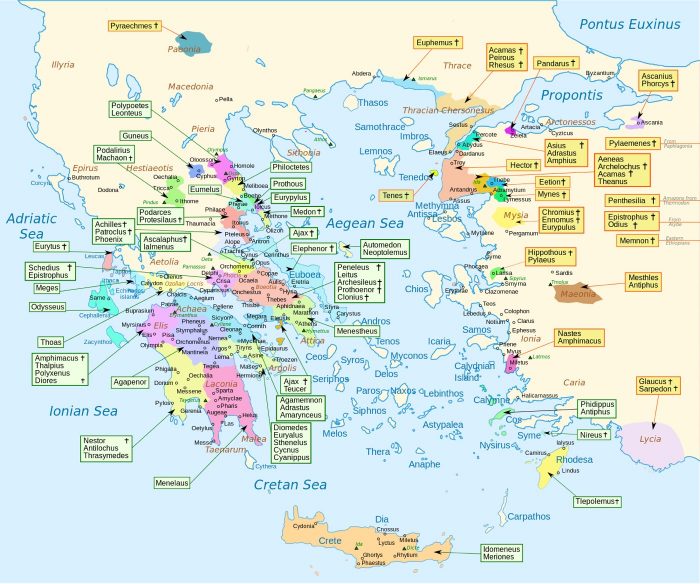
Click here to see a larger version of the map.
You’ve adjusted to the strangeness of names like Ascalaphus and Phidippus. You’ve more or less figured out who’s on which side in the ancient war between Greece and Troy. But as literary epics will do—from the ancient Greeks and Indians to the 19th century Russians—Homer’s Iliad also presents you with several logistical puzzles you must either ignore or spend countless hours trying to solve: you are given the names of major and minor characters’ hometowns, ranging all over the Adriatic, Ionian, Cretan, and Aegean Seas. Doubtless you have no idea where most of these places were.
Again and again, place names occur in rapid succession, and you’re told not only who hails from where, but who commands and conquers which city. Just a smattering of examples from Book II (in Samuel Butler’s translation):
Ulysses led the brave Cephallenians, who held Ithaca, Neritum with its forests, Crocylea, rugged Aegilips, Samos and Zacynthus, with the mainland also that was over against the islands.
Thoas, son of Andraemon, commanded the Aetolians, who dwelt in Pleuron, Olenus, Pylene, Chalcis by the sea, and rocky Calydon,
And those that held Pherae by the Boebean lake, with Boebe, Glaphyrae, and the populous city of Iolcus
“Huh,” you say, “Okay, Homer, I’ll take your word for it.” Questions of historicity aside, we can at least say that the hundreds of cities and towns mentioned in this culturally formative text did exist, or continue to do so, though it’s debatable, as Jason Kottke writes, whether “that level of mobility was accurate for the time [somewhere in the 11th or 12th century BC] or if Homer simply populated his poem with folks from all over Greece as a way of making listeners from many areas feel connected to the story.”
In any case, you need not despair of ever making sense of Homer’s bewildering geographical lists. The map above (click here to see it in a larger format) handily illustrates the world of the Iliad, showing the places of origins of a few dozen characters, with Greeks in green and Trojans in yellow. Kottke notes in an addendum to his post that “not every character is represented… (particularly the women) and… some of the locations and hometowns are incorrect.” We would welcome corrections—as would Wikipedia—if an enterprising classics scholar has the time and energy to devote to such an effort.
But for the lay reader of Homer’s epic, the map more than suffices as helpful visual context for a very complicated narrative. One defining feature of a war epic well-told, most critics would say, is that the human drama does not get lost in the scale and scope of the action. More than any other form, the epic illustrates what Tolstoy described in War and Peace as the “historical sense” that our conflicts are “bound up with the whole course of history and preordained from all eternity.” But against this kind of determinism, the great poets particularize, making their characters seem not like props in a cosmic drama but like actual people from actual places on earth. Seeing the Iliad mapped above reinforces our sense of the Greek epics as genuine—if fantastical—accounts of meaningful human action in the world.
You can find free versions of the Iliad and the Odyssey in our collection of Free eBooks and Free Audio Books.
via Kottke.org.
Related Content:
An Interactive Map of Odysseus’ 10-Year Journey in Homer’s Odyssey
Greek Myth Comix Presents Homer’s Iliad & Odyssey Using Stick-Man Drawings
Hear Homer’s Iliad Read in the Original Ancient Greek
Josh Jones is a writer and musician based in Durham, NC. Follow him at @jdmagness
Read More...Listen to a Marathon Reading of Elie Wiesel’s Night
A couple of weeks ago on January 27, International Holocaust Remembrance Day, a diverse group gathered for a marathon reading of Night, Nobel Prize winner, Elie Wiesel’s memoir of his youthful experiences as a prisoner in Auschwitz and Buchenwald.
The event was organized in part by the National Yiddish Theatre—fitting given that Night was originally written in Yiddish, though first published in French. The theater’s artistic director and several actors from past productions claimed several of the reading slots, but left more than sixty to be filled by participants from an intentionally broad pool.
There were rabbis and Broadway performers, a New Yorker writer, the Consul General of Germany, and the Hungarian Ambassador to the UN…
Students and educators…
A number of Holocaust survivors…
Dr. Ruth Westheimer and Wiesel’s grown son, Elisha, who observed:
At a time when this country is feeling so divided, when so much negativity is circulating about those who are different from ourselves — those who have different ethnicities, religions or even different political leanings — my father’s words are an important reminder of the dangers of the ‘us versus them’ mentality.
It took the volunteer readers a little over four hours to get through the slim volume, which shows up on many American high schools’ required reading lists.
The free event was co-sponsored by the Museum of Jewish Heritage—A Living Memorial to the Holocaust, whose location in lower Manhattan was quite convenient to another important event taking place that day—an interfaith rally to protest President Donald Trump’s executive order banning immigrants from 7 countries, suspending entry for all refugees for a period of four months, and calling for “extreme vetting” screenings.
There may be times when we are powerless to prevent injustice, but there must never be a time when we fail to protest.
- Elie Wiesel, Nobel Peace Prize Acceptance Speech, December, 1986
h/t Jeff N.
Related Content:
Elie Wiesel (RIP) Talks About What Happens When We Die
Yes, the Holocaust Happened, Even If a Top Google Search Result Says It Didn’t
Ayun Halliday is an author, illustrator, theater maker and Chief Primatologist of the East Village Inky zine. Her play Zamboni Godot is opening in New York City in March 2017. Follow her @AyunHalliday.
Read More...A Short Anti-LSD Horror Film Made by the Lockheed Corporation (1969)
During the late 1960s, the defense contractor Lockheed Corporation took a strange detour into filmmaking and sponsored a series of short films, each examining the perils of a particular hardcore drug. Above, you can watch “Case Study: LSD,” a three-minute short documenting a young woman’s acid trip. Everything seems pretty groovy, until the 18-year-old protagonist goes to eat a hot dog. That’s when things go horribly wrong: the hot dog springs to life, claims it has a wife and seven kids to support, and screams bloody murder as it gets mercilessly ingested. A horror film, if I’ve ever seen one.
You can watch the three other short films in the series here: Case Study: Heroin, Case Study: Amphetamines, and Case Study: Barbiturates.
Related Content:
The Historic LSD Debate at MIT: Timothy Leary v. Professor Jerome Lettvin (1967)
Watch The Bicycle Trip: An Animation of The World’s First LSD Trip in 1943
Artist Draws Nine Portraits on LSD During 1950s Research Experiment
Ken Kesey’s First LSD Trip Animated
Read More...David Foster Wallace on What’s Wrong with Postmodernism: A Video Essay
“We live in a nightmare that David Foster Wallace had in 1994,” said a tweet that put me in stitches last summer, but I have a sense that we’ve only sunk deeper into that hyperverbal, media-obsessed, and deeply fearful novelist’s bad dreams since then. “The American writer in the middle of the 20th century has his hands full in trying to understand, and then describe, and then make credible much of the American reality,” Philip Roth argued 55 years ago. “The actuality is continually outdoing our talents.” Now, at the beginning of the 21st, that actuality outdoes not just what the comparatively traditional Roth could come up with, but even anything imaginable by Wallace’s heirs in the form-breaking, extremity-oriented realm of “postmodernism.”
But did Wallace consider himself postmodernist? Asked by Charlie Rose in a 1997 interview what “postmodernism means in literature,” he at first replied only that it means “after modernism.” But soon he got into the broader cultural critique for which he’s now remembered: “Postmodernism has, to a large extent, run its course,” despite having made the considerable innovation of presenting “the first text that was highly self-conscious, self-conscious of itself as text, self-conscious of the writer as persona, self-conscious about the effects that narrative had on readers and the fact that the readers probably knew that.” Decades later, Wallace saw that “a lot of the schticks of post-modernism — irony, cynicism, irreverence — are now part of whatever it is that’s enervating in the culture itself.”
“The Problem with Irony,” Will Schoder’s video essay above, draws on Wallace’s interview with Rose and much other televisual material besides. That focus may seem slightly quaint in the internet age, but Wallace, a self-confessed television addict who wrote a thousand-page novel about a videotape so entertaining that it kills, looked into the screen and saw a real and powerful threat. “Irony, poker-faced silence, and fear of ridicule are distinctive of those features of contemporary U.S. culture (of which cutting-edge fiction is a part) that enjoy any significant relation to the television whose weird pretty hand has my generation by the throat,” he wrote in the 1993 essay “E Unibus Pluram,” blaming those qualities for “a great despair and stasis in U.S. culture.”
Even as “a certain subgenre of pop-conscious postmodern fiction, written mostly by young Americans, has lately arisen and made a real attempt to transfigure a world of and for appearance, mass appeal, and television [ … ] televisual culture has somehow evolved to a point where it seems invulnerable to any such transfiguring assault.” But as that culture moved on from the likes of David Letterman (to Wallace’s mind, “the ironic eighties’ true Angel of Death”) and Seinfeld to those of Jon Stewart and Community, Scholder argues, its attitudes de-ironized somewhat: “The best shows of our age aren’t finding humor in the gaps that have developed between people. They find humor in the absurd and awkward attempts by people trying to bridge those gaps. They want to show us that humans can have real connections and sincerity for each other.”
And yet humanity’s passivity remains worrisome. “Today, the average weekly screen time for an American adult – brace yourself; this is not a typo – is 74 hours (and still going up),” writes Andrew Postman, son of media theorist and Amusing Ourselves to Death author Neil Postman, in a Guardian piece just last week. “We watch when we want, not when anyone tells us, and usually alone, and often while doing several other things. The soundbite has been replaced by virality, meme, hot take, tweet.” Postman includes Wallace with his father in the group of observers who “warned of what was coming”: a time when few can be shocked by, among other current phenomena, “the rise of a reality TV star, a man given to loud, inflammatory statements, many of which are spectacularly untrue but virtually all of which make for what used to be called ‘good television.’ ” Stay tuned, if you must.
Related Content:
30 Free Essays & Stories by David Foster Wallace on the Web
David Foster Wallace: The Big, Uncut Interview (2003)
Animations Revive Lost Interviews with David Foster Wallace, Jim Morrison & Dave Brubeck
Noam Chomsky Calls Postmodern Critiques of Science Over-Inflated “Polysyllabic Truisms”
Based in Seoul, Colin Marshall writes and broadcasts on cities and culture. He’s at work on a book about Los Angeles, A Los Angeles Primer, the video series The City in Cinema, the crowdfunded journalism project Where Is the City of the Future?, and the Los Angeles Review of Books’ Korea Blog. Follow him on Twitter at @colinmarshall or on Facebook.
Read More...How Animated Cartoons Are Made: A Vintage Primer Filmed Way Back in 1919
Many techniques shown in Bray Studios’ 1919 short How Animated Cartoons are Made, above, were rendered obsolete by digital advancements, but its 21-year-old star, animator Wallace Carlson, seems as if he would fit right in at Cal Arts or Pratt, Class of 2017.
Like many of today’s working animators, the industry pioneer got started early, getting attention (and a distribution deal!) for work made as a young teen.
His comic sensibilities also suggest that young Carlson would’ve found a place among the 21st-century’s animation greats (and soon-to-be-greats).
It doesn’t hurt that he’s cute, in an indie Williamsburg Dandy sort of way.
The vintage feel of his little instructional film is pretty hip these days. It could be the work of a very particular kind of millennial, familiar to fans of Girls, Search Party, or other shows whose characters spend a lot of time in cafes, making art that will find its greatest audience on the internet.
You know, download some silent clips from the Prelinger Archives, browse the Free Music Archive for a suitably jangly old time tune, and put it all together in iMovie, messing around with title fonts until you achieve the desired effect. That’s what Carlson might have been doing, had he been born a hundred years later.
Some of his (silent) observations about his craft still ring true.
Unless you’re working on your own thing, it’s a good idea to get the boss’ blessing on your script before embarking on the painstaking animation process.
And character eyebrow movements remain an excellent storytelling device.
Animators whose talents are more visual than verbal could take a lesson from Carlson’s kicky period dialogue—“Gee I just busted a window! Hope I don’t get pinched.”—though I’d advise against turning a character’s disability into a punchline.
While today’s young animators have little to no experience with film processing, Carlson’s exhaustion after pumping out drawing after drawing may strike a chord. The devil is still in the details for anyone seeking to produce work of a higher quality than that which can be achieved with purchase of an app.
It’s also pretty cool to see Carlson prefiguring white board animation 56 years before the invention of dry erase markers, as he demonstrates how to set a scene using his Little Rascals-esque characters Mamie and Dreamy Dud.
Related Content:
Gertie the Dinosaur: The Mother of all Cartoon Characters (1914)
Early Japanese Animations: The Origins of Anime (1917–1931)
Winsor McCay Animates the Sinking of the Lusitania in a Beautiful Propaganda Film (1918)
Ayun Halliday is an author, illustrator, theater maker and Chief Primatologist of the East Village Inky zine. She used one of the alluded-to archives to create the trailer for her play, Zamboni Godot, opening in New York City next month. Follow her @AyunHalliday.
Read More...Stream Marc Maron’s Excellent, Long Interview with The Band’s Robbie Robertson
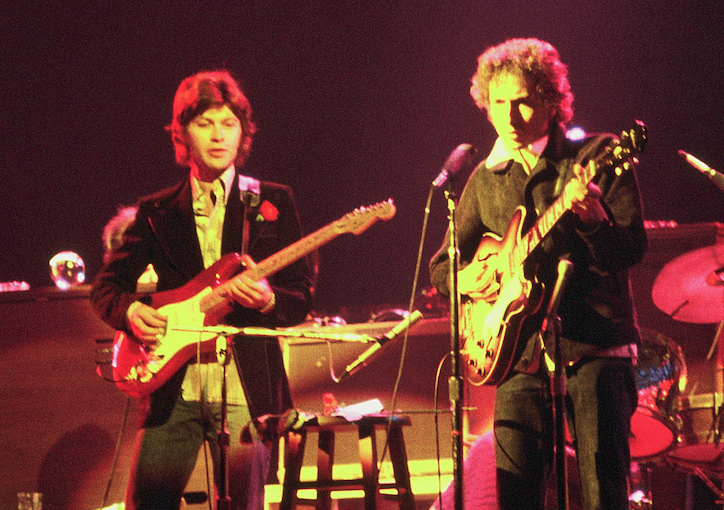
Image of Robertson (left) and Bob Dylan (right) by Jim Summaria, via Wikimedia Commons
A quick heads up: Marc Maron released this week a long, probing and quite excellent interview with The Band’s Robbie Robertson. The conversation gives you:
the full lowdown on the history of The Band, from its origins as a backing group to its final bow with The Last Waltz. Robbie talks about being with Bob Dylan when he went electric and dealing with the blowback of that, and he explains how he came to have such a great working relationship with Martin Scorsese on many of the director’s films.
You can stream the interview below. It’s worth listening to Maron’s impassioned monologue. But if you want to skip straight to the interview itself, then jump to the 15 minute mark.
Robertson recently published a new memoir called Testimony, and I should point out that you can download it as a free audiobook if you take part in Audible.com’s 30 day free trial program. Get details on Audible’s free trial here.
If you would like to support the mission of Open Culture, consider making a donation to our site. It’s hard to rely 100% on ads, and your contributions will help us continue providing the best free cultural and educational materials to learners everywhere. You can contribute through PayPal, Patreon, and Venmo (@openculture). Thanks!
Related Content:
Watch The Band Play “The Weight,” “Up On Cripple Creek” and More in Rare 1970 Concert Footage
Martin Scorsese Captures Levon Helm and The Band Performing “The Weight” in The Last Waltz
Jeff Bridges Narrates a Brief History of Bob Dylan’s Basement Tapes
Read More...The Filmmaking of Martin Scorsese Demystified in 6 Video Essays
Some filmmakers of the 1970s “New Hollywood” era have passed away, retired, or faded into relative obscurity, but each movie Martin Scorsese makes still meets with great interest from critics and moviegoers alike. His latest picture Silence, despite its outwardly dry subject matter of 17th-century Jesuit priests in Japan, has remained a subject of conversation and indeed debate since its release at the end of last year. Coincidentally, its title evokes one of the signature techniques that have kept his work engaging over the decades, no matter its story, setting, or theme: his unconventional and powerful use of moments without sound or music, explored in the Every Frame a Painting video essay “The Art of Silence” above.
One especially effective example of Scorsese’s silence comes from Goodfellas, quite possibly the most acclaimed of his gangster movies — and indeed, one of the most acclaimed works in his robust filmography.
The “film breakdown” from Film-Drunk Love above gets into what, exactly, has already solidified this quarter-century-old film into a classic, highlighting its use of freeze-frames to emphasize particularly significant moments in the life of its young mobster protagonist as well as the importance of that protagonist’s wife and other female characters in motivating or observing the events of this highly male-oriented story, one that fits well among those of Scorsese’s favorite subjects, a list that includes the police, boxers, investment bankers, Jesus Christ, and the Rolling Stones.
Scorsese’s movies may depict a man’s world, but as James Brown once sang, it wouldn’t be nothing without a woman — and this filmmaker certainly knows it. The Press Play video essay above examines the indispensable presence of women in his work, who offer ferocity, temptation, manipulation, judgment, and motivation, and often a combination of all of the above and more, but never friendship. “Men can’t be friends with women, Howard,” says Cate Blanchett’s Katharine Hepburn to Leonardo DiCaprio’s troubled mogul in The Aviator. “They must possess them or leave them be. It’s a primitive urge from caveman days. It’s all in Darwin: hunt the flesh, kill the flesh, eat the flesh. That’s the male sex all over.”
But Scorsese works in cinema, after all, and none of these elements would have a fraction of their impact if not delivered with the keen visual sense on display since his elementary-school days. We’ve previously featured the video essays of Antonios Papantoniou, which provide technical shot-by-shot breakdowns of how master filmmakers assemble their most memorable sequences. Scorsese’s filmography can sometimes seem made up of nothing other than memorable sequences, but Papantoniou picks one from Cape Fear where Scorsese’s wide-angle lenses, “constant motion,” “ultra quick shots,” and “unsettling angles and zooms,” the essay argues, put the viewer in the protagonist’s place “and project to us his private horror.”
Cape Fear came, of course, as a remake—starring Robert de Niro and Nick Nolte—of the eponymous 1962 psychological thriller with Robert Mitchum and Gregory Peck. Scorsese, perhaps America’s first openly cinephilic big-name director, has made no secret of his knowledge of and enthusiasm for this history of his chosen medium. In the Goodfellas breakdown, for example, he describes that picture as an homage to the decades of gangster movies that preceded it. “Equipped with encyclopedic knowledge of the medium, he draws from its past to inform his work,” argues Steven Benedict in his video essay “The Journeys of Martin Scorsese,” a look at how that mastery of what has come before allows his own films to not just “explore the human experience” but to “expand cinema’s ability to express that experience.”
In 2015 we featured Scorsese’s list of 85 films every aspiring filmmaker needs to see (this in addition to his 39 essential foreign films for the young filmmaker), all of which he mentioned during a four-hour interview granted to Fast Company. The Flavorwire video essay above illustrates Scorsese’s words with clips from the movies he recommends, making a crash-course “Martin Scorsese film school” that encompasses everything from Jennifer Jones shooting Gregory Peck in The Duel in the Sun to the “self-consciousness” of Citizen Kane’s style to the testament to “the power of movies to effect change in the world, to interact with life and fortify the soul” that is neorealism. From which cinematic tradition — or set of traditions — will Scorsese draw, and in the process expand and transform, next? No doubt this tireless auteur is just as excited to reveal it as we are to find out.
Related Content:
Martin Scorsese Reveals His 12 Favorite Movies (and Writes a New Essay on Film Preservation)
Martin Scorsese’s Very First Films: Three Imaginative Short Works
Revisit Martin Scorsese’s Hand-Drawn Storyboards for Taxi Driver
Martin Scorsese Creates a List of 39 Essential Foreign Films for a Young Filmmaker
Martin Scorsese Makes a List of 85 Films Every Aspiring Filmmaker Needs to See
Based in Seoul, Colin Marshall writes and broadcasts on cities and culture. He’s at work on a book about Los Angeles, A Los Angeles Primer, the video series The City in Cinema, the crowdfunded journalism project Where Is the City of the Future?, and the Los Angeles Review of Books’ Korea Blog. Follow him on Twitter at @colinmarshall or on Facebook.
Read More...Watch “Geometry of Circles,” the Abstract Sesame Street Animation Scored by Philip Glass (1979)
Look into the childhood of any highly innovative American artist of the past couple generations, and you’ll probably find at least a trace of Sesame Street. The long-running children’s public television series, though widely regarded as a sound source of entertainment and education for the country’s youngsters, has also done more than its part to expose its quite literally growing audience to the vast possibilities of creation. This has proven especially so in the realm of music, where the show’s performing guests have included Herbie Hancock, Nina Simone, and Grace Slick — to name just three of the ones we’ve previously featured here.
But Sesame Street, known in its heyday for a steadfast refusal to talk down to its viewers, no matter how small, has also demonstrated a reach far outside rock, pop, and soul. In 1979 it aired “Geometry of Circles,” a series of four animations with music by minimalist, “repetitive structure”-oriented composer Philip Glass, who turns 80 years old today. Producer Cathryn Aison, according to the Muppet Wiki, commissioned Glass to score her visual work, whose storyboards had already gotten the go-ahead from Children’s Television Workshop.
The music she received from Glass to accompany this show of shape, line, and color “underscores the animation in a style that closely resembles the ‘Dance’ numbers and the North Star vignettes written during the same time period as his Einstein on the Beach opera.”
“Glass has written scores to The Truman Show and Notes on a Scandal and his style is much imitated,” writes Telegraph “opera novice” Sameer Rahim by way of background on the composer’s wide range of other work in a review of his five-hour formalist collaboration with experimental theater director Robert Wilson. “Anyone, like me, born in 1981 has absorbed his musical grammar without realising.” Though a few years too young to have caught “Geometry of Circles” in its first run (and having grown up in the wrong country in any case), the willingness of creators like Glass to work in all kinds of settings, and the willingness of venues like Sesame Street to have them, planted the seeds for countless careers, both today’s and tomorrow’s, in art, in mathematics, and no doubt even in experimental opera.
Related Content:
A Minimal Glimpse of Philip Glass
Watch Philip Glass Remix His Own Music—Then Try it Yourself With a New App
Watch Herbie Hancock Rock Out on an Early Synthesizer on Sesame Street (1983)
Based in Seoul, Colin Marshall writes and broadcasts on cities and culture. He’s at work on a book about Los Angeles, A Los Angeles Primer, the video series The City in Cinema, the crowdfunded journalism project Where Is the City of the Future?, and the Los Angeles Review of Books’ Korea Blog. Follow him on Twitter at @colinmarshall or on Facebook.
Read More...Support Us
We're hoping to rely on loyal readers, rather than erratic ads. Please click the Donate button and support Open Culture. You can use Paypal, Venmo, Patreon, even Crypto! We thank you!

About Us

Open Culture scours the web for the best educational media. We find the free courses and audio books you need, the language lessons & educational videos you want, and plenty of enlightenment in between.
Advertise With Us

FREE UPDATES!
GET OUR DAILY EMAIL
Get the best cultural and educational resources on the web curated for you in a daily email. We never spam. Unsubscribe at any time.
FOLLOW ON SOCIAL MEDIA

Open Culture editor Dan Colman scours the web for the best educational media. He finds the free courses and audio books you need, the language lessons & movies you want, and plenty of enlightenment in between.
Advertise With Us


