The Harlem Jazz Singer Who Inspired Betty Boop: Meet the Original Boop-Oop-a-Doop, “Baby Esther”
Jazz Age cartoon flapper, Betty Boop, inhabits that rare pantheon of stars whose fame has not dimmed with time.
While she was never alive per se, her ten year span of active film work places her somewhere between James Dean and Marilyn Monroe. The market for Boop-collectibles is so vast, a definitive guide was published in 2003. Most recently, Betty has popped up on prepaid debit cards and emoji, and inspired fashion’s enfant terrible Jean Paul Gaultier to create a fragrance in her honor.
As noted in the brief history in the video above, Betty hailed from animator Max Fleischer’s Fleischer Studios and actress Margie Hines provided her voice.
Physically, she bore a close resemblance to popular singer Helen Kane. Their babyish vocal stylings were remarkably similar, too. But when Betty put the bite on a couple of Kane’s hits, below, Kane fought back with a lawsuit against Paramount and Max Fleischer Studios, seeking damages and an injunction which would have prevented them from making more Betty Boop cartoons.
The Associated Press reported that Kane confounded the court stenographer who had no idea how to spell the Boopsian utterances she reproduced before the judge, in an effort to establish ownership. Her case seemed pretty solid until the defense called Lou Bolton, a theatrical manager whose client roster had once included Harlem jazz singer,“Baby Esther” Jones.
Two years before Betty Boop debuted (as an anthropomorphic poodle) in the cartoon short, Dizzy Dishes, above, Kane and her manager took in Baby Esther’s act in New York. A couple of weeks’ later the nonsensical interjections that were part of Baby Esther’s schtick, below, began creeping into Kane’s performances.
According to the Associated Press, Bolton testified that:
Baby Esther made funny expressions and interpolated meaningless sounds at the end of each bar of music in her songs.
“What sounds did she interpolate?” asked Louis Phillips, a defense attorney.
“Boo-Boo-Boo!” recited Bolton.
“What other sounds?”
“Doo-Doo-Doo!”
“Any others?”
“Yes, Wha-Da-Da-Da!”
Baby Esther herself did not attend the trial, and did not much benefit from Kane’s loss. Casual cartoon historians are far more likely to identify Kane as the inspiration for the animated Boop-oop-a-doop girl. You can hear Kane on cds and Spotify, but you won’t find Baby Esther.
With a bit more digging, however, you will find Gertrude Saunders — the given name of “Baby Esther” — belting it out on Spotify. Some of her intonations are a bit reminiscent of Bessie Smith… who hated her (not without reason). Saunders appeared in a few movies and died in 1991.
Related Content:
Free Vintage Cartoons: Bugs Bunny, Betty Boop and More
Ayun Halliday is an author, illustrator, theater maker and Chief Primatologist of the East Village Inky zine. Her play Zamboni Godot is opening in New York City in March 2017. Follow her @AyunHalliday.
Read More...Ian McKellen Reads a Passionate Speech by William Shakespeare, Written in Defense of Immigrants
The identity of William Shakespeare has been a literary mystery for four hundred years, inspiring theory after theory, book after book. There has been, indeed, little biographical evidence to work with, though paleographer and “literary detective” Heather Wolfe has very recently filled in some critical gaps. It was long thought that Shakespeare’s will, in which he bequeaths to his wife his “second best bed,” was the only document in his hand, aside from a few signatures here and there.
Since around the turn of the 20th century, however, scholars have come to agree that three pages of a manuscript in an Elizabethan play called Sir Thomas More contain Shakespeare’s handwriting. The play, writes the British Library—who house the physical pages and have digital scans at their site—tells the story of “the Tudor lawyer and polymath who was sentenced to death for refusing to recognise Henry VIII as Supreme Head of the Church in England.”
Best known from A Man for All Seasons and for writing the philosophical novel Utopia, More was a humanist and a diplomat, and in this excerpt, he “delivers a gripping speech” to a rioting mob, “who are baying for so-called ‘strangers’ to be banished.” In the video above, you can see Ian McKellen give a passionate reading of More’s speech, in which he “relies on human empathy to make his point that if the rioters were suddenly banished to a foreign land, they would become ‘wretched strangers’ too, and equally vulnerable to attack.”
The speech, McKellen says, “is symbolic and wonderful… so much at the heart of Shakespeare’s humanity.” Read an excerpt below and more of the text at Quartz.
Say now the king
Should so much come too short of your great trespass
As but to banish you, whither would you go?
What country, by the nature of your error,
Should give you harbour? go you to France or Flanders,
To any German province, to Spain or Portugal,
Nay, any where that not adheres to England,
Why, you must needs be strangers: would you be pleased
To find a nation of such barbarous temper,
That, breaking out in hideous violence,
Would not afford you an abode on earth,
Whet their detested knives against your throats,
Spurn you like dogs, and like as if that God
Owed not nor made not you, nor that the claimants
Were not all appropriate to your comforts,
But chartered unto them, what would you think
To be thus used? this is the strangers case;
And this your mountainish inhumanity.
This scene refers to an actual event in English history, writes Anne Quito at Quartz, when “feverish xenophobia swept through the population.” In a period between 1330 and 1550, “64,000 foreigners, from wealthy Lombard bankers to Flemish laborers, arrived on English shores… in search of better lives.”
The tension came to head on May 1, 1517, when “riots broke out in London and a mob armed with stones, bricks, bats, boots and boiling water attacked the immigrants and looted their homes. Thomas More, then the city’s deputy sheriff, tried to reason with the crowd.”
The day became known as “Evil May Day” and cast a grim shadow several decades later when the play was believed to have been written, between 1596 and 1601. Shakespeare was not its only author, though the 147 lines of More’s speech are his. Sir Thomas More was immediately banned and never performed in Shakespeare’s lifetime. The queen’s censor Edmund Tilney “thought it might incite riots during a time when England was once again besieged by another immigrant crisis.” McKellen’s reading has become a “clarion call,” writes Quito for refugee advocates in the midst of Europe’s current crisis.
Americans might take this to heart as well, as victims of war and terror in countries all over the Middle East may soon be banned from finding refuge in the U.S. See a shorter reading of an excerpt from the speech just above by Harriet Walters.
via Quartz
Related Content:
Sir Ian McKellen Puts on a Dazzling One-Man Shakespeare Show
Sir Ian McKellen Releases New Apps to Make Shakespeare’s Plays More Enjoyable & Accessible
Josh Jones is a writer and musician based in Durham, NC. Follow him at @jdmagness
Read More...Meet Theda Bara, the First “Vamp” of Cinema, Who Revealed the Erotic Power of the Movies
Readers of a certain generation, asked to envision a vampirically alluring lady of cinema, may find their imaginations going straight to Elvira, Mistress of the Dark. But the tradition of the silver-screen “vamp” goes much deeper, reaching all the way back to the silent era. The term itself was first coined to refer to Theda Bara, not exactly a household name now, but then in a league with Charlie Chaplin and Mary Pickford. She was one of the most popular performers alive.
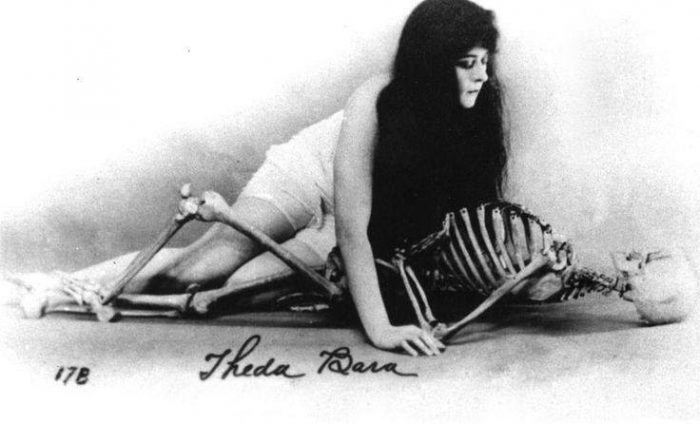
Bara revealed to a generation of moviegoers the sheer erotic power of cinema, an accomplishment you can glimpse in the clip above of 1915’s A Fool There Was, the picture that made her an icon. The minute she arrives on screen, writes The Guardian’s Kira Cochrane, “it becomes obvious why she was so popular — why she went on to have songs written about her, children named after her, a perfume and even a sandwich (minced ham, mayonnaise, sliced pimento and sweet pickles on toast — served warm) created in her honour.” Her face, though it may not seem so notable at first, soon “comes into its own — so much so that when you learn that her character’s malevolence has led one man to jail, another to beggary, and her most recent victim to a very public suicide, you believe it.”
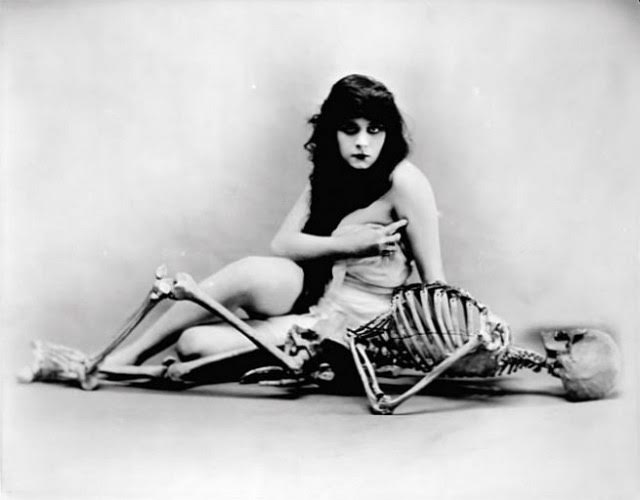
Frank Powell, director of A Fool There Was, “took a chance on a 29 year-old Theda (she lied and said she was 25)” by asking her to star, writes Messy Nessy’s Addison Nugent. “It’s the story of a devoted family man who, while on a ship to England, meets a beautiful stranger referred to only as ‘The Vampire Woman.’ This mysterious creature corrupts his soul, destroys his family, drains him of all of his money and dignity, and eventually causes his demise.”
And so the former Theodosia Goodman — with some assistance from Fox Studios’ PR team, who “planted false stories in the press and invented a fantasy backstory for her” — swiftly became a new kind of femme fatale for this new artistic and commercial medium. These dangerous young women, write the New York history podcasters the Bowery Boys, “were the spiritual children of the prior generation of newly empowered women who fought against the constraints of Victorian society. A few years later, as another vein of female power (the temperance movement) helped bring about Prohibition, these young women would be called flappers, carefree and fueled on the powers of jazz and illegal alcohol.”
During her dozen-year-long screen career, Bara made some forty films in total, most of them lost in the Fox vault fire of 1937, including the 1917 epic Cleopatra, a few fragments of which you can see in the video above. Her final appearance, in 1926’s Madame Mystery, both parodied the vamp image she could never quite shake and saw her bid farewell to the world of silent cinema. “Before pictures grew up and started to talk, we had to translate all our motion into pantomime,” said Bara herself in a later radio interview. “We had to express jealousy, hate, love, or devotion all in pantomime, and at the same time keep pace as the director guided us just as a metronome guides a pianist.”
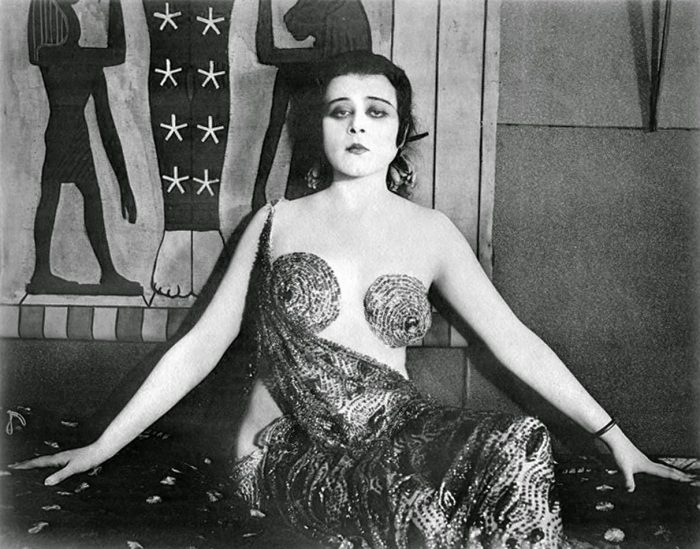
The vamp, as Bara played and defined the figure, expressed all those emotions with a fearsome vividness, and she “became so synonymous with the term that she is now referred to as the original on-screen vamp,” writes Cochrane, “the woman who made performances such as that of Louise Brooks in Pandora’s Box, Barbara Stanwyck in Double Indemnity and Linda Fiorentino in The Last Seduction possible.” Or as the original vamp summed up her own legacy, “To be good is to be forgotten. I’m going to be so bad I’ll always be remembered.”
A Fool There Was will be added to our collection, 4,000+ Free Movies Online: Great Classics, Indies, Noir, Westerns, Documentaries & More.
Related Content:
Watch After the Ball, the 1897 “Adult” Film by Pioneering Director Georges Méliès (Almost NSFW)
Brokeback Before Brokeback: The First Same-Sex Kiss in Cinema (1927)
Based in Seoul, Colin Marshall writes and broadcasts on cities and culture. He’s at work on a book about Los Angeles, A Los Angeles Primer, the video series The City in Cinema, the crowdfunded journalism project Where Is the City of the Future?, and the Los Angeles Review of Books’ Korea Blog. Follow him on Twitter at @colinmarshall or on Facebook.
Read More...Read Prince’s First Interview, Printed in His High School Newspaper (1976)
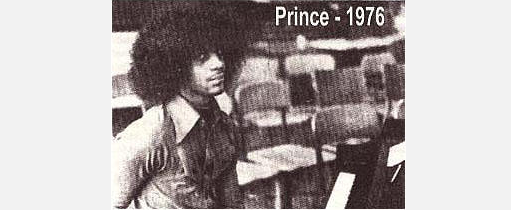
Two years before Prince released his first album For You and before he began his ascent into the funk-rock-pop pantheon, he was a very talented, very ambitious, and occasionally frustrated high school senior at Central High in Minneapolis. That’s where the school newspaper got him to sit for an interview, more of a character sketch, to talk about his hopes for a musical career. You can read it below.
If Prince was charismatic enough to be picked up on the high school paper’s radar, he doesn’t let it show in the article.
Mostly, he rues the location of his home town.
“I think it is very hard for a band to make it in this state, even if they’re good. Mainly because there aren’t any big record companies or studios in this state. I really feel that if we would have lived in Los Angeles or New York or some other big city, we would have gotten over by now.”
By the ‘80s, of course, he had made Minneapolis the center of his own musical empire, and Paisley Park became his home, compound, and music studio, the place where he would eventually pass away.
But he did like high school, according to him, because the music teachers let him do his own thing. Already a multi-instrumentalist, the article finds Prince just starting to explore singing. This might be the most surprising part of the piece. Prince’s range and the amount of character (and literally characters, male, female, or a mix) in his songs would lead you to believe that his voice came first.
Maybe some of the humility came from his status in the high school band. The name Grand Central was inspired by Prince’s obsession with Graham Central Station, whose bass player Larry Graham would later join Prince’s ‘90s band and also convert him to become a Jehovah’s Witness. Competing for attention was Morris Day and André Cymone, who Prince would write for and produce after he got his record contract. It was friendly but serious competition.
To round out the article, Prince—who plays by ear—gets asked if he has any advice for fellow students: “I advise anyone who wants to learn guitar to get a teacher unless they are very musically inclined. One should learn all their scales too. That is very important.”
You can read the full article below:
Nelson Finds It “Hard To Become Known”
“I play with Grand Central Corporation. I’ve been playing with them for two years,” Prince Nelson, senior at Central, said. Prince started playing piano at age seven and guitar when he got out of eighth grade.
Prince was born in Minneapolis. When asked, he said, “I was born here, unfortunately.” Why? “I think it is very hard for a band to make it in this state, even if they’re good. Mainly because there aren’t any big record companies or studios in this state. I really feel that if we would have lived in Los Angeles or New York or some other big city, we would have gotten over by now.”
He likes Central a great deal, because his music teachers let him work on his own. He now is working with Mr. Bickham, a music teacher at Central, but has been working with Mrs. Doepkes.
He plays several instruments, such as guitar, bass, all keyboards, and drums. He also sings sometimes, which he picked up recently. He played saxophone in seventh grade but gave it up. He regrets he did. He quit playing sax when school ended one summer. He never had time to practice sax anymore when he went back to school. He does not play in the school band. Why? “I really don’t have time to make the concerts.”
Prince has a brother that goes to Central whose name is Duane Nelson, who is more athletically enthusiastic. He plays on the basketball team and played on the football team. Duane is also a senior.
Prince plays by ear. “I’ve had about two lessons, but they didn’t help much. I think you’ll always be able to do what your ear tells you, so just think how great you’d be with lessons also,” he said.
“I advise anyone who wants to learn guitar to get a teacher unless they are very musically inclined. One should learn all their scales too. That is very important,” he continued.
Prince would also like to say that his band is in the process of recording an album containing songs they have composed. It should be released during the early part of the summer.
“Eventually I would like to go to college and start lessons again when I’m much older.”
via That Eric Alper
Related Content:
Hear Prince and Miles Davis’ Rarely-Heard Musical Collaborations
Prince Plays Mind-Blowing Guitar Solos On “While My Guitar Gently Weeps” and “American Woman”
Ted Mills is a freelance writer on the arts who currently hosts the FunkZone Podcast. You can also follow him on Twitter at @tedmills, read his other arts writing at tedmills.com and/or watch his films here.
Read More...Hear Jeremy Irons Read the Poetry of T.S. Eliot (Available for a Limited Time)
We may have come nearly to the end of January already, but we can still call 2017 a new year — at least until we’ve listened to the poetry of T.S. Eliot to properly ring it in. “There’s surely no better poet than Eliot to help us confront the problem of finding meaning in a world where old certainties are being troubled,” says Martha Kearney, host of BBC Radio 4’s New Year’s series celebrating his work.
“Our lives are so busy now that we need some help from the season to just take stock, both of where we’ve been and where we might like to go to,” says the first episode’s guest, novelist Jeanette Winterson. We need to inhabit “that inward moment that poetry’s so good at,” and that Eliot made entirely his own. The bulk of that broadcast comprises a reading of Eliot’s “The Love Song of J. Alfred Prufrock” by Jeremy Irons, surely one of the poet’s ideal living interpreters. (Note: you can stream all of the episodes in the series here.)
Irons reads more in the second, which includes a discussion with Winterson and Anthony Julius, Chair of Law and the Arts and University College London, about the opening of “Gerontion” and the “ugly references” made in Eliot’s other poems. The discussion in the third, in which Irons takes on Eliot’s immortal “The Waste Land,” looks for the source of the power of its “poetry of fragments” with former Archbishop of Canterbury Rowan Williams and Scots Makar (something like a Poet Laureate of Scotland) Jackie Kay.
“The Waste Land” continues as a subject in part four, as its guest, the actress Fiona Shaw, has drawn acclaim for her own reading of the poem, but the Irons section of the broadcast offers various other selections, including “The Hollow Men,” “Ash Wednesday,” and “Journey of the Magi.” Finally, in part five, Kearney and Rory Stewart, Member of Parliament and man of letters, talk about and hear Irons deliver Eliot’s “Four Quartets,” whose language Stewart memorized on a walk through Nepal and which he later used during his political campaign.
This poetic, conversational, and performative radio feast comes to nearly four hours (listen to all of the episodes here), but you’ve got only the next six days to stream it. Otherwise you’ll have to wait until Radio 4’s next, as yet announced calendar-appropriate celebration of Eliot. They’ve used his work to refresh audiences after a troubling year; perhaps they’ll use it again to get us through the cruelest month of this one.
Related Content:
Listen to T.S. Eliot Recite His Late Masterpiece, the Four Quartets
Bob Dylan Reads From T.S. Eliot’s Great Modernist Poem The Waste Land
Based in Seoul, Colin Marshall writes and broadcasts on cities and culture. He’s at work on a book about Los Angeles, A Los Angeles Primer, the video series The City in Cinema, the crowdfunded journalism project Where Is the City of the Future?, and the Los Angeles Review of Books’ Korea Blog. Follow him on Twitter at @colinmarshall or on Facebook.
Read More...George Orwell’s 1984 Is Now the #1 Bestselling Book on Amazon
George Orwell’s classic dystopian novel, 1984, has suddenly surged to the very top of the Amazon’s bestseller list. Though first published in 1949, it’s back with a vengeance. And George only has the new administration to thank.
We’ll have more on Orwell’s 1984 tomorrow. In the meantime, enjoy some great 1984 picks from our archive below:
George Orwell Explains in a Revealing 1944 Letter Why He’d Write 1984
A Complete Reading of George Orwell’s 1984: Aired on Pacifica Radio, 1975
Huxley to Orwell: My Hellish Vision of the Future is Better Than Yours (1949)
George Orwell’s Harrowing Race to Finish 1984 Before His Death
Note: You can download Orwell’s 1984 as a free audiobook (or two other books of your choice) if you sign up for Audible.com’s free trial program. Learn more about Audible’s free trial program here.
If you would like to support the mission of Open Culture, consider making a donation to our site. It’s hard to rely 100% on ads, and your contributions will help us continue providing the best free cultural and educational materials to learners everywhere. You can contribute through PayPal, Patreon, and Venmo (@openculture). Thanks!
Read More...Disco Demolition Night: Scenes from the Night Disco Died (or Did It?) at Chicago’s Comiskey Park, 1979
Surely you’ve heard of Disco Demolition Night, when Chicago DJ Steve Dahl invited listeners to the 1979 White Sox double header against the Tigers at Comiskey Park, offering tickets for .98 cents if they brought a disco record he could blow up between games. The event drew thousands more than Dahl expected, turned into a riot on the field, and has since passed into history for its rallying cry of “Disco sucks!” and its heralding of the end of disco’s reign.
Disco died at the end of the 70s, the story goes. But many music fans know differently. Disco didn’t die. It mutated, became House music, New Wave, and other hybrid genres. It made its way into the music of the Clash, Blondie, Michael Jackson, Madonna, and others. Nonetheless, Disco Demolition Night represented a widespread backlash that drove disco off the pop charts and back where it came from—the mostly black, Latino, and gay clubs in New York, Chicago, Detroit, and other cities.
Many people who have written histories of Disco Demolition have come to see it “as a not-so-subtle attack” against those groups of people, writes NPR, against “disco’s early adopters.” Dahl, who has co-authored his own book about the night, disagrees, but he admits that images of the event look “like a book burning.” Disco “obviously threatened a lot of rockers,” he concedes. Another witness to the event, an African-American usher named Vince Lawrence, saw evidence firsthand.
Lawrence—a disco fan and aspiring musician—tells the podcast Undone that he was actually looking forward to the event. He liked Dahl and “had strict intention of keeping records that were good that I didn’t have.” However, as he collected the records at the gate, he noticed among them Marvin Gaye and Stevie Wonder albums, “records that were black records,” he says, but not disco. He tells NPR, he saw “Curtis Mayfield records and Otis Clay records.… Records that were clearly not disco.” He balked, but was told he had to take them and issue tickets.
After Dahl rolled onto the field in a Jeep and blew up the dumpster full of records, chaos ensued, and the stunt turned into “this zany, real life slapstick routine,” says Undone’s host Pat Walters, “until all the sudden, it’s just not.” Rioters set a bonfire, stole the bases (literally), and became a raging mob. On his way out of the park, Lawrence was attacked by fans yelling “Disco Sucks!” and breaking records in his face.
Columnist Renee Graham, a gay woman of color who was a teenager at the time, recalls seeing photos of the event and being reminded of White Citizens Councils smashing rock and roll records because they brought white and black kids together. “This wasn’t just ‘We don’t like this music,’” she says, “this was ‘We don’t like these people who listen to this music.’” By 1979, however, “those people” included many of the same kids’ classmates, siblings, parents.… Disco had gone mainstream after Saturday Night Fever and the Bee Gees’ breakout. “It was almost like musical gentrification,” says Graham.
The Rolling Stones, Rod Stewart, Led Zeppelin, KISS—all of them appropriated disco. And the rock kids were furious. After the riot at Comiskey, “disco became a four-letter word.” Careers collapsed, radio stations changed format, record stores reordered, almost overnight. Had none of this happened, it’s possible disco would have fizzled out. Driven underground, back to its roots, it instead found new expression in the hands of pioneers like Chicago DJ Frankie Knuckles, the “Godfather of House,” and New York’s “Little” Louie Vega and Kenny “Dope” Ramirez.
Knuckles DJ’ed at Chicago club the Warehouse, which lent its name to the music—predominantly disco or disco inspired—he played. As house music evolved, “you could hear it fill in the space that disco had occupied,” says Walters. Vince Lawrence, too young to get into the Warehouse, began staging his own house parties, and these spread to cities all over the country, and eventually to Europe, where the music influenced bands like the Eurythmics and New Order, who discovered house on the Spanish island of Ibiza. Undone makes the case that Disco Demolition Night saved disco, in a way, so that it could emerge and influence many more appreciative crossover fans in the decades to come.
Related Content:
Disco Saves Lives: Give CPR to the The Beat of Bee Gees “Stayin’ Alive”
Saturday Night Fever: The (Fake) Magazine Story That Started it All
Josh Jones is a writer and musician based in Durham, NC. Follow him at @jdmagness
Read More...Download & Print Free Shepard Fairey Protest Posters

Shepard Fairey probably first crossed your radar when he drew the iconic “Hope” poster so associated with Barack Obama’s 2008 campaign. Now, he returns with another set of posters to help protest the inauguration of one Donald J. Trump. If you head over to the Amplifier Foundation web site, you can download and print a series of posters (shown above) by Fairey. The same applies to a number of posters designed by other artists, including Jessica Sabogal and Ernesto Yerena.
The images capture the “shared humanity of our diverse America” and condemn the exclusionary policies of the incoming administration. And thanks to the $1.3 million raised through a successful Kickstarter campaign, these posters will figure into a larger Inauguration Day plan. Here’s how it will work:
Much of Washington will be locked down on Inauguration Day, and in some areas there will be severe restrictions on signs and banners. But we’ve figured out a hack. It’s called the newspaper! On January 20th, if this campaign succeeds, we’re going to take out full-page ads in the Washington Post with these images, so that people across the capitol and across the country will be able to carry them into the streets, hang them in windows, or paste them on walls.
You’re welcome to print and post these posters around your town–wherever it’s legally permitted to do so. To download the posters, click here.
If you would like to support the mission of Open Culture, consider making a donation to our site. It’s hard to rely 100% on ads, and your contributions will help us continue providing the best free cultural and educational materials to learners everywhere. You can contribute through PayPal, Patreon, and Venmo (@openculture). Thanks!
Related Content:
2,200 Radical Political Posters Digitized: A New Archive
A Gallery of Visually Arresting Posters from the May 1968 Paris Uprising
Artist Shepard Fairey Curates His Favorite YouTube Videos
Google Puts Online 10,000 Works of Street Art from Across the Globe
Read More...
Jim Henson Creates an Experimental Animation Explaining How We Get Ideas (1966)
What do ideas look like?
Jim Henson’s looked very much like a Muppet nose, as evidenced by “The Idea Man,” a 1966 three-minute animation, above.
The film was originally intended to be part of a live multimedia performance on The Mike Douglas Show. The real star of that segment was Limbo, an abstract Muppet, whose physical manifestation was but a disembodied mouth and a pair of eyes, operated by two puppeteers.
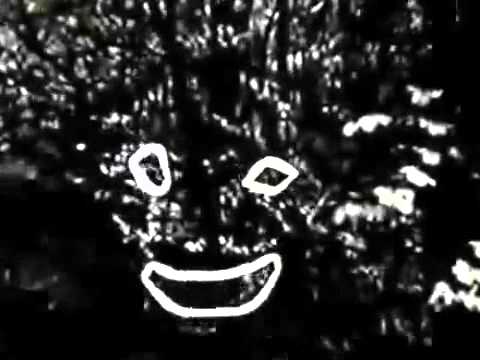
Henson favored the bodiless Limbo (who eventually morphed in Sesame Street’s Nobody) as a delivery mechanism for some of his more profound musings.
His vocal characterization imbued Limbo with a fairly Eeyore-ish outlook, though occasionally one catches an echo of Henson’s most famous creation—Kermit the Frog, making a brief, unbilled appearance, here, along with John F. Kennedy, Mad magazine’s Alfred E. Neuman, and Kukla of Kukla, Fran and Ollie.
Limbo, now just a disembodied voice as far as you and I are concerned, bemoans that all the really good ideas have already been taken—the safety pin, television, Atomic energy…
Eventually, though, he succumbs to the sort of excited curiosity that fired his creator, conceding the possibility of one “gloriously marvelous, great big beautiful idea,” visualized as the sort of giddy, collage pile-up beloved by Terry Gilliam.
Watch more of Henson’s experimental short films here.
“The Idea Man” will be added to the Animation section of our collection, 4,000+ Free Movies Online: Great Classics, Indies, Noir, Westerns, Documentaries & More.
Related Content:
Watch The Surreal 1960s Films and Commercials of Jim Henson
Jim Henson’s Violent Wilkins Coffee Commercials (1957–1961)
Ayun Halliday is an author, illustrator, theater maker and Chief Primatologist of the East Village Inky zine. Her play Zamboni Godot is opening in New York City in March 2017. Follow her @AyunHalliday.
Read More...Captivating GIFs Reveal the Magical Special Effects in Classic Silent Films
The early silent comedians were daredevils and masters of physical comedy, but they weren’t *that* crazy. In a series of gifs that show the secrets of silent filmmaking, the trickery behind some of silent cinema’s most impressive shots are revealed. The person behind these brief animations is a poster from Reddit called Auir2blaze.
Harold Lloyd did indeed hang from a clock face on the side of a building in his classic Safety Last! (watch the scene up top), but as the gif shows, a mattress was only a few feet below, safely out of shot. The angle of the camera, the editing that had gone before, and the actual city scene unfolding in the background all created the illusion that Lloyd was dangling many stories above Los Angeles.
Similarly, Charlie Chaplin rolling backwards on skates to the edge of a dangerous drop is magical…in that the magic lies in the excellent realistic matte painting work that replaced a floor with vertiginous open air.
As Auir2blaze explains, “The craziest thing about silent movie effects is that everything basically had to be done in camera. If you were filming multiple elements to create a complex shot that contained multiple elements and you messed up one part, the whole piece of film would be ruined.”
Which in turn makes these effects even more impressive. Not every special effect shot was a stunt. In another example, Auir2blaze shows how Mary Pickford (view on this page) was able to kiss her double on the cheek: They shot the actress sitting still, and projected the footage onto a screen cut out in the shape of the actress, which Pickford then kissed. One might say, “crude but effective” until you think about the delicacy needed to make the screen, and the brains behind these effects.
Many of these effects relied on large depth of field, which meant that sets and actors would have to be lit very brightly. In the world of film, camera lights can get very hot, and old movie sets must have been like ovens. (For more discussion and film tech geekery, the original Reddit page has many good threads.)
It shows that filmmaking has always been a magician’s art form, and that sometimes a practical effect can be worth 100 times a computer’s output.
via TwistedSifter
Related Content:
101 Free Silent Films: The Great Classics
The Power of Silent Movies, with The Artist Director Michel Hazanavicius
Three Great Films Starring Charlie Chaplin, the True Icon of Silent Comedy
Ted Mills is a freelance writer on the arts who currently hosts the FunkZone Podcast. You can also follow him on Twitter at @tedmills, read his other arts writing at tedmills.com and/or watch his films here.
Read More...Support Us
We're hoping to rely on loyal readers, rather than erratic ads. Please click the Donate button and support Open Culture. You can use Paypal, Venmo, Patreon, even Crypto! We thank you!

About Us

Open Culture scours the web for the best educational media. We find the free courses and audio books you need, the language lessons & educational videos you want, and plenty of enlightenment in between.
Advertise With Us

FREE UPDATES!
GET OUR DAILY EMAIL
Get the best cultural and educational resources on the web curated for you in a daily email. We never spam. Unsubscribe at any time.
FOLLOW ON SOCIAL MEDIA

Open Culture editor Dan Colman scours the web for the best educational media. He finds the free courses and audio books you need, the language lessons & movies you want, and plenty of enlightenment in between.
Advertise With Us


