Opposition Letter to Teach to One Signed by 180 Parents
December 7, 2016
Updated with additional signatures — December 16, 2016
Superintendent Ayindé Rudolph
Assistant Superintendent Cathy Baur
Mountain View Whisman School District
750‑A San Pierre Way
Mountain View, CA 94043–3133
Dear Superintendent Rudolph and Assistant Superintendent Baur:
We are the parents of current and incoming Graham and Crittenden sixth graders. After one trimester of the Teach to One (TTO) pilot, we have significant concerns with the program and its impact on our children as they prepare to enter the competitive high school environment. We recognize and praise the district for considering innovative ways to supplement student learning (Membeam, Lexia, Khan Academy). However, TTO does not appear to be serving our students as well as the traditional teacher-directed method.
We have found the TTO pilot to be ineffective in inspiring and encouraging our children. Living in Silicon Valley, we appreciate taking chances, examining impact and changing course if things are not working. After 3+ months of TTO, we feel that TTO is not the right solution for our students.
Overall, although laudable for its innovation, the TTO program is still under development and the kinks have not been worked out. Continuing to require the program, now that we have first-hand experience with the problems, would be a disservice to our children. We have fabulous, qualified and committed math teachers at Graham and Crittenden, and they should be permitted to teach our children, as they are trained to do. Online learning can be productive for extended learning, such as homework. But at this point, nothing matches the efficacy of a face-to-face student-teacher relationship in communicating complex and important materials. Students are not getting this from TTO in its current form. Some parents’ frustration has reached the point where they are now looking into other school options for seventh grade, which would be very unfortunate.
We understand that the district is currently evaluating TTO. With this letter, we respectfully ask that:
- TTO be discontinued for the spring 2017 trimester and thereafter.
- If the district wishes to continue with TTO, either:
- Make it optional for all students and provide a traditional teacher-led option for those who don’t wish to participate, or
- With the involvement of the parent community, restructure the program so that TTO is substantially minimized or limited to a subpopulation where it has proven to be beneficial.
- The district solicit parent feedback prior to implementing major curriculum changes going forward.
Below please find a list of items that summarize many parent concerns regarding the TTO program:
- The TTO curriculum does not follow a logical pathway, enabling students to build a strong math foundation. TTO removes the thoughtfulness behind math curriculum development, by presenting topics in an illogical and incoherent order. By jumping around among concepts, students fail to make connections between subject areas. Students may “pass” an Exit Slip without the opportunity to build mastery in core middle school math concepts. When topics jump around illogically, parents find themselves forced to teach earlier concepts to which the student was never exposed in order to assist with understanding the concepts at hand.
- Much of the instruction is quite shallow, in some cases even misleading and factually incorrect. Topics which would normally take days or even weeks of classroom instruction are sometimes completed in a single day. Further, this superficial exposure to math concepts will disadvantage all students. This will be especially evident when they join neighboring Los Altos middle school students in high school.
- With TTO, students are often tested on materials that they have never been taught, causing anxiety, frustration and dislike for math. In a time where we want to encourage students to build foundational skills for cutting edge STEM fields, TTO seems to be affecting student attitudes toward math and problem solving. Many parents report a striking change in their child’s attitude toward math this year. The students generally have very positive feedback about math teachers at Graham and Crittenden, but many students hate TTO and now dislike math.
- TTO does not support the Common Core curriculum, where student understanding is based on how the student arrived at a solution, not the final answer alone. With TTO, students choose a multiple choice answer without ever showing their work. This will not prepare them for high school math or advanced math classes, where the final answer just represents a fraction of the overall process.
- One benefit of the TTO program touted by the district is that “The program will reduce the time teachers dedicate to student assessments and allow more direct instructional time with students.” In fact, the students have little contact with teachers. With the Emotional Intelligence aspect of learning, students benefit from positive reinforcement of a teacher, especially in math where they have to push a little harder to get to a solution. Assigning more growth mindset videos is not a solution to overcoming frustration and encouraging perseverance. Furthermore, teachers appear to serve an administrative function, affording little instruction time. The few teacher-led sessions are degraded, as teachers must figure out their lessons with little advanced notice based on what TTO provides.
- The program doesn’t educate students or parents about what level of math skills the students are working on, so we have no idea if they are working at a fifth grade level or an eighth grade level.
- Parents and staff have identified multiple and pervasive errors throughout the TTO materials including: mistakes in answers, illogical questions, link errors, etc. The instructional material is often confusing and of poor quality. This is further complicated by the fact that there is no textbook, so when a student struggles with concept in the homework, they are left to looking for answers online.
- The TTO homework algorithm seems to be flawed. Sometimes students receive homework that is misaligned with their playlist. Other times the homework either too advanced or too simplistic for the student.
- While we are prepared to support our students in math, TTO requires too much parent involvement. Many parents spend significant time at home providing math instruction because there is no textbook and because there are few in-class teaching sessions by math teachers. Many parents have hired tutors to make up for the lack of teacher-student interaction. This is unfair to both the parents and teachers. Many families lack the academic or financial means to provide this extracurricular support to their students. Graham and Crittenden have excellent math teachers who are passionate about teaching math. Further, performance results may be flawed in favor of TTO as a result of parents providing daily direct instruction and/or tutoring to supplement TTO’s deficiencies.
- The lack of textbook and complete dependence on the internet interferes with math study in the classroom. Glitches in the system/Internet mean that students often miss instructional time, are unable to complete their Exit Slip, or are late to their next class. Not only does this compromise time in math class, but this affects learning in other subject areas. Unfortunately this has happened quite a few times to many of our children.
- Small group collaboration seems to be ineffective at this stage. One child likened this to practicing a complex piano piece without an instructor–you practice and practice, and when you meet your teacher, you realize you learned it incorrectly and must now unlearn what you taught yourself. Without the foundational skills, it is inefficient for a group of students to work out a problem without teacher guidance or foundation. Further, at this age, some students goof off and interfere with others’ ability to learn. The lack of teacher support makes this a constant problem.
Thank you very much for your consideration.
Sincerely,
Signature of 180 parents
Read More...Watch Orson Welles’ First Ever Film, Directed at Age 19
“It’s nothing at all. Absolutely nothing. It was a joke. I wanted to make a parody of Jean Cocteau’s first film. That’s all. We shot it in two hours, for fun, one Sunday afternoon. It has no sort of meaning.”–Orson Welles
The Hearts of Age may have indeed been a lark when it was shot in 1934, but given that one of the two teenagers went on to direct Citizen Kane seven years later, no doubt it’s worth a second look.
Like all things Welles, his 19-year-old life was much more fantastic than most high school grads. Though he and school chum William Vance shot the film at their alma mater, the Todd School in Woodstock, Illinois, Welles had graduated three years earlier. According to Senses of Cinema, Welles
had spurned a scholarship to Harvard University, visited Ireland on a sketching tour only to talk his way into performing for the Dublin Gate Theatre, written detective stories for pulp magazines, and travelled through London, Paris, the Ivory Coast, Morocco and Seville, where he spent an afternoon as a professional bullfighter. After returning to America in 1933, introductions to Thornton Wilder and Alexander Wolcott led to a position in Katherine Cornell’s touring repertory company. Welles toured with the Cornell company from November 1933 to June 1934, appearing in three plays and making his New York debut as Tybalt in Romeo and Juliet.
Back in Woodstock to sponsor a theater festival at the school, Welles and Vance borrowed a camera from their old principal and shot this eight minute short.
William Vance, Welles’ friend and co-director, kept the only copy until he donated it to the Greenwich Public Library, where film historian and writer Joseph McBride discovered it in 1969. McBride then wrote about it in Film Quarterly and the secret juvenilia of Welles was out of the closet. (“Why did Joe have to discover that film?” Welles was quoted as telling his cameraman).
Never entered into copyright, it’s a public domain film and so has been available on various platforms for years. (I saw it in the ‘90s as part of a “before they were famous” short film festival with student work by Lynch, Scorsese, and Spielberg).
The short indeed looks like a parody of surrealist film, a bit like Jean Cocteau’s Blood of a Poet as Welles intended, but with a bit of René Clair’s Entr’Acte and some good ol’ Eisensteinian montage thrown in.
Welles appears in heavy stage makeup as a rich, older man in a top hat and cane, looking not too far from the elderly Charles Foster Kane. His then girlfriend and future first wife Virginia Nicholson plays an old hag who rides forlornly back and forth on a bell. There’s a clown in blackface played by Paul Edgerton, an Indian in a blanket (co-director William Vance in a cameo) and a Keystone cop, which some websites say is also Nicholson. But Charles “Blackie” O’Neal is also credited as a performer without a role and he indeed may be the actor playing the Keystone Cop. (O’Neal, by the way, would later be father to Ryan O’Neal.)
Although he dismissed the film, Welles’ preoccupations with death are here, right at the beginning of his career, with suicides, coffins, skulls, and gravestones featuring prominently. And though it’s no masterpiece and honestly a bit of a mess, it shows a director interested in experimenting with film, with humor, and the wonders of makeup.
Related Content:
Ted Mills is a freelance writer on the arts who currently hosts the artist interview-based FunkZone Podcast. You can also follow him on Twitter at @tedmills, read his other arts writing at tedmills.com and/or watch his films here.
Read More...Download 20 Free eBooks on Design from O’Reilly Media

A quick note: Thanks to O’Reilly Media, you can now download 20 free ebooks focused on design–everything from Designing for Cities, to Designing for the Internet of Things, to Design Essentials. You can download the books in PDF format. No credit card is required. See the complete list here.
If you would like to support the mission of Open Culture, consider making a donation to our site. It’s hard to rely 100% on ads, and your contributions will help us continue providing the best free cultural and educational materials to learners everywhere. You can contribute through PayPal, Patreon, and Venmo (@openculture). Thanks!
Read More...Watch Japanese Woodworking Masters Create Elegant & Elaborate Geometric Patterns with Wood
A friend recently told me he’d had his hair cut with a pair of $10,000 scissors, reputedly the highest-quality in the world. He hardly needed to add that his barber ordered them from Japan, the land where those truly dedicated to their craft spare no expense of money, time, or energy to take each small step closer to perfection. The rigorous traditions behind that extend far back into history, especially in the making of paper, swords, and, as you can see in the video above, marquetry, patterned veneers which use wood — and only wood — to create elegant and elaborate geometric patterns to apply to the surfaces of all sorts of objects: artistic, functional, and anywhere in between.
In 2012 and 2013, Gucci Japan went around filming the world of masters of traditional arts and crafts all around the country and assembling them into the video series “Hand,” some of which we featured here last year.
Its four-minute short on marquetry, as practiced by Noboru Honma of Hakone, has especially dazzled its viewers by revealing how almost unreal-looking aesthetic precision can result from one man’s work with nothing more than saws, sanders, and woods of various natural colors. These woods, which include cherry, dogwood, ash, mulberry, and camphor, can make about 60 different canonical patterns combinable in an infinitude of ways.
You can learn more about traditional Japanese marquetry, or yosegi-zaiku, in the Technigeek video above. It pays a visit to another woodshop, not far from Honma’s in the neighboring city of Odawara. (Both Odawara and Hakone are located in Kanagawa Prefecture, an area known for its woods.) Kiyotaki Tsuyuki, the craftsman in charge, works with a group of younger yosegi practitioners with the aim of pushing the form’s boundaries and keeping it relevant to the times. “Yosegi is about beauty, the detail in the pattern, and the colors,” he says. “It’s about design, using it in your daily life, or enjoying it as art. If it’s fun to look at and easy to use on any occasion, you’re more likely to love it and enjoy being around it.” Especially if you understand the work — and in some sense, centuries of work — that went into it.
Related content:
20 Mesmerizing Videos of Japanese Artisans Creating Traditional Handicrafts
How Japanese Things Are Made in 309 Videos: Bamboo Tea Whisks, Hina Dolls, Steel Balls & More
The Making of Japanese Handmade Paper: A Short Film Documents an 800-Year-Old Tradition
Watch a Japanese Craftsman Lovingly Bring a Tattered Old Book Back to Near Mint Condition
Japanese Craftsman Spends His Life Trying to Recreate a Thousand-Year-Old Sword
Based in Seoul, Colin Marshall writes and broadcasts on cities and culture. He’s at work on a book about Los Angeles, A Los Angeles Primer, the video series The City in Cinema, the crowdfunded journalism project Where Is the City of the Future?, and the Los Angeles Review of Books’ Korea Blog. Follow him on Twitter at @colinmarshall or on Facebook.
Read More...
Carrie Fisher’s Long Career as a Writer, Screenwriter, and Hollywood Fixer: “I’m a Writer” First and Foremost
By now the news of Carrie Fisher’s death has hit hard all over the world. It’s true that for an entire generation of people, her breakout role at 19 as Princess Leia in the original Star Wars trilogy has made her a sci-fi icon and a childhood crush—both roles she longed to escape. Tribute after tribute on social media and elsewhere reminded us almost immediately after Tuesday’s announcement that her life and work have had a much wider impact, even on people who have never even seen a Star Wars film.
Fisher’s unabashedly candid public conversations about her personal struggles with substance abuse and bipolar disorder made her a powerful advocate for others who felt ashamed to talk about these too-often-taboo subjects and often too ashamed to seek help. Much like George Michael, another celebrity mourned by millions this holiday season, Fisher refused to be shamed into silence or to capitulate to bullies and bigots. Instead she practically bloomed with earthy charm and wit as she co-opted tabloid character assassination and turned it into her own form of autobiographical art and therapeutic outreach.
Her return to the rebooted Star Wars franchise last year as the wise, aging General Leia Organa elevated the conversation about older women in Hollywood, after her response to some vicious comments about her looks made her haters look small, mean, and stunted. Fisher’s talent for Oscar Wilde-worthy aphorisms that sliced right through layers of insufferable bullshit also led to one of her most successful career stints, as a writer, script doctor, and Hollywood fixer during a “long, very lucrative episode,” as she told Newsweek in a 2008 interview. (In true Carrie Fisher fashion, she brought these life experiences to an Emmy-nominated guest turn on an episode of 30 Rock as her funniest character, Rosemary Howard.)
It’s rumored that Fisher revised her lines in George Lucas’ notoriously wordy Star Wars scripts. (Although one image of Empire Strikes Back edits purported to be in her hand actually contains revisions by the film’s director Irvin Kershner.) But her formal screenwriting career began in 1990, when she adapted her bestselling 1987 autobiographical novel, Postcards from the Edge, into the screenplay for a Meryl Streep-starring film. The project led to rewriting work on high-profile comedies throughout the next decade. In addition to a credit for one of those unwieldy Lucas scripts for The Phantom Menace in 1999, Fisher helped rework films like Hook, Sister Act, Made in America, So I Married an Axe Murderer, The Wedding Singer, and several more.
Always a fiercely outspoken critic of the way Hollywood treats women, Fisher fought to make female characters more three-dimensional. In a WebMD interview, she was asked, “What does it take to heal bad dialogue?” Her pithy answer: “Make the women smarter and the love scenes better.” As a peacemaker for troubled productions, however, she often advised women actors to use diplomacy—with her own spin on the concept. When Whoopi Goldberg feuded with Disney’s Jeffrey Katzenberg, for example, Fisher advised, “Send Jeffrey a hatchet and say, ‘Please bury this on both our behalfs.’” Goldberg thought it over, and “the next day Katzenberg received his hatchet. Within a few days a token of Katzenberg’s respect arrived at her front door: two enormous brass balls.”
Stories like this one, and many more uproarious and often personally self-destructive episodes, formed the basis for Fisher’s autobiographical bestsellers, including her memoir Wishful Drinking, which also became a one-woman Broadway show, then an HBO special (see an excerpt at the top). She has always won over critics as an actress, and she made a wry kind of peace with her eternal fame as Princess Leia, imbuing the character with renewed gravitas and sensitivity in the year before her death. But she did not see herself principally as an actress. “I’m a writer,” she told WebMD. Asked whom she’d choose to share “confined quarters” with from history, she answered—with her winning combination of disarming sincerity and winking self-awareness—“Samuel Taylor Coleridge. He was manic-depressive, too.”
Related Content:
Watch a Young Carrie Fisher (RIP) Audition for Star Wars (1975)
Watch the Very First Trailers for Star Wars, The Empire Strikes Back & Return of the Jedi (1976–83)
Josh Jones is a writer and musician based in Durham, NC. Follow him at @jdmagness
Read More...Stephen King Explains the Key to His Creativity: Not Losing the Dream-State Thinking All Children Are Born With
While nothing could make me personally want to return to childhood, children do, for better or for worse, perceive the world more vividly than adults. The best writing for kids makes rich narrative use of that fact, as do stories about but not for kids by writers who haven’t forgotten their pre-grown-up selves’ experience of reality. Stephen King, for instance, hardly writes children’s literature, but his novels about the fear that seeps into every corner of working-class America often include very young characters. Not only does King write plausibly from their psychological point of view, he uses that point of view as an engine of his entire project.
King, in a 1989 interview on WAMC’s Public Radio Book Show, elaborated on “the two things that interest me about childhood,” the first being that “it’s a secret world that exists by its own rules and lives in its own culture, and the second that “we forget what it is to be a child and we forget that life, which is kind of exotic and strange.” Though readers often ask him what agonies his childhood must have visited upon him that spurred him to write such vividly horrific fiction, King doesn’t remember anything wrong with his formative years. But he does remember “that we think in a different way as children. We tend to think around corners instead of in straight lines.”
We see these differences animated in the Blank on Blank video at the top of the post, which envisions the adult King in the world of imagination that kids instinctively inhabit and out of which they eventually grow, but to which he regularly returns to write his stories. “Sometimes for a kid, the shortest distance between two points is not a straight line and that’s the way that we think and dream,” he says. “As children we tend to live in this kind of dream state [ … ] and because I equate that sort of dream state with a heightened sort of mental state, I make this easy cross-connection between childhood and strange powers, paranormal powers or whatever, and it has been successful as a fictional device.”
As the source of such bestsellers as Carrie, The Stand, Christine, It, the Dark Tower series, and countless other works, it’s been successful to say the least. If connecting one thing to another in new ways — be those things people, places, events, ideas, feelings, or whatever else — constitutes the central act of creation, then it makes sense that the naturally associative nature of a child’s imagination, harnessed to an adult’s experience and discipline, can produce such abundant and widely resonant results. No coincidence, surely, that youngsters unable to pay attention to the linear progression of the classroom get labeled “dreamers,” a tendency that King has used to his advantage — though he seems to have got most of his textual mileage out of the nightmares.
Related Content:
Stephen King’s Top 20 Rules for Writers
Stephen King Writes A Letter to His 16-Year-Old Self: “Stay Away from Recreational Drugs”
Based in Seoul, Colin Marshall writes and broadcasts on cities and culture. He’s at work on a book about Los Angeles, A Los Angeles Primer, the video series The City in Cinema, the crowdfunded journalism project Where Is the City of the Future?, and the Los Angeles Review of Books’ Korea Blog. Follow him on Twitter at @colinmarshall or on Facebook.
Read More...How the Films of Hayao Miyazaki Work Their Animated Magic, Explained in 4 Video Essays
Last week we featured a video that convincingly places the characters of Hayao Miyazaki and his Studio Ghibli’s animated films into real life-settings. It juxtaposed two very different kinds of reality, the concrete three-dimensional one in which we live and the fantastical two-dimensional one those characters inhabit, in the process demonstrating that both somehow carry an equal weight. How, then, do these most respected of all animators so consistently pull it off, creating realistic worlds through an inherently unrealistic medium? In “The Immersive Realism of Studio Ghibli,” the video essay just above, Asher Isbrucker addresses that very question, looking into the nuts and bolts of their animation techniques as well as, through Miyazaki’s own words, what we might call their animation philosophy.
Studio Ghibli has stayed (at the very least) a cut above other animators not just by virtue of their expertise at creating convincing physical worlds — whether or not their physics aligns with that of our own — but at creating convincing emotional worlds, populated with characters full of desires and contradictions of their own. In “Hayao Miyazaki — The Essence of Humanity,” which Ayun Halliday wrote up here last year, video essayist Lewis Bond of Channel Criswell examines Miyazaki’s “approach to animated filmmaking that concentrates on the emotional intricacies of his subjects, as opposed to creating — ironically — cartoony characters,” resulting in animated films that don’t speak down to children but “help us all further understand the human condition.”
Once you start seriously trying to answer the question of what makes a Nausicaä of the Valley of the Wind or a My Neighbor Totoro or a Spirited Away so captivating, an abundance of reasons occur. Just above in “Hayao Miyazaki: What You Can Imagine,” JD Thompson identifies the power of imagination that animates, literally and figuratively, all of Ghibli’s movies. Below in “Hayao Miyazaki — Everything by Hand,” the video essayist RC Anime considers the sheer amount of labor that goes into work that flies under the flag of “one of the hardest-working anime directors,” and how it ultimately delivers more impact with simple gestures than other high-profile pieces of animation do with extended action set pieces.
All these video essays touch on one especially important part of Miyazaki’s creative process: he begins making a film not with a script to be strictly adhered to, but with a series of sketches and storyboards. During the long and arduous course of production, the story can thus change to suit the needs of the characters, their emotions, and the worlds imagined around them. This primacy of the image makes sense for a creator like Miyazaki, who began with the childhood dream of becoming a comic artist, and who during his periodic “retirements” returns his focus to that much simpler medium. He has, in fact, just emerged from the latest such retirement and gotten to work on another animated feature, as revealed in a television documentary on his life and work appropriately titled Owaranai Hito — “The Man Who Doesn’t Stop.”
Related Content:
Watch Hayao Miyazaki Animate the Final Shot of His Final Feature Film, The Wind Rises
Software Used by Hayao Miyazaki’s Animation Studio Becomes Open Source & Free to Download
Watch Hayao Miyazaki’s Beloved Characters Enter the Real World
Based in Seoul, Colin Marshall writes and broadcasts on cities and culture. He’s at work on a book about Los Angeles, A Los Angeles Primer, the video series The City in Cinema, the crowdfunded journalism project Where Is the City of the Future?, and the Los Angeles Review of Books’ Korea Blog. Follow him on Twitter at @colinmarshall or on Facebook.
Read More...David Bowie Sends a Christmas Greeting in the Voice of Elvis Presley
After David Bowie died earlier this year, we discovered that the musician had a knack for doing impressions of fellow celebrities. Could he sing a song in the style of Iggy Pop, Lou Reed, Tom Waits, and Bruce Springsteen? Turns out, he could. And yes, he could do an Elvis impression too.
The clip above aired back in 2013 on “This Is Radio Clash,” a radio show hosted by the Clash’s Mick Jones, Paul Simonon and Topper Headon. “Hello everybody,” this is David Bowie making a telephone call from the US of A. At this time of the year I can’t help but remember my British-ness and all the jolly British folk, so here’s to you and have yourselves a Merry little Christmas and a Happy New Year. Thank you very much.”
It’s maybe not as memorable as his 1977 Christmas duet with Bing Crosby, but, hey, it’s still a fun little way to get the holiday season in swing.
If you would like to support the mission of Open Culture, consider making a donation to our site. It’s hard to rely 100% on ads, and your contributions will help us continue providing the best free cultural and educational materials to learners everywhere. You can contribute through PayPal, Patreon, and Venmo (@openculture). Thanks!
Related Content:
Ricky Gervais Creates Outlandish Comedy with David Bowie
David Bowie & Bing Crosby Sing “The Little Drummer Boy” (1977)
Read More...
Hear “Twas The Night Before Christmas” Read by Stephen Fry & John Cleese
You have to hand it to the English: they know how to do Christmas right. Maybe it has to do with their respect for tradition, maybe with their sense of occasion, maybe with their aptitude for pageantry, and maybe with their compulsion, for all that, not to take anything too seriously. It helps that they also produce performers of the highest caliber, especially of the oratorical variety: Monty Python’s John Cleese, for instance, or man of letters and all-around entertaining personality Stephen Fry. And so today, with its titular eve nearly here, we give you both of those Englishmen’s renditions of “ ‘Twas the Night Before Christmas.”
Fry’s reading at the top of the post, which comes with orchestral backing, adheres closely to Clement Clarke Moore’s original 1823 text. The poem, for those who’ve never spent Christmas in an English-speaking country, tells of a father awakened in the middle of the night by none other than Santa Claus, come to deliver his family’s presents. More recently, Fry narrated another story of Santa Claus in “Santa Forgot,” an animated promotional video for Alzheimer’s Research UK that uses the beloved figure glimpsed so vividly in Moore’s poem to raise awareness of dementia and the research dedicated to curing it.
In his reading of “ ‘Twas The Night Before Christmas” just above, John Cleese modernizes the story, freighting it with references to safety belts, flat-screen televisions, and Apple computers — and ending with Santa Claus captured by the father: “So he now lives with us, locked up in the cellar. We go down each day to see the old fellow and get our new presents. And we ate the reindeer, so we’re sorry but Christmas is canceled next year.” Cleese has a tendency to display such irreverence to the holiday. “So sad to see u end with a tirade against Christmas,” tweeted someone who’d attended a live show of his and Eric Idle’s last month in Arizona. “Not against Christmas,” Cleese fired back, “against its commercial exploitation. Big difference, which the rest of the audience understood.”
Nothing like a bracing shot of English wit to treat an overdose of commercialism, especially of the powerful American variety. But for all the mastery of Christmas on the other side of the pond, Clarke Moore, an American, defined the very character of Santa Claus in the popular imagination — a spry old gentleman with rose-like cheeks and a cherry-line nose, a beard “as white as the snow,” and “a little round belly that shook when he laughed, like a bowlful of jelly.” “ ‘Twas the Night Before Christmas,” originally titled “A Visit from Saint Nicholas,” remains quite possibly the best-known poem ever written by an American. But wherever in the world one reads them, Santa Claus’ final words, and the poem’s, still resonate: “Happy Christmas to all, and to all a good-night!”
Related Content:
Bob Dylan Reads “‘Twas the Night Before Christmas” On His Holiday Radio Show (2006)
“Werner Herzog” Reads ‘Twas The Night Before Christmas”
Impressionist Reads ‘Twas The Night Before Christmas in Celebrity Voices
Based in Seoul, Colin Marshall writes and broadcasts on cities and culture. He’s at work on a book about Los Angeles, A Los Angeles Primer, the video series The City in Cinema, the crowdfunded journalism project Where Is the City of the Future?, and the Los Angeles Review of Books’ Korea Blog. Follow him on Twitter at @colinmarshall or on Facebook.
Read More...75 Years of CIA Maps Now Declassified & Made Available Online
Satellite-connected devices do all the hard work of navigation for us: plan journeys, plot distances, tell us where we are and where we’re going. The age of the highly skilled cartographer may be coming to an end. But in the past few hundred years—since European states began carving the world between them—the winners of colonial contests, World War battles, and Cold War skirmishes were often those who had the best maps. In addition to their indispensable role in seafaring and battle strategy, “good maps,” writes Danny Lewis at Smithsonian, have been “an integral part of the tradecraft of espionage.”
The CIA will tell you as much… or they will now, at least, since they’ve declassified decades of once-secret maps from the days when they “relied on geographers and cartographers for planning and executing operations around the world” rather than on “digital mapping technologies and satellite images.”
Now celebrating its 75th anniversary, the CIA’s Cartography Center boasts of “a long, proud history of service to the Intelligence Community,” at the Agency’s friendly website; “Since 1941, the Cartography Center maps have told the stories of post-WWII reconstruction, the Suez crisis, the Cuban Missile crisis, the Falklands War, and many other important events in history.”
Whatever noble or nefarious roles the Agency may have played in these and hundreds of other events, we can now see–thanks to this new online gallery at Flickr–what presidents, Directors, and field agents saw when they planned their actions, beginning with the country’s first “non-departmental intelligence organization,” the COI (Office of the Coordinator of Information). Once the U.S. entered WWII, it became the Office of Strategic Services (OSS). The Cartography Center’s first chief, Arthur Robinson, was only 26 and a graduate student in geography when COI director William Donovan recruited him to lead the organization. The office rapidly expanded during the war, and by 1943, “geographers and cartographers amassed what would be the largest collection of maps in the world.”
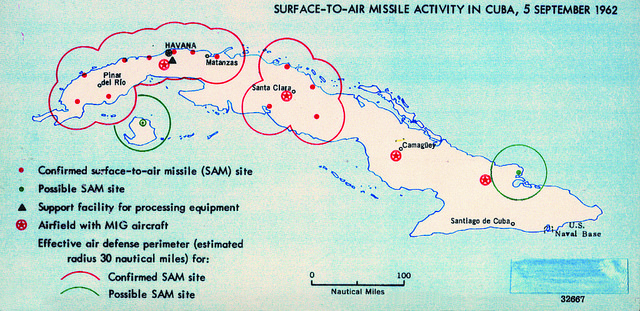
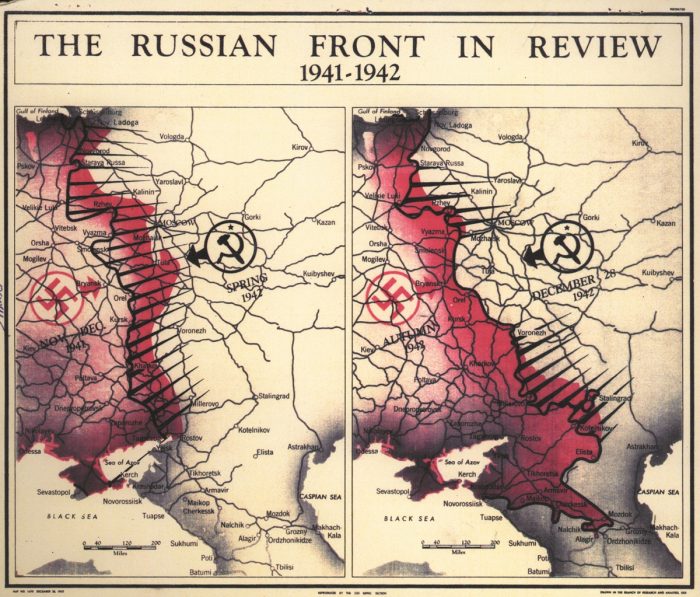
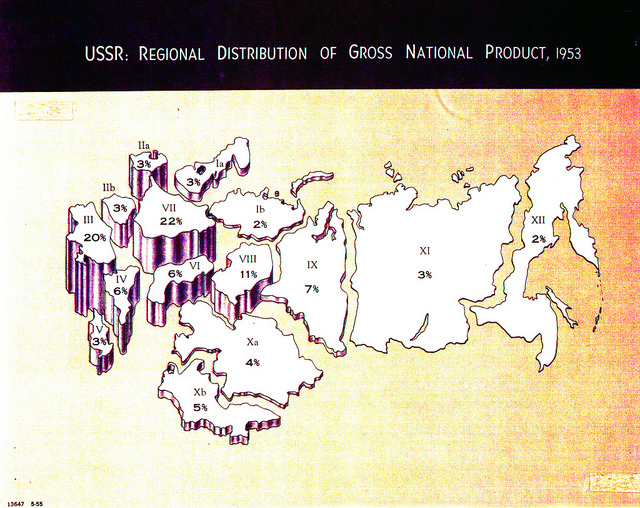
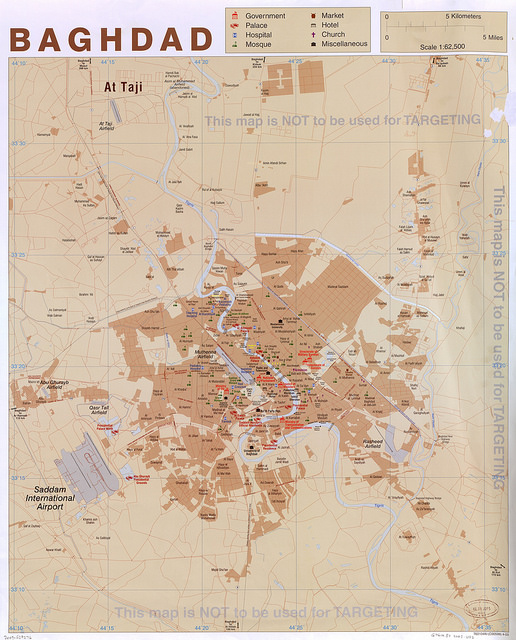
In the early forties, “map layers were drafted by hand using pen and ink on translucent acetate sheets mounted on large Strathmore boards.” These drafts were typically four times larger than the printed maps themselves, one of which you can see at the top of the post, “The Russian Front in Review.” In the fifties, “improved efficiency in map compilation and construction” produced visually striking documents like that further up from 1955, “USSR: Regional Distribution of Gross National Product.” Not a map, but what we would call an infographic, this image shows how the Cartography Center performed services far in excess of the usual map app—visualizing threats to the U.S. from Cuban surface-to-air missile sites in 1962 (above) and threats to the African elephant population from poachers in 2013 (below). Further down, you can see a 2003 map of Baghdad, with the ominously non-threatening note printed at the top and right, “This map is NOT to be used for TARGETING.”

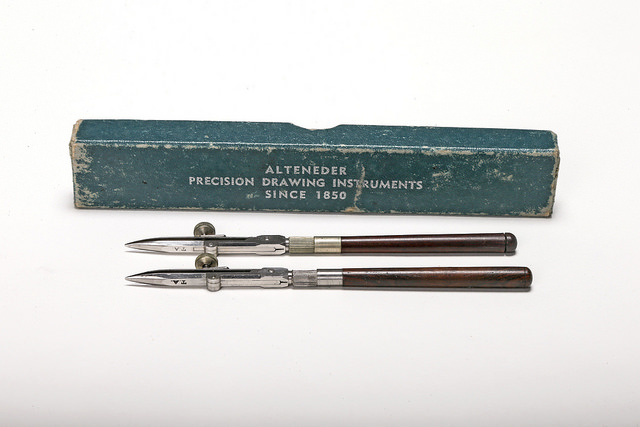
These maps and many more can be found at the CIA Cartography Flickr account, which has a category for each decade since the 1940s. Each map is downloadable in low to high resolution scans. In addition, one category, “Cartography Tools,” features high-quality photography of vintage draughtsman’s instruments, all of them, like the German-made ink pens further down, symbols of the painstaking handicraft mapmaking once required. While we can probably draw any number of political lessons or historical theses from a deep analysis of this deep state archive, what it seems to ask of us first and foremost is that we consider cartography as not only a useful discipline but as a fine art.
As the Cartography Center’s first director put it, “a map should be aesthetically pleasing, thought-provoking, and communicative.” Given these standards we might see how current technology, for all its tremendous ease of use and undeniable utility, might improve by looking to maps of the past. Visit the CIA’s flickr gallery here.
via Smithsonian
Related Content:
New York Public Library Puts 20,000 Hi-Res Maps Online & Makes Them Free to Download and Use
19th Century Maps Visualize Measles in America Before the Miracle of Vaccines
Josh Jones is a writer and musician based in Durham, NC. Follow him at @jdmagness
Read More...Support Us
We're hoping to rely on loyal readers, rather than erratic ads. Please click the Donate button and support Open Culture. You can use Paypal, Venmo, Patreon, even Crypto! We thank you!

About Us

Open Culture scours the web for the best educational media. We find the free courses and audio books you need, the language lessons & educational videos you want, and plenty of enlightenment in between.
Advertise With Us

FREE UPDATES!
GET OUR DAILY EMAIL
Get the best cultural and educational resources on the web curated for you in a daily email. We never spam. Unsubscribe at any time.
FOLLOW ON SOCIAL MEDIA

Open Culture editor Dan Colman scours the web for the best educational media. He finds the free courses and audio books you need, the language lessons & movies you want, and plenty of enlightenment in between.
Advertise With Us

