Neil Gaiman Reads Edgar Allan Poe’s “The Raven”: One Master of Dramatic Storytelling Reads Another
Which living writer stands as the heir to Edgar Allan Poe? A silly question, admittedly: now, more than 160 years after his death, Poe’s influence has spread so far and wide throughout literature that no one writer’s work could possibly count as his definitive continuation. The most popular and powerful modern storytellers owe more than a thing or two to Poe — or rather, have built upon Poe’s achievements — without even knowing it, especially if they hail from a different part of the world and work a different part of the cultural map than did 19th-century America’s pioneer of new and psychologically intense genre literature.
Take, for instance, Neil Gaiman. “Every year, Worldbuilders holds a giant auction-charity-donation thing, giving people cool things and raising an awful lot of money for a fantastic cause,” he says in the video above, which came out just this holiday season. “And every year, I seem to be reading a poem or book chosen by the people who pay money to Worldbuilders.
This year, for reasons known only to themselves, they have decided I need to read Edgar Allan Poe’s ghastly, gruesome, dark, and famous poem ‘The Raven.’ So I’ve lit a number of candles, fired up the fire, found a copy of the Oxford Book of Narrative Verse, and I’m going to read it to you in a comfortable chair by the fire, as befits a poem told in the days of yore.”
Though many of his fans come to know him through his novels like American Gods and Stardust, Gaiman’s writing career has also included work in poetry, comic books, radio drama, and movies, all of it using his signature mix of fantastical invention, resonant emotion, and polished, witty wordcraft. When potential collaborators on projects in these fields and others want to work with him, they want to tap not just his uncommon storytelling skill, regardless of the medium in which he tells his stories, but his ability to satisfy both wide audiences and critics with those stories.
Poe, too, knew how to do this, and indeed described “The Raven” in a magazine essay as a work deliberately composed to “suit at once the popular and the critical taste,” and since its first publication in 1845, the poem has only grown better-known and more beloved. Here, in Neil Gaiman’s ten-minute reading, we can see and hear one master of high-impact storytelling acknowledging another over all those 171 years.
Gaiman’s reading will be added to our collection, 1,000 Free Audio Books: Download Great Books for Free.
Related Content:
The Great Stan Lee Reads Edgar Allan Poe’s “The Raven”
James Earl Jones Reads Edgar Allan Poe’s “The Raven” and Walt Whitman’s “Song of Myself”
Lou Reed Rewrites Edgar Allan Poe’s “The Raven.” See Readings by Reed and Willem Dafoe
John Astin, From The Addams Family, Recites “The Raven” as Edgar Allan Poe
Based in Seoul, Colin Marshall writes and broadcasts on cities and culture. He’s at work on a book about Los Angeles, A Los Angeles Primer, the video series The City in Cinema, the crowdfunded journalism project Where Is the City of the Future?, and the Los Angeles Review of Books’ Korea Blog. Follow him on Twitter at @colinmarshall or on Facebook.
Read More...Watch Hayao Miyazaki’s Beloved Characters Enter the Real World
Beautiful backgrounds are a staple of director Hayao Miyazaki’s animated features. Whether depicting a whimsical European village, a massive traditional bathhouse complex populated by ghosts, or a rainy bus stop in suburban Tokyo, they come to the fore in the quiet moments for which this director is also deservedly celebrated.
Given the reverence this old-fashioned artistry has inspired, it was particularly audacious of Korean filmmaker Kojer to separate some of Miyazaki’s best known characters from their hand-painted habitats, via a painstaking Rotoscoping procedure.
Their liberation was short lived, given that Kojer’s interest lay in transposing them onto live action approximations of the Studio Ghibli originals.
Shot primarily in South Korea, the new settings, above, are uncanny doppelgängers, following some vigorous Photoshopping. One wonders if Kojer experienced any regret, several hundred hours into this masochistic assignment. So many challenges—from shadows to lighting to cloudy skies in need of altering, frame by painstaking frame. The obstacles posed by semi-transparent characters such as Spirited Away’s No Face sound positively unearthly.
Clearly a labor of love from an artist whose most high profile work seems to be a webseries starring his own hand. His quest took him to Provence Village in Paju, South Korea and Seoul’s Olympic Park. He rode the #4 line subway to the end of the line and the #2 to Seokchon Lake where the American art collective FriendswithYou’s Super Moon project floated earlier this year.
The result—some of it some shot out a car window and corrected in Adobe’s Warp Stabilizer—is set to the tune of “One Summer’s Day” from Spirited Away.
Lovely.
Related Content:
Software Used by Hayao Miyazaki’s Animation Studio Becomes Open Source & Free to Download
The Simpsons Pay Wonderful Tribute to the Anime of Hayao Miyazaki
Ayun Halliday is an author, illustrator, theater maker and Chief Primatologist of the East Village Inky zine. Her play Zamboni Godot is opening in New York City in March 2017. Follow her @AyunHalliday.
Read More...Bill Gates Lists His Favorite Books of 2016
Bill Gates has apparently been a big reader all along, even during his Microsoft days. On his site, Gates Notes, he writes, “I’ve been reading about a book a week on average since I was a kid. Even when my schedule is out of control, I carve out a lot of time for reading.” And periodically he publishes a list of his favorite reads.
He continues: “If you’re looking for a book to enjoy over the holidays, here are some of my favorites from this year. They cover an eclectic mix of topics—from tennis to tennis shoes, genomics to great leadership. They’re all very well written, and they all dropped me down a rabbit hole of unexpected insights and pleasures.”
The list includes String Theory by David Foster Wallace; The Gene: An Intimate History by Siddhartha Mukherjee; The Myth of the Strong Leader: Political Leadership in the Modern Age by Archie Brown; The Grid by Gretchen Bakke, and Shoe Dog by Phil Knight.
Head to Gates Notes to find out what particularly made each book near and dear to his heart.
If you would like to support the mission of Open Culture, consider making a donation to our site. It’s hard to rely 100% on ads, and your contributions will help us continue providing the best free cultural and educational materials to learners everywhere. You can contribute through PayPal, Patreon, and Venmo (@openculture). Thanks!
Related Content:
Take Big History: A Free Short Course on 13.8 Billion Years of History, Funded by Bill Gates
Read More...The Late Alan Thicke Hosts a Twin Peaks Behind-the-Scenes Special (1990)
When Alan Thicke died this week, he died a true man of television. His more than forty-year career saw him not just star in the hit ABC sitcom Growing Pains but host game, talk, and dance shows as well as compose the theme songs for Diff’rent Strokes and The Facts of Life. His final tweet praised the new season of the Netflix reboot of Full House (Growing Pains’ near-contemporary) on which he made a guest appearance. But he didn’t live exclusively in the mainstream: in September of 1990, he confessed — on national television, of course — his love of David Lynch and Mark Frost’s boundary-pushing, reality bending mystery series Twin Peaks.
“Every decade has its TV cult,” says Thicke, opening this ABC season-preview special from the Universal Studios lot. “Now, I was never a Trekkie myself, but I do confess, I am a Peaker.” A fair few viewers across America could, at that moment, say the same, since enthusiasm for the show peaked, as it were, around the end of its first season and the beginning of its second, the premiere of which the network put together this segment to hype (alongside the debut of Cop Rock, the non-ironic police-procedural/musical). “There’s so much more to Twin Peaks than a riveting murder mystery,” Thicke continues. “There’s a whole look and a feel and a texture,” an experience “180 degrees away from anything else on television.”
These fifteen minutes include brief conversations with Twin Peaks’ creators and collaborators. “It needed to be away from the regular world and be a kind of a hair of a dream spot,” says Lynch, somewhat cryptically, “and it needed a woods that had a wind of a mystery, you know, blowing through it.” Kyle MacLachlan, who starred as FBI Special Agent Dale Cooper, offers further insight into the show’s appeal: “The people don’t… they don’t behave normally.” It also includes Sheryl Lee, who played the murdered homecoming queen Laura Palmer, reading from the character’s “secret diary… her real diary.”
Using a map of the eponymous small Washington town, Thicke attempts to catch those who missed all or part of Twin Peaks’ first season up on its many plot threads, all directly or indirectly related to the question of who killed Laura Palmer. That central mystery would drive the plot all the way up to the middle of the second season, and its resolution resulted in declining ratings and eventual cancellation. But as we learned with from the collection of video essays we featured yesterday, the work of David Lynch is built on a foundation not of plot, but of pure images and sounds.
That so many more of us now understand that has placed us well to enjoy Twin Peaks’ long-awaited third season. Set to premiere next year on Showtime, it has, like Full House — two shows seldom compared to one another — transposed its core concepts from the realm of 20th-century network television into that of 21st-century specialty television. “Revisiting all this territory, there’s a freshness to it, there’s a lightness to it,” says MacLachlan in the new behind-the-scenes teaser above. Encouraging words, but one hopes above all that the project retains the animating creative tension expressed a quarter-century ago, when Thicke asked how thought-out the show really was: “Not too thought-out,” insisted Lynch. “Very thought-out,” insisted Frost.
Related Content:
Play the Twin Peaks Video Game: Retro Fun for David Lynch Fans
David Lynch Draws a Map of Twin Peaks (to Help Pitch the Show to ABC)
Angelo Badalamenti Reveals How He and David Lynch Composed the Twin Peaks‘ “Love Theme”
Hear the Music of David Lynch’s Twin Peaks Played by the Danish National Symphony Orchestra
David Lynch’s Twin Peaks Title Sequence, Recreated in an Adorable Paper Animation
Twin Peaks Tarot Cards Now Available as 78-Card Deck
Based in Seoul, Colin Marshall writes and broadcasts on cities and culture. He’s at work on a book about Los Angeles, A Los Angeles Primer, the video series The City in Cinema, the crowdfunded journalism project Where Is the City of the Future?, and the Los Angeles Review of Books’ Korea Blog. Follow him on Twitter at @colinmarshall or on Facebook.
Read More...Techie Working at Home Creates Bigger Archive of Historical Newspapers (37 Million Pages) Than the Library of Congress
“Real news, fake news, who cares, it’s all the same, am I right?”
… Not to make light of an existential crisis in journalism and the public trust—a disturbing development. Cynicism threatens to erode the very foundations of… well, ring your own alarm bell. Perhaps it’s time we (re)drew some hard lines around what we mean by the word “news.”
How to do that? I leave it to the experts—professors of journalism, reporters and archivists and historians who do the hard work of constructing genealogies and taxonomies of news, discovering its mutations and dead ends.
Journalism libraries around the country fulfill the needs of these scholars, as does the Library of Congress. But if you really want to dig into a comprehensive collection—one that bests even the august Federal government library (sort of)—you’ll need to visit the website of one Tom Tryniski, private citizen, retired “computer expert,” writes Jim Epstein at Reason, and dedicated amateur, “working alone.”
This being Reason, the preserve of “free minds and free markets,” you can expect a good bit of crowing about the entrepreneurial spirit of Tryniski’s accomplishment—an archive of 37,439,000 historic newspaper pages from the U.S. and Canada, “orders of magnitude bigger and more popular than one created by a federal bureaucracy with millions of dollars to spend.” The video above says it succinctly in a tagline: “Amateur beats gov’t at digitizing newspapers.”
Should you take an interest in what Tryniski—the sole employee of Old Fulton New York Postcards—spends, Epstein provides a full accounting of the site’s impressively meager operating budget. Should you wonder where the LoC’s money goes, and why it uses so many more resources than one retiree, you may wish to do your own comparison between Tryniski’s site and the Feds’ online news archive, Chronicling America. (And maybe pay their place a visit in the flesh.) There’s more to a library than numbers of pages and views.
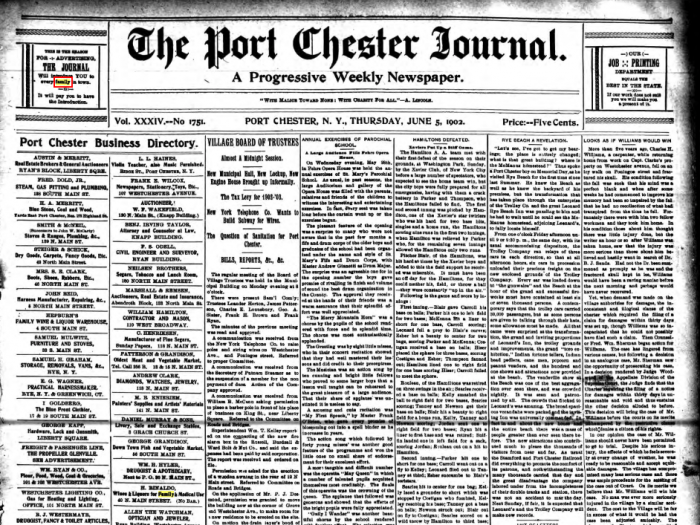
In some ways, it’s not a fair comparison. Tryniski may be a computer expert, but he’s not a web designer (or he’s an ornery, old-school purist). His site (last updated in 2014), with its frames and heavy use of Flash and GIFs, reflects the web’s anarchic 90s heyday. And where the LoC’s site chronicles all of America, Tryniski’s mostly sticks to New York, with local papers like The Port Chester Journal (above) represented heavily.
That said, the site’s search functions are much cooler than those of glossier competitors, with options for “fuzzy searching,” “phonic searching” (for those of us who can’t spell), “and “user-defined synonyms.” Tryniski also knows his way around microfilm and a microfilm scanner, despite (we’re expressly told for some reason in the video and Epstein’s article) his being “a high school graduate.”
In this triumph of the everyman story, however, Tryniski does not introduce his own collection with fulminations of the “old man shakes fist at” variety. Instead he describes his collection as a means of time travel. “It’s the day-to-day life,” he says, “that you could not imagine today. Reading the actual newspaper seems to bring it back into current context. People… sit there and it’s like, they move back into that time, and it’s like they’re living in the same time as their grandparents and great-grandparents.”
Nobody needs to fix journalism, libraries, or federal spending to have this experience, and it’s one everyone should have—whether by traveling through the pages of old newspapers or a family trove of photos and letters. History can seem like little more than a story we tell ourselves about the past, but the primary documents have tales to tell that we could never imagine.
Learn more about Tryniski’s collection at Reason, and visit the quirky, deceptively fulsome Old Fulton NY Post Cards (named as such because the site began as a scanned collection of postcards from Tryniski’s hometown of Fulton, NY). You’ll find in its charmingly clunky environs a fascinating repository of vintage news and photos. And remember, “If you did not read about it on Old Fulton NY Post Cards, IT DID NOT HAPPEN!!!”
Related Content:
From the Annals of Optimism: The Newspaper Industry in 1981 Imagines its Digital Future
Archive of Hemingway’s Newspaper Reporting Reveals Novelist in the Making
Josh Jones is a writer and musician based in Durham, NC. Follow him at @jdmagness
Read More...Patti Smith Sings Bob Dylan’s “A Hard Rains Gonna Fall” at Nobel Prize Ceremony & Gets a Case of the Nerves
Bob Dylan didn’t make the trip to Stockholm to accept his Nobel Prize in Literature. Instead, Patti Smith went on his behalf and performed a cover of his 1963 classic, “A Hard Rain’s A‑Gonna Fall.” And midway through a beautiful performance, she simply forgot the words, paused, and said, “I apologize. I’m sorry, I’m so nervous,” and asked to start the section of the song again. Which she did.
The lyrics for “A Hard Rain’s A‑Gonna Fall” are difficult, by no means easy to remember. Add a case of nerves (which can beset even the most experienced musician) and you have the makings for a very human moment. Watch the video the whole way through. It’s touching on many levels.
You can read the text of Bob Dylan’s acceptance speech, presented by the US Ambassador to Sweden, here. And if you’re wondering why Dylan won the Nobel Prize in Literature in the first place, you can pick up his handsome, new book, The Lyrics: 1961–2012.
If you would like to support the mission of Open Culture, consider making a donation to our site. It’s hard to rely 100% on ads, and your contributions will help us continue providing the best free cultural and educational materials to learners everywhere. You can contribute through PayPal, Patreon, and Venmo (@openculture). Thanks!
Related Content:
Patti Smith’s List of Favorite Books: Camus, Shakespeare, Woolf, Wilde & More
Patti Smith’s Cover of Nirvana’s “Smells Like Teen Spirit” Strips the Song Down to its Heart
Patti Smith Reads Her Final Words to Robert Mapplethorpe
Read More...A Complete Reading of George Orwell’s 1984: Aired on Pacifica Radio, 1975
“It was a bright cold day in April, and the clocks were striking thirteen.” Thus, with one of the best-known opening sentences in all English literature, begins George Orwell’s 1984, the novel that even 67 years after its publication remains perhaps the most oft-referenced vision of totalitarianism’s takeover of the modern Western world. Its fable-like power has, in fact, only intensified over the decades, which have seen it adapted into various forms for film, television, the stage (David Bowie even dreamed of putting on a 1984 musical), and, most often, the radio.
In recent years we’ve featured radio productions of 1984 from 1949, 1953, and 1965. On their program From the Vault, the Pacifica Radio network has just finished bringing out of the archives their own 1975 broadcast of the novel as read by morning-show host Charles Morgan.
Neither an all-out radio drama nor a straight-ahead audiobook-style reading, Pacifica’s 1984 uses sound effects and voice acting (some contributed by June Foray, of Rocky and Bullwinkle fame) to tell the story of Winston Smith and his inner and outer struggle with the repressive, all-seeing, language-distorting government of the superstate of Oceania (and the city of Airstrip One, formerly known as England) that surrounds him.
It makes sense that Pacifica would put the whole of Orwell’s dire novelistic warning on the airwaves. Founded just after World War II by a group of former conscientious objectors, its first station, KPFA in Berkeley, California, began broadcasting in the year of 1984’s publication. As it grew over subsequent decades, the listener-funded Pacifica radio network gained a reputation for both its political engagement and its unconventional uses of the medium. (The Firesign Theater, the troupe that arguably perfected the art of the dense, multi-layered studio comedy album, got their start at Pacifica’s Los Angeles station KPFK.) Every era, it seems, produces its own 1984, and this one sounds as resonant in the 21st century — a time even Orwell dared not imagine — as it must have in the 1970s.
You can hear Part 1 of Pacifica’s 1984 at the top of the post, then follow these links to all ten parts on their Soundcloud page: Part 1, Part 2, Part 3, Part 4, Part 5, Part 6, Part 7, Part 8, Part 9, Part 10, Part 11, Part 12, Part 13.
Related Content:
Hear a Radio Drama of George Orwell’s 1984, Starring Patrick Troughton, of Doctor Who Fame (1965)
George Orwell’s 1984 Staged as an Opera: Watch Scenes from the 2005 Production in London
George Orwell Explains in a Revealing 1944 Letter Why He’d Write 1984
Based in Seoul, Colin Marshall writes and broadcasts on cities and culture. He’s at work on a book about Los Angeles, A Los Angeles Primer, the video series The City in Cinema, the crowdfunded journalism project Where Is the City of the Future?, and the Los Angeles Review of Books’ Korea Blog. Follow him on Twitter at @colinmarshall or on Facebook.
Read More...Tim Robbins’ Improv Classes Transform Prisoners’ Lives & Lower Recidivism Rates
If a 20‑something, Yale-educated New Yorker reporter feels nervous stepping in to her first ever improv class, imagine the stakes for your average inmate, whose survival depends on a successfully monolithic projection of toughness and control.
Control is actually something the Actors’ Gang Prison Project seeks to cultivate in its incarcerated participants. The Actors’ Gang’s Artistic Director, Tim Robbins, who founded the radically experimental ensemble fresh out of college, notes a well-documented connection between an inability to control one’s emotions and criminal activity.
Unchecked rage may have put these players behind bars, but exploring a wide variety of emotions behind the safety of the Actors’ Gang’s mask-like white pancake make-up has proven liberating.
The dull prison routine leaves prisoners favorably inclined toward any diverting activity, particularly those that allow for creative expression. Shakespeare has made an impact on this population. Why not commedia dell’arte-influenced improv?
It’s a truly therapeutic fit, as Actors Gang ensemble member Sabra Williams, the founder of the Prison Project, explains in her TED Talk, below.
Participants are subjected and held to the rigorous physicality and emotional honesty at the core of this group’s aesthetic. Personal connection to the visitors is limited to whatever may transpire in-the-moment, but within the prison population, relationships blossom. Both guards and prisoners speak of newfound empathy.
The emotional insights arising from these spontaneous explorations teach participants how to diffuse aggressive situations, present a more positive face to the world, and interact generously with others. In between classes, participants write in journals, with a goal of sharing aloud.
Gang signs, mimed weapons, and bodily contact are out of bounds. Wild invention often carries the day.
Participants have zero recidivism, and a waiting list in the hundreds attests to the program’s popularity.
You can learn more about the Actors’ Gang ten-year-old Prison Project here.
Related Content:
B.B. King Plays Live at Sing Sing Prison in One of His Greatest Performances (1972)
Inmates in New York Prison Defeat Harvard’s Debate Team: A Look Inside the Bard Prison Initiative
What Prisoners Ate at Alcatraz in 1946: A Vintage Prison Menu
Ayun Halliday is an author, illustrator, theater maker and Chief Primatologist of the East Village Inky zine. Her play Zamboni Godot is opening in New York City in March 2017. Follow her @AyunHalliday.
Read More...All of Wes Anderson’s Cinematic Commercials: Watch His Spots for Prada, American Express, H&M & More
They say a filmmaker qualifies as an auteur if you can identify their work from any given shot. That might strike even cinephiles as a difficult task unless the filmmaker in question is Wes Anderson, who for twenty years’ worth of feature films now has defined and refined a cinematic style increasingly unique to him and his host of regular collaborators. What qualities constitute the unmistakably Andersonian? Vibrant colors, especially red and yellow. Old buildings. Uniforms. The sounds of the British Invasion. Perfect symmetry. The technology of the mid-twentieth-century as well as vintage American and European design of that era. An eye for the imagined past as well as the past’s imagined future (and its use of Futura). And of course, Bill Murray.
Anderson has used different combinations of these and other aesthetic choices not just in all his full-length films from Bottle Rocket to The Grand Budapest Hotel, but also in his commercials. Given the uncompromising look and feel of his “real” filmography as well as its overall success at the box office, one might not at first imagine Anderson as the kind of auteur with the need, desire, or even ability to make advertisements.
But make them he does, an aspect of his career that actually began with a self-parodying 2004 American Express commercial starring the director himself, hard at work on his latest, albeit fictional, quiet spectacle of meticulousness and anachronism (which also has explosions).
Ever the throwback, Anderson next shot a commercial for Japan, that land where, in the days before Youtube, so many American celebrities used to go to cash in on their image unbeknownst to their Western public. Specifically, he shot it for the Japanese telecommunications giant Softbank, casting Brad Pitt as a Jacques Tati-style vacationer, good-natured if bumbling and possessed of an eye for the ladies, in the French countryside. Two years later, he and frequent writing partner Roman Coppola returned to his beloved early 1960s for Apartomatic, a spot for Stella Artois (a brand that has also employed the likes of Wim Wenders) that brings to life every young man’s fantasy of the ultimate automated bachelor pad.
In 2012, Modern Life and Talk To My Car, a pair of thirty-second commercials for a new Hyundai sedan, brought Anderson back into the present. Naturally, he delivered a present deeply rooted in the dreams of decades past, which, when the idea is to sell a product as saturated with the mythology of the postwar years as an automobile, does the job ideally. “After months of creative development on the new Hyundai Azera we were almost out of time to produce the launch spots,” writes creative director Robert Prins. “At the last minute someone suggested asking Wes Anderson to direct. We all laughed. Then he said yes.” Imagine the resulting jealousy in the conference rooms of ad agencies all over the world, where the talk constantly references Anderson’s work without ever touching the genuine article.
The following year, we featured Castello Cavalcanti, Anderson’s eight-minute short film starring Jason Schwartzman (who became an Anderson regular, and a star in his own right, in Rushmore fifteen years earlier) as a race car driver who crashes into a strangely familiar village somewhere in 1955 Italy. He shot it at Rome’s legendary Cinecittà studio at the behest of a certain Italian brand called Prada (perhaps you’ve heard of them) and in collaboration with Coppola also put together Prada: Candy, a series of three somewhat more straightforward commercials embedded as a playlist just above. Set in France this time, they tell the Jules and Jim-esque story of twin brothers vying for the attention of the same girl, a blonde bon viveuse who happens to have the same name — and if you believe the marketing, the same personality — as Prada’s fragrance.
Just yesterday we featured Come Together, Anderson’s latest commercial directorial effort with Adrien Brody playing the dedicated conductor of a badly delayed passenger train on Christmas Eve. Though it ostensibly comes as nothing more than a promotion for fast-fashion retailer H&M, thousands of fans have already thrilled to this new glimpse into Anderson’s world — a make-believe one, but “we are all make-believe, too, every one of us,” as GQ’s Chris Heath puts it, “each self-assembled from a hotchpotch of dreams and experiences and wishes and ambitions and setbacks (and, yes, what we buy and what we say and what we wear and the way we choose to wear it, and all the rest of it).” Anderson himself might well agree. But when, we all wonder, will a brand come his way worthy of a commercial starring Bill Murray?
Related Content:
Has Wes Anderson Sold Out? Can He Sell Out? Critics Take Up the Debate
A Complete Collection of Wes Anderson Video Essays
Watch the Coen Brothers’ TV Commercials: Swiss Cigarettes, Gap Jeans, Taxes & Clean Coal
Fellini’s Fantastic TV Commercials
David Lynch’s Surreal Commercials
Jean-Luc Godard’s After-Shave Commercial for Schick
Based in Seoul, Colin Marshall writes and broadcasts on cities and culture. He’s at work on a book about Los Angeles, A Los Angeles Primer, the video series The City in Cinema, the crowdfunded journalism project Where Is the City of the Future?, and the Los Angeles Review of Books’ Korea Blog. Follow him on Twitter at @colinmarshall or on Facebook.
Read More...Richard Feynman’s Poignant Letter to His Departed Wife Arline: Watch Actor Oscar Isaac Read It Live Onstage
Media vita in morte sumus, goes the medieval line of poetry that lent the English Book of Common Prayer its most memorable expression: “In the midst of life we are in death.” The remainder of the poem extrapolates a theology from this observation, something one can only take on faith. But whatever way we dress up the mystery of death, it remains ever-present and inevitable. Yet we might think of the motto as a palindrome: In the midst of death, we are in life. The dead remain with us, for as long as we live and remember them. This is also a mystery.
Even theoretical physicists must confront the presence of the departed, and few scientists—few writers—have done so with as much poignancy, directness, eloquence, and humor as Richard Feynman, in a letter to his wife Arline written over a year after she died of tuberculosis at age 25. Feynman, himself only 28 years old at the time, sealed the letter, written in 1946, until his own death in 1988. “Please excuse my not mailing this,” he wrote with bitter humor in the postscript, “but I don’t know your new address.” Even in the midst of his profound grief, Feynman’s wit sparkles. It is not a performance for us, his posthumous readers. It is simply the way he had always written—in letter after letter—to Arline.
In the video above, Oscar Isaac, who has embodied many a wisecracking romantic, gives voice to the longing and pain of Feynman’s letter, in which the physicist confesses, “I thought there was no sense to writing.” Somehow, he could not help but do so, ending with starkly ambivalent truths he was unable to reconcile with what he colloquially calls his “realistic” nature: “You only are left to me. You are real.… I love my wife. My wife is dead.” Read the full letter below, via Letters of Note. For more from their Letters Live series, see Benedict Cumberbatch read Kurt Vonnegut’s letter to the school that banned his novel Slaughterhouse Five.
October 17, 1946
D’Arline,
I adore you, sweetheart.
I know how much you like to hear that — but I don’t only write it because you like it — I write it because it makes me warm all over inside to write it to you.
It is such a terribly long time since I last wrote to you — almost two years but I know you’ll excuse me because you understand how I am, stubborn and realistic; and I thought there was no sense to writing.
But now I know my darling wife that it is right to do what I have delayed in doing, and that I have done so much in the past. I want to tell you I love you. I want to love you. I always will love you.
I find it hard to understand in my mind what it means to love you after you are dead — but I still want to comfort and take care of you — and I want you to love me and care for me. I want to have problems to discuss with you — I want to do little projects with you. I never thought until just now that we can do that. What should we do. We started to learn to make clothes together — or learn Chinese — or getting a movie projector. Can’t I do something now? No. I am alone without you and you were the “idea-woman” and general instigator of all our wild adventures.
When you were sick you worried because you could not give me something that you wanted to and thought I needed. You needn’t have worried. Just as I told you then there was no real need because I loved you in so many ways so much. And now it is clearly even more true — you can give me nothing now yet I love you so that you stand in my way of loving anyone else — but I want you to stand there. You, dead, are so much better than anyone else alive.
I know you will assure me that I am foolish and that you want me to have full happiness and don’t want to be in my way. I’ll bet you are surprised that I don’t even have a girlfriend (except you, sweetheart) after two years. But you can’t help it, darling, nor can I — I don’t understand it, for I have met many girls and very nice ones and I don’t want to remain alone — but in two or three meetings they all seem ashes.
You only are left to me. You are real.
My darling wife, I do adore you.
I love my wife. My wife is dead.
Rich.
PS Please excuse my not mailing this — but I don’t know your new address
Related Content:
Richard Feynman Creates a Simple Method for Telling Science From Pseudoscience (1966)
Read More...
Support Us
We're hoping to rely on loyal readers, rather than erratic ads. Please click the Donate button and support Open Culture. You can use Paypal, Venmo, Patreon, even Crypto! We thank you!

About Us

Open Culture scours the web for the best educational media. We find the free courses and audio books you need, the language lessons & educational videos you want, and plenty of enlightenment in between.
Advertise With Us

FREE UPDATES!
GET OUR DAILY EMAIL
Get the best cultural and educational resources on the web curated for you in a daily email. We never spam. Unsubscribe at any time.
FOLLOW ON SOCIAL MEDIA

Open Culture editor Dan Colman scours the web for the best educational media. He finds the free courses and audio books you need, the language lessons & movies you want, and plenty of enlightenment in between.
Advertise With Us

