What’s the Deal with Pop Tarts? Jerry Seinfeld Explains How to Write a Joke
This week The New York Times Magazine published a story titled “Jerry Seinfeld Intends to Die Standing Up,” filling us in on what the comedian has been up to in the 14 years since Seinfeld, the sitcom that seemed to define the ’90s, went off the air. As Jonah Weiner explains, Seinfeld has been “living the life of a road comic, albeit one who sells out 20,000-seat London arenas and schleps to gigs via chartered planes rather than rented subcompacts.”
Despite his great wealth, Seinfeld has chosen to devote part of almost every week since 2000 (two years after the end of the TV show) to doing stand-up comedy. At 58, Seinfeld remains fully committed to the craft of telling jokes to a roomful of strangers. As he tells Weiner, he sees himself more as an exacting athlete than a tortured artist. “I’m not filling a deep emotional hole here,” Seinfeld says. “I’m playing a very difficult game, and if you’d like to see someone who’s very good at a difficult game, that’s what I do.”
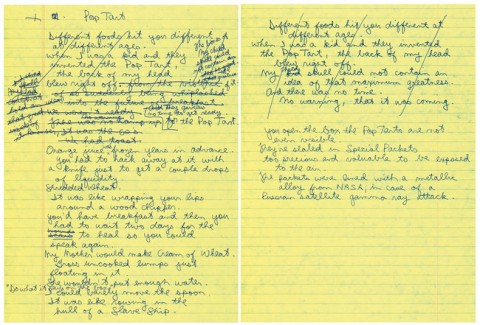
And if you’d like to learn a little about how the game of stand-up comedy is played, the Times has posted this interesting five-minute video in which Seinfeld explains the evolution of a joke, from simple childhood observation to carefully thought-out gag. “Whereas most comedians are lazy bastards,” Sarah Silverman says of Seinfeld, “he’s the ultimate craftsman.”
Related content:
Comedians in Cars Getting Coffee: Jerry Seinfeld’s New Series Debuts on the Web
Read More...Google Digitizes Ancient Copies of the Ten Commandments and Genesis
If digital technology poses any threat to the market for words printed on real paper—and the jury is still out on that one—then it must also be credited for exposing us to texts from the ancient world.
Last fall we posted about how the Israel Museum digitized the Dead Sea Scrolls, nearly 1,000 texts found on the northwest shore of the Dead Sea in 1946. They are the earliest known surviving manuscripts from what is called the Hebrew Bible. Digitizing the texts—most were on parchment but some were written on bronze or papyrus—allows viewers to zoom in to examine the writing and even the paper fibers of hundreds of fragments.
Now the Israel Antiquities Authority has expanded upon the collection. Housed in the Leon Levy Dead Sea Scrolls Digital Library are the earliest known copies of the Book of Deuteronomy (which includes the Ten Commandments) and Chapter One of the Book of Genesis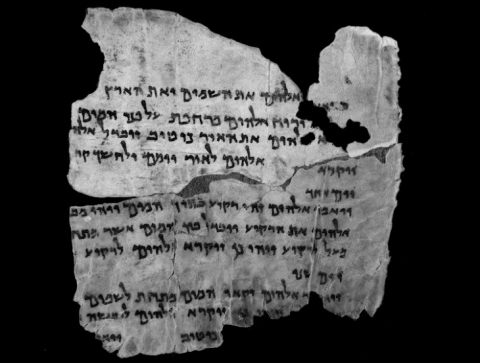 .
Each scroll fragment was scanned using spectral imaging technology that allows for the recovery of writing that had faded to near invisibility over the years. The boon for scholars is clear, but for regular folks this archive is better than a museum visit. The Leon Levy site is searchable by discovery site, content and ancient language.
Google is making its mark as a major facilitator of cultural preservation. Another recent project with ties to ancient texts and history is Caminos de Sefarad, a collaboration with Red de Juderías de España to create a digital map of Spain’s Jewish heritage.
 More than 500 landmarks from the Sefarad—the Sephardic Jews before they were expelled from Spain and Portugal in 1492—are fully annotated with current photos, text and special details. Visit Ribadavia, a once-prosperous city in Spain’s northwest mountains, and learn about Jewish wedding traditions from the Middle Ages. The Jewish Quarter of Léon is called the Barrio Húmedo (Wet District) and is known today for its fine wine and food. Use the timeline to keep yourself oriented in chronological history and click Street View to see this vibrant district as it is today.
Kate Rix writes about digital media and education. Read more of her work at and thenifty.blogspot.com.
Read More...NASA Presents “The Earth as Art” in a Free eBook and Free iPad App

In 1960, NASA put its first “Earth-observing environmental satellite” into orbit, and, ever since, these satellites have let us observe the dynamics of our planet in a new way. They can tell us all about changing weather patterns, the impact of climate change, what’s happening in the oceans, the coastlines, rivers and more.
The satellites have also demonstrated again and again the Earth’s aesthetic beauty, revealed in the patterns, shapes, colors, and textures seen from space. That beauty is what gets celebrated in NASA Earth As Art, a new visual publication made available as a Free 160-Page eBook (PDF) and a Free iPad App. Featuring 75 images in total, the app gives you a very aerial look at places like the Himalayas, Arizona’s Painted Desert, the Lena River Delta in Russia (shown above), the Byrd Glacier in Antarctica, and much more. Enjoy the images, from the surreal to the sublime.
You’ll find NASA Earth As Art listed in our collection of Free eBooks. Also see these related NASA materials:
NASA Archive Collects Great Time-Lapse Videos of our Planet
Ray Bradbury Reads Moving Poem on the Eve of NASA’s 1971 Mars Mission
Great Cities at Night: Views from the International Space Station
Read More...The Fascinating Science of Snow
Let it snow, let it snow, let it snow. Christmas songs and holiday cards abound in pictures of pristine landscapes covered in fresh powder. But what exactly is that white stuff, anyway? In a little over two minutes, The Chemistry of Snowflakes gives us the answer. The film is the latest installment in the Bytesize Science series from the American Chemical Society. It’s an interesting look at a beautiful subject–and much more fun to think about than, say, the physics of shoveling.
Follow us on Facebook and Twitter, and share the cultural goodness with your friends!
via BoingBoing
Read More...A Christmas Carol, A Vintage Radio Broadcast by Orson Welles (1939)
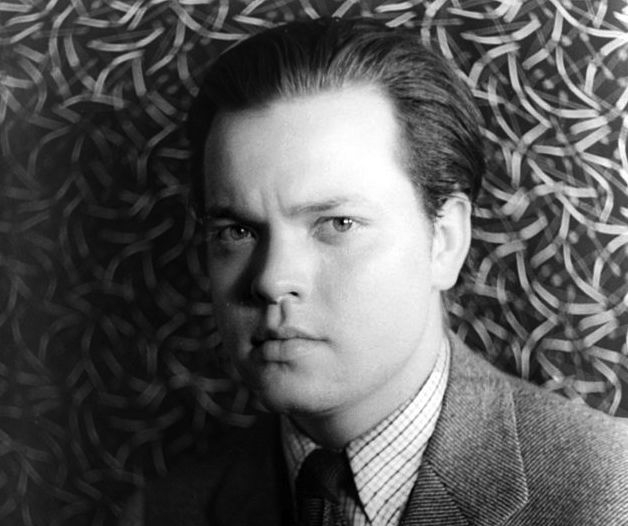
Image by Carl Van Vechten, via Wikimedia Commons
I wager that we could all recount the plot points of A Christmas Carol by heart. Furthermore, I wager that most of us inadvertently committed these to memory not by reading and re-reading Charles Dickens’ 1843 novella (available in our Free eBooks and Free Audio Books collections), but by having seen or heard a different adaptation of it each Christmas. The work has produced an almost confusing abundance of productions on film, television, and the stage, from Thomas Edison’s 1910 silent short to a Doctor Who Christmas special two years ago. Beyond that, we have countless reimaginings, like the animated Mickey’s Christmas Carol featuring Scrooge McDuck as Ebenezer Scrooge, and loosely Christmas Carol-inspired projects, like Scrooged with Bill Murray. The story has also made its way to the radio many times, most notably in the 1930s, when Campbell’s Soup would sponsor its yearly appearance. In 1939, the “Campbell Playhouse” brought in two especially formidable thespians, Orson Welles and Lionel Barrymore, and you can listen to the result at archive.org, or right below.
Welles, of course, came in as no stranger to adapting literature for radio; he’d pulled off his infamously realistic Halloween dramatization of H.G. Wells’ The War of the Worlds just the year before. My personal favorite of his adaptations remains the hauntingly askew Orson Welles Show version of Carl Ewald’s My Little Boy, but I can’t deny that he brings an entirely suitable tone of mild grandeur, initially stern but ultimately pleased, to A Christmas Carol. Barrymore, an actor of both the nineteenth and twentieth centuries who managed to succeed on stage, in silent films, and then in sound films, plays the now-archetypal miserly curmudgeon Ebenezer Scrooge with a style that, for my money, falls second only to Scrooge McDuck’s. But then, we can’t go comparing cartoon characters to flesh-and-blood performers, and Disney’s Scrooge surely drew his own signature miserliness and curmudgeonhood (not to mention his name) from Dickens’, a figure already firmly lodged in our collective holiday consciousness, thanks especially to performances like Barrymore’s.
Related content:
A Christmas Carol by Charles Dickens
Orson Welles Vintage Radio: The War of the Worlds That Petrified a Nation
Celebrate the 200th Birthday of Charles Dickens with Free Movies, eBooks and Audio Books
Colin Marshall hosts and produces Notebook on Cities and Culture and writes essays on literature, film, cities, Asia, and aesthetics. Follow him on Twitter at @colinmarshall.
Read More...A Christmas Carol Presented in a Thomas Edison Film (1910)
TMC writes:
A Christmas Carol (1910) is an early version of the classic Charles Dickens’ novel. Ten minutes in duration, this silent short was directed by J. Searle Dawley at the Edison Film Manufacturing Corporation.
Added to the Silent Film section of our collection, 4,000+ Free Movies Online: Great Classics, Indies, Noir, Westerns, Documentaries & More.
If you would like to support the mission of Open Culture, consider making a donation to our site. It’s hard to rely 100% on ads, and your contributions will help us continue providing the best free cultural and educational materials to learners everywhere. You can contribute through PayPal, Patreon, and Venmo (@openculture). Thanks!
Read More...10 Great Performances From 10 Legendary Jazz Artists: Django, Miles, Monk, Coltrane & More
Billie Holiday Sings ‘Strange Fruit,’ 1959:
Last week we brought you a post titled “Miles Davis and His ‘Second Great Quintet,’ Filmed Live in Europe, 1967,” featuring Herbie Hancock and Wayne Shorter. The response was enthusiastic, and it reminded us that a great many of you share our love of jazz. It got us thinking: Why not gather the material from our favorite jazz posts into one place? So today we’re happy to bring you ten great performances from ten legendary artists.
We begin with Billie Holiday (above) singing her painful signature song of racism and murder, “Strange Fruit.” The song was written by teacher and unionist Abel Meeropol, who was horrified when he saw a 1930 photograph of two black men hanging from a tree in Indiana, victims of a lynch mob. Holiday first recorded “Strange Fruit” in 1939 and continued to sing it, despite some resistance, for the rest of her life. The performance above was taped in London for the Granada TV program Chelsea at Nine in February of 1959, just five months before Holiday’s untimely death at the age of 44.
Dave Brubeck Performs ‘Take Five,’ 1961:
The legendary pianist Dave Brubeck died earlier this month, just one day short of his 92nd birthday. To remember him on that day we posted the clip above from a 1961 episode of the American public television program Jazz Casual, with Brubeck and his quartet performing the classic song “Take Five” from their influential 1959 album, Time Out. The musicians are: Brubeck on piano, Eugene Wright on bass, Joe Morello on drums, and Paul Desmond (who wrote “Take Five”) on alto saxophone. For more on Brubeck, including a delightful clip of the elderly master improvising with a young Russian violinist at the Moscow Conservatory, see our Dec. 5 post, “Remembering Jazz Legend Dave Brubeck with a Very Touching Musical Moment.”
Chet Baker Performs ‘Time After Time,’ 1964:
Last December we featured the clip above of Chet Baker playing the Sammy Cahn and Jule Styne standard, “Time After Time,” on Belgian television in 1964. Baker is joined by the Belgian flautist Jacques Pelzer, French pianist Rene Urtreger and an Italian rhythm section of Luigi Trussardi on bass and Franco Manzecchi on drums. Baker sings and plays the flugelhorn. For more of Baker’s music and a poignant look at his troubled life, be sure to see our 2011 post, Let’s Get Lost: Bruce Weber’s Sad Film of Jazz Legend Chet Baker.
Duke Ellington on the Côte d’Azur, 1966:
On a beautiful summer day in 1966, two of the 20th century’s great artists–Duke Ellington and Joan Miró–met at a museum in the medieval French village of St. Paul de Vence, high in the hills overlooking the Côte d’Azur. Neither one understood a word the other said, but Miró showed Ellington his sculpture and Ellington played music for Miró. In the scene above, narrated by the great jazz impressario Norman Granz, Ellington and his trio play a new song that would eventually be named “The Shepherd (Who Watches Over His Flock).” The trio is made up of Ellington on Piano, John Lamb on Bass and Sam Woodyard on drums. To learn more about that day, including recollections from the only surviving member of Ellington’s trio, see our May 10 post, “Duke Ellington Plays for Joan Miró in the South of France, 1966: Bassist John Lamb Looks Back on the Day.”
Django Reinhardt Performs ‘J’attendrai,’ 1938:
With only two good fretting fingers on his left hand, gypsy guitarist Django Reinhardt created one of the most distinctive instrumental styles in 20th century music. The clip above is from the 1938 short film Jazz “Hot”, which features Reinhardt, along with violinist Stéphane Grappelli and the Quintette du Hot Club de France, perfoming a swing version of the popular song “J’attendrai.” (“J’attendrai” means “I will wait.”) To learn about Reinhardt and the fire that cost him the use of most of his left hand, be sure to see our Aug. 10 post, “Django Reinhardt and the Inspiring Story Behind His Guitar Technique.”
John Coltrane Plays Material From A Love Supreme, 1965:
In December of 1964 the John Coltrane Quartet recorded its masterpiece, A Love Supreme, in one session. A highly original blending of hard bop and free jazz with spiritual overtones, the album is recognized as a landmark in jazz history. The Smithsonian Institution declared it a national treasure. But Coltrane reportedly played the material only once in public, at a 1965 concert in Antibes, France. You can see a portion of that performance above, as Coltrane and his quartet play “Part 1: Acknowledgement” from the four-part composition. The quartet is composed of Coltrane on tenor saxophone, McCoy Tyner on Piano, Jimmy Garrison on bass and Elvin Jones on drums. To watch and listen as the band plays “Part 2: Resolution,” see our 2011 post, John Coltrane Plays Only Live Performance of A Love Supreme.
Miles Davis on The Robert Herridge Theater, 1959:
Most of the great performances on this page were preserved by government-funded broadcasting companies, particularly in Europe. Left to its own devices, the “invisible hand” of the television marketplace was fairly content to ignore jazz and allow its great artists to pass unnoticed and unrecorded. A notable exception to this trend was made by the CBS producer Robert Herridge, who had the vision and foresight to organize an episode of The Robert Herridge Theater–a program normally devoted to the storytelling arts–around the music of Miles Davis. In an extraordinary 26-minute broadcast, shown above in its entirety, Davis performs with members of his “first great quintet” (John Coltrane on tenor and alto saxophone, Wynton Kelly on piano, Paul Chambers on bass and Jimmy Cobb on drums) and with the Gil Evans Orchestra. A sixth member of the smaller combo (by that time it had grown to a sextet), alto saxophonist Julian “Cannonball” Adderly, can be seen briefly but doesn’t play due to a splitting migraine headache. The broadcast took place between recording sessions for Davis’s landmark album, Kind of Blue. The set list is: “So What,” “The Duke,” “Blues for Pablo,” “New Rhumba” and a reprise of “So What.”
Thelonious Monk in Copenhagen, 1966:
Here’s a great half-hour set by Thelonious Monk and his quartet, recorded by Danish television on April 17, 1966. The lineup includes Monk on piano, Charlie Rouse on tenor saxophone, Larry Gales on Bass and Ben Riley on Drums. They play three songs–“Lulu’s Back in Town,” “Don’t Blame Me” and “Epistrophy”–with Monk giving the others plenty of room to solo as he gets up from the piano to do his stiff, idiosyncratic dance. For more on Monk, see our 2011 post on the extraordinary documentary film, Thelonious Monk: Straight No Chaser.
Bill Evans on the Jazz 625 show, 1965:
In March of 1965 the Bill Evans Trio visited the BBC studios in London to play a pair of sets on Jazz 625, hosted by British trumpeter Humphrey Lyttelton. The two 35-minute programs are shown above, back-to-back. The trio features Evans on piano, Chuck Israels on bass and Larry Bunker on drums. To read the set list for both shows, see our May 31 post, “The Bill Evans Trio in London, 1965: Two Sets by the Legendary Combo.” And for a fascinating introduction to the great jazz pianist’s philosophy of music, don’t miss our April 5 post, “The Universal Mind of Bill Evans: Advice on Learning to Play Jazz and the Creative Process.”
Charles Mingus in Belgium, 1964:
In April of 1964 the great bassist and composer Charles Mingus and his experimental combo, The Jazz Workshop, embarked on a three-week tour of Europe that is remembered as one of the high-water marks in Mingus’s career. The performance above was recorded by Belgian television on Sunday, April 19, 1964 at the Palais des Congrés in Liège, Belgium. Mingus and the band play three songs: “So Long Eric,” “Peggy’s Blue Skylight” and “Meditations on Integration.” The group features Mingus on bass, Dannie Richmond on drums, Jaki Byard on piano, Clifford Jordan on tenor saxophone and Eric Dolphy on alto saxophone, flute and bass clarinet. A sixth member, trumpeter Johnny Coles, was forced to drop out of the band after he collapsed onstage two nights earlier. For more of Mingus’s music and a look at his troubled life, see our Aug. 2 post, “Charles Mingus and His Eviction From His New York City Loft, Captured in Moving 1968 Film.”
Read More...Joni Mitchell: Singer, Songwriter, Artist, Smoking Grandma
Fans are always eager to find out what drives their favorite artist to create. Hidden torment? Secret passion? The publicity-shy singer-songwriter Joni Mitchell has dropped more than a few lyrical cues over the last half century. Things became infinitely more overt during the informal portion of a 2008 interview with Charlie Rose.
Want to know what spurs Joni? Cigarettes!
She’s been hustling to finance her habit since she took them up at nine. What, you think she actively wanted to be a singer-songwriter? No man, playing folk songs in the Canadian coffeehouse scene for fifteen bucks a night meant financial health, and financial health meant she could smoke forever! Modern audiences might expect such a sentiment from the raucous and now-dead Janis Joplin, but isn’t Joni more of a demure Ladies of the Canyon type?
Bob Dylan would likely say no.
These days Joni is taking the straightforward approach, no more peeking out from behind carefully-rendered poetic veils. Frankly, Grandma Mitchell seems unlikely to give a damn if her unqualified romance with tobacco shocks. (It seems likely to, though perhaps not so much as some of her other candidly expressed views.)
Below, you can catch Joni during those freewheelin’ early days, playing a 3o minute set on British TV in 1970.
- Ayun Halliday wishes she could find the tape of the tape of the Joni Mitchell-James Taylor Unconcert that a friend’s friend taped off of WXRT back in the day.
Read More...Woody Allen Boxes a Kangaroo, 1966
Last month, we featured Woody Allen answering thirteen unusual questions from Robert B. Weide’s film Woody Allen: A Documentary. Well, it turns out that it wasn’t the only unusual footage the documentary had to offer. During the 1960s, the young comic did whatever his managers (Charles H. Joffe and Jack Rollins) thought would enhance his public profile. Some of his early performances and stunts were genius. Others flopped. You decide where this one falls. In 1966, Allen appeared on Hippodrome, a British variety TV show that showcased jumping dogs, trapeze acts, musical acts and … kangaroo boxing matches. This match went one round, with the Australian light heavyweight champion landing the only punches.
Related Content:
Thomas Edison’s Boxing Cats (1894), or Where the LOLCats All Began
Muhammad Ali Plans to Fight on Mars in Lost 1966 Interview
Woody Allen and the Reverend Billy Graham In Conversation
Read More...Listen to the Beatles’ Holiday Messages to Fans: Seven Vintage Recordings from 1963 to 1969
1963:
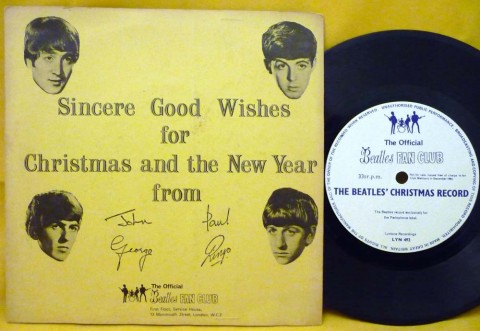
Every year from 1963 to 1969, the Beatles recorded a special Christmas greeting to their fans. It started when “Beatlemania” took off and the band found itself unable to answer all the fan mail. “I’d love to reply personally to everyone,” says Lennon in the 1963 message, “but I just haven’t enough pens.” The first message was intended to make their most loyal fans feel appreciated. Like those that followed, the 1963 message was mailed as a paper-thin vinyl “flexi disc” to members of the Beatles fan club. The recording features the Beatles’ trademark wit and whimsy, with a chorus of “Rudolph the Red-Nosed Ringo” and a version of “Good King Wenceslas” that refers to Betty Grable. It was made on October 17, 1963 at Abbey Road Studios, just after the band recorded “I Want to Hold Your Hand.”
Listen to the Beatles’ 1963 Message
1964:
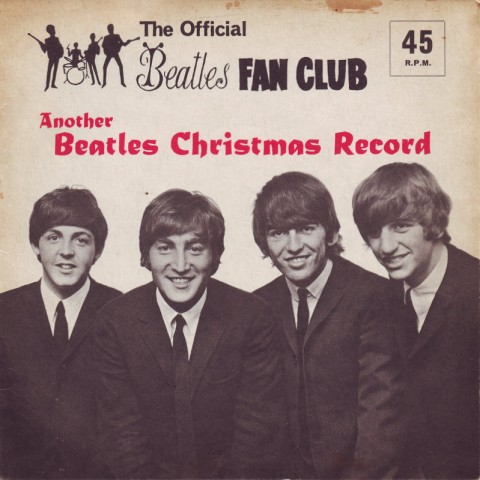
The band recorded their next holiday greeting, Another Beatles Christmas Record, on October 26, 1964, the same day they recorded the song “Honey Don’t.” Lennon’s rebellious nature begins to show, as he pokes fun at the prepared script: “It’s somebody’s bad hand wroter.”
Listen to the Beatles’ 1964 Message
1965:
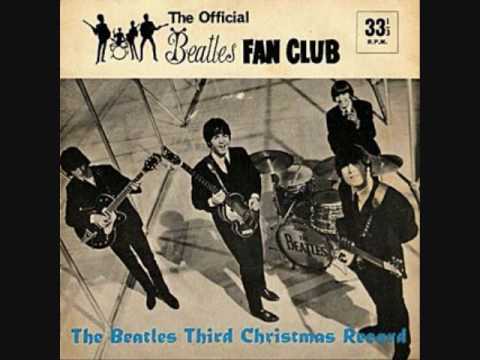
Recorded on November 8, 1965 during the Rubber Soul sessions at Abbey Road, the 1965 message features a re-working of “Yesterday,” with the refrain “Oh I believe on Christmas Day.” The band’s gift for free-associational role playing is becoming more apparent. One piece of dialogue near the end was eventually re-used by producer George Martin and his son Giles at the end of the re-mixed version of “All You Need is Love” on the 2006 album Love: “All right put the lights off. This is Johnny Rhythm saying good night to you all and God Blesses.”
Listen to the Beatles’ 1965 Message
1966:
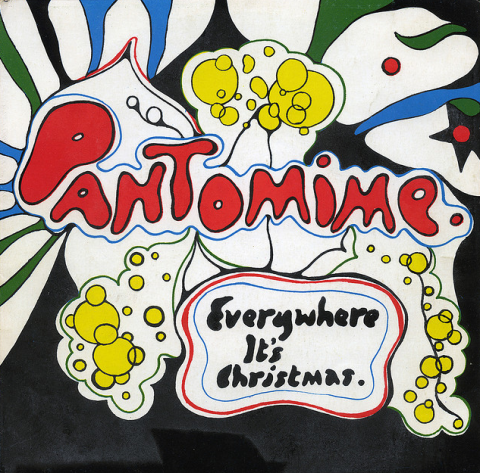
You can sense the band’s creative powers growing in the 1966 message, Pantomime: Everywhere It’s Christmas. The recording was made at Abbey Road on November 25, 1966, during a break from working on “Strawberry Fields Forever.” The Beatles were just beginning work on Sgt. Pepper’s Lonely Heart’s Club Band. Instead of simply thanking their fans and recounting the events of the year, the Beatles use sound effects and dialogue to create a vaudeville play based around a song that goes, “Everywhere it’s Christmas, at the end of every year.” Paul McCartney designed the cover.
Listen to the Beatles’ 1966 Message
1967:
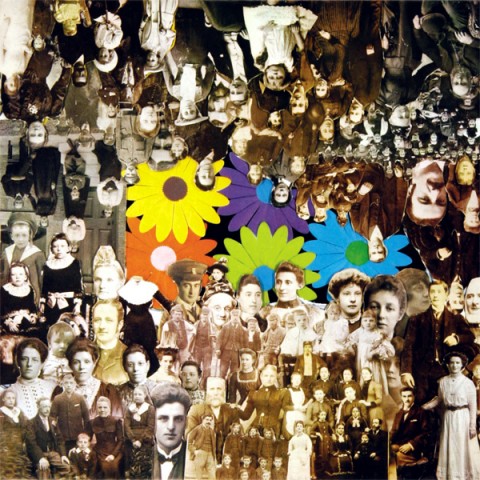
This was the last Christmas message recorded by the Beatles all together in one place. Titled Christmas Time (Is Here Again), it reveals the group’s continuing experimentation with sound effects and storytelling. The scenario, written by the band earlier on the day it was recorded (November 28, 1967), is about a group of people auditioning for a BBC radio play. Lennon and Ringo Starr designed the cover.
Listen to the Beatles’ 1967 Message
1968:
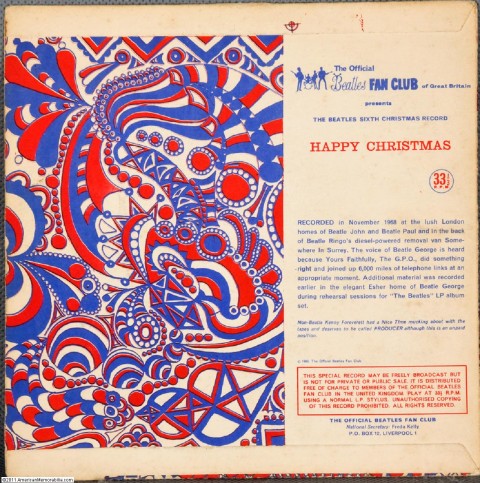
By the Christmas season of 1968, relations within the Beatles were becoming strained. The holiday message was produced around the time the “White Album” was released, in November of 1968. The four members’ voices were recorded separately, in various locations. There’s plenty of self-mockery. Perhaps the most striking moment comes when the American singer Tiny Tim (invited by George Harrison) strums a ukulele and sings “Nowhere Man” in a high falsetto.
Listen to the Beatles’ 1968 Message
1969:
The Beatles were in the process of breaking up when they recorded (separately) their final Christmas message in November and December of 1969. A couple of months earlier, just before the release of Abbey Road, Lennon had announced to the others that he was leaving the group. Yoko Ono appears prominently on the recording, singing and talking with Lennon about peace. Fittingly, the 1969 message incorporates a snippet from the Abbey Road recording of “The End.”
Listen to the Beatles’ 1969 Message
Read More...Support Us
We're hoping to rely on loyal readers, rather than erratic ads. Please click the Donate button and support Open Culture. You can use Paypal, Venmo, Patreon, even Crypto! We thank you!

About Us

Open Culture scours the web for the best educational media. We find the free courses and audio books you need, the language lessons & educational videos you want, and plenty of enlightenment in between.
Advertise With Us

FREE UPDATES!
GET OUR DAILY EMAIL
Get the best cultural and educational resources on the web curated for you in a daily email. We never spam. Unsubscribe at any time.
FOLLOW ON SOCIAL MEDIA

Open Culture editor Dan Colman scours the web for the best educational media. He finds the free courses and audio books you need, the language lessons & movies you want, and plenty of enlightenment in between.
Advertise With Us


