Annie Leibovitz, Photographer of Icons and Iconic Photographer, Profiled on American Masters
One must take care, when writing about well-connected cultural figures, not to abuse the word iconic. But when one writes about the photographer Annie Leibovitz, one almost has to abuse it. Here we have a woman who took two of the most memorable photos of John Lennon, collaborated (to the extent possible) with Hunter S. Thompson, went on tour with the Rolling Stones, followed Richard Nixon out of the White House the last time he left it, convinced Whoopi Goldberg to get into a bathtub of milk, and loved Susan Sontag. This whole post couldn’t possibly contain a complete list of her professional and personal involvement with the, yes, icons of twentieth-century popular culture. Her portraits of them became icons themselves, which, in turn, made Leibovitz herself iconic. For a visually rich sense of the scope of her life and career, look no further than the documentary above, Life Through a Lens.
This 2008 production comes from the PBS-distributed American Masters television series, which we featured on Tuesday. Directed by Leibovitz’s own sister and therefore possessed of the unusual familial insight you’d expect, Life Through a Lens also includes a great many of the hard-to-interview luminaries without which no profile of this photographer could be complete. We hear from Arnold Schwarzenegger, Jann Wenner, Hillary Clinton, Gloria Steinem, Patti Smith, Mick Jagger, Keith Richards, Bette Midler, Yoko Ono, and George Clooney, to name but a few of her admirers who’ve held their own at the business end of her camera. In the four years since this documentary, Leibovitz’s photographs — now of 21st-century celebrities like Miley Cyrus, Sasha Baron Cohen, Lady Gaga, Rihanna, and LeBron James — have continued to impress in the pages of Vogue and Vanity Fair. Whenever someone rises toward iconic status, Annie Leibovitz’s visual imagination can’t be far behind.
Related content:
Watch PBS’ American Masters Documentaries (Including Scorsese’s Homage to Kazan) Free Online
Alfred Stieglitz: The Eloquent Eye, a Revealing Look at “The Father of Modern Photography”
1972 Diane Arbus Documentary Interviews Those Who Knew the American Photographer Best
Henri Cartier-Bresson and the Decisive Moment
Colin Marshall hosts and produces Notebook on Cities and Culture. Follow him on Twitter at @colinmarshall.
Read More...
Beatboxing Bach’s Goldberg Variations
It might not surpass Glenn Gould’s recording of Bach’s Goldberg Variations from 1981. (Watch him perform it here). But this clip, featuring teenage pianist Kadar Qian and beatbox extraordinaire Kevin Olusola of Pentatonix, has a charm of its own. The clip comes from From the Top, a non-profit whose YouTube channel presents outstanding performances from the country’s best young classical musicians.
If you want your own copy of the Goldberg Variations, you can instantly download The Open Goldberg Variations, the first Kickstarter-funded, open source recording of Bach’s masterpiece. It’s available entirely for free. Also don’t miss the Complete Organ Works of J.S. Bach. They’re free too!
via BoingBoing
Read More...The Complete Sherlock Holmes Now Free on the Kindle
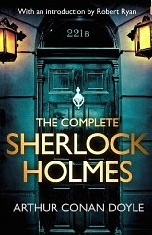
It’s surely worth giving you the quick heads up that, starting today, “the complete collection of Sir Arthur Conan Doyle’s Sherlock Holmes tales, both long and short, have been compiled together for the first time.” The Complete Sherlock Holmes (download it here) is free on the Kindle thanks to Simon & Schuster. Unlike many free texts, the formatting looks quite nice on my Kindle Paperwhite as well as on the iPad using the Free Kindle app. So, we’re gladly adding this one to our collection of 375 Free eBooks, which gives you immediate access to many more classics.
NOTE: We have unfortunately discovered that this particular text is not available in some countries. Sorry, there was no way for us to know that in advance. But, fear not, you can find other versions of Sherlock Holmes on the web. Give these links a try:
Doyle, Arthur Conan - The Adventures of Sherlock Holmes
Read More...Marilyn Monroe Explains Relativity to Albert Einstein (in a Nicolas Roeg Movie)
A certain motion picture has as its main characters Joe DiMaggio, Joseph McCarthy, Albert Einstein, and Marilyn Monroe. Sure, the script calls them the Ballplayer, the Senator, the Professor, and the Actress, but there’s no mistaking their real identities. Surely this already intrigues anyone interested in midcentury American culture, but what if I also mentioned that in the director’s chair sits Nicolas Roeg, whose richly askew visions for Walkabout, Don’t Look Now, and The Man Who Fell to Earth so enriched the cinema of the seventies? Adapted from a stage play by Terry Johnson, 1985’s Insignificance has each of its iconic characters pass through a single New York City hotel room in 1954. Roughly halfway through the story, we get the scene above, an explanation of the theory of relativity: by the Actress to the Professor.
Marilyn Monroe’s interest in things Einsteinian seems at least somewhat grounded in reality; Johnson thought up the play after reading about an autographed photo of the physicist found among the late star’s possessions. Roeg felt a similarly strong reaction upon watching the stage production, seizing the material as an opportunity to explore the theme of how “nobody knows a damn thing about anyone.” This he especially illustrated in the distant marriage of the Actress and the Ballplayer, their real-life inspirations having been briefly married themselves. (In the role of the Actress Roeg cast Theresa Russell, his own then-wife.) Though not Roeg’s best-known film, Insignificance has nonetheless inspired a constant stream of academic and cinephilic discussion since its release, and it received a handsome Criterion Collection edition last year. And if I had my way, I’d encourage both film and physics teachers everywhere to fire it up on slow class days.
via Biblioklept
Related content:
Marilyn Monroe Reads Joyce’s Ulysses at the Playground (1955)
Einstein Documentary Offers A Revealing Portrait of the Great 20th Century Scientist Einstein’s Big Idea: E=mc²
Colin Marshall hosts and produces Notebook on Cities and Culture. Follow him on Twitter at @colinmarshall.
Read More...12.12.12 Concert For Sandy Relief. It’s Streaming Live!
The relief concert is streaming live from New York City. Artists on the lineup include Bon Jovi, Eric Clapton, Dave Grohl, Billy Joel, Alicia Keys, Chris Martin, The Rolling Stones, Bruce Springsteen & the E Street Band, Eddie Vedder, Roger Waters, Kanye West, The Who, Paul McCartney and others. You can make your donations to the relief effort right here.
Read More...Ravi Shankar Gives George Harrison a Sitar Lesson … and Other Vintage Footage
Ravi Shankar, the Indian sitarist (and father of Norah Jones) known for his collaboration with the Beatles and other western musicians, died Tuesday in Southern California. He was 92 years old. Born in India in 1920, Shankar began playing the sitar during the late 1930s, and, by the 1940s, he started thinking about how to bring eastern music to western audiences. Tours brought him to the Soviet Union, Western Europe and the United States during the 50s. But everything changed when he crossed paths in 1966 with a rock star developing his own interest in the sitar.
George Harrison taught himself enough to play the sitar on “Norwegian Wood,” the eastern-inflected song written by Lennon and McCartney in 1965. Shankar and Harrison met the next year in London, marking the beginning of an important musical partnership. Soon enough, Harrison traveled to India — to a remote region in the Himalayas — to study the sitar and read spiritual texts with Shankar. Returning the favor, Harrison saw to it that Shankar performed at the Monterey Pop Festival in June 1967. Later, the two organized the influential Concert for Bangladesh, which brought them together with Bob Dylan, Eric Clapton, and Billy Preston.
Above, we have documentary footage featuring Shankar and Harrison together in a sitar lesson. Below, we present other clips from that fertile period.
Ravi Shankar’s Appearance with Harrison on the Dick Cavett Show (1971)
Shankar at Monterey Pop (1967)
If you would like to support the mission of Open Culture, consider making a donation to our site. It’s hard to rely 100% on ads, and your contributions will help us continue providing the best free cultural and educational materials to learners everywhere. You can contribute through PayPal, Patreon, and Venmo (@openculture). Thanks!
Read More...Watch an Animated Film of Emily Dickinson’s Poem ‘I Started Early–Took My Dog’
Today is the birthday of Emily Dickinson, an extraordinarily shy woman who rarely left her house but whose poems have gone out to meet the world.
Dickinson’s poetry is widely celebrated for its beauty and originality. As her biographer at the Poetry Foundation Web site writes, “To make the abstract tangible, to define meaning without confining it, to inhabit a house that never became a prison, Dickinson created in her writing a distinctively elliptical language for expressing what was possible but not yet realized.”
To celebrate Dickinson’s birthday (she was born on December 10, 1830) we bring you this little film of her poem, “I Started Early–Took My Dog,” from the “Poetry Everywhere” series by PBS and the Poetry Foundation. The poem is animated by Maria Vasilkovsky and read by actress Blair Brown. You can also read the poem for yourself here.
Related content:
Bill Murray Reads Emily Dickinson to Construction Workers
A Second, Previously Unknown Photo of Emily Dickinson Emerges
Find Emily Dickinson Poetry in our Free Audio Books and Free eBooks collections
Read More...Neil Gaiman Gives Sage Advice to Aspiring Artists
“I want to be a director, and I’ve been told that there are enough artists in the world, and that’s not something I should pursue. Do you [agree with that]?”
A young woman put that question to sci-fi and fantasy writer Neil Gaiman at The Connecticut Youth Forum last week. And he responded with an answer that might sound familiar, especially if you viewed the thoughtful commencement speech he gave at The University of the Arts in Philadelphia last spring. There, he gave 10 Essential Tips for Working in the Arts, and, if you have a really sharp memory, you’ll recall suggestions #6 and #10.
- Make your own art, meaning the art that reflects your individuality and personal vision.
- Leave the world more interesting than it was before.
They’re wise tips, but they’re better taken in conjunction with suggestions 1, 2, 3, 4, 5, 7, 8, and 9. Watch them all here. And don’t miss our collection of Free Neil Gaiman Stories, available in text, audio and video.
Read More...Gary Larson’s The Far Side Comes Alive in Series of Animated Cartoons
It used to be that you couldn’t go into a bookstore this time of year without being literally surrounded by Gary Larson’s The Far Side. His calendars and books were massive best sellers and his single-panel comics seemed to be everywhere, taped to cubicle walls and pinned to bulletin boards. Larson’s hilariously subversive sense of empathy–his way of rendering people with the detachment of an entomologist while investing his animal characters with the most sympathetic of human traits–endeared him to millions.
But in 1995, after 15 years of struggle against grinding deadlines, Larson called it quits. Since then he’s been about as reclusive as Greta Garbo or J.D. Salinger. And while Larson’s calendars and books continued to appear for some years after his retirement, The Far Side is not much in evidence these days. Which is sad. You can’t buy your friends a 2013 Far Side desk calendar this holiday season, but perhaps you can share this: a few twisted scenes from Larson’s 1994 animated film, Tales From the Far Side. The film was originally aired as a Halloween special on CBS. The clip above begins on a fittingly nostalgic note.
Related content:
Jazz Toons: Allen Mezquida’s Journey from Bebop to Smigly
Read More...Orson Welles’ The Stranger Free Online, Where 1940s Film Noir Meets Real Horrors of WWII
Did Orson Welles ever make an non-notable movie? Sure, the sheer cinematic importance of Citizen Kane, Touch of Evil, The Lady from Shanghai, and even the famously incomplete The Magnificent Ambersons, tend to draw all the attention most people have for his filmography. Make sure you watch those — no self-respecting lover of American film could do without them — but then look beyond them.
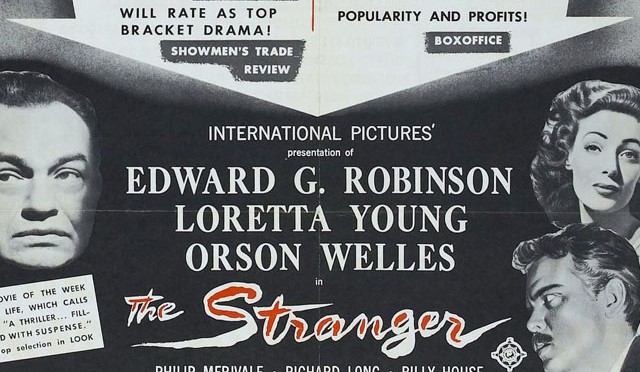
Personally, I yield to no one in my endorsement of Welles’ formally unique multi-genre quasi-documentary F for Fake. But first, I suggest you look to the top of this post and watch 1946’s The Stranger, a far more mainstream picture (for one can hardly travel farther from the mainstream than F for Fake), and in fact the only Welles film to meet with immediate box office success. Considering what it shows, that may come as a surprise.
The picture pits a United Nations Nazi hunter, played by Hollywood Golden Age legend Edward G. Robinson, against a Third Reich war criminal played by Welles himself. The hunter tracks down the hunted, who has taken on a new, nearly anonymous identity in small-town Connecticut. The U.N. man becomes desperate to bring the Nazi to justice, the Nazi’s becomes desperate to live his new life in peace, and his unsuspecting wife becomes desperate to deny the truth about her husband’s past. In order to convince the lady, Robinson’s character screens her actual footage of Nazi concentration camps. The shock on actress Loretta Young’s face was the shock on the faces of American audiences; neither previously had much of a chance to see what had really happened in wartime Europe. Leave it to Welles, whose fascination with and hatred of fascism led him to write a series of columns on the subject for the New York Post, to smuggle this depth of real human horror into what looks at first glance like a plain old 1940s noir thriller.
You will find The Stranger, a film now in the public domain, listed in our collection, 4,000+ Free Movies Online: Great Classics, Indies, Noir, Westerns, Documentaries & More.
Related content:
Orson Welles on the Art of Acting: ‘There is a Villain in Each of Us’
The Hearts of Age: Orson Welles’ Surrealist First Film (1934)
Colin Marshall hosts and produces Notebook on Cities and Culture. Follow him on Twitter at @colinmarshall.
Read More...Support Us
We're hoping to rely on loyal readers, rather than erratic ads. Please click the Donate button and support Open Culture. You can use Paypal, Venmo, Patreon, even Crypto! We thank you!

About Us

Open Culture scours the web for the best educational media. We find the free courses and audio books you need, the language lessons & educational videos you want, and plenty of enlightenment in between.
Advertise With Us

FREE UPDATES!
GET OUR DAILY EMAIL
Get the best cultural and educational resources on the web curated for you in a daily email. We never spam. Unsubscribe at any time.
FOLLOW ON SOCIAL MEDIA

Open Culture editor Dan Colman scours the web for the best educational media. He finds the free courses and audio books you need, the language lessons & movies you want, and plenty of enlightenment in between.
Advertise With Us