Sonny Rollins Plays Jazz on the Brooklyn Bridge in 1977 Pioneer Electronics Ad
In this 1977 television ad for Pioneer Electronics, jazz saxophone great Sonny Rollins wails into the New York City night air while standing on the Brooklyn Bridge. A voice-over announcer tells viewers of Rollins’ 1959–61 hiatus from the jazz scene, when he took his sound to the streets to rediscover himself musically. It’s mostly a true story. Only trouble is, Rollins actually retired to the Williamsburg Bridge—admittedly not quite as picturesque! Here’s the story as Rollins tells it:
In the 50s and 60s, Lucille and I had a small apartment on Grand Street on the Lower East Side of New York. It was a nice time. I had a lot of friends there and I was welcomed by the neighborhood people. Like most of New York, the Lower East Side has undergone gentrification but back then, it was a much more ethnic place.
I started practicing in the house because I had to practice, but I felt guilty because I’m a sensitive person and I know that people need quiet in their apartments.
I was walking on Delancey Street one day, not far from where I lived on Grand Street and I just happened to look up and see these steps that I decided to check out. And there, of course, was the bridge, the Williamsburg Bridge. It was this nice big expanse going over the East River. There was nobody up there. So I started walking across the bridge and said, “Wow. This is what I have been looking for. This is a private place. I can blow my horn as loud as I want.” Because the boats are coming under, and the subway is coming across, and cars, and I knew it was perfect, just serendipity. Then, I began getting my horn and going up there regularly. I would be up there 15 or 16 hours at a time spring, summer, fall and winter.
Rollins’ perfectionism paid off. He returned to the music business with his brilliant 1962 album The Bridge, a chronicle of where he’d been those four years, sometimes in freezing cold temperatures, alone or with friends. British documentary filmmaker Dick Fontaine captured Rollins discussing his bridge sabbatical and has released a 2012 film about Rollins called Beyond the Notes, which features live performances of the jazz great in his 80s, and has been showing in the UK since last spring. Rollins recently took home three trophies from the annual Jazz Awards in New York, including a best-record award for his latest album of live recordings, Road Shows, Vol. 2.
Josh Jones is currently a doctoral student in English at Fordham University and a co-founder and former managing editor of Guernica / A Magazine of Arts and Politics.
Read More...The Spanish Earth: Ernest Hemingway’s 1937 Film on The Spanish Civil War
German warplanes cross the sky. Explosions flash. Shell-shocked villagers stagger out of their damaged homes and begin to grieve. “Before,” says Ernest Hemingway in his flat Midwestern accent, “death came when you were old or sick. But now it comes to all this village. High in the sky and shining silver, it comes to all who have no place to run, no place to hide.”
The scene is from the 1937 film The Spanish Earth, an important visual document of the Spanish Civil War and a rare record of the famous writer’s voice. Hemingway went to Spain in the spring of 1937 to report on the war for the North American Newspaper Alliance (NANA), but spent a good deal of time working on the film. Before leaving America, he and a group of artists that included Archibald MacLeish, John Dos Passos and Lillian Hellman banded together to form Contemporary Historians, Inc., to produce a film to raise awareness and money for the Spanish Republican cause. The group came up with $18,000 in production money–$5,000 of it from Hemingway–and hired the Dutch documentary filmmaker Joris Ivens, a passionate leftist, to make the movie.
MacLeish and Ivens drafted a short outline for the story, with a theme of agrarian reform. It was MacLeish who came up with the title. The film, as they envisioned it, would tell the story of Spain’s revolutionary struggle through the experience of a single village. To do that, Ivens planned to stage a number of scenes. When he and cameraman John Fernhout (known as “Ferno”) arrived in Spain they decided to focus on the tiny hamlet of Fuentedueña de Tajo, southeast of Madrid, but they soon realized it would be impossible to set up elaborate historical re-enactments in a country at war. They kept the theme of agrarian struggle as a counterpoint to the war. When Dos Passos arrived in Fuentedueña, he encouraged that approach. “Our Dutch director,” wrote Dos Passos, “did agree with me that, instead of making the film purely a blood and guts picture we ought to find something being built for the future amid all the misery and massacre.”
That changed when Hemingway arrived. The friendship between the two writers was disintegrating at the time, so they didn’t work together on the project. It was agreed upon in advance that Hemingway would write the commentary for the film, but while in Spain he also helped Ivens and Fernhout navigate the dangers of the war zone. “Hemingway was a great help to the film crew,” writes Hans Schoots in Living Dangerously: A Biography of Joris Ivens. “With a flask of whisky and raw onions in his pockets, he lugged equipment and arranged transport. Ivens generally wore battle dress and a black beret. Hemingway went as far as a beret but otherwise stuck to civvies. Although he rarely wore glasses, he almost never took them off in Spain, clear evidence of the seriousness of their task.” In “Night Before Battle,” a short story based partially on his experience making the movie, Hemingway describes what it’s like filming in a place where the glint from your camera lens draws fire from enemy snipers:
At this time we were working in a shell-smashed house that overlooked the Casa del Campo in Madrid. Below us a battle was being fought. You could see it spread out below you and over the hills, could smell it, could taste the dust of it, and the noise of it was one great slithering sheet of rifle and automatic rifle fire rising and dropping, and in it came the crack of the guns and the bubbly rumbling of the outgoing shells fired from the batteries behind us, the thud of their bursts, and then the rolling yellow clouds of dust. But it was just too far to film well. We had tried working closer but they kept sniping at the camera and you could not work.
The big camera was the most expensive thing we had and if it was smashed we were through. We were making the film on almost nothing and all the money was in the cans of film and the cameras. We could not afford to waste film and you had to be awfully careful of the cameras.
The day before we had been sniped out of a good place to film from and I had to crawl back holding the small camera to my belly, trying to keep my head lower than my shoulders, hitching along on my elbows, the bullets whocking into the brick wall over my back and twice spurting dirt over me.
The Western front at Casa de Campo on the outskirts of Madrid was just a few minutes’ walk from the Florida Hotel, where the filmmakers were staying. Any doubt about whether the passage from “Night Before Battle” is autobiographical are dispelled in the following excerpt from one of Hemingway’s NANA dispatches, quoted by Schoots:
Just as we were congratulating ourselves on having such a splendid observation post and the non-existent danger, a bullet smacked against a corner of brick wall beside Ivens’s head. Thinking it was a stray, we moved over a little and, as I watched the action with glasses, shading them carefully, another came by my head. We changed our position to a spot where it was not so good observing and were shot at twice more. Joris thought Ferno had left his camera at our first post, and as I went back for it a bullet whacked into the wall above. I crawled back on my hands and knees, and another bullet came by as I crossed the exposed corner. We decided to set up the big telephoto camera. Ferno had gone back to find a healthier situation and chose the third floor of a ruined house where, in the shade of a balcony and with the camera camouflaged with old clothes we found in the house, we worked all afternoon and watched the battle.
In May, Ivens returned to New York to oversee the work of editor Helen van Dongen. Hemingway soon followed. When Ivens asked Hemingway to clarify the theme of the picture, according to Kenneth Lynn in his biography Hemingway, the writer supplied three sentences: “We gained the right to cultivate our land by democratic elections. Now the military cliques and absentee landlords attack to take our land from us again. But we fight for the right to irrigate and cultivate this Spanish Earth which the nobles kept idle for their own amusement.” (more…)
Read More...Discovered: Conversation with John Lennon, Yoko Ono, and Timothy Leary at Montreal Bed-In (1969)
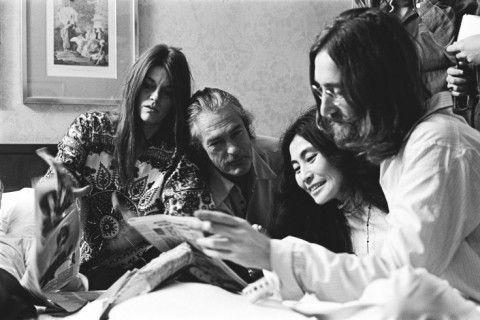
On May 26, 1969, John Lennon and Yoko One began their second “Bed-In,” a form of anti-Vietnam War protest that combined the media impact of a press conference with the comfort of hotel sheets. Their first Bed-In, which happened in various rooms of the Amsterdam Hilton in late March of that year, saw them grant interview after interview about peace all day long without moving from the bed in which they had ensconced themselves. They’d scheduled its follow up in New York City, but Lennon found he couldn’t enter the United States due to a previous conviction for marijuana possession. They relocated it to the Bahamas, where the heat soon prompted them to move again to the entirely cooler Queen Elizabeth Hotel in Montreal. There they recorded the song “Give Peace a Chance,” aided by such visitors as Tommy Smothers, Dick Gregory, Murray the K, and psychedelic drug advocate Timothy Leary.
But Leary didn’t just come to provide a backing vocal. With his wife Rosemary, he recorded a conversation with Lennon and Ono about… well, about a variety of subjects, but they’d all fall under the broad heading of Leary’s one great pursuit, “consciousness.” Only recently did Leary archivist Michael Horowitz discover the transcript of this session in “an unmarked envelope in a box of miscellaneous papers,” and this week the Timothy Leary Archives made it available to the public for the first time ever. The conversation begins with the finer points of teepee life, moves on to the effects of place on one’s state of mind, touches on both couples’ having found themselves on the wrong side of drug law enforcement, and ends with Lennon and Leary comparing notes on how they use the media to convey their message:
TIMOTHY: John, about the use of the mass media … the kids must be taught how to use the media. People used to say to me–I would give a rap and someone would get up and say, “Well, what’s this about a religion? Did the Buddha use drugs? Did the Buddha go on television? I’d say, “Ahh—he would’ve. He would’ve….”
JOHN: I was on a TV show with David Frost and Yehudi Menuhin, some cultural violinist y’know, they were really attacking me. They had a whole audience and everything. It was after we got back from Amsterdam…and Yehudi Menuhin came out, he’s always doing these Hindu numbers. All that pious bit, and his school for violinists, and all that. And Yehudi Menuhi said, “Well, don’t you think it’s necessary to kill some people some times?” That’s what he said on TV, that’s the first thing he’s ever said. And I said, “Did Christ say that? Are you a Christian?” “Yeah,” I said, and did “Christ say anything about killing people?” And he said, “Did Christ say anything about television? Or guitars?”
To learn more about Lennon and Ono’s Bed-Ins, you can visit the 70-minute documentary Bed Peace (below), previously featured on Open Culture and still freely viewable on YouTube:
Related content:
Timothy Leary’s Wild Ride and the Folsom Prison Interview
Beyond Timothy Leary: 2002 Film Revisits History of LSD
Bed Peace Starring John Lennon & Yoko Ono (Free for Limited Time)
Colin Marshall hosts and produces Notebook on Cities and Culture. Follow him on Twitter at @colinmarshall.
Read More...Alfred Hitchcock Presents a Chilling Tale by Roald Dahl (1960)
“Good evening, ladies and gentlemen.” From 1955 to 1962, Alfred Hitchcock greeted viewers to his weekly series Alfred Hitchcock Presents with some version of this phrase, in his unmistakable English drawl. After the iconic introductory sequence featuring Hitchcock stepping into a caricature—drawn by himself—of his jowly profile, the veteran director introduced the audience to the week’s episode with a droll monologue written by longtime TV writer James B. Allardice, in which Hitchcock would poke fun at himself, the viewers, and the show’s sponsors. In addition to Allardice, Hitchcock’s series relied on the talents of several well-known writers, including literary names like John Cheever, Robert Bloch (author of Psycho), and, most famously, the much-loved Roald Dahl.
Primarily known for his whimsical, and often quite dark, children’s books (James and the Giant Peach, Charlie and the Chocolate Factory, Fantastic Mr. Fox), Dahl was also a novelist, screenwriter, and a writer of macabre short stories for adults (he won three Edgars, or mystery writer awards). In 1958, Alfred Hitchcock Presents adapted Dahl’s story “Lamb to the Slaughter.” And, two years later in 1960, Dahl’s story “Man from the South” provided the basis for AHP’s most popular episode (above). The episode stars Steven McQueen as a young man talked into a grisly wager by a mysterious figure named Carlos, played by Peter Lorre. “Man from the South” was adapted several more times in the following years: in 1979 by Dahl himself in a television series called Tales of the Unexpected, again in the 1985 revival of AHP (starring John Huston as Carlos), and in 1995 as the basis for Quentin Tarantino’s segment in the film Four Rooms. Without a doubt, however, this original adaptation of Dahl’s story remains the most memorable and haunting.
J. David Jones is currently a doctoral student in English at Fordham University and a co-founder and former managing editor of Guernica / A Magazine of Arts and Politics.
Read More...Nora Ephron’s Lists: “What I Will Miss” and “What I Won’t Miss”
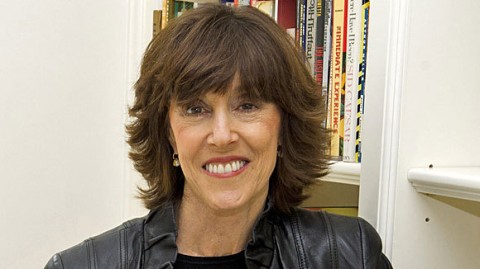
By now, you’ve almost certainly heard that Nora Ephron, the screenwriter best known for “Sleepless in Seattle” and “When Harry Met Sally,” died yesterday in Manhattan. She was 71. Her bout with leukemia apparently wasn’t widely known, but discerning readers of her 2010 book, I Remember Nothing, could have sensed something was wrong. The book closes with two lists, each revealing on a couple of levels.
What I Will Miss
My kids · Nick · Spring · Fall · Waffles · The concept of waffles · Bacon · A walk in the park · The idea of a walk in the park · The park · Shakespeare in the Park · The bed · Reading in bed · Fireworks · Laughs · The view out the window · Twinkle lights · Butter · Dinner at home just the two of us · Dinner with friends · Dinner with friends in cities where none of us lives · Paris · Next year in Istanbul · Pride and Prejudice · The Christmas tree · Thanksgiving dinner · One for the table · The dogwood · Taking a bath · Coming over the bridge to Manhattan · Pie
What I Won’t Miss
Dry skin · Bad dinners like the one we went to last night · E‑mail · Technology in general · My closet · Washing my hair · Bras · Funerals · Illness everywhere · Polls that show that 32 percent of the American people believe in creationism · Polls · Fox · The collapse of the dollar · Joe Lieberman · Clarence Thomas · Bar mitzvahs · Mammograms · Dead flowers · The sound of the vacuum cleaner · Bills · E‑mail. I know I already said it, but I want to emphasize it. · Small print · Panels on Women in Film · Taking off makeup every night
via Showbiz411
Read More...Isaac Asimov Recalls the Golden Age of Science Fiction (1937–1950)
In this short clip, Isaac Asimov discusses the golden age of science fiction, which began in 1937 (and ended in 1950) when John W. Campbell Jr. took over as editor of the magazine Astounding Science Fiction. Prior to Campbell’s editorship, most sci-fi stories were published in the “pulps,” and were in Asimov’s words “heavily adventure-flavored” because underpaid writers often wrote in several genres in order to compete in an overcrowded marketplace for escapist stories of romance, war, jungle and sea adventures, and horror tales. Unlike most of the “pulp” writers, Campbell was a scientist who studied physics at MIT and Duke, not to mention a prolific writer of fiction. (Many of Campbell’s novels and short stories are available in full-text as ePUB and PDF files here).
Campbell’s ascension was a watershed moment for the genre since his “engineering attitude” gave him a high regard for writers of science fiction who understood the science of the day and could portray scientists authentically while still having the freedom to “extrapolate wildly.” Astounding published some of the earliest stories by Asimov, Robert Heinlein (an early story, published under the name “Anson MacDonald” in 1941 is here), and L. Ron Hubbard. The relationship between Campbell and Hubbard is a fascinating story. Campbell published a very early version of what would become the founding text of Scientology in March 1950, and he claimed to be an early supporter of Hubbard’s “science of dianetics.”
Campbell is a complicated figure. In addition to supporting Hubbard’s ideas, writer Harlan Ellison has claimed that Campbell was an adherent of pseudoscience who would “believe anything,” and he apparently held some very objectionable racist and far right political views which he championed in his editorials and which made Asimov uncomfortable, as Asimov writes in his introduction to the golden age collection Astounding: John W. Campbell Memorial Anthology. Nevertheless, Asimov acknowledges Campbell as a “Father of Science Fiction” who was indispensable in bringing the genre out of the pulp era.
J. David Jones is currently a doctoral student in English at Fordham University and a co-founder and former managing editor of Guernica / A Magazine of Arts and Politics.
Related Content:
Free Science Fiction Classics on the Web: Huxley, Orwell, Asimov, Gaiman & Beyond
A Trip to the Moon (1902): Where Sci Fi Movies Began
Read More...Mathematics Made Visible: The Extraordinary Mathematical Art of M.C. Escher
The eye and the intellect play off one another in surprising and beautiful ways in the art of M.C. Escher. Where the Renaissance masters used shading and perspective to create the illusion of three-dimensional depth on two dimensional surfaces, Escher turned those tricks in on themselves to create puzzles and paradoxes. He manipulated our faculties of perception not simply to please the senses, but to stimulate the mind.
His cool, analytic tendency was apparent from the start. “Maurits Escher is a good graphic artist,” wrote the headmaster of the Haarlem School of Architecture and Decorative Arts in 1922, the year of Escher’s graduation, “but he lacks the right artistic temperament.
His work is to too cerebral–neither emotional nor lyrical enough.” Escher’s work became even more cerebral over time, as it grew in geometric sophistication. In describing what went into the creation of his woodcuts and engravings, Escher wrote:
The ideas that are basic to them often bear witness to my amazement and wonder at the laws of nature which operate in the world around us. He who wonders discovers that this is in itself a wonder. By keenly confronting the enigmas that surround us, and by considering and analyzing the observations that I had made, I ended up in the domain of mathematics. Although I am absolutely innocent of training or knowledge in the exact sciences, I often seem to have more in common with mathematicians than with my fellow artists.
The affinity between Escher and mathematicians is described in the scene above from the the BBC documentary, The Mathematical Art of M.C. Escher. “Mathematicians know their subject is beautiful,” says Ian Stewart of the University of Warwick. “Escher shows us that it’s beautiful.”
If the BBC clip whets your appetite, be sure to watch Metamorphose: M.C. Escher, 1898–1972, a 2002 documentary by Jan Brodriesz. The one-hour film gives an excellent overview of the Dutch artist’s life and work, and features a rare interview with Escher, along with scenes of him creating his art. If you’re a fan of Escher, this film is a must-see.
If you would like to support the mission of Open Culture, consider making a donation to our site. It’s hard to rely 100% on ads, and your contributions will help us continue providing the best free cultural and educational materials to learners everywhere. You can contribute through PayPal, Patreon, and Venmo (@openculture). Thanks!
Related Content:
M.C. Escher’s Perpetual Motion Waterfall Brought to Life: Real or Sleight of Hand?
Inspirations: A Short Film Celebrating the Mathematical Art of M.C. Escher
Read More...Historic Barn Etchings Tell Tale of Hard-Working Children
Since Canadian Confederation, it was the policy of the Canadian government to provide education to Aboriginal peoples through a system of church-run Residential Schools. The idea was that by separating the children at an early age from their parents’ influence, they might be more easily assimilated into white Canadian society, including the Christian religion. (A very similar fate befell Australian Aboriginal children after 1931.) The Methodist and Presbyterian churches, and the United Church of Canada, explicitly supported the goals of assimilation and Christianization.
Mount Elgin Industrial School, operating near London, Ontario between 1851 and 1946, was one such institution. Apart from attending school itself, the native children had to work day and night at a nearby barn. Recently, scholars discovered words and drawings all over the barn walls left behind by some of the 1,200 children forced to work there. Described as the “Dead Sea Scrolls” of this dark chapter in Canadian history, the words tell a moving tale of children isolated from friends and families, working very hard under less than ideal circumstances.
On June 20 2012, a monument to the survivors of Canadian residential schools will be unveiled on the site of Mount Elgin Residential School.
Here are some historical photos of Mount Elgin Residential School.
By profession, Matthias Rascher teaches English and History at a High School in northern Bavaria, Germany. In his free time he scours the web for good links and posts the best finds on Twitter.
Read More...Peefeeyatko: A Look Inside the Creative World of Frank Zappa
In the last years of his life, Frank Zappa spent much of his remaining time doing what he loved best: composing.
The 1991 documentary Peefeeyatko, by German-born filmmaker and composer Henning Lohner, takes us inside Zappa’s secluded world to watch and listen as he creates symphonic compositions on an early digital synthesizer called a Synclavier. The film was made not long after Zappa learned he had terminal cancer. Like its subject, Lohner’s film is eccentric, with scenes from monster movies spliced in with footage of Zappa working and talking. “Peefeeyatko,” we learn at the end, is Bigfoot-language for “Give me some more Apples.”
Zappa talks about his wide range of musical tastes–how from an early age he would listen to rhythm and blues one minute and the French experimental composer Edgard Verèse the next. The film includes interviews with his fellow avant-garde composers John Cage, Pierre Boulez, Iannis Xenakis and Karlheinz Stockhausen. To describe his radical eclecticism, Zappa says: “The easiest way to sum up the aesthetic would be: anything, anytime, anyplace for no reason at all. And I think with an aesthetic like that you can have pretty good latitude for being creative.”
Peefeeyatko runs 59 minutes, and will be added to our expanding collection of Free Movies Online.
Related Content:
Frank Zappa Debates Censorship on CNN’s Crossfire (1986)
A Young Frank Zappa Plays the Bicycle on The Steve Allen Show (1963)
John Cage Performs Water Walk on “I’ve Got a Secret” (1960)
Read More...Inside the 1969 Bob Dylan-Johnny Cash Sessions
Bob Dylan and Johnny Cash had formed a mutual admiration society even before they met in the early 1960s.
“Of course, I knew of him before he ever heard of me,” Dylan wrote shortly after Cash’s death in 2003. “In ’55 or ’56, ‘I Walk the Line’ played all summer on the radio, and it was different than anything else you had ever heard. The record sounded like a voice from the middle of the Earth. It was so powerful and moving.”
When the young Dylan arrived on the scene in 1962, Cash was impressed.
“I was deeply into folk music in the early 1960s,” he wrote in Cash: The Autobiography, “both the authentic songs from various periods and areas of American life and the new ‘folk revival’ songs of the time, so I took note of Bob Dylan as soon as the Bob Dylan album came out in early ’62 and listened almost constantly to The Freewheelin’ Bob Dylan in ’63. I had a portable record player I’d take along on the road, and I’d put on Freewheelin’ backstage, then go out and do my show, then listen again as soon as I came off.”
Cash wrote the young Dylan a fan letter, and they began corresponding. When they met at the 1964 Newport Folk Festival, Cash gave Dylan his guitar as a gesture of respect and admiration. Five years later, when Dylan was in Nashville recording his ninth studio album, Cash was recording in the studio next door. He decided to drop in. On February 17 and 18, 1969, Cash and Dylan recorded more than a dozen duets. Only one of them, a version of Dylan’s “Girl From the North Country,” made it onto the album, Nashville Skyline. The others were never officially released, but have long been circulating as bootlegs. In the video above, Dylan and Cash work on one of two versions they made of “One Too Many Mornings,” a song originally recorded by Dylan in 1964 for The Times They Are a‑Changin’. The outtakes Dylan and Cash recorded together are all scattered around Youtube. One Youtuber posted a compilation back in 2013.
A few weeks after the release of Nashville Skyline, Dylan and Cash performed “Girl From the North Country” on The Johnny Cash Show. It was taped on May 1, 1969 at the Ryman Auditorium in downtown Nashville. A rough video clip (around the 30 minute mark) captures the moment. Despite Dylan’s reported nervousness, the performance was well-received. “I didn’t feel anything about it,” Cash said later. “But everybody said it was the most magnetic, powerful thing they ever heard in their life. They were just raving about electricity and magnetism. And all I did was just sit there hitting G chords.”
If you would like to support the mission of Open Culture, consider making a donation to our site. It’s hard to rely 100% on ads, and your contributions will help us continue providing the best free cultural and educational materials to learners everywhere. You can contribute through PayPal, Patreon, and Venmo (@openculture). Thanks!
Read More...Support Us
We're hoping to rely on loyal readers, rather than erratic ads. Please click the Donate button and support Open Culture. You can use Paypal, Venmo, Patreon, even Crypto! We thank you!

About Us

Open Culture scours the web for the best educational media. We find the free courses and audio books you need, the language lessons & educational videos you want, and plenty of enlightenment in between.
Advertise With Us

FREE UPDATES!
GET OUR DAILY EMAIL
Get the best cultural and educational resources on the web curated for you in a daily email. We never spam. Unsubscribe at any time.
FOLLOW ON SOCIAL MEDIA

Open Culture editor Dan Colman scours the web for the best educational media. He finds the free courses and audio books you need, the language lessons & movies you want, and plenty of enlightenment in between.
Advertise With Us

