The Top Five Regrets of the Dying
 A little food for thought. The Guardian talked with a palliative nurse who has recorded the most common regrets of the dying. It’s worth giving the top five regrets a read, especially if you’re at risk of ending up in the same penitent place. Here, the nurse lists the misgiving most commonly cited by men: “I wish I hadn’t worked so hard.”
This came from every male patient that I nursed. They missed their children’s youth and their partner’s companionship. Women also spoke of this regret, but as most were from an older generation, many of the female patients had not been breadwinners. All of the men I nursed deeply regretted spending so much of their lives on the treadmill of a work existence.
You can read the rest here…
Read More...The Archaeology of an Ant Colony
Ants never cease to amaze. They navigate the world with internal pedometers. They can build a life raft in 100 seconds flat. And, further demonstrating the remarkable powers of de-centralized intelligence, they can tunnel into the earth and produce sprawling underground colonies, structures equivalent to humans building the Great Wall of China. This clip comes from the documentary Ants: Nature’s Secret Power, which appears in full here. H/T BoingBoing.
Read More...Writing Tips by Henry Miller, Elmore Leonard, Margaret Atwood, Neil Gaiman & George Orwell
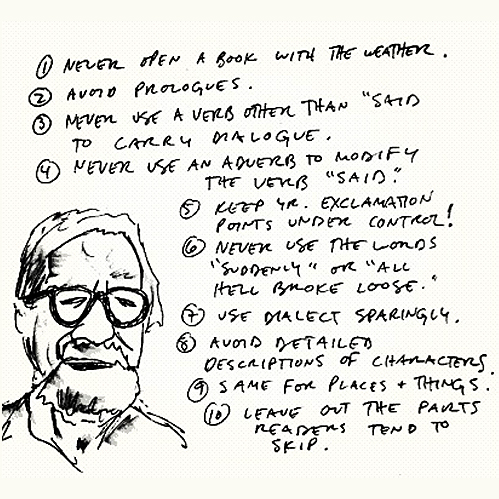
Here’s one way to become a better writer. Listen to the advice of writers who earn their daily bread with their pens. During the past week, lists of writing commandments by Henry Miller, Elmore Leonard (above) and William Safire have buzzed around Twitter. (Find our Twitter stream here.) So we decided to collect them and add tips from a few other veterans — namely, George Orwell, Margaret Atwood, and Neil Gaiman. Here we go:
Henry Miller (from Henry Miller on Writing)
1. Work on one thing at a time until finished.
2. Start no more new books, add no more new material to “Black Spring.”
3. Don’t be nervous. Work calmly, joyously, recklessly on whatever is in hand.
4. Work according to the program and not according to mood. Stop at the appointed time!
5. When you can’t create you can work.
6. Cement a little every day, rather than add new fertilizers.
7. Keep human! See people; go places, drink if you feel like it.
8. Don’t be a draught-horse! Work with pleasure only.
9. Discard the Program when you feel like it–but go back to it the next day. Concentrate. Narrow down. Exclude.
10. Forget the books you want to write. Think only of the book you are writing.
11. Write first and always. Painting, music, friends, cinema, all these come afterwards.
George Orwell (From Why I Write)
1. Never use a metaphor, simile, or other figure of speech which you are used to seeing in print.
2. Never use a long word where a short one will do.
3. If it is possible to cut a word out, always cut it out.
4. Never use the passive where you can use the active.
5. Never use a foreign phrase, a scientific word, or a jargon word if you can think of an everyday English equivalent.
6. Break any of these rules sooner than say anything outright barbarous.
Margaret Atwood (originally appeared in The Guardian)
1. Take a pencil to write with on aeroplanes. Pens leak. But if the pencil breaks, you can’t sharpen it on the plane, because you can’t take knives with you. Therefore: take two pencils.
2. If both pencils break, you can do a rough sharpening job with a nail file of the metal or glass type.
3. Take something to write on. Paper is good. In a pinch, pieces of wood or your arm will do.
4. If you’re using a computer, always safeguard new text with a memory stick.
5. Do back exercises. Pain is distracting.
6. Hold the reader’s attention. (This is likely to work better if you can hold your own.) But you don’t know who the reader is, so it’s like shooting fish with a slingshot in the dark. What fascinates A will bore the pants off B.
7. You most likely need a thesaurus, a rudimentary grammar book, and a grip on reality. This latter means: there’s no free lunch. Writing is work. It’s also gambling. You don’t get a pension plan. Other people can help you a bit, but essentially you’re on your own. Nobody is making you do this: you chose it, so don’t whine.
8. You can never read your own book with the innocent anticipation that comes with that first delicious page of a new book, because you wrote the thing. You’ve been backstage. You’ve seen how the rabbits were smuggled into the hat. Therefore ask a reading friend or two to look at it before you give it to anyone in the publishing business. This friend should not be someone with whom you have a romantic relationship, unless you want to break up.
9. Don’t sit down in the middle of the woods. If you’re lost in the plot or blocked, retrace your steps to where you went wrong. Then take the other road. And/or change the person. Change the tense. Change the opening page.
10. Prayer might work. Or reading something else. Or a constant visualisation of the holy grail that is the finished, published version of your resplendent book.
Neil Gaiman (read his free short stories here)
1. Write.
2. Put one word after another. Find the right word, put it down.
3. Finish what you’re writing. Whatever you have to do to finish it, finish it.
4. Put it aside. Read it pretending you’ve never read it before. Show it to friends whose opinion you respect and who like the kind of thing that this is.
5. Remember: when people tell you something’s wrong or doesn’t work for them, they are almost always right. When they tell you exactly what they think is wrong and how to fix it, they are almost always wrong.
6. Fix it. Remember that, sooner or later, before it ever reaches perfection, you will have to let it go and move on and start to write the next thing. Perfection is like chasing the horizon. Keep moving.
7. Laugh at your own jokes.
8. The main rule of writing is that if you do it with enough assurance and confidence, you’re allowed to do whatever you like. (That may be a rule for life as well as for writing. But it’s definitely true for writing.) So write your story as it needs to be written. Write it honestly, and tell it as best you can. I’m not sure that there are any other rules. Not ones that matter.
William Safire (the author of the New York Times Magazine column “On Language”)
1. Remember to never split an infinitive.
2. The passive voice should never be used.
3. Do not put statements in the negative form.
4. Verbs have to agree with their subjects.
5. Proofread carefully to see if you words out.
6. If you reread your work, you can find on rereading a great deal of repetition can be by rereading and editing.
7. A writer must not shift your point of view.
8. And don’t start a sentence with a conjunction. (Remember, too, a preposition is a terrible word to end a sentence with.)
9. Don’t overuse exclamation marks!!
10. Place pronouns as close as possible, especially in long sentences, as of 10 or more words, to their antecedents.
11. Writing carefully, dangling participles must be avoided.
12. If any word is improper at the end of a sentence, a linking verb is.
13. Take the bull by the hand and avoid mixing metaphors.
14. Avoid trendy locutions that sound flaky.
15. Everyone should be careful to use a singular pronoun with singular nouns in their writing.
16. Always pick on the correct idiom.
17. The adverb always follows the verb.
18. Last but not least, avoid cliches like the plague; seek viable alternatives.
Related Content:
Ray Bradbury Gives 12 Pieces of Writing Advice to Young Authors (2001)
John Steinbeck’s Six Tips for the Aspiring Writer and His Nobel Prize Speech
Elmore Leonard’s Ultimate Guide for Would-Be Writers
Read More...We Were Wanderers on a Prehistoric Earth: A Short Film Inspired by Joseph Conrad
“We were wanderers on a prehistoric earth,” says the narrator Marlow in Joseph Conrad’s Heart of Darkness, “on an earth that wore the aspect of an unknown planet. We could have fancied ourselves the first of men taking possession of an accursed inheritance, to be subdued at the cost of profound anguish and of excessive toil.”
The palpable menace that permeates Conrad’s classic novella has been edited out of the narration in this short film, made for Tourism Malaysia by British filmmaker James W. Griffiths. What remains is a poetic sense of wonder for a natural world that is no longer frightening, no longer in need of being subdued. In the original, the twisting and turning sentences are like a microcosm of a journey up the winding Congo River, into the metaphorical darkness that lies at the heart of all men. Out of the stillness of the page, Conrad’s imagination washes over us in a rolling wave of words:
The great wall of vegetation, an exuberant and entangled mass of trunks, branches, leaves, boughs, festoons, motionless in the moonlight, was like a rioting invasion of soundless life, a rolling wave of plants, piled up, crested, ready to topple over the creek, to sweep every little man of us out of his little existence. And it moved not.
Griffiths can perhaps be forgiven for defanging Conrad. We Were Wanderers on a Prehistoric Earth is a beautiful little film, a quiet meditation on the unspoiled rainforest of West Malaysia shot in November by cinematographer Christopher Moon, who also collaborated with Griffiths on last year’s award-winning Nokia cellphone film Splitscreen. The music is by Lennert Busch, the sound design is by Mauricio d’Orey, and Conrad’s words are spoken by Terry Burns.
Read More...The Fantastic Flying Books of Mr. Morris Lessmore: An Oscar-Nominated Film for Book Lovers
The Fantastic Flying Books of Mr. Morris Lessmore offers a modern tribute to an old world. Made with an animation style that blends stop motion with computer animation and traditional hand-drawing, the silent film pays homage to a bygone era when elegantly printed books inhabited our world. The 15-minute short is the first made by Moonbot Studios, a fledgling animation shop in Shreveport, Louisiana. For their efforts, Moonbot’s founders (William Joyce, Brandon Oldenburg and Lampton Enochs) received an Oscar-nomination this week (Best Animated Short), putting them in competition with two other films featured on Open Culture: Sunday and Wild Life.
We recommend watching The Fantastic Flying Books of Mr. Morris Lessmore in “Couch mode” on Vimeo, or downloading it for free in HD from iTunes. iPad owners will also want to consider buying the related app ($4.99) that turns the film into an interactive narrative experience.
For more animated bibliophilia, don’t miss:
Spike Jonze Presents a Stop Motion Film for Bibliophiles
Books Savored in Stop Motion Film
Going West: A Stop Motion Novel
Books Come to Life in Classic Cartoons from 1930s and 1940s
Read More...Before Brokeback: The First Same-Sex Kiss in Cinema (1927)
BrainPickings recently highlighted the first kiss in cinema history. That takes you back to 1896, to a film brought to you by Thomas Edison. Now we rewind the videotape and present the first same-sex kiss in film history (or at least one of the earliest known ones). This Brokeback-before-Brokeback moment took place in the 1927 film Wings — the first and only silent film to win the Academy Award for Best Picture. Buddy Rogers and Richard Arlen star in the film, playing two combat pilots who vie for the affection of the same woman (Clara Bow). That’s the storyline. But neither, as writer Kevin Sessums writes, “shows as much love for her … as they do for each other.”
Find more classics in our collection, 4,000+ Free Movies Online: Great Classics, Indies, Noir, Westerns, Documentaries & More.
Follow Open Culture on Facebook and Twitter and share intelligent media with your friends. Or better yet, sign up for our daily email and get a daily dose of Open Culture in your inbox. And if you want to make sure that our posts definitely appear in your Facebook newsfeed, just follow these simple steps.
Read More...Wilco Rehearses ‘The Weight’ Backstage in Chicago with Mavis Staples and Nick Lowe
In December, the alternative rock band Wilco played a special series of hometown shows called the “Incredible Shrinking Tour of Chicago.”
The tour kicked off on December 12 at the majestic Civic Opera House and continued over the next four nights, moving to successively smaller and more intimate venues: the Riviera, the Vic, the Metro, and finally Lincoln Hall, with a capacity of only 500 people.
At the opera house on opening night, Wilco played a 24-song retrospective of the band’s 18-year history, followed by an extended series of encores featuring Mavis Staples and Nick Lowe. The grand finale was a stirring rendition of The Band’s classic “The Weight.”
Photographer Zoran Orlic caught a special moment before the show (above), when the musicians gathered in the dressing room to rehearse “The Weight.” You can see amateur footage of the on-stage performance of the song here, and learn more about the concert (plus see a clip of the band performing “One Sunday Morning”) on the WXRT website.
And for an interesting comparison, watch The Band’s performance of “The Weight” (below) from Martin Scorsese’s film The Last Waltz, which also features a guest appearance by Mavis Staples, along with her father and sisters in The Staple Singers. Although the film consisted mostly of footage from The Band’s farewell concert on November 25, 1976, Scorsese filmed “The Weight” afterward, on an MGM soundstage.
Read More...Cambridge Nights: Late Night TV-Style Show Takes Deep Look at Scientific Thinking
Cambridge, Massachusetts is one of the world’s great intellectual crossroads. With Harvard University at one end of town and the Massachusetts Institute of Technology at the other, many of the most influential thinkers of our time either work there or visit. That gave César Hidalgo an idea.
Hidalgo is a professor at M.I.T., where he studies the relationship between physics, network science and economic development. Building on his own interdisciplinary curiosity, Hidalgo thought it would be interesting to share a little of Cambridge’s intellectual wealth with the outside world, so in October he and the M.I.T. Media Lab launched a series of informal Web interviews called Cambridge Nights: Conversations About a Life in Science.
Cambridge Nights is a little like The Tonight Show with Jay Leno, if Leno talked about things like fractal geometry in the metabolic theory of ecology. That’s the subject of the discussion above featuring the renowned physicist Geoffrey West, professor and past president of the Santa Fe Institute, who gives a fascinating account of the universal scaling laws that pervade all life, from single-celled organisms and complex species to whole ecosystems.
What sets Cambridge Nights apart from other Web forums, like BigThink, is that guests are under no pressure to compress or “popularize” their ideas. “We invite them because we want to hear what they have to say, and we want to give them the time to say it comfortably,” writes Hidalgo. “There are many high-speed formats out there. Cambridge Nights is an alternative where thoughts can be developed and reflected upon without the need to rush.”
In the first season, Hidalgo talks with six scholars from fields spanning the natural and social sciences, including physicist and network scientist Albert-László Barabási, biologist Marc Vidal and international development expert Lant Pritchett. A number of guests are already lined up for Season Two, including experimental psychologist Steven Pinker.
To view all six videos from Season One, and to learn more about the project, visit the Cambridge Nights website.
Courses from MIT can be found in our collection of 400 Free Courses Online.
Read More...Yosemite National Park in All of Its Time-Lapse Splendor
This video shows Yosemite National Park in all of its glory. Watch as darkness descends over Half Dome after a gorgeous sunset. Then, looking to the heavens, we observe the brilliant sky and the millions of stars visible. It’s Yosemite like you’ve never seen it before.
The video was created by Sheldon Neill and Colin Delehanty, who share an interest in time-lapse photography and found each other via Vimeo. The result, after numerous visits to Yosemite, was this completed project. All time-lapses were shot on the Canon 5D Mark II with a variety of Canon L and Zeiss CP.2 lenses. The music accompanying the video is “Outro” from the new album Hurry Up, We’re Dreaming by electronic band M83.
One of the scenes from this video is of El Capitan, a vertical rock formation that’s twice the height of the Empire State Building. Wall: The Journey Up tells the heroic story of Steve Wampler’s quest to become the first person with Cerebral Palsy to climb El Capitan. The inspiring video/film trailer is worth watching.
Eugene Buchko is a blogger and photographer living in Atlanta, GA. He maintains a photoblog, Erudite Expressions, and writes about what he reads on his reading blog.
Read More...A Robot That Flies with the Grace of a Bird: A Great TED Flight
The dream of flight fired the imagination of Leonard da Vinci in the early sixteenth century. In designing his famous flying machines, the painter, sculptor, architect, mathematician, engineer, inventor, anatomist — ah heck, let’s just call him a Renaissance man — closely studied the mechanics of birds in flight, noting the elegant ways in which they turn and glide. Centuries later the Wright Brothers got us off the ground, but never with equal grace. It has taken a long time, but finally engineers at the German company, Festo, have found a way to mechanically reproduce the beauty of birds in flight. They call their robot the SmartBird, and they showed it off last year at TED.
Read More...Support Us
We're hoping to rely on loyal readers, rather than erratic ads. Please click the Donate button and support Open Culture. You can use Paypal, Venmo, Patreon, even Crypto! We thank you!

About Us

Open Culture scours the web for the best educational media. We find the free courses and audio books you need, the language lessons & educational videos you want, and plenty of enlightenment in between.
Advertise With Us

FREE UPDATES!
GET OUR DAILY EMAIL
Get the best cultural and educational resources on the web curated for you in a daily email. We never spam. Unsubscribe at any time.
FOLLOW ON SOCIAL MEDIA

Open Culture editor Dan Colman scours the web for the best educational media. He finds the free courses and audio books you need, the language lessons & movies you want, and plenty of enlightenment in between.
Advertise With Us

