The Sins of the Renaissance, or The History That Shaped Michele Bachmann’s Worldview
During the 1970s, Francis A. Schaeffer, an evangelical theologian, wrote and narrated How Should We Then Live?, a ten-part film series that traced the history of Western culture and thought. Lots of art and philosophy were put on display. But the real narrative focused on something a little different — the history of humanity’s lapse from God and a Biblical worldview. The film became a sensation at evangelical churches across America, sometimes drawing 5,000 people per screening. And, as Ryan Lizza writes in a New Yorker profile published this week, the film had a life-altering effect on Michele Bachmann, the US Representative now vying for the presidency.
For Schaeffer, the big turning point came during the Renaissance. That’s when things went wrong. He laments (starting around the 10:45 mark above):
At the beginning of the Renaissance, it could have gone either way. Nature could have had its proper place. Man could have been in his proper place, and it would have been absolutely beautiful. But at a certain point in the Renaissance, the scales tipped, and man put himself at the center absolutely, and this opened the door completely to the whole destructive force of humanism that followed down through the Enlightenment [otherwise called “The Age of Non Reason”] and into our own day.
If you want to see where this destructive force brings us, you need only turn to the last segment “Final Choices.” (Part 1 — Part 2 — Part 3) According to Schaeffer, we end up under the control of an authoritarian elite that imposes its arbitrary will on the people, sometimes injecting birth control into the water supply, and sometimes deciding who will be born, and who won’t. The authoritarian elite resides in no one place. It’s shadowy, doing its work in many places. But one place you definitely find it? The Supreme Court that gave us Roe v. Wade.
Should you wish, you can watch the remaining segments via the links below.
Episode I — The Roman Age
Episode II — The Middle Ages
Episode III — The Renaissance
Episode IV — The Reformation
Episode V — The Revolutionary Age
Episode VI — The Scientific Age
Episode VII — The Age of Non Reason
Episode VIII — The Age of Fragmentation
Episode IX — The Age of Personal Peace & Affluence
Episode X — Final Choices (Part 1 — Part 2 — Part 3)
via The LA Times
Read More...The Making of The Shining
In 1980, Stanley Kubrick shot The Shining, the classic horror film based on Stephen King’s novel. During production, the director allowed his daughter Vivian, then 17 years old, to shoot a documentary called Making The Shining, which lets you spend 33 minutes being a fly on the wall. The film originally aired on the BBC and gave British audiences the chance to see Jack Nicholson revving himself up to act, and Shelley Duvall collapsing in the hallway from stress and fatigue. Minutes later, we watch Mr. Kubrick exert some directorial force on the actress, and we understand her predicament all the more.
via Coudal.com
If you would like to support the mission of Open Culture, consider making a donation to our site. It’s hard to rely 100% on ads, and your contributions will help us continue providing the best free cultural and educational materials to learners everywhere. You can contribute through PayPal, Patreon, and Venmo (@openculture). Thanks!
Related Content:
4,000+ Free Movies Online: Great Classics, Indies, Noir, Westerns, Documentaries & More
Download & Play The Shining Board Game
Stanley Kubrick’s Annotated Copy of Stephen King’s The Shining
Saul Bass’ Rejected Poster Concepts for The Shining (and His Pretty Excellent Signature)
Read More...A Day in California
Opinions are famously mixed on Southern California. It has never been Woody Allen’s kind of place. In Annie Hall, he quipped “I mean, who would want to live in a place where the only cultural advantage is that you can turn right on a red light.” But this is coming from a guy who prefers fog and overcast skies to sunny days at the beach, someone who doesn’t quite connect with what has drawn 25 million people to the region. Ryan Killackey’s short film, “A Day in California,” will speak to those residents, or anyone who dreams of the Southern California life. He worked on the project for a year and a half, and it combines 10,000 images into a seamless whole. Learn more about the project or watch the film here.
via @alyssa_milano
Read More...Ken Kesey’s First LSD Trip Animated
Back in 1959, Ken Kesey, then a grad student in Stanford’s creative writing program, started participating in government-sponsored medical research that tested a range of hallucinogens — LSD, psilocybin, mescaline, and the rest. As part of the research project, Kesey spoke into a taperecorder and recounted the ins-and-outs of his hallucinations. These tapes were eventually stored away, and Kesey went on to write One Flew Over the Cuckoo’s Nest, a book that now sits on TIME’s list of the 100 Best English-Language Novels since 1923.
A half century later (and ten years after Kesey’s own death), the LSD tapes live again. This week, the filmmaker Alex Gibney will release Magic Trip, a new documentary that revisits Kesey’s fabled road trip across America with the Merry Pranksters and their psychedelic “Further” bus. (Tom Wolfe, you might recall, famously covered this trip with The Electric Kool-Aid Acid Test, published in 1968.) Taken from the new film, the sequence above mixes the rediscovered tapes with some artful animation, and it captures the whole mood of Kesey’s first trip …
If you would like to support the mission of Open Culture, consider making a donation to our site. It’s hard to rely 100% on ads, and your contributions will help us continue providing the best free cultural and educational materials to learners everywhere. You can contribute through PayPal, Patreon, and Venmo (@openculture). Thanks!
Related Content:
Beyond Timothy Leary: 2002 Film Revisits History of LSD
Timothy Leary’s Wild Ride and the Folsom Prison Interview
via Wired
Read More...The Adoration of the Mona Lisa Begins with Theft
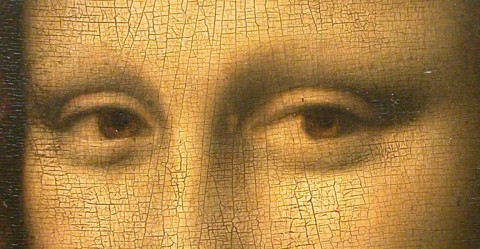
Every year, five million visitors stream into the Louvre in Paris, making it the most visited museum in the world. And, more than any other painting, visitors head to see Leonardo da Vinci’s Mona Lisa, painted circa 1503 — 1519.
It’s tempting to attribute the popularity of the Mona Lisa to the enduring genius of da Vinci. But, as NPR’s All Things Considered recounts, there was a time when the painting hardly attracted public attention, and what turned the painting into an object of public adoration was something baser than genius itself: brazen theft. Click here and NPR will tell you the story of the great Mona Lisa heist that went down on August 21, 1911, almost 100 years ago…
Related Content:
A Virtual Tour of the Sistine Chapel
Google “Art Project” Brings Great Paintings & Museums to You
MoMA Puts Pollock, Rothko & de Kooning on Your iPad
Read More...David Lynch’s Video Response to Washington Debt Deal
No one is happy with Washington D.C. this week, and that includes filmmaker David Lynch, who gives you his commentary in sounds and images, not words. The symbolism? America is in a dark position and moving backwards? The deficit deal is flat out garbage?
H/T @opedr
Related Content:
David Lynch and Interpol Team Up on Short Film
David Lynch’s Organic Coffee (Barbie Head Not Included)
David Lynch on his Favorite Movies and Filmmakers
Read More...Al Jazeera: The Top 1% in America
Al Jazeera forced many Westerns viewers to take their reporting seriously during the Egyptian uprising this spring, and now the Qatar-based news network has released a timely reportage (Aug. 2) on the fault lines in America — on the gap between rich and poor that only grew wider this week. Alexis de Tocqueville they’re not. There’s no subtle sociology here. But, at the same time, I suspect that this foreign perspective on the U.S. won’t appear unfamiliar to many Americans. The program runs 24 minutes, and other shows in the Fault Lines series can be viewed on YouTube here. H/T @courosa
Read More...Snack Foods of Great Writers
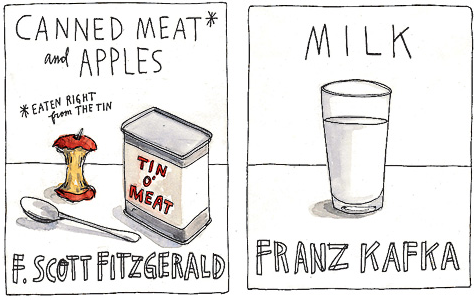 Wendy MacNaughton, an artist and illustrator living in San Francisco, wondered what snacks fueled some of our greatest writers. F. Scott Fitzgerald turned to apples and canned meats, and Kafka to milk, during their daily writing routines. How about Lord Byron, Emily Dickinson, Marcel Proust, John Steinbeck, Truman Capote or food writer Michael Pollan? MacNaughton tells you about their dietary habits in The New York Times Book Review. (And it just so happens you can find texts by many of these authors in our collection of Free eBooks.)
MacNaughton’s illustrated column, “Meanwhile,” appears regularly at The Rumpus.
Read More...The Tarantino Mixtape (NSFW)
Take Quentin Tarantino’s movies, then let Eclectic Method deconstruct and reconstruct the scenes, leaving you with The Tarantino Mixtape, which is a little Not Safe for Work.
Based in London, the members of Eclectic Method have been experimenting with audio-visual mixing of sounds and images for a good decade. 60+ of their videos appear online, including their latest release — a Star Wars remix called Dark Wars. H/T Devour
Related Content:
What if Tarantino Directed the Super Bowl Broadcast?
“Tarantino’s Mind,” Award Winning Short Film
Tarantino’s Favorite Films Since ’92
Read More...Life in Moments/Moments in Life
Back in 2009, the folks at RadioLab tackled another big question: “What happens at the moment when we slip from life…to the other side? Is it a moment? If it is, when exactly does it happen? And what happens afterward?”
The show (listen here) inspired filmmaker Will Hoffman to shoot a video the meditates on the little moments that give life (and death) their meaning. Some moments stand in isolation. Others moments are connected, creating a link between birth and death, cause and effect, beginnings and ends. In this audio clip, Hoffman talks with RadioLab co-host Robert Krulwich about the vision informing the video simply called Moments. And, if it delights, don’t miss two other Hoffman/RadioLab productions, one simply called Words, the other Symmetry.
Read More...Support Us
We're hoping to rely on loyal readers, rather than erratic ads. Please click the Donate button and support Open Culture. You can use Paypal, Venmo, Patreon, even Crypto! We thank you!

About Us

Open Culture scours the web for the best educational media. We find the free courses and audio books you need, the language lessons & educational videos you want, and plenty of enlightenment in between.
Advertise With Us

FREE UPDATES!
GET OUR DAILY EMAIL
Get the best cultural and educational resources on the web curated for you in a daily email. We never spam. Unsubscribe at any time.
FOLLOW ON SOCIAL MEDIA

Open Culture editor Dan Colman scours the web for the best educational media. He finds the free courses and audio books you need, the language lessons & movies you want, and plenty of enlightenment in between.
Advertise With Us

