37 Hitchcock Cameo Appearances Over 50 Years: All in One Video
Early in his career, Alfred Hitchcock began making small appearances in his own films. The cameos sometimes lasted just a few brief seconds, and sometimes a little while longer. Either way, they became a signature of Hitchcock’s filmmaking, and fans made a sport of seeing whether they could spot the elusive director. From 1927 to 1976, Hitchcock made 37 appearances in total, and they’re all nicely catalogued by Hitchcock.TV and the clip above.
If you’re hungry for a good film over the long Labor Day weekend, then don’t miss our collection 22 Free Hitchcock Films Online, which includes The 39 Steps, The Lodger, The Man Who Knew Too Much and other early classics. Or simply dive into our meta collection, 4,000+ Free Movies Online: Great Classics, Indies, Noir, Westerns, Documentaries & More. You’re bound to find something you like…
If you would like to support the mission of Open Culture, consider making a donation to our site. It’s hard to rely 100% on ads, and your contributions will help us continue providing the best free cultural and educational materials to learners everywhere. You can contribute through PayPal, Patreon, and Venmo (@openculture). Thanks!
Related Content:
Alfred Hitchcock Recalls Working with Salvador Dali on Spellbound
Read More...Santiago de Compostela: A View From the Octocopter
Microcoptervideo is a Spanish company that specializes in shooting videos using small remote-control helicopters called “octocopters.” (You can see the one used in this video here; and if you want to build one yourself, you can find instructions here.) Since these small helicopters go places where normal cameras can’t, these newfangled cameras can offer views that are simply out of this world.
The latest video gives you a tour of the medieval Santiago de Compostela Cathedral located in northern Spain. It starts with beautiful views of the exterior, but the most impressive shots are saved for inside the cathedral, especially when the octocopter soars high above the chamades of the organ, giving us an incredible look at the choir.
Some of these views have been captured as stills and can be seen at Flickr. And don’t forget to enjoy some more of those wonderful octocopter videos on this Vimeo page.
By profession, Matthias Rascher teaches English and History at a High School in northern Bavaria, Germany. In his free time he scours the web for good links and posts the best finds on Twitter.
Read More...Mr. Deity: The Everyday Life of the Creator
Not long after the devastating tsunami of 2004, Brian Keith Dalton began working on a skit that morphed into Mr. Deity, a satirical look at our Creator and his everyday struggle to manage his new creation. The first episode (above) aired on iTunes and the web in early 2007, and straightaway, we encounter Mr. Deity and his sidekick Larry bumbling their way through the Genesis story and related theological questions. (Also don’t miss the pair trying to figure out how to light their new world.) By the second episode, we’re already skipping forward to the New Testament and Mr. Diety recruiting a skeptical Jesus for an important job. Talk about awkward.
57 episodes have since followed, including the most recent installment — Mr. Deity and the Philosopher — released just last week. You can find all episodes easily on iTunes. When it comes to the web, Seasons One, Three and Four appear officially on YouTube, and Season 2 can be best viewed via this informal collection.
Related Content:
Steve Martin Writes Song for Hymn-Deprived Atheists
Woody Allen and the Reverend Billy Graham In Conversation
Read More...Sweet Jane: Then and Now
The Velvet Underground first released “Sweet Jane” in 1970, and a cool version it was. But, soon enough, Lou Reed launched his solo career, put out a live version of “Sweet Jane” on Rock n Roll Animal (1974), and made the song his own. That same year, Reed performed another funk-laden version in Paris, with Prakash John playing bass and Steve Hunter on guitar. And that’s what the vintage video gods are serving up today.
All these years later, Sweet Jane still fires the rock ‘n roll imagination. In 2009, Reed performed the anthem with Metallica at the Rock and Roll Hall of Fame Benefit Concert at Madison Square Garden, and it laid the foundation for a project now coming to fruition — a collaborative album called Lulu that will drop on October 31st in the US, and November 1 abroad. Reed originally wrote the songs for a play called Lulu, then he brought Metallica into the sometimes emotional project and things just rolled along. In a recent interview with New York Magazine, Reed said, “the version of the Lulu music I did with Metallica is awe-inspiring. It’s maybe the best thing done by anyone, ever. It could create another planetary system. I’m not joking, and I’m not being egotistical.” The bar is now officially set high…
Related Content:
Warhol’s Screen Tests: Lou Reed, Dennis Hopper, Nico, and More
The Velvet Revolution Revisited: Havel at Columbia
Read More...The Decemberists’ New Video Inspired by Scenes from Infinite Jest
Michael Schur, the co-creator of NBC’s Parks and Recreation, has had a long-running fascination with David Foster Wallace’s sprawling magnum opus, Infinite Jest. So when his favorite band, The Decemberists, asked him to shoot a video for their new track “Calamity Song,” he knew the creative direction he wanted to take. And so here it is — the newly-premiered video that makes “Eschaton” its creative focus. Fans of DWF’s novel will remember that Eschaton — “basically, a global thermonuclear crisis recreated on a tennis court” — appears on/around page 325. The New York Times has more, and you can also find another version of the video if you’re having problems viewing it here.
Related Content:
The David Foster Wallace Audio Project
The Best Magazine Articles Ever, Curated by Kevin Kelly
Read More...Richard Feynman: The New Graphic Novel
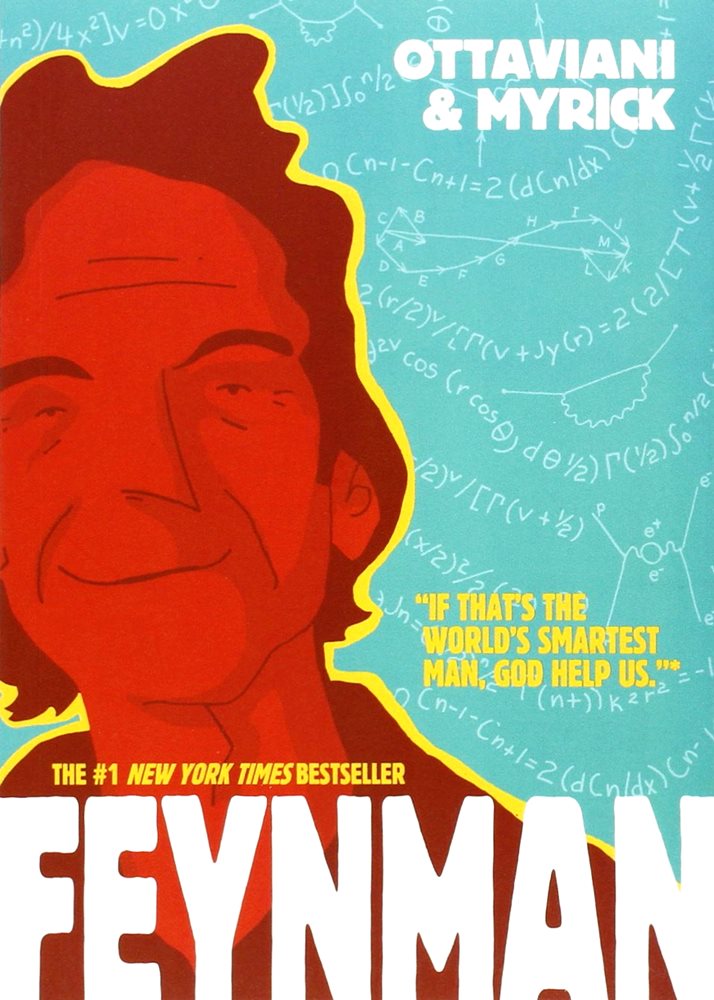
Last week, we highlighted The Last Journey Of A Genius, a documentary that recorded the final days of the great physicist Richard Feynman and his obsession with traveling to Tannu Tuva, a state outside of outer Mongolia.
Now here is what next week will bring — a new “substantial graphic novel biography” that “presents the larger-than-life exploits of the Nobel-winning quantum physicist, adventurer, musician and world-class raconteur.” The book written by Jim Ottaviani and illustrated by Leland Myrick runs a fairly hefty 272 pages. The video clip on Youtube will give you a good feel for the artwork that tells Feynman’s personal tale.
If you would like to support the mission of Open Culture, consider making a donation to our site. It’s hard to rely 100% on ads, and your contributions will help us continue providing the best free cultural and educational materials to learners everywhere. You can contribute through PayPal, Patreon, and Venmo (@openculture). Thanks!
Related Content:
Richard Feynman’s Physics Lectures Online
The Pleasure of Finding Things Out
Read More...Extreme Photography: Shooting Big Climbs at Yosemite
When you think photography and Yosemite National Park, you think of Ansel Adams shooting “Moon and Half Dome” or “El Capitan.”
But today we’re thinking about something a little different — about the vertigo-inducing photography of Renan Ozturk. Working on behalf of National Geographic, Ozturk heads to Yosemite to shoot a feature story on the climbing culture that thrives in this valley surrounded by 3000-foot rock walls. The park features extreme A5 climbs that constantly push climbers to new limits, and naturally it takes a special photographer to record the action. How Renan does it? We’ll let him tell the rest of the story … H/T Curiosity Counts
Follow us on Facebook and Twitter, and we’ll deliver great culture right to your virtual doorstep, day in, day out.
Read More...The DIY Tornado Machine
Bob Smerbeck, a senior meteorologist for AccuWeather.com, has figured it all out — how to let loose a tornado in the comfort of his own home. Using a hair dryer, plastic tubes, and a light switch, Smerbeck can recreate the basic dynamics of supercell thunderstorms that produce tornadoes — except his tornadoes are inches, not miles, wide.
As Scientific American explains it, tornadoes take form when winds occurring at different levels of the atmosphere vary in direction causing thunderstorms to rotate, and when the rotation within the thunderstorm extends down to the ground. Smerbeck’s DIY machine simulates these movements, and you can do the same. You will just need to follow a series of videos created by the Tornado Project on YouTube. Start with Part 1 here, and then proceed to Parts 2, 3, 4, 5, and 6.
More fascinating videos can be found in our new collection: 125 Great Science Videos: From Astronomy to Physics & Psychology
Follow us on Facebook and Twitter, and we’ll deliver great culture right to your virtual doorstep, day in, day out.
Read More...Hiroshima After the Atomic Bomb in 360 Degrees

In early August 1945, the world officially entered the atomic age when the United States dropped two devastating bombs on Hiroshima and Nagasaki, killing 200,000 people. The destruction is hard to put to words. But when words fail, images begin to fill the void.
Last week, 360Cities gave viewers one very stark reminder of what happened 66 years ago when the site posted a panoramic view of Hiroshima. When you click here, you can look north, south, east and west at the widespread destruction. Nothing was left untouched. This panorama is the byproduct of several images taken by different photographers — three from the United States and one from Japan. The 360Cities blog tells you more about the project here. H/T Gizmodo
Related Content:
Hiroshima Atomic Bombing Remembered with Google Earth
Way of Life: Rare Footage of the Hiroshima Aftermath, 1946
Read More...David Lynch’s Eraserhead Remade in Clay
David Lynch spent five years working on his surrealist film Eraserhead, and when it finally hit cinemas in 1977, critics panned the film. (Variety called it a “sickening bad-taste exercise.”) Then, adding insult to injury, the film was rejected by the Cannes Film Festival.
Time has certainly been kinder to Eraserhead. Over the years, Stanley Kubrick, George Lucas, and John Waters have counted themselves as major fans of the film. Charles Bukowski claimed that his love affair with cable television started when he first tuned in and started watching Eraserhead. Rock bands have named themselves after the film. And now the latest honor: Lee Hardcastle has remade the film in claymation, and the plot unfolds in pretty much 60 seconds flat. H/T opedr
More Claymation Films:
William S. Burroughs’ Claymation Christmas Film
Read More...Support Us
We're hoping to rely on loyal readers, rather than erratic ads. Please click the Donate button and support Open Culture. You can use Paypal, Venmo, Patreon, even Crypto! We thank you!

About Us

Open Culture scours the web for the best educational media. We find the free courses and audio books you need, the language lessons & educational videos you want, and plenty of enlightenment in between.
Advertise With Us

FREE UPDATES!
GET OUR DAILY EMAIL
Get the best cultural and educational resources on the web curated for you in a daily email. We never spam. Unsubscribe at any time.
FOLLOW ON SOCIAL MEDIA

Open Culture editor Dan Colman scours the web for the best educational media. He finds the free courses and audio books you need, the language lessons & movies you want, and plenty of enlightenment in between.
Advertise With Us

