The Thinking Man’s iPod
Spend some time on iTunes, and you’ll find some excellent cultural podcasts, simply hours worth of high-touch intellectual content. And the excellent part is that the trove is growing, and the quality content keeps on coming.
The rub is that it takes time to separate the wheat from the chaff — too much time, if you honestly ask me. So, for the benefit of our readers, we’ve rolled up our sleeves, sifted through it all, and isolated the high-value content that’s worth your time. Spend some time rummaging through our iTunes Cultural Podcast Collection, and you’ll be sure to find among the cultural programs and audio texts something that piques your interest. Separately, you can also explore our University iTunes Collection, another collection of podcasts from 25 of America’s leading educational institutions. Together, they should keep you thinking, learning and growing for a while.
Also check out our list of University Podcasts on iTunes. It includes lots of great campus lectures and full-fledged courses.
Read More...The 10 Best Books of the Year
Last week, The New York Times’ Book Review published its list, 100 Notable Books of the Year and it has since followed up with a whittled down list, The 10 Best Books of 2006. It’s boiled down to 5 works of fiction, and 5 non-fiction, and here’s what it looks like:
FICTION
ABSURDISTAN — Gary Shteyngart
THE COLLECTED STORIES OF AMY HEMPEL — Amy Hempel
THE EMPEROR’S CHILDREN — Claire Messud
THE LAY OF THE LAND — Richard Ford
SPECIAL TOPICS IN CALAMITY PHYSICS — Marisha Pessl
NONFICTION
FALLING THROUGH THE EARTH: A Memoir — Danielle Trussoni
THE LOOMING TOWER: Al-Qaeda and the Road to 9/11. — Lawrence Wright.
MAYFLOWER: A Story of Courage, Community, and War — Nathaniel Philbrick
THE OMNIVORE’S DILEMMA: A Natural History of Four Meals — Michael Pollan
THE PLACES IN BETWEEN — Rory Stewart
(Note: This list won’t appear in print until the December 10th.)
Read More...100 Notable Books of the Year
Gift buying season is upon us, and it’s time to start thinking about a thoughtful gift for friends and family. On December 3, The New York Times Book Review will publish in print its list, “100 Notable Books of the Year.” However, you can catch it online beforehand and use it to start making your list.
UPDATE: The New York Times has since followed up with its whittled down list, The 10 Best Books of 2006. Click here for more info.
Read More...Beyond Belief
These days, the Enlightenment project finds itself in a tense cultural competition with religion. Go around the US and ask, “how did we come to be?” and you will get different answers. Some, appealing to science and reason, the children of the Enlightenment, will look to evolution for answers. Others, with a religious bent, will refer you to the Bible or intelligent design — which is another way of saying, God is behind it all.
Is the Enlightenment project nearing an end? Can science and reason eventually reassert themselves, perhaps as powerfully as religion recently has? Or, can science and religion at least co-exist and address different questions?
Earlier this month, an impressive list of scientists and philosophers got together at the Salk Institute for a conference called, “Beyond Belief: Science, Religion, Reason and Survival.” The presenters ranged from Richard Dawkins (Oxford’s well-known evolution theorist), to Joan Roughgarden (a Stanford professor who recently wrote Evolution and Christian Faith: Reflections of an Evolutionary Biologist), to Craig Venter (who helped decode the human genome). Thanks to The Science Network, the so-called “C‑SPAN of science,” you can watch the videos of the different conference presentations for free online.
Read More...Robert Altman
Robert Altman has died at 81, leaving behind a legacy of ambitious films. After making his mark with MASH in 1970, Altman’s career moved along in fits and starts. He would give us The Long Goodbye in 1973, Nashville in 1975, unfortunately Popeye in 1980 (and nothing else too remarkable during the 1980s), then two career-reviving films, The Player and Short Cuts, in 1992 & 1993, and Gosford Park in 2001. Despite being a five-time Academy Award nominee for best director, Altman never received an Oscar until this past year, when he received a lifetime achievement award, recognizing his distinctive film-making style. Glimpses into discrete slices of American life (Hollywood, the country music scene, the fashion world, etc.), large casts, long improvised scenes, complex mosaics of characters — these were all trademarks of Altman’s filmmaking, and what his legacy will call to mind.
Altman’s complete filmography
New Yorker Review of Nashville (1975)
Here, Altman talks about the difficulties of making MASH
Read More...Milton Friedman Remembered
Milton Friedman, a Nobel Prize winner, architect and leading advocate of free markets, and one of the most important economists of the 20th century, died this past week at 94.
The University of Chicago, where Friedman taught since 1946, has collected a series of articles reviewing his life and accomplishments. Along similar lines, Stanford’s Hoover Institution, with which Friedman was affiliated from 1977 until his death, has posted a page that includes links to videos featuring the economist. (Look for the videos under the area called “Publications.”)
Finally, from the Youtube archives, you can see a short clip from 1980, where we find a younger Milton Friedman and Don Rumsfeld in conversation.
Read More...Google Presents the Classics (for Free)
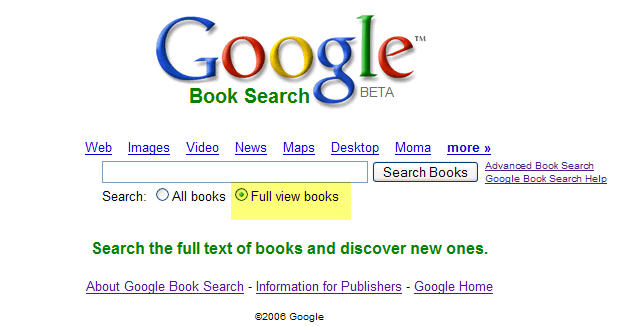
There’s more to Google Book Search than a good lawsuit. These days, they’re serving up the classics — all in the public domain– for free. Literary folks can now read and search the complete collection of Shakespeare’s works. And, in some cases, you can even download PDF versions to your computer. Beyond the Bard, you can also get The Iliad and The Odyssey, from the original bard, Homer. A little Dante’s Inferno in Italian, plus Machiavelli’s The Prince in translation. And Jane Austen’s Pride and Prejudice. I think you get the picture. If it’s old and classic, you can nab it at Google Book Search.
Resources:
- Other Major eText Collections: check out this Open Culture page.
- Google’s Scary Stories — For Halloween, Google put together a nice page where you can read or download some spooky classics on the cheap. Here, you’ll find Bram Stoker’s Dracula, Henry Jame’s Turn of the Screw, Robert Louis Stevenson’s Dr. Jekyll and Mr. Hide, and more. For more info, see Google’s Blog entry.
- Related Google Blog Entries
- Download the Classics
- Preserving Public Domain Books
- A New Way to Browse Books — On Google’s Blog, they mention that, with the help of Ajax, they just improved the usability of Book Search. It’s worth reading how you can now get the most out of the product.
- See our collection of Free eBooks
A Harvard Free Ride
What do sleeping and computing have in common? Not a whole lot (nor really should they), except for this. We sleep and use computers a good chunk of our lives, and yet we generally have no idea how either works. Sleep is the 33% of our lives that we hardly give a thought to. And computing, well, few of us know what’s going on inside that box when we turn it on, open a program, surf the web or, alas, get a virus.
As usual, Harvard has answers, at least for the techies among us. But instead of asking students to go into hock to get them, this time the university is giving the answers away. (Consider it a gift from the school’s $29.2 billion endowment.) Courtesy of the Harvard Extension School, any student who can’t make it to Cambridge can freely access the online course Understanding Computers and the Internet. The course, which revolves around a series of 14 lectures, is conveniently delivered in several formats — one version that downloads to your computer, another that downloads to the Ipod/iTunes, and finally one that streams over the web, which you can find at Google Video and Youtube. To get started, to get your little piece of Harvard for free, click here.
Read More...E.O. Wilson’s Olive Branch: The Creation
A world renowned biologist, devoted Darwinist, and unabashed secular humanist, Harvard’s E.O. Wilson has taken an intriguing religious turn with his latest work, “The Creation: An Appeal to Save Life on Earth.” A Baptist by upbringing, Wilson offers literally a sermon addressed to America’s large and growing evangelical community. The essence of the message is simple: We might have our political and intellectual differences, but, when it comes to staving off environmental disaster, we need to put our simmering differences aside and work together to solve a problem that affects us all. We need to save God’s creation. If you consider the divide between red and blue America, you’d figure that Wilson’s overture would fall on deaf ears. But, as Wilson tells it on NPR, it’s anything but the case, and the first signs suggest that the culture wars aren’t blinding either side from the much bigger issues at stake.
Recent reviews:
Washington Post: “Science and Salvation”
New York Times: “God is Green”
The Christian Post “Heeding Edward O. Wilson”
Read More...Science Podcast Collection
Please visit this page at the following url:
https://www.openculture.com/weblog/2007/02/science_podcast.html
Read More...Support Us
We're hoping to rely on loyal readers, rather than erratic ads. Please click the Donate button and support Open Culture. You can use Paypal, Venmo, Patreon, even Crypto! We thank you!

About Us

Open Culture scours the web for the best educational media. We find the free courses and audio books you need, the language lessons & educational videos you want, and plenty of enlightenment in between.
Advertise With Us

FREE UPDATES!
GET OUR DAILY EMAIL
Get the best cultural and educational resources on the web curated for you in a daily email. We never spam. Unsubscribe at any time.
FOLLOW ON SOCIAL MEDIA

Open Culture editor Dan Colman scours the web for the best educational media. He finds the free courses and audio books you need, the language lessons & movies you want, and plenty of enlightenment in between.
Advertise With Us

