Watch the Last, Transcendent Performance of “Echoes” by Pink Floyd Keyboardist Richard Wright & David Gilmour (2006)
“Gentle, unassuming and private.” These are the words David Gilmour chose in his eulogy of Richard Wright, Pink Floyd’s keyboard player and co-songwriter, who joined the band in 1964 and stayed with them through all of their major albums, leaving after The Wall and rejoining for A Momentary Lapse of Reason. Wright was the quiet one; drummer Nick Mason compared him to George Harrison, and like Harrison, he was also Pink Floyd’s secret weapon, helping to deliver many of their most career-defining songs.
Wright may rarely get much mention in songwriting tributes to Pink Floyd’s warring leaders or its tragic elfin first singer/songwriter Syd Barrett (“had his profile been any lower,” one obituary put it, “he would have been reported missing.”), but his “soulful voice and playing were vital, magical components of our most recognized Pink Floyd sound,” Gilmour went on. “In my view, all of the greatest PF moments are the ones where he is in full flow.”
Wright’s jazz training gave an improvisatory bent. His formal music education gave him an ear for composition. He was the band’s most versatile musician, playing dozens of instruments in addition to his signature Farfisa organ, and he was equally at home writing orchestral pieces or falling into whatever groove the band cooked up, as on their sixth studio album, Meddle, which emerged from several stages of experimental methods and happy accidents like the “ping” sound Wright’s piano makes at the beginning of the sprawling epic “Echoes,” the 23-minute second side of the album.
The song continued to grow, overdub by overdub. Waters wrote lyrics, Gilmour experimented with a sound effect he’d stumbled on by plugging his wah-wah pedal in backwards. If you ask Wright, as Mojo did in their final interview with him in 2008, the year of his death, it was largely his piece. Or at least, “the whole piano thing at the beginning and the chord structure for the song is mine.”
Like so many of Wright’s compositions, “Echoes” is also a showcase for Gilmour’s soaring solos and delicate rhythm playing. The interplay between the two musicians is on transcendent display in Wright’s final, live 2006 performance of the song before he succumbed to cancer two years later, for an audience of 50,000 at the Gdańsk Shipyard in Poland, recorded on the last show of Gilmour’s On an Island tour.
This is really great stuff. The filmed performance, which appears on Gilmour’s album and concert film Live in Gdańsk, shows both Wright and Gilmour in top form, trading solos and creating the kind of atmosphere only those two could. Gilmour has said he’ll never perform the song again without Wright. It’s hard to imagine that he even could.
The band closed with the 20-plus-minute “Echoes” every night of the tour, and Wright brought out his old Farfisa just for the song. Given how long Gilmour and Wright had been completing each other’s virtuoso strengths as co-creators of instrumental moods, every performance on the tour was surely something special. But in hindsight, none are as moving as this one—the last time fans would ever have the experience of seeing Pink Floyd, or one version of them, recreate the magic of “Echoes” live onstage.
Related Content:
Clare Torry’s Rare Live Performances of “Great Gig in the Sky” with Pink Floyd
Josh Jones is a writer and musician based in Durham, NC. Follow him at @jdmagness
Read More...Revisit Six of Elton John’s Most Iconic Concerts, Streaming in Their Entirety for 72 Hours
Just as Bohemian Rhapsody introduced Freddy Mercury to an unsuspecting generation of young fans, last year’s Elton John biopic, Rocketman, has netted its subject a host of fresh admirers.
John’s newest fans were born into a far different world than the one that was astounded when he declared, in a 1976 interview with Rolling Stone, that he was bisexual.
Now a knight (the first openly gay musician to be so anointed), Sir Elton is using his enormous public platform to encourage youth who may be struggling with their sexuality or gender identity and to end the global AIDS epidemic.
To date, the Elton John AIDS Foundation has raised over $450,000,000 to support HIV-related programs in fifty-five countries, and is now doubling down with coronavirus relief efforts for the population it has long served.
To that end, Sir Elton is revisiting six of his most iconic performances over the last half-century, posting a concert in its entirety to his Youtube channel every week in hope that viewers will be moved to make a donation at concert’s end.
(As further incentive, an anonymous supporter has pledged to match donations up to $250,000.)
Each concert streams for 72 hours, but clips of individual songs linger longer.
Last week the Classic Concert Series turned the dial back 30 years to find Sir Elton playing a 1st-century Roman amphitheater—Italy’s Arena di Verona—as part of his 130-show Reg Strikes Back tour. His interplay with singers Mortonette Jenkins, Marlena Jeter, and Kudisan Kai during an 8‑minute gospel-tinged spin on “Sad Songs (Say So Much),” above, is a highlight of the 22-song set.
The series kicked off at the Playhouse Theater in Edinburgh in 1976 as “Don’t Go Breaking My Heart” was topping the charts, and continues to the Sydney Entertainment Center ten years further on, when Sir Elton defied doctor’s orders, performing despite vocal nodules.
On July 24, John takes us along to Rio’s Estadio Do Flamengo when the release of 1995’s Made In England prompted his first ever tour of Brazil.
The following week, we’ll enter the 21st-century with a pitstop at Madison Square Garden before the series comes to a close at the Great Amphitheater in Ephesus, Turkey.
Watch Elton John’s Classic Concert Series on his Youtube channel, and even though it’s not obligatory, seek out the blue donation button that appears on every post. You can also make a tax deductible donation via the Elton John AIDS Foundation’s website.
Related Content:
Elton John Takes Us Through the Creative Process of His Early Hit “Tiny Dancer” (1970)
Elton John Sings His Classic Hit ‘Your Song’ Through the Years
Ayun Halliday is an author, illustrator, theater maker and Chief Primatologist of the East Village Inky zine. Follow her @AyunHalliday.
Read More...W.E.B. Du Bois Devastates Apologists for Confederate Monuments and Robert E. Lee (1931)
Who won the U.S. Civil War? “The north, of course,” you say… but ah… if you did not know the answer, you would have reason to be confused. Who loses a war and puts up statues of its heroes on the victor’s land? In the south, say, in Northern Virginia, you’ll find public shrines to Stonewall Jackson, public highways named for Jefferson Davis, and public schools named after Robert E. Lee and J.E.B. Stewart. These are not historical monuments, i.e. preserved battlefields, graveyards, or historic homes. They were erected decades after the war. You’ll find them in California, Oregon, and Washington state, which did not exist at the time.
Next question: who did the Confederacy fight in the Civil War? The Union, of course. But the leaders of the region also warred with another enemy, as they had for over two hundred years: millions of enslaved people kept in brutal subjection. In many respects, they won this war, though they lost the privileges of legal slavery. Once Andrew Johnson came to power, the south reinstituted conditions that were often more or less the same for Black people as they had been before the war. Grant struggled to reverse the tide, but Reconstruction ultimately failed.
This is the victory the south commemorated when organizations like the United Daughters of the Confederacy and Sons of Confederate Veterans put up monuments to southern generals all over the country. It is the victory invoked by the Battle Flag of the Army of Northern Virginia (or the “Confederate Flag”). A defiance of multi-racial democracy and a government that serves the needs of all its citizens; a menacing promotion of white supremacist mythology, maintained with public funds on public lands. Those symbols include:
- 780 monuments, more than 300 of which are in Georgia, Virginia or North Carolina;
- 103 public K‑12 schools and three colleges named for Robert E. Lee, Jefferson Davis or other Confederate icons;
- 80 counties and cities named for Confederates;
- 9 observed state holidays in five states; and
- 10 U.S. military bases.
But, no, one might say, these are observances for the southern dead, who were, after all, Americans too. This is what we’ve heard, over and over. It was a hoary old story when W.E.B. Du Bois heard it in the early decades of the twentieth century. “Lost Cause” ideology had done its work, flooding the culture with sympathetic portrayals of the Confederacy, a wave of propaganda that reached its apex in the spectacle of 1915’s Birth of a Nation (first titled The Clansman), responsible for resurrecting the Ku Klux Klan.
The story went something like this: “No nobler young men ever lived; no braver soldiers ever answered the bugle call nor marched under a battle flag,” proclaimed southern industrialist Julian Carr at the 1913 dedication of Confederate statue Silent Sam, which stood on the campus of the University of North Carolina in Chapel Hill until activists tore it down recently. “They fought, not for conquest, not for coercion, but from a high and holy sense of duty. They were like the Knights of the Holy Grail.”
Carr goes on like this at length, reciting poetry and making constant references to Greek heroes and gods. His purpose, he says, is to memorialize “the Sacred Cause.” But he never says what that cause is, though he has many exalted words for “the noble women of my dear Southland, who are to-day as thoroughly convinced of the justice of that cause.” The speech is boilerplate Confederate apologism: an almost hysterically bombastic defense of the south that never once mentions slavery.
Yet in an odd moment, Carr breaks off—during a rant about “what the Confederate soldier meant to the welfare of the Anglo Saxon race”—to make a “rather personal… allusion” for seemingly no reason:
One hundred yards from where we stand, less than ninety days perhaps after my return from Appomattox, I horse-whipped a negro wench until her skirts hung in shreds, because upon the streets of this quiet village she had publicly insulted and maligned a Southern lady, and then rushed for protection to these University buildings where was stationed a garrison of 100 Federal soldiers. I performed the pleasing duty in the immediate presence of the entire garrison, and for thirty nights afterwards slept with a double-barrel shot gun under my head.
What does it say about his audience that Carr thinks this admission reflects well on him? Du Bois understood it. He had diagnosed the fear and violent hatred men like Carr embodied and seen their cowardice and desperate overcompensation. “They preach and strut and shout and threaten,” he wrote in The Souls of White Folk, “crouching as they clutch at rags of facts and fancies to hide their nakedness, they go twisting, flying by my tired eyes and I see them ever stripped—ugly, human.”
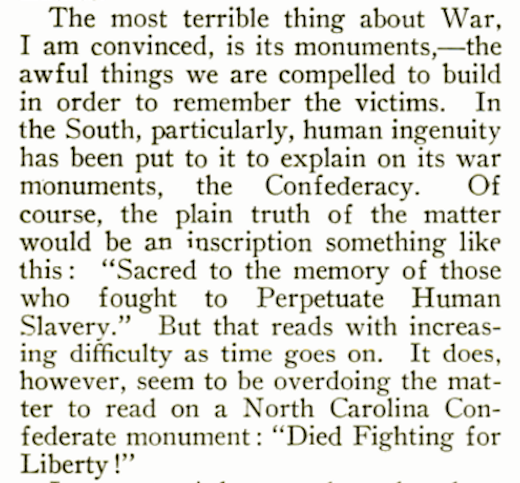
Du Bois knew what Confederate monuments were meant to represent. In 1931, he cut to the heart of the matter in brief remarks published in The Crisis (top). “Du Bois pushes right back against the myth of the Lost Cause,” writes historian Kevin M. Levin. “He refuses to draw a distinction between the Confederate government and men in the ranks,” as represented by statues like Silent Sam. “Du Bois clearly understood that as long as white southerners were able to mythologize the war through their monuments, African Americans would remain second class citizens.”
He did not refer to monuments put up in Confederate cemeteries, as many had been immediately after the war, but to the hundreds of statues and other memorials erected in prominent places of government beginning around 1900. “All of these monuments were there to teach values to people,” says Mark Elliott, professor of history at University of North Carolina, Greensboro. “That’s why they put them in the city squares. That’s why they put them in front of state buildings.” It’s why there are Confederate statues in the U.S. Capital, gifts to the nation from southern states, gladly accepted.
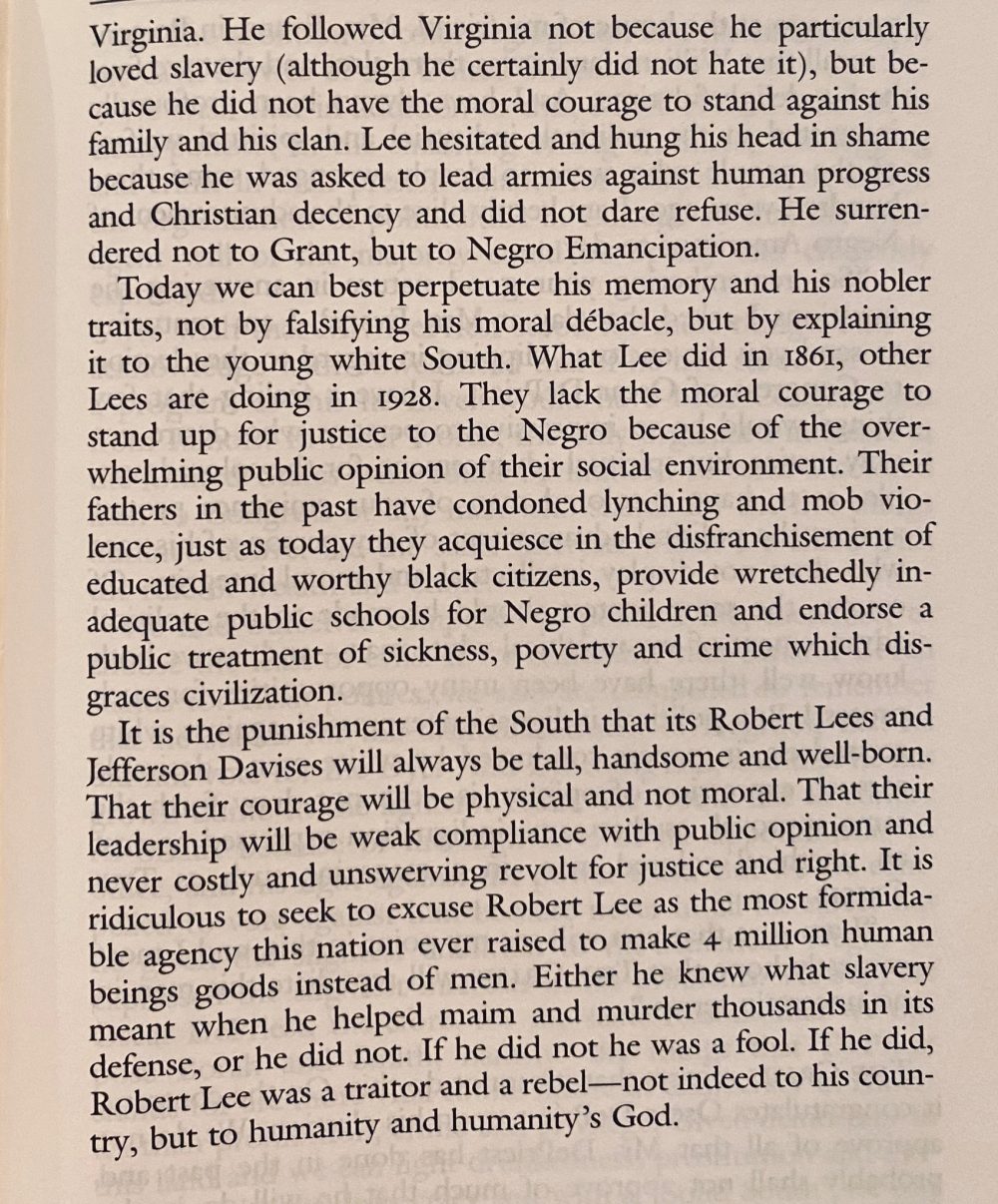
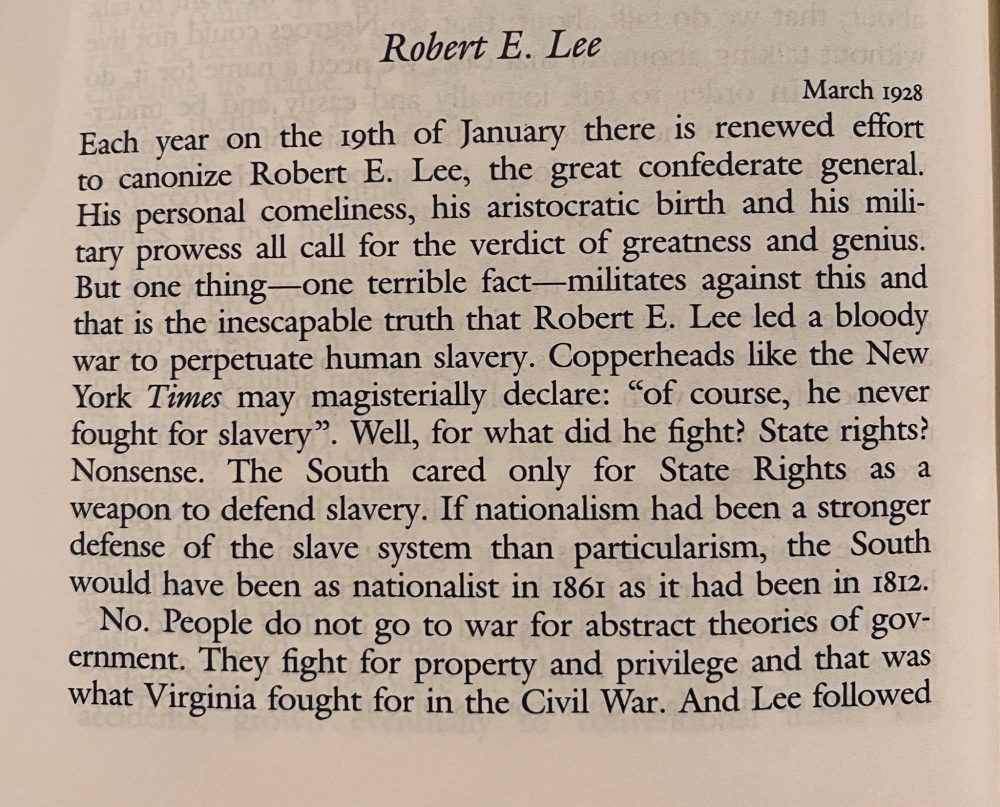
Three years earlier, Du Bois had written many choice words about attempts to deify Confederate leaders like Robert E. Lee (who himself opposed monuments). He also countered the argument that the war was about “States Rights” in one incisive sentence: “If nationalism had been a stronger defense of the slave system than particularism, the South would have been as nationalist in 1861 as it had been in 1812.” None of the high-flown rhetoric about “the cause” of governing principles had anything to do with it, Du Bois argues. “People do not go to war for abstract theories of government. They fight for property and privilege.”
One statue in North Carolina, Du Bois notes wryly in his Crisis remarks, goes so far as to claim that Confederate soldiers “Died Fighting for Liberty!” This would not strike Lost Cause defenders like Carr as ironic. They too fought for liberty, of a kind—the freedom to punish, kill, imprison, exploit, disenfranchise, and otherwise terrorize and impoverish Black Americans at will.
Related Content:
The Civil War & Reconstruction: A Free Course from Yale University
Josh Jones is a writer and musician based in Durham, NC. Follow him at @jdmagness
Read More...Raymond Chandler’s 36 Great Unused Titles: From “The Man With the Shredded Ear,” to “Quick, Hide the Body”
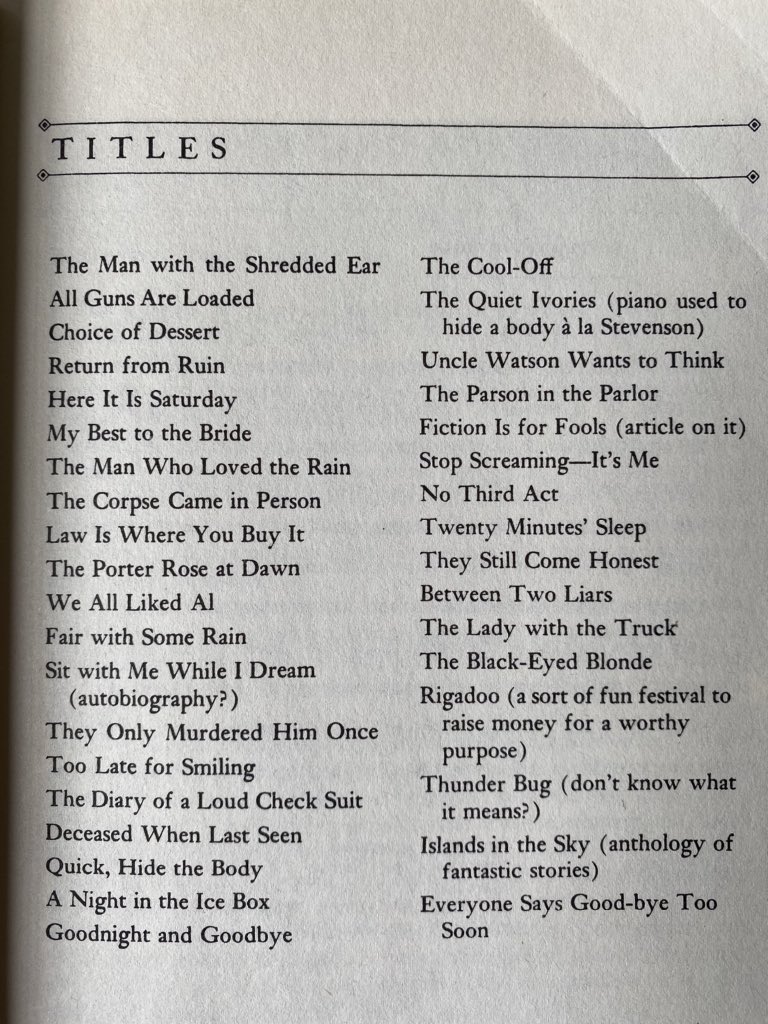
For Chandler’s birthday today. He was born on this day in 1888.
Related Content:
Raymond Chandler’s Ten Commandments for Writing a Detective Novel
Watch Raymond Chandler’s Long-Unnoticed Cameo in Double Indemnity
Read More...
Devo De-Evolves the Rolling Stones’ “(I Can’t Get No) Satisfaction”: See Their Groundbreaking Music Video and Saturday Night Live Performance (1978)
In 1978, the debut album by a forcefully idiosyncratic new wave band out of Akron, Ohio both asked and answered a question: Q: Are We Not Men? A: We Are Devo! When we look back on the still-active group’s career more than 40 years later, we may still ask ourselves who, or what, Devo are. Given that they’re a rock band — albeit only just recognizable as one at the time they hit it big — we could define them by their songs. Were Devo made Devo by their their first single, “Mongoloid”? Or was it “Whip It,” their biggest hit and the Devo song we all know today?
There’s also a case to be made that few of us would ever have heard of Devo if they hadn’t recorded their cover of another band’s defining song: the Rolling Stones’ “(I Can’t Get No) Satisfaction.” Devo’s “wicked deconstruction,” writes Allmusic critic Steve Huey, “reworks the original’s alienation into a spastic freak-out that’s nearly unrecognizable.” At The New Yorker, Ron Padgett tells the story of the recording and release of Devo’s “Satisfaction,” a process that began with a rhythm track co-founder Gerald Casale calls “some kind of mutated devolved reggae.” Aesthetically, this tied neatly in with the band’s central concept: “that instead of evolving, society was in fact regressing (‘de-evolving’) as humans embraced their baser instincts.”
It was Casale, by day a catalog designer for a janitorial supply company, who discovered the baggy yellow waste-disposal suits Devo would wear in the “Satisfaction” music video — a daring enough medium to begin with, given the paucity of venues for such productions in the late 70s. But “when MTV launched, in 1981,” writes Padgett, “very few bands had videos ready for the network to play. As a result, Devo’s ‘Satisfaction’ video earned endless rotations.” But the big break came “when they performed the song on Saturday Night Live, wearing the suits and pitch-black sunglasses, and doing the same jerky robo-motions, as in the video.”
You can see their SNL performance, introduced by the late Fred Willard, in the clip above. Negotiated by the band’s manager Elliot Roberts in exchange for bringing Neil Young on a later broadcast, the appearance exposed Devo to an audience that included no few viewers hungry for just the kind of subversiveness the band’s music exuded. All this only happened because Mick Jagger himself had given Devo’s spastic freakout his blessing — and, as recorded in the book Devo: Unmasked, somehow managed to dance to it as he did so. Later, as Casale remembers it, Roberts claimed to have suggested in advance to Jagger’s people that he “just says he likes it, because it’s going to make him a lot of money.” Or could that living embodiment of rock stardom be a closet subscriber to the theory of de-evolution?
Related Content:
The Mastermind of Devo, Mark Mothersbaugh, Presents His Personal Synthesizer Collection
DEVO Is Now Selling COVID-19 Personal Protective Equipment: Energy Dome Face Shields
Watch Phish Play All of The Rolling Stones’ Classic Album, Exile on Main Street, Live in Concert
The Rolling Stones’ “Gimme Shelter” Played by Musicians Around the World
A Big 44-Hour Chronological Playlist of Rolling Stones Albums: Stream 613 Tracks
Based in Seoul, Colin Marshall writes and broadcasts on cities, language, and culture. His projects include the book The Stateless City: a Walk through 21st-Century Los Angeles and the video series The City in Cinema. Follow him on Twitter at @colinmarshall, on Facebook, or on Instagram.
Read More...The Rolling Stones Release a Long Lost Track Featuring Led Zeppelin’s Jimmy Page
The Rolling Stones are readying a re-release of their 1973 album Goats Head Soup in September, featuring demos and rarities and all sorts of goodies. Yesterday, they dropped the above song: “Scarlet.” Never bootlegged before, this firecracker of a track features Led Zeppelin’s Jimmy Page on guitar.
The recording happened in October 1974, long, long after the recording of the Goats Head Soup tracks in Jamaica at Dynamic Sound Studios. In fact, they’d also finished recording It’s Only Rock and Roll, Goats Head Soup’s follow-up. Mick Taylor was about to leave the band. But in this case, Led Zep and the Stones were two groups passing in the night, or in this case the corridors of London’s Island Studios.
Jimmy Page was there recording solo with Richards, along with a group that included Ian Stewart (a longtime unofficial member of the Stones) on piano, Traffic’s Ric Grech on bass, and Bruce Rowland on drums.
“My recollection is we walked in at the end of a Zeppelin session,” says Richards. “They were just leaving, and we were booked in next and I believe that Jimmy decided to stay. We weren’t actually cutting it as a track, it was basically for a demo, a demonstration, you know, just to get the feel of it, but it came out well, with a lineup like that, you know, we better use it.”
The initial sketch of the song came out of an earlier jam session, according to Jagger:
“I remember first jamming this with Jimmy and Keith in Ronnie (Wood)’s basement studio,” he said. “It was a great session.” The choppy riff is very much Keith Richards all over. Jagger’s lyrics are rough too, and you can hear a shared melody with “Angie,” their hit from that year.
Named after Page’s young daughter, “Scarlet” coulda woulda shoulda been a single or even an album track, but was shelved for whatever reason.
In the Stones’ minds, Goats Head Soup was one of their best. But when it came out in August the music press considered it as a pale follow-up to the sprawling Exile on Main Street. The band were riding high, but their fame sort of turned on this album, as the band started to reference themselves and plunge into true 1970s rock star excess. Lester Bangs hated the album, writing in Creem, “just because the Stones have abdicated their responsibilities is no reason we have to sit still for this shit! Because there is just literally nothing new happening.”
Allen Crowley, also in Creem, noted the generational shift happening: “The Stones are still consummate entertainers, but somewhere along the line we began to expect something more than entertainment from them. In Beggars Banquet and Let It Bleed, the Stones began to tell us what was going on… And that’s what missing in this very durable record. And beneath that knowledge is the wonderment at how that durable expertise carries on in the face of disintegration.”
Rolling Stone’s Bud Coppa was more enthusiastic, knowing that a lot of Stones’ albums are sleepers: “Soup stands right next to Mott, the thematically similar LP of the Stones’ brightest students, as the best album of 1973. For me, its deepening and unfolding over the coming months will no doubt rate as one of the year’s richest musical experiences.”
Over the years, the critical reception has come around on Goats Head Soup. Not a classic, but not a disaster—it was a conscious break with the muffled sounds of Exile, yet still filled with lyrics about crime, despair, and alienation. It’s not the happiest of albums.
And by the way, this would not be the last time Jimmy Page played with the Stones. He played the solo on their 1986 single “One Hit (to the Body).”
Related Content:
A Big 44-Hour Chronological Playlist of Rolling Stones Albums: Stream 613 Tracks
Ted Mills is a freelance writer on the arts who currently hosts the Notes from the Shed podcast and is the producer of KCRW’s Curious Coast. You can also follow him on Twitter at @tedmills, and/or watch his films here.
Read More...Pretty Much Pop: A Culture Podcast #53 Explores the Hamilton Phenomenon
Your hosts Erica Spyres, Mark Linsenmayer, and Brian Hirt are joined by Broadway actor Sam Simahk (Carousel, The King and I, My Fair Lady) to discuss this unique convergence of musical theater, rap, and historical drama. Does Hamilton deserve its accolades? We cover the re-emergence of stage music as pop music, live vs. filmed vs. film-adapted musicals, creators starring in their shows, race-inclusive casting, and the politics surrounding the show.
Some articles we looked at included:
- “Lin-Manuel Miranda Responds to the ‘Hamilton is Canceled’ Controversy” by Samantha Vincenty
- “Meet the People who Didn’t Like Hamilton” by Zachary Pincus-Roth
- “Why We Need ‘Hamilton’ Now More than Ever” by Alan Sepinwall
- “Watching Hamilton Will Give You What You So Desperately Need This Pandemic: Hope” by Jessica Gold
- “Hamilton Is Fanfic, and it’s Historical Critics are Totally Missing the Point” by Aja Romano
- “How the ‘Hamilton’ Effect Is Reverberating Across Broadway” by Gordon Cox
- “Should Hamilton Be Eligible For Oscars?” by Eric Eisenberg and Mike Reyes
- Sam found this Tumblr user’s argument for casting minorities helpful.
Learn more at prettymuchpop.com. This episode includes bonus discussion including Sam that you can only hear by supporting the podcast at patreon.com/prettymuchpop. This podcast is part of the Partially Examined Life podcast network.
Pretty Much Pop: A Culture Podcast is the first podcast curated by Open Culture. Browse all Pretty Much Pop posts.
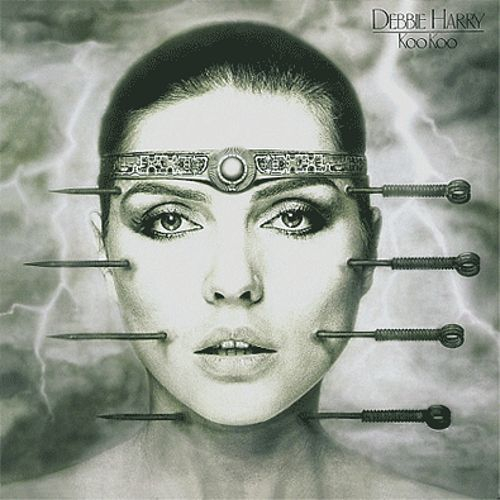
Read More...H.R. Giger’s Dark, Surrealist Album Covers: Debbie Harry, Emerson, Lake & Palmer, Celtic Frost, Danzig & More
The work of H.R. Giger is immensely powerful. Giger’s amazing cover for Emerson, Lake and Palmer’s album Brain Salad Surgery portrays a Gothic touch that could fit any heavy metal band at any time.
—Jimmy Page
Swiss artist Hans Ruedi Giger is a genre unto his own, single-handedly inventing the biomechanical horror of the 1980s with his designs for Ridley Scott’s 1979 Alien, the film that launched him into international prominence and turned Debbie Harry on to his work. Meeting him the following year, the Blondie singer asked Giger to design the cover and music videos for her solo album, KooKoo.
The album was panned, but the cover ended up being as prescient as the film that preceded it. It would “see its influence in films like Hellraiser, the rise of what was called the ‘modern primitive’ movement, and help cultivate the dark masochistic character Harry would play in David Cronenberg’s Videodrome,” writes Ted Mills in an earlier Open Culture post. “It was a feeling that would flourish in the decadent ‘80s.”
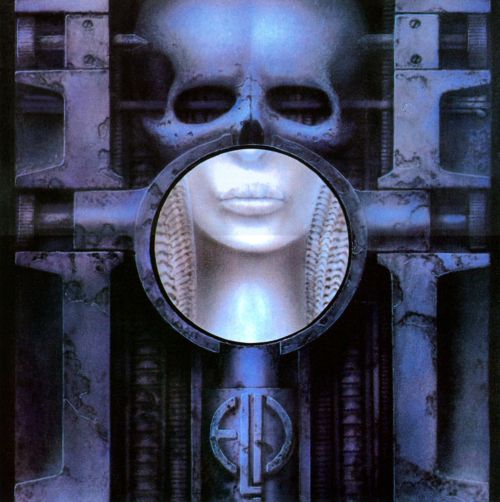
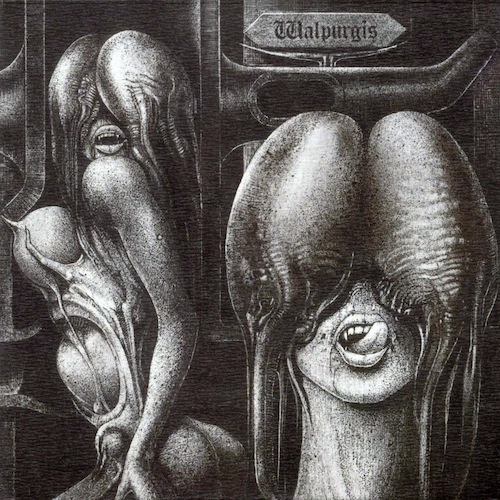
The record was also, in a way, “a throwback to Giger’s other famous record cover, the one for Emerson, Lake, and Palmer’s Brain Salad Surgery” from 1973 (above). Ten years before Alien, Giger designed his first album cover, for a “proto-metal” band called The Shivers.
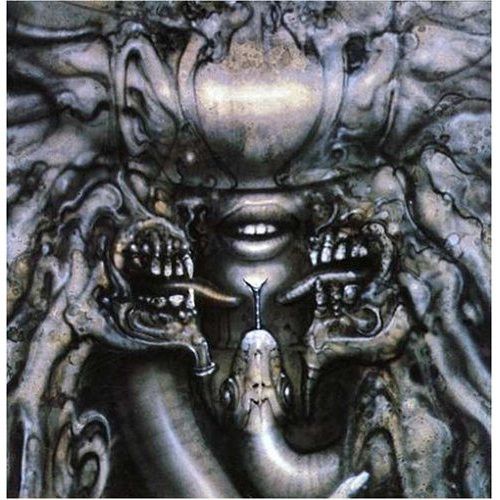
Their 1969 Walpurgis, features what look very much like Alien’s facehuggers. Giger had been having this nightmare for a long time. Years after these beginnings, due in large part to Alien and its sequels and the Debbie Harry cover, Giger became highly sought after by metal bands, from Celtic Frost to Danzig to Carcass.
His work appears, however, on far more album covers than he would like. There have been “many small bands over the years,” he writes on his site, “presumably fans of mine, who had appropriated my artwork for their album and CD covers,” without getting permission. Giger himself has only created a few pieces specifically as album cover art, the last in 1989 for Steve Stevens’ Atomic Playboys. “Of the approximately 20 records on which my artwork has been seen over the last 30 years,” he writes, only a small number have been commissions. These include The Shivers, ELP, Harry, and Stevens.
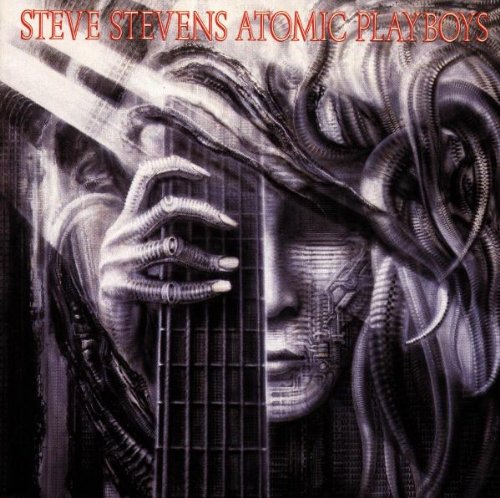
All the other covers—those officially sanctioned, in any case—come from work Giger “made for myself, many years before, which the bands, later, licensed for their own use after seeing them in my books.” Though Giger himself is more of a jazz fan, his appeal to heavy metal is obvious. “Giger’s style of adding a surrealist twist to mechanical and biological scenes,” writes Allmusic, “often with twisted sexual undertones—was immediately identifiable,” and immediately identified a band as something seductively taboo and possibly deadly.
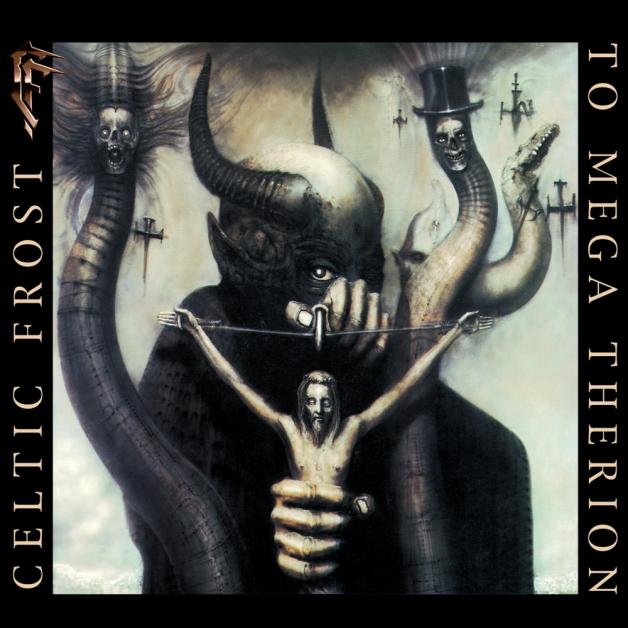
At least one use of his work got a band prosecuted. “Bay Area punks the Dead Kennedys included a poster of Giger’s Landscape #XX, also known as Penis Landscape (the image depicted rows of erect phalluses in coitus), in the packaging of their 1985 album Frankenchrist,” writes Rolling Stone, “and were subsequently put on trial for obscenity.”
Those who would misuse his work and violate his copyright may also find themselves in court. “It will,” he warns, “cost a lot more than if they had first contacted me, through my agent, to ask for permission.”
Related Content:
When Debbie Harry Combined Artistic Forces with H.R. Giger
Josh Jones is a writer and musician based in Durham, NC. Follow him at @jdmagness
Read More...Lin-Manuel Miranda Breaks Down How He Wrote Hamilton’s Big Hit, “My Shot”
The current moment has forced the original cast and crew of Lin-Manuel Miranda’s massive hit musical Hamilton to revisit and reevaluate the story it tells about America’s founding. As Miranda himself told The Root’s Tonja Renée Stidhum, “All of these guys are complicit in the brutal practice of slavery, slavery is the third line of our show… that is just a prerequisite for the story we’re telling.” But he didn’t first set out to write history. “Originally, this was a concept album. I wanted to write a hip hop album, so I was never picturing the guys on the statues that are being torn down right now. I was picturing, ‘What are the voices that are best suited to tell the story.’”
Debuting in more optimistic times, when the country had its first Black president, Hamilton declared, says Leslie Odom, Jr. (who played Aaron Burr) that “if this history belongs to all of us… then we’re going to take it and we’re going to say it and use our own words to tell it!” Controversy and critique aside, there’s no denying Miranda’s tremendous gifts as a dramatist and songwriter, on display not only in Hamilton but in the Moana soundtrack.
How does he do it? Riding the wave of renewed Hamilton fandom after the Disney release of the original cast film, Miranda recently sat down with Rotten Tomatoes to discuss his process. When he gets to Hamilton, he gives us a detailed breakdown of “My Shot,” which, he says, took him a year to write.
“It was not only writing Hamilton’s ‘I want’ song,” says Miranda, “although it certainly is that. It was also proving my thesis that Hamilton’s intellect is what allows him to propel through the narrative of the story.” The play’s protagonist proves his intellectual worthiness by mastering and making his own the styles of Miranda’s favorite rappers, from Big Pun to Jay Z to Biggie to Mobb Deep. “I’m grabbing from the influences and paying homage to those influences. …I’m literally calling on the ancestors of this flow. …The ‘Whoah’ section, I’ll just say, is based on the AOL startup sound because I wanted it to feel like …his words are connecting with the world.”
Whether or not any of Hamilton’s younger viewers have ever heard the AOL startup sound, the detail reveals how Miranda’s mind works. His creations emerge from a matrix of references and allusions, each one chosen for its specific relation to the story. Many of these callbacks go over the audience’s heads, but they still have their intended effect, creating tension in “the densest couplets that I could write,” Miranda says. The message in “My Shot,” within the context of the musical itself, is that “Hamilton is the future within this group of friends.” But the message of Hamilton has nothing to do with the 18th century and everything to do with the 21st. Perhaps its most subversive idea is that the highest leadership in the U.S. might just as well look like Hamilton as Hamilton. See Miranda and the Hamilton cast perform “My Shot” at the White House just below.
via Laughing Squid
Related Content:
A Whiskey-Fueled Lin-Manuel Miranda Reimagines Hamilton as a Girl on Drunk History
The Muppets Sing the First Act of Hamilton
Josh Jones is a writer and musician based in Durham, NC. Follow him at @jdmagness
Read More...Artists Give Advice to the Young: Words of Wisdom from Andrei Tarkovsky, Patti Smith, Laurie Anderson, John Cleese & Many More
When Rainer Maria Rilke began corresponding with a poetically inclined 19-year-old military-academy cadet named Franz Xaver Kappus, he inadvertently founded a genre. After Rilke’s death, Kappus published the missives the two had exchanged in the 1900s as the book Letters to a Young Poet, a title to which established older artists giving advice to aspiring younger ones have paid homage ever since. Here in the 21st century, of course, their words of advice don’t usually come written in letters. They aren’t even limited to one-to-one correspondence: now such words of wisdom can easily be broadcast to every young person in the world with relative ease. For the young artist, the challenge thus has shifted from seeking advice to seeking out the right advice.
Hence the roundups we’ve posted here on Open Culture of offerings like “Advice to the Young,” a Youtube series from Denmark’s Louisiana Museum of Modern Art. In 2016 we highlighted its videos of creators who succeeded in shaping the culture without much in the way of compromise to their idiosyncratic visions: Laurie Anderson, Daniel Lanois, David, Byrne, Patti Smith, Umberto Eco, Marina Abramović.
In 2018 we featured an update on further advice to the young offered by writers like Jonathan Franzen and Lydia Davis, filmmakers like Wim Wenders, and artists like Ed Ruscha. The Louisiana Channel, which has continued to add new clips of advice from an ever-widening range of figures, has since uploaded sage counsel from the likes of photographer and filmmaker Anton Corbijn, dissident artist Ai Weiwei, and Trainspotting author Irvine Welsh.
As Welsh puts it, “The most important thing I would say to anybody who’s doing anything” — writing, music, art, what have you — is to “do it with exuberance, because that will come across.” Longtime Open Culture readers may remember Andrei Tarkovsky (an artist who in most respects seems to have occupied an entirely separate world from Welsh’s) having taken that idea further: young filmmakers shouldn’t “separate their work, their movie, their film, from the life they live,” and indeed should accept that their art requires “sacrificing of yourself. You should belong to it, it shouldn’t belong to you.” He also advises young people of any inclination that they “should learn to be alone and try to spend as much time as possible by themselves” — perhaps the only mode in which they can stay true to their own perceptions and motivations.
“I think many writers are led into a compromise in their basic relationship to truth in their material,” says Rachel Cusk, author of the recent “Outline Trilogy” of novels and much other fiction and non-fiction besides, in her Louisiana Channel video. “You get a lot further by sticking to your guns.” But where do you find that material in the first place?
John Cleese answers that straightforwardly in the Big Think interview clip just above: “I suggest at the start that you steal, or borrow — or as the artists would say, ‘are influenced by’ — anything that you think is really good and really funny, and which appeals to you. If you study that and try to reproduce it in some way, then it’ll have your own stamp on it.” Only then can you develop your own style. Or, to return to the needs of young poets of the world, you could take the advice of no less celebrated a predecessor in the art than Walt Whitman: “Don’t write poetry.”
Related Content:
Based in Seoul, Colin Marshall writes and broadcasts on cities, language, and culture. His projects include the book The Stateless City: a Walk through 21st-Century Los Angeles and the video series The City in Cinema. Follow him on Twitter at @colinmarshall, on Facebook, or on Instagram.
Read More...Support Us
We're hoping to rely on loyal readers, rather than erratic ads. Please click the Donate button and support Open Culture. You can use Paypal, Venmo, Patreon, even Crypto! We thank you!

About Us

Open Culture scours the web for the best educational media. We find the free courses and audio books you need, the language lessons & educational videos you want, and plenty of enlightenment in between.
Advertise With Us

FREE UPDATES!
GET OUR DAILY EMAIL
Get the best cultural and educational resources on the web curated for you in a daily email. We never spam. Unsubscribe at any time.
FOLLOW ON SOCIAL MEDIA

Open Culture editor Dan Colman scours the web for the best educational media. He finds the free courses and audio books you need, the language lessons & movies you want, and plenty of enlightenment in between.
Advertise With Us


