How Vladimir Nabokov Wrote Lolita, “My Most Difficult Book”: A 1989 Documentary
How many of us could write a book with the impact of Lolita? The task, as revealed in the BBC Omnibus documentary above, lay almost beyond even the formidable literary powers of Vladimir Nabokov — almost, but obviously not quite. It did push him into new aesthetic, cultural, and compositional realms, as evidenced by his memories of drafting the novel on index cards in roadside motels (and when faced with especially noisy or drafty accommodations, in the backseat of the parked car) while road-tripping though the United States. The documentary’s subject is the exiled aristocrat novelist’s experience writing and publishing Lolita, the book that would make him world-famous — as well as the experience that brought him to the time and place that made such a cultural coup possible.
Aired in 1989, a dozen years after Nabokov’s death, My Most Difficult Book features interviews with the novelist’s Ferrari-driving son and translator Dmitri, his scholar-biographer Brian Boyd, and his younger admirer-colleagues including Martin Amis, A.S. Byatt, and Edmund White. That last describes Nabokov’s novels as “great systems of meaning in which every element refers to every other one,” and Lolita marked a new height in his achievement in that form.
But the book’s popularity, or at least its initial wave of popularity, may be better explained by the controversy surrounding the elements of its by now well-known premise: the refined middle-aged European narrator, the coarse twelve-year-old stepdaughter whom he contrives to sexually possess — and succeeds in sexually possessing — as they drive across America, a vast land whose look, feel, and language Nabokov took pains to capture and repurpose.
“There are a lot of literalists out there,” says Amis, “who will think that you can’t write a novel like Lolita without being a secret slaver after young girls.” That was as true in 1989 as it was in 1955, when the book was first published, and indeed as true as it is today. Well into middle age, we learn in the documentary, strangers would ask Dmitri what it was like to be the son of a “dirty old man,” and in archive interview footage we see Nabokov address the public conflation of himself and Humbert Humbert, Lolita’s pedophiliac narrator. A serious chess enthusiast, Nabokov describes himself as writing novels as he would solve chess problems he posed to himself. What could present a more rigorous challenge than to tell a story, at a high artistic level, from the perspective of a monster? But Nabokov, as he admitted to one interviewer, was indeed a monster, at least according to one definition offered by his much-consulted English dictionary: “A person of unnatural excellence.”
Related Content:
Nabokov Reads Lolita, and Names the Greatest Books of the 20th Century
Hear Vladimir Nabokov Read From the Penultimate Chapter of Lolita
Vladimir Nabokov on Lolita: Just Another Great Love Story?
The Notecards on Which Vladimir Nabokov Wrote Lolita: A Look Inside the Author’s Creative Process
Vladimir Nabokov’s Script for Stanley Kubrick’s Lolita: See Pages from His Original Draft
Vladimir Nabokov Marvels Over Different Lolita Book Covers
Based in Seoul, Colin Marshall writes and broadcasts on cities, language, and culture. His projects include the book The Stateless City: a Walk through 21st-Century Los Angeles and the video series The City in Cinema. Follow him on Twitter at @colinmarshall, on Facebook, or on Instagram.
Read More...A Beatboxing Buddhist Monk Creates Music for Meditation
Most of us assume Japanese Buddhist monks to be silent types. In their personal lives they may well be, but if they want to go viral, they’ve got to log onto the internet and make some noise. This is the lesson one draws from some of the Buddhist figures previously featured here on Open Culture: Kossan, he of the Beatles and Ramones covers, or Gyōsen Asakura, the priest who performs psychedelic services soundtracked with electronic dance music. Depending on your taste in music, their performances may or may not induce the mental quiet one associates with Buddhist practice, and the music of Yogetsu Akasaka, the latest Japanese Buddhist monk to attain internet fame, may at first sound equally untraditional. But listen and you may well find yourself in a meditative state without even trying.
“The 37-year-old went viral in May, after posting his ‘Heart Sutra Live Looping Remix,’ a video that’s relaxing like ASMR, and engrossing like a DJ set,” writes Vice’s Miran Miyano. “With the loop machine, he layers sounds and chants all coming from one instrument — his voice.” A musician since his teens and a beatboxer since his early twenties, the Tokyo-based Akasaka became a monk five years ago, following the path taken by his father, an abbott at a temple in rural Iwate Prefecture.
“Before he was ordained in 2015, he belonged to a theatre company formed in Fukushima prefecture, northeast Japan, after the region was devastated by the 2011 Tohoku earthquake and tsunami,” writes Richard Lord in the South China Morning Post. “He has also been a full-time busker in countries including the United States and Australia.”
A busker Akasaka remains, in a sense, albeit one who, from the corner of YouTube he’s made his own, can be heard across the globe. In addition to recordings like his hit version of the Heart Sutra, he’s also been live streaming performances for the past two months. Lasting up to nearly two hours, these streams provide Akasaka an opportunity to vary his musical as well as spiritual themes, bring different instruments into the mix, and respond to fans who send him messages from all over the world, mostly outside his homeland. “I think in Japan, people often associate Buddhism with funerals, and the sutra has a little bit of a negative and sad image,” he says to Vice. Indeed, as the saying goes, the modern Japanese is born Shinto, marries Christian, and dies Buddhist. But as Akasaka shows us, his tradition has something to offer all of us, no matter our nationality, in life as well.
Related Content:
Buddhist Monk Covers Judas Priest’s “Breaking the Law,” Then Breaks Into Meditation
Beatboxing Bach’s Goldberg Variations
What Beatboxing and Opera Singing Look Like Inside an MRI Machine
Based in Seoul, Colin Marshall writes and broadcasts on cities, language, and culture. His projects include the book The Stateless City: a Walk through 21st-Century Los Angeles and the video series The City in Cinema. Follow him on Twitter at @colinmarshall, on Facebook, or on Instagram.
Read More...Dr. Fauci Reads an Undergrad’s Entire Thesis, Then Follows Up with an Encouraging Letter

Photo via the National Institute of Allergy and Infectious Diseases
What are some qualities to look for in a leader?
- A thirst for knowledge
- A sense of duty
- The scruples to give credit where credit is due
- A calm, clear communication style
- Humility
Dr. Anthony Fauci brings these qualities to bear as Director of the National Institute of Allergy and Infectious Diseases at the National Institute of Health.
They’re also on display in his message to then-undergrad Luke Messac, now an emergency medicine resident at Brown University, whose research focuses on the histories of health policy in southern Africa and the US, and who recently tweeted:
13 years ago, I emailed Dr. Fauci out of the blue to ask if I might interview him for my undergrad thesis. He invited me to his office, where he answered all my questions. When I sent him the thesis, HE READ THE WHOLE THING (see his overly effusive review below). Who does that?!
Here’s what Fauci had to say to the young scientist:
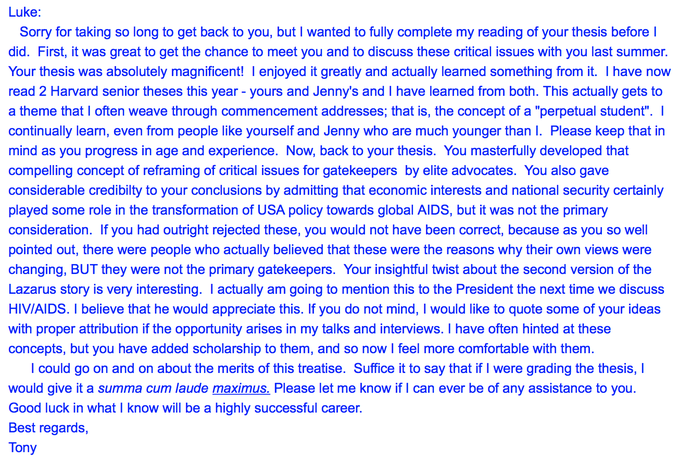
It certainly reads like the work of a class act.
In addition to serving as one of the COVID-19 pandemic’s most recognizable faces, Dr. Fauci has acquired another duty—that of scapegoat for Donald Trump, the 6th president he has answered to in his long career.
He seems to be taking the administration’s potshots with a characteristically cool head, though compared to the furious criticisms AIDS activists directed his way in the 80s and 90s, he’s unlikely to find much of educational value in them.
Last March, The Body Pro, a newsletter for workers on the front lines of HIV education, prevention, care, and services quoted ACT UP NY’s Jim Eigo on the doctor’s response to a letter demanding parallel tracking, a policy revision that would put potentially life-saving drugs in the hands of those who tested positive far earlier than the existing clinical trial requirements’ schedule would have allowed:
Lo and behold, he read the letter and liked it, and the following year he started promoting the idea of a parallel track for AIDS drugs to the FDA. Had he not helped us push that through, we couldn’t have gotten a lot of the cousin drugs to AZT, such as ddC and ddI, approved so fast. They were problematic drugs, but without them, we couldn’t have kept so many people alive.
Fauci, despite being straight and Catholic, was not only not homophobic, which much of medical practice still was in the late 1980s, he also wouldn’t tolerate homophobia among his colleagues. He knew there was no place for that in a public-health crisis.
Speaking of correspondence, Dr Messac seems to have taken the “perpetual student” concept Dr. Fauci impressed upon him back in 2007 to heart, as evidenced by a recent tweet, regarding a lesson gleaned from Arnold Schwarzenegger in Pumping Iron, a 1977 documentary about bodybuilders:
Schwarzenegger explained how he would figure out what to work out every day by looking in a mirror and finding his weakest muscles. It’s pretty good advice for studying during residency. Every shift reveals a weakness, and greats never stop looking for their own.
In writing to Messac, Dr. Fauci alluded to his commencement speeches, so we thought it appropriate to leave you with one of his most recent ones, a virtual address to the graduating class of his alma mater, College of the Holy Cross:
“Now is the time, if ever there was one” he tells the Class of 2020, “to care selflessly about one another… Stay safe, and I look forward to the good work you will contribute in the years ahead.”
Related Content:
Real Women Talk About Their Careers in Science
Richard Feynman’s Technique for Learning Something New: An Animated Introduction
Ayun Halliday is an author, illustrator, theater maker and Chief Primatologist of the East Village Inky zine. Follow her @AyunHalliday.
Read More...Dr. Wise on Influenza: Rare Silent Film Shows How They Tried to Educate the Public About the Spanish Flu a Century Ago (1919)
“Pics or it didn’t happen,” says the Internet, a phrase typically “used in jest,” writes Erin Ratelle at Space and Culture, as “a counter to an outrageous claim of events. However, its root is predicated on the notion that media is integral to being or existence,” that we must record everything. Such implicit understanding was only in its infancy in 1918, when the influenza outbreak known as the Spanish Flu began, which perhaps goes some way toward explaining why a viral pandemic that killed millions around the world—far more than World War I—is so underrepresented in the historical record.
These days if a Utah county commission meeting about masks for children gets thronged by unmasked protesters, we get almost-instant video at The Washington Post. Images filter out through Twitter and Facebook, or move in the other direction, and millions see them within hours. During the 1918 flu pandemic, unmasked protesters against mask laws also abounded, but coverage of their stunts took months to move from local papers to national outlets, who eventually covered the San Francisco Anti-Mask League’s strident refusals. The devastating epidemic, however, estimated to have infected one third of the world, was almost entirely absent from silent film at the time.
Cinema of all kinds avoided the subject, writes Bryony Dixon at the British Film Institute (BFI): “It’s astonishing to think how invisible the first pandemic in the time of cinema is from the film record. Apart from one informational film, which survives in the BFI National Archive, the influenza pandemic of 1918/1919 doesn’t appear in British film at all. There were no newsreel reports, and no fiction films were made that even mentioned the three waves of the pandemic that struck the country in the final year of the First World War and would kill 200,000 people” in the UK and 500 million worldwide.
This does not mean there are no films about plague and pestilence from the time. But the present seemed to have been too painful. Filmmakers looked back to Boccaccio, one of whose Decameron stories was adapted for the screen. “It must certainly have been easier,” Dixon writes, “for silent era audiences to contemplate pandemic within the moral framework of the medieval period.” Edgar Allan Poe’s Masque of the Red Death was adapted by Fritz Lang in a screenplay for Otto Rippert’s 1919 The Plague in Florence. F.W. Murnau’s 1922 Nosferatu is, arguably, about disease, as is its source, Bram Stoker’s Dracula. But fiction and documentary mostly stayed mum about the deadly flu pandemic.
In 1918, the War had nearly every European nation (and the U.S. at that point) preoccupied. Government control over major media outlets censored coverage of the disease, ostensibly to avoid a panic. The staggering death tolls of war and infection were overwhelming. A political narrative took shape to suggest a culprit, Spain, which was neutral during WWI, and the first country to begin covering the disease in their press (hence the “Spanish Flu,” which did not originate in Spain). The one exception to the blackout in the BFI archive is the short informational film at the top, Dr. Wise on Influenza.
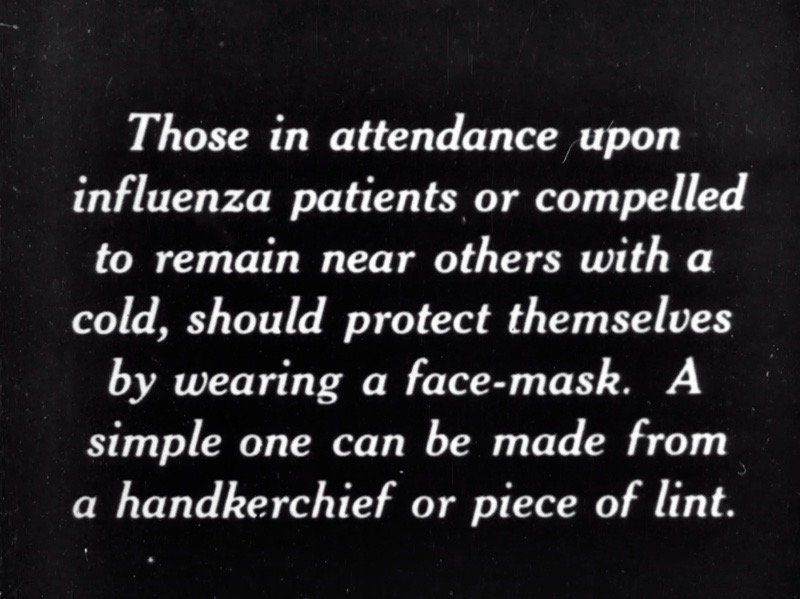
Produced under the auspices of Sir Arthur Newsholme, the Chief Medical Officer of the Local Government Board (LGB), the film arrived a little too late to do much good after the second wave of infections began in 1919, and it was not widely distributed. The short film promotes wearing masks, and it tells a very familiar story, as Dixon explains:
The ‘doctor’ uses the device of a fictional story in which a rather dim Mr Brown coughs and sneezes over colleagues in the office and the street, before going on to infect 100 people at a theatre (we see a rare early glimpse of the Empire Leicester Square, which was showing a musical, The Lilac Domino).
It doesn’t end well for Mr Brown, and an on-screen title lists the grim totals of deaths in British cities, just as we’ve become used to seeing today. Other parallels with the current situation are spooky: the prime minister, Lloyd George, like Boris Johnson, was hospitalised for days with the virus, and an anxious nation was told it was ‘touch and go’ for a while.
History has been rhyming all over the place lately, maybe the most poetic thing about the ugly times we’re living in. As much as we might have believed that the world, or our particular corner of it, had changed, we’re finding out how little progress we’ve actually made. Ironically, one of the most remarkable differences between the early 21st century and everything that came before—the omnipresence of cameras and video—has accelerated these realizations. We can now witness, in ways no one possibly could have in 1919, just how much of the past we’re dragging along behind us.
Related Content:
What Happened When Americans Had to Wear Masks During the 1918 Flu Pandemic
Josh Jones is a writer and musician based in Durham, NC. Follow him at @jdmagness
Read More...Modern English Performs Their 1982 Hit, “I Melt With You,” in Quarantine
Nearly 40 years after they released their New Wave classic, Modern English is back, performing together in isolation, to get us through the pandemic. Find more socially-distanced performances by Roger Waters, the Rolling Stones and the Doobie Brothers below.
Related Content:
The Doobie Brothers Sing Their 1974 Classic, “Black Water,” Live, in Isolation
Roger Waters Performs a Socially-Distanced Version of Pink Floyd’s “Mother”
Read More...Everything You Need To Know About Viruses: A Quick Visual Explanation of Viruses in 9 Images
It’s a great time to tune in to what scientists are trying to tell us.
It’s true that we’ve received a lot of conflicting information over the last four months with regard to how to best protect ourselves and others from COVID-19.
Scientists and health care professionals have a learning curve, too.
Their bulletins evolve as their understanding of the novel coronavirus grows, through research and hands-on experience.
There are still a lot of unknowns.
Some people take any evidence-based messaging updates regarding masks and re-opening as proof that scientists don’t know their asses from their elbows.
To which we might counter, “If that’s the case, please take a minute from berating the poor grocery store employee who asked you to follow clearly posted state mandated public health practices to educate us. Forget the economy. Forget the election. Blind us with some science. Pretend we don’t know anything and hit us with some hardcore facts about viruses. We’re listening.”
(Crickets…)
Science writer Dominic Walliman, founder of the Domain of Science Youtube channel, may have a PhD in quantum device physics, but he also had the humility to realize, earlier in the pandemic, that he didn’t know much about viruses:
So I did a load of research and have summarized what I learned in… nine images. This video (above) explains the key aspects of viruses: how big they are, how they infect and enter and exit cells, how viruses are classified, how they replicate, and subjects involving viral infections like how they spread from person to person, how our immune system detects and destroys them and how vaccines and anti-viral drugs work.
Walliman animates his 10-minute overview with the same bright infographics he uses to help students and laypeople wrap their heads around computer science, biology, chemistry, physics, and math.
The virus video has been fact-checked by immunologist Michael Bramhall and biologist Christoph von Arx.
And how refreshing to see transparency with regard to human error, published as a corrective:
In slide 9 toxin vaccines are for bacterial infections like tetanus, not viruses.
For those who’d like to learn more, Walliman has tacked a whopping 15 links onto the episode’s description, from sources such as Scientific American, Nature, Stanford Medicine’s Scope blog, and the National Center for Biotechnology Information.
Download a free poster of Domain of Science’s Viruses Explained in 9 Images here.
Related Content:
Spring Break vs. COVID-19: Mapping the Real Impact of Ignoring Social Distancing
The Case for a Universal Basic Income in the Time of COVID-19
Ayun Halliday is an author, illustrator, theater maker and Chief Primatologist of the East Village Inky zine. Her latest project is an animation and a series of free downloadable posters related to COVID-19 public health Follow her @AyunHalliday.
Read More...Sunken Films: Watch a Cinematic Meditation on Films Found on the Ocean’s Floor
Bill Morrison has been entranced by the beauty of decaying nitrate film for decades, creating art out of unsalvageable celluloid. His 2002 film Decasia equated the fading of memory and time with the chemical dissolution of silent films, where audiences are teased with characters and maybe a hint of a story only to have the images destroyed by nitrates. He’s returned to this theme again and again, creating a filmography of melancholy and sadness.
In his latest short, Sunken Films, Morrison riffs on stories of films found at the bottom of the sea, using the sinking of the Lusitania as an entry into the ghosts of cinema past.
The RMS Lusitania was the ill-fated British luxury liner that German U‑boats torpedoed off the coast of Ireland on May 7, 1915. It had left New York six days before, and the Germans claimed the commercial liner was secretly transporting munitions to Britain for the Great War, a war that America was trying not to join. (Divers never found evidence of munitions in the wreckage.)
The attack killed 1,198 passengers, and the great ship sunk in under 20 minutes, an unforgiving speed. The sinking would be one of the reasons America finally decided to fight alongside the British. Morrison edits in Winsor McCay’s animated version of the tragedy to show how the boat went down, and there’s something surreal in his rendering of all the people, only their heads above water, bobbing in the ocean.
Morrison’s film also uses footage shot at the time and captions to move the action along. The soundtrack is silent save for the nostalgic sound of a film projector. There is only one surviving film of the ship leaving New York harbor. Morrison points out the author Elbert Hubbard and his wife Alice Moore waving to the camera–Hubbard wrote eloquently a few years before about those who died on board the Titanic.
The Lusitania had a cinema on board, and Morrison meditates on the films that sunk to the ocean floor, including one that was salvaged: one reel of Colin Campbell’s The Carpet from Baghdad, now archived at the British Film Institute. It is the only existing reel of this lost feature.
If you think Morrison then shows the film, you’ll be disappointed. Instead Morrison heads off in another direction, discovering other films that have been lost at sea, and some that have been found, like footage of Vladimir Lenin speaking to the public and more importantly snuggling up with his pet cat. (This revolution-adjacent cat’s name has been lost to time unfortunately.) Caught in a fishing net, the weathered film is a mysterious object–though not necessarily a rare one, the footage is available elsewhere. Instead Morrison hopes to leave us with images of undersea cinema, reels of kelp-like film, only on view to passing fish.
Related Content:
A Mesmerizing Trip Across the Brooklyn Bridge: Watch Footage from 1899
Winsor McCay Animates the Sinking of the Lusitania in a Beautiful Propaganda Film (1918)
Ted Mills is a freelance writer on the arts who currently hosts the Notes from the Shed podcast and is the producer of KCRW’s Curious Coast. You can also follow him on Twitter at @tedmills, and/or watch his films here.
Read More...You Can Play the New Samurai Video Game Ghost of Tsushima in “Kurosawa Mode:” An Homage to the Japanese Master
Video games are starting to look and feel like movies: even those of us who haven’t gamed seriously in decades have taken notice. Nor has the convergence between the art forms — if, unlike the late Roger Ebert, you consider video games an art form in the first place — been lost on game developers themselves. While the most ambitious creators in the industry looked for inspiration from cinema even when they were working with relatively primitive digital tools, they can now pay practically direct homage to their aesthetic sources. Take Sucker Punch Productions’ Ghost of Tsushima, released this week for the Playstation 4, which features a selectable audiovisual mode “inspired by the movies of legendary filmmaker Akira Kurosawa.”
An ambitious production set on the titular Japanese island during a 13th-century Mongol invasion, Ghost of Tsushima casts the player in the role of a young samurai named Jin Sakai. “All the aesthetic and thematic conventions of samurai films are present and correct,” writes The Guardian’s Keza MacDonald, including “a story centered on honor and self-mastery; dramatic weather that sweeps across Japan’s spellbinding landscapes; standoffs against backdrops of falling leaves and deserted towns; screen wipe and axial cuts; quick, lethal katana combat that ends with enemies staggering and spurting blood before toppling like felled trees.” Kurosawa Mode presents the game’s hypnotically lavish visuals in a “grainy black-and-white,” and its dialogue in English-subtitled Japanese — just how many of us remember pictures like Seven Samurai, Throne of Blood, and Yojimbo.
Of course, some of us had no choice but to first encounter the work of Kurosawa and other 20th-century Japanese auteurs in versions dubbed into English. In an uncanny reversal of that awkwardness, the American-made Ghost of Tsushima’s Japanese-language dialogue comes out of mouths clearly synchronized to an English-language script. Western critics have taken the developers to task for that shortcoming, but Japanese critics have proven comparatively unrestrained in expressing their admiration. According to Kotaku’s Brian Ashcraft, not only did popular gaming site Dengeki Online “praise the game for its understanding of the period (as well as historical Japanese movies), it also lauded the game for how it brought the landscape and scenery to life.”
While MacDonald calls protagonist Jin Sakai “stiff even by stoical samurai standards,” Ashcraft points to a review in Japanese pop-culture site Akiba Souken which calls him not “the typical samurai of foreign creation, but rather, a real Japanese 侍 (samurai),” using “both the English ‘samurai’ and the word’s kanji to highlight this distinction.” Any Kurosawa fan will have a sense of the difference, and of the importance of one thing the game doesn’t get right. In a review headlined “There Is No Sense Of Discomfort In This Foreign-Made Japanese World,” gaming magazine Weekly Famitsu does note the game’s lack of “pauses in conversation that are typical of period pieces. That pause and that silence are key; in Japan, what isn’t said is just as important as what is.” Sucker Punch’s Ghost of Tsushima team must already know they should retain Kurosawa Mode for the inevitable sequel; all they need to work on is the unspoken.
Related Content:
How Akira Kurosawa’s Seven Samurai Perfected the Cinematic Action Scene: A New Video Essay
Andrei Tarkovsky’s Masterpiece Stalker Gets Adapted into a Video Game
Based in Seoul, Colin Marshall writes and broadcasts on cities, language, and culture. His projects include the book The Stateless City: a Walk through 21st-Century Los Angeles and the video series The City in Cinema. Follow him on Twitter at @colinmarshall, on Facebook, or on Instagram.
Read More...Make Your Own Krispy Kreme Face Shield: A Primer for Making Your Own Personal Protective Equipment (PPE)
Magician Andy Clockwise shows you how you can make “your very own Krispy Kreme face shield using just the lid from a 12 box of Krispy Kreme doughnuts, some sticky tape and a pair of scissors.”
If you need to improvise, you know what to do…
Read More...Hear an Enchanted Medieval Cover of Dolly Parton’s Classic Ode to Jealousy, “Jolene”
Dolly Parton’s “Jolene” is an endlessly renewable resource of beautiful sadness, and many a modern-day bard has a “Jolene” in their quiver. The White Stripes turned it into garage rock, Olivia Newton John did it as disco, and Norah Jones as cabaret jazz. There is the obligatory house remix. Slow it down to 33rpm and Dolly’s gender begins to blur, while her voice loses none of its plaintive mystique. “Jolene” set a standard for melancholy few, if any, tunes can meet. So, you know, there’s a bardcore cover of “Jolene.”
Bardcore (also called “tavernwave”), has “taken over pop music,” kind of, as you might have learned from Ayun Halliday’s post on bardcore artist Hildegard von Blingin’ here a few weeks back. The short version—bardcore artists make covers of pop songs with medieval instrumentation and vocal stylings. Lyrics are rewritten with archaisms like “I want thine ugly, I want thy disease/Take aught from thee shall I if it can be free,” which are not lyrics to “Jolene,” let’s move on.
What does “Jolene” sound like as bardcore? In a word, spellbinding. And I don’t mean to be cheeky—this is enchanting, not least because, medievalized, the song sounds at times like it could be coming from a tortured nun on the edge of leaving the cloister in the dead of night to run off with a woman named Jolene, whose attributes she lovingly, poetically lays out.
Jolene, Jolene, Jolene, Jolene
I beg of thee, pray take not my lord
Jolene, Jolene, Jolene, Jolene
I fear, from thee, ‘twould take naught but a wordThy beauty is beyond compare
With flaming locks of auburn hair
With ivory skin and eyes of emerald green
Thy smile is like a breath of Spring
Thy voice is soft like Summer rain
And I cannot compete with thee
Jolene
An ode to jealousy hints at a potentially spicy tale of forbidden romance and broken vows, further tribute to Parton’s skill as a songwriter (and the sexual ambiguity inherent in the song). Hildegard von Blingin’ is not joking, novelty names aside. She has a lovely voice and has invested her medieval covers with high production values and period-correct illuminated music videos.
Everyone listens to house music in Hollywood sci-fi futures, but maybe it’s bardcore they’ll play on the interstellar cruise ships. “’Tis a veritable phenomenon on t’internet,” says bardcore creator Cornelius Link (which means it could go the way of vaporwave). For years, medieval memes have been hot online currency, for reasons we need not get too pop-sociological about. They’re fun and weird and alien and WTF and remind us that it could be worse, I guess. They appeal to Gen Z’s “existential humour.” They were Games of Thrones-y. They’re cooler than Harry Potter.
For most of medieval times, plague was on everyone’s mind. “The pandemic is thought to be significant,” says Link, “with a new Black Death hovering over us all.” But if we’re talking about “Jolene,” we’re talking about a song that “registers with the basest of bitterness we’ve all felt,” hither and thither, shut up in convents or locked down in our houses. Explore more not-“Jolene” bardcore jams here.
via Boing Boing
Related Content:
Dolly Parton’s “Jolene” Slowed Down to 33RPM Sounds Great and Takes on New, Unexpected Meanings
Josh Jones is a writer and musician based in Durham, NC. Follow him at @jdmagness
Read More...Support Us
We're hoping to rely on loyal readers, rather than erratic ads. Please click the Donate button and support Open Culture. You can use Paypal, Venmo, Patreon, even Crypto! We thank you!

About Us

Open Culture scours the web for the best educational media. We find the free courses and audio books you need, the language lessons & educational videos you want, and plenty of enlightenment in between.
Advertise With Us

FREE UPDATES!
GET OUR DAILY EMAIL
Get the best cultural and educational resources on the web curated for you in a daily email. We never spam. Unsubscribe at any time.
FOLLOW ON SOCIAL MEDIA

Open Culture editor Dan Colman scours the web for the best educational media. He finds the free courses and audio books you need, the language lessons & movies you want, and plenty of enlightenment in between.
Advertise With Us

