The Story Behind the Iconic Black Power Salute Photo at the 1968 Olympics in Mexico City
You may know his name, and you definitely know the iconic photo of him standing next to Tommie Smith and Peter Norman on the medals podium at the 1968 Olympics in Mexico City, his black-gloved fist raised next to Smith’s in defiance of racial injustice. But you may know little more about John Carlos. Many of us learned about him the same way students at a Southern California high school, where he worked as a counselor after retiring from running, did: “Man, we see this picture in the history book and they don’t have any story about it,” he remembers some kids telling him. “It’s just a two-liner with the people’s names.”
The Vox Darkroom video above packs more than a caption version of his history in just under 10 minutes. The silent protest, we learn, followed a threatened boycott from the athletes earlier in the year, supported by Martin Luther King, Jr., who appears in a clip. Instead, they went on to win medal after medal. We also learn much more about how all three runners on the podium, including Silver-winning Aussie Peter Norman, participated by wearing buttons supporting the Olympic Project for Human Rights. Founded by former athlete and activist Harry Edwards, the organization aimed to strategically disrupt U.S. Olympic success by “opting out of the games,” refusing to give Black athletes’ labor to sports that refused to combat racism.
Twenty years before these actions, Black athletes became potent symbols of the bootstrapping American success story for the media, long before the end of legal segregation. As history professor Dexter Blackman says in the video, the message became, “if Jackie Robinson can make it, then why can’t other Blacks make it?” This “myth of racial progress” could not survive the 1960s. By the time of Smith and Carlos’ arrival in Mexico City in October of 1968, Martin Luther King had been assassinated. Cities around the country were erupting as frustration over failed Civil Rights efforts boiled over. Neither Carlos nor Smith wear shoes in their podium photo, in protest of the poverty that persisted in Black communities.
The three paid a price for their statement. The protest was called “a deliberate and violent breach of the fundamental principles of the Olympic spirit” by the IOC president, who had not objected to Nazi salutes when he had been an Olympic official in 1936. Norman, who seems completely oblivious at first glance in the photograph, “returned home to Australia a pariah,” CNN writes, “suffering unofficial sanction and ridicule as the Black Power salute’s forgotten man. He never ran in the Olympics again.” Smith fared better, though he was suspended with Carlos from the Olympic team. He left running, played NFL football, won several awards and commendations, and became a track coach and sociology professor at Oberlin.
In an essay at Vox, Carlos describes how “the mood in the stadium went straight to venom” after the two raised their fists. “The first 10 years after those Olympics were hell for me. A lot of people walked away from me…. they were afraid. What they saw happening to me, they didn’t want it to happen to them and theirs.” His kids, he said “were tormented,” his marriage “crumbled.” Still, he would do it again. Carlos embodies the same uncompromising attitude, one that refuses to silently accept racism, even while standing (or kneeling) in silence. “If you’re famous and you’re black,” he writes, “you have to be an activist. That’s what I’ve tried to do my whole life.”
Related Content:
Muhammad Ali Gives a Dramatic Reading of His Poem on the Attica Prison Uprising
How Jazz Helped Fuel the 1960s Civil Rights Movement
Josh Jones is a writer and musician based in Durham, NC. Follow him at @jdmagness
Read More...Rick and Morty as Absurdist Humor, Yet Legitimate Sci-Fi with Family Drama (Pretty Much Pop: A Culture Podcast #54)

Mark Linsenmayer, Erica Spyres, and Brian Hirt address the 4‑season 2013 Adult Swim show, which currently has a 94% critics’ rating on Rotten Tomatoes. What kind of humor is it, and how are we supposed to take its sci-fi and family drama elements? While its concepts start as parody, with an anything-goes style of animation, they’re creative and grounded enough to actually contribute to multiple genres. How smart is the show, exactly? And its fans? Is Rick a super hero, or maybe essentially Dr. Who? What might this very serialized sit-com look like in longevity?
We also touch on other adult cartoons like South Park, Solar Opposites, The Simpsons, Family Guy, plus Community, Scrubs, and more.
Hear the interview we refer to with the show’s creators. Watch the video we mention about its directors. Visit the Rick and Morty wiki for episode descriptions and other things.
Some articles that we bring up or otherwise fueled our discussion include:
- “Is ‘Rick and Morty’ as Smart as Its Fans Think It Is?” by Tom Usher
- “The Self is Dead – Alienation and Nihilism in Rick and Morty” by Lucas Miranda
- “Rick and Morty Season 4 Episode 9 Review: Childrick of Mort” by Joe Matar (This is the negative reivew Mark mentions. For a counterpoint, “ ‘Rick and Morty’ Review: ‘Childrick of Mort’ Proves It’s More Fun When the Whole Family’s Involved” by Steve Greene)
- “ ‘Rick and Morty’ Episodes Ranked from Worst to Best” by Adam Chitwood
- “Rick And Morty Is Giving Rick A Nemesis In Season 5, Check Out The First Look” by Eric Eisenberg
Learn more at prettymuchpop.com. This episode includes bonus discussion that you can only hear by supporting the podcast at patreon.com/prettymuchpop. This podcast is part of the Partially Examined Life podcast network.
Pretty Much Pop: A Culture Podcast is the first podcast curated by Open Culture. Browse all Pretty Much Pop posts.
Read More...The Rise & Fall of Silver Apples: The 1960s Electronic Band That Built Their Own Synthesizer, Produced Two Pioneering Albums, and Then Faded into Obscurity
In the late 70s and early 80s, a handful of musical duos emerged who would have tremendous impact on post-punk, alternative, new wave, and experimental electronic music. Bands like Suicide, NEU!, and the Pet Shop Boys made far bigger sounds than their size would suggest. Before them all came Silver Apples, a duo who should rightly get credit as pioneers of electronic experimentation in pop song form. Like many a pioneer, Silver Apples had no idea what they were doing. They also suffered from a string of some of the worst luck a band could have, disappearing after their second album in 1969 until a mid-90s rediscovery and brief return.
Bandmembers Simeon Coxe and Danny Taylor formed the band in 1967 from the ruins of a rock group called The Overland Stage Electric Band, which fell apart when Coxe began experimenting with old oscillators onstage. All of the members quit except Taylor, and Coxe set about building his own synthesizer, “a machine nicknamed ‘the Simeon,’” Daniel Dylan Wray writes at The Guardian, “which grew to consist of nine audio oscillators with 86 manual controls—including telegraph keys—to control lead, rhythm and bass pulses with the user’s hands, feet and elbows.”
Coxe was the only person who could play the Simeon, and he sang as he did so, his weird, warbly voice complementing his machine, as Taylor played proto-Krautrock beats behind him. “I had heard the word synthesizer,” he says, “but I had no idea what it was. We were dirt poor and used what we had, which was often discarded world war two gear.” They were essentially making up electronic pop music as they went along, isolated from parallel developments happening at the same time. They named the project after a line by William Butler Yeats (many of their lyrics were written by poet Stanley Warren). Around the same time, composer Morton Subotnick released his groundbreaking all-electronic album, titled—after Yeats—Silver Apples of the Moon.
It was Silver Apples’ fate to be overshadowed by other releases that came out immediately after their 1968 self-titled debut, such as Wendy Carlos’ Switched on Bach and Gershon Kingsley’s hit “Popcorn,” both of which popularized Robert Moog’s modular synthesizers. Moog himself became so fascinated with Coxe’s singular creation that he visited the Silver Apples studio to see it for himself. The band’s manager scored them their very first gig playing for 30,000 people in Central Park, “providing a live soundtrack to the Apollo moon landing—broadcast on enormous screens beside them,” writes Cian Traynor at Huck magazine, “as people took their clothes off in the rain.”
This magical experience—and other brushes with fame, such as a one-off recording session with Jimi Hendrix—was no indication of a bright future for the band. For their second album, they were allowed to photograph themselves inside the cockpit of a Pan Am jet. The inclusion of drug paraphernalia in the photo, and of a crashed airplane on the back, prompted a lawsuit from the airline. The album was pulled from the shelves, the band shut out of the industry, and a third album, The Garden, remained unreleased until 1998.
For a look at how musically forward-thinking Silver Apples were, see the short documentary about their rise and fall above. They ended up influencing neo-psychedelic electronic bands like Stereolab and 90s duo Portishead, whose Geoff Barrow says, “for people like us, they are the perfect band…. They should definitely be up there with the pioneers of electronic music.” Taylor sadly died in 2005, just after Coxe had partially recovered from a broken neck suffered the year of their 90s resurgence. But Silver Apples music is immortal, and immortally otherworldly and strange, even if its creators never quite understood why. “To me and Danny,” says Coxe, “it sounded perfectly normal and was a normal progression into the areas we were trying to go.”
As so much experimental electronic pop music that emerged around the same time proves, Coxe was more right than he knew. What Silver Apples did turned out to be a “normal” musical development, though they had no idea that it was happening when they made their astonishingly groovy, spaced-out records.
Related Content:
Daphne Oram Created the BBC’s First-Ever Piece of Electronic Music (1957)
The History of Electronic Music in 476 Tracks (1937–2001)
Josh Jones is a writer and musician based in Durham, NC. Follow him at @jdmagness
Read More...Tony Hawk & Architectural Historian Iain Borden Tell the Story of How Skateboarding Found a New Use for Cities & Architecture
Wouldn’t we enjoy seeing our cities like an architectural historian, in command of deep knowledge about the technology, ideology, and aesthetics of the buildings we pass by every day? For most of us, this would hugely enrich our experience of the urban environment. But then so, less obviously, would seeing our cities like a skateboarder, in command of deep knowledge about how to glide, jump, and bounce along the streets, the buildings, and all the myriad pieces of infrastructure as a surfer rides the waves. The architectural historian learns the city with his mind; the skater learns the city, no less painstakingly, with his body.
The Vox video above brings mind and body come together in the persons of Iain Borden, author of Skateboarding and the City: A Complete History, and Tony Hawk, to whom even those wholly ignorant of skateboarding need no introduction. Their complementary interviews reveal the history of modern skateboarding through the sport’s “legendary spots”: public-school campuses, abandoned swimming pools, dry drainage ditches, forgotten sections of concrete pipe. In the main this selection reflects the highly suburbanized 1970s in which skateboards first came to popularity in the United States. But at its outer limits, such as the Mt. Baldy pipeline in northern California, it also shows how far skaters will go in search of the ideal place to ride.
Though purpose-build skate parks do exist (their numbers kept low by formidable insurance challenges), serious skaters prefer spaces not expressly designed for skating. This is thanks in large part to the innovations of a skater with less wider-world name recognition than Hawk, but no less influence within the sport: Natas Kaupas. Hawk remembers the thoughts triggered by footage of the young Kaupas skating masterfully through his neighborhood in the 1987 film Wheels of Fire: “Wow, you can skate curbs like that? You can skate benches? You can skate fire hydrants? The whole world is a skate park now.” Suddenly, Borden adds, “you didn’t need to be in California, or in the Arizona desert, or in Florida anymore. You could be anywhere.”
Reviewing Borden’s Skateboarding and the City, Jack Layton in Urban Studies highlights its history of “how the assemblage of materials that makes up cities has been – in countless ways – re-imagined by the skateboarder to create acceleration, rotation, friction and flow.” It’s easy to forget, Layton writes, that “along with facilitating commerce, transport and habitation, cities can be spaces that facilitate play, exhilaration and pleasure.” Despite often having been regarded as public nuisances, skateboarders are “a constant reminder that our cities are creative and rich places,” says Borden. With the exception of the skate parks secretly constructed in hidden urban spaces across the world, skaters, of course, don’t build the city — but they do show us some of its untapped potential.
Related Content:
3 Iconic Paintings by Frida Kahlo Get Reborn as Vans Skate Shoes
Saxophonist Plays into Large Gas Pipes & Then Uses the Echo to Accompany Himself
Based in Seoul, Colin Marshall writes and broadcasts on cities, language, and culture. His projects include the book The Stateless City: a Walk through 21st-Century Los Angeles and the video series The City in Cinema. Follow him on Twitter at @colinmarshall, on Facebook, or on Instagram.
Read More...New Digital Archive Opens Access to Thousands of Digitized African American Funeral Programs (1886–2019)
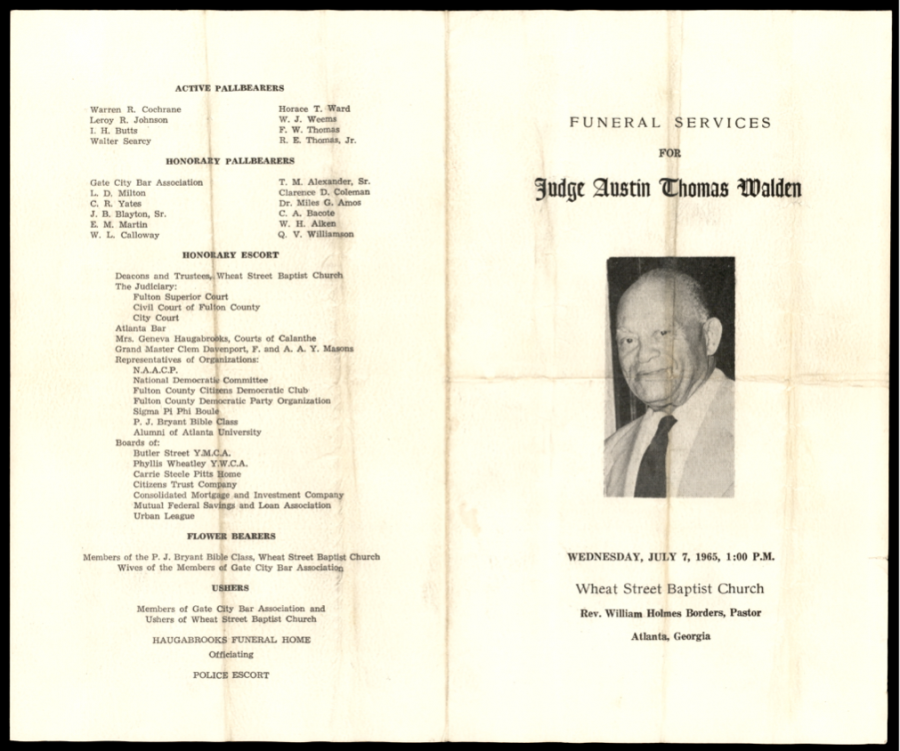
Funeral rites, burials, and other rituals are held near-universally sacred, not only due to religious and cultural beliefs about death: We preserve our connection to our ancestors through the records of their births and deaths. For many Black Americans in the U.S. south, grief and loss have been compounded by centuries of violence and tragedy, but funerals have still tended to be “celebrations of life” rather than mournful events, says Derek Mosley, archivist at the Auburn Avenue Research Library on African American Culture and History.” African American “funeral programs tend to reflect that,” and therefore offer a wealth of information for historians and genealogists as well as family members.
Mosley is a contributor to a new digital archive that “currently boasts more than 11,500 digitized pages and is expected to grow as more programs are contributed.” These historical documents date from between 1886 to 2019, though “most of the programs are from services during the late twentieth and early twenty-first centuries,” notes the Digital Library of Georgia, who houses the collection. “A majority of the programs are from churches in the Atlanta, Georgia area, with a few programs from other states such as South Carolina, Tennessee, Florida, Michigan, New Jersey, and New York, among others.”
The archive offers an incredible resource for people looking for information about relatives. For researchers “these documents also represent a gold mine of archival information,” Nora McGreevy writes at Smithsonian, including “birth and death dates, photos, lists of relatives, nicknames, maiden names, residences, church names, and other clues that can help reveal the stories of the deceased.”
In many cases, those stories were lost when Jim Crow, poverty, and redevelopment displaced families and erased burial sites. The collection, says Mosley, offers “a public space for legacy.”
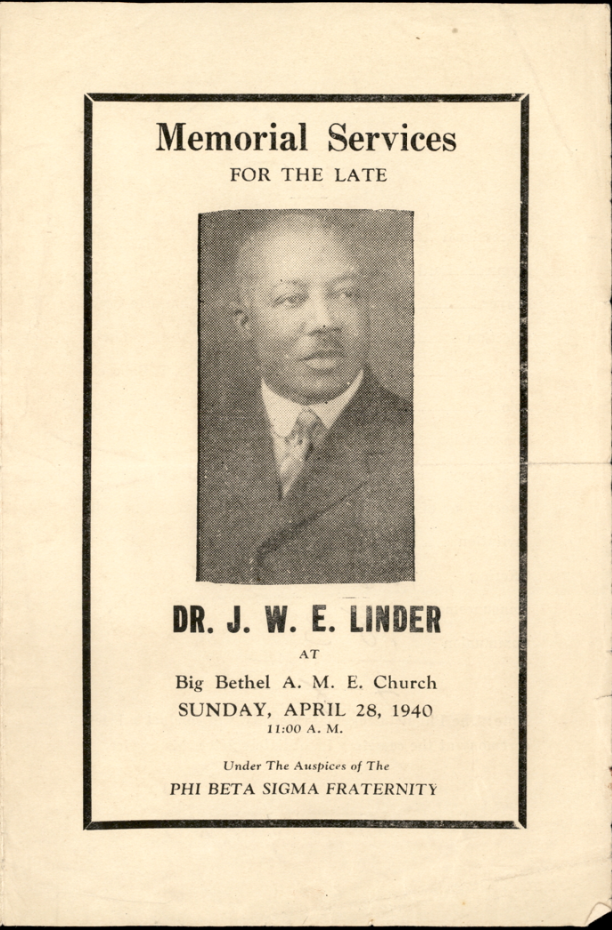
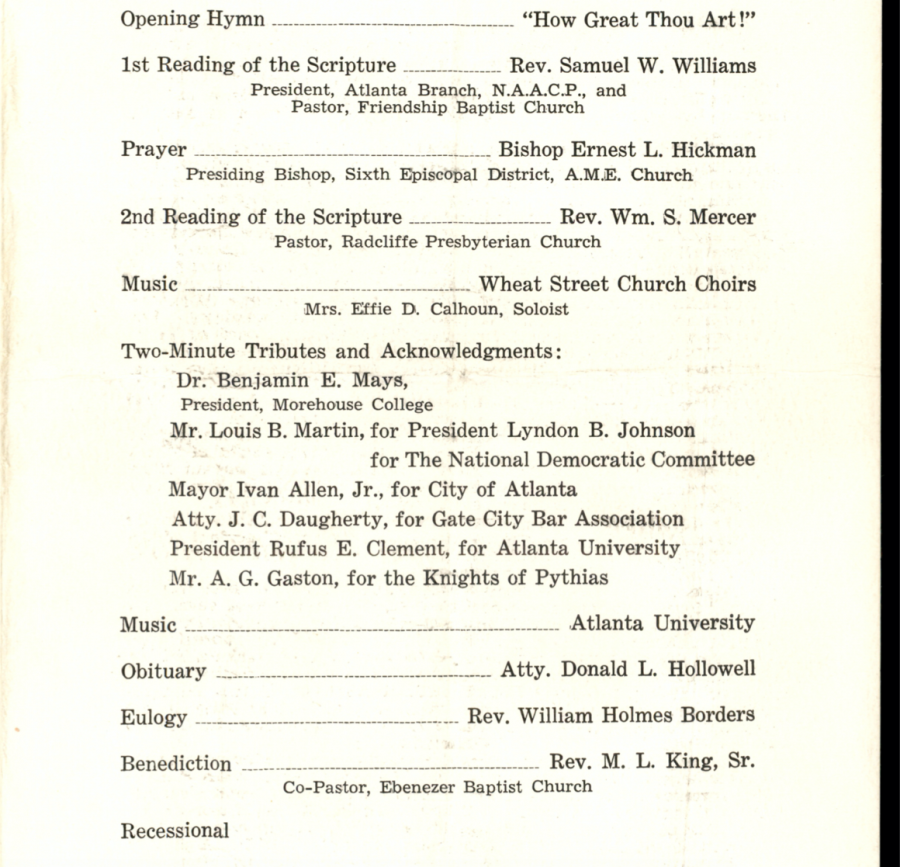
It is a way for local historians to recover important community figures. One program, for Dr. J.W.E. Linder, “who died in 1939,” Atlas Obscura’s Matthew Taub writes, “and whose memorial service was held in 1940” informs us that the deceased was the son of “Congressman George W. Linder, of the Georgia House of Representatives during the Reconstruction Period.” In the program for Judge Austin Thomas Walden, who died in 1965, we learn that he served as the first municipal judge in Georgia since Reconstruction. His benediction was delivered by the Reverend Martin Luther King Sr. and he received tributes from the Mayor of Atlanta, the President of Morehouse College, and the office of President Johnson.
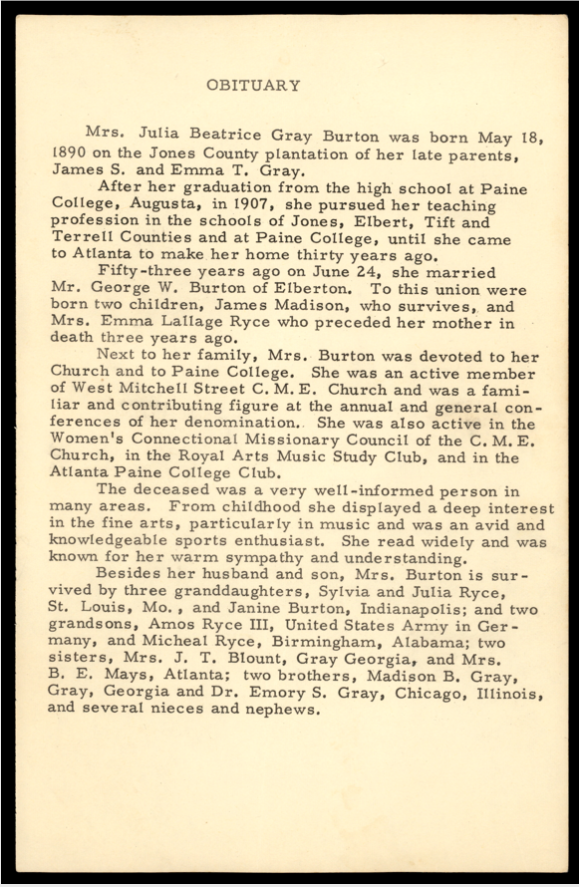
Such pillars of the community can be found among a host of programs memorializing ordinary, everyday people. The descriptions in the funeral literature open fascinating windows onto their lives and their extended family connections. Mrs. Julia Burton’s program from 1960, for example, tells us she was born on the plantation where her parents were likely enslaved. Her obituary not only describes her many clubs and her character as “a well-informed person in many areas,” but also lists the names of her husband and son, three granddaughters, two grandsons, two sisters, and two brothers—invaluable information for people searching for relatives.
“The challenge for African American genealogy and family research continues to be the lack of free access to historical information that can enable us to the tell the stories of those who have come before us,” remarks Tammy Ozier, president of the Atlanta Chapter of the Afro-American Historical and Genealogical Society. “This monumental collection helps to close the gap.” As it grows, it will likely come to represent greater geographical areas around the country. For now, the roughly 3300 digitized funeral programs, some a single page, some elaborate, full-color productions, focus on an area to which thousands of families around the country can trace their lineage, and to which many may find their way back through public archives like this one.
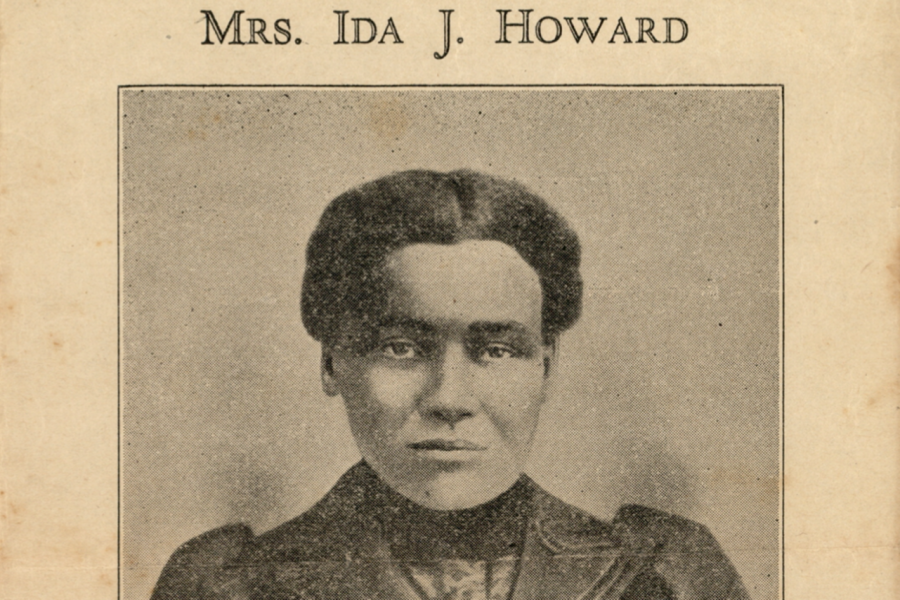
via Atlas Obscura
Related Content:
Josh Jones is a writer and musician based in Durham, NC. Follow him at @jdmagness
Read More...Behold 19th-Century Japanese Firemen’s Coats, Richly Decorated with Mythical Heroes & Symbols
Some firemen today may complain about the boredom of all the time spent doing nothing at the station between calls, but when the hour comes to do battle with a serious blaze, no one can say they have it easy. Firefighting has, of course, never been a particularly relaxed gig, especially back in the days before not just water cannon-equipped helicopters, and not just fire engines, but fire hoses as we know them today. Putting out urban conflagrations without much water at hand is one thing, but imagine having to do it every day in a densely packed, highly flammable city like Tokyo — or rather Edo, as it was known between the early 17th and mid-19th centuries.
“Fires were frequent during this period because of crowded living conditions and wooden buildings, and the firefighters’ objective was to prevent a burning house from spreading its flames to the neighboring residences,” writes Antique Trader’s Kris Manty. With only weak water pumps at their disposal, Edo firemen “did not save the home, but rather tore down the burning structure and extinguished the fire. They did this by using long poles and other fire implements to demolish the blazing house and once the fire was doused, the surrounding homes were once again safe.” In peacetime they “emerged as latter-day samurai heroes, with the motto, ‘duty, sympathy and endurance’ ” — and bedecked in truly glorious handmade coats.

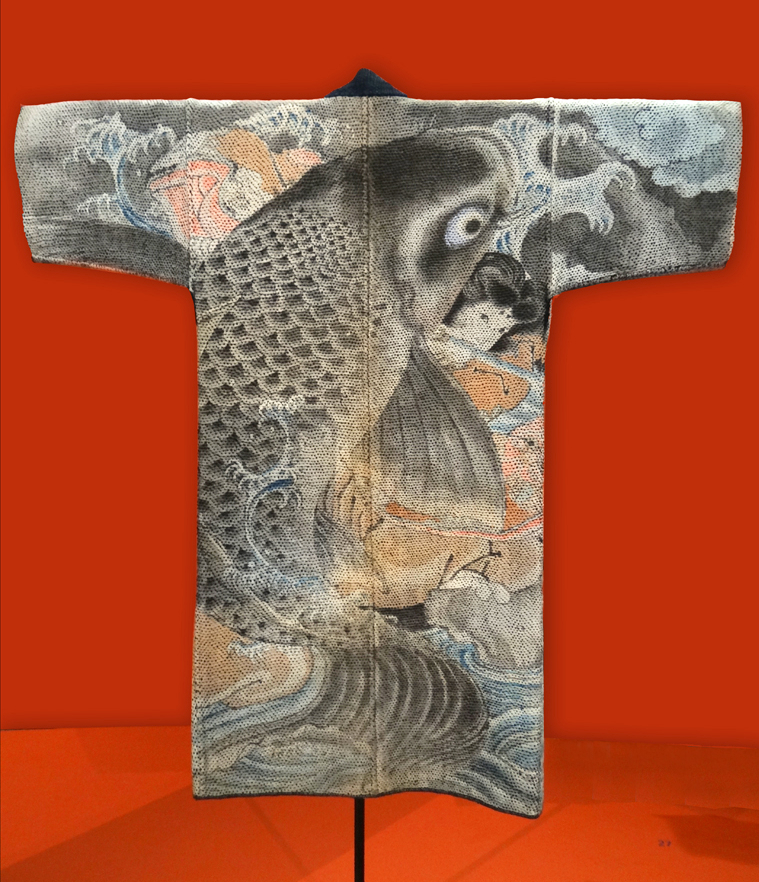
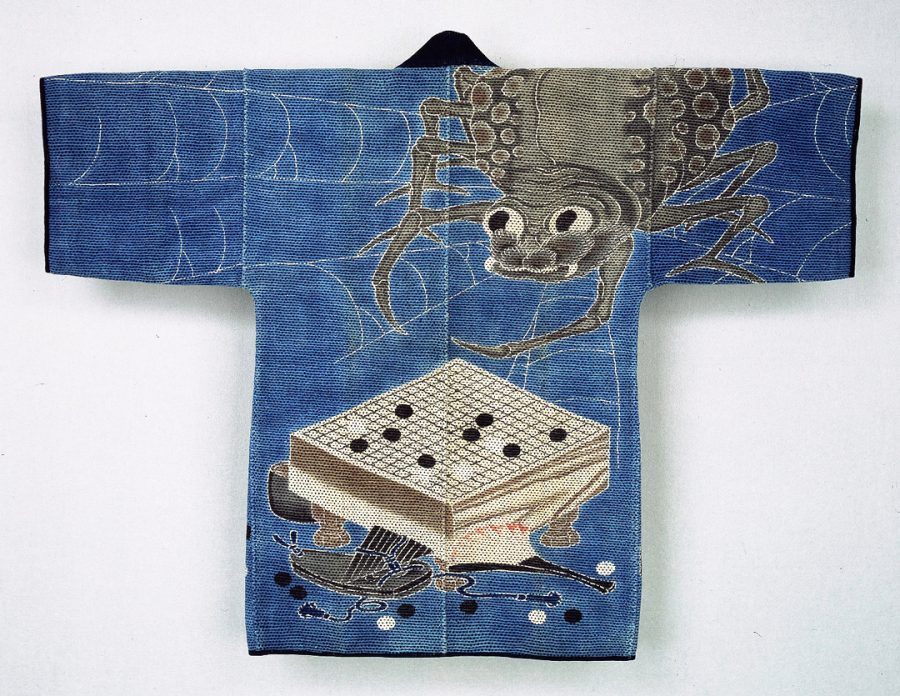
“Each firefighter in a given brigade was outfitted with a special reversible coat (hikeshi banten), plain but for the name of the brigade on one side and decorated with richly symbolic imagery on the other,” says the Public Domain Review, where you can behold a gallery of such garments.
“These coats would be worn plain-side out and thoroughly soaked in water before the firefighters entered the scene of the blaze. No doubt the men wore them this way round to protect the dyed images from damage, but they were probably also concerned with protecting themselves, as they went about their dangerous work, through direct contact with the heroes and creatures represented on the insides of these beautiful garments.”
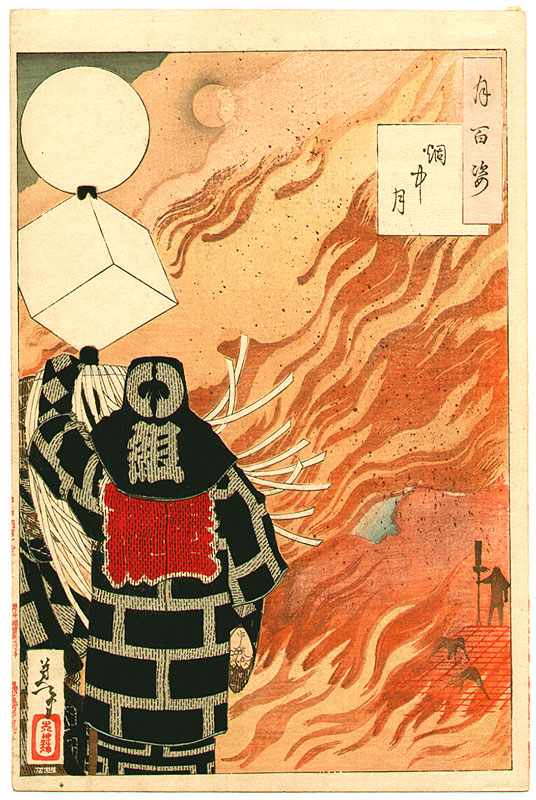
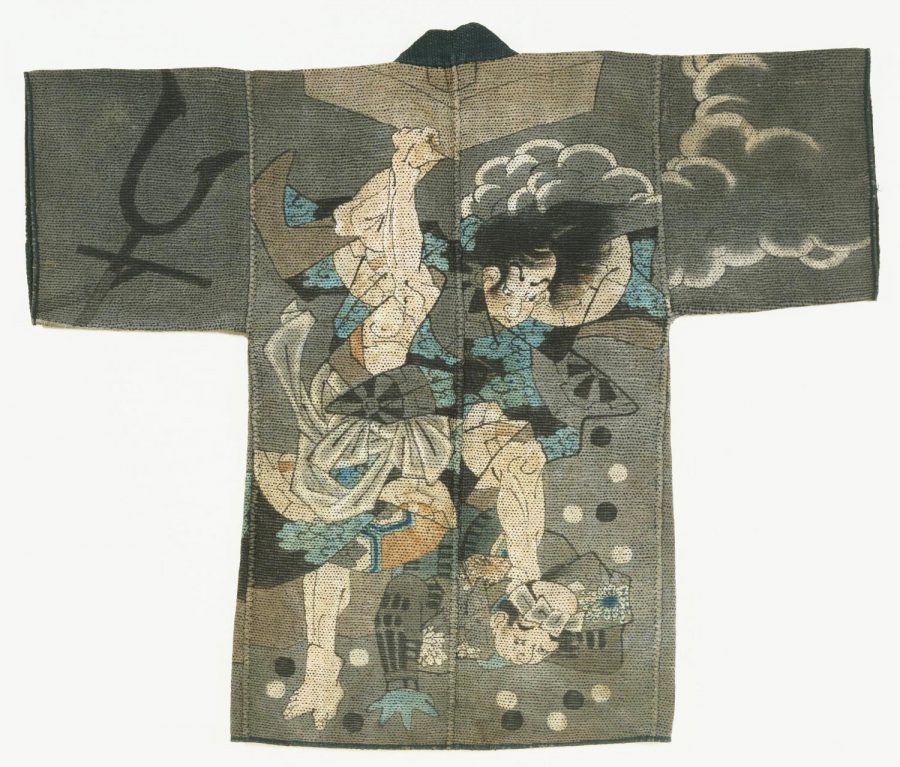
At the top of the post appears an example of an Edo fireman’s coat held by the Philadelphia Museum of Art, one emblazoned with imagery from perhaps the best-known Japanese fable of all. “The center of this coat shows Momotaro, a legendary boy born from a peach, stomping on an ogre,” says the museum’s web site. “The smoke billowing behind him reminds us of the use of this coat, as does the fireman’s hook pictured on the left sleeve. After their duty, firemen reversed their coats to display the bold and inspiring designs.” As with many prominent figures of the age, Edo firefighters were also immortalized, coats and all, in ukiyo-e woodblock prints.
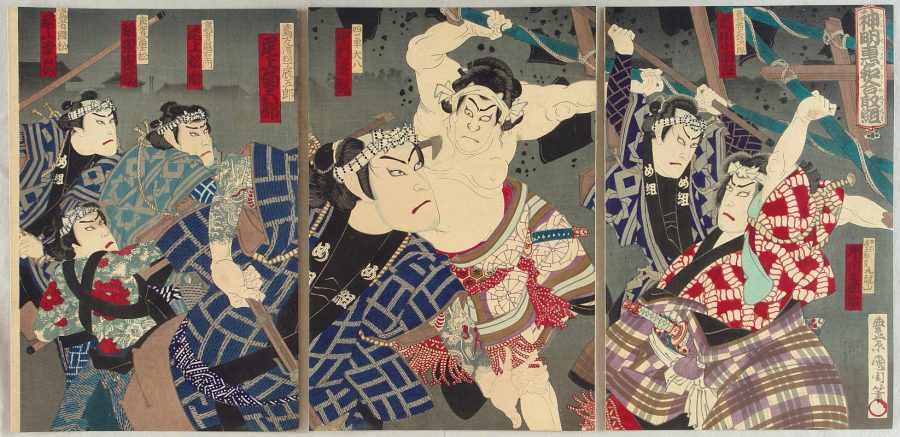
The noble image is not least thanks to the fact, writes Artelino’s Dieter Wanczura, that “the great master Hiroshige I was the son of a fire warden in the service of the shogunate,” and indeed a firefighter himself, keeping the job years into his printmaking career. The prints featured there include one depicting an 1805 clash “between sumo wrestlers and fire-fighters at Shinmei shrine,” not an entirely unexpected occurrence given the rowdy public image of the kind of men who joined fire brigades. But “the average Japanese always cherished a liking for what they considered to be honorable bandits and outcasts” — and who today, anywhere in the world, could argue with their style?
Related Content:
Hand-Colored 1860s Photographs Reveal the Last Days of Samurai Japan
1850s Japan Comes to Life in 3D, Color Photos: See the Stereoscopic Photography of T. Enami
Female Samurai Warriors Immortalized in 19th Century Japanese Photos
Download Hundreds of 19th-Century Japanese Woodblock Prints by Masters of the Tradition
Based in Seoul, Colin Marshall writes and broadcasts on cities, language, and culture. His projects include the book The Stateless City: a Walk through 21st-Century Los Angeles and the video series The City in Cinema. Follow him on Twitter at @colinmarshall, on Facebook, or on Instagram.
Read More...Comedians Speaking Truth to Power: Lenny Bruce, George Carlin & Richard Pryor (NSFW)
No matter how strenuously people claim to support free speech, hardly anyone believes we should get to say whatever we want, however we want, wherever we want. We all just draw the lines differently between speech we find tolerable and that we find beyond the pale. There are reasonable arguments for establishing legal boundaries, but comedy—goes one line of thought—should never be subject to constraints. Anything goes in stand-up, since the comic’s role is to say the unsayable, to shock and surprise, to speak truth to power, etc.
Rising comic John Early (“the left’s funniest comedian,” The Nation proclaims) finds all this gravitas a little absurd. “It’s just a weird, weird, time to be a comedian,” he says in a recent interview. “I feel there’s no greater testament to the fact that our public institutions have failed us than the fact that comedians are somehow moral authorities of this moment. We give so much power to comedians and their platforms, and I’m absolutely horrified by it.” To expect people who tell jokes for a living to have the best handle on what power needs to hear may be expecting too much. “Please don’t ever listen to me,” says Early.
Another argument goes that since comedians are just entertainers, they can say whatever they want, no matter how vicious or demeaning, because it’s “just a joke.” Whatever the merits of this position, when we look back to the greatest comics who shocked, surprised, spoke truths, etc., we see that they took jokes seriously—and that the targets of their humor were institutions that actually held power. This was maybe a prerequisite for how enduringly funny they still are, and how relevant, even if some specific references are lost on us now.
Before Early, Lenny Bruce went on TV to tell viewers of his 1959 jazz special that all entertainers, himself included, are liars. It’s just the nature of the business, he says, then goes through a bit where he shows—with real newspaper headlines all printed on the same day—how news media also exaggerates, embellishes, and lies to sensationalize crime. In under two minutes he rips through the cherished illusion of journalistic objectivity; just as Carlin, who also built a career on saying the unsayable, tears up the U.S.’s most cherished beliefs, above.
The American Dream is a scam, Carlin says. Argue over free speech all you like, but politics is a distraction. “Forget the politicians. The politicians are put there to give you the idea that you have freedom of choice. You don’t.” (One is reminded of Devo.) In a scathing rant, Carlin goes after the biggest game, the corporate owners who control the politicians, the land, and “all the big media companies, so they control just about all of the news and information you get to hear.” He delivers his most famous line: “It’s a big club, and you ain’t in it,” and the audience applauds with recognition of a truth they already know.
Leave it to Richard Pryor, the comedy standard of speaking shocking truths to power, to bring these observations together in the interview clip above that takes digs at his own integrity as a TV entertainer, the slippery nature of television executives, and why they feared the kinds of truths he had to tell. “What do you think [they’re] afraid you’re going to do to America?” he’s asked (meaning specifically white America). He responds in all seriousness, “probably stop some racism.” If people can laugh at hard truths, they can recognize and talk about them. This is a problem for those in power.
“If people don’t hate each other, and start talking to each other, they find out who’s the problem,” Pryor says. “Greedy people.” Racism is a strategy, like sensationalist crime headlines or promises of a better life, to keep people distracted and divided. Those who promote it don’t need personal reasons to do so. “It’s part of capitalism to promote racism,” Pryor says. It’s how the system works. “That separates people. And if you keep people separated it keeps them from thinking about the real problem.” Maybe we are free to say what we want, but Pryor has a warning for those who emulate people in power, even if they think they have the best of intentions. The interview segment ends with the sounds of dueling cesspools.
Related Content:
George Carlin Performs His “Seven Dirty Words” Routine: Historic and Completely NSFW
Lenny Bruce: Hear the Performances That Got Him Arrested (NSFW)
Josh Jones is a writer and musician based in Durham, NC. Follow him at @jdmagness
Read More...Hear the Sound Of Endangered Birds Get Turned Into Electronic Music
Bird-watching is having a moment, thanks to the pandemic.
As non-essential workers adjusted to spending more time at home, their ears adjusted to the increasingly non-foreign sound of birdsong outside their windows.
Those sweet tweets are no doubt largely responsible for the record breaking turnout at this year’s Global Big Day, the Cornell Lab of Ornithology’s annual birding event, held earlier this spring.
50,000 participants logged 2.1 million individual observations, and 6,479 species.
Apparently, there are even more birds in this world than there are sourdough starters…
…though for the immediate future, civic-minded birdwatchers will be confining their observations to the immediate vicinity, as a matter of public health.
We look forward to the day when bird enthusiasts residing outside of Belize, Mexico, or Guatemala can again travel to the Yucatán Peninsula in hopes of a face-to-face encounter with the Black Cat Bird.
Til then, the animated video above, in which a Black Catbird unwittingly duets with Belize’s Garifuna Collective, makes a soothing place holder.
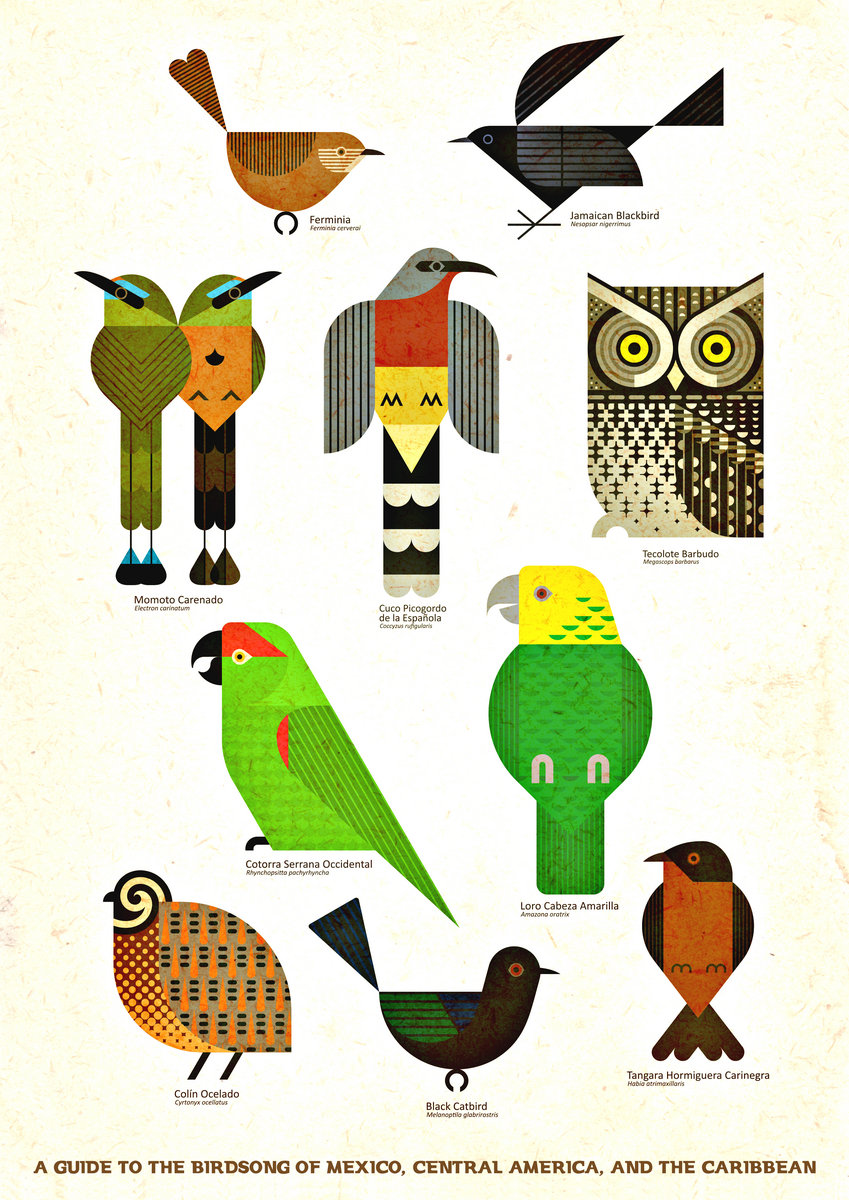
The catbird and the collective appear along with nine other electronic musician / endangered native bird teams on the fundraising album, A Guide to the Birdsong of Mexico, Central America & the Caribbean.
A Black-cheeked Ant-Tanager joins NILLO, a producer and DJ from Costa Rica who draws musical inspiration from the tribal communities around him.
Siete Catorce, a producer who helped popularize the popular border genre known as ruidosón—a mix of cumbia and prehispanic tribal sounds—is paired with a Yellow-headed Parrot.
Jordan “Time Cow” Chung of Equiknoxx seamlessly integrates a Jamaican Blackbird into his unique brand of organic, experimental dancehall.
The album follows 2015’s Guide to the Birdsong of South America, and as with its predecessor, 100% of the profits will be donated to regional organizations focused on birds and conservation—Birds Caribbean, La Asociación Ornitológica de Costa Rica, and Mexico’s Fundacion TXORI.
Birds, as the project’s founder, Robin Perkins, told Gizmodo’s Earther, are the most musical animals in the world:
There’s something really nice about focusing on endangered species and songs that are disappearing and not being preserved and to use music to raise awareness about the species. I believe music has a big power for social activism and social change and for environmental change.
Listen to A Guide to the Birdsong of Mexico, Central America & the Caribbean for free on Spotify.
Buy the album or individual tracks on Bandcamp to benefit the charities above.
Robin Perkins’ limited edition prints of the featured birds also benefit the bird-focused regional charities and can be purchased here.
Related Content:
The Bird Library: A Library Built Especially for Our Fine Feathered Friends
What Kind of Bird Is That?: A Free App From Cornell Will Give You the Answer
Download 435 High Resolution Images from John J. Audubon’s The Birds of America
Ayun Halliday is an author, illustrator, theater maker and Chief Primatologist of the East Village Inky zine. Follow her @AyunHalliday.
Read More...Why Fleetwood Mac’s Peter Green (RIP) Was the Most Underrated Guitarist in British Blues
Debates about whether a guitarist is underrated often involve a lot of posturing and needless name-dropping—they don’t tend to go anywhere, in other words. This is not the case with Peter Green, founder and former singer, songwriter, and guitarist for Fleetwood Mac, who died this past weekend. He is, probably most definitely, “the most underrated guitarist in British Blues,” argues the Happy Bluesman, or at least he became so in the last decades of his life.
Green experienced a tragic end to his career with Fleetwood Mac when his mental health declined precipitously in 1970, and he was eventually diagnosed with schizophrenia. His legend lived long among musicians (and fans of the band who preferred their early work), but Green more or less disappeared from public view, even after releasing a handful of solo albums in a period of recovery.
Fleetwood Mac, the group he founded and carried to its first years of major stardom became, of course, “a household name, widely recognized as one of the best soft rock bands ever for hits like ‘The Chain,’ ‘Go Your Own Way,’ and ‘Everywhere’”—songs Peter Green had nothing to do with, though he had the soft rock chops, as the melancholy “Man of the World” beautifully demonstrates. Hear him in some of his other finest moments in the band, including a phenomenal “Black Magic Woman” at the top, before Carlos Santana made the song his signature.
The argument for Green’s most underrated-ness as a blues guitarist is more than compelling, with endorsements from B.B. King—who said Green had “the sweetest tone I ever heard”—and John Mayall, who said he was better than Clapton when Green joined the Bluesbreakers at age 20. After founding Fleetwood Mac, Green wrote “Black Magic Woman,” sent a guitar instrumental, “Albatross,” to the top of the British Charts in 1969 and, that same year, recorded at Chess Records with, among other blues legends, Willie Dixon and Buddy Guy.
Was he the “best” British blues guitarist? He was “the only one who gave me the cold sweats,” King confessed, which sure is something, even if you prefer Clapton or Jeff Beck. Is he the most underrated? Probably most definitely. “Within a few short years, Peter Green had achieved greater commercial success than two of the world’s most famous bands,” selling more records in 1969 than “both The Rolling Stones and The Beatles, combined.” Then he disappeared.
Green is receiving the recognition in death that eluded him in his last years, though fame never seemed to truly motivate him at any time in his life. Fellow musicians have spared no superlatives in online memorials, including Metallica’s Kirk Hammett, not known for going anywhere near an early Fleetwood Mac sound. But Green was a consummate musician’s musician (he named his band after the rhythm section!), and he earned the respect of serious rock artists and serious blues artists and serious metal artists.
A longtime friend and admirer, Hammett owns Green’s ’59 Gibson Les Paul (nicknamed “Greeny”). He recently covered Green’s last Fleetwood Mac song—“The Green Manalishi (With the Two Prong Crown)”—live onstage and was collaborating on new material with his idol. “Our loss is total,” Hammett wrote in tribute, perhaps the most succinct and devastating tribute among so many. Fleetwood Mac would never have existed without him. And his influence on the British Blues and beyond goes even deeper. See Green revisit his lovely “Man of the World” in a more recent performance, just below. He steps back from the fiery leads, playing subtle rhythm parts, but he still has the old magic in his fingers.
Related Content:
The Thrill is Gone: See B.B. King Play in Two Electric Live Performances
Josh Jones is a writer and musician based in Durham, NC. Follow him at @jdmagness
Read More...A Free Stanford Course on How to Teach Online: Watch the Lectures Online
Earlier this month, Stanford’s Online High School offered (in partnership with Stanford Continuing Studies) a free, five-day course “Teach Your Class Online: The Essentials.” With many schools starting the next academic year online, this course found a large audience. 7,000 teachers signed up. Aimed at middle and high school teachers, the course covered “general guidelines for adapting your course to an online format, best practices for varied situations, common pitfalls in online course design, and how to troubleshoot student issues online.”
The videos from “Teach Your Class Online: The Essentials” are all now available online. You can watch them in sequential order, moving from top to bottom, here. Or watch them on this Stanford hosted page. Day 1 (above) provides a general introduction to teaching online. See topics covered in Days 2–5 below.
Please feel free to share these videos with any teachers. And if anyone watches these lectures and takes good class notes (ones other teachers can use), please let us know. We would be happy to help share them with other teachers.
Finally, just to give you a little background, Stanford’s Online High School has operated as a fully-online, independent, accredited high school since 2006. Stanford Continuing Studies provides open enrollment courses to adults worldwide. All of its courses are currently online. For anyone interested, Coursera also offers a specialization (a series of five courses) on online learning called the Virtual Teacher. It can be explored here.
Day 2
- Getting Specific: Situations and Tools
- Science: Labs in Online Pedagogy
Day 3
- Online Classroom Example Clips
- Building and Maintaining a Classroom
Community
Day 4
- Review of Submitted Sample Lesson Drafts
- Troubleshooting Obstacles to Success in the Online Environment
Day 5
- Math: Using Writing Tablets and Whiteboards
- Modern Languages: Tips for Highly Interactive Class During Which Students Actively Speak and Write in the Target Language
- Humanities: Productive Classroom Conversations About Challenging Subjects
- Closing Thoughts
Related Content:
1,700 Free Online Courses from Top Universities.
“I Will Survive,” the Coronavirus Version for Teachers Going Online
Read More...Support Us
We're hoping to rely on loyal readers, rather than erratic ads. Please click the Donate button and support Open Culture. You can use Paypal, Venmo, Patreon, even Crypto! We thank you!

About Us

Open Culture scours the web for the best educational media. We find the free courses and audio books you need, the language lessons & educational videos you want, and plenty of enlightenment in between.
Advertise With Us

FREE UPDATES!
GET OUR DAILY EMAIL
Get the best cultural and educational resources on the web curated for you in a daily email. We never spam. Unsubscribe at any time.
FOLLOW ON SOCIAL MEDIA

Open Culture editor Dan Colman scours the web for the best educational media. He finds the free courses and audio books you need, the language lessons & movies you want, and plenty of enlightenment in between.
Advertise With Us

