Evelyn Waugh’s “Victorian Blood Book”: A Most Strange & Macabre Illustrated Book
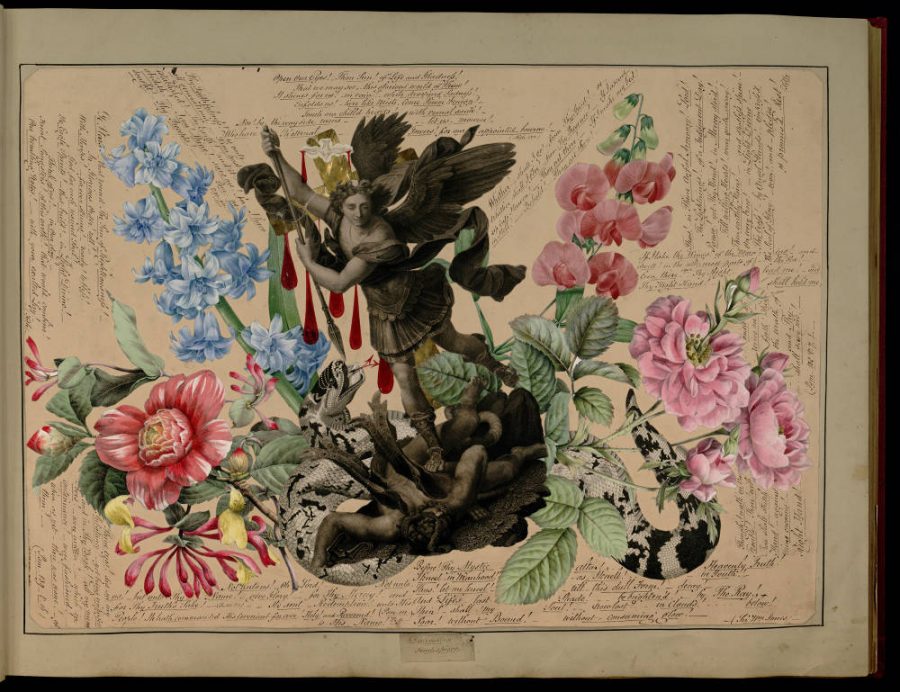
Most U.S. readers come to know Evelyn Waugh as the “serious” writer of the saga Brideshead Revisited (and inspirer of the 1981 miniseries adaptation). This was also the case in 1954, when Charles Rolo wrote in the pages of The Atlantic that the novel “sold many more copies in the United States than all of Waugh’s other books put together.” Yet “among the literary,” Waugh’s name evokes “a singular brand of comic genius… a riotously anarchic cosmos, in which only the outrageous can happen—and when it does happen is outrageously diverting.”
The comic Waugh’s imagination “runs to… appalling and macabre inventions,” incorporating a “lunatic logic.” The sources of that imagination now reside at the Harry Ransom Center at the University of Texas, Austin, who hold Waugh’s manuscripts and 3,500-volume library.
The novelist, the Ransom Center notes, “was an inveterate collector of things Victorian (and well ahead of most of his contemporaries in this regard). Undoubtedly the single most curious object in the entire library is a large oblong folio decoupage book, often referred to as the ‘Victorian Blood Book.’”
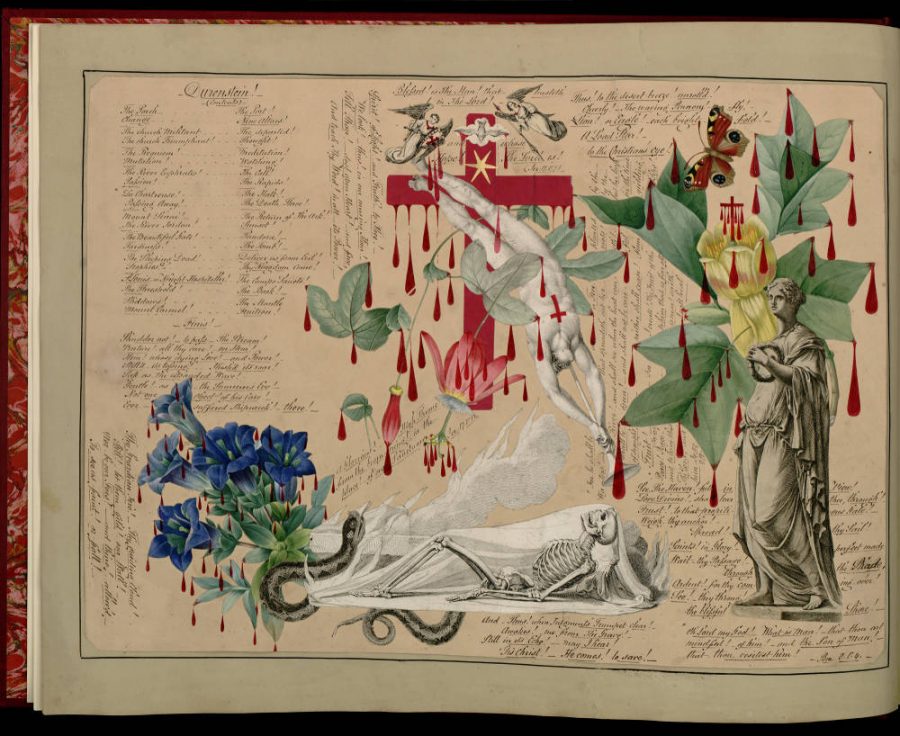
Waugh deeply admired Victorian art, and especially “those nineteenth-century enemies of technology, the Pre-Raphaelites,” writes Rolo. Still, like us, he may have looked upon scrapbooks like these as bizarre and morbidly humorous, if also possessed by an unsettling beauty. (One 2008 catalogue described them as “weird” and “rather elegant but very scary.”) More than anything, they resemble the kind of thing a goth teenager raised on Monty Python and Emily Dickinson might put together in her bedroom late at night. Such an artist would be carrying on a long “cherished tradition.”
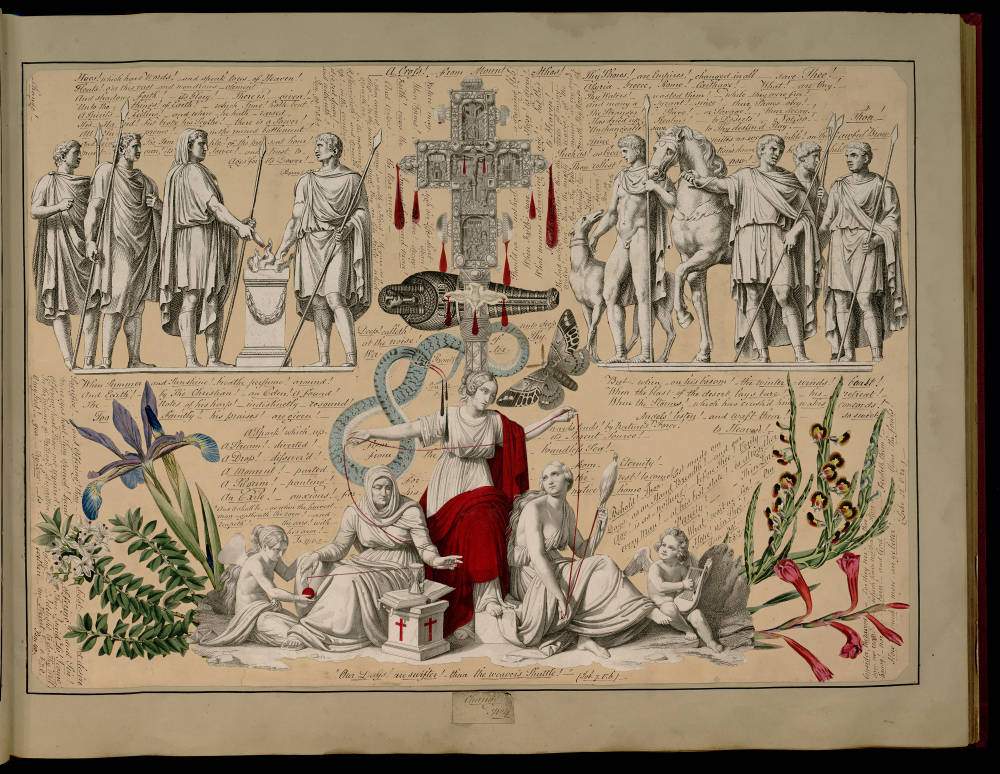
“Victorian scrapbooking,” the Ransom Center writes, “was almost exclusively the province of women,” a way of organizing information, although “the esthetic aspect” could sometimes be “secondary.” The “Victorian Blood Book,” however, is the work of a paterfamilias named John Bingley Garland, “a prosperous Victorian businessman who moved to Newfoundland, went on to become speaker of its first Parliament, and returned to Stone Cottage in Dorset to end his days.”
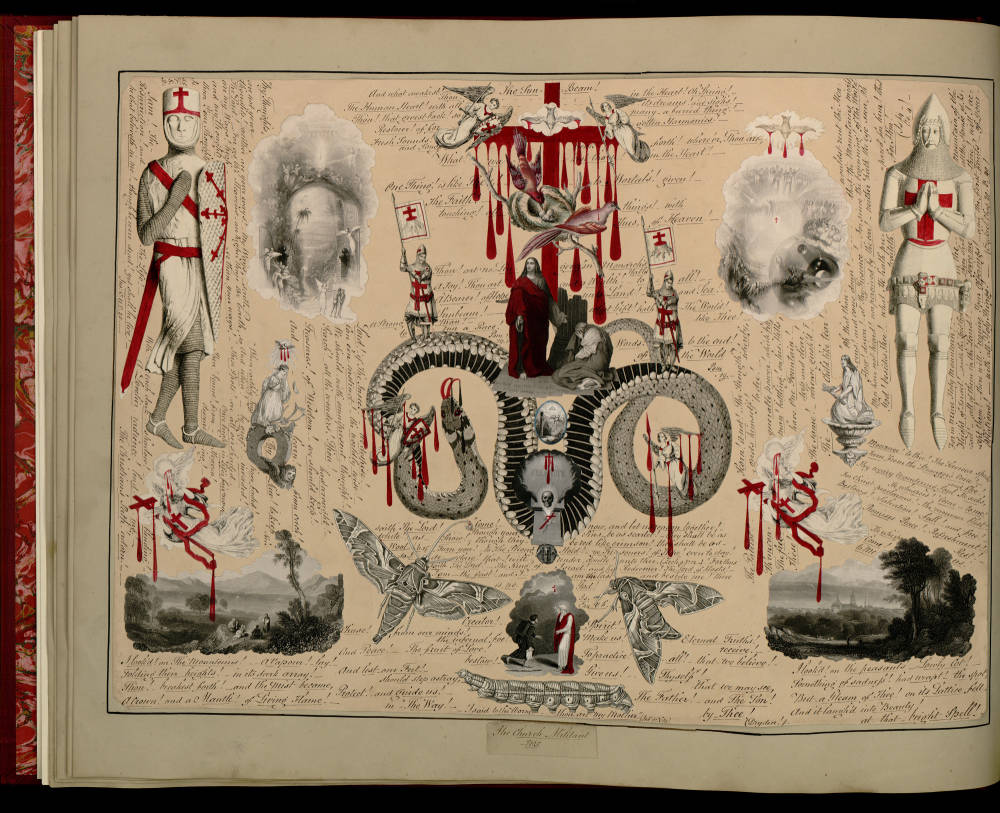
Inscribed to Bingley’s daughter Amy on September 1, 1854, the book seems to have been a wedding present, made with serious devotional intent:
How does one “read” such an enigmatic object? We understandably find elements of the grotesque and surreal. But our eyes view it differently from Victorian ones. As Garland’s descendants have written, “our family doesn’t refer to…‘the Blood Book;’ we refer to it as ‘Amy’s Gift’ and in no way see it as anything other than a precious reminder of the love of family and Our Lord.”
The “Blood Book“ ‘s actual title appears to have been Durenstein!, which is the Austrian castle where Richard the Lionhearted was imprisoned. Assembled from hundreds of engravings, many by William Blake, it apparently depicts “the spiritual battles encountered by Christians along the path of life and the ‘blood’ to Christian sacrifice.” The “blood” is red India ink. The quotations surrounding each collage, according to the Garland family “are encouraging one to turn to God as our Saviour.”
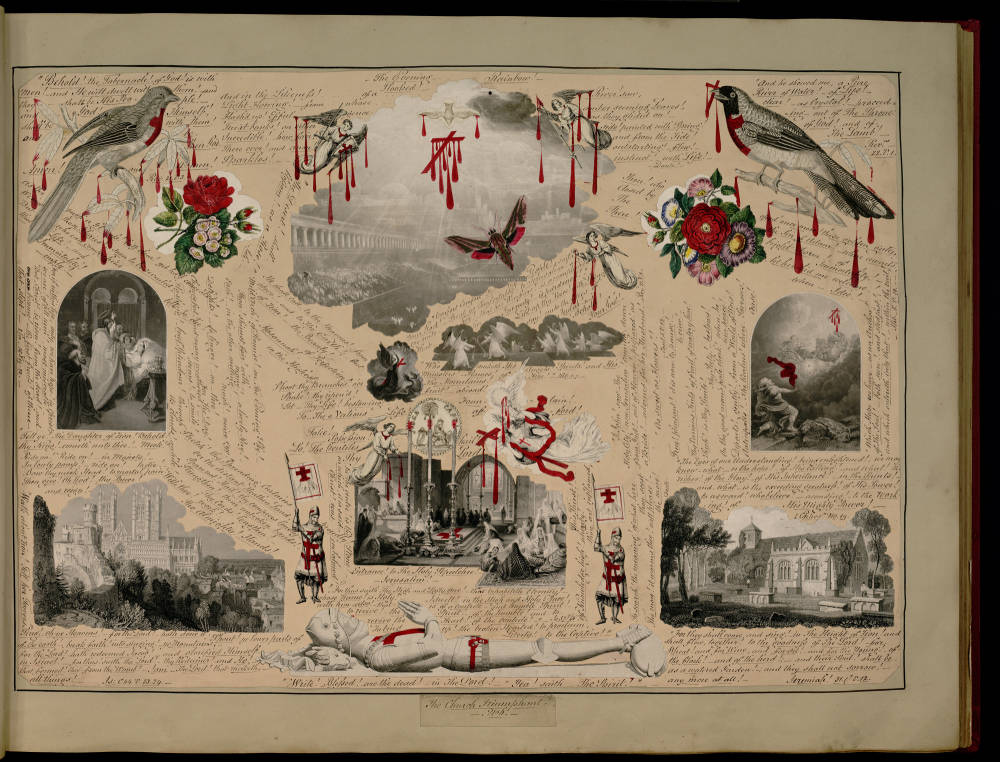
One can imagine the “serious” Waugh looking on this strange object with almost reverential affection. He lapsed into a highly affected, reactionary nostalgia in his later period, announcing himself “two hundred years” behind the times. One contemporary declared, “He grows more old-fashioned every day.” But the savagely comic Waugh would not have been able to approach such a bizarre piece of folk collage art without an eye toward its use as material for his own “appalling and macabre inventions.”
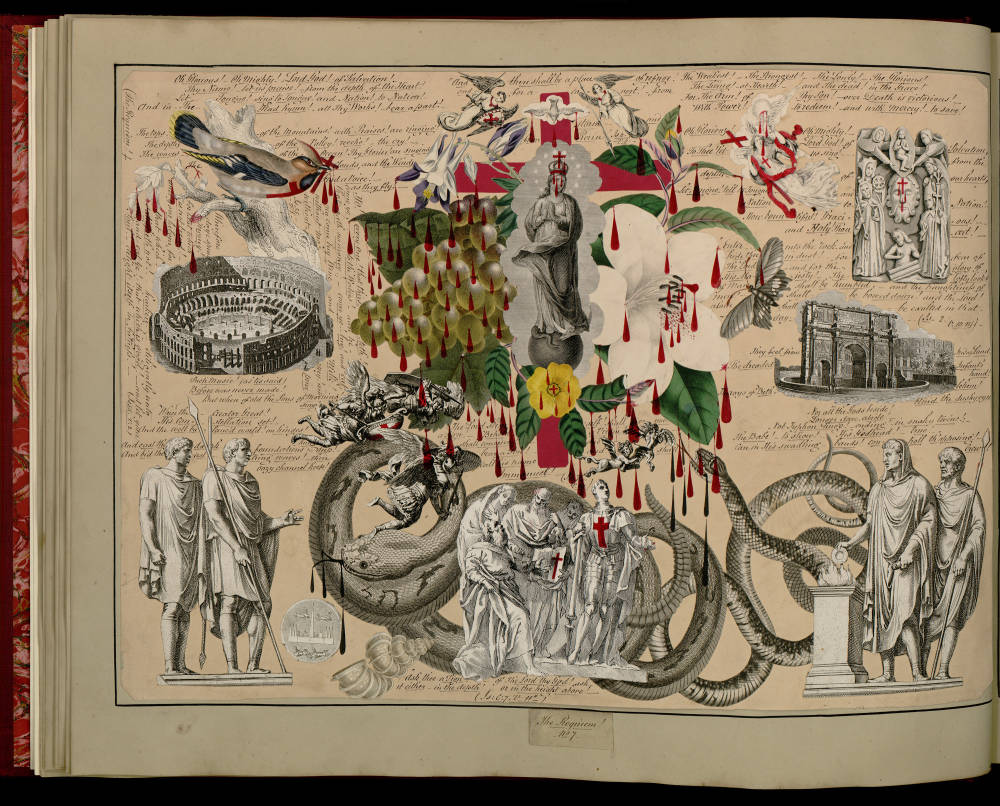
See a full scanned copy of the “Victorian Blood Book,” and download high-resolution images, online at the University of Texas, Austin’s Harry Ransom Center.
Related Content:
Browse The Magical Worlds of Harry Houdini’s Scrapbooks
A Witty Dictionary of Victorian Slang (1909)
Josh Jones is a writer and musician based in Durham, NC. Follow him at @jdmagness
Read More...Scorsese’s The Irishman in the Context of his Oeuvre–Pretty Much Pop: A Culture Podcast #29 Featuring Colin Marshall

What distinguishes the highly lauded 2019 film The Irishman within director Martin Scorsese’s body of work? Frequent Open Culture contributor Colin Marshall joins Mark Linsenmayer, Erica Spyres, and Brian Hirt to talk about what we do and don’t connect with in Scorsese’s work and how these films qualify as “art films” despite their watchability, not to mention the big budgets and stars.
We cover CGI age alteration, the connection to The Joker, his comments about the Marvel franchise vs. him being a franchise unto himself, his use of music, and making films as an old guy. We hit particularly on Raging Bull, Taxi Driver, Bringing out the Dead, The King of Comedy, Goodfellas, Gangs of New York, The Departed, Casino, Silence, and Cape Fear. (There are no significant spoilers about any of these other films, just The Irishman.)
Beyond just watching or re-watching a lot of films, here are some articles we used to prep:
- “Explore the Films of Martin Scorsese” by Zach Hollwedel
- “A Guide to Watching Scorsese Movies Like an Insider” by Ben Keningsberg
- “Martin Scorsese Is Letting Go” by Dave Itzkoff
- “How To Watch The Irishman (As A Miniseries)” by Luke Parker
- “Scorsese’s ‘The Irishman’ Is a Big Lie. Here’s What Really Happened to Jimmy Hoffa” by Vince Wade
- “The Irishman: The Inconvenient Truth About the Movie’s Central Confession” by Julie MIller
- “Netflix’s Limited ‘The Irishman’ Release Is a ‘Disgrace,’ Head of Movie Theater Group Says” by Beatrice Verhoeven
- “Martin Scorsese Does Not Recommend Watching ‘The Irishman’ on a Phone: ‘A Big iPad, Maybe’” by Erin Nyren
- “The Irishman Shows The Limits of CGI Deaging” by Adrienne Tyler
- “The De-Aging In ‘The Irishman’ May Make You A Believer In This Controversial Tech” by Jasmine Ting
Colin recommends the books Easy Riders, Raging Bulls, Scorsese on Scorsese, and Gangster Priest: The Italian American Cinema of Martin Scorsese. Read Colin’s Open Culture articles on Scorsese. Also, Colin reviews The Partially Examined Life in 2012.
Here’s that clip from Singles about “the next Martin Scorseeze.” Here’s Peter Boyle in Taxi Driver giving “Wizard” advice. Watch Abed in Community consider whether Nicolas Cage is good or bad.
This episode includes bonus discussion that you can only hear by supporting the podcast at patreon.com/prettymuchpop. This podcast is part of the Partially Examined Life podcast network.
Pretty Much Pop: A Culture Podcast is the first podcast curated by Open Culture. Browse all Pretty Much Pop posts or start with the first episode.
Read More...Hear the Voice of a 3,0000-Year-Old Egyptian Mummy: Scientists 3‑D Print His Throat & Mouth and Get Him to Speak … a Little
“The Mummy Speaks!” announces The New York Times in Nicholas St. Fleur’s story about Nesyamun, a mummified Egyptian priest whose voice has been recreated, sort of, “with the aid of a 3‑D printed vocal tract” and an electronic larynx. Does the mummy sound like the monster of classic 1930’s horror? Scientists have only got as far as one syllable, “which resembles the ‘ah’ and ‘eh’ vowels sounds heard in the words ‘bad’ and ‘bed.’ ” Yet it’s clear that Nesyamun would not communicate with guttural moans.
This may not make the recreation any less creepy. Nesyamun, whose coffin is inscribed with the words “true of voice,” was charged with singing and chanting the liturgies; “he had this wish,” says David Howard, speech scientist at Royal Holloway, University of London, “that his voice would somehow continue into perpetuity.” Howard and his team’s 3‑D printed recreation of his mouth and throat has allowed them to synthesize “the sound that would come out of his vocal tract if he was in his coffin and his larynx came to life again.”
Let’s imagine a different scenario, shall we? One in which Nesyamun speaks from the ancient past rather than from the sarcophagus. “Voice from the Past” is, indeed, what the researchers call their project, and they hope that it will eventually enable museum goers to “engage with the past in completely new and innovative ways.”
If Nesyamun could be made to speak again, St. Fleur writes, “perhaps the mummy could recite for museum visitors his words to Nut, the ancient Egyptian goddess of the sky and heavens: ‘O mother Nut, spread out your wings over my face so you may allow me to be like the stars-which-know-no-destruction, like the stars-which-know-no-weariness, (and) not to die over again in the cemetery.”
Might we empathize? As University of York archaeologist John Schofield puts it, “there is nothing more personal than someone’s voice.” Hearing the mummy speak would be “more multidimensional” than only staring at his corpse. The novelty of this experience aside, one can imagine the knowledge historians and linguists of ancient languages might gather from this research. Others in the scientific community have expressed their doubts. We may wish to temper our expectations.
Piero Cosi, an Italian speech scientist who helped reconstruct the voice of a mummified iceman named Ötzi in 2016 (speaking only in Italian vowels), points out the speculative nature of the science: “Even if we have the precise 3‑D-geometric description of the voice system of the mummy, we would not be able to rebuild precisely his original voice.” Egyptologist Kara Cooney notes the clear potential for human biases to shape research that uses “so much inference about what [ancient people] looked or sounded like.”
So, what might be the value of approximating Nesyamun’s voice? In their paper, published in Nature Scientific Reports, Howard and his co-authors explain, in language that sounds suspiciously like the kind that might invoke a classic horror movie mummy’s curse:
While this approach has wide implications for heritage management/museum display, its relevance conforms exactly to the ancient Egyptians’ fundamental belief that ‘to speak the name of the dead is to make them live again.’ Given Nesyamun’s stated desire to have his voice heard in the afterlife in order to live forever, the fulfilment of his beliefs through the synthesis of his vocal function allows us to make direct contact with ancient Egypt.
Learn more about the Nesyamun’s vocal recreation in the videos above.
Related Content:
How to Make a Mummy — Demonstrated by The Getty Museum
Josh Jones is a writer and musician based in Durham, NC. Follow him at @jdmagness
Read More...Discover the Disappearing Turkish Language That is Whistled, Not Spoken
We so often privilege individuals as the primary drivers of innovation. But what if technology is also self-organizing, developing as an evolutionary response to the environment? If we think of whistled language as a kind of technology, we have an excellent example of this self-organizing principle in the 42 documented whistled languages around the world.
As we noted in a previous post, reports of whistled languages go back hundreds of years in cultures that would have had no contact with each other: Oaxaca, Mexico, northern Africa’s Atlas Mountains, the Brazilian Amazon, northern Laos, and the Canary Islands.
These are “places with steep terrain or dense forests,” writes Michelle Nijhuis at The New Yorker, “where it might otherwise be hard to communicate at a distance.” Such is the case in the village of Kuşköy, in “the remote mountains of northern Turkey,” notes Great Big Story:
“For three centuries” farmers there “have communicated great distances by whistling. It’s a language called kuş dili that is still used to this day, though fewer people are learning it in the age of the cell phone.” Also called “bird language” by locals, “for obvious reasons,” this system of vocal telephony, like all other examples, is based on actual speech. Nijhuis explains:
Kuşköy’s version [of whistled language] adapts standard Turkish syllables into piercing tones that can be heard from more than half a mile away. The phrase “Do you have fresh bread?,” which in Turkish is “Taze ekmek var mı?,” becomes, in bird language, six separate whistles made with the tongue, teeth, and fingers.
The method may be avian, but the messages are human, albeit in simplified language for ease of transmission. In the video above Muazzez Köçek, Kuşköy’s best whistler, shows how she translates Turkish vocabulary into melodies—turning words into music, an act of coding without a computer.
That this bio-technological feat arose spontaneously to solve the same problem the world over shows how us how humans collectively problem-solve. But of course, individualism has its advantages. Despite the huge amount of data they gather on us, modern communications technologies have met one particular human need.
In Kuşköy, “bird language is rapidly disappearing from daily life,” writes Nijhuis. “In a small town filled with nosy neighbors, texting affords a level of privacy that whistling never did.”
Related Content:
Speaking in Whistles: The Whistled Language of Oaxaca, Mexico
How Languages Evolve: Explained in a Winning TED-Ed Animation
Josh Jones is a writer and musician based in Durham, NC. Follow him at @jdmagness.
Read More...What Is the Coronavirus?: Answers to Common Questions About the Mysterious New Virus Spreading Across China
Above, The Guardian’s health editor, Sarah Boseley, answers basic questions you might have about the coronavirus outbreak in Wuhan, China.
What are the symptoms? Where have cases been confirmed so far? How is the virus transmitted? What are the available treatments? Should I be panicking? and more…
For more information, visit the CDC website.
If you would like to support the mission of Open Culture, consider making a donation to our site. It’s hard to rely 100% on ads, and your contributions will help us continue providing the best free cultural and educational materials to learners everywhere. You can contribute through PayPal, Patreon, and Venmo (@openculture). Thanks!
Read More...Jim Lehrer’s 16 Rules for Practicing Journalism with Integrity
In 1988, stalwart PBS news anchor, writer, and longtime presidential debate moderator Jim Lehrer was accused of being too soft on the candidates. He snapped back, “If somebody wants to be entertained, they ought to go to the circus.” The folksy quote sums up the Texan journalist’s philosophy succinctly. The news was a serious business. But Lehrer, who passed away last Thursday, witnessed the distinction between political journalism and the circus collapse, with the spread of cable infotainment, and corporate domination of the Internet and radio.
Kottke remarks that Lehrer seemed “like one of the last of a breed of journalist who took seriously the integrity of informing the American public about important events.” He continually refused offers from the major networks, hosting PBS’s MacNeil-Lehrer Newshour with cohost Robert MacNeil until 1995, then his own in-depth news hour until his retirement in 2011. “I have an old-fashioned view that news is not a commodity,” he said. “News is information that’s required in a democratic society… That sounds corny, but I don’t care whether it sounds corny or not. It’s the truth.”
To meet such high standards required a rigorous set of journalistic… well, standards—such as Lehrer was happy to list, below, in a 1997 report from the Aspen Institute.
- Do nothing I cannot defend.*
- Do not distort, lie, slant, or hype.
- Do not falsify facts or make up quotes.
- Cover, write, and present every story with the care I would want if the story were about me.*
- Assume there is at least one other side or version to every story.*
- Assume the viewer is as smart and caring and good a person as I am.*
- Assume the same about all people on whom I report.*
- Assume everyone is innocent until proven guilty.
- Assume personal lives are a private matter until a legitimate turn in the story mandates otherwise.*
- Carefully separate opinion and analysis from straight news stories and clearly label them as such.*
- Do not use anonymous sources or blind quotes except on rare and monumental occasions. No one should ever be allowed to attack another anonymously.*
- Do not broadcast profanity or the end result of violence unless it is an integral and necessary part of the story and/or crucial to understanding the story.
- Acknowledge that objectivity may be impossible but fairness never is.
- Journalists who are reckless with facts and reputations should be disciplined by their employers.
- My viewers have a right to know what principles guide my work and the process I use in their practice.
- I am not in the entertainment business.*
In a 2006 Harvard commencement address (at the top), Lehrer reduced the list to only the nine rules marked by asterisks above by Kottke, who goes on to explain in short why these guidelines are so routinely cast aside—“this shit takes time! And time is money.” It’s easier to patch together stories in rapid-fire order when you don’t cite or check sources or do investigative reporting, and face no serious consequences for it.
Lehrer’s adherence to professional ethics may have been unique in any era, but his attention to detail and obsession with accessing multiple points of view came from an older media. He “saw himself as ‘a print/word person at heart’ and his program as a kind of newspaper for television,” writes Robert McFadden in his New York Times obituary. He was also “an oasis of civility in a news media that thrived on excited headlines, gotcha questions and noisy confrontations.”
Lehrer understood that civility is meaningless in the absence of truth, or of kindness and humility. His longtime cohost’s list of journalistic guidelines also appears in the Aspen Institute report. “The values which Jim Lehrer and I observed,” MacNeil writes, “he continues to observe.” Journalism is a serious business—“behave with civility”—but “remember that journalists are no more important to society than people in other professions. Avoid macho posturing and arrogant display.”
Read more about Lehrer’s list of guidelines at Kottke.
Related Content:
Journalism Under Siege: A Free Course from Stanford Explores the Imperiled Freedom of the Press
Journalistic Ethics: A Free Online Course from UCLA
Josh Jones is a writer and musician based in Durham, NC. Follow him at @jdmagness
Read More...China’s 8,000 Terracotta Warriors: An Animated & Interactive Introduction to a Great Archaeological Discovery
Unless you’re a Chinese history buff, the name of Qin Shi Huang may not immediately ring a bell. But perhaps his accomplishments will sound familiar. “He conquered the warring states that surrounded him, creating the first unified Chinese empire” — making him the very first emperor of China — “and enacted a number of measures to centralize his administration and bolster infrastructure,” writes Smithsonian.com’s Brigit Katz. “In addition to standardizing weights, measures and the written language, the young ruler constructed a series of fortifications that later became the basis for the Great Wall.”
Second only to the Great Wall as an ancient Chinese artifact of note is Emperor Qin’s army: not the living army he maintained to defend and expand his empire, fearsome though it must have been, but the even more impressive one made out of terracotta.
“In 1974, farmers digging a well near their small village stumbled upon one of the most important finds in archaeological history,” says the TED-Ed lesson written by Megan Campisi and Pen-Pen Chen above: “a vast underground chamber surrounding the emperor’s tomb, and containing more than 8,000 life-size clay soldiers, ready for battle,” all commissioned by Qin, who after ascending to the throne at age thirteen “began the construction of a massive underground necropolis filled with monuments, artifacts, and an army to accompany him into the next world and continue his rule.”
Qin’s ceramic soldiers, 200 more of which have been discovered over the past decade, have stood ready in battle formation for well over 2000 years now. Stored in the same area’s underground chambers are 130 chariots with 520 horses, 150 cavalry horses, and a variety of musicians, acrobats, workers, government officials, and exotic animals — all made of terracotta, all life-size, and each with its own painstakingly crafted uniqueness. They populate what we now call a necropolis, an elaborately designed “city of the dead” built around a mausoleum. You can get a 360-degree view of a section of Qin’s necropolis above, as well as a deeper look into its historical background from the BBC documentary New Secrets of the Terracotta Warriors, the BBC documentary above, and this episode of PBS’ Secrets of the Dead.
Why direct so much material and labor to such a seemingly obscure project? Qin, who also showed a great interest in searching far-flung lands for life-prolonging elixirs, must have considered building a well-populated necropolis a reasonable bet to secure for himself a place in eternity. Nor was such an endeavor without precedent, and in fact Qin’s version represented a civilizing step forward for the necropolis. “Ruthless as he was,” write Campisi and Chen, he at least “chose to have servants and soldiers built for this purpose, rather than having living ones sacrificed to accompany him, as had been practiced in Egypt, West Africa, Anatolia, parts of North America,” and even previous Chinese dynasties. “You can’t take it with you,” we often hear today regarding the amassment of wealth in one’s lifetime — but maybe, as Qin must have thought, you can take them.
Related Content:
One of World’s Oldest Books Printed in Multi-Color Now Opened & Digitized for the First Time
How Ancient Greek Statues Really Looked: Research Reveals Their Bold, Bright Colors and Patterns
Roman Statues Weren’t White; They Were Once Painted in Vivid, Bright Colors
Based in Seoul, Colin Marshall writes and broadcasts on cities, language, and culture. His projects include the book The Stateless City: a Walk through 21st-Century Los Angeles and the video series The City in Cinema. Follow him on Twitter at @colinmarshall or on Facebook.
Read More...Iconic Songs Played by Musicians Around the World: “Stand by Me,” “Redemption Song,” “Ripple” & More
We here at Open Culture love to see how well known and well loved songs pop up all over the globe in new and interesting forms. These covers could be played on very un-rock instruments, or on ones we’ve never heard of. We’ve seen schoolkids sing songs that their grandparents loved, and we’ve heard senior citizens singing death metal. Music unites us in troubling times, and we need more of it.
The above video from Playing for Change imagines a world where people from all four corners of the earth play and sing a song together, and makes it real through the power of technology and interconnectivity.
It started in 2005 when Mark Johnson heard street musician Roger Ridley singing Ben E. King’s “Stand By Me” in Santa Monica. Struck by Ridley’s emotive voice, he returned with recording equipment and began a process of bringing the world to join in. Johnson recorded Grandpa Elliott in New Orleans sharing a verse, Washboard Chaz providing washboard rhythm, then Clarence Bekker in Amsterdam taking a verse, the Twin Eagle Drum Group providing a Native American rhythm, and so on. By the end of the video, Johnson had racked up frequent flier miles and stitched together a cohesive track.
Years later, the Playing for Change non-profit has accumulated an impressive back catalog of cover songs and has helped fund 15 music programs worldwide.
One takeaway is this: the world agrees on Bob Marley. Whether he’s being political or spiritual, everybody seems to get it. Here’s “War” featuring Bono. Also see “Redemption Song” here:
Other stars have done guest spots to bring awareness to the project. Bunny Wailer, Manu Chao and Bushman singing “Soul Rebel”:
Most recently, they recorded “The Weight” with Robbie Robertson and Ringo Starr:
And we always enjoy this version of the Dead’s “Ripple.”
The videos are heartwarming, but the music stands by itself without the globetrotting. For those who need a good vibe injection to start 2020, start here.
Related Content:
BBC Launches World Music Archive
Ted Mills is a freelance writer on the arts who currently hosts the artist interview-based FunkZone Podcast and is the producer of KCRW’s Curious Coast. You can also follow him on Twitter at @tedmills, read his other arts writing at tedmills.com and/or watch his films here.
Read More...How Humans Domesticated Cats (Twice)
Depending on how you feel about cats, the feline situation on the island of Cyprus is either the stuff of a delightful children’s story or a horror film to be avoided at all cost.
Despite being surrounded on all sides by water, the cat population—an estimated 1.5 million—currently outnumbers human residents. The overwhelming majority are feral, though as we learn in the above episode of PBS’ EONS, they, too, can be considered domesticated. Like the other 600,000,000-some living members of Felis Catus on planet Earth—which is to say the type of beast we associate with litterboxes, laser pointers, and Tender Vittles—they are descended from a single subspecies of African wildcat, Felis Silvestris Lybica.
While there’s no single narrative explaining how cats came to dominate Cyprus, the story of their global domestication is not an uncommon one:
An ancient efficiency expert realized that herding cats was a much better use of time than hunting them, and the idea quickly spread to neighboring communities.
Kidding. There’s no such thing as herding cats (though there is a Chicago-based cat circus, whose founder motivates her skateboard-riding, barrel-rolling, high-wire-walking stars with positive reinforcement…)
Instead, cats took a commensal path to domestication, lured by their bellies and celebrated curiosity.
Ol’ Felis (Felix!) Silvestris (Sufferin’ Succotash!) Lybica couldn’t help noticing how human settlements boasted generous supplies of food, including large numbers of tasty mice and other rodents attracted by the grain stores.
Her inadvertent human hosts grew to value her pest control capabilities, and cultivated the relationship… or at the very least, refrained from devouring every cat that wandered into camp.
Eventually, things got to the point where one 5600-year-old specimen from northwestern China was revealed to have died with more millet than mouse meat in its system—a pet in both name and popular sentiment.
Chow chow chow.
Interestingly, while today’s house cats’ gene pool leads back to that one sub-species of wild mackerel-tabby, it’s impossible to isolate domestication to a single time and place.
Both archeological evidence and genome analysis support the idea that cats were domesticated both 10,000 years ago in Southwest Asia… and then again in Egypt 6500 years later.
At some point, a human and cat traveled together to Cyprus and the rest is history, an Internet sensation and an if you can’t beat em, join em tourist attraction.
Such high end island hotels as Pissouri’s Columbia Beach Resort and TUI Sensatori Resort Atlantica Aphrodite Hills in Paphos have started catering to the ever-swelling numbers of uninvited, four-legged locals with a robust regimen of healthcare, shelter, and food, served in feline-specific tavernas.
An island charity known as Cat P.A.W.S. (Protecting Animals Without Shelter) appeals to visitors for donations to defray the cost of neutering the massive feral population.
Sometimes they even manage to send a furry Cyprus native off to a new home with a foreign holidaymaker.
Related Content:
A New Photo Book Documents the Wonderful Homemade Cat Ladders of Switzerland
Ayun Halliday is an author, illustrator, theater maker and Chief Primatologist of the East Village Inky zine. Join her in NYC on Monday, February 3 when her monthly book-based variety show, Necromancers of the Public Domain celebrates New York, The Nation’s Metropolis (1921). Follow her @AyunHalliday.
Read More...Monty Python’s Terry Jones (RIP) Was a Comedian, But Also a Medieval Historian: Get to Know His Other Side
Monty Python’s surreal, slapstick parodies of history, religion, medicine, philosophy, and law depended on a competent grasp of these subjects, and most of the troupe’s members, four of whom met at Oxford and Cambridge, went on to demonstrate their scholarly acumen outside of comedy, with books, guest lectures, professorships, and serious television shows.
Michael Palin even became president of the Royal Geographical Society for a few years. And Palin’s onetime Oxford pal and early writing partner Terry Jones—who passed away at 77 on January 21 after a long struggle with degenerative aphasia—didn’t do so badly for himself either, becoming a respected scholar of Medieval history and an authoritative popular writer on dozens of other subjects.
Indeed, as the Pythons did throughout their academic and comedic careers, Jones combined his interests as often as he could, either bringing historical knowledge to absurdist comedy or bringing humor to the study of history. Jones wrote and directed the pseudo-historical spoofs Monty Python and the Holy Grail and Life of Brian, and in 2004 he won an Emmy for his television program Terry Jones’ Medieval Lives, an entertaining, informative series that incorporates sketch comedy-style reenactments and Terry Gilliam-like animations.
In the program, Jones debunks popular ideas about several stock medieval European characters familiar to us all, while he visits historical sites and sits down to chat with experts. These characters include The Peasant, The Damsel, The Minstrel, The Monk, and The Knights. The series became a popular book in 2007, itself a culmination of decades of work. Jones first book, Chaucer’s Knight: The Portrait of a Medieval Mercenary came out in 1980. There, notes Matthew Rozsa at Salon:
[Jones] argued that the concept of Geoffrey Chaucer’s knight as the epitome of Christian chivalry ignored an uglier truth: That the Knight was a mercenary who worked for authoritarians that brutally oppressed ordinary people (an argument not dissimilar to the scene in which a peasant argues for democracy in The Holy Grail).
In 2003, Jones collaborated with several historians on Who Murdered Chaucer? A speculative study of the period in which many of the figures he later surveyed in his show and book emerged as distinctive types. As in his work with Monty Python, he didn’t only apply his contrarianism to medieval history. He also called the Renaissance “overrated” and “conservative,” and in his 2006 BBC One series Terry Jones’ Barbarians, he described the period we think of as the fall of Rome in positive terms, calling the city’s so-called “Sack” in 410 an invention of propaganda.
Jones’ work as a popular historian, political writer, and comedian “is not the full extent of [his] oeuvre,” writes Rozsa, “but it is enough to help us fathom the magnitude of the loss suffered on Tuesday night.” His legacy “was to try to make us more intelligent, more well-educated, more thoughtful. He also strove, of course, to make us have fun.” Python fans know this side of Jones well. Get to know him as a passionate interpreter of history in Terry Jones’ Medieval Lives, which you can watch on YouTube here.
For an academic study of Jones’ medieval work, see the collection: The Medieval Python The Purposive and Provocative Work of Terry Jones.
Related Content:
Monty Python’s Eric Idle Breaks Down His Most Iconic Characters
Josh Jones is a writer and musician based in Durham, NC. Follow him at @jdmagness
Read More...Support Us
We're hoping to rely on loyal readers, rather than erratic ads. Please click the Donate button and support Open Culture. You can use Paypal, Venmo, Patreon, even Crypto! We thank you!

About Us

Open Culture scours the web for the best educational media. We find the free courses and audio books you need, the language lessons & educational videos you want, and plenty of enlightenment in between.
Advertise With Us

FREE UPDATES!
GET OUR DAILY EMAIL
Get the best cultural and educational resources on the web curated for you in a daily email. We never spam. Unsubscribe at any time.
FOLLOW ON SOCIAL MEDIA

Open Culture editor Dan Colman scours the web for the best educational media. He finds the free courses and audio books you need, the language lessons & movies you want, and plenty of enlightenment in between.
Advertise With Us

