A Concise Breakdown of How Time Travel Works in Popular Movies, Books & TV Shows
As least since H.G. Wells’ 1895 novel The Time Machine, time travel has been a promising storytelling concept. Alas, it has seldom delivered on that promise: whether their characters jump forward into the future, backward into the past, or both, the past 125 years of time-travel stories have too often suffered from inelegance, inconsistency, and implausibility. Well, of course they’re implausible, everyone but Ronald Mallett might say — they’re stories about time travel. But fiction only has to work on its own terms, not reality’s. The trouble is that the fiction of time travel can all too easily stumble over the potentially infinite convolutions and paradoxes inherent in the subject matter.
In the MinutePhysics video above, Henry Reich sorts out how time-travel stories work (and fail to work) using nothing but markers and paper. For the time-travel enthusiast, the core interest of such fictions isn’t so much the spectacle of characters hurtling into the future or past but “the different ways time travel can influence causality, and thus the plot, within the universe of each story.” As an example of “100 percent realistic travel” Reich points to Orson Scott Card’s Ender’s Game, in which space travelers at light speed experience only days or months while years pass back on Earth. The same thing happens in Planet of the Apes, whose astronauts return from space thinking they’ve landed on the wrong planet when they’ve actually landed in the distant future.
But when we think of time travel per se, we more often think of stories about how actively traveling to the past, say, can change its future — and thus the story’s “present.” Reich poses two major questions to ask about such stories. The first is “whether or not the time traveler is there when history happens the first time around. Was “the time-traveling version of you always there to begin with?” Or “does the very act of time traveling to the past change what happened and force the universe onto a different trajectory of history from the one you experienced prior to traveling?” The second question is “who has free will when somebody is time traveling” — that is, “whose actions are allowed to move history onto a different trajectory, and whose aren’t?”
We can all look into our own pasts for examples of how our favorite time-travel stories have dealt with those questions. Reich cites such well-known time-travelers’ tales as A Christmas Carol, Groundhog Day, and Bill & Ted’s Excellent Adventure, as well, of course, as Back to the Future, the most popular dramatization of the theoretical changing of historical timelines caused by travel into the past. Rian Johnson’s Looper treats that phenomenon more complexly, allowing for more free will and taking into account more of the effects a character in one time period would have on that same character in another. Consulting on that film was Shane Carruth, whose Primer — my own personal favorite time-travel fiction — had already taken time travel “to the extreme, with time travel within time travel within time travel.”
Harry Potter and the Prisoner of Azkaban, Reich’s personal favorite time-travel fiction, exhibits a clarity and consistency uncommon in the genre. J.K. Rowling accomplishes this by following the rule that “while you’re experiencing your initial pre-time travel passage through a particular point in history, your time-traveling clone is also already there, doing everything you’ll eventually do when you time-travel yourself.” This single-time-line version of time travel, in which “you can’t change the past because the past already happened,” gets around problems that have long bedeviled other time-travel fictions. But it also demonstrates the importance of self-consistency in fiction of all kinds: “In order to care about the characters in a story,” Reich says, “we have to believe that actions have consequences.” Stories, in other words, must obey their own rules — even, and perhaps especially, stories involving time-traveling child wizards.
Related Content:
Professor Ronald Mallett Wants to Build a Time Machine in this Century … and He’s Not Kidding
What Happened When Stephen Hawking Threw a Cocktail Party for Time Travelers (2009)
Based in Seoul, Colin Marshall writes and broadcasts on cities, language, and culture. His projects include the book The Stateless City: a Walk through 21st-Century Los Angeles and the video series The City in Cinema. Follow him on Twitter at @colinmarshall or on Facebook.
Read More...The Lost Neighborhood Buried Under New York City’s Central Park
New York City is in a constant state of flux.
For every Nets fan cheering their team on in Brooklyn’s Barclays Center and every tourist gamboling about the post-punk, upscale East Village, there are dozens of local residents who remember what—and who—was displaced to pave the way for this progress.
It’s no great leap to assume that something had to be plowed under to make way for the city’s myriad gleaming skyscrapers, but harder to conceive of Central Park, the 840-acre oasis in the middle of Manhattan, as a symbol of ruthless gentrification.
Plans for a peaceful green expanse to rival the great parks of Great Britain and Europe began taking shape in the 1850s, driven by well-to-do white merchants, bankers, and landowners looking for temporary escape from the urban pressures of densely populated Lower Manhattan.
It took 20,000 workers—none black, none female—over three years to realize architects Frederick Law Olmsted and Calvert Vaux’s sweeping pastoral design.
A hundred and fifty years later, Central Park is still a vital part of daily life for visitors and residents alike.
But what of the vibrant neighborhood that was doomed by the park’s construction?

As historian Cynthia R. Copeland, co-director of the Seneca Village Project, points out above, several communities were given the heave ho in order to clear the way for the park’s creation.
The best established of these was Seneca Village, which ran from approximately 82nd to 89th Street, along what is known today as Central Park West. 260-some residents were evicted under eminent domain and their homes, churches, and school were razed.
This physical erasure quickly translated to mass public amnesia, abetted, no doubt, by the way Seneca Village was framed in the press, not as a community of predominantly African-American middle class and working class homeowners, but rather a squalid shantytown inhabited by squatters.
As Brent Staples recalls in a New York Times op-ed, in the summer of 1871, when park workers dislodged two coffins in the vicinity of the West 85th Street entrance, The New York Herald treated the discovery as a baffling mystery, despite the presence of an engraved plate on one of the coffins identifying its occupant, an Irish teenager, who’d been a parishioner of Seneca Village’s All Angels Episcopal Church.
According to historian Leslie Alexander’s African or American? Black Identity and Political Activism in New York City, 1784–1861, All Angels’ congregation was unique in that it was integrated, a reflection of Seneca Village’s population, 2/3 of whom were African American and 1/3 of European descent, mostly Irish and German.
Copeland and her colleagues kept Alexander’s work in mind when they began excavating Seneca Village in 2011, focusing on the households of two African-American residents, Nancy Moore and William G. Wilson, a father of eight who served as sexton at All Angels and lived in a three-story wood-frame house. The dig yielded 250 bags of material, including a piece of a bone-handled toothbrush, an iron tea kettle, and fragments of clay pipes and blue-and-white Chinese porcelain:
Archaeologists have begun to consider the lives of middle class African Americans, focusing on the ways their consumption of material culture expressed class and racial identities. Historian Leslie Alexander believes that Seneca Village not only provided a respite from discrimination in the city, but also embodied ideas about African pride and racial consciousness.
Owning a home in Seneca Village also bestowed voting rights on African American male heads of household.
Two years before it was torn down, the community was home to 20 percent of the city’s African American property owners and 15 percent of its African American voters.
Thanks to the efforts of historians like Copeland and Alexander, Seneca Village is once again on the public’s radar, though unlike Pigtown, a smaller, predominantly agricultural community toward the southern end of the park, the origins of its name remain mysterious.
Was the village named in tribute to the Seneca people of Western New York or might it, as Alexander suggests, have been a nod to the Roman philosopher, whose thoughts on individual liberty would have been taught as part of Seneca Village’s African Free Schools’ curriculum?
For now, there is little more than a sign to hip Park visitors to the existence of Seneca Village, but that should change in the near future, after the city erects a planned monument to abolitionists and former Seneca Village residents Albro and Mary Joseph Lyons and their daughter Maritcha.
Learn more about this bygone community in Copeland’s interview with the New York Preservation Archive Project the New York Historical Society’s Teacher’s Guide to Seneca Village.
Related Content:
New York Public Library Puts 20,000 Hi-Res Maps Online & Makes Them Free to Download and Use
Immaculately Restored Film Lets You Revisit Life in New York City in 1911
Ayun Halliday is an author, illustrator, theater maker and Chief Primatologist of the East Village Inky zine. Join her in NYC on Monday, February 3 when her monthly book-based variety show, Necromancers of the Public Domain celebrates New York: The Nation’s Metropolis (1921). Follow her @AyunHalliday.
Read More...The Flute of Shame: Discover the Instrument/Device Used to Publicly Humiliate Bad Musicians During the Medieval Period
Since humanity has had music, we’ve also had bad music. And bad music can come from only one source: bad musicians. Despite such personal technologies of relatively recent invention as noise-canceling headphones, bad music remains nigh unavoidable in the modern world, issuing as it constantly does from the sound systems installed in grocery stores, gyms, passing automobiles, and so on. And against the bad musicians responsible we have less recourse than ever, or at least less than medieval Europeans did, as shown by the Ripley’s Believe It or Not video above on the “shame flute,” a non-musical instrument used to punish crimes against the art.
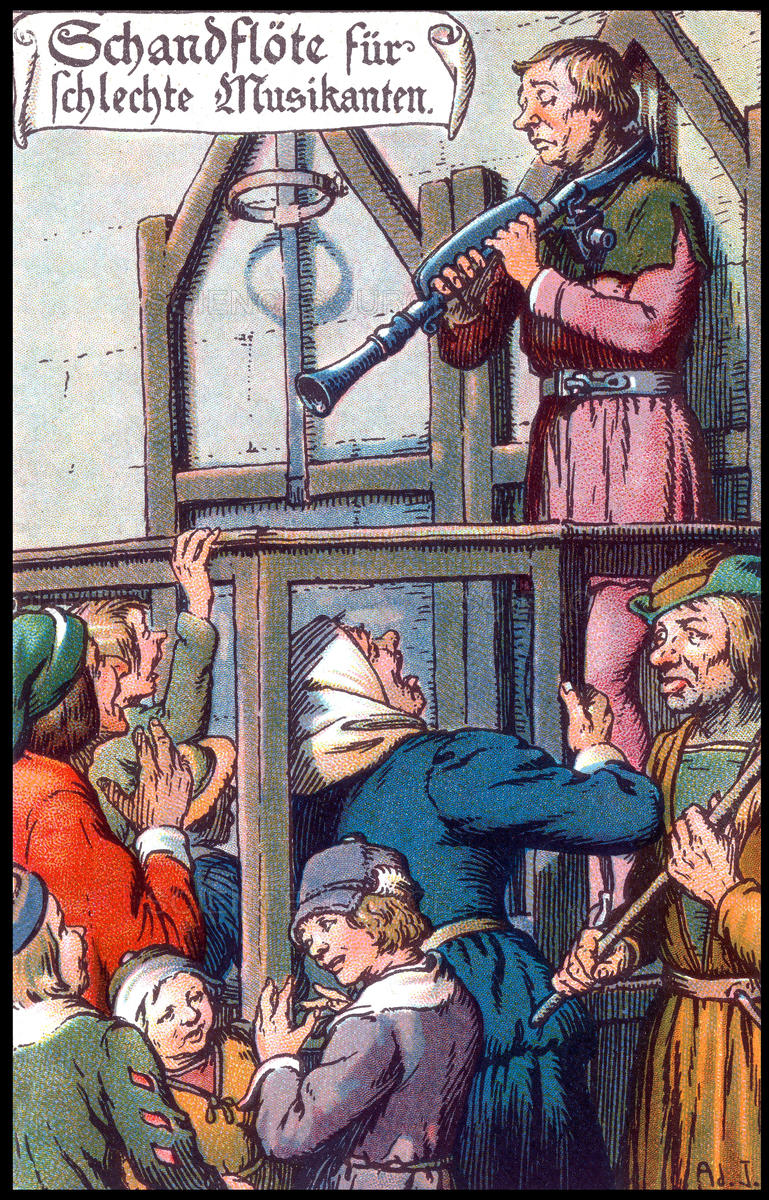
“The contraption, which is essentially a heavy iron flute – although you probably wouldn’t want play it – was shackled to the musician’s neck,” writes Maddy Shaw Roberts at Classic FM. “The musician’s fingers were then clamped to the keys, to give the impression they were playing the instrument. Finally, just to further their humiliation, they were forced to wear the flute while being paraded around town, so the public could throw rotten food and vegetables at them.” Surely the mere prospect of such a fate made many music-minded children of the olden days think twice about slacking on their practice sessions.
The sight of this flute of shame, which you can take in at either the equally stimulating-sounding Medieval Crime Museum in Rothenburg or the Torture Museum in Amsterdam, would get any of us moderns thinking about considering which musicians of our own day deserve to be shackled to it. The Guardian’s Dave Simpson suggests, among others, “all bands with silly names,” “any musician called Sir who is over 60,” and “anyone who has ever appeared on The X Factor, ever.” In this day and age they would all probably complain of cruel and unusual punishment, but as music-related torture devices go, the shame flute certainly seems preferable to ancient Greece’s “brazen bull.”
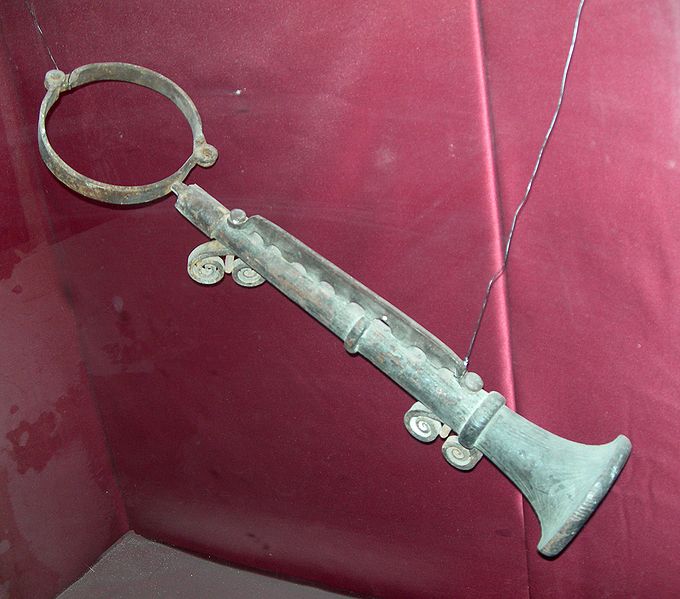
Though still a little-known historical artifact, the shame flute has regained some cultural currency in recent years. It even inspired the name of a Finnish rock group, Flute of Shame. As the band members put it in an interview with Vice’s Josh Schneider, “We were having a night out in Amsterdam and found ourselves in a torture museum whilst looking for the Banana Bar,” a well-known spot in the city’s red-light district. “We saw the device and the rest is history.” Of course, any rock group that names itself after a torture device will draw comparisons to Iron Maiden, and journalistic diligence compels Schneider to ask Flute of Shame which band would win in a shredding contest. “Probably Iron Maiden,” the Finns respond, “but are they happy?”
via Classic FM
Related Content:
Meet the Hurdy Gurdy, the Hand-Cranked Medieval Instrument with 80 Moving Parts
Hear the World’s Oldest Instrument, the “Neanderthal Flute,” Dating Back Over 43,000 Years
Based in Seoul, Colin Marshall writes and broadcasts on cities, language, and culture. His projects include the book The Stateless City: a Walk through 21st-Century Los Angeles and the video series The City in Cinema. Follow him on Twitter at @colinmarshall or on Facebook.
Read More...Actor Margaret Colin (VEEP, Independence Day) Joins Pretty Much Pop #28 to Take On the Trope of the Alpha Female

What’s the deal with images of powerful women in media? The trope of the tough-as-nails boss-lady who may or may not have a heart of gold has evolved a lot over the years, but it’s difficult to portray such a character unobjectionably, probably due to those all-too-familiar double standards about wanting women in authority (or, say, running for office) to be assertive but not astringent.
Margaret was the female lead in major films including Independence Day and The Devil’s Own, is a mainstay on Broadway, and has appeared on TV in many roles including the mother of the Gossip Girl and as an unscrupulous newscaster on the final seasons of VEEP. Her height and voice have made her a good fit for dominant-lady roles, and she leads Mark, Erica, and Brian through a quick, instructive tour through her work with male directors (e.g. in a pre-Murphy-Brown Dianne English sit-com), playing the lead in three Lifetime Network movies, on Broadway as Jackie, and opposite Harrison Ford, Al Pacino, Melanie Griffith, Michael Shannon, Wallace Shawn, and others.
Given the limitations of short-form storytelling in film, maybe some use of stereotypes is just necessary to get the gist of a character out quickly, but actors can load their performances with unseen backstory. We hear about the actor’s role in establishing a character vs. the vision of the filmmakers or show-runners. Also, the relative conservatism of film vs. stage vs. TV in granting women creative control, the “feminine voice,” why women always apparently have to trip in movies when chased, and more.
A few resources to get you thinking about this topic:
- Wikipedia on the strong female stock character
- TV Tropes on the “Iron Lady” stereotype (The parent category to this is the “Ice Queen.”)
- IMDB’s entry on Alpha Females of Film and TV
- “Fierce Femmes: The Problem With Strong Female Characters” by Rachel Wayne
- “The 9 Most Badass Female Bosses from TV & Movies” by Christina Murphy
- “Horrible Movie Bosses Ranked” by Julia Hays
- “Playbill.com’s Brief Encounter With Margaret Colin” by Robert Simonson
Someone’s posted a tape of Carousel featuring Erica and Margaret.
This episode includes bonus discussion that you can only hear by supporting the podcast at patreon.com/prettymuchpop. This podcast is part of the Partially Examined Life podcast network.
Pretty Much Pop: A Culture Podcast is the first podcast curated by Open Culture. Browse all Pretty Much Pop posts or start with the first episode.
Read More...How the Female Scientist Who Discovered the Greenhouse Gas Effect Was Forgotten by History
In the early 19th century, Aristotle’s Meteorologica still guided scientific ideas about the climate. The model “sprang from the ancient Greek concept of klima,” as Ian Beacock writes at The Atlantic, a static scheme that “divided the hemispheres into three fixed climatic bands: polar cold, equatorial heat, and a zone of moderation in the middle.” It wasn’t until the 1850s that the study of climate developed into what historian Deborah Cohen describes as “dynamic climatology.”
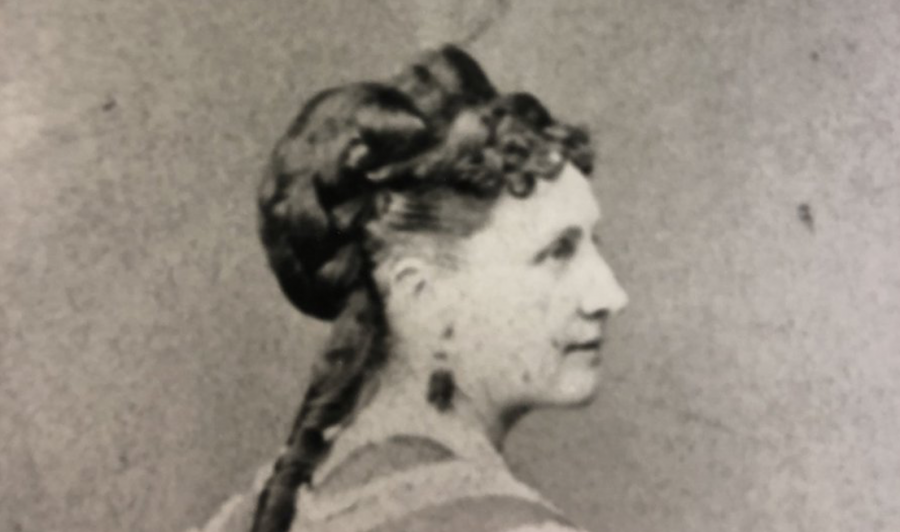
Indeed, 120 years before Exxon Mobile learned about—and then seemingly covered up—global warming, pioneering researchers discovered the greenhouse gas effect, the tendency for a closed environment like our atmosphere to heat up when carbon dioxide levels rise. The first person on record to link CO2 and global warming, amateur scientist Eunice Newton Foote, presented her research to the Eight Annual Meeting of the American Association for the Advancement of Science in 1856.
Foote’s paper, “Circumstances affecting the heat of the sun’s rays,” was reviewed the following month in the pages of Scientific American, in a column that approved of her “practical experiments” and noted, “this we are happy to say has been done by a lady.” She used an air pump, glass cylinders, and thermometers to compare the effects of sunlight on “carbonic acid gas” (or carbon dioxide) and “common air.” From her rudimentary but effective demonstrations, she concluded:
An atmosphere of that gas [CO2] would give to our earth a high temperature; and if as some suppose, at one period of its history the air had mixed with it a larger proportion than at present, an increased temperature…must have necessarily resulted.
Unfortunately, her achievement would disappear three years later when Irish physicist John Tyndall, who likely knew nothing of Foote, made the same discovery. With his superior resources and privileges, Tyndall was able to take his research further. “In retrospect,” one climate science database writes, Tyndall has emerged as the founder of climate science, though the view “hides a complex, and in many ways more interesting story.”
Neither Tyndall nor Foote wrote about the effect of human activity on the contemporary climate. It would take until the 1890s for Swedish scientist Svante Arrhenius to predict human-caused warming from industrial CO2 emissions. But subsequent developments depended upon their insights. Foote, whose was born 200 years ago this past July, was marginalized almost from the start. “Entirely because she was a woman,” the Public Domain Review points out, “Foote was barred from reading the paper describing her findings.”
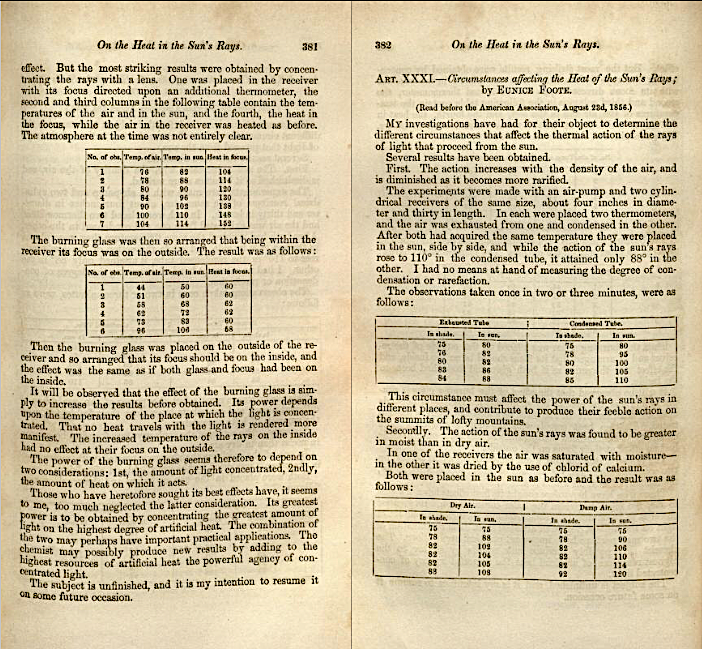
Furthermore, Foote “was passed over for publication in the Association’s annual Proceedings.” Her paper was published in The American Journal of Science, but was mostly remarked upon, as in the Scientific American review, for the marvel of such homespun ingenuity from “a lady.” The review, titled “Scientific Ladies—Experiments with Condensed Gas,” opened with the sentence “Some have not only entertained, but expressed the mean idea, that women do not possess the strength of mind necessary for scientific investigation.”
The praise of Foote credits her as a paragon of her gender, while failing to convey the universal importance of her discovery. At the AAAS conference, the Smithsonian’s Joseph Henry praised Foote by declaring that science was “of no country and of no sex,” a statement that has proven time and again to be untrue in practice. The condescension and discrimination Foote endured points to the multiple ways in which she was excluded as a woman—not only from the scientific establishment but from the educational institutions and funding sources that supported it.
Her disappearance, until recently, from the history of science “plays into the Matilda Effect,” Leila McNeill argues at Smithsonian, “the trend of men getting credit for female scientist’s achievements.” In this case, there’s no reason not to credit both scientists, who made original discoveries independently. But Foote got there first. Had she been given the credit she was due at the time—and the institutional support to match—there’s no telling how far her work would have taken her.
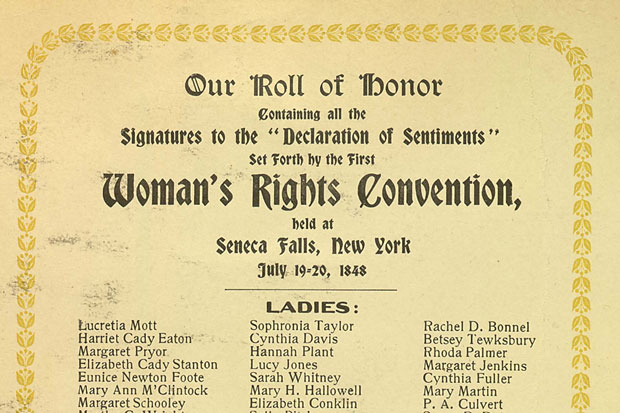
Just as Foote’s discovery places her firmly within climate science history, retrospectively, her “place in the scientific community, or lack therof,” writes Amara Huddleston at Climate.gov, “weaves into the broader story of women’s rights.” Foote attended the first Women’s Rights Convention in Seneca Falls, NY in 1848, and her name is fifth down on the list of signatories to the “Declaration of Sentiments,” a document demanding full equality in social status, legal rights, and educational, economic, and, Foote would have added, scientific opportunities.
Learn much more about Foote and her fascinating family from her descendent, marine biologist Liz Foote.
Related Content:
Women Scientists Launch a Database Featuring the Work of 9,000 Women Working in the Sciences
Josh Jones is a writer and musician based in Durham, NC. Follow him at @jdmagness
Read More...When Salvador Dali Met Sigmund Freud, and Changed Freud’s Mind About Surrealism (1938)
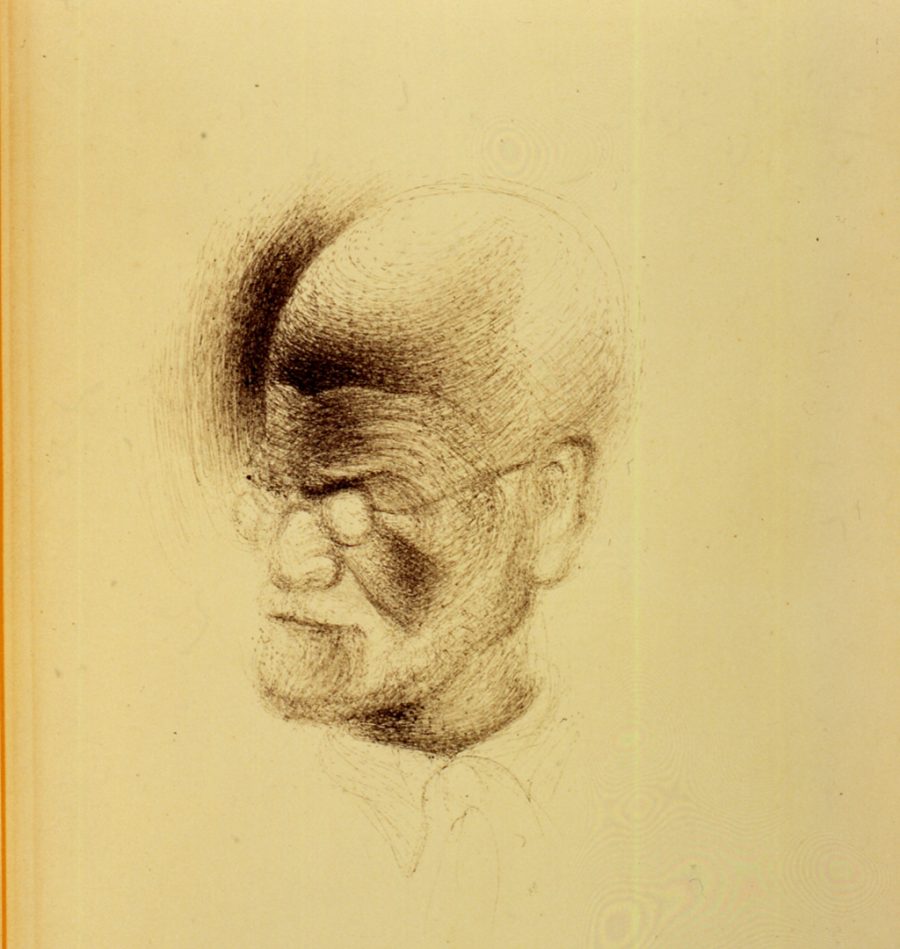
The close associations between Surrealism and Freudian psychoanalysis were liberally encouraged by the most famous proponent of the movement, Salvador Dalí, who considered himself a devoted follower of Freud. We don’t have to wonder what the founder of psychoanalysis would have thought of his self-appointed protégé.
We have them recording, in their own words, their impressions of their one and only meeting—which took place in July of 1938, at Freud’s home in London. Freud was 81, Dali 34. We also have sketches Dali made of Freud while the two sat together. Their memories of events, shall we say, differ considerably, or at least they seemed totally bewildered by each other. (Freud pronounced Dali a “fanatic.”)
In any case, There’s absolutely no way the encounter could have lived up to Dali’s expectations, as the Freud Museum London notes:
[Dalí] had already travelled to Vienna several times but failed to make an introduction. Instead, he wrote in his autobiography, he spent his time having “long and exhaustive imaginary conversations” with his hero, at one point fantasizing that he “came home with me and stayed all night clinging to the curtains of my room in the Hotel Sacher.”
Freud was certainly not going to indulge Dalí’s peculiar fantasies, but what the artist really wanted was validation of his work—and maybe his very being. “Dali had spent his teens and early twenties reading Freud’s works on the unconscious,” writes Paul Gallagher at Dangerous Minds, “on sexuality and The Interpretation of Dreams.” He was obsessed. Finally meeting Freud in ’38, he must have felt “like a believer might feel when coming face-to-face with God.”
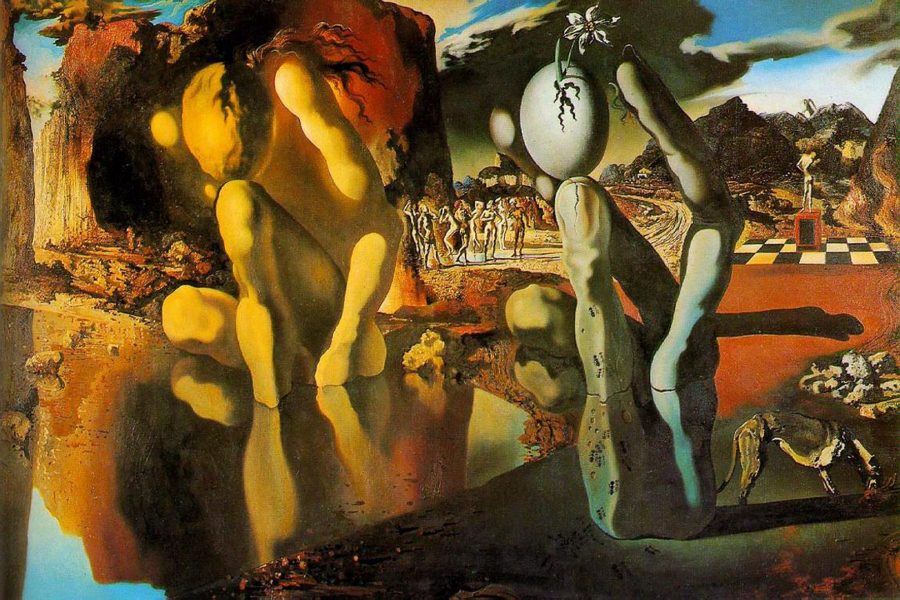
He brought with him his latest painting The Metamorphosis of Narcissus, and an article he had published on paranoia. This, especially, Dali hoped would gain the respect of the elderly Freud.
Trying to interest him, I explained that it was not a surrealist diversion, but was really an ambitiously scientific article, and I repeated the title, pointing to it at the same time with my finger. Before his imperturbable indifference, my voice became involuntarily sharper and more insistent.
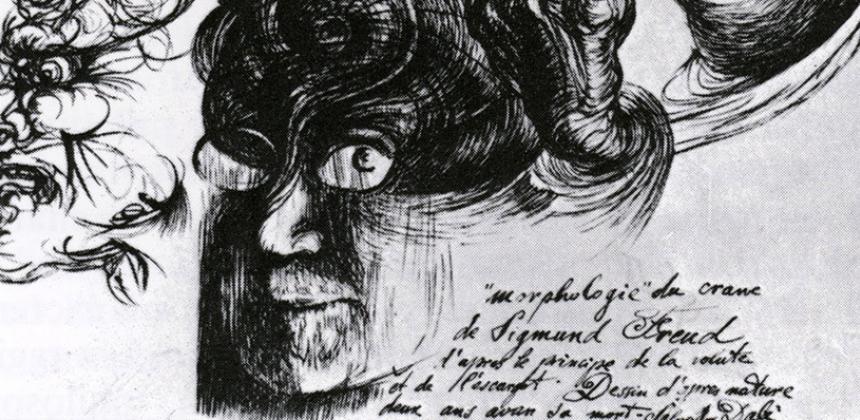
On being shown the painting, Freud supposedly said, “in classic paintings I look for the unconscious, but in your paintings I look for the conscious.” The comment stung, though Dali wasn’t entirely sure what it meant. But he took it as further evidence that the meeting was a bust. Sketching Freud in the drawing below, he wrote, “Freud’s cranium is a snail! His brain is in the form of a spiral—to be extracted with a needle!”
One might see why Freud was suspicious of Surrealists, “who have apparently chosen me as their patron saint,” he wrote to Stefan Zweig, the mutual friend who introduced him to Dali. In 1921, poet and Surrealist manifesto writer André Breton “had shown up uninvited on [Freud’s] doorstep.” Unhappy with his reception, Breton published a “bitter attack,” calling Freud an “old man without elegance” and later accused Freud of plagiarizing him.
Despite the memory of this nastiness, and Freud’s general distaste for modern art, he couldn’t help but be impressed with Dali. “Until then,” he wrote to Zweig, “I was inclined to look upon the surrealists… as absolute (let us say 95 percent, like alcohol), cranks. That young Spaniard, however, with his candid and fanatical eyes, and his undeniable technical mastery, has made me reconsider my opinion.”
Related Content:
The Famous Break Up of Sigmund Freud & Carl Jung Explained in a New Animated Video
Josh Jones is a writer and musician based in Durham, NC. Follow him at @jdmagness
Read More...The First Real Museum of Philosophy Prepares to Launch: See the Museo della Filosofia in Milan
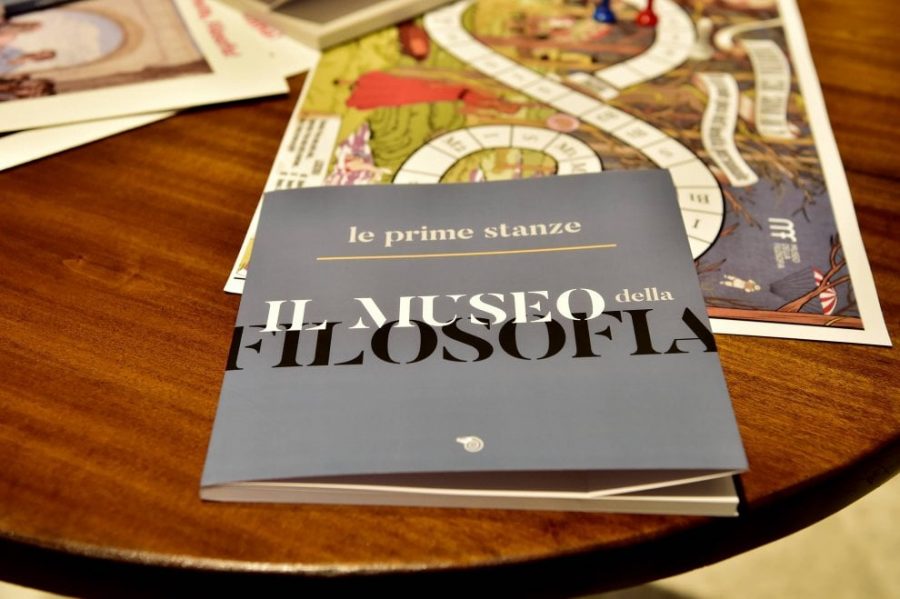
You’ve almost certainly been to more art museums than you can remember, and more than likely to a few museums of natural history, science, and technology as well. But think hard: have you ever set foot inside a museum of philosophy? Not just an exhibition dealing with philosophers or philosophical concepts, but a single institution dedicated wholly to putting the practice of philosophy itself on display. Your answer can approach a yes only if you spent time in Milan last November, and more specifically at the University of Milan, in whose halls the Museo della Filosofia set up shop and proved its surprisingly untested — and surprisingly successful — concept.

“What we had in mind was not an historically-minded museum collecting relics about the lives and works of important philosophers, but something more dynamic and interactive,” writes University of Milan postdoctoral research fellow Anna Ichino at Daily Nous, “where philosophical problems and theories become intuitively accessible through a variety of games, activities, experiments, aesthetic experiences, and other such things.”
In the first hall, “we used images like Mary Midgely’s ‘conceptual plumbing’ or Wittgenstein’s ‘fly bottle’ to convey the idea according to which philosophical problems are in important respects conceptual problems, which amount to analyzing concepts that we commonly use in unreflective ways.”
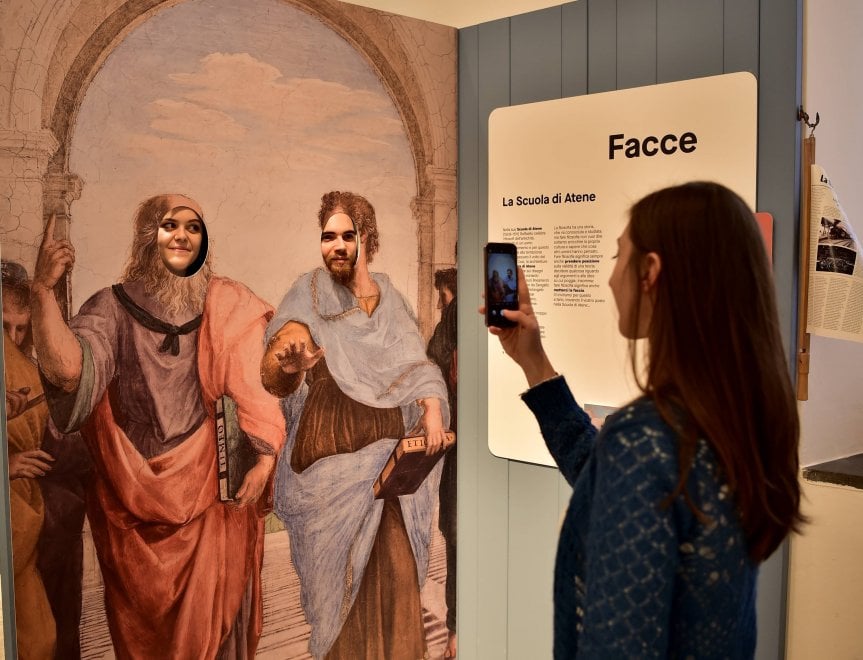
In the second hall, visitors to the Museo della Filosofia “could literally play with paradoxes and thought experiments in order to appreciate their heuristic role in philosophical inquiry.” The experiences available there ranged from using an oversized deck of cards to “solve” paradoxes, the perhaps inevitable demonstration of the well-known “trolley problem” using a model railroad set, and — most harrowing of all — the chance to “eat chocolates shaped as cat excrement” straight from the litter box. Then came the “School of Athens” game, “in which visitors had to decide whether to back Plato or Aristotle; then they could also take a souvenir picture portraying themselves in the shoes (and face!) of one or the other.”
In the third, “programmatic” hall, the museum’s organizers “presented the plan for what still needs to be done,” a to-do list that includes finding a permanent home. Before it does so, you can have a look at the project’s web site as well as its pages on Facebook and Instagram. At the top of the post appears a short video introducing the Museo della Filosofia which, like the rest of the materials, is for the moment in Italian only, but it nevertheless gets across even to non-Italian-speakers a certain idea of the experience a philosophical museum can deliver. Philosophical thinking, after all, occurs prior to language. Or maybe it’s inextricably tied up with language; different philosophers have approached the problem differently. And when the Museo della Filosofia opens for good, you’ll be able to visit and approach a few philosophical problems yourself. Read more about the museum at Daily Nous.
Related Content:
Free Online Philosophy Courses
The History of Philosophy Visualized
A Data Visualization of Modern Philosophy, 1950–2018
Philosophy Explained With Donuts
Watch a 2‑Year-Old Solve Philosophy’s Famous Ethical “Trolley Problem” (It Doesn’t End Well)
Based in Seoul, Colin Marshall writes and broadcasts on cities, language, and culture. His projects include the book The Stateless City: a Walk through 21st-Century Los Angeles and the video series The City in Cinema. Follow him on Twitter at @colinmarshall or on Facebook.
Read More...
Introducing The Radiohead Public Library: Radiohead Makes Their Full Catalogue Available via a Free Online Web Site
Radiohead remained relevant longer than any of their peers not only because they adapted to technological change but because they’ve just as often been a force behind it, whether musically or otherwise. Yet when it comes to their release strategies, we might call them increasingly conservative–they have embraced one of the oldest traditional features of the internet: the ability to give away free content to huge numbers of people all at once, and to archive that content in freely accessible repositories.
At least since In Rainbows, Radiohead has seen the internet as an opportunity to give away their work or sell it at a low-cost sliding scale, often with profits benefitting charities. Last year, when hackers stole demos from 1997’s OK Computer, Radiohead countered by releasing 18 hours of the material free to stream or buy for a limited time, with all proceeds going to climate action. Then they released every single studio album, including dozens of rarities, live sessions, and more, on YouTube, making everything free to stream for anyone with the bandwidth.
Now, concerned with the integrity of Radiohead collections online, they’ve gone full Internet Archive and started a “public library” (complete with a printable library card). And for any fan of the band—from the most casual to the most terminally dedicated—it’s an experience. “The band has brought nearly the entirety of their catalog to one place,” writes Rob Arcand at Spin, “which doesn’t contain ads and doesn’t use algorithms or obtrusive design gestures that could encourage myopic listening.” Dive in and you never know what you’ll find.

I stumbled upon OK Computer’s “Paranoid Android” and was reminded of how inexplicably weird the video is; crossed paths with 1992’s Drill, the band’s surprising power-pop-punk first EP (hear “Thinking About You” at the top); found a recent live performance of Thom Yorke, Jonny Greenwood, and a drum machine—the two demonstrating with electric guitars and voice why even the band’s most abstract and foreboding songs still have at their heart the delicate melodies that made up the entirety of their achingly earnest second album, The Bends.
Other rarities include the King of Limbs remix EP TKOL RMX 8 (“not to be confused with their King of Limbs remix album TKOL RMX 1234567”) and a 2005 track titled “I Want None of This” made for war relief compilation Help!: A Day in the Life. The “stress” here in this archive “is on ‘Public,’” notes Daniel Kreps at Rolling Stone. “The library is free to enter and audio and video files are accessible even to those without premium streaming services.” Each member of the band served as a “librarian” for the first week of the archive’s existence, curating their favorite selections of material for posting on social media from January 20th to the 24th.
Check out the Radiohead Public Library here.
Related Content:
Radiohead Puts Every Official Album on YouTube, Making Them All Free to Stream
Josh Jones is a writer and musician based in Durham, NC. Follow him at @jdmagness
Read More...Can You Spot Liars Through Their Body Language? A Former FBI Agent Breaks Down the Clues in Non-Verbal Communication
Can you spot a liar? We all know people who think they can, and very often they claim to be able to do so by reading “body language.” Clearing one’s throat, touching one’s mouth, crossing one’s arms, looking away: these and other such gestures, they say, indicate on the part of the speaker a certain distance from the truth. In the WIRED “Tradecraft” video above, however former FBI special agent Joe Navarro more than once pronounces ideas about such physical lie indicators “nonsense.” And having spent 25 years working to identify people presenting themselves falsely to the world — “my job was to catch spies,” he says — he should know, at the very least, what isn’t a tell.
Not that all the throat-clearing and arm-crossing doesn’t indicate something. Navarro calls such behaviors “self-soothers,” physical actions we use to pacify ourselves in stressful moments. Of course, even if self-soothers provide no useful information about whether a person is telling the truth, that doesn’t mean they provide no useful information at all.
But Navarro’s career has taught him that actions decisively indicating deception are much more specific, and without relevant knowledge completely illegible: take the suspected spy he had under surveillance who gave the game away just by leaving a flower shop holding a bouquet facing not upward but downward, “how they carry flowers in eastern Europe.”
For the most part, detecting a liar requires a great deal of what Navarro calls “face time,” a necessity when it comes to observing the full range of and patterns in an individual’s forms of non-verbal communication. In the video he analyzes footage of a poker game, the kind of setting that heightens our awareness of such non-verbal communication. At the table we all know to put on a “poker face” and shut our mouths, but even when we say nothing, Navarro emphasizes, we’re constantly transmitting a high quantity of information about ourselves. Whatever the setting, it comes through in how we dress, how we walk, how we carry ourselves — especially if we think it doesn’t. In the eyes of those who know how to interpret this information, all the world becomes a poker game.
Navarro is the author of two books on this subject: The Dictionary of Body Language: A Field Guide to Human Behavior and What Every Body Is Saying: An Ex-FBI Agent’s Guide to Speed-Reading People. For a contrarian point of view that challenges the idea that we can ever read people accurately, see Malcolm Gladwell’s new book, Talking to Strangers: What We Should Know about the People We Don’t Know.
Related Content:
How to Spot Bullshit: A Primer by Princeton Philosopher Harry Frankfurt
Based in Seoul, Colin Marshall writes and broadcasts on cities, language, and culture. His projects include the book The Stateless City: a Walk through 21st-Century Los Angeles and the video series The City in Cinema. Follow him on Twitter at @colinmarshall or on Facebook.
Read More...The Neuroscience of Drumming: Researchers Discover the Secrets of Drumming & The Human Brain
An old musician’s joke goes “there are three kinds of drummers in the world—those who can count and those who can’t.” But perhaps there is an even more global divide. Perhaps there are three kinds of people in the world—those who can drum and those who can’t. Perhaps, as the promotional video above from GE suggests, drummers have fundamentally different brains than the rest of us. Today we highlight the scientific research into drummers’ brains, an expanding area of neuroscience and psychology that disproves a host of dumb drummer jokes.
“Drummers,” writes Jordan Taylor Sloan at Mic, “can actually be smarter than their less rhythmically-focused bandmates.” This according to the findings of a Swedish study (Karolinska Institutet in Stockholm) which shows “a link between intelligence, good timing and the part of the brain used for problem-solving.” As Gary Cleland puts it in The Telegraph, drummers “might actually be natural intellectuals.”
Neuroscientist David Eagleman, a renaissance researcher The New Yorker calls “a man obsessed with time,” found this out in an experiment he conducted with various professional drummers at Brian Eno’s studio. It was Eno who theorized that drummers have a unique mental makeup, and it turns out “Eno was right: drummers do have different brains from the rest.” Eagleman’s test showed “a huge statistical difference between the drummers’ timing and that of test subjects.” Says Eagleman, “Now we know that there is something anatomically different about them.” Their ability to keep time gives them an intuitive understanding of the rhythmic patterns they perceive all around them.
That difference can be annoying—like the pain of having perfect pitch in a perpetually off-key world. But drumming ultimately has therapeutic value, providing the emotional and physical benefits collectively known as “drummer’s high,” an endorphin rush that can only be stimulated by playing music, not simply listening to it. In addition to increasing people’s pain thresholds, Oxford psychologists found, the endorphin-filled act of drumming increases positive emotions and leads people to work together in a more cooperative fashion.
Clash drummer Topper Headon discusses the therapeutic aspect of drumming in a short BBC interview above. He also calls drumming a “primeval” and distinctly, universally human activity. Former Grateful Dead drummer Mickey Hart and neuroscientist Adam Gazzaley have high hopes for the science of rhythm. Hart, who has powered a light show with his brainwaves in concerts with his own band, discusses the “power” of rhythm to move crowds and bring Alzheimer’s patients back into the present moment.
Whether we can train ourselves to think and feel like drummers may be debatable. But as for whether drummers really do think in ways non-drummers can’t, consider the neuroscience of Stewart Copeland’s polyrhythmic beats, and the work of Terry Bozzio (below) playing the largest drumkit you’ve ever seen.
Note: An earlier version of this post appeared on our site in 2015.
Related Content:
Playing an Instrument Is a Great Workout For Your Brain: New Animation Explains Why
Isolated Drum Tracks From Six of Rock’s Greatest: Bonham, Moon, Peart, Copeland, Grohl & Starr
The Neuroscience of Bass: New Study Explains Why Bass Instruments Are Fundamental to Music
Josh Jones is a writer and musician based in Durham, NC. Follow him at @jdmagness.
Read More...Support Us
We're hoping to rely on loyal readers, rather than erratic ads. Please click the Donate button and support Open Culture. You can use Paypal, Venmo, Patreon, even Crypto! We thank you!

About Us

Open Culture scours the web for the best educational media. We find the free courses and audio books you need, the language lessons & educational videos you want, and plenty of enlightenment in between.
Advertise With Us

FREE UPDATES!
GET OUR DAILY EMAIL
Get the best cultural and educational resources on the web curated for you in a daily email. We never spam. Unsubscribe at any time.
FOLLOW ON SOCIAL MEDIA

Open Culture editor Dan Colman scours the web for the best educational media. He finds the free courses and audio books you need, the language lessons & movies you want, and plenty of enlightenment in between.
Advertise With Us

