Drunk History Takes on the Father of Prohibition: The Ban on Alcohol in the U.S. Started 100 Years Ago This Month
There may be plenty of good reasons to restrict sales and limit promotion of alcohol. You can search the stats on traffic fatalities, liver disease, alcohol-related violence, etc. and you’ll find the term “epidemic” come up more than once. Yet even with all the dangers alcohol poses to public health and safety, its total prohibition has seemed “so hostile to Americans’ contemporary sensibilities of personal freedom,” writes Mark Lawrence Schrad at The New York Times, “that we struggle to comprehend how our ancestors could have possibly supported it.” Prohibition in the United States began 1oo years ago–on January 17, 1920–and lasted through 1933.
How did this happen? Demand, of course, persisted, but public support seemed widespread. Despite stories of thousands rushing bars and liquor stores on the evening of January 16, 1920 before the 18th Amendment banning alcohol nationwide went into effect, “the final triumph of prohibition was met with shrugs…. The United States had already been ‘dry’ for the previous half-year thanks to the Wartime Prohibition Act. And even before that, 32 of the 48 states had already enacted their own statewide prohibitions.”
We tend to think of prohibition now as a wild overreaction and a political miscalculation, and frankly, it’s no wonder, given how bonkers some of its most prominent advocates were. Who better to profile one of the most fanatical than the irresponsibly drunk comedians of Comedy Central’s Drunk History? See John Levenstein and friends take on the leader of the Anti-Saloon League, Wayne Wheeler, above,
Wheeler indirectly killed tens of thousands of people when his ASL pushed to have poison added to industrial alcohol to deter bootlegging in the 20s. His pre-prohibition tactics (he coined the term “pressure group”) recall those of the Moral Majority campaigns that took over local and state legislatures nationwide in the U.S. in recent decades, and it is largely due to the ASL that prohibition gained such significant political ground.
They allied with progressives in the North and racists in the South; with suffragists and with the Klan, whom Wheeler secretly employed to smash up bars. As Daniel Okrent writes at Smithsonian:
Wheeler’s devotion to the dream of a dry America accommodated any number of unlikely allies. Billy Sunday, meet pioneering social worker Jane Addams: you’re working together now. The evangelical clergy of the age were motivated to support Prohibition because of their faith; reformers like Addams signed on because of the devastating effect that drunkenness had on the urban poor. Ku Klux Klan, shake hands with the Industrial Workers of the World (IWW): you’re on the same team. The Klan’s anti-liquor sentiment was rooted in its hatred of the immigrant masses in liquor-soaked cities; the IWW believed that liquor was a capitalist weapon used to keep the working classes in a stupor.
Dogged, uncompromising, shrewd, and seemingly amoral, Wheeler was once described by the Cincinnati Enquirer as a crusader who “made great men his puppets.” Prohibition may be impossible to imagine one hundred years later, but we surely recognize Wayne Wheeler as a perennial figure in American politics. Don’t trust a drunk comedian to give you the straight story? Get a sober history above in the excerpt from the Ken Burns’ documentary Prohibition.
Related Content:
A Whiskey-Fueled Lin-Manuel Miranda Reimagines Hamilton as a Girl on Drunk History
Drunk History: An Intoxicated Look at the Famous Alexander Hamilton – Aaron Burr Duel
Ben Franklin’s List of 200 Synonyms for “Drunk”: “Moon-Ey’d,” “Hammerish,” “Stew’d” & More (1737)
Josh Jones is a writer and musician based in Durham, NC. Follow him at @jdmagness.
Read More...A Medical Student Creates Intricate Anatomical Embroideries of the Brain, Heart, Lungs & More
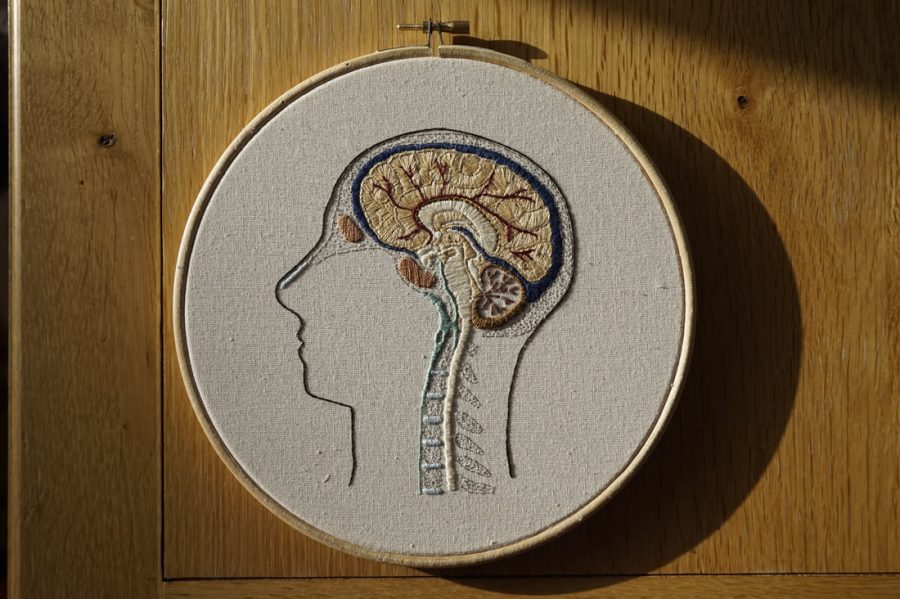
My first thought upon seeing the delicate, anatomy-based work of the 23-year-old embroidery artist and medical student Emmi Khan was that the Girl Scouts must have expanded the categories of skills eligible for merit badges.
(If memory serves, there was one for embroidery, but it certainly didn’t look like a cross-sectioned brain, or a sinus cavity.)
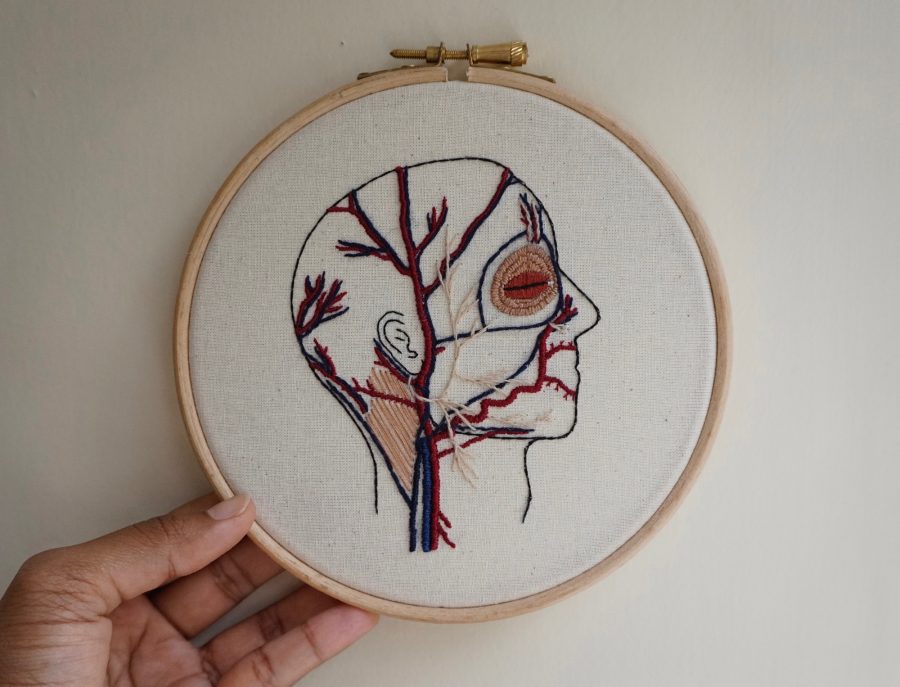
Closer inspection revealed that the circular views of Khan’s embroideries are not quite as tiny as the round badges stitched to high achieving Girl Scouts’ sashes, but rather still framed in the wooden hoops that are an essential tool of this artist’s trade.
Methods both scientific and artistic are a source of fascination for Khan, who began taking needlework inspiration from anatomy as an undergrad studying biomedical sciences. As she writes on her Moleculart website:
Science has particular methods: it is fundamentally objective, controlled, empirical. Similarly, art has particular methods: there is an emphasis on subjectivity and exploration, but there is also an element of regulation regarding how art is created… e.g. what type of needle to use to embroider or how to prime a canvas.
The procedures and techniques adopted by scientists and artists may be very different. Ultimately, however, they both have a common aim. Artists and scientists both want to 1) make sense of the vastness around them in new ways, and 2) present and communicate it to others through their own vision.

A glimpse at the flowers, intricate stitches, and other dainties that populate her Pinterest boards offers a further peek into Khan’s methods, and might prompt some readers to pick up a needle themselves, even those with no immediate plans to embroider a karyotype or The Circle of Willis, the circular anastomosis of arteries at the base of the brain.
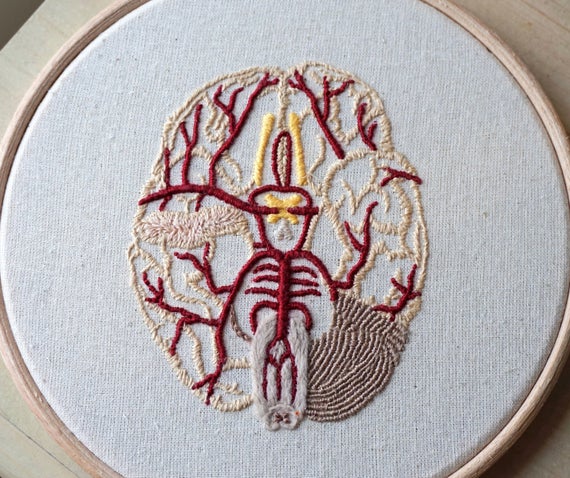
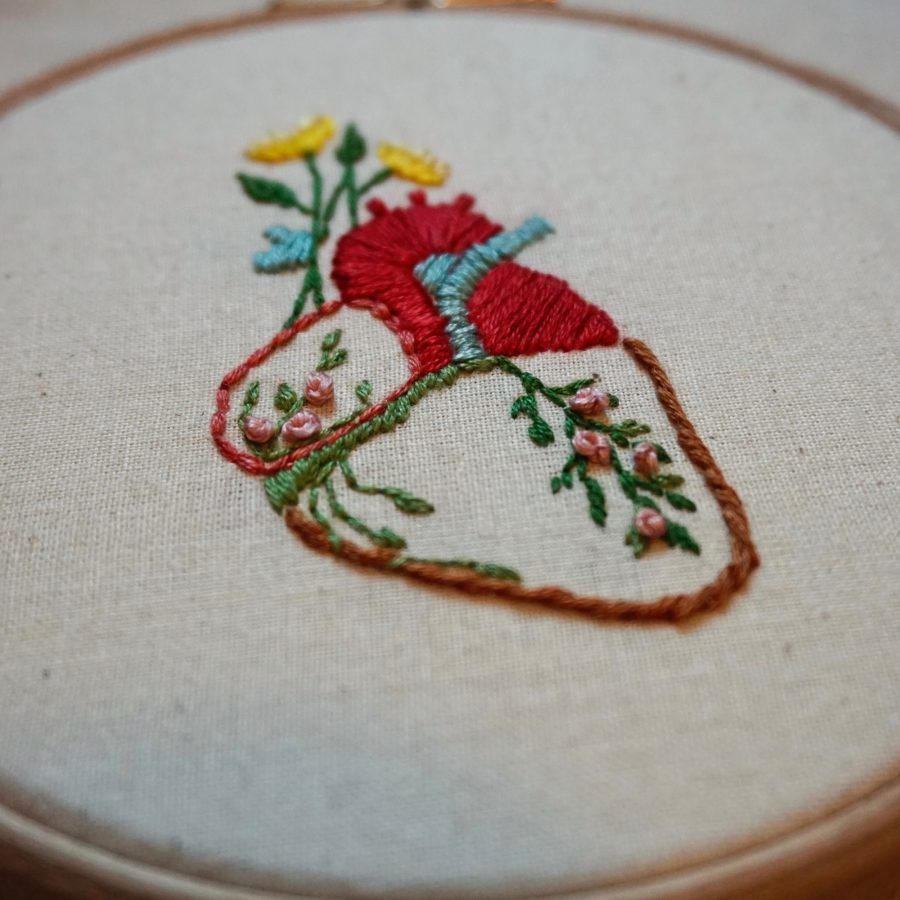
The Cardiff-based medical student delights in embellishing her threaded observations of internal organs with the occasional decorative element—sunflowers, posies, and the like…
She makes herself available on social media to answer questions on subjects ranging from embroidery tips to her relationship to science as a devout Muslim, and to share works in progress, like a set of lungs that embody the Four Seasons, commissioned by a customer in the States.

To see more of Emmi Khan’s work, including a downloadable anatomical floral heart embroidery pattern, visit Moleculart, her Instagram page, or her Etsy shop.
via Colossal
Related Content:
Behold an Anatomically Correct Replica of the Human Brain, Knitted by a Psychiatrist
An Artist Crochets a Life-Size, Anatomically-Correct Skeleton, Complete with Organs
Watch Nina Paley’s “Embroidermation,” a New, Stunningly Labor-Intensive Form of Animation
Ayun Halliday is an author, illustrator, theater maker and Chief Primatologist of the East Village Inky zine. Join her in NYC on Monday, February 3 when her monthly book-based variety show, Necromancers of the Public Domain celebrates New York: The Nation’s Metropolis (1921). Follow her @AyunHalliday.
Read More...Watch Hunter S. Thompson & Ralph Steadman Head to Hollywood in a Revealing 1978 Documentary
In 1978, Hollywood was looking to make a film about Hunter S. Thompson. No, it was not an adaptation of Fear & Loathing in Las Vegas–that would come later. Instead, this was the now-almost-forgotten Bill Murray vehicle Where the Buffalo Roam, which was based on Thompson’s obituary for his friend and “attorney” from Fear & Loathing, Oscar “Zeta” Acosta.
Knowing that both Thompson and illustrator Ralph Steadman would be involved and reuniting and driving from Aspen, through Las Vegas, and into Hollywood, the BBC dispatched a film crew for the arts program Omnibus. Director Nigel Finch returned with a ramshackle road trip of a film, one that always seems in danger of falling apart due to Thompson’s paranoid and antagonistic state.
For a lot of British viewers, this would have been their primer on the American writer, and quickly brings them up to date on Thompson’s rise to infamy, the creation of Gonzo journalism, and his alter-ego Raoul Duke.
Perhaps Finch thought that getting Thompson and Steadman together in a car would conjure up the Fear & Loathing vibe on screen, but the two make an awkward couple. At one point the reserved Steadman compares himself to Thompson’s pet bird Edward. Thompson antagonizes this bird into some sort of trauma, then holds it close and talks to it. “I feel absolutely taken apart,” being friends with the writer, Steadman says. “…he’s holding me like that bird and I’m trying to bite my way out.”
In Vegas, the crew and Steadman try to rouse Thompson, then find him, confused, and with his face covered in white make-up. In Hollywood, Thompson hates the attention from the camera crew so much–not to mention the tourists who assume he is a celebrity of some kind–that they find him hiding behind a parked car.
This era was indeed the end of that phase of Thompson’s career. At one point he asks Finch if he’s there to film Thompson or to film Raoul Duke. Finch doesn’t know. Thompson doesn’t know either, but he does realize that “The myth has taken over…I feel like an appendage.” He can no longer cover events like he did with the Hell’s Angels, or the Kentucky Derby, because of his fame. He can’t cover the story, because he’s become part of the story, and to a real journalist that’s death.
So perhaps that’s the appeal of Hollywood? We see Thompson and Steadman meet with a screenwriter (probably John Kaye, who wrote Where the Buffalo Roam) to discuss the script.
Thompson had agreed to option the script because, like Fear & Loathing in Las Vegas, he never believed it would get made. So when it went into production he had pretty much given away creative control. The script, he said, “It sucks – a bad, dumb, low-level, low-rent script.”
However, Bill Murray and Thompson hung out in Aspen together during the shoot and engaged in a sort of mind-meld, Murray becoming a version of Duke. When Murray returned to Saturday Night Live that season, he came back as a cigarette-holder-smoking faux-Thompson. Years later, Johnny Depp would also find himself being transformed during Fear & Loathing in Las Vegas. (I noticed right after watching this Omnibus special that I answered my phone in a sort of Thompson drawl until my friend called me out. The power of the Gonzo is such.)
But the man who had an equal power over Thompson was Richard Nixon. Since seeing the wily politician reappear on the national stage during the Barry Goldwater campaign in 1964, Thompson correctly recognized an enemy of everything he held dear, a dark side of America rising from the corpse of John F. Kennedy. And Nixon caused the fear and the loathing in America to bear fruit. As Thompson says in the documentary:
Richard Nixon for me stands for everything that I would not want to have happen to myself, or be, or be around. He is everything that I have contempt for and dislike and I think should be stomped out: Greed, treachery, stupidity, cupidity, positive power of lying, total contempt for any sort of human, constructive, political instinct. Everything that’s wrong with America, everything that this country has demonstrated as a national trait, that the world finds repugnant: the bully instinct, the power grab, the dumbness, the insensitivity. Nixon represents everything that’s wrong with this country, down the line.
Maybe the question is not, what would Thompson think of Trump, who doesn’t even feign Nixon’s humble routine. The question is, where is our Hunter S. Thompson?
Related content:
Read 11 Free Articles by Hunter S. Thompson That Span His Gonzo Journalist Career (1965–2005)
Hunter S. Thompson Gets Confronted by The Hell’s Angels: Where’s Our Two Kegs of Beer? (1967)
Ted Mills is a freelance writer on the arts who currently hosts the artist interview-based FunkZone Podcast and is the producer of KCRW’s Curious Coast. You can also follow him on Twitter at @tedmills, read his other arts writing at tedmills.com and/or watch his films here.
Read More...How to Draw Like an Architect: An Introduction in Six Videos
That we pass through life without really perceiving our surroundings has long been a commonplace. How can we cure ourselves of this regrettable condition? Before we can learn to notice more of what’s around us, we must have a process to test how much we already notice. Many artists and all architects already have one: drawing, the process of recording one’s perceptions directly onto the page. But while artists may take their liberties with physical reality — it isn’t called “artistic license” by coincidence — architects draw with more representationally rigorous expectations in mind.
Though we can heighten our awareness of the built environment around us by practicing architectural drawing, we need not learn only from architects. In the video at the top of the post, a Youtuber named Shadya Campbell who deals with creativity more generally offers a primer on how to draw buildings — or, perhaps less intimidatingly, on “architectural doodles for beginners.” As an example, she works through a drawing of Paris’ Notre-Dame cathedral (mere weeks, incidentally, before the fire of last April so dramatically altered its appearance), using a simple head-on viewpoint that nevertheless provides plenty of opportunity to practice capturing its shapes and filling in its details.
Below that, architect Llyan Austria goes a step further by introducing a few drawing practices from the profession under the banner of his “top six architecture sketching techniques.” Much of his guidance has to do with drawing something as simple — or as seemingly simple — as a line: he recommends beginning with the most general outlines of a space or building and filling in the details later, emphasizing the start and end of each line, and letting the lines that meet overlap. To get slightly more technical, he also introduces the methods of perspective, used to make architectural drawings look more realistically three-dimensional.
When you introduce perspective to your drawings, you have three types to choose from, one-point, two-point, and three-point. A drawing in one-point perspective, the simplest of the three, has only a single “vanishing point,” the point at which all of its parallel lines seem to converge, and is most commonly used to render interiors (or to compose shots in Stanley Kubrick movies). In two-point perspective, two vanishing points make possible more angles of viewing, looking not just straight down a hall, for example, but at the corner of a building’s exterior. With the third vanishing point incorporated into three-point perspective, you can draw from a high angle, the “bird’s eye view,” or a low angle, the “worm’s eye view.”
You can learn how to draw from all three types of perspective in “How to Draw in Perspective for Beginners,” a video from Youtube channel Art of Wei. Below that comes the more specifically architecture-minded “How to Draw a House in Two Point Perspective” from Tom McPherson’s Circle Line Art School. After a little practice, you’ll soon be ready to enrich your architectural drawing skills, however rudimentary they may be, with advice both by and for architecture professionals. At his channel 30X40 Design Workshop, architect Eric Reinholdt has produced videos on all aspects of the practice, and below you’ll find his video of “essential tips” on how to draw like an architect.”
In this video and another on architectural sketching, Reinholdt offers such practical advice as pulling your pen or pencil instead of pushing it, moving your arm rather than just pivoting at the wrist, and making “single, continuous, confident strokes.” He also goes over the importance of line weight — that is, the relative darkness and thickness of lines — and how it can help viewers to feel what in a drawing is supposed to be where. But we can’t benefit from any of this if we don’t also do as he says and make drawing a habit, switching up our location and materials as necessary to keep our minds engaged. That goes whether we have a professional or educational interest in architecture or whether we just want to learn to see the ever-shifting mixture of manmade and natural forms that surrounds us in all its richness.
Related Content:
How to Write Like an Architect: Short Primers on Writing with the Neat, Clean Lines of a Designer
How to Draw the Human Face & Head: A Free 3‑Hour Tutorial
Cartoonist Lynda Barry Teaches You How to Draw
Milton Glaser Draws Shakespeare & Explains Why Drawing is the Key to Understanding Life
The Elements of Drawing: A Free Course from Oxford
Based in Seoul, Colin Marshall writes and broadcasts on cities, language, and culture. His projects include the book The Stateless City: a Walk through 21st-Century Los Angeles and the video series The City in Cinema. Follow him on Twitter at @colinmarshall or on Facebook.
Read More...The Anti-Conformist, Libertarian Philosophy That Shaped Rush’s Classic Albums
“Throughout their career, Rush have been proudly anti-conformist and anti-authoritarian,” notes the Polyphonic video on recently departed drummer and lyricist Neil Peart, above. “This philosophy is clearly reflected in many of their finest works.” Since the addition of Peart in 1974 after their first, self-titled album, Rush’s philosophy has also been unambiguously Libertarian.
Of course, Peart also turned Rush into the most literary of progressive rock bands. Steeped in fantasy, science fiction, and moral philosophy, he translated his influences into a sprawling sci-fi vision all his own, and one that consistently exceeded the sum of its parts. Yet early Rush was also very much a band that wrote earnest, epic songs about Ayn Rand’s Objectivism.
Peart drew heavily on her work in the first three albums he recorded with the band, including 1975’s Fly by Night, which included the song “Anthem,” an ode to towering creative geniuses that cribs from Rand’s dystopian novel of the same name. Rush’s breakout masterwork, 2112, released the following year, expanded dramatically on the theme, as you’ll see in the Polyphonic breakdown of its lyrics.
The 20-minute opening title track tells the story of a futuristic, fictional city of Megadon, a place, writes Rob Bowman in the 40th anniversary edition liner notes, “where individualism and creativity are outlawed with the population controlled by a cabal of malevolent Priests who reside in the Temples of Syrinx.” Based on a short story by Peart, he himself credited its inspiration in the original liner notes to “the genius of Ayn Rand.”
These references don’t seem to make Rush fans love their career-defining mid-seventies concept albums any less. But it has meant that a great deal of talk about Rush has forever linked Peart with this phase in his life. Asked about it in Rolling Stone almost four decades after 2112’s release, he disavowed a lasting influence.
Oh, no. That was 40 years ago. But it was important to me at the time in a transition of finding myself and having faith that what I believed was worthwhile…. On that 2112 album, again, I was in my early twenties. I was a kid. Now I call myself a bleeding heart libertarian.
The change came about, he says, after he saw how libertarian ideals get “twisted by the flaws of humanity.” Peart, and Rush, however never wavered from their anti-authoritarian championing of individual rights. And denials aside, the Randian influence lingered, especially in songs like “Freewill” from 1980’s Permanent Waves:
You can choose from phantom fears
And kindness that can kill
I will choose a path that’s clear
I will choose free will
Rush’s libertarian streak—both the early Objectivist and later “bleeding heart” varieties—can broadly be called their guiding political philosophy. But it should not be mistaken for Peart’s sole obsession. His songs are full of huge themes, as well as the “thorny questions” of everyday life, writes Annie Zaleski at NPR. “Like the best songwriting, Peart’s body of work was also malleable enough to grow with its listeners—his songs often mused about aging and the importance of dreaming.”
Sometimes Rush spoke even more directly to their aging fans. “The ominous ‘Subdivisions’ railed against the conformist suburbs that ‘have no charms to soothe the restless dreams of youth.’” Whether or not Rush fans themselves have had an early Ayn Rand phase, all of them identify with Peart’s lifelong desire to seize his own destiny and escape the mundane.
Related Content:
Witness Rush Drummer Neil Peart’s (RIP) Finest Moments On Stage and Screen
Free Audio: Ayn Rand’s 1938 Dystopian Novella Anthem
Josh Jones is a writer and musician based in Durham, NC. Follow him at @jdmagness.
Read More...Cooking with Wool: Watch Mouthwatering Tiny Woolen Food Animations
Our fascination with tiny food can be traced to the mouthwatering illustrations in Beatrix Potter’s The Tale of Two Bad Mice.
Just like the dollhouse-sized comestibles that so confounded the titular rodents, Tom Thumb and Huncamunca, animator Andrea Love’s miniature pasta with red sauce is as inedible as it is appetizing.
The self-taught stop motion specialist’s medium of choice is wool.
In an interview with Dragon Frame stop motion software’s company blog, when they featured Cooking with Wool: Breakfast, above, Love explained:
I like to make short personal projects experimenting with the different ways to animate wool. The technique is called needle felting and it involves shaping wool with a barbed needle. I love the fuzzy aesthetic, and feel like the possibilities are endless. Everything in this video is made out of wool or felt, and is built over rigid insulation foam. This was a weekend/evening project, done over the course of three days… It is very challenging working with tiny bits of wool, but also amazing how much detail can be achieved on a small scale when you consider that it is just tiny clumps of fur.
Forget the showstoppers—the melting butter, the fried eggs flipping in the pan, the steam rising from cup and kettle…
Let’s take a moment to admire the attention to detail that went into the background aspects—the rubber spatula, the bananas, the cheery flecked wallpaper…
The only thing missing is a potholder to handle that piping hot cast iron skillet.
Perhaps she ran out of wool?
The Port Townsend, Washington resident, who graduated from Hampshire College with a concentration in film studies and sustainable agriculture, whips up her teeny weeny wooly meals in the same basement studio where she crafts promotional videos for local businesses, including the yarn shop where she sources her wool rovings.
View more of Andrea Love’s fiber-art stop motion animations, including a “digital” banana painting created with a woolen tablet and stylus, on her website and Instagram page.
Related Content:
The Online Knitting Reference Library: Download 300 Knitting Books Published From 1849 to 2012
Behold an Anatomically Correct Replica of the Human Brain, Knitted by a Psychiatrist
20+ Knitters and Crochet Artists Stitch an Astonishing 3‑D Recreation of Picasso’s Guernica
Ayun Halliday is an author, illustrator, theater maker and Chief Primatologist of the East Village Inky zine. Join her in NYC on Monday, February 3 for New York: The Nation’s Metropolis the 21st installment of her book-based variety show, Necromancers of the Public Domain. Follow her @AyunHalliday.
Read More...The Daily Routines of Famous Creative People, Presented in an Interactive Infographic

Click the image above to access the interactive infographic.
The daily life of great authors, artists and philosophers has long been the subject of fascination among those who look upon their work in awe. After all, life can often feel like, to quote Elbert Hubbard, “one damned thing after another” — a constant muddle of obligations and responsibilities interspersed with moments of fleeting pleasure, wrapped in gnawing low-level existential panic. (Or, at least, it does to me.) Yet some people manage to transcend this perpetual barrage of office meetings, commuter traffic and the unholy allure of reality TV to create brilliant work. It’s easy to think that the key to their success is how they structure their day.
Mason Currey’s blog-turned-book Daily Rituals describes the workaday life of great minds from W.H. Auden to Immanuel Kant, from Flannery O’Connor to Franz Kafka. The one thing that Currey’s project underlines is that there is no magic bullet. The daily routines are as varied as the people who follow them– though long walks, a ridiculously early wake up time and a stiff drink are common to many.
One school of thought for creating is summed up by Gustave Flaubert’s maxim, “Be regular and orderly in your life, so that you may be violent and original in your work.” Haruki Murakami has a famously rigid routine that involves getting up at 4am and writing for nine hours straight, followed by a daily 10km run. “The repetition itself becomes the important thing; it’s a form of mesmerism. I mesmerize myself to reach a deeper state of mind. But to hold to such repetition for so long—six months to a year—requires a good amount of mental and physical strength. In that sense, writing a long novel is like survival training. Physical strength is as necessary as artistic sensitivity.” He admits that his schedule allows little room for a social life.
Then there’s the fantastically prolific Belgian author George Simenon, who somehow managed to crank out 425 books over the course of his career. He would go for weeks without writing, followed by short bursts of frenzied activity. He would also wear the same outfit everyday while working on his novel, regularly take tranquilizers and somehow find the time to have sex with up to four different women a day.
Most writers fall somewhere in between. Toni Morrison, for instance, has a routine that that seems far more relatable than the superman schedules of Murakami or Simeon. Since she juggled raising two children and a full time job as an editor at Random House, Morrison simply wrote when she could. “I am not able to write regularly,” she once told The Paris Review. “I have never been able to do that—mostly because I have always had a nine-to-five job. I had to write either in between those hours, hurriedly, or spend a lot of weekend and predawn time.”
Above is a way cool infographic of the daily routines of 26 different creators, created by Podio.com. And if you want to see an interactive version of the same graphic but with rollover bits of trivia, just click here. You’ll learn that Voltaire slept only 4 hours a day and worked constantly. Victor Hugo preferred to take a morning ice bath on his roof. And Maya Angelou preferred to work in an anonymous hotel room.
Note: The infographic above is very light on women. For anyone interested in the daily habits of female creators, see this post and Mason Currey’s related book: The Daily Rituals of 143 Famous Female Creators.
An earlier version of this post appeared on our site in January 2015.
Related Content:
The Daily Habits of Highly Productive Philosophers: Nietzsche, Marx & Immanuel Kant
Ursula K. Le Guin’s Daily Routine: The Discipline That Fueled Her Imagination
The Daily Habits of Famous Writers: Franz Kafka, Haruki Murakami, Stephen King & More
Jonathan Crow is a Los Angeles-based writer and filmmaker whose work has appeared in Yahoo!, The Hollywood Reporter, and other publications. You can follow him at @jonccrow. And check out his blog Veeptopus, featuring lots of pictures of badgers and even more pictures of vice presidents with octopuses on their heads. The Veeptopus store is here.
Read More...When People Gave Anti-Valentine’s Day Cards: Revisit the “Vinegar Valentines” That Spread Ridicule and Contempt
Krampus—the Christmas “half goat, half demon” of Germanic folklore—has become a figure of some fascination in popular culture recently. We might call the appetite for this “anti-St. Nicholas… who literally beats people into being nice and not naughty,” National Geographic writes, a testament to a widespread sentiment: Hang the forced cheer, Christmas can be dreadful.
How much more so can Valentine’s Day feel like a big con, cooked up by marketers and chocolatiers? Though established 200 years after the saint’s 3rd century A.D. martyrdom, and linked with romantic love by Geoffrey Chaucer in the 14th century, its status as a day to overspend has more modern origins. Even some of us who dutifully buy jewelry, flowers, and cards each year may wish for a Valentine’s Day Krampus.
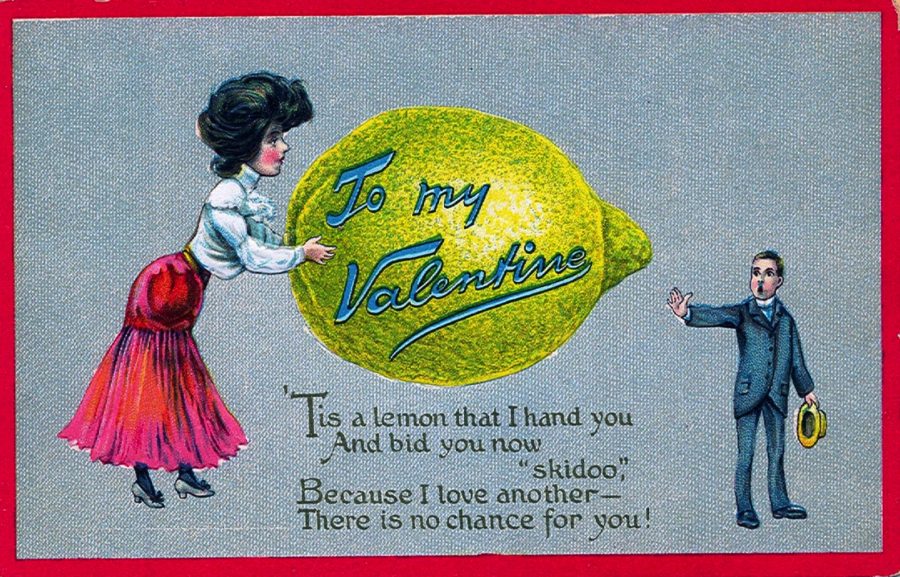
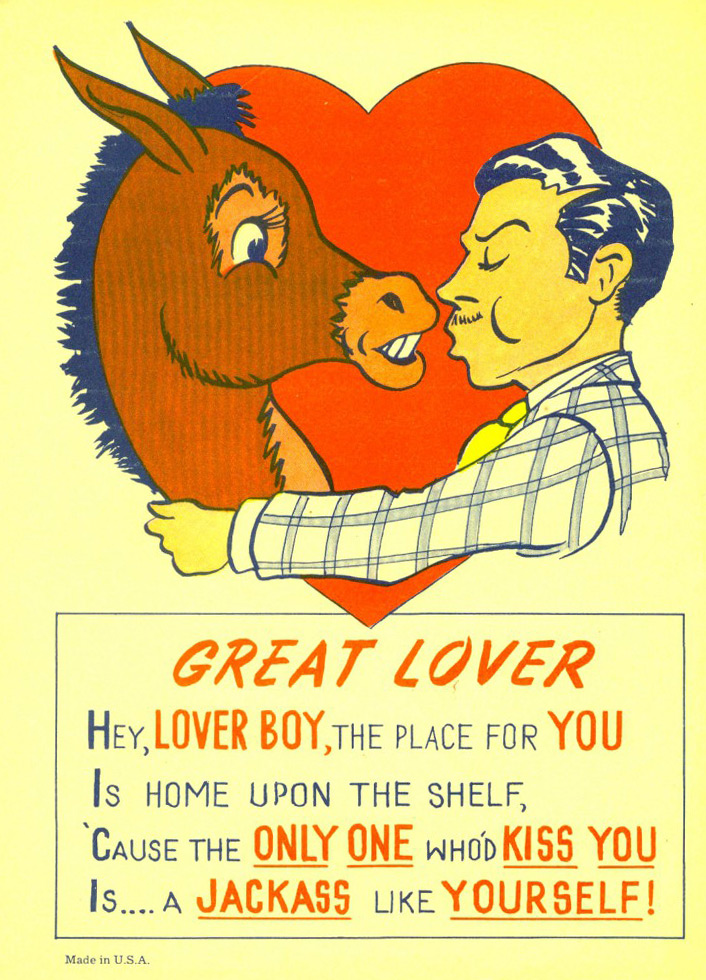
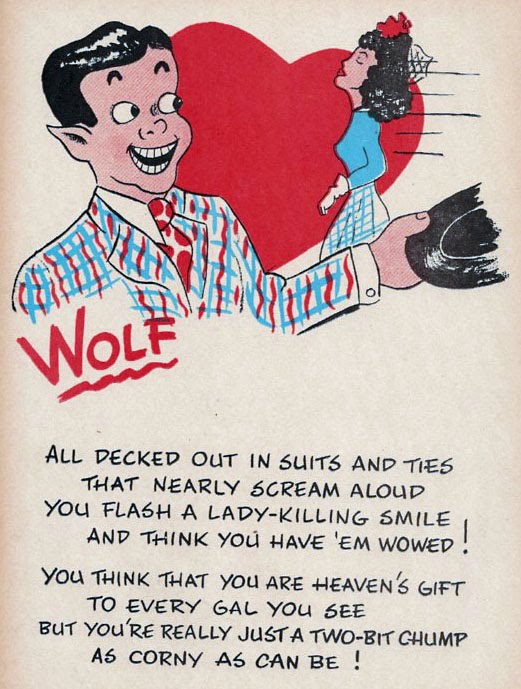
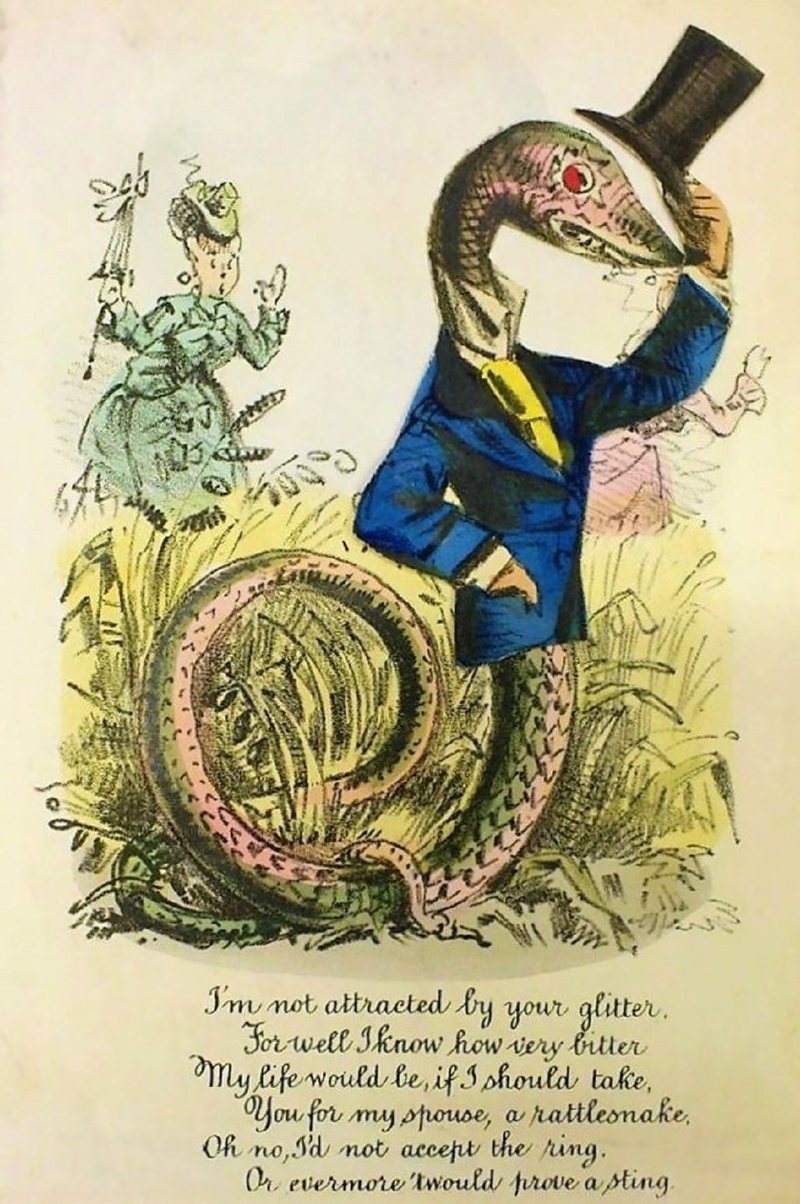
If you count yourself among those humbugs, you’ll be happy to learn about a once-rich anti-Valentine’s Day tradition “during the Victorian era and the early 20th century,” as Becky Little writes at Smithsonian, “February 14 was also a day in which unlucky victims could receive ‘vinegar valentines’ from their secret haters.” Like the choices of Santa or Krampus, tricks or treats, one could make the holiday about love or hate.
One scholar, Annebella Pollen, who has written on the subject “says that people often ask her whether these cards were an early form of ‘trolling.’” Perhaps that’s not an entirely accurate comparison. Trolls like hoaxes, and mostly like to witness the reactions to their provocations. But Valentines cynics proceeded with the same cruel glee. As Atlas Obscura notes, anti-Valentines were meant to wound and shame, Krampus-like. Their appeal proved profitable:
Vinegar valentines were commercially bought postcards that were less beautiful than their love-filled counterparts, and contained an insulting poem and illustration. They were sent anonymously, so the receiver had to guess who hated him or her; as if this weren’t bruising enough, the recipient paid the postage on delivery. In Civil War Humor, Cameron C. Nickels wrote that vinegar valentines were “tasteless, even vulgar,” and were sent to “drunks, shrews, bachelors, old maids, dandies, flirts, and penny pinchers, and the like.” He added that in 1847, sales between love-minded valentines and these sour notes were split at a major New York valentine publisher.
Some vinegar valentines publishers had another thing in common with modern-day trolls: they capitalized on a hatred of feminism. “The women’s suffrage movement of the late 19th and early 20th century brought another class of vinegar valentines, targeting women who fought for the right to vote.” These portrayed suffragists as ugly, abusive, and undesirable, a stereotype found in the world of sincere valentines as well. One such card “depicted a pretty woman surrounded by hearts, with a plain appeal: ‘In these wild days of suffragette drays, I’m sure you’d ne’er overlook a girl who can’t be militant, but simply loves to cook.’”
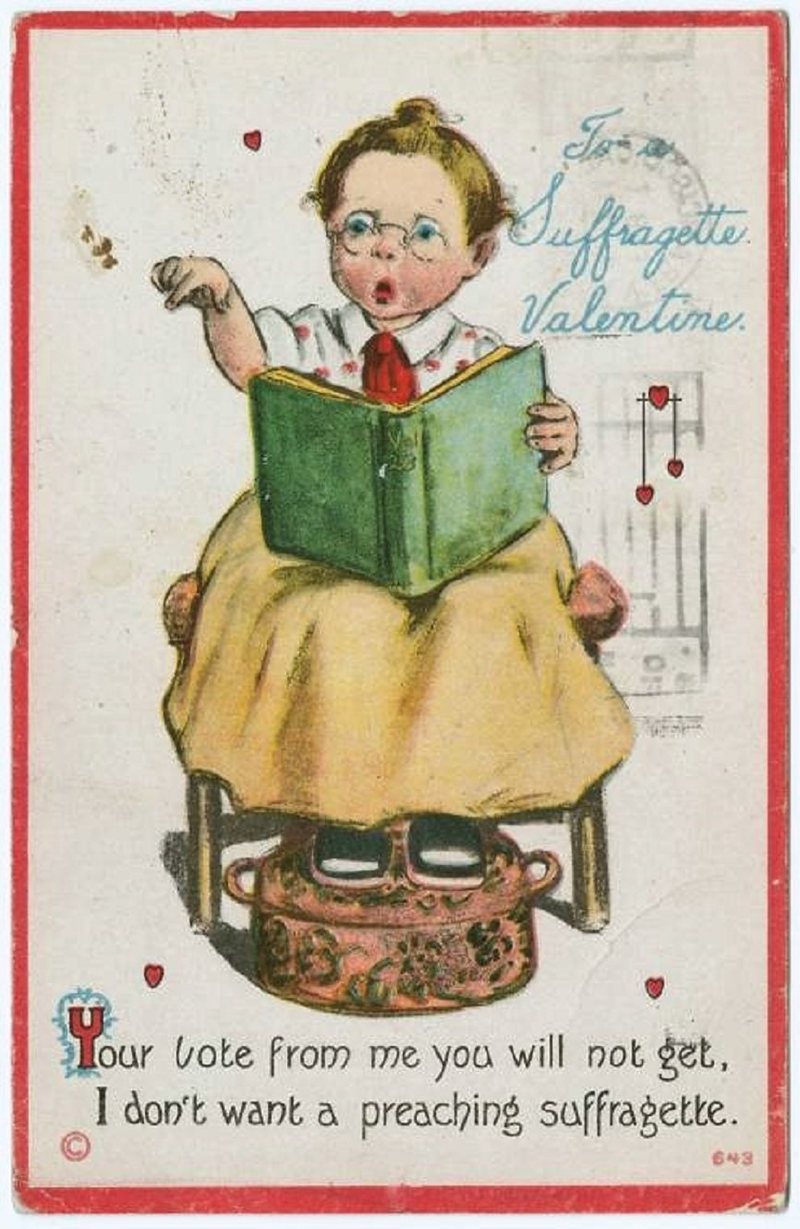
Vinegar valentines (a later name—they were called “comic valentines” at the time) prompted all the sorts of concerns we’re used to seeing. Teachers worried about the effect of such commercialized emotional cruelty on their students. One magazine enjoined teachers to make Valentine’s Day “a day for kind remembrance than a day for wrecking revenge.” But where’s the fun in that? Vinegar valentines, says Pollen, “were designed to expand this holiday into something that could include a whole range of different people and a whole range of different emotions,” including some very un-Valentine’s Day-like contempt.
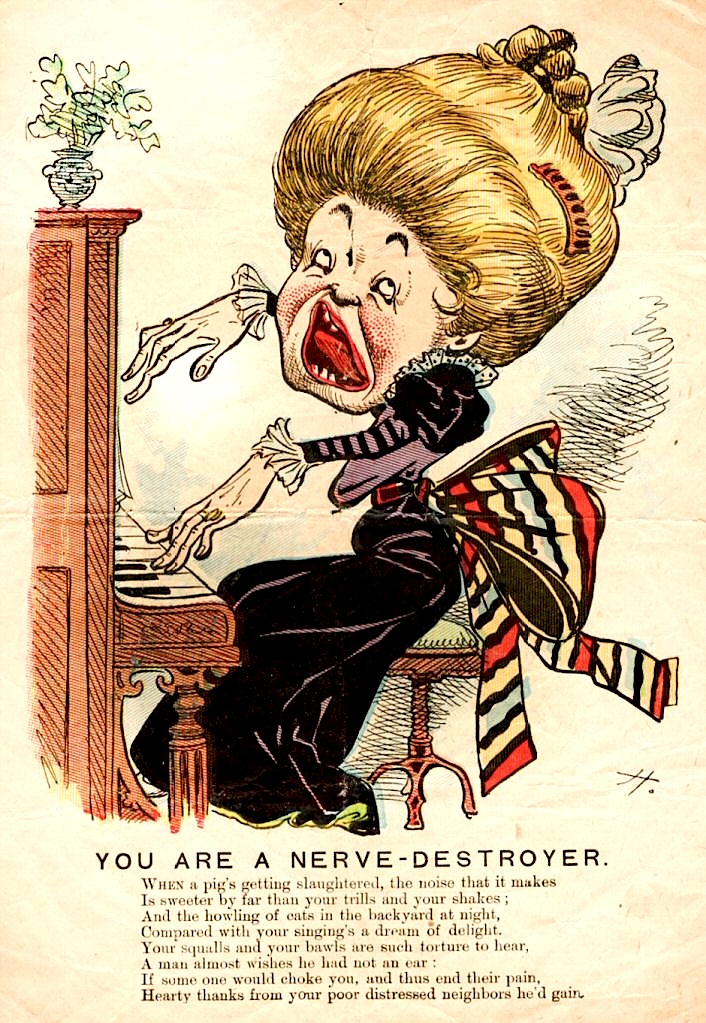
Find a big collection of Vinegar Valentines at Collector’s Weekly.
via 41 Strange
Related Content:
Celebrate Valentine’s Day with a Charming Stop Motion Animation of an E.E. Cummings’ Love Poem
Tom Waits Shows Us How Not to Get a Date on Valentine’s Day
Franz Kafka’s Kafkaesque Love Letters
Josh Jones is a writer and musician based in Durham, NC. Follow him at @jdmagness.
Read More...How Stravinsky’s The Rite of Spring Incited a Riot? An Animated Introduction
There was a time when a ballet could start a riot — specifically, the night of May 29th, 1913. The place was Paris’ Théâtre des Champs-Élysées, and the ballet was The Rite of Spring, composed by Igor Stravinsky for the Ballets Ruses company. Popular history has remembered this debut performance as too bold, too daring, too avant-garde for its genteel audience to handle — and so, with the bourgeois duly épaté, we can freely appreciate Stravinsky’s radical work from our position of 21st-century sophistication. But whether The Rite of Spring incited a riot, a “near-riot” (as some source describe it), or merely a wave of dissatisfaction, what aspects of its art were responsible?
May 29th, 1913 at the Théâtre des Champs-Élysées comes alive again in the animated TED-Ed lesson above, which examines all the ways The Rite of Spring broke violently with the ballet form as it had established itself in the 19th century. Lesson creator Iseult Gillespie (previously featured here on Open Culture for her explanatory work on everything from Shakespeare and Guernica to Frida Kahlo and Haruki Murakami) writes of its “harsh music, jerky dancing, and uncanny staging,” all in service of a highly un-genteel Pagan premise that “set audiences on edge and shattered the conventions of classical music.”
Among Stravinsky’s musical provocations — or rather, “formal experiments,” — Gillespie names “syncopation, or irregular rhythm,” “atonality, or the lack of a single key,” and “the presence of multiple time signatures,” as well as the inclusion of aspects of the Russian folk music that was Stravinsky’s cultural inheritance. Along with the music, already startling enough, came visual design by Nicholas Roerich, a painter-philosopher “obsessed with prehistoric times” and professionally concerned with human sacrifice and ancient tomb excavation.
Wearing Roerich’s awkwardly-hanging peasant garments in front of his “vivid backdrops of primeval nature full of jagged rocks, looming trees, and nightmarish colors,” the ballet’s dancers performed steps by Vaslav Nijinsky, whose sense of rigor brought him to create dances “to rethink the roots of movement itself.” His choreography “contorted traditional ballet, to both the awe and horror of his audience” — but then, that possibly overdetermined awe and horror could have arisen from several number of artistic sources at once. The Rite of Spring’s tension and urgency still today reflects the historical moment of its composition, “the cusp of both the first world war and the Russian revolution,” and we could also take the early reaction to its innovations as a reflection of its creators’ genius — or perhaps those first viewers, as Stravinsky himself put it, were simply “naïve and stupid people.”
Related Content:
Hear The Rite of Spring Conducted by Igor Stravinsky Himself: A Vintage Recording from 1929
Hear 46 Versions of Stravinsky’s Rite of Spring in 3 Minutes: A Classic Mashup
Stravinsky’s The Rite of Spring, Visualized in a Computer Animation
The Night When Charlie Parker Played for Igor Stravinsky (1951)
Based in Seoul, Colin Marshall writes and broadcasts on cities, language, and culture. His projects include the book The Stateless City: a Walk through 21st-Century Los Angeles and the video series The City in Cinema. Follow him on Twitter at @colinmarshall or on Facebook.
Read More...Pretty Much Pop: A Culture Podcast #27 Discusses the Impact and Aesthetics of Star Wars

Mark Linsenmayer, Erica Spyres, and Brian Hirt grasp the low-hanging fruit in pop culture to talk about Star Wars: The unique place that these films have in the brains of people of a certain age, how we grappled with the prequels, and why we feel the need to fill in and argue about the details.
We primarily focus on the two most recent emanations of this beast, The Mandalorian and Rise of Skywalker. We talk alien and droid aesthetics (how much cuteness is too much?), storytelling for kids vs. adults reliving their childhood, pacing, plotting, casting, whether celebrity appearances ruin the Star Wars mood, creation by an auteur vs. a committee, and what we’d like to see next.
We had enough to say about this that we didn’t need to draw on online articles, but here’s a sampling of what we looked at anyway:
- “The Robotic Familiarity of ‘Star Wars: the Rise of Skywalker’ ” by Richard Brody
- “After ‘Star Wars: The Rise of Skywalker,’ Where Does Disney (and the Franchise) Go From Here?” by Noah Berlatsky
- “After ‘Rise of Skywalker,’ Here’s How Lucasfilm Should Handle Future ‘Star Wars’ Films” by Brandon Katz
- “I Never Knew How Much I Needed a Star Wars TV Series Before The Mandalorian” by Rob Bricken
- “‘The Mandalorian’ and the Power of an Unimpeachable Season Finale” by Alison Herman
- “‘The Mandalorian’ Creators on the Weekly Release, Choosing Directors, and the ‘Star Wars’ Holiday Special” by Christina Radish
- “Star Wars at 40: 5 Ways Star Wars: A New Hope Changed Everything” by Dan Brooks
- “Ithorians: Star Wars’ Strangest Aliens, Explained” by Vincent Pasquill
This episode includes bonus discussion that you can only hear by supporting the podcast at patreon.com/prettymuchpop. In this case, it’s all just more Star Wars talk, covering droid body dysmorphia and humanization, the cycle of embodiment via action figures and re-presentation on the screen, tragedy in Star Wars vs. Watchmen, making up for racism in Star Wars through sympathetic portrayals of Sand Person culture, watching particular scenes many times, clown biker troopers, and more. Don’t miss it!
This podcast is part of the Partially Examined Life podcast network.
Pretty Much Pop: A Culture Podcast is the first podcast curated by Open Culture. Browse all Pretty Much Pop posts or start with the first episode.
Read More...Support Us
We're hoping to rely on loyal readers, rather than erratic ads. Please click the Donate button and support Open Culture. You can use Paypal, Venmo, Patreon, even Crypto! We thank you!

About Us

Open Culture scours the web for the best educational media. We find the free courses and audio books you need, the language lessons & educational videos you want, and plenty of enlightenment in between.
Advertise With Us

FREE UPDATES!
GET OUR DAILY EMAIL
Get the best cultural and educational resources on the web curated for you in a daily email. We never spam. Unsubscribe at any time.
FOLLOW ON SOCIAL MEDIA

Open Culture editor Dan Colman scours the web for the best educational media. He finds the free courses and audio books you need, the language lessons & movies you want, and plenty of enlightenment in between.
Advertise With Us


