Imagined Medieval Comics Illuminate the Absurdities of Modern Life
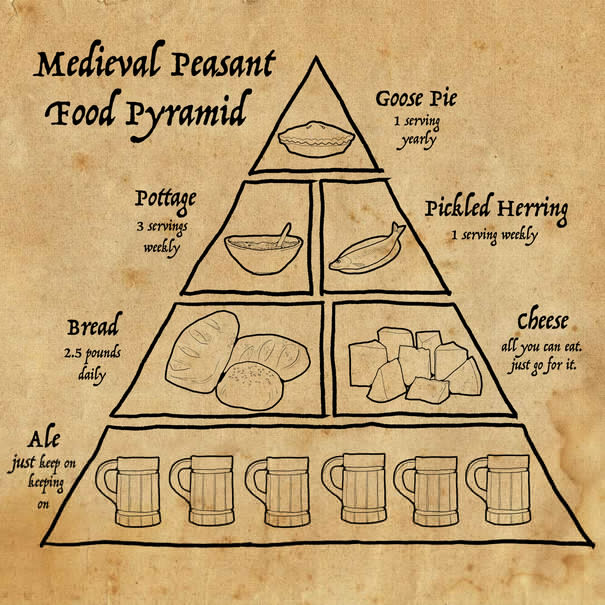
In 2005, the U.S. Department of Agriculture revised its famous food pyramid, jettisoning the familiar hierarchical graphic in favor of vertical rainbow stripes representing the various nutritional groups. A stick figure bounded up a staircase built into one side, to reinforce the idea of adding regular physical activity to all those whole grains and veggies.
The dietary information it promoted was an improvement on the original, but nutritional scientists were skeptical that the public would be able to parse the confusing graphic, and by and large this proved to be the case.
Artist Tyler Gunther, however, was inspired:
I started thinking about the messaging school children in 1308 were force fed to believe was part of a heart healthy diet, only to have the rug pulled out from under them 15 years later when some monk rearranged the whole thing.
In other words, you’d better dig into that annual goose pie, kids, while you’ve still got 6 glasses of ale to wash it down.
The imagined overlap between the modern and the medieval is a fertile vein for Gunter, whose MFA in Costume Design is often put to good use in his hilarious historical comics:
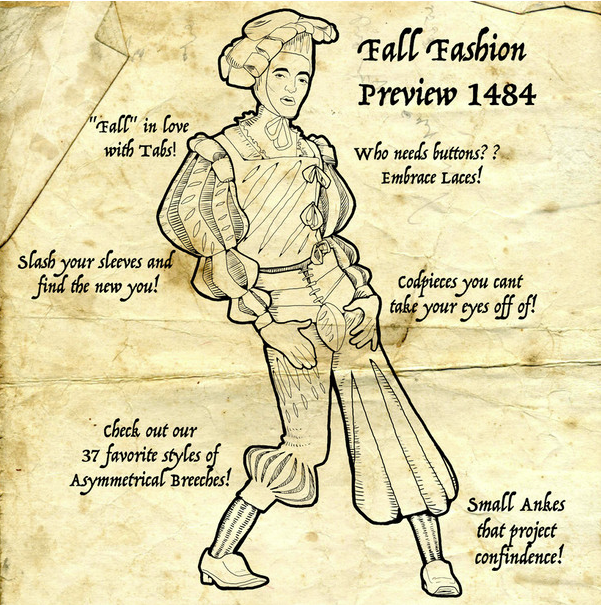
Modern men’s fashion is so incredibly boring. A guy wears a pattered shirt with a suit and he gets lauded as though he won the super bowl of fashion. But back in the Middle Ages men made bold, brave fashion choices and I admire them greatly for this. It’s so exciting to me to think of these inventive, strange, fantastic creations being a part of the everyday masculine aesthetic.
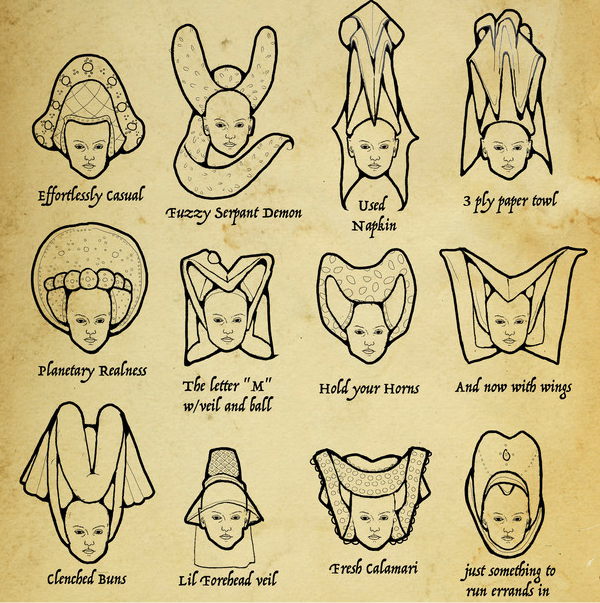
The shapes and structures of women’s headwear in the dark ages are truly inspiring. Where were these milliners drawing inspiration from? How were they engineered? How comfortable were they to wear? How did they fit through the majority of doorways? What was it like to sit behind a particularly large one in church? I’m still scrolling through many an internet history blog to find the answers.
Kathryn Warner’s Edward II blog has proved a helpful resource, as has Anne H. van Buren’s book Illuminating Fashion: Dress in the Art of Medieval France and the Netherlands.
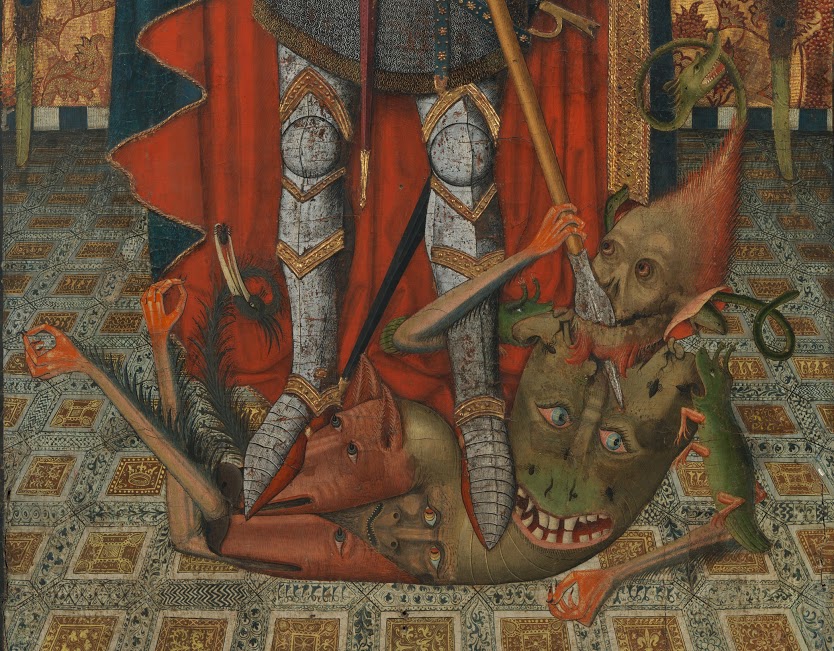
The Brooklyn-based, Arkansas-born artist also makes periodic pilgrimages to the Cloisters, where the Metropolitan Museum houses a vast number illuminated manuscripts, panel paintings, altar pieces, and the famed Unicorn Tapestries:
On my first trip to The Cloisters I saw a painting of St. Michael and the devil almost immediately. I don’t think my life or art has been the same since. None of us know what the devil looks like. But you wouldn’t know that based on how confidently this artist portrays his likeness. After gazing at this painting for an extended period of time I wanted so badly to understand the imagination of whoever could imagine an alligator arms/face crotch/dragon ponytail combo. I don’t think I’ve come close to scratching the surface.
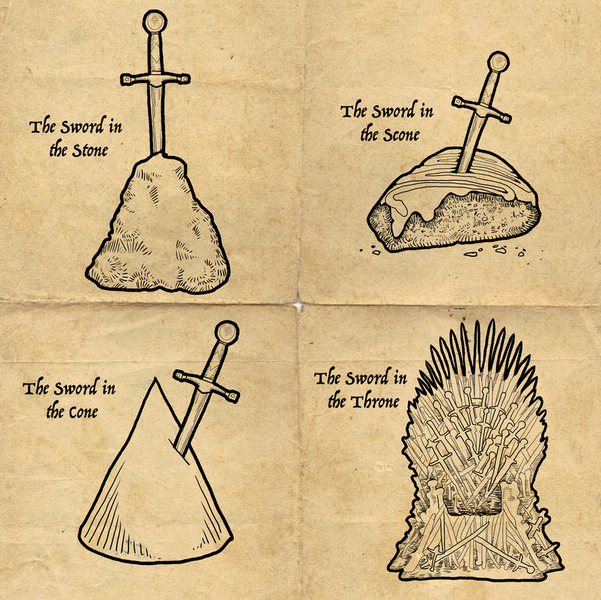
Every time I go to that museum I think, “Wow it’s like I’m on Game of Thrones” and then I have to remind myself kindly that this was real life. Almost everything there was an object that people interacted with as part of their average daily life and that fascinates me as someone who lives in a world filled with mass produced, plastic objects.

Gunther’s drawings and comics are created (and aged) on that most modern of conveniences—the iPad.
The British monarchy and the First Ladies are also sources of fascination, but the middle ages are his primary passion, to the point where he recently costumed himself as a page to tell the story of Piers Gaveston, 1st Earl of Cornwall and Edward II’s darling, aided by a garment rack he’d retooled as a medieval pageant cart-cum-puppet theater.
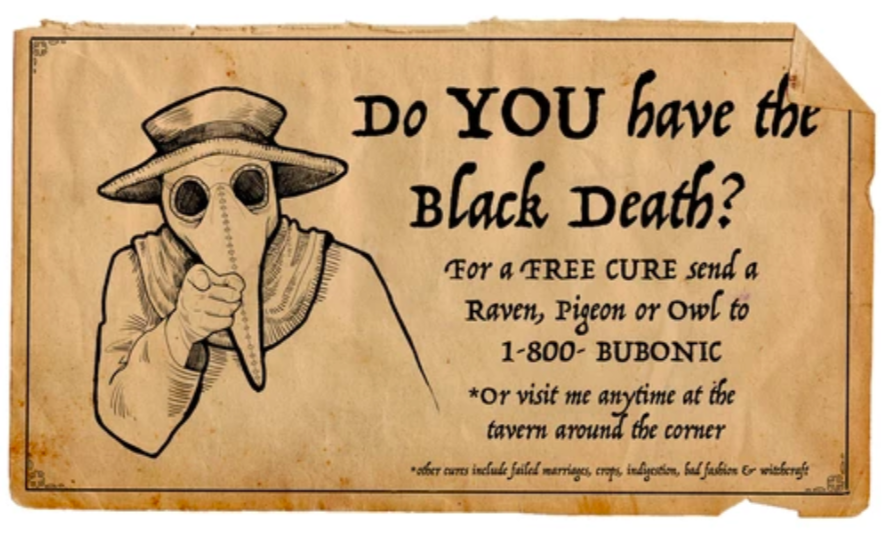
See the rest of Tyler Gunther’s Medieval Comics on his website and don’t forget to surprise your favorite hygienist or oral surgeon with his Medieval Dentist print this holiday season.
All images used with permission of artist Tyler Gunther
Related Content:
How to Make a Medieval Manuscript: An Introduction in 7 Videos
Medieval Monks Complained About Constant Distractions: Learn How They Worked to Overcome Them
Why Knights Fought Snails in Illuminated Medieval Manuscripts
Ayun Halliday is an author, illustrator, theater maker and Chief Primatologist of the East Village Inkyzine. Join her in NYC on Monday, October 7 when her monthly book-based variety show, Necromancers of the Public Domaincelebrates the art of Aubrey Beardsley, with a special appearance by Tyler Gunther. Follow her @AyunHalliday.
Read More...Bob Moog Demonstrates His Revolutionary Moog Model D Synthesizer
There are far better players of Bob Moog’s wonderous analog synthesizers than Bob Moog himself–from Wendy Carlos, who reinterpreted Bach for the newfangled instrument in the 60s to Rick Wakeman and Richard Wright to Giorgio Moroder to Gary Numan, to virtually anyone who has ever recorded music with a Moog. Bob Moog was not a musician, he was an engineer who took piano lessons before earning his B.A. in physics, M.A. in electrical engineering, and Ph.D. in engineering physics from Cornell.
Academic credentials have no bearing on what moves us musically, but it’s always worth noting that the Moog synthesizers—which did more to change the sound of modern music than perhaps any instrument since the electric guitar—came out of decades of dogged scientific research, beginning when Moog was only 14 years old and built a homemade Theremin from plans he found printed in the magazine Electronics World. That was 1949. Almost thirty years later, the Minimoog Model D appeared, the revolutionary portable version of studio-sized machine Carlos used to reimagine classical music in the late 60s.
“It’s an analogue monophonic synthesizer,” says Moog in the video above. “That means it makes the waveforms by electronic means and it plays one note at a time.” Sounds rather primitive by our standards, but watch the demonstration below by Marc Doty, who walks us through the sweeping range of functions in the compact machine, made between 1970 and 1981 (and reissued for a limited run in 2016). Its banks of waveform selectors, oscillators, filters, and envelopes produce “something sweeter,” says Doty, than your average synthetic sounds, though he can’t quite put his finger on what it is.
We’ve all heard the difference, whether we know it or not, and discriminating ears can pick a Minimoog out of any lineup of analogue synths. It is, Doty declares in the description for his video, “perhaps the most beautiful, beautiful sounding, and functional synthesizer ever produced.” Called the Model D because it was the fourth iteration of previous versions made in-house between 1969–70, it was truly, says author and composer Albert Glinsky, “the first portable synthesizer where everything is contained in one unit. It really is the prototype, the ancestor, of every portable keyboard in every music shop today.”
One of its innovations, the pitch wheel, now standard issue on almost all of those mass-produced successors of the Minimoog, was the first of its kind. If Moog “had patented [the pitch wheel],” says David Borden, one of the first musicians to play the Minimoog live, “he would have been an extremely wealthy man.” Others have made similar observations about Moog’s pioneering sound-shaping technologies, but as Richard Leon points out at Sound on Sound, it’s a good thing for us all that the inventor wasn’t motivated by profit.
Competition nearly buried the company Moog sold in the mid-70s (only reacquiring rights to his own name in 2002), but had Moog “tried to create a monopoly on these fundamentals,” Leon writes, “it’s likely the synth industry as we know it today would never have happened.”
Related Content:
How the Moog Synthesizer Changed the Sound of Music
Josh Jones is a writer and musician based in Durham, NC. Follow him at @jdmagness
Read More...Watch Babe Ruth and Lou Gehrig Taking Batting Practice in Strikingly Restored Footage (1931)
How would Babe Ruth, Lou Gehrig, and other famous ballplayers of bygone eras fare if put on the diamond today? Variations on that question tend to come up in conversation among enthusiasts of baseball and its history, and different people bring different kinds of evidence to bear in search of an answer: statistics, eyewitness accounts, analogies between particular historical players and current ones. But the fact remains that none of us have ever actually seen the likes of Ruth, who played his last professional game in 1935, and Gehrig, who did so in 1939, in their prime. But now we can at least get a little closer by watching the film clip above, which shows both of the titanic Yankees at batting practice on April 11, 1931.
What’s more, it shows them moving at real-life speed. “Fox Movietone sound cameras made slow-motion captures of Babe Ruth and Lou Gehrig at batting practice during an exhibition practice in Brooklyn, New York,” writes uploader Guy Jones (whose other baseball videos include Ruth hitting a home run on opening day the same year and Ruth’s last appearance at bat a decade later). “With modern technology, we can witness this footage adjusted to a normal speed which results in a very high framerate.”
In other words, the film shows Ruth and Gehrig not just moving in the very same way they did in real life, but captured with a smoothness uncommon in newsreel footage from the 1930s. For comparison, Jones includes at the end of the video “more footage of the practice (shot at typical fps) and the original un-edited slow-mo captures.”
Unfortunately, what this film reveals doesn’t impress observers of modern baseball. “Ruth and Gehrig in no way look like a modern ballplayer,” writes The Big Lead’s Kyle Koster. “Ruth is off-balance, falling into his swing. Gehrig routinely lifts his back foot off the ground. Again, it’s batting practice so the competitive juices weren’t flowing. But even by that standard, the whole exercise looks sloppy and inefficient.” Cut4’s Jake Mintz gets harsher, as well as more technical: “Tell me Ruth’s cockamamie swing mechanics would enable him to hit a 98-mph heater.” As for the Iron Horse, his “hack is a little better,” but still “absurdly low” by today’s standards. It goes to show, Mintz writes, that “these two legends, while undeniably transcendent in their time, would be good Double‑A hitters at best if they played today.” We evolve, our technologies evolve, and so, it seems, do the games we play.
Related Content:
Home Movies of Duke Ellington Playing Baseball (And How Baseball Coined the Word “Jazz”)
Read Online Haruki Murakami’s New Essay on How a Baseball Game Launched His Writing Career
Fritz Lang’s M: The Restored Version of the Classic 1931 Film
Immaculately Restored Film Lets You Revisit Life in New York City in 1911
Based in Seoul, Colin Marshall writes and broadcasts on cities, language, and culture. His projects include the book The Stateless City: a Walk through 21st-Century Los Angeles and the video series The City in Cinema. Follow him on Twitter at @colinmarshall or on Facebook.
Read More...How E.E. Cummings Writes a Poem
Most of us encounter E.E. Cummings at an early age; his poems for adults regularly appear in poetry anthologies for children. We derive great pleasure from his brazen misspellings, portmanteaus, neologisms, and “typographical high jinks,” as Paul Muldoon writes at The New Yorker. Look at this famous writer breaking all the rules, and thereby giving us occasion to talk about the rules, about how poetry is different, about how, among poets, E.E. Cummings stands alone.
Only someone with a keen facility for language can bend it to their individual will, something we may recognize when reading Cummings in high school, when we also recognize the irony and grim satire in his poems. The inventive whimsy had veiled something darker. In 1960, then-high-school student Peter Carlton got the chance to interview Cummings about his poem “Humanity, I love you,” then posted the exchange online 37 years later. “I, for one, do not love humanity,” the poet told him, “I feel that humanity itself is cruel and unjust.”
A common sentiment among modernists, especially those, like Cummings, who had served in World War I. But few of his contemporaries, who included James Joyce, T.S. Eliot, and Ezra Pound, had his ability to speak to so many different audiences. It’s almost shocking to see the shift in voice between Cummings’ interview with young Carlton and a letter he wrote to Pound 20 years earlier, full of the usual Cummings coinages (“innulluxuls”) and vicious literary barbs (Archibald MacLeish becomes “the macarchibald maclapdog macleash”).
Was Cummings a radical? A romantic? A literary naïf? An outsider? A savvy, cynical player of the game? He contained multitudes. From Eliot he “learned to distrust the hierarchical in every aspect of life,” writes Muldoon, “beginning with his own being. In his poetry, ‘I’ becomes ‘i.’” Whatever attitudes he expresses, Cummings always forces us to wrestle with language—its durability and malleability, its familiar strangenesses—first.
In his most accessible poem, “i carry your heart with me (i carry it in,” Cummings draws our attention to the simplicity of his archetypal images, as if to smirkingly announce, “this is a universal love poem.” Standard fare. But such obvious mirroring of form and content does not diminish the poem’s accomplishment, argues Evan Puschak, the Nerdwriter, in the video above. On the contrary, simple repetitions lead us into far more complicated recursions inside the poem.
Puschak quotes lines from Yeats to illustrate the deftness of Cummings’ deceptive simplicity: “A line will take us hours maybe; / yet if it does not seem a moment’s thought, / Our stitching and unstitching has been naught.” While many a poet has made the art seem easy, few have made it seem so playful or irreverent as Cummings, or have delighted so many people of so many ages and walks of life—so few of whom may suspect the conceptual heft and rigor that went into his work.
To read Cummings’ poetry yourself, pick up a copy of his complete poems.
Related Content:
Two Childhood Drawings from Poet E.E. Cummings Show the Young Artist’s Playful Seriousness
Celebrate Valentine’s Day with a Charming Stop Motion Animation of an E.E. Cummings’ Love Poem
E.E. Cummings Recites ‘Anyone Lived in a Pretty How Town,’ 1953
Josh Jones is a writer and musician based in Durham, NC. Follow him at @jdmagness
Read More...Charles Bukowski Explains What Good Writing and the Good Life Have in Common
I have no politics, I observe. I have no sides except the side of the human spirit, which after all does sound rather shallow, like a pitchman, but which means mostly my spirit, which means yours too, for if I am not truly alive, how can I see you?
—Charles Bukowski, Notes of. Dirty Old Man
In Notes of a Dirty Old Man, his weekly column for the underground L.A. newspaper Open City, Charles Bukowski became the common man’s philosopher, issuing profundities amidst wild vulgarities and proving that he did, in fact, have a politics, as much as he had theories and contrarian half-thoughts and opinions aplenty. He took sides when it came to literature, at least—the side of Celine, Dostoevsky, and Camus, for example, against Faulkner, Shakespeare, and George Bernard Shaw (“the most overblown fantasy of the Ages”).
Bukowski had no room for cool appreciation or mild preference. With him, as with Catullus, life was love and hate. Get him talking on any subject and those loves and hates would emerge, as would his ideas about matters of most consequence: life, death, drinking, sex, and, of course, writing. In the interview clip above, for example, Bukowski is asked if he fears death. He answers, “No, in fact, I almost feel good at the approach of death.” This becomes a meditation on repetition and dullness, and on the “juice” that a good life—and good writing—requires.
…. You see, as you live many years, things take on a repeat…. You understand? You keep seeing the same thing over and over again… so you get a little bit tired of life. So as death comes, you almost say, okay, baby, it’s time, it’s good.
The answer puts the interviewer in mind of Malcolm Lowry’s Under the Volcano, which sends Bukowski on one of his signature cranky critiques, also an introduction to his theory of prose, which can be summed up in just three syllables, “BIM BIM BIM!”—the sound he makes to show the “quickness” of a well-written line. Good writing needs “pace,” “life,” and “sunlight.” “Each line,” he says, “must be full of a delicious little juice, they must be full of power, they must make you like to turn a page, bim bim bim!” Writing like Lowry’s, he says, is “too leisurely.” There’s too much setup, too little payoff.
He may seem unfair to Lowry, but most writers bore Bukowski. After pages of tedious buildup, “when they get to the grand emotion, there isn’t any,” he says. Bukowski has never been one for subtlety, but no one can say his writing lacks “juice” or grand emotion. On the contrary, he endears himself to so many aspiring writers (or aspiring male writers, in any case) because his poetry and prose are so electrifyingly alive. He had a limited range of subjects, mostly confined to his own thoughts, feelings, and drunken misadventures. Yet the voice that carries us through his violently funny tales and reveries, wicked and maudlin and tender by turns, seems capable of limitless invention.
“Writing must never be boring,” says Bukowski. He set a high bar, and he met it. As writers, we need not live his life to do the same. But we must each be “truly alive” in our own way to make our lines go bim bim bim. “Each line,” he says, “must be an entity unto itself.”
Related Content:
Charles Bukowski Reads His Poem “The Secret of My Endurance”
Josh Jones is a writer and musician based in Durham, NC. Follow him at @jdmagness
Read More...Expressionist Dance Costumes from the 1920s, and the Tragic Story of Lavinia Schulz & Walter Holdt
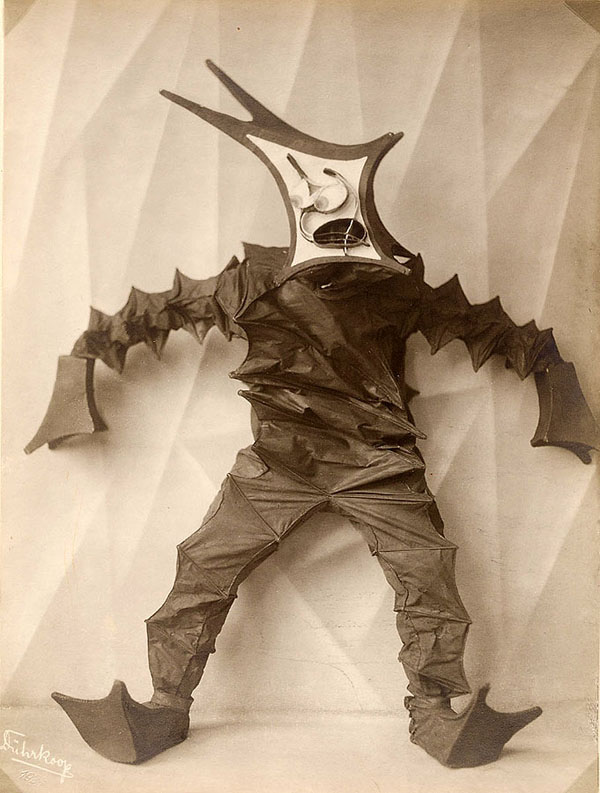
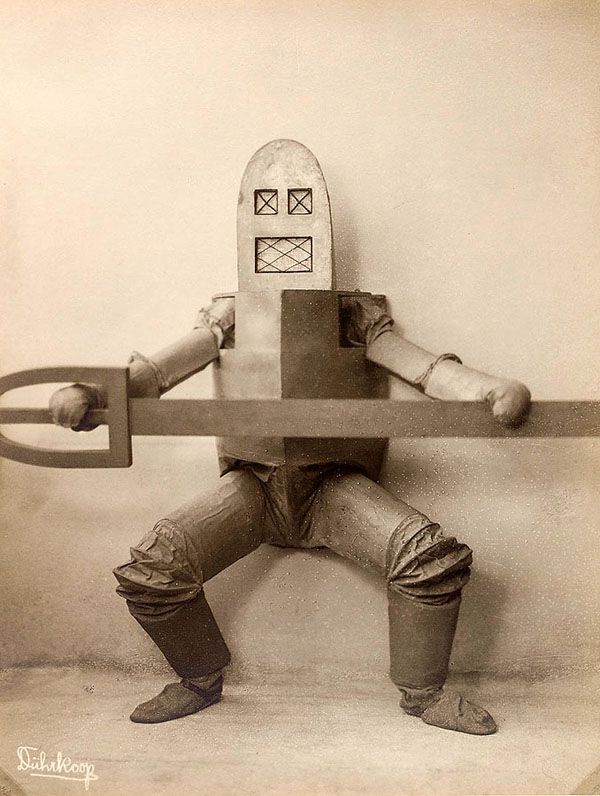
The most fruitful creative partnerships, long or short, have often been tempestuous. On the shorter side, and among the stormiest, we have a husband-and-wife team who realized visions hitherto unseen onstage, and who very nearly fell into total obscurity after a murder-suicide brought their partnership to an end. But in the Hamburg of the late 1910s and early 1920s, writes Hyperallergic’s Allison Meier, Lavinia Schulz and Walter Holdt “created wild, Expressionist costumes that looked like retro robots and Bauhaus knights,” twenty of them, for performances accompanied by avant-garde music. After their death in 1924, Schulz and Holdt’s work went into storage, never to be found again until the late 1980s.
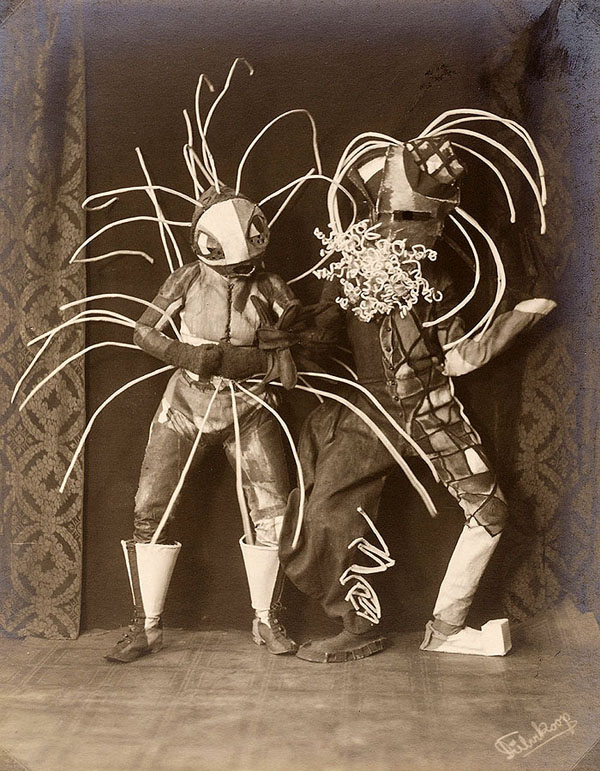
The costumes had been gifted to the Museum für Kunst und Gewerbe, which in 1925 “staged an evening in memory of Lavinia Schulz and Walter Holdt,” writes blogger Jan Reetze.
“After this, the masks, photos and drawings” — including dances diagrammed in a system of Schulz’s own invention — “went into a couple of ‘acrobat’s baggage’ boxes and fell into oblivion on the museum’s attic. They were not even inventoried. Which turned out to be a stroke of luck because this way the objects didn’t fall into the hands of the Nazis, who, without any doubt, would have seen these works as ‘degenerate art’ and in all probability would have destroyed them.”
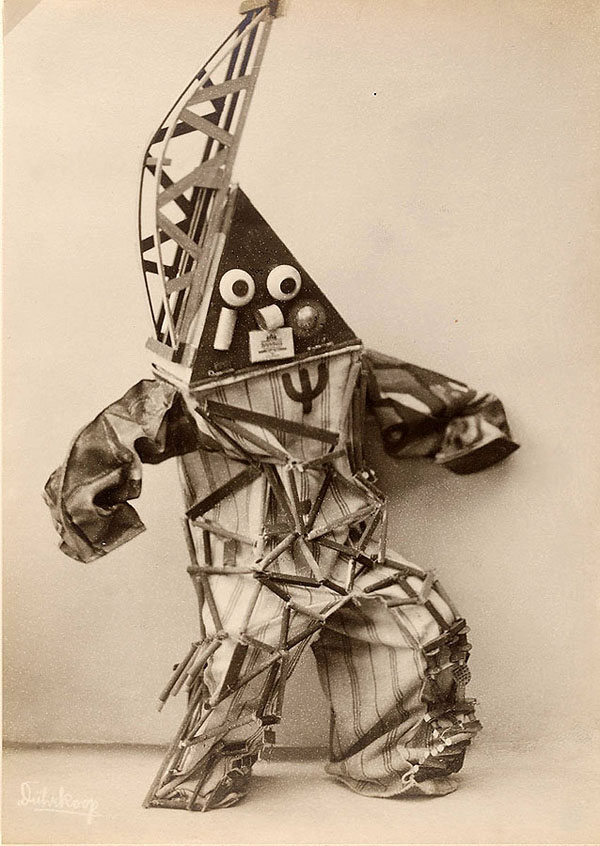
You can see the costumes in action in the video at the top of the post, and more of the photos taken by Minya Diez-Dührkoop in the last year of Schulz and Holdt’s lives at Hyperallergic. Their performances began in the expressionism with which the Berlin-educated Schultz had been associated and moved toward “the supposed purity of pre-Judeo-Christian, Aryan-Nordic culture,” as Dangerous Minds’ Paul Gallagher writes.
“Between 1920–24, the couple performed their dance routines to the bewildered and often antagonistic audiences of Hamburg. Though some critics appreciated the pair’s talent and startling originality, this praise was never enough to pay the rent.”
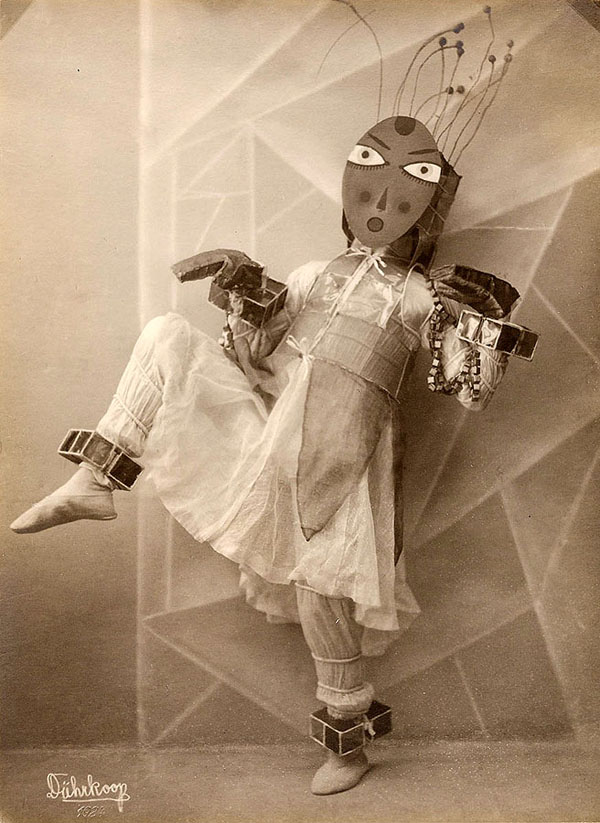
“According to contemporary critics, Lavinia seemed to be the more creative one,” writes Reetze. “Walter, on the other hand, was the better and more disciplined dancer, he exactly knew his formal means and how to use them.” The counterpart to Holdt’s rigor was Schulz’s more primal genius, a sensibility that manifested aesthetically — seen in her highly unconventional use of everyday materials like “wire, gypsum, papier mâché and industrial garbage” — and emotionally.
Reetze quotes from the autobiography of composer Hans Heinz Stuckenschmidt, who briefly lived with the couple: “Deprivation, hunger, coldness, nordic landscape with storm, ice, and catastrophes: That was her world, and she had found herself in it with Holdt.”
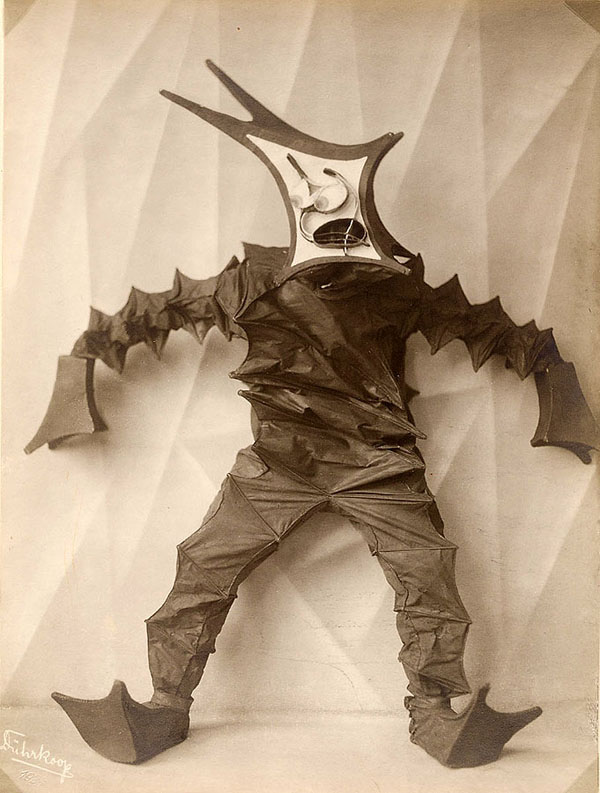
Schulz and Holdt also refused to be paid for their performances. “You cannot sell spiritual ideas for money,” Schulz wrote. “Spirit and money are two antagonistic poles, and if you sell spiritual ideas for money, you sold the spirit to the money and lost the spirit.” Eventually their poverty — as well as the unusually volatile nature of their relationship, said to spark physical marital spats on stage — reached a breaking point. “Both were in their 20s, and had earned little money from their artistic work,” writes Meier. “In financial ruin, on June 18, 1924, Schulz shot Holdt, and then turned the gun on herself.” But against all odds, their still-startling creativity — the kind that can, perhaps, emerge only from the opposition of two incompatible forces — lives on.
via Dangerous Mind
Related Content:
1930s Fashion Designers Predict How People Would Dress in the Year 2000
An Online Trove of Historic Sewing Patterns & Costumes
Harvard Puts Online a Huge Collection of Bauhaus Art Objects
Based in Seoul, Colin Marshall writes and broadcasts on cities, language, and culture. His projects include the book The Stateless City: a Walk through 21st-Century Los Angeles and the video series The City in Cinema. Follow him on Twitter at @colinmarshall or on Facebook.
Read More...Animated Series Drawn & Recorded Tells “Untold Stories” from Music History: Nirvana, Leonard Cohen, Blind Willie Johnson & More
Who hasn’t tasted the pleasures, guilty or otherwise, of VH1’s Behind the Music? The long-running show, a juicy mix of tabloid gossip, documentary insight, and unabashed nostalgia, debuted in 1997, a totally different media age. Its original viewers were the first generation to use email, shop online, or download (usually pirated) music. People were willing to sit through episodes of an hour or more, without a pause button, whether they liked the music or not. (Some of the best shows profile the most ridiculous one-hit wonders).
Behind the Music is still on, and you can stream old episodes all day long, pausing every few minutes to check email or social media, stream another video, or download an album in seconds. But with so many distractions, it’s easy to lose the thread of Huey Lewis and the News’ rise to stardom or the thrilling life and times of Ice‑T. We need stories like these, but we may need them in a smaller, more self-contained form.
Enter Drawn & Recorded: Modern Myths of Music, an online series that delivers the frisson of Behind the Music in a fraction of the time, with the added bonus of whimsical, high-quality animation and narration by T. Bone Burnett. Now in its fourth season, the award-winning series, directed and hand-drawn by animator Drew Christie for studio Gunpowder & Sky, brings us anecdotes “sometimes hilarious, occasionally tragic, always compelling,” writes Animation Magazine.
Those stories include “Leonard Cohen’s escape from Cuban authorities after being detained under suspicion of espionage” (see the trailer here) and the origins of Kurt Cobain’s “Smells Like Teen Spirit” (above), a story we covered in a previous post. Drawn & Recorded has differentiated itself from the aforementioned pop music documentary show not only in its length and aesthetic sensibilities but also in its willingness to venture deeper into music history.
The episode below, for example, features tragic bluesman Blind Willie Johnson, who made modern history when his music traveled into outer space on the Voyager Golden Record. Given their lengths of under five minutes, each Drawn & Recorded must prune its story carefully—there’s no room for meandering or gratuitous repetition. Each of the vignettes promises an “untold story” from music history, and while that may not always be the case, they are each well-told and surprising and often as strange as Christie’s animations and Burnett’s haunted, raspy baritone suggest.
In the episode below, country legend Jimmie Rogers, whose influence “would range from Hank Williams to Louis Armstrong to Bob Dylan,” arrived in Kenya a decade after his death, by way of British missionaries toting a phonograph. The native people became fascinated with the sound of Rogers’ music. They pronounced his name “Chemirocha,” a word that came to mean “anything new and different.” This became a song called “Chemirocha,” about a half-man/half-antelope god.
It’s a fascinatingly odd little tale about cross-cultural contact, one that has little to do with the biography of Jimmie Rogers, and hence might never make it into your standard-issue documentary. But Drawn & Recorded is something else—a handmade artifact that streams digitally, telling stories about musicians famous, infamous, and rarely remembered. Other episodes feature a canny mix of the contemporary, classic, and golden age, including Grimes, David Bowie, the Beatles, Sister Rosetta Tharpe, MF Doom, and more. Find them, notes Animation Magazine, “on the Network, available on DirecTV, DirecTV Now and AT&T U‑verse” or find scattered episodes on Vimeo.
Related Content:
Josh Jones is a writer and musician based in Durham, NC. Follow him at @jdmagness
Read More...Pretty Much Pop #10 Examines Margaret Atwood’s Nightmare Vision: The Handmaid’s Tale

Mark Linsenmayer, Erica Spyres, and Brian Hirt take on both Margaret Atwood’s 1985 novel plus the Bruce Miller/Hulu TV series through season 3. There’s also a graphic novel and the 1990 film.
We get into what’s needed to move a novel to the screen like that: The character can’t just remain passive as in the novel in order to keep us suffering with her past the first season as storytelling beyond the book begins. We talk about Atwood’s funny neologisms (like “prayvaganza”) that didn’t make it into the show.
How does race play into the story, and how should it? Is the story primarily a political statement or a self-contained work of art? Given the bleakness of the situation depicted, can there be comic relief? How can we have a nominally funny podcast about this work?
Some of the articles we drew on or bring up include:
- “The Differences Between The Handmaid’s Tale Show and Book, Explained” by Eliana Dockterman
- “In Its First Season, The Handmaid’s Tale’s Greatest Failing Is How It Handles Race” by Angelica Jade Bastién
- “The Handmaid’s Tale Could Be So Much Better. But First It Has to Leave Its Star Behind” by Judy Berman
Plus Erica brings up this video of Bill Moyers interviewing Atwood about religion. We also touch on Shindler’s List, Jean-Paul Sartre’s Nausea, David Brin dissing Star Wars as anti-democratic storytelling, and the many conservative dismissals of the show as hysterical propaganda.
Buy the book, the graphic novel, or its new sequel The Testaments.
You may be interested in these related Partially Examined Life episodes (Mark’s long-running philosophy podcast): #181 on Hannah Arendt and the banality of evil, #139 on bell hooks and her historical account of conditions for black women not terribly dissimilar to the ones described by Atwood, #90 interviewing David Brin about the connections between speculative fiction, philosophy, and political speech. PEL has also recorded several episodes on Sartreand Mark ran a supporter-only session that you could listen to on Nausea in particular. Also check out Brian’s Contellary Tales podcast #2 talking about another breeding-related sci-fi story by Octavia Butler.
This episode includes bonus discussion that you can only hear by supporting the podcast at patreon.com/prettymuchpop. This podcast is part of the Partially Examined Life podcast network.
Pretty Much Pop is the first podcast curated by Open Culture. Browse all Pretty Much Pop posts or start with the first episode.
Read More...What Would Michel Foucault Think of Social Media, Fake News & Our Post Truth World?
During the late 70s, Michel Foucault gave a series of lectures at the College de France in which he defined the concept of biopolitics, an idea Rachel Adams calls “political rationality which takes the administration of life and populations as its subject.” These ideas have come to have even more resonance in the spread of biometric identification systems and militarized population control policies.
Foucault begins his lecture series on biopolitics with an account of the birth of Neoliberalism, the engineered privatization of public goods and services and the concentration of capital and power into the hands of a few. “Everything I do,” he once said, “I do in order that it might be of use.” What would he have to say about the current situation? asks the BBC video above, a political landscape permeated by fake news, accusations of fake news, and the general admission that we are now “post truth”?
In some sense, Foucault, argued, we have always lived in such a world—not one in which real news and actual truth did not exist, but in which we are conditioned through language to adopt ideological perspectives that may have little to do with fact. What counts as knowledge, Foucault showed, gets authenticated to serve the interests of power. Later in his career, he saw more space for resistance and self-transformation emerge in power relations—and he would have seen such spaces in social media too, the video claims.
After his infamous acid trip in Death Valley, Foucault reportedly (and self-reportedly) returned a changed man, with a much less gloomy, claustrophobic outlook. The earlier Foucault may have emphasized the totalizing mechanisms of surveillance and control in social media, perhaps to the exclusion of any potential for liberation. The video doesn’t make these distinctions between early and late or give us much in the way of a history of his thought, though it acknowledges how critically important history was to Foucault himself.
We can’t know that he would say any of the things attributed to him here. He was a contrarian thinker, who “didn’t believe in all-embracing theories to explain the world,” the narrator admits. Perhaps he would have seen social media as technical elaboration of biopower: harvesting personal data, tracking everyone’s location, getting us all to watch each other. Or as a version of Jeremy Bentham’s panopticon, in which we never know when someone’s watching us, so we internalize the control system. These are some of the prisons, Foucault might say, that appear under regimes of “security, territory, population.”
The video features Angie Hobbs, Professor of Public Understanding of Philosophy at the University of Sheffield.
Related Content:
Michel Foucault and Noam Chomsky Debate Human Nature & Power on Dutch TV (1971)
An Animated Introduction to Michel Foucault, “Philosopher of Power”
Hear Hours of Lectures by Michel Foucault: Recorded in English & French Between 1961 and 1983
Josh Jones is a writer and musician based in Durham, NC. Follow him at @jdmagness
Read More...Watch an Archaeologist Play the “Lithophone,” a Prehistoric Instrument That Let Ancient Musicians Play Real Classic Rock
Surely each of us hears more music in a day than the average prehistoric human being heard in a lifetime. Then again, it depends on the definition of “music”: though what we listen to is undoubtedly more complex than what our distant ancestors listened to, our music descends from theirs just as we descend from them. And so it shouldn’t come as too much of a surprise that the musical instruments used in prehistoric times should sound vaguely familiar to us. Take, for instance, archaeologist and prehistoric music specialist Jean-Loup Ringot’s performance on the semicircle of stones known as a lithophone, or “rock gong.”
Lithophones, wrote Josh Jones on the instrument’s last appearance here on Open Culture, “have been found all over the African continent, in South America, Australia, Azerbaijan, England, Hawaii, Iceland, India, and everywhere else prehistoric people lived. Not the cultural property of any one group, the rock gong came, rather, from a universal human insight into the natural sonic properties of stone.”
A commenter on the video of Ringot playing the lithopone describes it as “reminiscent of the bonang,” the collection of small gongs set on strings that constitutes one of the defining instruments of the traditional Javanese percussion ensemble known as gamelan.
Even if you’ve never heard of gamelan or bonang, the sound of the lithophone — and its resemblance to that of instruments used in other traditional musics — may well resonate with you, so to speak. The main difference comes out of the materials: the gongs, or kettles, of a bonang are made from bronze, iron, or mixtures of other metals, while the lithophone generates sound with only what would have been available to the Flintstones. The use of such a naturally abundant substance has, of course, inspired many a modern wag to Flintstonian quips about lithophone players as the first “rockers.” Players of the real classic rock, in other words — not like all the junk that has come out in the last few millennia. But then, don’t we all prefer the early stuff?
Related Content:
A Modern Drummer Plays a Rock Gong, a Percussion Instrument from Prehistoric Times
Hear a 9,000 Year Old Flute—the World’s Oldest Playable Instrument—Get Played Again
What Did Ancient Greek Music Sound Like?: Listen to a Reconstruction That’s ‘100% Accurate’
Visit an Online Collection of 61,761 Musical Instruments from Across the World
Based in Seoul, Colin Marshall writes and broadcasts on cities, language, and culture. His projects include the book The Stateless City: a Walk through 21st-Century Los Angeles and the video series The City in Cinema. Follow him on Twitter at @colinmarshall or on Facebook.
Read More...Support Us
We're hoping to rely on loyal readers, rather than erratic ads. Please click the Donate button and support Open Culture. You can use Paypal, Venmo, Patreon, even Crypto! We thank you!

About Us

Open Culture scours the web for the best educational media. We find the free courses and audio books you need, the language lessons & educational videos you want, and plenty of enlightenment in between.
Advertise With Us

FREE UPDATES!
GET OUR DAILY EMAIL
Get the best cultural and educational resources on the web curated for you in a daily email. We never spam. Unsubscribe at any time.
FOLLOW ON SOCIAL MEDIA

Open Culture editor Dan Colman scours the web for the best educational media. He finds the free courses and audio books you need, the language lessons & movies you want, and plenty of enlightenment in between.
Advertise With Us

