Sun Ra Applies to NASA’s Art Program: When the Inventor of Space Jazz Applied to Make Space Art
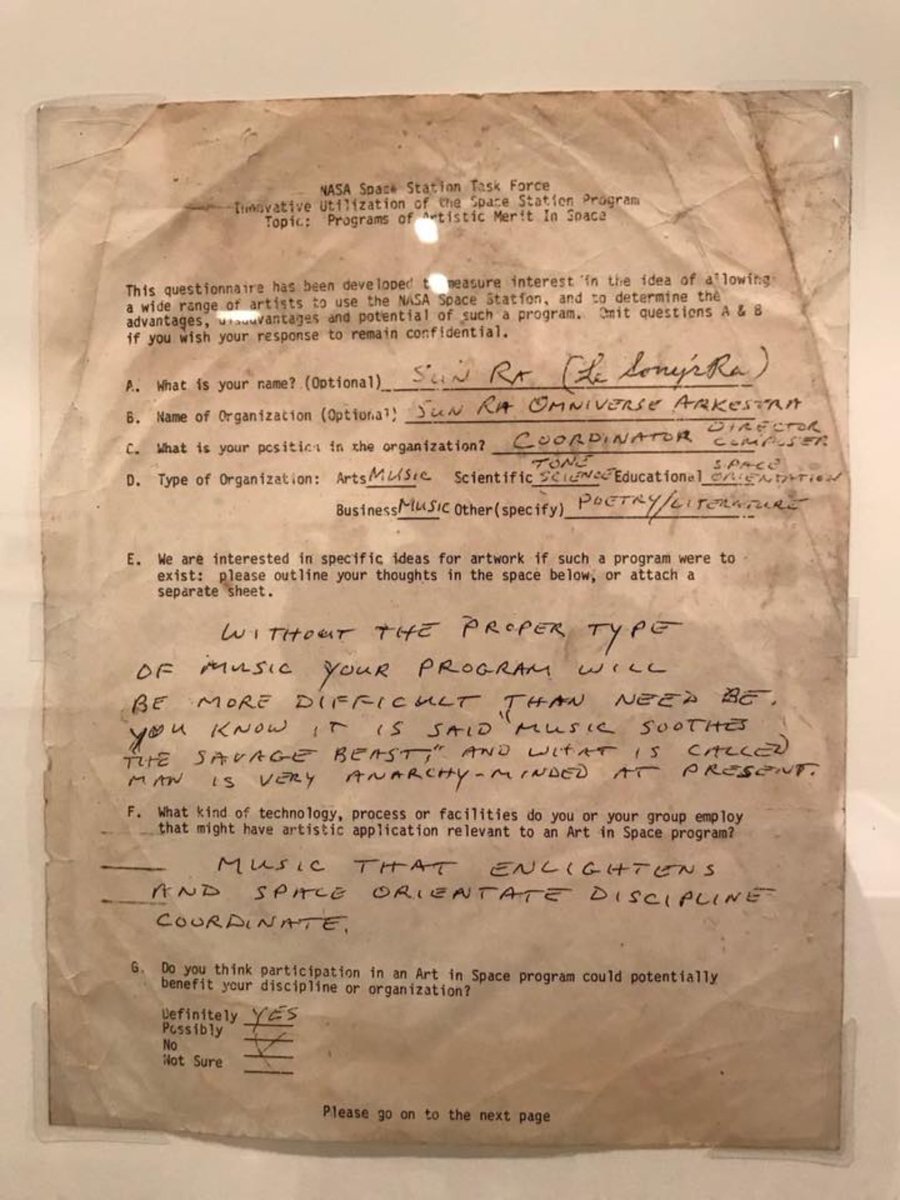
You may have seen the image above floating around, especially if you follow jazz lovers and writers like Ted Gioia: the first page of Sun Ra’s application to NASA’s art program. The program was “somewhat of a glorified PR campaign,” writes Shannon Gormley at Willamette Week, but one nonetheless that has employed many prominent artists since its inception in 1962, including Annie Leibovitz, Andy Warhol, Laurie Anderson, and Norman Rockwell. NASA has “enlisted musicians, poets and others for more variety,” the Administration notes. “Patti LaBelle even recorded a space-themed song.”
But Sun Ra—given name Herman Blount; legal name (as he writes in parentheses) Le Sony’r Ra—was not, it seems, considered when he applied in the 1960s, even if he more or less invented space jazz in the previous decade. After many years in Chicago, he’d relocated his free jazz big band, the Arkestra, to New York, where they influenced later Beats and the early psychedelic scene (just as he was to influence funk, prog, and fusion in the 70s, and come in for a major revival in the 90s through indie rock and hip hop.)
Likely, whoever read his application was unfamiliar with the creative idiosyncrasies of his language, written just as he sang and played—with incantatory repetition, syntactical surprises, and ALL CAPS all the time. The prodigious, visionary bandleader proposes to contribute “music that enlightens and space orientate discipline coordinate.” One might cast a wary eye on this description, from an applicant who lists their educational mission as “space orientation.” Unless you’d heard what Sun Ra meant by the phrase.
Take his orientation in 1961’s “Space Jazz Reverie” from The Futuristic Sounds of Sun Ra, recorded just after he arrived in New York, on the threshold of pushing the Arkestra further out into the solar system. The tune “ostensibly sounds like a large-ensemble take on hard bop,” writes Matthew Wuethrich at All About Jazz. “Mid-tempo swing, strange-but-not-unheard-of-intervals and a string of solos.” But the composition starts to warp and wobble. “Ra’s comping on the piano generates an unsettling backdrop.” A “bizarre bridge” after the solos throws things further off-kilter.
This is not cold, crystalline music of the stars, but an emotional journey into the excitation, coordination (to take his phrase), and defamiliarization of space travel. Listening to Sun Ra almost inclines me to believe his tales of interstellar travel and alien abduction—or at least to feel, for a few minutes, as though I had taken a cosmic trip. NASA’s art program would have certainly been enriched by his contributions, though whether it would have raised either one’s profile is uncertain.
Ra’s application “reads like a prophecy,” writes Gormley. We need music, in space and otherwise. “What is called man is very anarchy-minded at present,” he wrote. But Sun Ra himself was “anarchy-minded,” in the best sense of the term—he gave his imagination free rein and did not cater to any authority. This rankled many of his jazz peers, who frequently said he went too far. Sun Ra never seemed to bother about the criticism.
He may have taken the NASA snub a little hard. In his landmark 1972 film Space is the Place, he discusses the space program with a group of black Oakland youth, saying, “I see none of you have been invited.” Sun Ra and the young people to whom he brought the hope of outer space could not have known about the hidden history of African American scientists and astronauts in the space program. In any case, Ra had his own space program. A one-band cultural revolution that was too forward-looking for both jazz and NASA.
via Ted Gioia
Related Content:
Star Trek‘s Nichelle Nichols Creates a Short Film for NASA to Recruit New Astronauts (1977)
Josh Jones is a writer and musician based in Durham, NC. Follow him at @jdmagness
Read More...Watch a Short 1967 Film That Imagines How We’d Live in 1999: Online Learning, Electronic Shopping, Flat Screen TVs & Much More
Nobody uses the word computerized anymore. Its disappearance owes not to the end of computerization itself, but to the process’ near-completeness. Now that we all walk around with computers in our pockets (see also the fate of the word portable), we expect every aspect of life to involve computers in one way or another. But in 1967, the very idea of computers got people dreaming of the far-flung future, not least because most of them had never been near one, let alone brought one into their home. But for the Shore family, each and every phase of the day involves a computer: their “central home computer, which is secretary, librarian, banker, teacher, medical technician, bridge partner, and all-around servant in this house of tomorrow.”
Tomorrow, in this case, means the year 1999. Today is 1967, when Philco-Ford (the car company having purchased the bankrupt radio and television manufacturer six years before) didn’t just design and build this speculative “house of tomorrow,” which made its debut on a television broadcast with Walter Cronkite, but produced a short film to show how the family of tomorrow would live in it. Year 1999 AD traces a day in the life of the Shores: astrophysicist Michael, who commutes to a distant laboratory to work on Mars colonization; “part-time homemaker” Karen, who spends the rest of the time at the pottery wheel; and eight-year-old James, who attends school only two mornings a week but gets the rest of his education in the home “learning center.”
There James watches footage of the moon landing, plausible enough material for a history lesson in 1999 until you remember that the actual landing didn’t happen until 1969, two years after this film was made. The flat screens on which he and his parents perform their daily tasks (a technology that would also surface in Stanley Kubrick’s 2001: A Space Odyssey the following year) might also look strikingly familiar to we denizens of the 21st century. (Certainly the way James watches cartoons on one screen while his recorded lectures play on another will look familiar to today’s parents and educators.) But many other aspects of the Philco-Ford future won’t: even though the year 2000 is also retro now, the Shores’ clothes and decor look more late-60s than late-90s.
In this and other ways, Year 1999 AD resembles a parody of the techno-optimistic shorts made by postwar corporate America, so much so that Snopes put up a page confirming its veracity. “Many visionaries who tried to forecast what daily life would be like for future generations made the mistake of simply projecting existing technologies as being bigger, faster, and more powerful,” writes Snopes’ David Mikkelson. Still, Year 1999 AD does a decent job of predicting the uses of technology to come in daily life: “Concepts such as ‘fingertip shopping,’ an ‘electronic correspondence machine,’ and others envisioned in this video anticipate several innovations that became commonplace within a few years of 1999: e‑commerce, webcams, online bill payment and tax filing, electronic funds transfers (EFT), home-based laser printers, and e‑mail.”
Even twenty years after 1999, many of these visions have yet to materialize: “Split-second lunches, color-keyed disposable dishes,” pronounces the narrator as the Shores sit down to a meal, “all part of the instant society of tomorrow, a society of leisure and taken-for-granted comforts.” But as easy as it is to laugh at the notion that “life will be richer, easier, healthier as Space-Age dreams come true,” the fact remains that, like the Shores, we now really do have computer programs that let us communicate and do our shopping, but that also tell us what to eat and when to exercise. What would the minds behind Year 1999 AD make of my watching their film on my personal screen on a subway train, amid hundreds of riders all similarly equipped? “If the computerized life occasionally extracts its pound of flesh,” says the narrator, “it holds out some interesting rewards.” Few statements about 21st-century have turned out to be as prescient.
Related Content:
Walter Cronkite Imagines the Home of the 21st Century… Back in 1967
Arthur C. Clarke Predicts the Future in 1964… And Kind of Nails It
Did Stanley Kubrick Invent the iPad in 2001: A Space Odyssey?
Based in Seoul, Colin Marshall writes and broadcasts on cities, language, and culture. His projects include the book The Stateless City: a Walk through 21st-Century Los Angeles and the video series The City in Cinema. Follow him on Twitter at @colinmarshall or on Facebook.
Read More...The Secret Student Group Who Took on the Nazis: An Introduction to “The White Rose”
Lately, young people standing up against oppressive regimes have faced unrelenting streams of ridicule, abuse, and worse: some have even lost their lives in mysterious circumstances that recall the tragic fates of those who battled racism in the U.S. south decades ago. Though it’s cold consolation to the bereaved and harassed, it at least remains the case today that activists who speak out can count on varying, but vocal levels of support, and they will find celebrities and politicians, whether cynical or well-meaning, to amplify (or co-opt) their message.
We can and should draw parallels between 20th-century European fascism and the 21st-century’s fascist turn. But the above situation could never have obtained in Nazi Germany of the 1930s and 40s. Anti-Nazi points of view were banned even for entertainment purposes. Circulating them would almost certainly result in execution. Ordinary Germans may have also vented their spleens at dissenters, but they did so with full assurance that those people would be crushed by the government, and that no one would stand up for them, not even to posture.
It was in this paralyzing climate of terror that the student members of The White Rose, a secretive, anonymous group of activists, began distributing leaflets denouncing Hitler and Nazism. “At a time when a sarcastic remark could constitute treason,” notes the TED-Ed lesson above, the strident language “was unprecedented.” Most of the leaflets were written by Hans Scholl, as the short, animated video—scripted by scholar Iseult Gillespie—informs us. Just a few years earlier, Scholl had been an enthusiastic member of the Hitler Youth, and his sister Sophie, who joined him in The White Rose, had been a member of the League of German Girls.

In 1936, when Hans witnessed a mass Nazi rally for the first time, he began to seriously question his life choices. Sophie had been entertaining her own doubts. Their parents, both increasingly concerned about the Nazi threat, were very supportive. The Scholl family had secretly listened to foreign broadcasts and learned “shocking truths” about what was happening in their country. While at the University of Munich, Hans “started reading anti-Nazi sermons,” writes Erin Blakemore at Smithsonian, “and attending classes with Kurt Huber, a psychology and philosophy professor whose lectures included veiled criticisms of the regime.”
Hans was drafted into the army as a medic, where he witnessed abuses against Jewish prisoners and heard about the concentration camps. When he returned to medical school at the University of Munich, he met several friends who shared his outrage. In 1939, The White Rose printed its first leaflets, spreading them all over Munich. “Adopt passive resistance,” they urged, inspiring Germans to sabotage the war effort. “Block the functioning of this atheistic war machine before it is too late. Before the last city is a heap of rubble. Before the last youth in our nation bleeds to death.”
Many more leaflets followed. (Sophie would not discover them and join the group until after their activities began.) “The White Rose mailed the pamphlets to random people they found in the phone book,” writes Blakemore. They “took them in suitcases to other cities, and left them in phone booths. They also painted graffiti on the walls of the University of Munich with slogans like ‘Freedom!’ and ‘Hitler the Mass Murderer!’” It was the first time public dissent against the Nazis had taken hold. “The society’s work quickly spread to other cities, with some of its literature even showing up in Austria.”
In 1943, Allied planes dropped tens of thousands of The White Rose’s leaflets over Nazi Germany. News of them “even reached concentrations camps and prisons,” the video notes. Soon afterward, the Scholls and their friend Christoph Probst were arrested by the Gestapo. (Read a moving account of their arrest and trial at the Jewish Virtual Library.) The three were put on show trial and executed by guillotine. Later, their professor, Kurt Huber and other members of The White Rose were also beheaded.
The identities of The White Rose would not be known until after the war. They have since become heroes to anti-fascists and activists around the world, and their call for passive resistance echoes in one of their final leaflets: “We will not be silent. We are your bad conscience. The White Rose will not leave you in peace!” In spite of the risks, which they all knew, the Scholls and their allies chose to act, cautiously, but decisively, against a regime they finally saw to be a terrible evil.
To learn more about The White Rose, explore these books: The White Rose (1970), A Noble Treason (1979), and An Honourable Defeat (1994).
Related Content:
Rare 1940 Audio: Thomas Mann Explains the Nazis’ Ulterior Motive for Spreading Anti-Semitism
Josh Jones is a writer and musician based in Durham, NC. Follow him at @jdmagness
Read More...30 Fans Joyously Sing the Entirety of Bob Marley’s Legend Album in Unison
The thirty Bob Marley superfans who heeded artist Candice Breitz’s 2005 call to visit a Port Antonio, Jamaica recording studio, to be filmed individually performing the entirety of Marley’s Legend album a capella, were not propelled by showbiz dreams.
Rather, their participation was a way for them to connect with the beloved icon, in a manner as intimate as singing along in one’s teenaged bedroom.
They were given no direction as far as performance style or costume, only that they stick with it for the duration of the hour-long album, piped into their ears via discreet grey buds.
Some dart their eyes apprehensively, barely moving.
Others bob and weave with unbridled abandon.
One man shucks his cap when dreadlocks are mentioned in “Buffalo Soldier.”
A young woman grimaces and shrugs apologetically as the final track’s many “jammin’s” get away from her.
Some nod and widen their eyes at personally significant lines, pointing for emphasis, as if to tell viewers less familiar with Marley’s work to listen up, because herein the message lies.
In between songs, they sip from plastic bottles of water and soda, occasionally offering impromptu commentary (“I feel this one!”). The grey-bearded gent mops his brow.
Once these solos were in the can, Breitz arranged them into a choir, stacked Brady Bunch-style, six across, five down.
Everyone starts at the same moment, but with no instruction as to how to approach backing vocals and the wordless aspects of Marley’s performance, inadvertent soloists emerge, sometimes as the result of a jumped gun.
(You try singing “I Shot the Sheriff” with no karaoke prompts guiding you…)
Breitz, who has since created similar work with Michael Jackson, John Lennon, Madonna, and Leonard Cohen fans, took pains to make sure the participants left the studio feeling good about the experience. It’s not a TV talent contest.
While certain squares contain star quality charisma, all thirty were necessary to achieve the goal of a composite portrait that eschews the “overtly iconic representation” of the subject as “some kind of fixed, unchanging entity.”
As art critic Christy Lange observed in conjunction with an interview with Breitz for Modern Painters:
While Marley, Madonna and Jackson may play a lopsidedly central role in shaping their fans’ lives and identities, these fans play a reciprocal part in resurrecting the stars’ original appeal, which has been subsumed by the celebrity culture that created them. The culture of stardom may thrive on a series of cheap imitations, mimicking an elusive idea of ‘celebrity’, but even in this concatenation of simulated identities, a few authentic portraits can still be discovered.
Listen—and sing along—to Bob Marley’s Legend in its entirety on Spotify.
Related Content:
Bob Marley’s “Redemption Song” Played by Musicians Around the World
Johnny Cash & Joe Strummer Sing Bob Marley’s “Redemption Song” (2002)
Ayun Halliday is an author, illustrator, theater maker and Chief Primatologist of the East Village Inky zine. Join her in NYC tonight, September 9, for the season kick-off of her book-based variety show, Necromancers of the Public Domain. Follow her @AyunHalliday.
Read More...Medieval Monks Complained About Constant Distractions: Learn How They Worked to Overcome Them

St. Benedict by Fra Angelico, via Wikimedia Commons
We might imagine that life in a monastery is one of the safest, most predictable ways of life on offer, and therefore one of the least distracted. But “medieval monks had a terrible time concentrating,” writes Sam Haselby at Aeon, “and concentration was their lifelong work!” They complained of information overload, forgetfulness, lack of focus, and overstimulation. Their jumpy brains, fundamentally no different from those we use to navigate our smart phones, were the culprit, though, like us, the monks found other sources to blame.
“Sometimes they accused demons of making their minds wander. Sometimes they blamed the body’s base instincts.” Given the nature of their restrictive vows, it’s no wonder they found themselves thinking “about food or sex when they were supposed to be thinking about God.” But the fact remains, as University of Georgia professor Jamie Kreiner says in an interview with PRI’s The World, monks living 1600 years ago found themselves constantly, painfully distracted.
It wasn’t even necessarily about tech at all. It was about something inherent in the mind. The difference between us and them is not that we are distracted and they aren’t, it’s that they actually had savvier ways of dealing with distraction. Ways of training their minds the way we might train our bodies.
So, what did the wisest monks advise, and what can we learn, hundreds of years later, from their wisdom? Quite a lot, and much of it applicable even to our online lives. Some of what medieval monks like the 5th century John Cassian advised may be too austere for modern tastes, even if we happen to live in a monastery. But many of their practices are the very same we now see prescribed as therapeutic exercises and good personal habits.
Cassian and his colleagues devised solutions that “depended on imaginary pictures” and “bizarre animations” in the mind,” Haselby explains. People were told to let their imaginations run riot with images of sex, violence, and monstrous beings. “Nuns, monks, preachers and the people they educated were always encouraged to visualize the material they were processing,” often in some very graphic ways. The gore may not be fashionable in contemplative settings these days, but ancient methods of guided imagery and creative visualization certainly are.
So too are techniques like active listening and nonviolent communication, which share many similarities with St. Benedict’s first rule for his order: “Listen and incline the ear of your heart.” Benedict spoke to the mind’s tendency to leap from thought to thought, to prejudge and formulate rebuttals while another person speaks, to tune out. “Basically,” writes Fr. Michael Rennier, Benedict’s form of listening “is taking time to hear in a certain way, with an attitude of openness, and commitment to devote your whole self to the process,” without doing anything else.
Benedict’s advice, Rennier writes, is “great… because obstacles are all around, so we need to be intentional about overcoming them.” We do not need to share the same intentions as St. Benedict, however, to take his advice to heart and stop treating listening as waiting to speak, rather than as a practice of making space for others and making space for silence. “Benedict knew the benefits of silence,” writes Alain de Botton’s School of Life, “He knew all about distraction,” too, “how easy it is to want to keep checking up on the latest developments, how addictive the gossip of the city can be.”
Silence allows us to not only hear others better, but to hear our deeper or higher selves, or the voice of God, or the universe, or whatever source of creative energy we tune into. Like their counterparts in the East, medieval Catholic monks also practiced daily meditation, including meditations on death, just one of several methods “Cistercian monks used to reshape their own mental states,” as Julia Bourke writes at Lapham’s Quarterly.
“A medieval Cistercian and a modern neuroscientist” would agree on at least one thing, Bourke argues: “the principle that certain feelings and emotions can be changed through meditative exercises.” No one devises numerous formal solutions to problems they do not have; although their physical circumstances could not have been more different from ours, medieval European monks seemed to suffer just as much as most of us do from distraction. In some part, their lives were experiments in learning to overcome it.
via Aeon
Related Content:
Meditation for Beginners: Buddhist Monks & Teachers Explain the Basics
How Information Overload Robs Us of Our Creativity: What the Scientific Research Shows
How to Focus: Five Talks Reveal the Secrets of Concentration
Josh Jones is a writer and musician based in Durham, NC. Follow him at @jdmagness
Read More...Orson Welles Trashes Famous Directors: Alfred Hitchcock (“Egotism and Laziness”), Woody Allen (“His Arrogance Is Unlimited”) & More
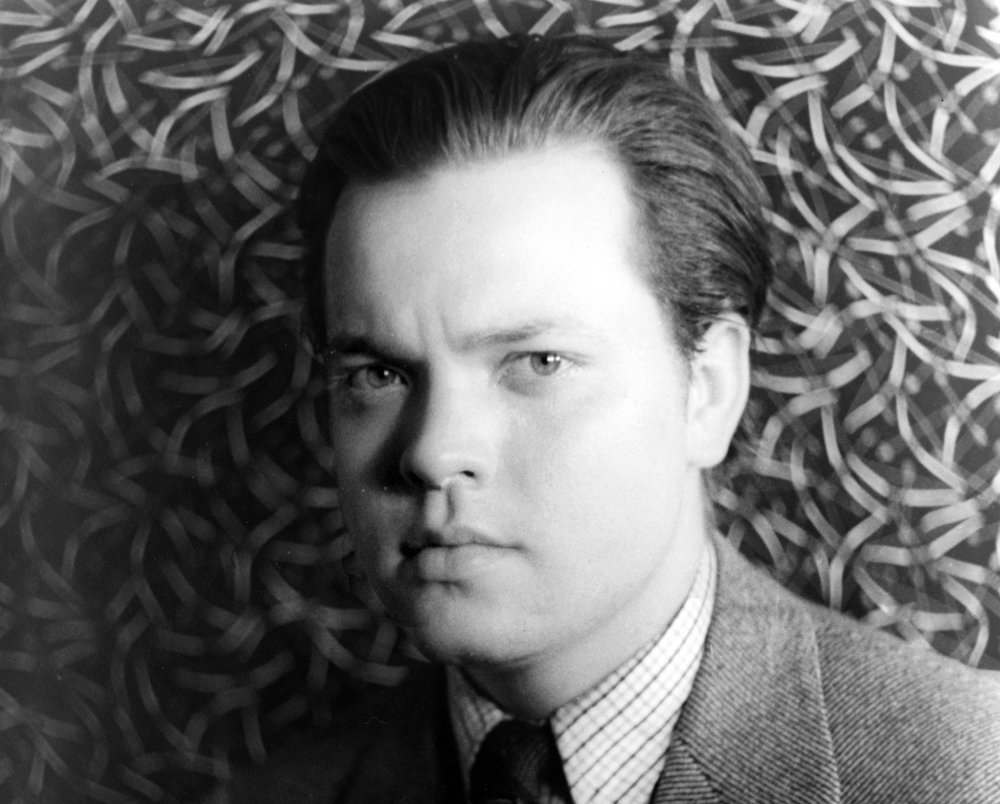
A bold artist acts first and thinks later. In the case of Orson Welles, one of the boldest artists produced by 20th-century America, that habit also found its way into his speech. This became especially true in the interviews he gave later in life, when he freely offered his opinions, solicited or otherwise, on the work of his fellow filmmakers. The man who made Citizen Kane didn’t hesitate to roast, for instance, the European auteurs who ascended after his own career in cinema seemed to stall, and whose work he elaborately satirized in the posthumously released The Other Side of the Wind. His considered remarks include the following: “There’s a lot of Bergman and Antonioni that I’d rather be dead than sit through.” No, Orson, tell us what you really think.
“According to a young American film critic, one of the great discoveries of our age is the value of boredom as an artistic subject,” Welles says in another interview. If so, Michelangelo Antonioni “deserves to be counted as a pioneer and founding father,” a maker of movies that amount to “perfect backgrounds for fashion models.” As for Bergman, “I share neither his interests nor his obsessions. He’s far more foreign to me than the Japanese.” Welles has kinder words for Federico Fellini, whom he calls “as gifted as anyone making movies today,” but also “fundamentally very provincial.” His pictures are “a small-town boy’s dream of the big city,” which is also the source of their charm, but the man himself “shows dangerous signs of being a superlative artist with little to say.”
Welles estimated the younger Jean-Luc Godard’s gifts as a director as “enormous. I just can’t take him very seriously as a thinker — and that’s where we seem to differ, because he does. And though Godard may admire Woody Allen (himself an admirer of Bergman), Welles certainly didn’t: “I hate Woody Allen physically, I dislike that kind of man,” he tells filmmaker Henry Jaglom. “That particular combination of arrogance and timidity sets my teeth on edge.” When Jaglom objects that Allen isn’t arrogant but shy, Welles drives on: “Like all people with timid personalities, his arrogance is unlimited.” Allen “hates himself, and he loves himself, a very tense situation. It’s people like me who have to carry on and pretend to be modest,” while, in Allen’s case, “everything he does on screen is therapeutic.”
Allen has what Welles calls “the Chaplin disease,” and Welles’ interviews also feature severe criticisms of Chaplin himself. After referencing the fact that, unlike his fellow silent comedian Harold Lloyd, Chaplin didn’t write all his own jokes but used “six gagmen,” he declares that Modern Times — regarded by many as Chaplin’ masterpiece — “doesn’t have a good moment in it.” Clearly Welles felt no more need to pull his punches on his elders than he did with the whippersnappers: John Ford “made very many bad pictures,” including The Searchers (“terrible”); Cecil B. DeMille Welles credits with giving Mussolini and Hitler the idea for the fascist salute; Elia Kazan will never be forgiven for naming names to the House Committee on Un-American Activities (“it’s just inexcusable”); and even Sergei Eisenstein, father of the montage, is also “the most overrated great director of them all.”
You can read more of Welles’ choice words on his colleagues in cinema in this thread of interview clips posted by a Twitter user who goes by John Frankensteiner. It also includes Welles’ assessment of Alfred Hitchcock, who declined into “egotism and laziness,” making films “all lit like television shows.” Welles suspects age-related cognitive issues — “I think he was senile a long time before he died,” in part because “he kept falling asleep while you were talking to him” — but he also trashes the work Hitchcock did in his prime, such as Vertigo. Sight & Sound’s last critics poll named that film the greatest of all time, but Welles calls it even worse than Rear Window, about which “everything was stupid.” But at least all these filmmakers, living and dead, can rest easy knowing they didn’t rank as low in Welles’ estimation as John Landis, “the asshole from Animal House.” Jaglom, believing he can influence Landis and mend their relationship, asks what he can do to help. Welles’ suggestion: “Kill him.”
Related Content:
Jorge Luis Borges Reviews Citizen Kane — and Gets a Response from Orson Welles
Jean-Paul Sartre Reviews Orson Welles’ Masterwork (1945): “Citizen Kane Is Not Cinema”
Based in Seoul, Colin Marshall writes and broadcasts on cities, language, and culture. His projects include the book The Stateless City: a Walk through 21st-Century Los Angeles and the video series The City in Cinema. Follow him on Twitter at @colinmarshall or on Facebook.
Read More...Bob Odenkirk & Errol Morris Create Comedic Shorts to Help You Take Action Against Global Warming: Watch Them Online
My beach house must be somewhere around here. I used to be able to see the ocean from it. I should be able to see it from the ocean. Ooo, that looks familiar. Lady Liberty. Ha ha! Hellooo! All the best to you. —Admiral Horatio Horntower
Are there any Better Call Saul fans among the global warming deniers?
A scenario in which one can simultaneously pooh pooh the melting of the polar ice caps and embrace The Thin Blue Line?
Director Errol Morris and his star, Bob Odenkirk, may not change any minds with their Global Meltdown spots they produced in partnership with the Institute for the Future, but hopefully the emphatic end cards will stir some fans to action.
The absurdist 30-second shorts feature Odenkirk, encrusted in epaulets and naval insignia, as the fictional Horntower, “an admiral of a fleet of one and perhaps the last man on Earth.” Marooned on a small block of ice, he rails against the inexpertly animated wildlife encroaching on his domain.
(“You don’t even have the facility of language!” he tells a penguin, and later threatens a walrus that it will “get painted out” of the final cut for “complaining all the time…”)
Certainly a documentarian of Morris’ stature could have taken a lengthier, more serious approach to the subject, but as he notes:
Logic rarely convinces anybody of anything. Climate change has become yet another vehicle for political polarization. If Al Gore said the Earth was round there would be political opposition insisting that the Earth was flat. It’s all so preposterous, so contemptible.
Odenkirk also has some out-of-uniform concerns about climate change, as expressed in “Where I Got These Abs,” a 2011 Shouts & Murmurs piece for The New Yorker:
The middle ab on the left (not my left, your left, if you are looking at me) is called Terrence. It’s a dignified ab. It tenses each time I read an op-ed article about global warming. The article’s point of view is immaterial; simply being reminded that I can do nothing to stop the horrific future of floods and catastrophe gives this ab a taut yank that lingers, burning calories in my well-creased forehead at the same time.
Watch all of Morris and Odenkirk’s Admiral Horntower spots, currently totaling nine, with ten more to come, on Global Meltdown’s YouTube channel.
via Kottke
Related Content:
Climate Change Gets Strikingly Visualized by a Scottish Art Installation
Global Warming: A Free Course from UChicago Explains Climate Change
NASA Captures the World on Fire
Ayun Halliday is an author, illustrator, theater maker and Chief Primatologist of the East Village Inkyzine. Join her in NYC this Monday, September 9 for the new season’s kickoff of her book-based variety show, Necromancers of the Public Domain. Follow her @AyunHalliday.
Read More...Why Learn Latin?: 5 Videos Make a Compelling Case That the “Dead Language” Is an “Eternal Language”
“I tried to get Latin canceled for five years,” says an exasperated Max Fischer, protagonist of Wes Anderson’s Rushmore, when he hears of his school’s decision to scrap Latin classes. “ ‘It’s a dead language,’ I’d always say.” Many have made a similarly blunt case against the study of Latin. But as we all remember, Max’s educational philosophy overturns just as soon as he meets Miss Cross and brings up the cancellation to make conversation. “That’s a shame because all the Romance languages were based on Latin,” she says, articulating a standard defense. “Nihilo sanctum estne?” Max’s reply, after Miss Cross clarifies that what she said is Latin for “Is nothing sacred?”: “Sic transit gloria.”
From ad hoc and bona fide to status quo and vice versa, all of us know a little bit of Latin, even the “dead language’s” most outspoken opponents. But do any of us have a reason to build deliberately on that inherited knowledge? The video at the top of the post offers not just one but “Three Reasons to Study Latin (for Normal People, Not Language Geeks).”
As its host admits, “I could tell you that studying Latin will set you up to learn the Romance languages or give you a base of knowledge for fine arts and literature. I can tell you that you’ll be able to read Latin on old buildings, hymns, state mottoes, or that reading Cicero and Virgil in the original is divinely beautiful.” But the number one reason to study Latin, he says, is that it will improve your language acquisition skills.
And language acquisition isn’t just the skill of learning languages, but “the skill of learning other skills.” It teaches us that “thoughts themselves are formed differently in different languages,” and learning even a single foreign word “is the act of learning to think in a new way.” Study a foreign language and you enter a community, just as you do “every time you learn a new profession, learn a new hobby,” or when you “interact with historians or philosophers, interact with the writers of cookbooks, or gardening books, or even writers of software.” Latin in particular will also make you better at speaking English, especially if you already speak it natively. Not only are you “unavoidably blind to the weaknesses and strengths of your native meaning carrying system — your language — until you test drive a new one,” the more complex, abstract half of the English vocabulary comes from Latin in the first place.
Above all, Latin promises wisdom. Not only can it “train you to conceptualize one thing in the context of many things and to see the connections between all of them,” it can, by the time you’re understanding meaning as well as form, “grow you in big-picture and small-picture thinking and give you the dexterity to move back and forth between both.” Just as you are what you eat, “your mind becomes like what you spend your time thinking about,” and the rigorously structured Latin language can imbue it with “logic, order, discipline, structure, precision.” In the TED Talk above, Latin teacher Ryan Sellers builds on this idea, calling the study of Latin “one of the most effective ways of building strong fundamentals in students and preparing them for the future.” Among the timeless benefits of the “eternal language” Sellers includes its ability to increase English “word power,” its “mathematical” nature, and the connections it makes between the ancient world and the modern one.
Latin used to be more a part of the average school curriculum than it is now, but the debates about its usefulness have been going on for generations. Why Study Latin?, the 1951 classroom film above, covers a wide swath of them in ten minutes, from reading classics in the original to understanding scientific and medical terminology to becoming a sharper writer in English to tracing modern Western governmental and societal principles back to their Roman roots. And as the School of Life video below tells us, some things are still best expressed in Latin, an economical language that can pack a great deal of meaning into relatively few words: Veni, vidi, vici. Carpe diem. Homo sum: humani nil a me alienum puto. And of course, Latin makes every expression sound weightier — it gives a certain gravitas, we might say.
If all these arguments have sold you on the benefits of Latin, or at least got you intrigued enough to learn more, watch “How Latin Works” for a brief overview of the history and mechanics of the language, as well as an explanation of what it has given to and how it differs from English and the other European languages we use today. You might then proceed to the free Latin lessons available at the the University of Texas’ Linguistics Research Center, previously featured here on Open Culture. The more Latin you acquire, the more you’ll see and hear it everywhere. You might even ask the same question Max Fischer poses to the assembled administrators of Rushmore Academy: “Is Latin dead?” His motivations have more to do with romance than Romance, but there are no bad reasons to learn a language, living or otherwise.
Related Content:
Learn Latin, Old English, Sanskrit, Classical Greek & Other Ancient Languages in 10 Lessons
What Ancient Latin Sounded Like, And How We Know It
Why Should We Read Virgil’s Aeneid? An Animated Video Makes the Case
The Tree of Languages Illustrated in a Big, Beautiful Infographic
Based in Seoul, Colin Marshall writes and broadcasts on cities, language, and culture. His projects include the book The Stateless City: a Walk through 21st-Century Los Angeles and the video series The City in Cinema. Follow him on Twitter at @colinmarshall or on Facebook.
Read More...Yale Presents an Archive of 170,000 Photographs Documenting the Great Depression

During the Great Depression, The Farm Security Administration—Office of War Information (FSA-OWI) hired photographers to travel across America to document the poverty that gripped the nation, hoping to build support for New Deal programs being championed by F.D.R.‘s administration.
Legendary photographers like Dorothea Lange, Walker Evans, and Arthur Rothstein took part in what amounted to the largest photography project ever sponsored by the federal government. All told, 170,000 photographs were taken, then catalogued back in Washington DC. The Library of Congress became their eventual resting place.

We first mentioned this historic project back in 2012, when the New York Public Library put a relatively small sampling of these images online. But now we have bigger news.
Yale University has launched Photogrammar, a sophisticated web-based platform for organizing, searching, and visualizing these 170,000 historic photographs.

The Photogrammar platform gives you the ability to search through the images by photographer. Do a search for Dorothea Lange’s photographs, and you get over 3200 images, including the now iconic photograph at the bottom of this post.
Photogrammar also offers a handy interactive map that lets you gather geographical information about 90,000 photographs in the collection.
And then there’s a section called Photogrammar Labs where innovative visualization techniques and data experiments will gradually shed new light on the image archive.
According to Yale, the Photogrammar project was funded by a grant from the National Endowment for the Humanities (NEH). Directed by Laura Wexler, the project was undertaken by Yale’’s Public Humanities Program and its Photographic Memory Workshop.

Top image: A migrant agricultural worker in Marysville migrant camp, trying to figure out his year’s earnings. Taken in California in 1935 by Dorothea Lange.
Second image: Allie Mae Burroughs, wife of cotton sharecropper. Photo taken in Hale County, Alabama in 1935 by Walker Evans.
Third image: Wife and children of sharecropper in Washington County, Arkansas. By Arthur Rothstein. 1935.
Fourth image: Wife of Negro sharecropper, Lee County, Mississippi. Again taken by Arthur Rothstein in 1935.
Bottom image: Destitute pea pickers in California. Mother of seven children. Age thirty-two. Taken by Dorothea Lange in Nipomo, California, 1936.

If you would like to support the mission of Open Culture, consider making a donation to our site. It’s hard to rely 100% on ads, and your contributions will help us continue providing the best free cultural and educational materials to learners everywhere. You can contribute through PayPal, Patreon, and Venmo (@openculture). Thanks!
Note: An earlier version of this post appeared on our site in 2014.
Related Content:
Harvard Puts Online a Huge Collection of Bauhaus Art Objects
Download for Free 2.6 Million Images from Books Published Over Last 500 Years on Flickr
130,000 Photographs by Andy Warhol Are Now Available Online, Courtesy of Stanford University
The Medieval Masterpiece, the Book of Kells, Is Now Digitized & Put Online
Read More...The Paul McCartney is Dead Conspiracy Theory, Explained
Hoaxes used to be fun, I imagine, before the internet turned them into weapons of mass disinformation. One shudders to think what kind of lunacy might have resulted had the Paul McCartney-is-dead-and-has-been-replaced-by-a-lookalike hoax first spread on Facebook instead of college newspapers, local radio stations, and good-old word of mouth. The hoax is emblematic not only of how misinformation spread differently fifty years ago, but also how the counterculture figured out information warfare, and used it to produce reams of satirical proto-viral content.
Whether the author of the original 1969 article—“Is Beatle Paul McCartney Dead?,” from the Drake University student newspaper the Times-Delphic—intended to fool the public hardly matters. His speculation reads like parody, like a star chart crossed with lurid tabloid gossip that, through a strange twist of fate created a network of people who believed that Paul was killed in a 1966 car crash and the band found an imposter named Billy Shears to replace him.
It should be noted that Paul McCartney is very much alive and has not been played by an impersonator for fifty years. There are no “two sides” to this story. There is the life of Paul McCartney and there is a strange and amusing rumor that never harmed anyone, except the Paul McCartney of its imagination. “Paul is Dead” ranks highly among “music’s most WTF conspiracy theories,” also the title of the Rolling Stone video above, which aims to explain “the original insane rock n’ roll conspiracy theory.”
The Beatles had a lot of fun with the conspiracy, doubly hoaxing their fans by playing along occasionally. McCartney responded with his classic wit: “If I were dead, I’d be the last to know it.” But publicly confirming or denying Paul McCartney’s body snatching didn’t matter. Like those who claimed Stanley Kubrick staged the moon landing and left clues in The Shining, true believers found evidence everywhere they looked.
The cover of Sgt. Pepper’s supposedly represents Paul’s funeral; his doppelgänger allegedly wears a patch with the letters O.P.D.—officially pronounced dead.” (It’s actually O.P.P., “Ontario Provincial Police.”); lyrics played backwards spell it out: “Paul is Dead.” As with most crackpot theories, there is one crucial missing element: motive. Why would the band not only cover up Paul’s death but leave trails of breadcrumbs on every subsequent record?
Why does the villain explain their entire plan to the hero as soon as they get the upper hand? Why do killers leave detailed, incriminating documents called “The Plan” on their hard drives on Dateline? Who can say? In the world of weird conspiracy theories, conspirators are compelled to place cryptic but decipherable clues all over the place. It’s like they want to be caught, or it’s like conspiracy fans desperately want to believe they do. Either way, as far as conspiracy theories go, “Paul is Dead” earns its “WTF” status. It also bears the distinction of never actually having involved anyone’s death.
Related Content:
The Band Everyone Thought Was The Beatles: Revisit the Klaatu Conspiracy of 1976
Stanley Kubrick’s Daughter Vivian Debunks the Age-Old Moon Landing Conspiracy Theory
Josh Jones is a writer and musician based in Durham, NC. Follow him at @jdmagness
Read More...Support Us
We're hoping to rely on loyal readers, rather than erratic ads. Please click the Donate button and support Open Culture. You can use Paypal, Venmo, Patreon, even Crypto! We thank you!

About Us

Open Culture scours the web for the best educational media. We find the free courses and audio books you need, the language lessons & educational videos you want, and plenty of enlightenment in between.
Advertise With Us

FREE UPDATES!
GET OUR DAILY EMAIL
Get the best cultural and educational resources on the web curated for you in a daily email. We never spam. Unsubscribe at any time.
FOLLOW ON SOCIAL MEDIA

Open Culture editor Dan Colman scours the web for the best educational media. He finds the free courses and audio books you need, the language lessons & movies you want, and plenty of enlightenment in between.
Advertise With Us

