Watch the Trailer for Echo in the Canyon, the New Documentary on the 1960s Laurel Canyon Music Scene
Next month will mark the release of Echo in the Canyon. Directed by Andrew Slater, the new documentary revisits the 60s music scene that emerged in L.A.‘s Laurel Canyon–a fertile period when folk went brilliantly electric. Find the brand new trailer above, and a short summary below:
Echo In The Canyon celebrates the explosion of popular music that came out of LA’s Laurel Canyon in the mid-60s as folk went electric and The Byrds, The Beach Boys, Buffalo Springfield and The Mamas and the Papas gave birth to the California Sound. It was a moment (1965 to 1967) when bands came to LA to emulate The Beatles and Laurel Canyon emerged as a hotbed of creativity and collaboration for a new generation of musicians who would soon put an indelible stamp on the history of American popular music.
Featuring Jakob Dylan, the film explores the beginnings of the Laurel Canyon music scene. Dylan uncovers never-before-heard personal details behind the bands and their songs and how that music continues to inspire today. Echo in the Canyon contains candid conversations and performances with Brian Wilson, Ringo Starr, Michelle Phillips, Eric Clapton, Stephen Stills, David Crosby, Graham Nash, Roger McGuinn and Jackson Browne as well as contemporary musicians they influenced such as Tom Petty (in his very last film interview), Beck, Fiona Apple, Cat Power, Regina Spektor and Norah Jones.
The film will be released in LA on May 24th and in NYC on May 31st.
If you would like to support the mission of Open Culture, consider making a donation to our site. It’s hard to rely 100% on ads, and your contributions will help us continue providing the best free cultural and educational materials to learners everywhere. You can contribute through PayPal, Patreon, and Venmo (@openculture). Thanks!
Read More...Neurons as Art: See Beautiful Anatomy Drawings by the Father of Neuroscience, Santiago Ramón y Cajal
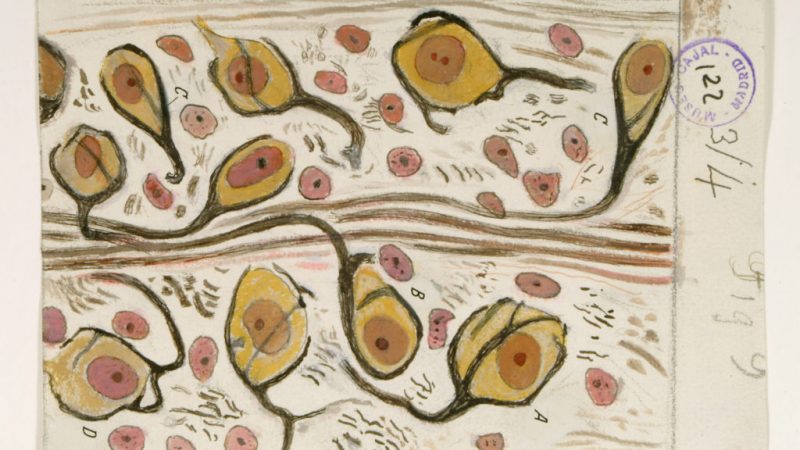
Art depends on popular judgments about the universe, and is nourished by the limited expanse of sentiment. . . . In contrast, science was barely touched upon by the ancients, and is as free from the inconsistencies of fashion as it is from the fickle standards of taste. . . . And let me stress that this conquest of ideas is not subject to fluctuations of opinion, to the silence of envy, or to the caprices of fashion that today repudiate and detest what yesterday was praised as sublime.
The above drawing is the sort of sublime rendering that attracts throngs of visitors to the world’s great modern art museums, but that’s not the sort of renown the artist, Nobel Prize-winning father of modern neuroscience Santiago Ramón y Cajal (1852 ‑1934), actively sought.
Or rather, he might have back before his father, a professor of anatomy, coerced his wild young son into transferring from a provincial art academy to the medical school where he himself was employed.
After a stint as an army medical officer, the artist-turned-anatomist concentrated on inflammation, cholera, and epithelial cells before zeroing in on his true muse—the central nervous system.
At the time, reticular theory, which held that everything in the nervous system was part of a single continuous network, prevailed.
Ramón y Cajal was able to disprove this widely held belief by using Golgi stains to support the existence of individual nervous cells—neurons—that, while not physically connected, communicated with each other through a system of axons, dendrites, and synapses.
He called upon both his artistic and medical training in documenting what he observed through his microscope. His meticulous freehand drawings are far more accurate than anything that could be produced by the microscopic-image photographic tools available at the time.
His precision was such that his illustrations continue to be published in medical textbooks. Further research has confirmed many of his suppositions.
As art critic Roberta Smith writes in The New York Times, the drawings are “fairly hard-nosed fact if you know your science”:
If you don’t, they are deep pools of suggestive motifs into which the imagination can dive. Their lines, forms and various textures of stippling, dashes and faint pencil circles would be the envy of any modern artist. That they connect with Surrealist drawing, biomorphic abstraction and exquisite doodling is only the half of it.
The drawings’ pragmatic titles certainly take on a poetic quality when one considers the context of their creation:
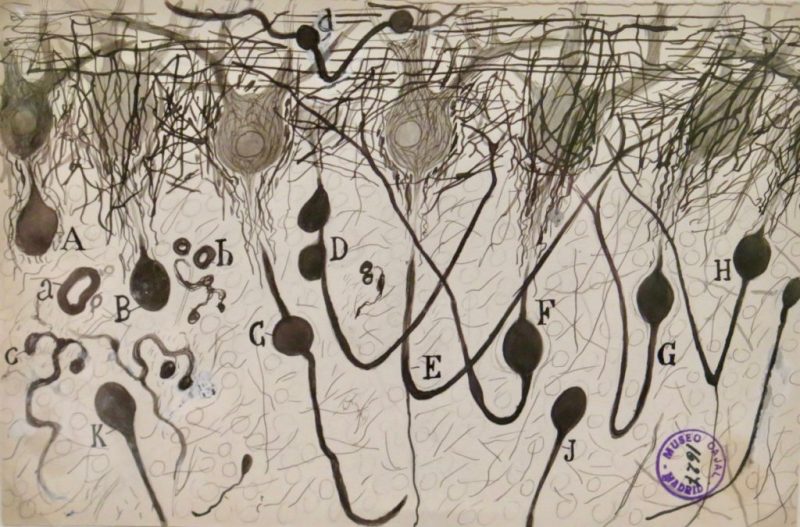
Axon of Purkinje neurons in the cerebellum of a drowned man
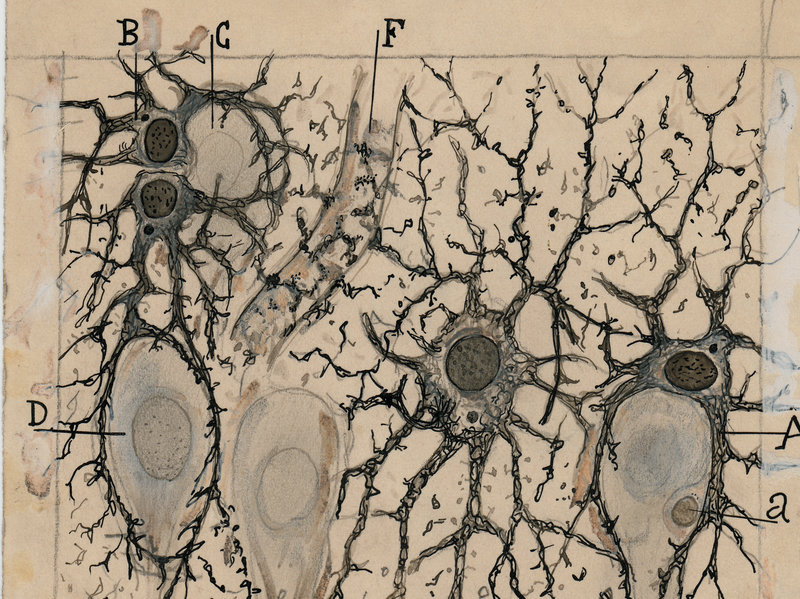
The hippocampus of a man three hours after death
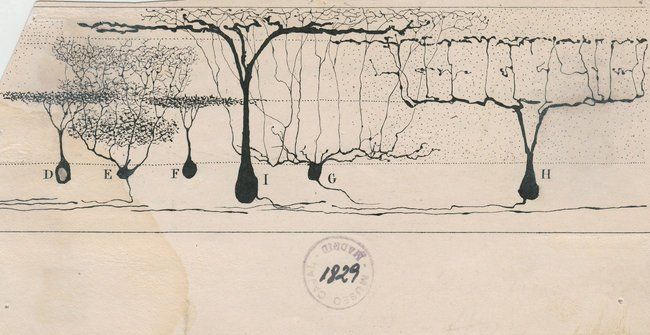
Glial cells of the cerebral cortex of a child
His specimens were not limited to the human world:
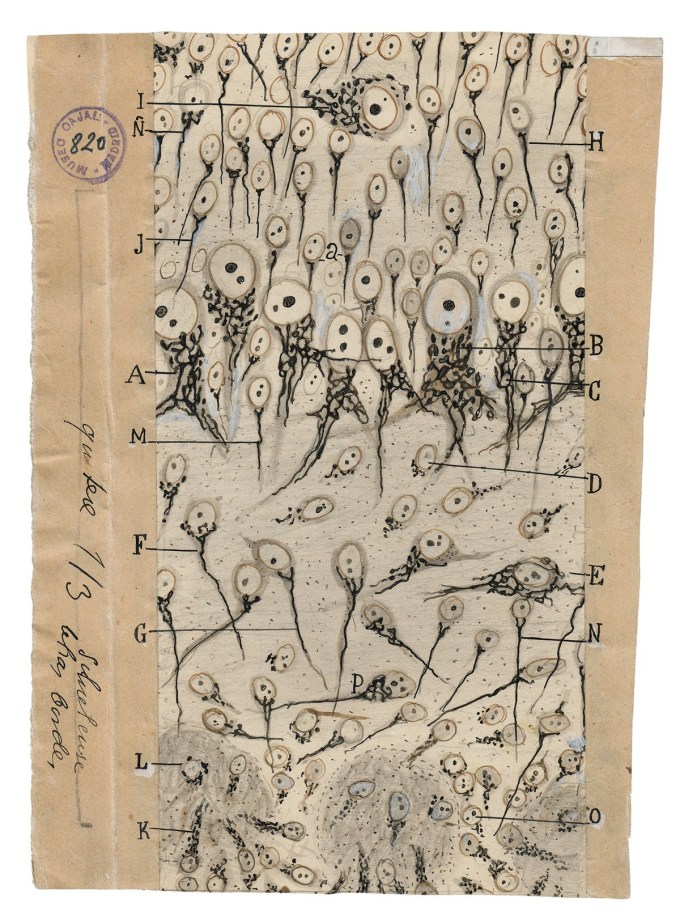
Retina of lizard
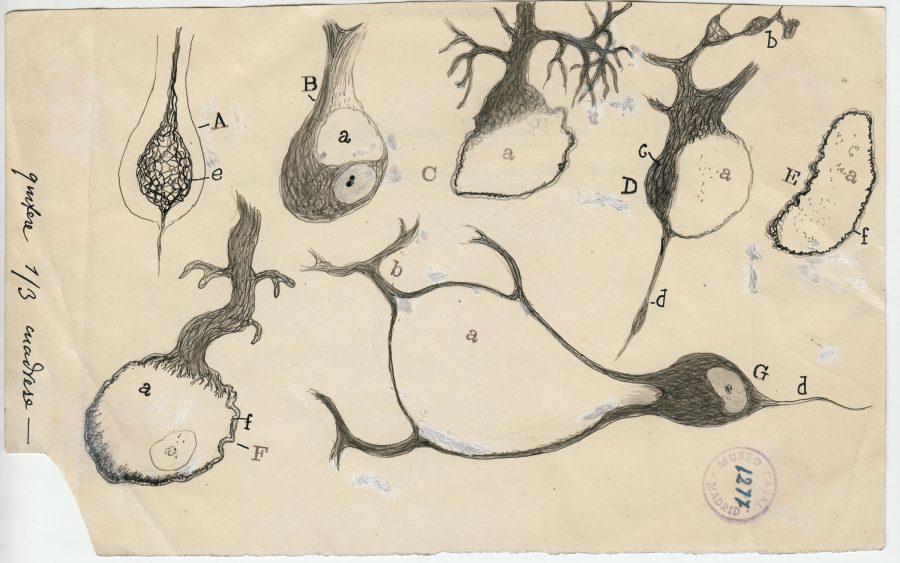
The olfactory bulb of the dog
In his book Advice for a Young Investigator, Ramón y Cajal took a holistic view of the relationship between science and the arts:
The investigator ought to possess an artistic temperament that impels him to search for and admire the number, beauty, and harmony of things; and—in the struggle for life that ideas create in our minds—a sound critical judgment that is able to reject the rash impulses of daydreams in favor of those thoughts most faithfully embracing objective reality.
Explore more of Ramón y Cajal’s cellular drawings in Beautiful Brain: The Drawings of Santiago Ramón y Cajal, the companion book to a recent traveling exhibition of his work. Or immerse yourself at the neural level by ordering a reproduction on a beach towel, yoga mat, cell phone case, shower curtain, or other necessity on Science Source.
Related Content:
Leonardo da Vinci’s Visionary Notebooks Now Online: Browse 570 Digitized Pages
Two Million Wondrous Nature Illustrations Put Online by The Biodiversity Heritage Library
Ayun Halliday is an author, illustrator, theater maker and Chief Primatologist of the East Village Inky zine. Join her in New York City April 15 for the next installment of her book-based variety show, Necromancers of the Public Domain. Follow her @AyunHalliday.
Read More...Cinema Lovers Rejoice, the New Criterion Channel Launches Today: Get a 14-Day Free Trial
If you lamented the demise of Filmstruck last year, you’ll surely welcome the rise of the new Criterion Channel. It launches today. According to Criterion, the “new service will host the Criterion Collection and Janus Films’ ever-growing library of more than 1,000 feature films, 350 shorts, and 3,500 supplementary features, including trailers, introductions, behind-the-scenes documentaries, interviews, video essays, commentary tracks, and rare archival footage.” In addition, you will get access to a “constantly refreshed selections of Hollywood, international, art-house, and independent movies.”
The Criterion Channel will launch in the U.S. and Canada. It can be accessed on desktop browsers and also apps for Apple TV, Amazon Fire, Roku, iOS, and Android and Android TV devices. If you sign up now, you can get a 14 day free trial. Find more information on the channel here.
If you would like to support the mission of Open Culture, consider making a donation to our site. It’s hard to rely 100% on ads, and your contributions will help us continue providing the best free cultural and educational materials to learners everywhere. You can contribute through PayPal, Patreon, and Venmo (@openculture). Thanks!
Read More...Deconstructing Steely Dan: The Band That Was More Than Just a Band
How do you explain Steely Dan to someone who’s never heard of them? Two pretentious, perfectionistic, and very talented white guys who love Bebop and R&B meet in passing at Bard College in 1967. They start a series of bands, one of them featuring Chevy Chase on drums. They rub everyone the wrong way and write songs too complicated for pop and TV but too good to go away, so they become a celebrated studio unit, named after a fictional steam-powered dildo in a William S. Burroughs’ Naked Lunch.
They obsess over studio production, putting together a revolving cast of high-end session musicians and pushing them through take after take. They carefully edit songs together from hours and hours of tape. And somehow, they end up creating some of the funkiest music of the 70s—the smoothest of smooth jazz, the yacht-iest of yacht rock… then, a generation later, they become perhaps the most sampled band of all time, their grooves a sine qua non of hip hop’s evolution….
Hardly sounds plausible. But there it is: Donald Fagen and Walter Becker—two super-fans of the genres they creatively appropriated—made some incredible, snarling, cynical, viciously groovy easy listening music, and it has more than held up over the decades since they released their debut album Can’t Buy a Thrill in 1972. Despite decades of critical praise and hit after hit, they also remain a profoundly misunderstood band.
That is, if we can even call them a band. The Polyphonic video above convincingly argues otherwise. Becker and Fagen maintained total control at all times over the project, and mostly resisted touring to focus on building albums out of thousands of perfect takes. They were curating “an aesthetic… one that relied on intense perfectionism” and satirical, oblique lyricism. Something of a conceptual art project that never once broke character.
The elements were there from the beginning—in “Do it Again,” for example, from their first album—and they grew more sophisticated and calculated throughout the decade. The band’s obsession with quality culminated in their masterpiece Aja and their swan song (before re-uniting 20 years later), the slick and bitter Gaucho. Their hyper-critical detachment can be off-putting to people who prefer to see musicians telegraph passionate authenticity, but for Steely Dan fans, the aloofness is part of the appeal.
Major guitar-rock hit “Reelin’ in the Years,” a song Fagen called “dumb, but effective,” satirizes 60s nostalgia long before that became a major cultural phenomenon. The song mocks the very people who most respond to it, like Springsteen’s “Born in the U.S.A.” tips the sacred cows of many of its biggest fans. Even Steely Dan’s detractors can’t help but admire their ability to choose the perfect players for every song and to coax, or browbeat, out of them the best possible performances.
Their perfectionism and studio polish, qualities you’ll learn much more about in the video, masked a dark, subversive core. “For Fagen and Becker,” writes Chris Morris at Variety, “the beautifully tooled music they made with their studio cohorts served as the ultimate alienation effect. The true import of their work, which addressed forbidden impulses that moved to the edge of crime and frequently beyond, was always garbed in satiny elegance; its sardonic and horrific essence was marketed as the purest ear candy.”
Or, maybe, put differently, if you get the dark humor of Patrick Bateman earnestly extolling the virtues of Huey Lewis and the News, Whitney Houston, and Phil Collins before a captive audience of his murder victims in Mary Harron’s American Psycho, there’s a good chance you get Steely Dan. As Jay Black, lead singer of Jay and the Americans, once said, Becker and Fagen were “the Manson and Starkweather of rock ‘n’ roll,” referring, of course, to Charles Manson and spree killer Charles Starkweather. With that in mind, you might never hear “Rikki Don’t Lose that Number” the same way again.
Related Content:
How Steely Dan Wrote “Deacon Blues,” the Song Audiophiles Use to Test High-End Stereos
Josh Jones is a writer and musician based in Durham, NC. Follow him at @jdmagness
Read More...Watch Great Directors, a Documentary That Explores the Minds of 10 Great Auteurs: David Lynch, Agnès Varda, Richard Linklater & More
When we first start watching movies, often we decide what to watch by settling on a favorite genre, divisions first solidified by video-store shelves: action, comedy, drama, science fiction, and so on. When we’ve watched more movies, many of us move on to following the work of a particular actor, which takes us across not just genres but eras as well. And practically all cinephiles will remember when it dawned on us that no figure could better guide our viewing than the director — about the same time we usually learn the term auteur, which identifies certain directors as the primary “authors” of their films. From that point on, we had only to master the knowledge of as many directors’ filmographies as possible, then determine those too whom we would pledge our allegiance — thus forging bonds with (or drawing battle lines against) all other film fans.
If the best movies come primarily from the minds of their directors, then there must be a great deal else of interest in those directorial minds. Or so implicitly argues Angela Ismailos’ 2010 documentary Great Directors, which consists of interviews with ten auteurs of the late 20th and early 21st century whose work has not only drawn critical acclaim but also provoked the full range of audience opinion, even inspiring some viewers to dedicate themselves to cinema.
“I wanted to cover the French cinema and I love the controversial cinema of Catherine Breilliat and how she portrays the emotional and physical travails of women in her cinema,” Ismailos says of the project’s origin in an interview with Filmmaker magazine. Then came Agnès Varda, and after her a lineup including Bernardo Bertolucci, Liliana Cavani, Todd Haynes, Richard Linklater, John Sayles, Ken Loach, and Stephen Frears. “The last director I added to the film was David Lynch. He was the most difficult to get.”
Put together, these ten filmographies — containing pictures from Matewan to My Beautiful Laundrette, The Last Emperor to Velvet Goldmine, Poor Cow to Eraserhead, Fat Girl to Slacker — contain an impressively wide range of cinematic sensibilities. But what do the ten directors, coming as they do from several different countries and cultures, have in common? “In their films they’re trying… to break moral standards,” says Ismailos. “They are not surrendering to preconceived notions of commerce or audience popularity or preconception of what cinema should be. I believe through the years they are constantly asking their audience to grow and face the uncertainties and unpredictability of adult life. This is the cinema I personally love.” She’s certainly not the only one, and all the rest of us with an interest in films of that kind — and thus an interest in directors of this kind — will certainly be glad that she’s made Great Directors free to view online.
Great Directors will be added to our list of Free Documentaries, a subset of our collection, 4,000+ Free Movies Online: Great Classics, Indies, Noir, Westerns, Documentaries & More
Related Content:
Stanley Kubrick’s Rare 1965 Interview with The New Yorker
Listen to Eight Interviews of Orson Welles by Filmmaker Peter Bogdanovich (1969–1972)
Based in Seoul, Colin Marshall writes and broadcasts on cities, language, and culture. His projects include the book The Stateless City: a Walk through 21st-Century Los Angeles and the video series The City in Cinema. Follow him on Twitter at @colinmarshall or on Facebook.
Read More...700 Years of Persian Manuscripts Now Digitized and Available Online
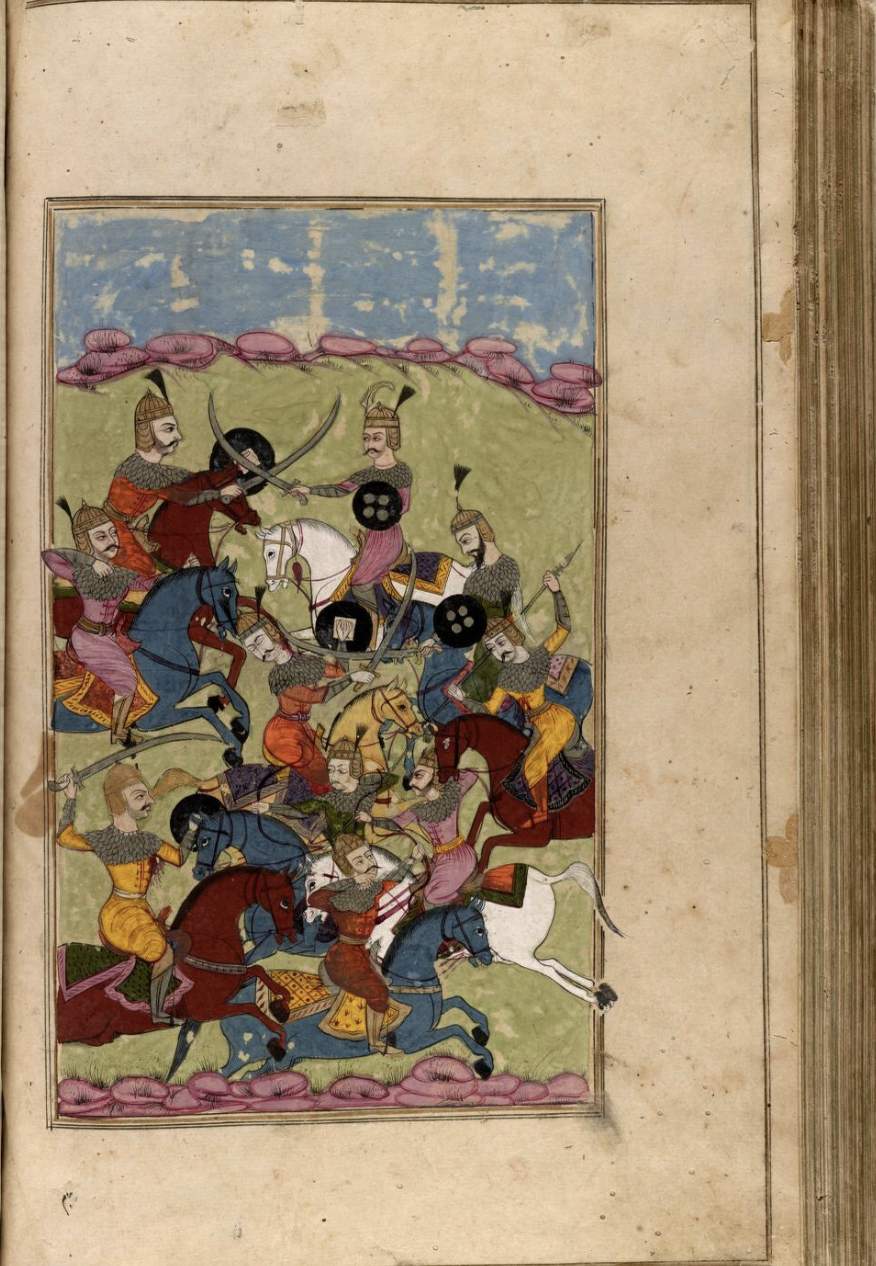
Too often those in power lump thousands of years of Middle Eastern religion and culture into monolithic entities to be feared or persecuted. But at least one government institution is doing exactly the opposite. For Nowruz, the Persian New Year, the Library of Congress has released a digital collection of its rare Persian-language manuscripts, an archive spanning 700 years. This free resource opens windows on diverse religious, national, linguistic, and cultural traditions, most, but not all, Islamic, yet all different from each other in complex and striking ways.
“We nowadays are programmed to think Persia equates with Iran, but when you look at this it is a multiregional collection,” says a Library specialist in its African and Middle Eastern Division, Hirad Dinavari. “Many contributed to it. Some were Indian, some were Turkic, Central Asian.” The “deep, cosmopolitan archive,” as Atlas Obscura’s Jonathan Carey writes, consists of a relatively small number of manuscripts—only 155. That may not seem particularly significant given the enormity of some other online collections.
But its quality and variety mark it as especially valuable, representative of much larger bodies of work in the arts, sciences, religion, and philosophy, dating back to the 13th century and spanning regions from India to Central Asia and the Caucuses, “in addition to the native Persian speaking lands of Iran, Afghanistan and Tajikistan,” the LoC notes.
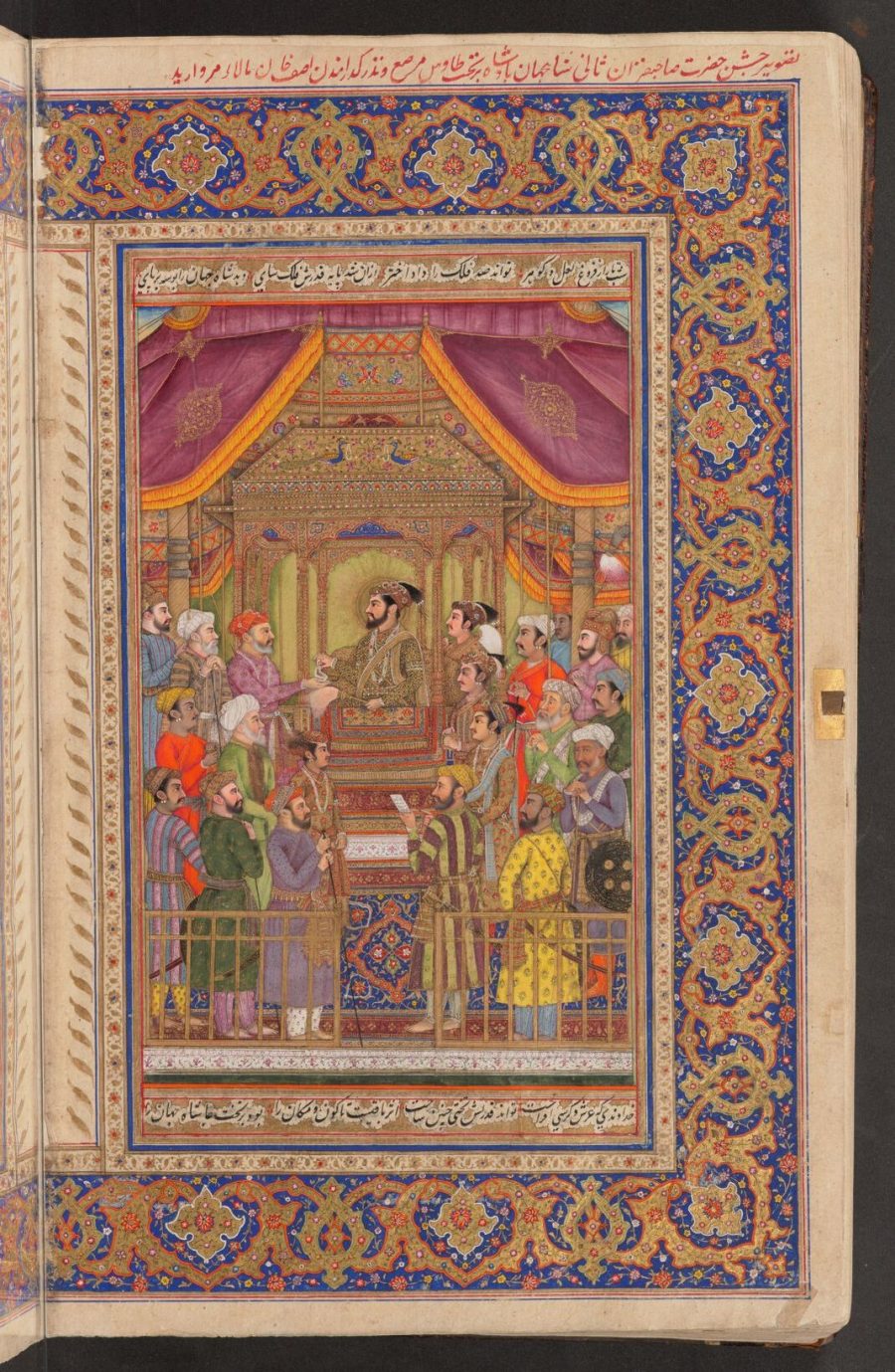
Prominently represented are works like the epic poem of pre-Islamic Persia, the Shahnamah, “likened to the Iliad or the Odyssey,” writes Carey, as well as “written accounts of the life of Shah Jahan, the 17th-century Mughal emperor who oversaw construction of the Taj Mahal.”
The Library points out the archive includes the “most beloved poems of the Persian poets Saadi, Hafez, Rumi and Jami, along with the works of the poet Nizami Ganjavi.” Some readers might be surprised at the pictorial opulence of so many Islamic texts, with their colorful, stylized battle scenes and groupings of human figures.
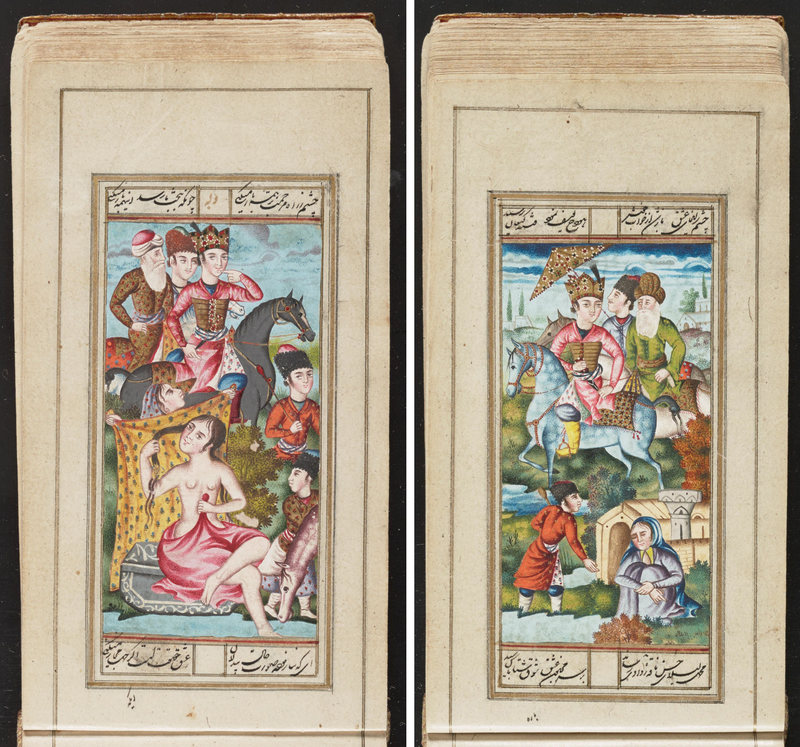
Islamic art is typically thought of as iconoclastic, but as in Christian Europe and North America, certain sects have fought others over this interpretation (including over depictions of the Prophet Mohammad). This is not to say that the iconoclasts deserve less attention. Much medieval and early modern Islamic art uses intricate patterns, designs, and calligraphy while scrupulously avoiding likenesses of humans and animals. It is deeply moving in its own way, rigorously detailed and passionately executed, full of mathematical and aesthetic ideas about shape, proportion, color, and line that have inspired artists around the world for centuries.

The page from a lavishly illuminated Qur’ān, above, circa 1708, offers such an example, written in Arabic with an interlinear Persian translation. There are religious texts from other faiths, like the Psalms in Hebrew with Persian translation, there are scientific texts and maps: the Rare Persian-Language Manuscript Collection covers a lot of historical ground, as has Persian language and culture “from the 10th century to the present,” the Library writes. Such a rich tradition deserves careful study and appreciation. Begin an education in Persian manuscript history here.
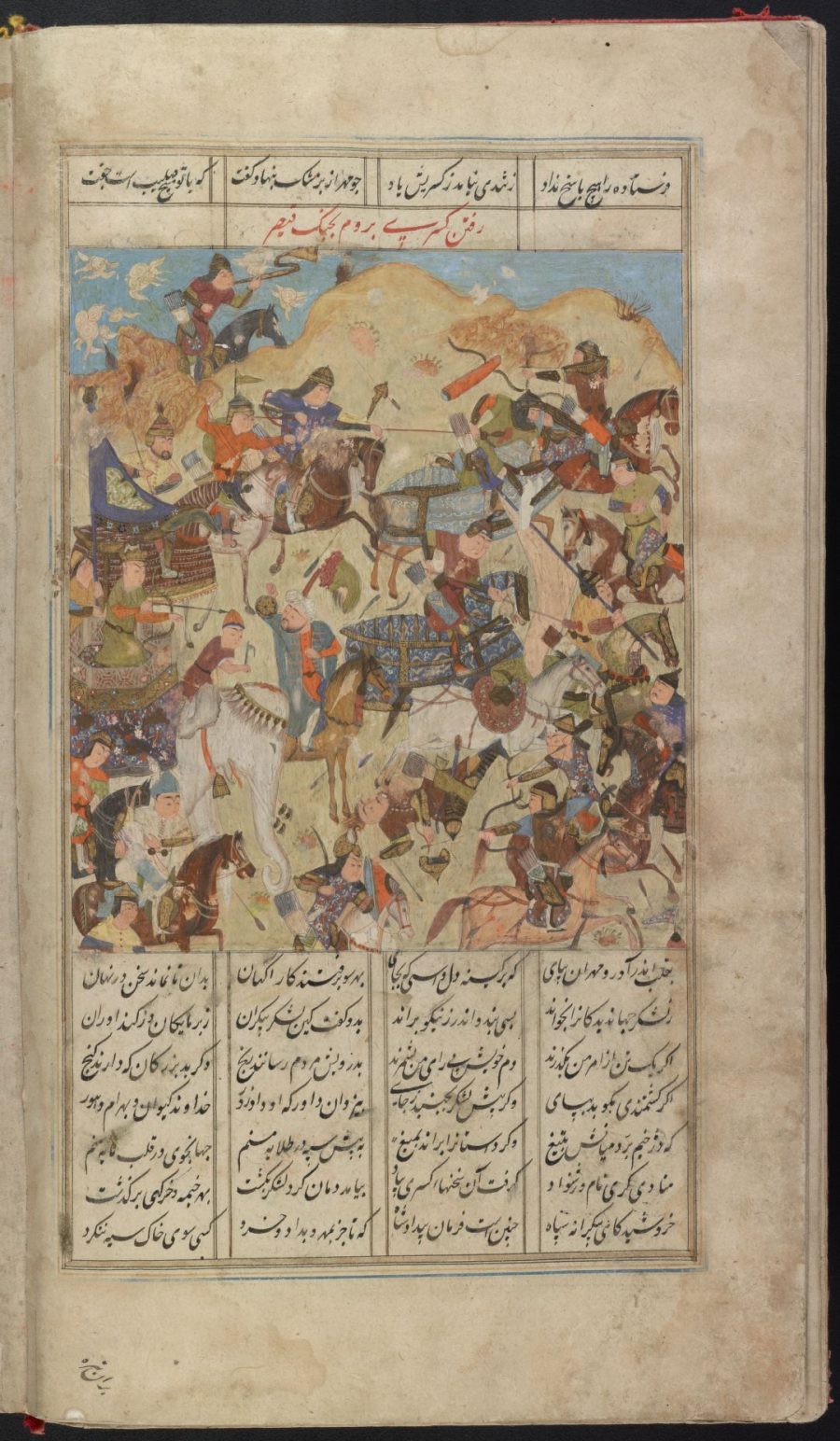
via Atlas Obscura
Related Content:
15,000 Colorful Images of Persian Manuscripts Now Online, Courtesy of the British Library
The Complex Geometry of Islamic Art & Design: A Short Introduction
Josh Jones is a writer and musician based in Durham, NC. Follow him at @jdmagness
Read More...800+ Treasured Medieval Manuscripts to Be Digitized by Cambridge & Heidelberg Universities
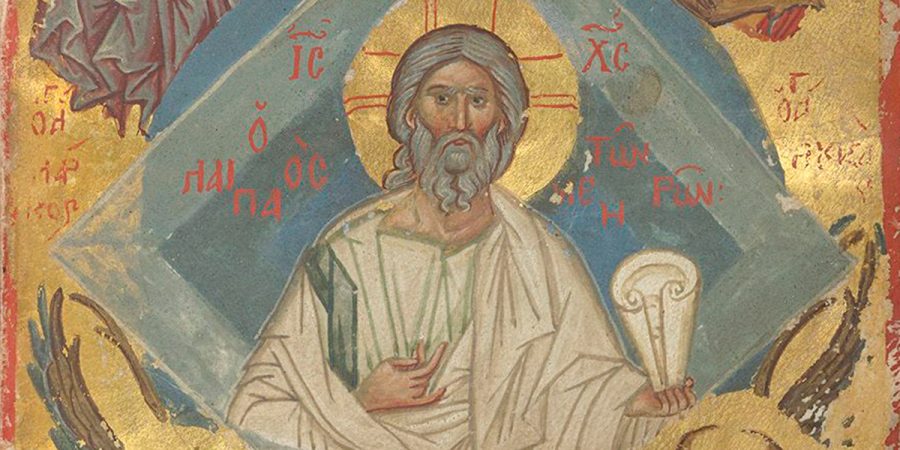
Western civilization may fast be going digital, but it still retains its roots in Ancient Greece. And so it makes a certain circle-closing sense to digitize the legacy left us by our Ancient Greek forebears and the medieval scholars who preserved it. Cambridge and Heidelberg, two of Europe’s oldest universities, this month announced their joint intention to embark upon just such a project. It will take two years and cost £1.6 million, reports the BBC, but it will digitize “more than 800 volumes featuring the works of Plato and Aristotle, among others.” As the announcement of the project puts it, the texts will then “join the works of Charles Darwin, Isaac Newton, Stephen Hawking and Alfred Lord Tennyson on the Cambridge Digital Library.”
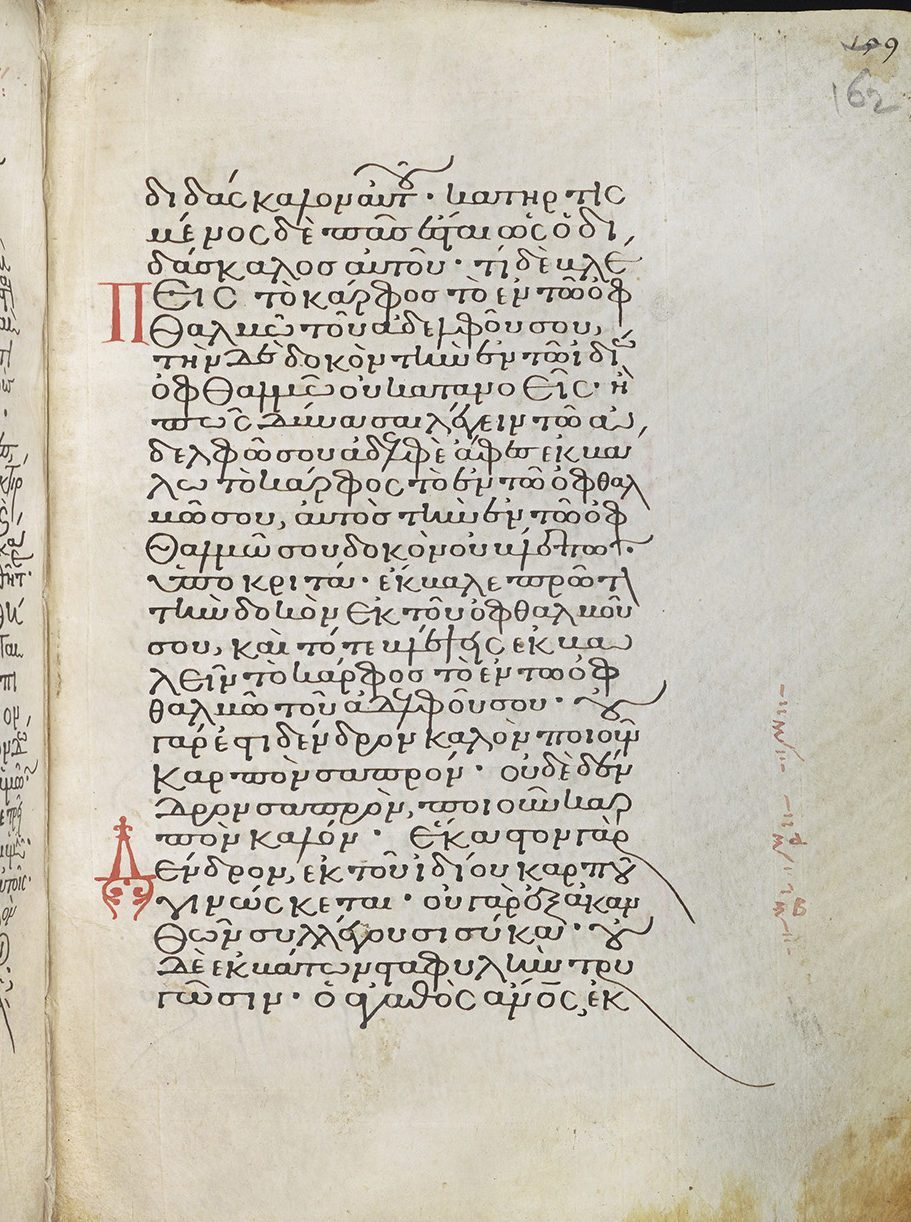
These medieval and early modern Greek manuscripts, which date more specifically “from the early Christian period to the early modern era (about 1500 — 1700 AD),” present their digitizers with certain challenges, not least the “fragile state” of their medieval binding.
But as Heidelberg University Library director Dr. Veit Probst says in the announcement, “Numerous discoveries await. We still lack detailed knowledge about the production and provenance of these books, about the identities and activities of their scribes, their artists and their owners – and have yet to uncover how they were studied and used, both during the medieval period and in the centuries beyond.” And from threads including “the annotations and marginalia in the original manuscripts” a “rich tapestry of Greek scholarship will be woven.”
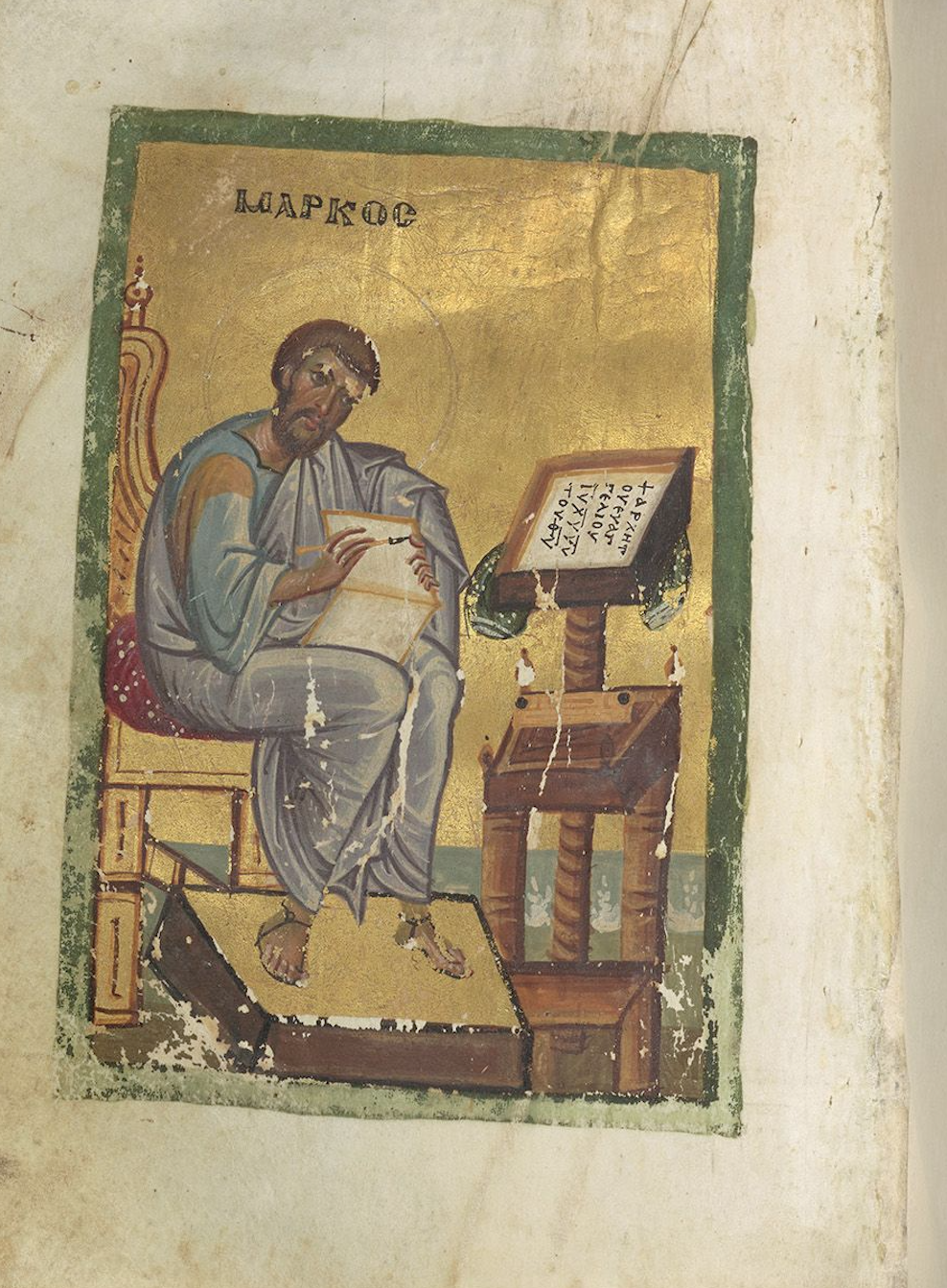
This massive undertaking involves not just Cambridge and Heidelberg but the Vatican as well. Together Heidelberg University and the Vatican possess the entirety of the Bibliotheca Palatina, split between the libraries of the two institutions, and the digitization of the “mother of all medieval libraries” previously featured here on Open Culture, is a part of the project. This collected wealth of texts includes not just the work of Plato, Aristotle, and Homer as they were “copied and recopied throughout the medieval period,” in the words of Cambridge University Library Keeper of Rare Books and Early Manuscripts Dr. Suzanne Paul, but a great many other “multilingual, multicultural, multifarious works, that cross borders, disciplines and the centuries” as well. And with luck, their digital copies will stick around for centuries of Western civilization to come.
Related Content:
Based in Seoul, Colin Marshall writes and broadcasts on cities, language, and culture. His projects include the book The Stateless City: a Walk through 21st-Century Los Angeles and the video series The City in Cinema. Follow him on Twitter at @colinmarshall or on Facebook.
Read More...NASA Captures First Air-to-Air Images of Supersonic Shockwaves Interacting in Flight
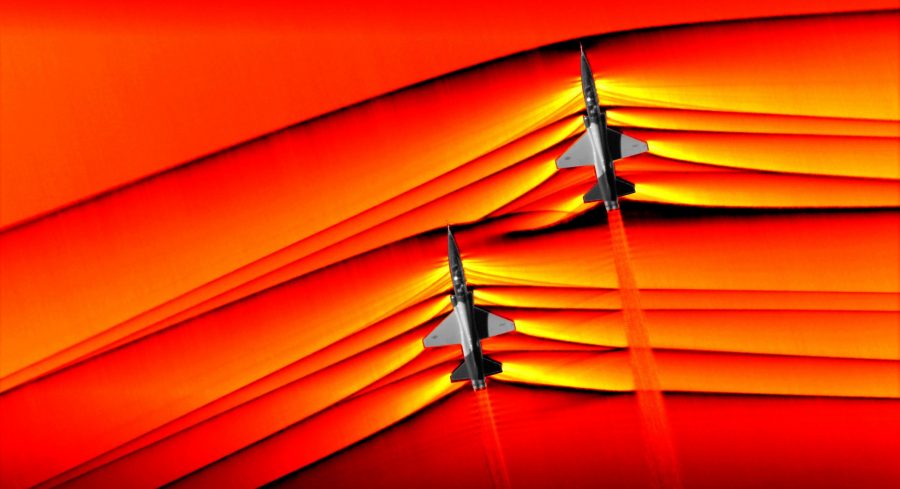
“We never dreamt that it would be this clear, this beautiful.” That’s how NASA scientist J.T. Heineck responded when he got his first glimpse of images that captured “the first-ever images of the interaction of shockwaves from two supersonic aircraft in flight.”
The images feature a pair of T‑38s from the U.S. Air Force Test Pilot School at Edwards Air Force Base, flying in formation at supersonic speeds. The T‑38s are flying approximately 30 feet away from each other, with the trailing aircraft flying about 10 feet lower than the leading T‑38. With exceptional clarity, the flow of the shock waves from both aircraft is seen, and for the first time, the interaction of the shocks can be seen in flight.
“We’re looking at a supersonic flow, which is why we’re getting these shockwaves,” said Neal Smith, a research engineer with AerospaceComputing Inc. at NASA Ames’ fluid mechanics laboratory.
“What’s interesting is, if you look at the rear T‑38, you see these shocks kind of interact in a curve,” he said. “This is because the trailing T‑38 is flying in the wake of the leading aircraft, so the shocks are going to be shaped differently. This data is really going to help us advance our understanding of how these shocks interact…”
While NASA has previously used the schlieren photography technique to study shockwaves, the AirBOS 4 flights featured an upgraded version of the previous airborne schlieren systems, allowing researchers to capture three times the amount of data in the same amount of time.
“We’re seeing a level of physical detail here that I don’t think anybody has ever seen before,” said Dan Banks, senior research engineer at NASA Armstrong. “Just looking at the data for the first time, I think things worked out better than we’d imagined. This is a very big step.”

Related Content:
The Full Rotation of the Moon: A Beautiful, High Resolution Time Lapse Film
Hear the Very First Sounds Ever Recorded on Mars, Courtesy of NASA
Read More...
A Brief Animated Introduction to the Life and Work of Frida Kahlo
Reducing an artist’s work to their biography produces crude understanding. But in very many cases, life and work cannot be teased apart. This applies not only to Sylvia Plath and her contemporary confessional poets but also to James Joyce and Marcel Proust and writers they admired, like Dante and Cervantes.
Such an artist too is Frida Kahlo, a practitioner of narrative self-portraits in a modernizing idiom that at the same time draws extensively on tradition. The literary nature of her art is a subject much neglected in popular discussions of her work. She wrote passionate, eloquent love poems and letters to her husband Diego Rivera and others, full of the same kind of visceral, violent, verdant imagery she deployed in her paintings.
More generally, the “obsession with Kahlo’s biography,” writes Maria Garcia at WBUR, ends up focusing “almost voyeuristically—on the tragic experiences of her life more than her artistry.” Those terribly compounded tragedies include surviving polio and, as you’ll learn in Iseult Gillespie’s short TED-Ed video above, a bus crash that nearly tore her in half. She began painting while recovering in bed. She was never the same and lived her life in chronic pain and frequent hospitalizations.
Perhaps a certain cult of Kahlo does place morbid fascination above real appreciation for her vision. “There’s a compulsion that’s satiated only through consuming Kahlo’s agony,” Garcia writes. But it’s also true that we cannot reasonably separate her story from her work. It’s just that there is so more to the story than suffering, all of it woven into the texts of her paintings. Kahlo’s mythology, or “inspirational personal brand,” ties together her commitments to Marxism and Mexico, indigenous culture, and native spirituality.
Like all self-mythologizers before her, she folded her personal story into that of her nation. And unlike European surrealists, who “used dreamlike images to explore the unconscious mind, Kahlo used them to represent her physical body and life experiences.” The experience of disability was no less a part of her ecology than mortality, symbolic landscapes, floral tapestries, animals, and the physically anguished experiences of love and loss.
Generous approaches to Kahlo’s work, and this short overview is one of them, implicitly recognize that there is no need to separate the life from the work, to the extent that the artist saw no reason to do so. But also, there is no need to isolate one narrative theme, whether intense physical or emotional suffering, from themes of self-transformation and transfiguration or experiments in re-creating personal identity as a political act.
Related Content:
Artists Frida Kahlo & Diego Rivera Visit Leon Trotsky in Mexico: Vintage Footage from 1938
Frida Kahlo’s Passionate Love Letters to Diego Rivera
Josh Jones is a writer and musician based in Durham, NC. Follow him at @jdmagness
Read More...
High School Kids Stage Alien: The Play, Get Kudos from Ridley Scott and Sigourney Weaver
High school drama departments tend to work from a pretty standardized repertoire, which makes sense given the strict limitations they work under: short time frames, school-sized budgets, teenage actors. The elaborate, Hollywood film-like productions staged by Max Fischer in Wes Anderson’s Rushmore speak to frustrated high-school theater directors and their fantasies about what they could put on stage with a bit more in the way of resources. But just this month, a real high-school drama club put on a show that out-Max Fischered Max Fischer, drawing not just the astonishment of the internet but the respect of one of the most eminent filmmakers alive.
“A New Jersey high school has found itself the unexpected recipient of online acclaim and viral attention for its recent stage production of Alien, the 1979 science-fiction thriller,” writes the New York Times’ Dave Itzkoff. “Alien: The Play, presented last weekend by the drama club of North Bergen High School, starred a cast of eight students in the film roles originally played by Sigourney Weaver, Tom Skerritt, John Hurt and Ian Holm. Whereas the movie had a budget in the range of about $10 million, Alien: The Play had costumes, props and set designs made mostly from donated and recycled materials.” Or as North Bergen student Justin Pierson put it in NJ.com’s video on the surprise hit: “This is going to sound really funny but (the set crew) used garbage essentially.”
With that “garbage” — “just anything that was lying around, like cardboard and metal” — they built not only a set that convincingly evokes the dark claustrophobia of the space ship Nostromo, but a shockingly accurate-looking alien, the terrifying creature originally born from the mind of Swiss illustrator H.R. Giger.
The young cast and crew get into detail about how they did it on Syfy’s Fandom File podcast: “Much of the attention has highlighted and embraced their DIY approach,” writes host Jordan Zakarin, and “they were endlessly creative in building the sets, with hand-puppet aliens, egg crate walls, a stuffed cat (the stand-in for Jones was a particularly ingenious idea), and other sweded props.”
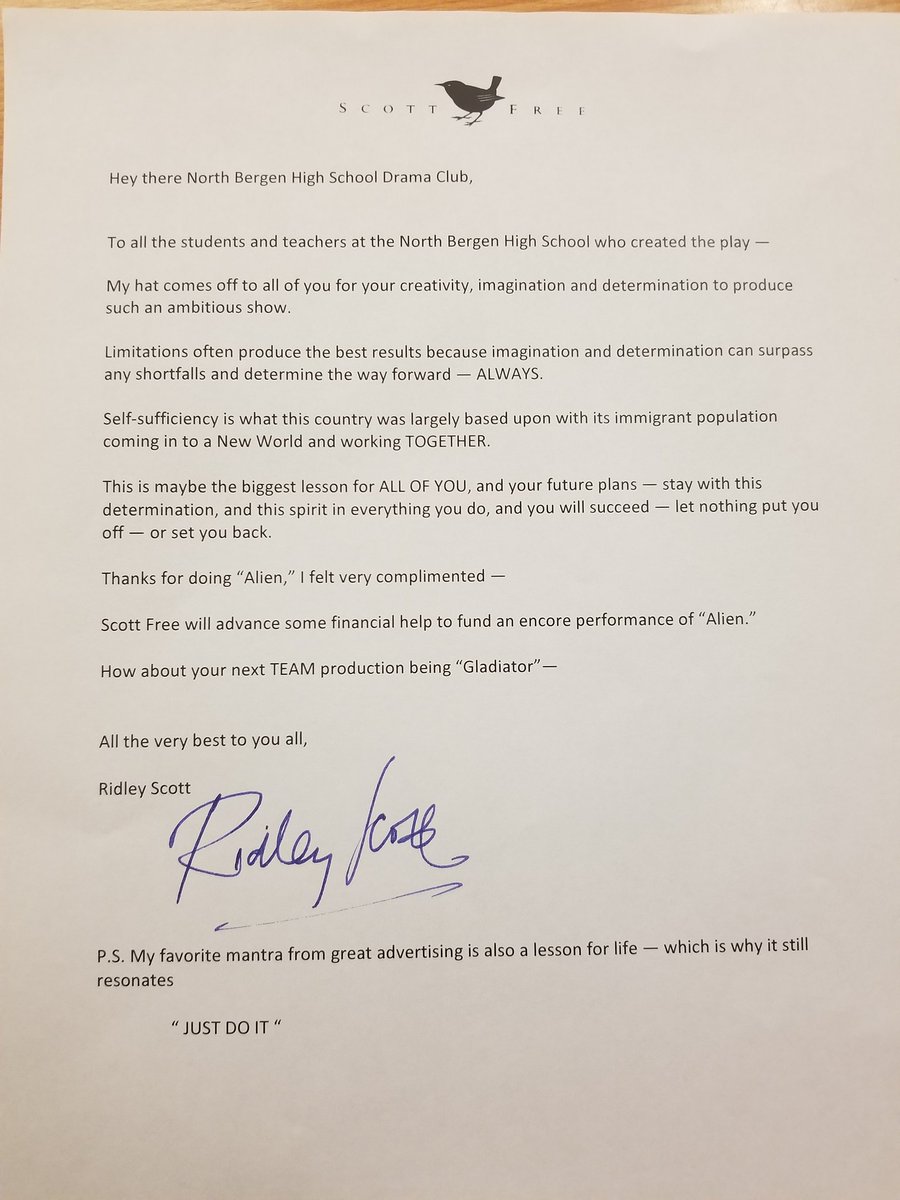
Responses to the video clips of Alien: The Play that have circulated on the internet include a personal congratulatory message from the original film’s star Sigourney Weaver as well as a letter from its director Ridley Scott, which Alien: The Play’s director, North Bergen English-teacher-by-day Perfecto Cuervo, posted on Twitter. “Limitations often produce the best results because imagination and determination can surpass any shortfalls and determine the way forward — ALWAYS,” writes Scott, who has built his reputation in the film industry on taking firm and decisive action in the face of any and all production difficulties. He also offers both the funds for an encore production as well as a suggestion: “How about your next TEAM production being Gladiator.” No doubt Cuervo and his enterprising players are feeling pretty vindicated in their decision not to do Our Town right about now.

Related Content:
Ridley Scott Walks You Through His Favorite Scene from Blade Runner
Elementary School Students Perform in a Play Inspired by David Lynch’s Twin Peaks
Based in Seoul, Colin Marshall writes and broadcasts on cities, language, and culture. His projects include the book The Stateless City: a Walk through 21st-Century Los Angeles and the video series The City in Cinema. Follow him on Twitter at @colinmarshall or on Facebook.
Read More...Support Us
We're hoping to rely on loyal readers, rather than erratic ads. Please click the Donate button and support Open Culture. You can use Paypal, Venmo, Patreon, even Crypto! We thank you!

About Us

Open Culture scours the web for the best educational media. We find the free courses and audio books you need, the language lessons & educational videos you want, and plenty of enlightenment in between.
Advertise With Us

FREE UPDATES!
GET OUR DAILY EMAIL
Get the best cultural and educational resources on the web curated for you in a daily email. We never spam. Unsubscribe at any time.
FOLLOW ON SOCIAL MEDIA

Open Culture editor Dan Colman scours the web for the best educational media. He finds the free courses and audio books you need, the language lessons & movies you want, and plenty of enlightenment in between.
Advertise With Us

