Watch an Animated Score for Steve Reich’s Minimalist Piece “Clapping Music“–and Try Your Hardest to Follow Along
Steve Reich’s Clapping Music is one of the simplest scores of modern classical music, and as you might soon find out, one of the most difficult to perform. Written in 1972 while on a European tour and after a night of mediocre flamenco, Clapping Music is for two players. One claps a steady rhythm (technically an African Bell Rhythm).
A second performer claps in unison in the same pattern for eight bars. At the end of the eighth bar, the second performer goes out of sync for one eighth note and after another eight bars, goes out of sync again. This continues until both players are back in unison. (The above video explains this technique visually).
For Reich it was a simpler evolution of “phase” compositions that he had been creating since 1965. The earlier example was “It’s Gonna Rain,” which used two tape loops of a Pentecostal street preacher’s rant going slowly out of sync with each other, revealing first an echo and then, as the two loops wind up 180 degrees out of sync, pure apocalyptic cacophony.
The sync issues were due to the vagaries of the analog machines themselves, but Reich moved on to recreating phase music with actual instruments. In 1967 he composed “Piano Phase,” in which a simple melody is played by two musicians first in unison, and then slowly out of sync. Reich followed up with “Reed Phase” and “Violin Phase,” the latter of which was set to dance by Anne Teresa of Keersmaeker.
Asked about performing “Clapping Music” live, Reich told ClassicFM:
It’s a piece that I’m always standing up there doing, and it makes me nervous every time because you’re very exposed, as it’s just you and the other guy. If you make one little hesitation you can find yourself at a place in the piece where you have to figure out where you are to get things right. So it never ceases to be a challenge; it’s easy on one level, but it’s challenging on another.
If you’d like to have a go at Clapping Music, there is a free app from the London Sinfonietta and Touchpress that plays the steady loop while you try to go out of phase. (It tracks and rates your performance, with the hope you’ll perfect it.) I haven’t had a chance myself to try it out, but if you have, let us know in the comments.
Related Content:
Steve Reich is Calling: A Minimalist Ringtone for the iPhone
Ted Mills is a freelance writer on the arts who currently hosts the artist interview-based FunkZone Podcast and is the producer of KCRW’s Curious Coast. You can also follow him on Twitter at @tedmills, read his other arts writing at tedmills.com and/or watch his films here.
Read More...Jack Kerouac’s “Beat Paintings:” Now Gathered in One Book and Exhibition for the First Time
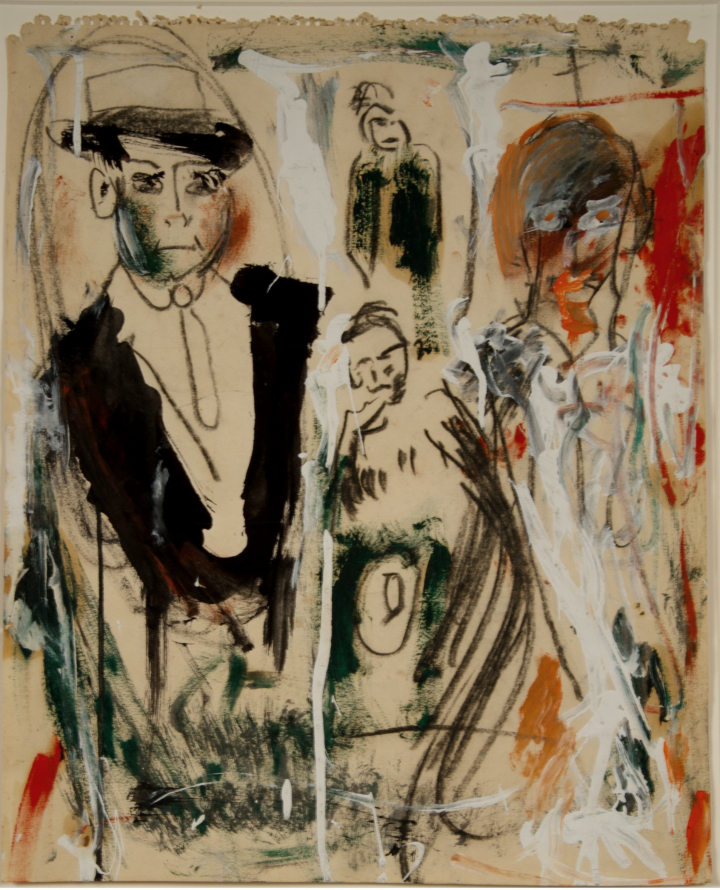
Most of us enter Jack Kerouac’s world through his 1959 novel On the Road. Those of us who explore it more deeply thereafter may find much more than we expected to: Kerouac’s inner life came out not just in his formidable body of written work, but in spoken-word jazz albums, fantasy baseball materials, and even paintings. Though Kerouac has now been gone for nearly half a century, it wasn’t until just last year that his works of visual art were brought together: Kerouac: Beat Painting did it in book form, and the Museo Maga near Milan put on an exhibition of the more than 80 pieces it could find, beginning with his first self-portrait, drawn at the age of nine.

Kerouac had an interest in portraiture in general: the book, the Independent’s David Barnett writes, “begins with a series of portraits of people Kerouac knew or admired. They also highlight Kerouac’s complicated spirituality: brought up a Catholic, he later embraced Buddhism and developed an almost ‘holy fool’ persona.” Cardinal Giovanni Montini, later to become Pope Paul VI, counts as one particularly notable subject of a Kerouac portrait; another is Kerouac’s fellow culture-defining writer Truman Capote (above), who at the time Kerouac painted him had already criticized On the Road publicly, and harshly. Sandrina Bandera, a curator of the exhibition and editor of Kerouac: Beat Painting, ascribes to the Capote portrait “a dynamic, almost violent quality.”
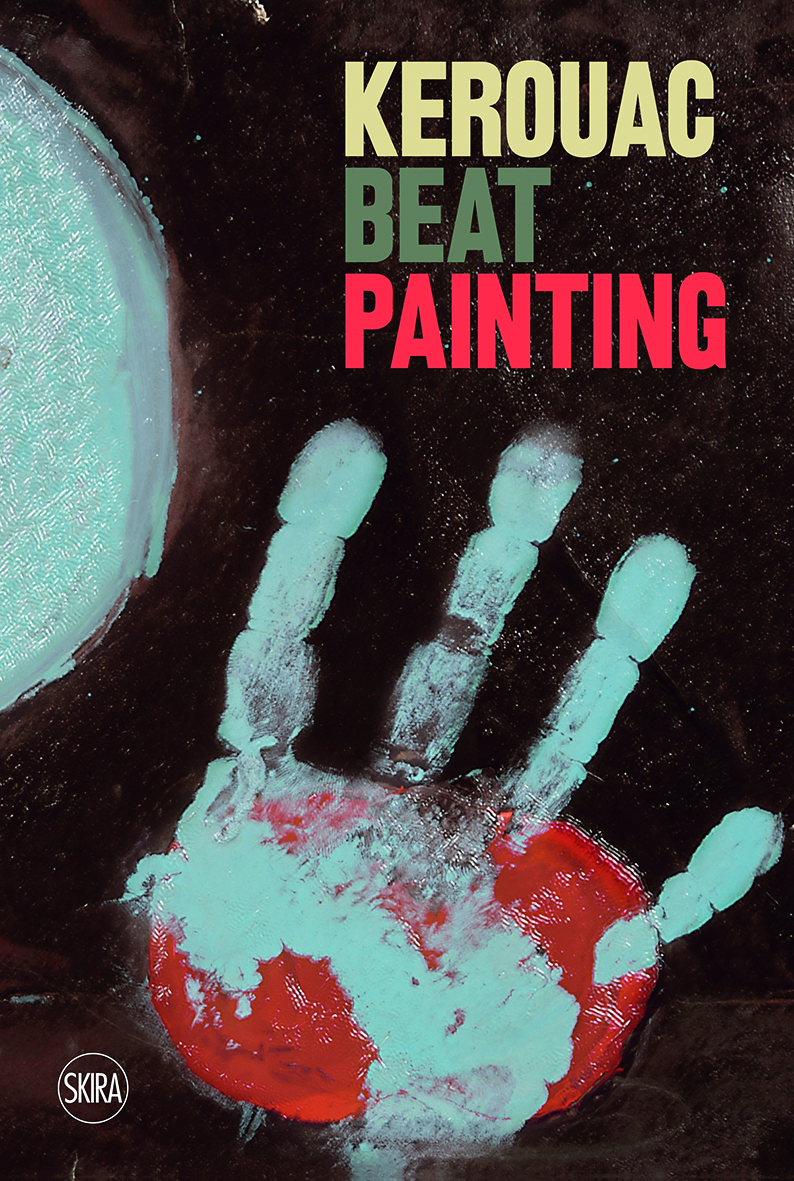
The same could perhaps be said of all of Kerouac’s creative output, and certainly of much of his best-known writing. And like many a creator known for his visceral nature, Kerouac made strict rules and built systems to work within: his 1959 manifesto for painting includes the commandments “use only one brush” and “stop when you want to ‘improve’… it’s done.” Detractors of Kerouac’s work will certainly see a connection between his visual art and his verbal art in his self-directed commandment to “pile it on,” but who could call the “beat painting” of this Beat Generation figurehead not of an aesthetic and intellectual piece with everything else that Bandera describes, unimprovably, as “that potent entity known as Jack Kerouac.”
via Hyperallergic
Related Content:
Jack Kerouac’s Hand-Drawn Map of the Hitchhiking Trip Narrated in On the Road
Jack Kerouac Lists 9 Essentials for Writing Spontaneous Prose
Jack Kerouac Reads from On the Road (1959)
Jack Kerouac Was a Secret, Obsessive Fan of Fantasy Baseball
Based in Seoul, Colin Marshall writes and broadcasts on cities, language, and culture. His projects include the book The Stateless City: a Walk through 21st-Century Los Angeles and the video series The City in Cinema. Follow him on Twitter at @colinmarshall or on Facebook.
Read More...The Band Everyone Thought Was The Beatles: Revisit the Klaatu Conspiracy of 1976
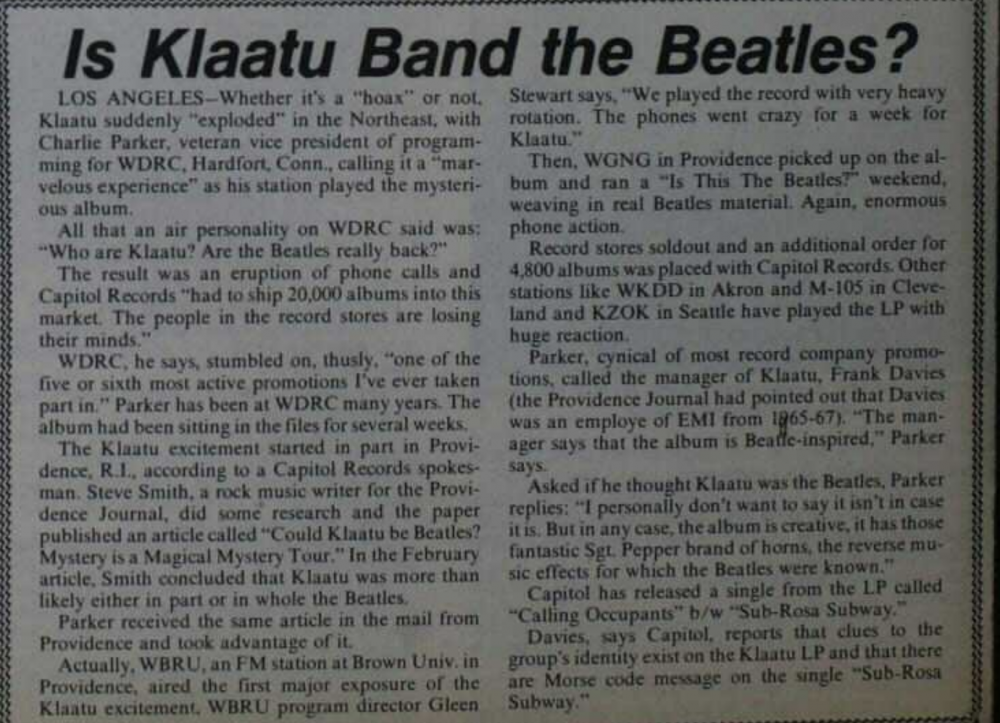
In 1976, hundreds of diehard Beatles fans became convinced that the mysterious album 3:47 EST by the band Klaatu was actually a new release from The Beatles in disguise, after a DJ in Providence, Rhode Island played one of its songs on the radio. Shortly afterward, Steve Smith discovered the album at the newspaper he worked for, Rhode Island’s The Providence Journal, listened to it, and became immediately intrigued.
The album contained no photographs, no identifying information at all, and the band’s The Day the Earth Stood Still reference echoed the cover of Ringo Starr’s album Goodnight Vienna. Smith heard Starr’s drumming, Harrison’s guitars, Lennon and McCartney’s voices in the psychedelic songs. Though he wasn’t a music critic or reporter himself, he persuaded the paper to publish a feature in which he suggested Klaatu could be The Beatles.
The “Klaatu Konspiracy” spread. An Australian fan issued a 34-page booklet on the case. Executives at Klaatu’s label, Capital Records Canada, refused to confirm or deny, enjoying the publicity, as Smith recalled in a 1997 interview.
More specifically, “hedging his bets,” writes Ken Raisanen for WOAS FM, Smith concluded that “the mystery band could be 1) The Beatles. 2) A couple of the Beatles with other people. 3) A Beatles-backed band. 4) A completely unknown but ingenious and talented band.” If the American Smith had caught an episode of Keith Hampshire’s Music Machine on CBC two years earlier, he would have seen the evidence of number four (see the real Klaatu play “California Jam” in 1974, above). But the band otherwise made an effort to obscure their identity.
As Klaatu bassist Jon Woloshuck told Goldmine magazine in 2013, one reason for the air of mystery they cultivated is that “we were just three guys from Toronto.” They wanted the music to speak for itself, and “nobody knew who were anyway.” They were amused by the rumor. “It caught us by surprise,” says drummer Terry Draper, but they “didn’t think much of it at the time…. We were all big Beatles fans, and we were hoping they would reunite. At the time, the idea of a reunited Beatles wasn’t all that far-fetched at all.”
These attitudes may have been prevalent, but Klaatu wasn’t deliberately setting out to tap into them, they say, but to “do music that was on par” with “late ‘60s progressive bands like King Crimson and The Moody Blues.” They’re clearly also channeling The Beatles, whether they admit it or not. Still the “rumor did us as much harm as good,” says guitarist Dee Long. “It got us noticed, which was great, but also led to a situation where we could not ever really measure up to expectations.” Hear what Beatles fans and Klaatu conspiracists heard in 1976 in the song “Sub Rosa Subway” above from 3:47 EST, and learn more about the Klaatu conspiracy theory in the Polyphonic video at the top.
Related Content:
Josh Jones is a writer and musician based in Durham, NC. Follow him at @jdmagness
Read More...William Faulkner’s Review of Ernest Hemingway’s The Old Man and the Sea (1952)
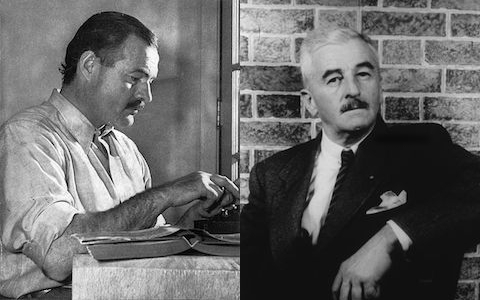
Images via Wikimedia Commons
In the mid-20th century, the two big dogs in the American literary scene were William Faulkner and Ernest Hemingway. Both were internationally revered, both were masters of the novel and the short story, and both won Nobel Prizes.
Born in Mississippi, Faulkner wrote allegorical histories of the South in a style that is both elliptical and challenging. His works were marked by uses of stream-of-consciousness and shifting points of view. He also favored titanically long sentences, holding the record for having, according to the Guinness Book of Records, the longest sentence in literature. Open your copy of Absalom! Absalom! to chapter 6 and you’ll find it. Hemingway, on the other hand, famously sandblasted the florid prose of Victorian-era books into short, terse, deceptively simple sentences. His stories were about rootless, damaged, cosmopolitan people in exotic locations like Paris or the Serengeti.
If you type in “Faulkner and Hemingway” in your favorite search engine, you’ll likely stumble upon this famous exchange — Faulkner on Hemingway: “He has never been known to use a word that might send a reader to the dictionary.” Hemingway: “Poor Faulkner. Does he really think big emotions come from big words?” Zing! Faulkner reportedly didn’t mean for the line to come off as an insult but Hemingway took it as one. The incident ended up being the most acrimonious in the two authors’ complicated relationship.
While Faulkner and Hemingway never formally met, they were regular correspondents, and each was keenly aware of the other’s talents. And they were competitive with each other, especially Hemingway who was much more insecure than you might surmise from his macho persona. While Hemingway regularly called Faulkner “the best of us all,” marveling at his natural abilities, he also hammered Faulkner for resorting to tricks. As he wrote to Harvey Breit, the famed critic for The New York Times, “If you have to write the longest sentence in the world to give a book distinction, the next thing you should hire Bill Veek [sic] and use midgets.”
Faulkner, on his end, was no less competitive. He once told the New York Herald Tribune, “I think he’s the best we’ve got.” On the other hand, he bristled when an editor mentioned getting Hemingway to write the preface for The Portable Faulkner in 1946. “It seems to me in bad taste to ask him to write a preface to my stuff. It’s like asking one race horse in the middle of a race to broadcast a blurb on another horse in the same running field.”
When Breit asked Faulkner to write a review of Hemingway’s 1952 novella The Old Man and the Sea, he refused. Yet when a couple months later he got the same request from Washington and Lee University’s literary journal, Shenandoah, Faulkner relented, giving guarded praise to the novel in a one paragraph-long review. You can read it below.
His best. Time may show it to be the best single piece of any of us, I mean his and my contemporaries. This time, he discovered God, a Creator. Until now, his men and women had made themselves, shaped themselves out of their own clay; their victories and defeats were at the hands of each other, just to prove to themselves or one another how tough they could be. But this time, he wrote about pity: about something somewhere that made them all: the old man who had to catch the fish and then lose it, the fish that had to be caught and then lost, the sharks which had to rob the old man of his fish; made them all and loved them all and pitied them all. It’s all right. Praise God that whatever made and loves and pities Hemingway and me kept him from touching it any further.
And you can also watch below a fascinating talk by scholar Joseph Fruscione about how Faulkner and Hemingway competed and influenced each other. He wrote the recent book, Faulkner and Hemingway: Biography of a Literary Rivalry .
Note: An earlier version of this post appeared on our site in July 2014.
Related Content:
Ernest Hemingway Creates a Reading List for a Young Writer, 1934
See a Beautifully Hand-Painted Animation of Ernest Hemingway’s The Old Man and the Sea (1999)
The Art of William Faulkner: Drawings from 1916–1925
Jonathan Crow is a Los Angeles-based writer and filmmaker whose work has appeared in Yahoo!, The Hollywood Reporter, and other publications. You can follow him at @jonccrow.
Read More...Buckminster Fuller Rails Against the “Nonsense of Earning a Living”: Why Work Useless Jobs When Technology & Automation Can Let Us Live More Meaningful Lives
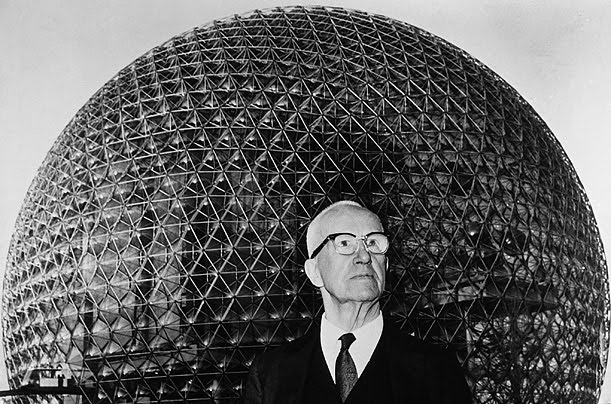
We are a haunted species: haunted by the specter of climate change, of economic collapse, and of automation making our lives redundant. When Marx used the specter metaphor in his manifesto, he was ironically invoking Gothic tropes. But Communism was not a boogeyman. It was a coming reality, for a time at least. Likewise, we face very real and substantial coming realities. But in far too many instances, they are also manufactured, under ideologies that insist there is no alternative.
But let’s assume there are other ways to order our priorities, such as valuing human life as an end in itself. Perhaps then we could treat the threat of automation as a ghost: insubstantial, immaterial, maybe scary but harmless. Or treat it as an opportunity to order our lives the way we want. We could stop inventing bullshit, low-paying, wasteful jobs that contribute to cycles of poverty and environmental degradation. We could slash the number of hours we work and spend time with people and pursuits we love.
We have been taught to think of this scenario as a fantasy. Or, as Buckminster Fuller declared in 1970—on the threshold of the “Malthusian-Darwinian” wave of neoliberal thought to come—“We keep inventing jobs because of this false idea that everybody has to be employed at some kind of drudgery…. He must justify his right to exist.” In current parlance, every person must somehow “add value” to shareholders’ portfolios. The shareholders themselves are under no obligation to return the favor.
What about adding value to our own lives? “The true business of people,” says Fuller, “should be to go back to school and think about whatever it was they were thinking about before somebody came along and told them they had to earn a living.” Against the “specious notion” that everyone should have to make a wage to live–this “nonsense of earning a living”–he takes a more magnanimous view: “It is a fact today that one in ten thousand of us can make a technological breakthrough capable of supporting all the rest,” who then may go on to make millions of small breakthroughs of their own.
He may have sounded overconfident at the time. But fifty years later, we see engineers, developers, and analysts of all kinds proclaiming the coming age of automation in our lifetimes, with a majority of jobs to be fully or partially automated in 10–15 years. It is a technological breakthrough capable of dispensing with huge numbers of people, unless its benefits are widely shared. The corporate world sticks its head in the sand and issues guidelines for retraining, a solution that will still leave masses unemployed. No matter the state of the most recent jobs report, serious losses in nearly every sector, especially manufacturing and service work, are unavoidable.
The jobs we invent have changed since Fuller’s time, become more contingent and less secure. But the obsession with creating them, no matter their impact or intent, has only grown, a runaway delusion no one can seem to stop. Should we fear automation? Only if we collectively decide the current course of action is all there is, that “everybody has to earn a living”—meaning turn a profit—or drop dead. As Congresswoman Alexandria Ocasio-Cortez—echoing Fuller—put it recently at SXSW, “we live in a society where if you don’t have a job, you are left to die. And that is, at its core, our problem…. We should not be haunted by the specter of being automated out of work.”
“We should be excited about automation,” she went on, “because what it could potentially mean is more time to educate ourselves, more time creating art, more time investing in and investigating the sciences.” However that might be achieved, through subsidized health, education, and basic services, new New Deal and Civil Rights policies, a Universal Basic Income, or some creative synthesis of all of the above, it will not produce a utopia—no political solution is up that task. But considering the benefits of subsidizing our humanity, and the alternative of letting its value decline, it seems worth a shot to try what economist Bill Black calls the “progressive policy core,” which, coincidentally, happens to be “centrist in terms of the electorate’s preferences.”
Related Content:
Bertrand Russell & Buckminster Fuller on Why We Should Work Less, and Live & Learn More
The Life & Times of Buckminster Fuller’s Geodesic Dome: A Documentary
Everything I Know: 42 Hours of Buckminster Fuller’s Visionary Lectures Free Online (1975)
Josh Jones is a writer and musician based in Durham, NC. Follow him at @jdmagness
Read More...An Animated Introduction to the Famous Thought Experiment, the “Trolley Problem,” Narrated by Harry Shearer
You don’t have to get too deep into the study of ethics before you run across the trolley problem. It comes up so readily that it hardly needs an introduction: a runaway train is on course to collide with and kill five people working on the tracks, but you can pull a lever that will switch it to another section of track on which stands only one person. Do you pull it? According to a purely utilitarian interpretation, you should, since one life lost surely beats five lives lost. But faced with the decision, real individuals tend to struggle: not pulling the lever feels like letting five people die, but pulling it feels like murdering one.
What if you could stop the train by pushing one especially large individual off a bridge into the train’s path, stopping it but killing him? Few say, or at least admit, that they would do it. But why not? The Harry Shearer-narrated animation above, a part of BBC Radio 4 and The Open University’s series on the history of ideas, considers what our responses reveal about how we think ethically.
“What the trolley problem examines is whether moral decisions are simply about outcomes, or about the manner in which you achieve them,” says Shearer. “Lots of people say they would switch the points, but they wouldn’t push the man off the bridge. Are they simply inconsistent… or are they on to something?
The TED-Ed video just above, written by educator Eleanor Nelsen, gets deeper into what they might be on to. “The dilemma in its many variations reveals that what we think is right or wrong depends on factors other than a logical weighing of the pros and cons,” says Nelsen. “For example, men are more likely than women to say it’s okay to push the man over the bridge. So are people who watch a comedy clip before doing the thought experiment. And in one virtual reality study, people were more willing to sacrifice men than women.” The study of “Trolleyology,” a subject since Philippa Foot first articulated the problem in 1967, now finds “researchers who study autonomous systems” collaborating with philosophers “to address the complex problem of programming ethics into machines.” Alternatively, of course, they could just put the question to the nearest two-year-old.
Related Content:
48 Animated Videos Explain the History of Ideas: From Aristotle to Sartre
Oxford’s Free Course A Romp Through Ethics for Complete Beginners Will Teach You Right from Wrong
Watch a 2‑Year-Old Solve Philosophy’s Famous Ethical “Trolley Problem” (It Doesn’t End Well)
Based in Seoul, Colin Marshall writes and broadcasts on cities, language, and culture. His projects include the book The Stateless City: a Walk through 21st-Century Los Angeles and the video series The City in Cinema. Follow him on Twitter at @colinmarshall or on Facebook.
Read More...A Stunning Live Concert Film of Queen Performing in Montreal, Digitally Restored to Perfection (1981)
The legend of Queen is immortal. It needs no further burnishing, not even, some might argue, by the most recent Oscar-winning biopic. The film may gamely recreate the stagecraft of Britain’s most operatic export. But once you’ve seen the real thing, what need of a substitute? For the millions who loved them before Wayne’s World brought them back to global consciousness, and the millions who came to love them afterward, the only thing that could be better than watching live Queen is watching more live Queen.
If you’re one of those millions, you’ll thrill at this concert film of Queen live in Montreal in 1981, “at their near peak,” writes Twisted Sifter. The footage you see here has been lovingly restored from an original release that chopped two different nights’ performances together in a hash the band hated.
The restoration, as Brian May himself explained in 2007, is now “much much more true to what actually happened at any given moment…. And I do find that once I’m five minutes into the film, I’m caught up in it as a real live show.” It is, he says, “a great piece of work.”
Directed by Saul Swimmer, the documentarian who made George Harrison’s Concert for Bangladesh, the film was plagued by misunderstanding and hostility, as May describes it. Freddie Mercury hated the experience and the director. “What you will see,” says the guitarist, “is a very edgy, angry band, carving out a performance in a rather uncomfortable situation.” But what performances they are. “High energy, real, and raw.”
Yet no justice was done to the electric rage they brought to the stage those two nights. The film was shot on very high-quality 35mm, then very badly edited with poor attempts at matching sound and video from different performances. In 1984, an even worse VHS version titled We Will Rock You appeared, then it went to DVD in 2001. The band protested but could only remedy the situation when they bought the rights to the film.
In describing the restoration process, May, the irrepressible scientist, gets most excited:
The surviving negative went to be doctored in the USA – by a process using algorithms invented by John D Lowry of NASA for rescuing the film from the Apollo Moon missions. (Astrophysics gets everywhere!) You know how quick computers are these days…? Well, to give you an idea of the huge number-crunching involved, it took 700 Apple Mac G5’s one MONTH to process this film.
From the original 24-track audio, all the songs, which had been edited, were restored to their full length, and what footage wasn’t cut and discarded was rejoined “with modern digital artistry” into full performances.
Given that the outtakes had disappeared, the result “is a document which concentrates on Freddie,” says May, but no one in the band “is upset” about that. I doubt any Queen fans will be overly upset either. See and hear the gloriously restored film and live audio from Montreal in 1981 here: a fast version of “We Will Rock You,” “Somebody to Love,” “Killer Queen,” “Bohemian Rhapsody,” “Another One Bites the Dust,” the slow version of “We Will Rock You,” and “We Are the Champions,” below.
via Twisted Sifter
Related Content:
Scenes from Bohemian Rhapsody Compared to Real Life: A 21-Minute Compilation
Josh Jones is a writer and musician based in Durham, NC. Follow him at @jdmagness
Read More...Take a Free Online Course on the Great Medieval Manuscript, the Book of Kells
Last week, we called your attention to the digitization of the Book of Kells, one of the great manuscripts from the medieval period. The digitized manuscript, we should note, comes accompanied by another great resource–a free online course on the Book of Kells. Both digital initiatives are made possible by Trinity College Dublin.
The six-week course covers the following topics:
- Where and how the manuscript was made
- The social context from which the manuscript emerged, including early medieval faith and politics
- The artistic context of the manuscript, reflecting local and international styles
- The theology and interpretations of the text
- How and why the manuscript survived
- The Book of Kells and contemporary culture
The course “is for anyone with an interest in Ireland, medieval studies, history, art, religion and/or popular culture.” Sign up for the free course today.
If you would like to support the mission of Open Culture, consider making a donation to our site. It’s hard to rely 100% on ads, and your contributions will help us continue providing the best free cultural and educational materials to learners everywhere. You can contribute through PayPal, Patreon, and Venmo (@openculture). Thanks!
Related Content
80 Free Online History Courses from Great Universities, a subset of our larger collection, 1,700 Free Online Courses from Top Universities
The Medieval Masterpiece, the Book of Kells, Is Now Digitized & Put Online
Read More...Why Should We Read Sylvia Plath? An Animated Video Makes the Case
In “Morning Song,” from Sylvia Plath’s posthumous 1965 collection Ariel, published two years after her suicide, a newborn infant is a “fat gold watch.” Among the incessant lists of adjectives in both her work, “fat” is one that stands out, appearing often, in several synonyms, as a celebration of abundance and real anxiety over weight gain and a general too-muchness. In the same poem, the baby is a work of art, a “new statue.” Its mother, on the other hand, is in one stanza a cloud effaced by the wind in a mirror, and a clumsy animal, “cow-heavy and floral / In my Victorian nightgown. / Your mouth opens clean as a cat’s.”
Plath’s images are bracing and unexpected, awed and stricken, usually at once. She deploys them so quickly and adroitly that even when one fails to land, the others immediately take up the slack, making even her less-great poems impressive for a line or stanza that takes hold in the mind for days. This ability was not the result of either divine inspiration or mental illness, but talent honed through hard work and commitment. Plath “chose the artist’s way. Poetry was her calling,” the animated TED-Ed video by Iseult Gillespie tells us above. As such, she persevered even through severe bouts with depression and many suicide attempts before she finally succumbed at age 30.
Plath’s semi-autobiographical novel, The Bell Jar, which dramatizes these themes, as well as a handful of her darkest poems, have come to popularly symbolize her legacy. You’ve heard of them even if you’ve never read them. Yet she composed a “large bulk of poetry,” her husband, poet Ted Hughes, wrote in the introduction to her Collected Works, published and unpublished, never throwing anything out. “She brought every piece she worked on to some final form acceptable to her, rejecting at most the odd verse…. Her attitude to her verse was artisan-like: if she couldn’t get a table out of the material, she was quite happy to get a chair, or even a toy.”
His characterization may not sound like the most charitable, and as her literary executor, Hughes was accused of refusing to publish some of her work. But he was also a fellow poet who watched her tirelessly write and revise. Quoting from her journals, Hughes shows how her first collection, 1960’s The Colossus and Other Poems, came together over a period of many years, its title changing every few months, new poems appearing and old ones falling away. The result is a debut whose “breathtaking perspectives on emotion, nature, and art continue to captivate and resonate,” notes the video’s narrator.
Despite her major presence in the literary magazines and the respect she won especially in the UK, The Colossus and Other Poems would be Plath’s only published collection in her lifetime. It made her a well-respected poet, but did not make her the celebrity she became after the publication of The Bell Jar three years later and her suicide the following month. “Within a week of her death,” writes Time magazine in its review of Ariel in 1966, “intellectual London was hunched over copies of a strange and terrible poem she had written during her last sick slide toward suicide. ‘Daddy’ was its title.”
After the publication of Ariel, readers fixed on “Daddy” and “Lady Lazarus,” sensational poems in which “fear, hate, love, death and the poet’s own identity become fused at bleak heat with the figure of her father, and through him, with the guilt of the German exterminators and the suffering of their Jewish victims.” These are poems, wrote Robert Lowell in his preface, that “play Russian roulette with six cartridges in the cylinder.” As feminist scholars embraced her work in the 1970s, a morbid fascination with her image only grew. This is the Plath many people know by word of mouth. But those who haven’t read more of her will miss out.
Plath doesn’t shy away from staring at suicide, abuse, and mass murder. She helped to “break the silence surrounding issues of trauma, frustration, and sexuality.” Ariel and her dozens of uncollected poems are also “filled with moving meditations on heartbreak and creativity,” including the heartbreak and creativity of motherhood, a theme always fraught with fears of love and death. Plath’s work can be dark, and it can be at once luminous in its imaginative candor. In writing about life with depression and the domestic misery visited on her in her marriage to Hughes, she celebrates life’s sublime pleasures and mourns its depths of suffering, in poem ofter poem, with near-constant ingenuity, wit, and courage.
Related Content:
Hear Sylvia Plath Read 50+ of Her Dark, Compelling Poems
Sylvia Plath, Ted Hughes & Peter Porter Read Their Poetry: Free Audio
Sylvia Plath, Girl Detective Offers a Hilariously Cheery Take on the Poet’s College Years
Josh Jones is a writer and musician based in Durham, NC. Follow him at @jdmagness
Read More...The Roman Roads of Spain & Portugal Visualized as a Subway Map: Ancient History Meets Modern Graphic Design

Between the first century BC and the fourth century AD, Rome displayed what we might call an impressive ambition. In his project illustrating those chapters of history in a way no one has before, statistics student Sasha Trubetskoy has shown increasingly Roman-grade ambitions himself, at least in the realm of historical graphic design. We’ve previously featured his modern subway-style maps of the roads of the Roman Empire as well as the Roman roads of Britain here on Open Culture. Today, we have his map of the Roman Roads of Iberia, the region today occupied mainly by Spain and Portugal.
“This map was a blast to make,” writes Trubetskoy. “I chose to follow the Antonine Itinerary more strictly, which meant that I had to deal with many parallel lines.” Also known as the itinerary of the Emperor Antoninus or “Itinerarium Provinciarum Antoni(ni) Augusti,” according to the Roman Roads Research Association, the Antonine Itinerary is “a collection of 225 lists of stopping places along various Roman roads across the Roman Empire.” Its value “comes from it being one of a very few documents to have survived to modern times which provide detail of names and clues to the location of Roman sites and the routes of roads.”
Each list, or iter, that makes up the Antonine Itinerary “gives the start and end of each route, with the total mileage of that route, followed by a list of intermediate points with the distances in between.” In creating his Roman Roads of Iberia subway map, Trubetskoy made each iter into its own “line,” though for some of them he had to draw from other sources: “A couple of Antonine routes were ambiguous and not easily placed on a map, while a few important routes were missing for which there is archaeological evidence.”
It takes no small amount of work to convert this kind of often patchy and scattered knowledge from ancient history into graphics as cleanly and legibly designed as Trubetskoy’s Roman-road subway maps. But the result, apart from offering a nifty juxtaposition of past and present, reminds us of what the roads of the Romain Empire actually meant: a degree of connectedness between distant lands never before achieved in human history. You can support Trubetskoy’s efforts to show this to us in ever greater detail by making the US$9 suggested donation to download a high-resolution version of the Roman Roads of Iberia map. Rome wasn’t built in a day, much less its empire: the complete subway-mapping of Rome’s roads will also require more time and labor — but then, would the builders of the Roman Empire have described their task as a “blast”?
Related Content:
Ancient Rome’s System of Roads Visualized in the Style of Modern Subway Maps
The Roman Roads of Britain Visualized as a Subway Map
Rome Reborn: Take a Virtual Tour of Ancient Rome, Circa 320 C.E.
The Rise & Fall of the Romans: Every Year Shown in a Timelapse Map Animation (753 BC ‑1479 AD)
A Wonderful Archive of Historic Transit Maps: Expressive Art Meets Precise Graphic Design
Based in Seoul, Colin Marshall writes and broadcasts on cities, language, and culture. His projects include the book The Stateless City: a Walk through 21st-Century Los Angeles and the video series The City in Cinema. Follow him on Twitter at @colinmarshall or on Facebook.
Read More...Support Us
We're hoping to rely on loyal readers, rather than erratic ads. Please click the Donate button and support Open Culture. You can use Paypal, Venmo, Patreon, even Crypto! We thank you!

About Us

Open Culture scours the web for the best educational media. We find the free courses and audio books you need, the language lessons & educational videos you want, and plenty of enlightenment in between.
Advertise With Us

FREE UPDATES!
GET OUR DAILY EMAIL
Get the best cultural and educational resources on the web curated for you in a daily email. We never spam. Unsubscribe at any time.
FOLLOW ON SOCIAL MEDIA

Open Culture editor Dan Colman scours the web for the best educational media. He finds the free courses and audio books you need, the language lessons & movies you want, and plenty of enlightenment in between.
Advertise With Us


