The Amazing Franz Kafka Workout!: Discover the 15-Minute Exercise Routine That Swept the World in 1904
Does your spare tire show no signs of deflating as bikini season looms?
Is the fear of bullies kicking sand in your face beginning to outstrip the horror of transforming into a giant bug overnight?
Do you long to experience lasting health benefits along with an impressively fit appearance?
Friends, we make you this promise: The Amazing Franz Kafka Workout will transform your life along with your physique in just 15 minutes a day.
That’s right, just 15 minutes of daily calisthenics (and some common sense practices with regard to diet, sleep, and hygiene) is all it takes. Even pencil-necked authors walking around with their backs bowed, their shoulders drooping, their hands and arms all over the place, afraid of mirrors because they show an inescapable ugliness, can discover the confidence that eludes them, through improved posture, breathing, and muscle tone.
(Note: the Amazing Franz Kafka Workout will not protect you from the pernicious, eventually fatal effects of tuberculosis.)
The Amazing Franz Kafka Workout is more correctly attributed to fitness guru Jørgen Peter Müller, above, the author of several exercise regimen pamphlets, including the bestselling My System: 15 Minutes’ Exercise a Day for Health’s Sake, which was published in 1904 and then translated into 25 languages.
Kafka was definitely the best known of Müller’s devotees, scrupulously running through the prescribed exercises morning and evening, wearing nothing more than the skin he was born in—another practice Müller heartily endorsed.
The chiseled Mr. Müller was a proponent of regular dental check ups, sensible footwear, and vigorous toweling (or “rubbing”), and an enemy of constrictive woolen underwear, closed windows, and sedentary lifestyles. My System includes some observations that wouldn’t sound out of place in a Kafka novel:
The town office type is often a sad phenomenon prematurely bent, with shoulders and hips awry from his dislocating position on the office stool, pale, with pimply face and pomatumed head, thin neck protruding from a collar that an ordinary man could use as a cuff, and swaggering dress in the latest fashion flapping round the sticks that take the place of arms and legs! At a more advanced age the spectacle is still more pitiable… the eyes are dull, and the general appearance is either still more sunken and shriveled or else fat, flabby, and pallid, and enveloped in an odour of old paper, putrified skin grease, and bad breath.
In an essay on Slate, Sarah Wildman, the descendent of two lean Müller fans, delves into the Müller System’s popularity, particularly amongst 20th-century European Jews.
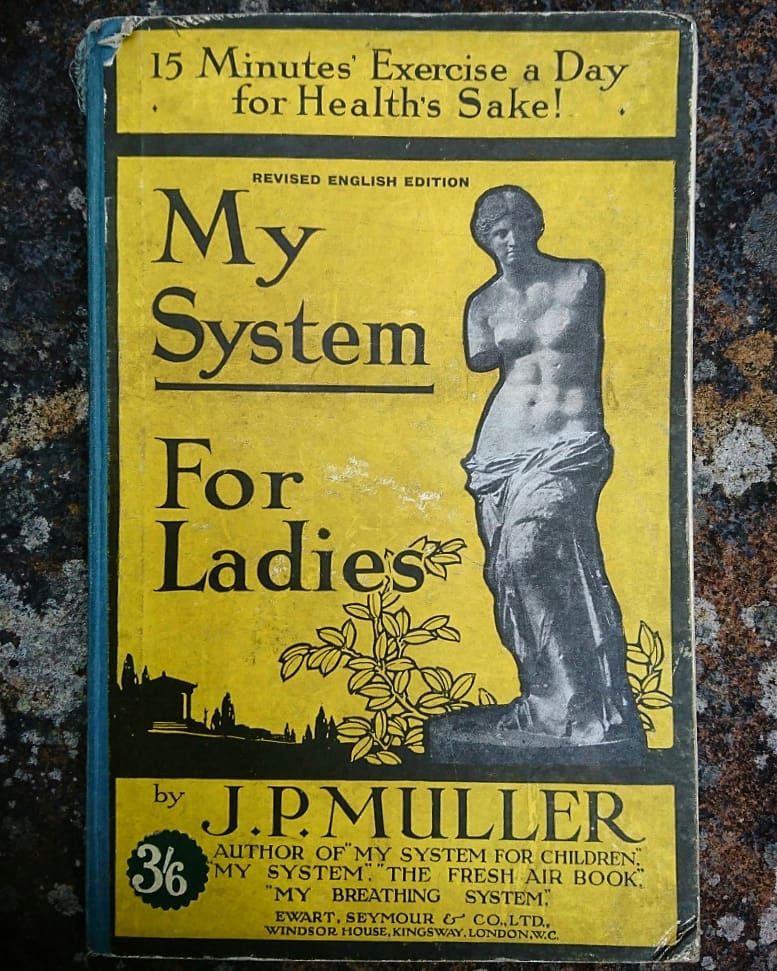
Just as best-selling fitness experts do today, Müller beefed up his franchise with related titles: My System for Ladies, My System for Children, and My Sunbathing and Fresh Air System.
The original book is in the public domain and can be downloaded for free from the Internet Archive, where one commenter who has been following the system for nearly seventy years gives it a hearty thumbs-up for its stamina restoring powers.
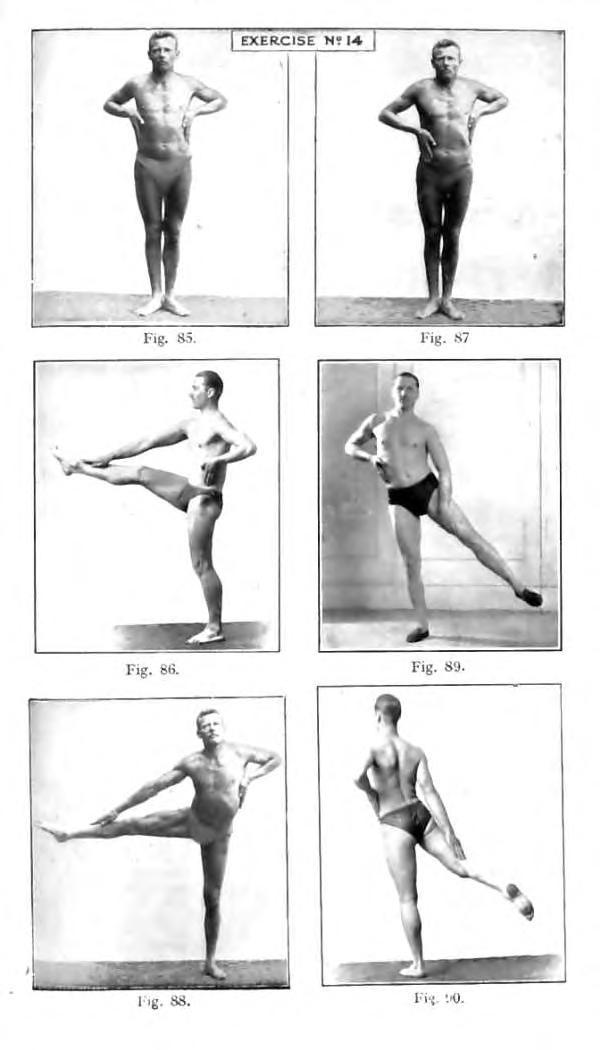
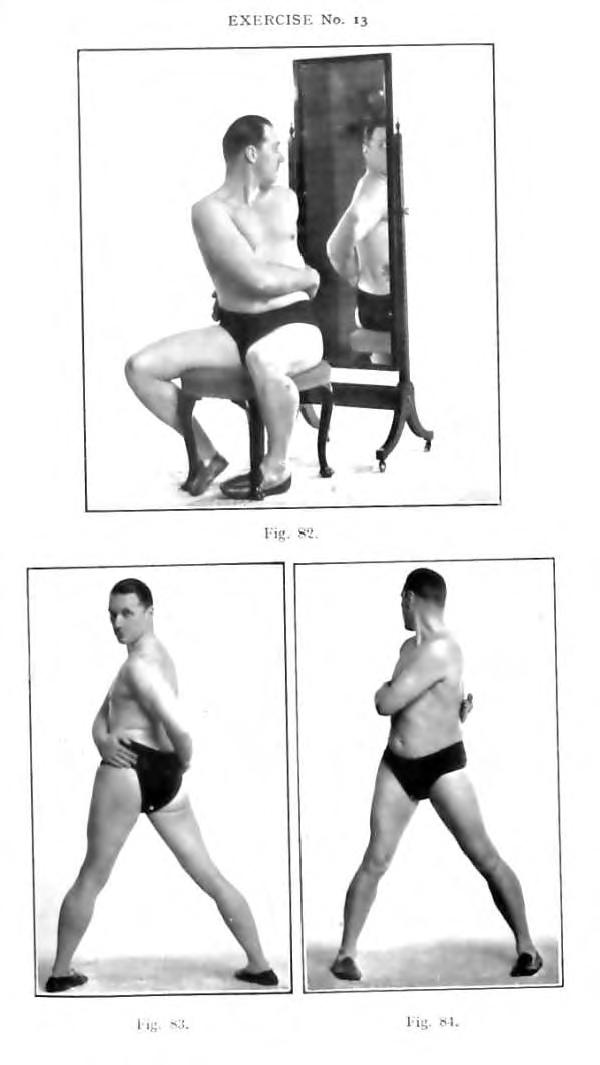
Others seeking to make a buck by charging for Kindle downloads have the decency to offer free instructions for each of the individual exercises, including Quick Sideways Bending of Trunk (with Rubbing) and the plank‑y Bending and Stretching of the Arms, partly Loaded with the Weight of the Body.
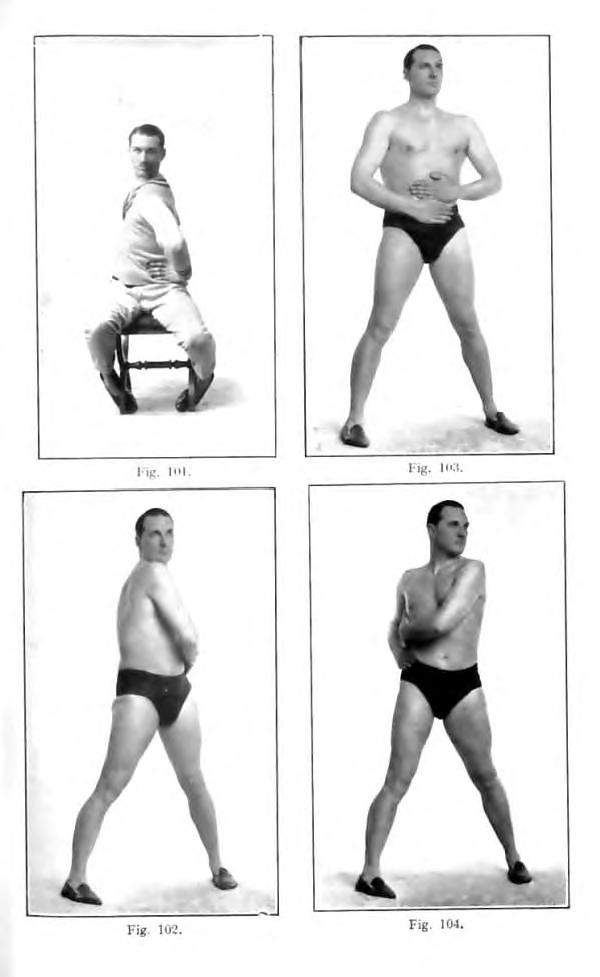
Even those unlikely to perform so much as a single deep knee bend should get a bang out of the original photo illustrations, which, back in 1904, were as ripe for erotic double duty as the wholesome men’s physique mags of the 50s and 60s.
Insert speculation as to Kafka’s sexual orientation here, if you must.
Related Content:
77 Exercises: A Workout Video For Fans of the Talking Heads
What’s a Scientifically-Proven Way to Improve Your Ability to Learn? Get Out and Exercise
Ayun Halliday is an author, illustrator, theater maker and Chief Primatologist of the East Village Inky zine. Join her in New York City tonight, March 11, for the next installment of her ongoing book-based variety show, Necromancers of the Public Domain. Follow her @AyunHalliday.
Read More...Alan Watts Presents a 15-Minute Guided Meditation: A Time-Tested Way to Stop Thinking About Thinking
The concept of emptiness—shūnyatā—in Mahayana Buddhism is perhaps a subject best avoided in casual conversation. It so vexes everyone not least because of issues of translation: “emptiness,” many scholars think, hardly suffices as a substitute. In English it has a more distinctly nihilist flavor than was intended. Yet emptiness is so indispensable that it can hardly go unmentioned when the practice and purpose of meditation come up in Buddhist thought.
Leave it to Zen to put things in such succinct and down-to-earth ways: the practice of meditation is to develop “’no mind,’” says Suzuki Roshi. It is to have “no gaining idea.” The reason is to have no reason. But from the same point of view, there is a point: “the point we should make clear in our practice,” the Zen master tells us: we should “put more emphasis on big mind rather than small mind.”
If you need more clarification, you might turn to another Zen popularizer who also began to draw audiences in California in the 50s: Alan Watts. Watts came to San Francisco not with a lifetime of monastic training in Japan, but through his training as an academic, Episcopal priest, and Zen enthusiast in Britain. He is wordier, less poetic, and more essayistic in his delivery, but in discussing the purpose of meditation, you will find him saying the very same things as the Zen masters:
Meditation is the discovery that the point of life is always arrived at in the immediate moment. And therefore, if you meditate for an ulterior motive — that is to say, to improve your mind, to improve your character, to be more efficient in life — you’ve got your eye on the future and you are not meditating!
As for Suzuki’s “big mind,” Watts has his own version: “The art of meditation is a way of getting into touch with reality… our basic inseparability from the whole universe.” These are not necessarily synonyms for “emptiness,” but the idea of having no idea maybe comes close to summarizing the concept. “Not knowing,” as the koan says, “is most intimate.”
Maybe it’s hair-splitting and belabors the comparison, but Suzuki Roshi did not talk about meditation as a way to stop all thinking. This is futile, he would argue. Watts seems to suggest otherwise when he says that “we become interiorally silent and cease from the interminable chatter that goes on inside our skulls. Because you see, most of us think compulsively all the time.” Most honest people will tell you they think compulsively during meditation as well. But in his guided meditation above, Watts acknowledges just this fact.
Indeed, his matter-of-fact way of recognizing the ever-presence of thought is what makes the instructions he gives so useful, even if they are also, ultimately, pointless. Hear the original fifteen minute guided meditation at the top of the post and an edit, with some, maybe distracting, background music, just above. To let thinking recede into the background, we must engage our other senses, letting every sound and sensation come and go and the autonomous nervous system take over.
How to let go of thinking about thinking? Let Watts guide you in an exercise and see what happens. Then listen to Suzuki Roshi describe the Buddhist philosophy of emptiness. As far as meditation, or “zazen practice,” goes, he says, our zazen practice is based on… the teaching of shūnyatā or emptiness,” which is not an idea but an experience of “letting go of fixed ideas,” writes another Zen master who brought his practice to the U.S., “in order to go beyond them.”
Related Content:
Alan Watts Dispenses Wit & Wisdom on the Meaning of Life in Three Animated Videos
How Meditation Can Change Your Brain: The Neuroscience of Buddhist Practice
Stream 18 Hours of Free Guided Meditations
Josh Jones is a writer and musician based in Durham, NC. Follow him at @jdmagness
Read More...Bill Murray Explains How a 19th-Century Painting Saved His Life
You don’t understand prewar 20th-century America unless you understand a particular 19th-century French painting: Jules Breton’s The Song of the Lark. “In this evocative work, a young peasant woman stands silently in the flat fields of the artist’s native Normandy as the sun rises, listening to the song of a distant lark,” says a post from the Art Institute of Chicago. Apart from being selected as America’s favorite painting in 1934, it was also Eleanor Roosevelt’s favorite work of art, it provided the title for Willa Cather’s third novel, and it “inspired Bill Murray while he was struggling as an actor in Chicago.”
In the video above, a clip from a press conference on the Murray-featuring historical art-heist film The Monuments Men, he tells the story of how The Song of the Lark saved him. “This may be a little bit not-completely-true,” Murray says, “but it’s pretty true.”
When he first started acting on the stage in his hometown of Chicago, he didn’t quite have the skills that have made him such a compelling presence for more than forty years on the screen. After what sounds like one particularly poor early performance — poor enough to make him consider his life practically over — he took a despairing walk toward Lake Michigan, thinking, “If I’m going to die where I am, I may as well go over to the lake and float for a while after I’m dead.”
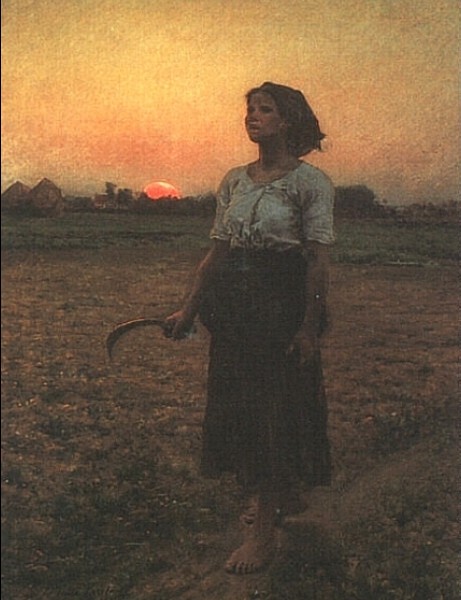
But then a sudden, impulsive turn up Michigan Avenue took Murray to the Art Institute of Chicago, and there he found himself in front of The Song of the Lark, which has now hung there for over a century. The sight of it got him thinking: “ ‘Well, there’s a girl who doesn’t have a whole lot of prospects, but the sun’s coming up anyway and she’s got another chance at it.’ So I think that gave me some sort of feeling that I, too, am a person, and I get another chance every day the sun comes up.” Many of the Great Depression-era Americans who admired Breton’s painting must have drawn similar feelings from it, just as surely as many of Murray’s fans have found inspiration in all his characters, artfully crafted between the comedic and the dramatic — characters that, without The Song of the Lark, he may never have lived to perform.
Related Content:
The Art Institute of Chicago Puts 44,000+ Works of Art Online: View Them in High Resolution
The Philosophy of Bill Murray: The Intellectual Foundations of His Comedic Persona
Listen to Bill Murray Lead a Guided Mediation on How It Feels to Be Bill Murray
Art Exhibit on Bill Murray Opens in the UK
Based in Seoul, Colin Marshall writes and broadcasts on cities, language, and culture. His projects include the book The Stateless City: a Walk through 21st-Century Los Angeles and the video series The City in Cinema. Follow him on Twitter at @colinmarshall or on Facebook.
Read More...The Big Pond: Stream 50 Audio Stories from the Goethe-Institut, Available Free Online

Who doesn’t love a good podcast? Don’t tell me you’ve never binged Serial or laughed out loud with Marc Maron. Over the last few years, podcasts have become a cultural phenomenon–they help us endure our daily commutes and then lull us back to sleep at night. Listening culture isn’t new, though–talk radio has been filling the silence with anecdotes, news, and drama since the early 1900s. The Goethe-Institut’s new radio and podcast series THE BIG POND. A US-German Listening Series is a perfect marriage of these two audible storytelling formats.
The Goethe-Institut, a German cultural center with its North American headquarters in Washington, has partnered with the Public Radio Exchange (PRX), the RIAS Berlin Kommission, KCRW Berlin, and other public radio stations and producers in Germany and the US to bring you THE BIG POND, a collection of 50 unique audio pieces released on a weekly basis. From pretzels and beer to the Berlin Wall, from motorcycles to recycling, THE BIG POND offers a fresh perspective on just how much these two countries share while celebrating podcasting, broadcasting, and “Wunderbar Together” – the German-American Year of Friendship.
Don’t worry, the radio features are all in English! Episodes are available for free via PRX, iTunes, Spotify, and THE BIG POND’s website as podcasts and for broadcast by public radio stations in the United States. This carefully curated library of audio productions covers all things German-American: German motorcycle tourists in Utah, a young German journalist’s mythical day with John Lennon, German-style apprenticeships in the US, an American opera singer’s life in Berlin, New York City beer gardens, and much more. THE BIG POND is home to features from up-and-coming producers as well as industry greats like Katie Davis, a contributor to NPR’s “All Things Considered” and “This American Life”, and the Kitchen Sisters (Davia Nelson and Nikki Silva), producers of the award-winning NPR series “Hidden Kitchens”.
“When an editor asks me to do a radio story, it usually comes with lots of directions,” said radio producer Katie Davis. “When the team at THE BIG POND talked to me about a story for this series, everything was wide open. No rules, requirements; just a wide open canvas with space for original stories.”
Provided with the necessary freedom to tell their transatlantic tales, THE BIG POND producers have developed pieces that resonate with audiences of all backgrounds on both sides of the big pond, conveying a balanced and modern image of Germany and the US. THE BIG POND isn’t a collection of puff pieces about Germany–it’s a well-researched narrative of German and American life and culture. Close cooperation with German and American journalists gives an authentic voice to Germany, the US, and their many subcultures while building up the transatlantic radio network.
Anyone interested in the series can download episodes free of charge for individual use or broadcasting at PRX, iTunes, Spotify, or by visiting THE BIG POND’s website. Check www.goethe.de/bigpond and the Goethe-Institut Washington’s social media channels for transcripts and behind-the-scenes content.
For the project’s press release and other press materials, please visit:
Savannah Beck is the Online Editor at the Goethe-Institut Washington.
Read More...Here’s John Steinbeck Asking Marilyn Monroe for Her Autograph (1955)
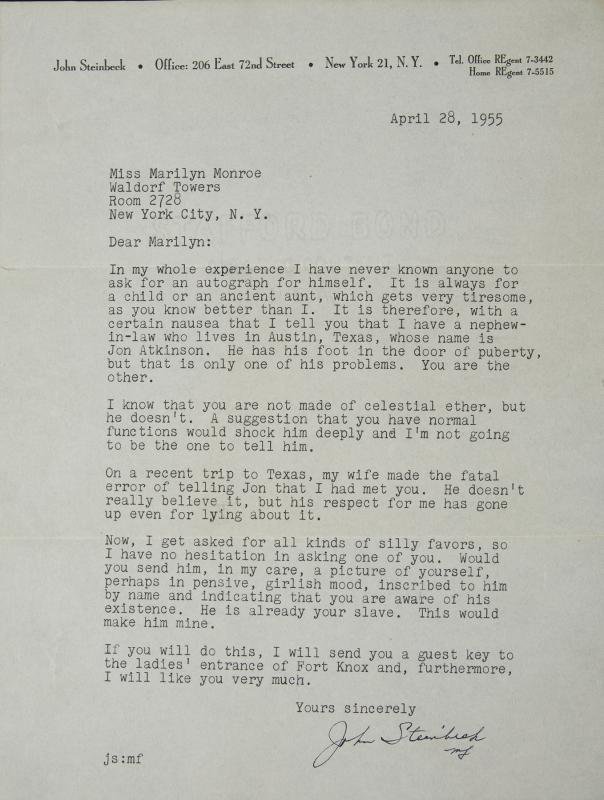
When asking a celebrity for a special favor, it helps to be a bit of a celebrity yourself.
As Keith Ferrell details in his biography, John Steinbeck: The Voice of the Land, the Nobel laureate had little patience for autograph seekers, pushy young writers seeking help getting published, and “people who never read books but enjoyed meeting authors.”
The shoe went on the other foot when Mrs. Steinbeck let slip to her nephew that Uncle John had met the boy’s movie star crush, Marilyn Monroe.
Suddenly, an autographed photo seemed in order.
And not just some standard issue publicity shot, but ideally one showing the star of The Seven Year Itch and Gentlemen Prefer Blondes in a “pensive girlish mood.”
Also, could she please inscribe it by name to nephew Jon, a young man with, his uncle confided, “one foot in the door of puberty”?
The star-to-star tone Steinbeck adopts for the above letter seems designed to ward off suspicion that this nephew could be a convenient invention on the part of someone desiring such a prize for himself.
Sixty years after a secretary typed it up, Steinbeck’s message fetched $3,520 at Julien’s Auctions, one of a wide range of items culled from hardcore Marilyn Monroe collector, David Gainsborough-Roberts as well as the estate of Monroe’s acting teacher, Lee Strasberg.
In addition to other correspondence, the Marilyn auction included annotated scripts, an empty prescription bottle, a ballerina paperweight, stockings and gowns, some pinup-type memorabilia, and a program from John F Kennedy’s 1962 birthday celebration at Madison Square Garden.
One lot that is conspicuous for its absence is Steinbeck’s promised “guest key to the ladies’ entrance of Fort Knox.”
Could it be that the boy never got his customized autograph?
We’d like to think that he did. Perhaps he’s still savoring it in private.
H/T Alan Goldwasser/Letters of Note/Flashbak
Related Content:
“Nothing Good Gets Away”: John Steinbeck Offers Love Advice in a Letter to His Son (1958)
The 430 Books in Marilyn Monroe’s Library: How Many Have You Read?
Marilyn Monroe & Elvis Presley Star in an Action-Packed Pop Art Japanese Monster Movie
Ayun Halliday is an author, illustrator, theater maker and Chief Primatologist of the East Village Inky zine. Join her in New York City for the next installment of her book-based variety show, Necromancers of the Public Domain, this Monday, March 11. Follow her @AyunHalliday.
Read More...The Cringe-Inducing Humor of The Office Explained with Philosophical Theories of Mind
“I’m a friend first and a boss second,” says David Brent, middle manager at the Slough branch of paper company Wernham-Hogg. “Probably an entertainer third.” Those of us who’ve watched the original British run of The Office — and especially those of us who still watch it regularly — will remember that and many other of Brent’s pitiable declarations besides. As portrayed by the show’s co-creator Ricky Gervais, Brent constitutes both The Office’s comedic and emotional core, at once a fully realized character and someone we’ve all known in real life. His distinctive combination of social incompetence and an aggressive desperation to be liked provokes in us not just laughter but a more complex set of emotions as well, resulting in one expression above all others: the cringe.
“In David Brent, we have a character so invested in the performance of himself that he’s blocked his own access to others’ feelings.” So goes the analysis of Evan Puschak, a.k.a. the Nerdwriter, in his video interpreting the humor of The Office through philosophical theories of mind.
The elaborate friend-boss-entertainer song-and-dance Brent constantly puts on for his co-workers so occupies him that he lacks the ability or even the inclination to have any sense of what they’re thinking. “The irony is that Brent can’t see that a weak theory of mind always makes for a weak self-performance. You can’t brute force your preferred personality onto another’s consciousness: it takes two to build an identity.”
Central though Brent is to The Office, we laugh not just at what he says and does, but how the other characters (which Puschak places across a spectrum of ability to understand the minds of others) react — or fail to react — to what he says and does, how he reacts to their reactions, and so on. Mastery of the comedic effects of all this has kept the original Office effective more than fifteen years later, though its effect may not be entirely pleasurable: “A lot of people say that cringe humor like this is hard to watch,” says Puschak, “but in the same way that under our confidence, in theory of mind, lies an anxiety, I think that under our cringing there’s actually a deep feeling of relief.” When Brent and others fail to connect, their “body language speaks in a way that is totally transparent: in that moment the embarrassment is not only palpable, it’s palpably honest.” And it reminds us that — if we’re being honest — none of us are exactly mind-readers ourselves.
You can get the complete British run of The Office on Amazon here.
Related Content:
Ricky Gervais Presents “Learn Guitar with David Brent”
The Philosophy of Bill Murray: The Intellectual Foundations of His Comedic Persona
A Romp Through the Philosophy of Mind: A Free Online Course from Oxford
Based in Seoul, Colin Marshall writes and broadcasts on cities, language, and culture. His projects include the book The Stateless City: a Walk through 21st-Century Los Angeles and the video series The City in Cinema. Follow him on Twitter at @colinmarshall or on Facebook.
Read More...Hear Patti Smith’s New Work With The Soundwalk Collective, a Tribute to the Avant-Garde Poet Antonin Artaud
The Soundwalk Collective has made music art out of found sounds since 2004. They recorded 2012’s Medea while traversing the Black Sea and fishing for sounds using a scanner and high powered aerial antennas; 2014’s Last Beat used contact microphones on the architecture of a music club to collect vibrations instead of music; 2017’s Before Music There Is Blood collaged deep echoing recordings of classical music played in various halls. This time, in their upcoming The Peyote Dance, they have brought in poet and rock goddess Patti Smith for a trip into Mexico.
The above track “The New Revelations of Being” is a preview of what’s to come. The album title comes from a book by Antonin Artaud, the avant-garde theater director and author, who traveled to Mexico to explore revelatory visions with the Rarámuri people in 1936. Artaud was hoping that peyote would shake his opioid addiction. When he later returned to France, Artaud stayed and remained in an insane asylum, receiving electric shock therapy. His time with the Rarámuri stayed a touchstone of happiness during his darkest days.
With a shared belief that travel expands the mind, the Soundwalk Collective traveled to the same Sierra Tarahumarar region of Mexico as Artaud, visited the same places he stayed, and indeed also took peyote. They recorded instruments and soundscapes, and then back in the States, Patti Smith wrote and recorded poems based on Artaud’s book, his other works, and her own responses to the sound fields.
“The poets enter the bloodstream, they enter the cells. For a moment, one is Artaud,” Smith said about the recording. “You can’t ask for it, you can’t buy it, you can’t take drugs for it to be authentic. It just has to happen, you have to be chosen as well as choose.”
The album is the first in a trilogy with Smith about poets and travel. The other two albums will be based on works and journeys by Arthur Rimbaud and René Daumal, and feature sounds recorded at the Abyssinian valley of Ethiopia and the Himalayan Summit of India respectively.
This not the first time the group has collaborated with Patti Smith. In 2016, they released Killer Road a tribute to Nico and her final days on the island of Ibiza, where the singer plunged to her death on a bicycle ride. The album also featured vocals by Smith’s daughter Jessie Paris Smith.
Soundwalk Collective member Stephan Crasneanscki first met Patti Smith, fittingly, at an airport in Paris, as the two were returning from separate artistic travels: Crasneanscki from Eastern Europe and Russia, Smith from French Guiana and Tangiers.
The Peyote Dance will be released May 31 on Bella Union.
Related Content:
Patti Smith’s List of Favorite Books: From Rimbaud to Susan Sontag
Patti Smith’s Award-Winning Memoir, Just Kids, Now Available in a New Illustrated Edition
Hear Antonin Artaud’s Censored, Never-Aired Radio Play: To Have Done With The Judgment of God (1947)
Ted Mills is a freelance writer on the arts who currently hosts the artist interview-based FunkZone Podcast and is the producer of KCRW’s Curious Coast. You can also follow him on Twitter at @tedmills, read his other arts writing at tedmills.com and/or watch his films here.
Read More...“Stay Free: The Story of the Clash” Narrated by Public Enemy’s Chuck D: A New 8‑Episode Podcast
Spotify, in partnership with the BBC, has launched “Stay Free: The Story of the Clash,” an eight-part podcast on the iconic punk band, narrated by Public Enemy front man, Chuck D. It might seem like an unexpected pairing. And yet Spotify explains: “Like The Clash, Public Enemy openly challenged the status quo in a completely original way—this parallel and Chuck D’s personal experiences bring a surprising new dimension to the story of The Clash.” Reviewing the production in The New Yorker, Sarah Larson adds:
In [“Stay Free: The Story of the Clash”], we learn that Chuck D, a radio d.j. at the time, co-founded Public Enemy after a conversation, in 1986, with a friend at Def Jam, who wanted him to become “the hip-hop version of Joe Strummer,” of the Clash—to make music with “intellectual heft” that could also “rock the party.” And reader, he did. His presence as narrator adds appealing perspective and gravitas to the podcast, which begins with the story of the Clash’s origins, in a West London riot in 1976. With a skillfully layered presentation of punk music, seventies-London audio, and interview clips, the podcast so far thrills me the way that “Mogul,” the Spotify-Gimlet podcast about the late hip-hop mogul Chris Lighty, did; I’m eager to hear the rest.
Watch the podcast trailer above. Stream the podcast episodes–all eight–on Spotify here. Also the related playlist of music. And remember folks, The Clash, they’re still the only band that matters…
If you would like to support the mission of Open Culture, consider making a donation to our site. It’s hard to rely 100% on ads, and your contributions will help us continue providing the best free cultural and educational materials to learners everywhere. You can contribute through PayPal, Patreon, and Venmo (@openculture). Thanks!
Related Content:
The Clash Live in Tokyo, 1982: Watch the Complete Concert
Mick Jones Plays Three Favorite Clash Songs at the Library
The Clash Star in 1980’s Gangster Parody Hell W10, a Film Directed by Joe Strummer
Read More...Sleep or Die: Neuroscientist Matthew Walker Explains How Sleep Can Restore or Imperil Our Health
Wouldn’t it be nice if we could fix the work/life thing by chucking out the difference? At home, you’re in the office, at the office, you’re at home, always on and never off—sleep, optional. Two-four hours per 24-hour cycle should be enough, right? Wrong. We need proper sleep like we need good food, low stress, engaging pursuits, etc.—to thrive and live a long and happy life. If you wait until you’re dead to sleep, you’ll be dead sooner than you think. “Short sleep predicts a shorter life,” explains sleep researcher Matthew Walker in the RSA animation Sleep or Die, above. “Sleep,” he says, “is a non-negotiable biological necessity.“
The National Sleep Foundation recommends that adults sleep an average of eight hours a night. That number may vary from person to person, but fewer than six can be highly detrimental. Walker is something of a “sleep evangelist,” notes Berkeley News. Ask him about “the downside of pulling an all-nighter, and he’ll rattle off a list of ill effects that range from memory loss and a compromised immune system to junk food cravings and wild mood swings.” The neuroscientist tells Terry Gross on Fresh Air, “Every disease that is killing us in developed nations has causal and significant links to a lack of sleep.”
Walker has a lot more to say about sleep in the interview below, including tips for getting there, whether you can make up for lost sleep (you can’t), and why you shouldn’t yank teenagers out of bed on the weekends. Why should we listen to him? Well, he isn’t just any sleep scientist. “To be specific,” writes Rachel Cooke at The Guardian, “he is the director of the Center for Human Sleep Science at the University of California, a research institute whose goal—possibly unachievable—is to understand everything about sleep’s impact on us, from birth to death, in sickness and health.”
The benefits of sound sleep include enhanced creativity and concentration, lower blood pressure, better mood regulation, and higher immunity and fertility. Lack of sleep, however, is “increasing our risk of cancer, heart attack and Alzheimer’s,” notes Cooke. Indeed, “after just one night of only four or five hours’ sleep,” Walker tells The Guardian, “your natural killer cells—the ones that attack the cancer cells that appear in your body every day—drop by 70%.” Sleep deprivation has such serious outcomes that “the World Health Organisation has classed any form of night-time shift work as a probable carcinogen.”
Sleep holds many mysteries, but one thing scientists like Walker seem to know: poor sleep leaves us more in sickness than in health. And we are in the midst of a “catastrophic sleep-loss epidemic.” “No one would look at an infant baby asleep, and say ‘What a lazy baby!” Walker observes. Yet adults have “stigmatized sleep with the label of laziness. We want to seem busy, and one way we express that is by proclaiming how little sleep we’re getting.” It’s a way to broadcast that we aren’t falling behind or missing out. But our bodies’ natural cycles and rhythms don’t speed up along with technology and global markets.
“As bedrooms everywhere glow from the screens of round-the-clock technology consumption,” Berkeley News writes, millions of people suffer physical, emotional, cognitive, and psychological stresses. Or, put more positively, “a growing body of scientific work” shows that “a solid seven to nine hours of sleep a night serves functions beyond our wildest imaginations.” Learn more about not only what’s gone wrong with sleep, but how to start addressing the problem in Walker’s book Why We Sleep: Unlocking the Power of Sleep and Dreams.
Related Content:
10 Longevity Tips from Dr. Shigeaki Hinohara, Japan’s 105-Year-Old Longevity Expert
Josh Jones is a writer and musician based in Durham, NC. Follow him at @jdmagness
Read More...Van Gogh’s Ugliest Masterpiece: A Break Down of His Late, Great Painting, The Night Café (1888)
Ask passersby to name a Vincent van Gogh painting off the top of their heads, and most will come up with works like The Starry Night, The Potato Eaters, one of his self-portraits (probably with his ear bandaged), or maybe the one with the smoking skeleton David Sedaris used for a book cover. How many will mention 1888’s The Night Café, an interior, van Gogh wrote to his brother Theo from Arles (the town in the south of France where he had come in search of Japan-like surroundings), “of the café where I have a room, by gas light, in the evening,” the kind of place that never closes, accommodating the kind of “night prowlers” who “have no money to pay for a lodging, or are too drunk to be taken in”?
Promising subject matter for a painter, one might think. When Vincent wrote back to Theo after completing The Night Café, he described the painting “one of the ugliest I’ve done,” but that doesn’t necessarily mean he saw it as a failure, or indeed that we shouldn’t see it as a masterpiece. “At first glance, you can see what he meant,” says Evan Puschak, better known as the Nerdwriter, in the explainer above. “This is a jarring image, even for van Gogh, especially when you compare it to his other famous scene of a café in Arles, Café Terrace at Night,” which “captures that romantic sense of European cafés on summer evenings where friends gather to talk and laugh.” And yet The Night Café is “a painting of anxiety,” offering the nightmare to Café Terrace at Night’s “dream of French night life.”
Just as van Gogh used color “to capture his emotional response to natural beauty” in other paintings, here he used color “to convey the uneasiness of a low-class barroom after midnight.” Puschak digs into the artist’s letters and finds clearly stated intent behind all this: “I’ve tried to express the terrible human passions with the red and the green,” wrote van Gogh. “Everywhere it’s a battle and an antithesis of the most different greens and reds.” Puschak goes on to break down all the elements van Gogh used to deliberately make The Night Café unsettling: making the wall of the space “a thick, oppressive ribbon the color of blood,” a color that clashes with the green of the ceiling and creates “a tension that trembles in the eye,” and using on the rest of the interior “a sulfur yellow that gets into everything.”
The mood is set by much more than color: the lack of shadows apart from that cast by the pool table, the hunched posture of the patrons and the scattered positions of the chairs and glasses, the “warped quality” of the perspective itself. “There’s no escape,” Puschak says, “not for the people inside the painting, not for the people outside it” — and not for van Gogh himself, who committed his famous act of ear-slicing mere months after finishing The Night Café. But through this inescapable painting we can see as well as or better than in any other how van Gogh’s artistic mastery really worked, and how mastery in service of something other than beauty remains mastery all the same.
Related Content:
Van Gogh’s 1888 Painting, “The Night Cafe,” Animated with Oculus Virtual Reality Software
13 Van Gogh’s Paintings Painstakingly Brought to Life with 3D Animation & Visual Mapping
Edward Hopper’s Iconic Painting Nighthawks Explained in a 7‑Minute Video Introduction
Based in Seoul, Colin Marshall writes and broadcasts on cities, language, and culture. His projects include the book The Stateless City: a Walk through 21st-Century Los Angeles and the video series The City in Cinema. Follow him on Twitter at @colinmarshall or on Facebook.
Read More...Support Us
We're hoping to rely on loyal readers, rather than erratic ads. Please click the Donate button and support Open Culture. You can use Paypal, Venmo, Patreon, even Crypto! We thank you!

About Us

Open Culture scours the web for the best educational media. We find the free courses and audio books you need, the language lessons & educational videos you want, and plenty of enlightenment in between.
Advertise With Us

FREE UPDATES!
GET OUR DAILY EMAIL
Get the best cultural and educational resources on the web curated for you in a daily email. We never spam. Unsubscribe at any time.
FOLLOW ON SOCIAL MEDIA

Open Culture editor Dan Colman scours the web for the best educational media. He finds the free courses and audio books you need, the language lessons & movies you want, and plenty of enlightenment in between.
Advertise With Us

