Download the ModulAir, a Free Polyphonic Synthesizer, and Make Your Own Electronic Sounds
Over the years, we’ve talked a fair share about electronic music–from the earliest days of the genre, through contemporary times. Now, we give you a chance to make your own electronic sounds.
According to Synthopia, a portal devoted to electronic music, “Full Bucket Music has released ModulAir 1.0 – a free polyphonic modular synthesizer for Mac & Windows.” (For the uninitiated, a polyphonic synthesizer–versus a monophonic one–can play multiple notes at once.) The ModulAir “is a modular polyphonic software synthesizer for Microsoft Windows (VST) and Apple macOS (VST/AU), written in native C++ code for high performance and low CPU consumption.” Watch a demo above, and download it here.
Related Content:
The Mastermind of Devo, Mark Mothersbaugh, Presents His Personal Synthesizer Collection
Read More...100-Year-Old Holocaust Survivor Helen Fagin Reads Her Letter About How Books Save Lives
“Could you imagine a world without access to reading, to learning, to books?” Helen Fagin, who poses that question, doesn’t have to imagine it: she experienced that grim reality, and worse besides. “At twenty-one,” she continues, “I was forced into Poland’s World War II ghetto, where being caught reading anything forbidden by the Nazis meant, at best, hard labor; at worst, death.” There she operated a school in secret where she taught Jewish children Latin and mathematics, soon realizing that “what they needed wasn’t dry information but hope, the kind that comes from being transported into a dream-world of possibility.”
That hope, in Fagin’s wartime experience, came from books. “I had spent the previous night reading Gone with the Wind — one of a few smuggled books circulated among trustworthy people via an underground channel, on their word of honor to read only at night, in secret.”
The next day she retold the story of Margaret Mitchell’s novel in her clandestine classroom, where the students had expressed their desire for her to “tell us a book,” and one young girl expressed a special gratitude, thanking Fagin “for this journey into another world.” To hear how her story, and Fagin’s, turned out, you can listen to the 100-year-old Fagin herself read the letter that tells the tale in the video above, and you can follow along with the text at Brain Pickings.
Brain Pickings founder Maria Popova has included Fagin’s letter in the new collection A Velocity of Being: Illustrated Letters to Children about Why We Read by 121 of the Most Inspiring Humans in Our World. The book contains “original illustrated letters about the transformative and transcendent power of reading from some immensely inspiring humans,” Popova writes, from Jane Goodall and Marina Abramović to Yo-Yo Ma and David Byrne to Judy Blume and Neil Gaiman — the last of whom, as Fagin’s cousin, offered Popova the connection to this centenarian living testament to the power of reading. There are times when dreams sustain us more than facts,” writes Fagin, one suspects as much to the adult readers of the world as to the children. “To read a book and surrender to a story is to keep our very humanity alive.”
via Brain Pickings
Related Content:
96-Year-Old Holocaust Survivor Fronts a Death Metal Band
Stewart Brand’s List of 76 Books for Rebuilding Civilization
Based in Seoul, Colin Marshall writes and broadcasts on cities, language, and culture. His projects include the book The Stateless City: a Walk through 21st-Century Los Angeles and the video series The City in Cinema. Follow him on Twitter at @colinmarshall or on Facebook.
Read More...John Cleese Revisits His 20 Years as an Ivy League Professor in His New Book, Professor at Large: The Cornell Years

Creative Commons image by Paul Boxley
It takes real intelligence to successfully make dumb comedy. John Cleese and his Monty Python colleagues are a premium example. You can call sketches like the “Ministry of Silly Walks” and “Dead Parrot” surrealist, and they are comparable to the absurdist stunts favored by certain early 20th century modern artists. But you can also call them very smart kinds of stupid, a description of some of the highest forms of comedy, I’d say, and one that applies to so much of Cleese’s best work, from the Pythons, to Fawlty Towers, to A Fish Called Wanda. We are moved by stupidity, Cleese believes, and silliness is the engine of good comedy. “Sometimes very, very silly things,” he says in the interview with Cornell University Press director Dean Smith below, “have the power to touch us deeply.” Then he tells the old joke about a grasshopper named Norman.
Is Cleese still funny? Depends. Many listeners of a recent BBC Radio 4 show found his act a little stale. He has also come off lately as a “classic old man yelling at a cloud,” writes Fiona Sturges at The Guardian. (He called, surely in jest, for the hanging of EU president Jean Claude Juncker, for example, during the Brexit campaign).
In curmudgeonly interviews, he complains about hypersensitivity with examples of jokes contemporary audiences simply don’t find amusing, or at least not coming from him. Cleese has railed about the evils of political correctness, especially on college campuses, while spending the past 20 years as a “professor-at-large” on the prestigious campus of Cornell University, where he has delivered “incredibly popular events and classes—including talks, workshops, and an analysis of A Fish Called Wanda and The Life of Brian.”
These appearances draw hundreds of people, and their enormous popularity should offer Cleese some reassurance that he may not need to fear censorship, and that his wit—while it might not be as well appreciated in today’s mass entertainment—still has plenty of currency in places where smart people gather. From seminars on script writing to lectures on psychology and human development, Cleese’s appearances at Cornell lead to riveting, sometimes hilarious, and often controversial conversations.
In the episodes here from the Cornell University Press podcast, you can hear Cleese’s full conversation with Smith, part of the promotion of his 2018 book Professor at Large: The Cornell Years, in which he includes an interview with Princess Bride screenwriter William Goldman, a lecture about creativity called “Hare Brain, Tortoise Mind,” a discussion of facial recognition technology, and a talk on group dynamics with business students and faculty. Like Cleese’s mind, these lectures and discussions range far and wide, demonstrating, once again in his long career, that it takes real smarts to not only speak with ease on several academic subjects, but to understand the mechanics of stupidity. You can pick up a copy of Professor at Large: The Cornell Years here.
Related Content:
John Cleese Explains the Brain — and the Pleasures of DirecTV
John Cleese’s Philosophy of Creativity: Creating Oases for Childlike Play
Josh Jones is a writer and musician based in Durham, NC. Follow him at @jdmagness
Read More...A Visualization of the United States’ Exploding Population Growth Over 200 Years (1790 – 2010)
The U.S. is barely even an adolescent compared to many other countries around the world. Yet it ranks third, behind China and India, in population. How did the country go, in a little over 200 years, from 6.1 people per square mile in 1800 to 93 per square mile today? We’ve previously featured maps of how the real estate came on the market. And we’ve brought you a map that tells the locations and stories of the peoples who used to live there. The map above takes a different approach, showing population density growth from 1790 to 2010, in numbers based on Census records.
Originally appearing on Vivid Maps, the animated timeline contains no information about the how, who, or why of things. But we know that since it only accounts for those who were counted, the numbers of people actually living within the borders is often much higher. “Not only did the population boom as a result of births and immigrants,” writes Jeff Desjardins at the site Visual Capitalist, “but the borders of the country kept changing as well.” This change, and the fact that indigenous people were not recorded, leads to an interesting visualization of westward expansion from the point of view of the settlers.
As Desjardins notes, the state of Oklahoma appears as an “empty gap” on the map in the late-1800s, lightly shaded while its borders are surrounded by dark brown. This is because “the area was originally designated as Indian Territory…. However, in 1889, the land was opened up to a massive land rush, and approximately 50,000 pioneers lined up to grab a piece of the two million acres opened for settlement.” Thousands of the people living there had already, of course, been pushed off their land during the decades-long “Trail of Tears.” The question of who “exactly is counted as a whole person?” comes up in the comments on Visual Capitalist post, another key consideration for understanding this data in its proper context.
The ways people have been categorized are products of contemporary biases, political attitudes, and legal and social discriminations. These attitudes are not incidental to the populating of the country, but materially integral. As we see the massive, yet hugely uneven, spread of people across the expanding country, we might be given the impression that it constitutes a unified surge of expansion and development, when the historical reality, of course, is anything but. Of the many questions we can ask of this data, “who fully counted as an American during each of these periods and why or why not?” might be one of the most relevant, in 1790 and today. Or, if you’d rather just watch the map fill up with sepia and burnt umber pixels, to the tune of some martial-sounding drum & bass, watch the video above.
Related Content:
Native Lands: An Interactive Map Reveals the Indigenous Lands on Which Modern Nations Were Built
A Radical Map Puts the Oceans–Not Land–at the Center of Planet Earth (1942)
Josh Jones is a writer and musician based in Durham, NC. Follow him at @jdmagness
Read More...60 Free-to-Stream Movies for Women’s History Month: Classic Agnès Varda, a Portrait of Susan Sontag, Greta Gerwig’s Lady Bird, and More
March is Women’s History Month, and every month is a good one for watching movies. Well aware of both those facts, the people behind free-to-user online streaming service Kanopy have made a range of 60 woman-centric and mostly woman-made films available this month. Some of the women involved include Nouvelle Vague auteur Agnès Varda, director of Cléo from 5 to 7 and The Beaches of Agnès; Susan Sontag, the prolific writer and subject of Regarding Susan Sontag; and Greta Gerwig, who went from respected indie-cinema actress to even more respected indie-cinema director with 2017’s Lady Bird.
If the trailers for these films in this post intrigue you, you can, of course, go right to Kanopy to watch them in full. First, though, you’ll want to pull out your local library card. “We stream thoughtful entertainment to your preferred device with no fees and no commercials by partnering with public libraries and universities,” says Kanopy’s about page, explaining that you need only “log in with your library membership and enjoy our diverse catalog with new titles added every month.”
To check and see whether your library (or university) is among Kanopy’s partners, just type it into the search window on this page.
After logging in you can explore the full breadth of Kanopy’s list of Women’s History Month selections, which also includes documentaries like Wonder Women: The Untold Story of American Superheroines, The Girls in the Band: Female Jazz Musicians, Who Does She Think She Is?: A Portrait of Female Artists, and Women of ’69: Unboxed: Women from the Sixties Share their Stories, as well as other examinations of women in politics, women in gaming, women in STEM, and women in prison. Once you’ve seen them all, you might consider exploring Kanopy’s other cinematic offerings, from a variety of other documentaries to drama, comedy, and even horror and thriller as well as science fiction and fantasy.
That last section, one can’t help but notice, comes headed by Mark Sawers’ No Men Beyond This Point, which takes as its setting a world that hasn’t been able to produce male babies for the past 60 years. Its main character is the last man alive. Kanopy describes it as “a wry mockumentary that asks the question, what would the world be like if women were in charge?” However positive or negative an answer to that question just popped into your head, all these films will surely give it a bit more nuance, and at no charge at that.
Kanopy’s own list of five Women’s History Month films recommended from each of their major collection runs as follows:
Films Directed by Women
- Lady Bird — Directed by Greta Gerwig and nominated for five Oscars, this warm, affecting comedy follows a high schooler who must navigate a loving, but turbulent relationship with her strong-willed mother over the course of her eventful and poignant senior year of high school.
- Cleo from 5 to 7 — Director Agnes Varda eloquently captures Paris in the ‘60s with this real-time portrait of a singer (Corinne Marchand) set adrift as she awaits test results following a biopsy.
- The Miseducation of Cameron Post — Directed by Desiree Akhavan and Grand Jury Prize winner at the Sundance Film Festival, the film follows Cameron when she’s sent to a gay conversion therapy center after getting caught with another girl in the backseat of a car.
- American Honey — Nominated for six Film Independent Spirit Awards and winner of two Special Jury Prizes at the Cannes Film Festival, the film follows an adolescent girl from a troubled home who runs away with a traveling sales crew across the American Midwest to sell subscriptions door-to-door.
- Madeline’s Madeline — From director Josephine Decker, the lines between performance and reality begin to blur when a young actress is pushed too far. An Official Selection at the Berlin International Festival, Madeline’s Madeline stars Molly Parker (“Lost in Space”).
History
- Anita — Against a backdrop of sex, politics, and race, Anita reveals the intimate story of a woman who spoke truth to power.
- Killing Us Softly (Four-Part Series) — Jean Kilbourne takes a fresh look at how print and television advertisements bare a stunning pattern of damaging gender stereotypes, distorting the ideals of femininity over the decades.
- Women of ’69: Unboxed — An intimate, personalized portrait of women of the 1960s through the eyes of one colorful class that graduated in 1969 and started to explore the New Old Age.
- Political Animals — This multi-award winning film tells the story of the civil rights struggle of this century — the gay rights movement — through the eyes of the first four members of the LGBT Legislative Caucus.
- The Girls in the Band — An award-winning documentary film that tells the poignant, untold stories of female jazz and big band instrumentalists and their fascinating, history-making journeys from the late ‘30s to present day.
Major Figures
- Regarding Susan Sontag — An intimate and nuanced investigation into the life of one of the most important literary, political and feminist icons of the 20th century, Susan Sontag.
- Maya Angelou: And Still I Rise — The film traces Dr. Angelou’s incredible journey, shedding light on the untold aspects of her life through never-before-seen footage, rare archival photographs and videos in her own words.
- Jane’s Journey — A 2010 film that follows Jane Goodall across several continents, from her childhood home in England to the Gombe National Park in Tanzania, where she began her groundbreaking research and where she still returns every year to enjoy the company of chimpanzees.
- The Beaches of Agnes — From director Agnes Varda, this cinematic self-portrait touches on everything from the feminist movement and the Black Panthers to the filmmaker’s husband Jacques Demy and the birth of the French New Wave.
- Mavis! — An award-winning documentary on gospel/soul music legend and civil rights icon, Mavis Staples and her family group, The Staple Singers.
Current Events
- Women’s March — Shot on location in five U.S. cities in 2017, this is a story about democracy, human rights and what it means to stand up for values in today’s America.
- I am a Girl — Nominated for four Australian Academy Awards including Best Documentary and Best Director, this inspirational feature-length documentary follows six girls from around the world, painting a clear picture of the reality of what it means to be a female in the 21st century.
- Miss Representation — Written and directed by Jennifer Siebel Newsom, this film exposes how mainstream media contributes to the under-representation of women in positions of power and influence in America.
- Starless Dreams — A stark testimonial of the previously unseen and unheard, this award-winning documentary plunges into the lives of young teenage girls sharing temporary quarters at a rehabilitation and correction center on the outskirts of Tehran.
- Hooligan Sparrow — Maverick activist Ye Haiyan (a.k.a Hooligan Sparrow) and her band of colleagues travel to Hainan Province in southern China to protest the case of six elementary school girls who were sexually abused by their principal.
Related Content:
1,150 Free Movies Online: Great Classics, Indies, Noir, Westerns, etc.
An Ambitious List of 1400 Films Made by Female Filmmakers
The First Feminist Film, Germaine Dulac’s The Smiling Madame Beudet (1922)
11 Essential Feminist Books: A New Reading List by The New York Public Library
Based in Seoul, Colin Marshall writes and broadcasts on cities, language, and culture. His projects include the book The Stateless City: a Walk through 21st-Century Los Angeles and the video series The City in Cinema. Follow him on Twitter at @colinmarshall or on Facebook.
Read More...Watch Lin-Manuel Miranda Perform the Earliest Version of Hamilton at the White House, Six Years Before the Play Hit the Broadway Stage (2009)
Another immigrant comin’ up from the bottom
His enemies destroyed his rep, America forgot him…
Holler if you can remember a time when few Americans were well-versed enough in founding father Alexander Hamilton’s origin story to recite it in rhyme at the drop of a hat.
Believe it or not, as recently as the summer of 2015, when Lin-Manuel Miranda’s Pulitzer Prize-winning Hamilton: An American Musical exploded on Broadway, Hamilton the man was, as the Tony award winning lyrics above suggest, largely forgotten, a relic whose portrait on the $10 bill aroused little curiosity.
Back then, Hamilton was perhaps best known as the hapless soul embodied by Michael Cera in the web series Drunk History.
Ron Chernow’s 2005 biography served up a more nuanced portrait to readers with the stamina to make it through his massive tome.
That’s the book Miranda famously took along on vacation in the period between his musical In the Heights’ Broadway and Off-Broadway runs.
The rest, as they say, is history.
As is the above video, in which a 29-year-old Miranda performs The Hamilton Mixtape for President Obama, the First Lady, and other luminaries as part of a White House evening of poetry, music, and spoken word.
There’s your Hamilton (the musical) origin story.
Its creator initially conceived of it as a hip hop concept album in which celebrated rappers would give voice to different historical characters.
Music director Alex Lacamoire’s jubilant expression at the White House piano confirms that they had some inkling that they were on to something very big.
A few months later, Miranda reflected on the experience in an interview with Playbill:
The whole day was a day that will exist outside any other day in my life. Any day that starts with you sharing a van to the White House with James Earl Jones is going to be a crazy day! I was the closing act of the show and I had never done this project in public before so I was already nervous. I looked at the President and the First Lady only once and when I looked at him he was whispering something to her and I couldn’t let that get to me. Afterwards, George Stephanopoulos came up to me and said, “The President is back there talking about your song, he’s saying ‘Where is (Secretary of the Treasury) Timothy Geitner? We need him to hear the Hamilton rap!’” To hear that the President enjoyed the song was a real dream come true.
The Obamas enjoyment was such that they appeared in a pre-taped segment to introduce the Hamilton cast at the 2016 Tony awards (a tough year for any other musical unlucky enough to have debuted in the same period as this juggernaut).
They also hosted a Hamilton workshop for DC-area youth, for which the Broadway cast traveled down on their day off, performing the opening number out of costume. Biographer Ron Chernow was in the front row for that one, as Obama remarked that “Hamilton is the only thing Dick Cheney and I agree on.”
(“Dick Cheney attended the show tonight,” Miranda tweeted after Cheney’s visit. “He’s the OTHER vice-president who shot a friend while in office.” Current Vice President Mike Pence also took in a performance shortly before his swearing in, though his appearance was met with a much less pithy response.)
As for The Hamilton Mixtape, many of Miranda’s dream rappers turned out for its recording, though the tracks they laid down diverge from the one performed live for the Obamas in 2009, which legions of adoring fans can chant along to thanks to the musical’s overwhelming popularity. Instead, this mixtape’s contributing artists were invited to reimagine and expand upon the themes of the play—immigration, ambition, and stubble—placing them in an explicitly 21st-century context.
Listen to The Hamilton Mixtape and the original cast recording of Hamilton for free on Spotify.
Related Content:
Lin-Manuel Miranda & Emily Blunt Take You Through 22 Classic Musicals in 12 Minutes
A Whiskey-Fueled Lin-Manuel Miranda Reimagines Hamilton as a Girl on Drunk History
Hamilton’s Lin-Manuel Miranda Creates a 19-Song Playlist to Help You Get Over Writer’s Block
Ayun Halliday is an author, illustrator, theater maker and Chief Primatologist of the East Village Inky zine. She has yet to win the Hamilton lottery. Join her in New York City for the next installment of her book-based variety show, Necromancers of the Public Domain, this March. Follow her @AyunHalliday.
Read More...A Tactile Map of the Roman Empire: An Innovative Map That Allowed Blind & Sighted Students to Experience Geography by Touch (1888)
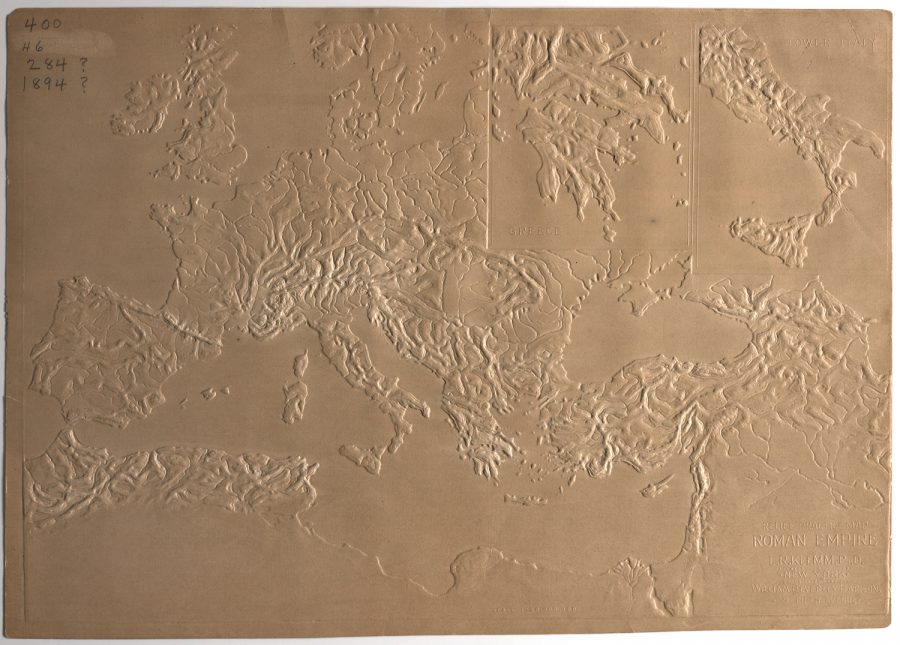
From curb cuts to safer playgrounds, the public spaces we occupy have been transformed for the better as they become easier for different kinds of bodies to navigate. Closed captioning and printable transcripts benefit millions, whatever their level of ability. Accessibility tools on the web improve everyone’s experience and provide the impetus for technologies that engage more of our senses. While smell may not be a high priority for developers, attention to a sense most sighted people tend to take for granted could open up an age of using feedback systems to make visual media touch responsive.
One such tactile system designed for Smithsonian Museums has developed “new methods for fabricating replicas of museum artifacts and other 3D objects that describe themselves when touched,” reported the National Rehabilitation Information Center in a February post for Low Vision Awareness Month. “Depth effects are achieved by varying the height of relief of raised lines, and texture fills help improve awareness of figure-ground distinctions.” Haptic feedback technology, like that the iPhone and various video game systems have introduced over the past few years, promises to open up much more of the world to the visually-impaired… and to everyone else.
One invention introduced over a century ago held out the same promise. The tactile map, “an innovation of the 19th century,” writes Rebecca Onion at Slate, “allowed both blind and sighted students to feel their way across a given geography.” One popularizer of the tactile map, former school superintendent L.R. Klemm, who made the example above, believed that “while the waterproof map could be used to teach students without sight,” it could also “fruitfully engage sighted students through the sense of touch.”
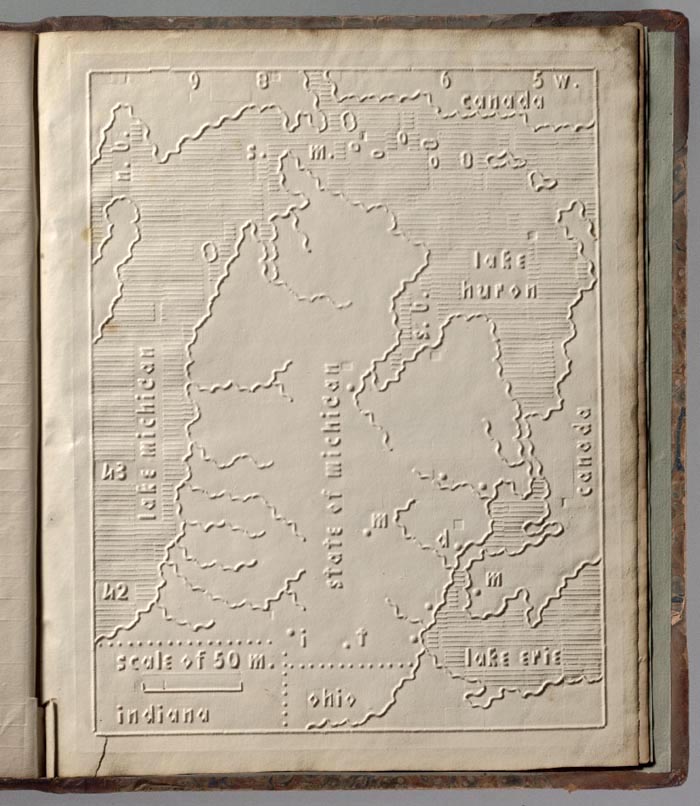
Though created in Europe, tactile maps have had a relatively long history in the U.S., debuting in 1837 with an atlas of the United States developed by Samuel Gridley Howe of the Perkins School for the Blind. (See Michigan above.) Klemm’s map up top, depicting the Roman Empire (284–476 CE), is a later entry, patented in 1888, and, he promises it’s a decided improvement on earlier models. In an article that year for The American Teacher, he described “the painstaking process of creating one of these relief maps,” notes Onion, “a process he used as another teaching tool, enlisting students to help him scrape and carve plaster casts into negative shapes of mountain ranges and plateaus.”
Those students, he wrote, developed “so clear a conception of the topography and irrigation of the respective country that it can scarcely be improved.” Tactile accuracy meant a lot to Klemm. In text published alongside the map, he took Howe and other publishers to task for raising water above land, an idea “so unnatural, that the mind never thoroughly becomes accustomed to it.” Klemm also critiques a French map of “very perfect construction.” This handmade version, he says, though ingenious, is “expensive and very inefficient.” While its utility “in the case of institutions, and for the use of pupils of the wealthy classes is undoubted… the costliness of maps constructed on such a principle places the advantages of the system beyond the reach of the blind generally.”
Klemm’s concern for the quality, accuracy, utility, and economic accessibility of this early accessibility tool is admirable. And though you can’t experience it through your screen, his method is probably a vastly-improved way of learning geography for many people, sighted or not. Tactile maps did not quite become general use technologies, but their digital progeny may soon have us all experiencing more of the world through touch. View and download a larger (2D) version of Klemm’s map and learn more at 19th Century Disability Cultures & Contexts.
via Slate
Related Content:
Vintage Geological Maps Get Turned Into 3D Topographical Wonders
A Radical Map Puts the Oceans–Not Land–at the Center of Planet Earth (1942)
Josh Jones is a writer and musician based in Durham, NC. Follow him at @jdmagness
Read More...An Animated Introduction to the Chaotic Brilliance of Jean-Michel Basquiat: From Homeless Graffiti Artist to Internationally Renowned Painter
By the late 1970s, New York City had fallen into such a shambolic state that nobody could have been expected to notice the occasional streak of additional spray paint here and there. But somehow the repeated appearance of the word “SAMO” caught the attention of even jaded Lower Manhattanites. That tag signified the work of Al Diaz and Jean-Michel Basquiat, the latter of whom would create work that, four decades later, would sell for over $110 million at auction, a record-breaking number for an American artist. But by then he had already been dead for nearly 20 years, brought down by a heroin overdose at 27, an age that reflects not just his rock-star status in life but his increasingly legendary profile after it.
“Born in 1960 to a Haitian father and a Puerto Rican mother, Basquiat spent his childhood making art and mischief in Boerum Hill,” Brooklyn, says University of Maryland art history professor Jordana Moore Saggese in the animated Ted-Ed introduction above. “While he never attended art school, he learned by wandering through New York galleries, and listening to the music his father played at home.”
He seems to have drawn inspiration from everything around him, “scribbling his own versions of cartoons, comic books and biblical scenes on scrap paper from his father’s office” (leading to a method that has something in common with William Burroughs’ cut-up techniques). He also spent a great deal of artistically formative time laid up in the hospital after a car accident, poring over a copy of Gray’s Anatomy given to him by his mother, which “ignited a lifelong fascination with anatomy that manifested in the skulls, sinew and guts of his later work.”
A skull happens to feature prominently in that $110 million painting of Basquiat’s, but he also made literally thousands of other works in his short life, having turned full-time to art after SAMO hit it big on the Soho art scene. The day job he quit was at a clothing warehouse, a position he landed, after a period of unemployment and even homelessness, when the company’s founder spotted him spray-painting a building at night. Success came quickly to the young Basquiat, but it certainly didn’t come without effort: still, when we regard his paintings today, don’t we feel compelled by not just what Saggesse calls a distinctive “inventive visual language” and hyper-referential “physical evidence of Basquiat’s restless and prolific mind,” but also of the glimpse they offer into the rare life lived at maximum productivity, maximum intensity, and maximum speed?
To delve deeper into the world of Basquiat, you can watch two documentaries online: Basquiat: Rage to Riches, and Jean Michel Basquiat-The Radiant Child.
Related Content:
The Odd Couple: Jean-Michel Basquiat and Andy Warhol, 1986
Google Puts Online 10,000 Works of Street Art from Across the Globe
Big Bang Big Boom: Graffiti Stop-Motion Animation Creatively Depicts the Evolution of Life
How to Jumpstart Your Creative Process with William S. Burroughs’ Cut-Up Technique
Based in Seoul, Colin Marshall writes and broadcasts on cities, language, and culture. His projects include the book The Stateless City: a Walk through 21st-Century Los Angeles and the video series The City in Cinema. Follow him on Twitter at @colinmarshall or on Facebook.
Read More...Jim Morrison Declares That “Fat is Beautiful” .… And Means It
There’s a bit of cognitive dissonance in a young rock god giving voice to the fat pride movement some four decades after his death.
Years before social media amplified celebrity weight gain coverage to the realm of national news, The Doors’ lead singer, Lizard King Jim Morrison, was the subject of intense bodily scrutiny.
The musician’s drug of choice—alcohol—swiftly added some extra cushioning to the sexy, shirtless young lion image photographer Joel Brodsky managed to capture in 1967.
That lean, leather-panted version is the one the Morrison director Patrick Smith went with for the Blank on Blank animation above, using audio from a 1969 interview with the Village Voice’s Howard Smith (no relation).
Occasionally animator Smith balloons the 2‑D Morrison’s belly for humorous effect, but let’s be frank. By today’s standards, the 5’11 Morrison, who by his own estimate tipped the scales at 185lb, was hardly “fat.”
Pleasingly plump perhaps…
Filling out…
Eating (and drinking) like someone whose bank account didn’t require belt tightening.
His compassion toward generously proportioned bodies likely sprang from early experience.
As photographer Linda McCartney recalled in Linda McCartney’s The Sixties—Portrait Of An Era:
He … told me that he’d grown up as a fat kid that no one wanted to know and that this had caused him a lot of emotional pain.
Then he explained what had brought it all to the surface. Apparently he had been walking around Greenwich Village that morning and a girl who he knew as a child had spotted him and started going crazy over him. That bothered him because he sensed the hypocrisy of it all. When he was a fat military brat these people had rejected and ignored him but now, because of his new public image, they were fawning over him.
That “new public image” is the one most of us think of first when thinking of Jim Morrison, but as a flesh and blood exemplar, it was unsustainable. Photographer Brodsky reflects:
The shot on the inner sleeve of the Greatest Hits album was pretty near the end, I think. By that time, he was so drunk he was stumbling into the lights and we had to stop the session. Morrison never really looked that way again, and those pictures have become a big part of The Doors’ legend. I think I got him at his peak.
Morrison didn’t dwell on childhood miseries in his Village Voice interview, nor did he show any self-loathing or regret for physiques past.
Rather, he gave voice to the positive effects of his increased size. He felt like a tank, a beast—a body of consequence.
(To consider the implications of bodily size for a female in Morrison’s world, have a look at cartoonist Pénélope Bagieu’s California Dreamin’: Cass Elliot before the Mamas and The Papas.)
Related Content:
“The Lost Paris Tapes” Preserves Jim Morrison’s Final Poetry Recordings from 1971
The Last Known Photos of Jim Morrison, Taken Days Before His Death in Paris (June 1971)
The Doors Play Live in Denmark & LA in 1968: See Jim Morrison Near His Charismatic Peak
Ayun Halliday is an author, illustrator, theater maker and Chief Primatologist of the East Village Inky zine. Join her in New York City March 11 for the next installment of her book-based variety show, Necromancers of the Public Domain. Follow her @AyunHalliday.
Read More...The Elaborate Pictogram Ernest Hemingway Received in the Hospital During WWI: Can You Decode Its Meaning?
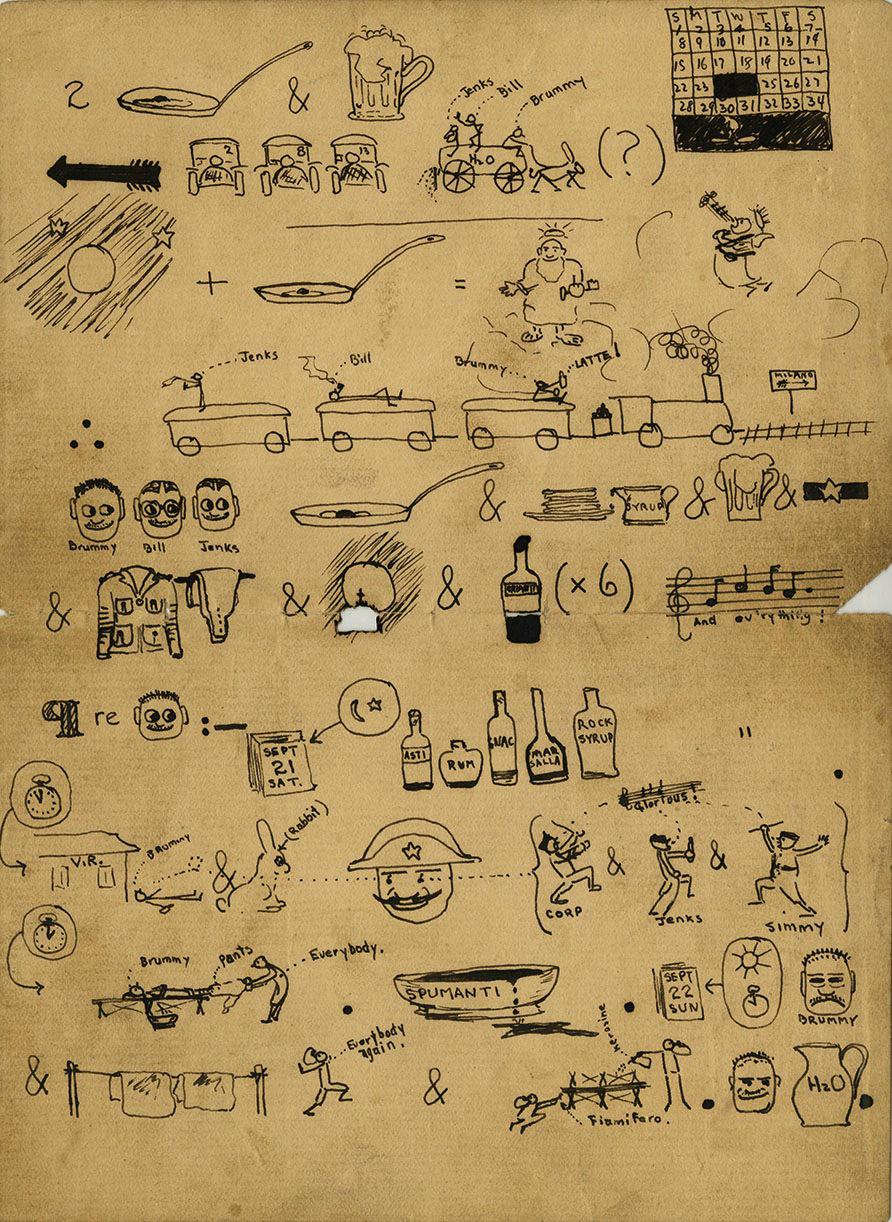
Everyone who knows the work of Ernest Hemingway knows A Farewell to Arms, and everyone who knows A Farewell to Arms knows that Hemingway drew on his experience as a Red Cross ambulance driver in Italy during World War I. Just a few months after shipping out, the eighteen-year-old writer-to-be — filled, he later said, with “a great illusion of immortality” — got caught by mortar fire while taking chocolate and cigarettes from the canteen to the front line. Recovering from his wounds in a Milanese hospital, he fell in love with an American nurse named Agnes Hannah von Kurowsky, who would become the model for Catherine Barkley in A Farewell to Arms.
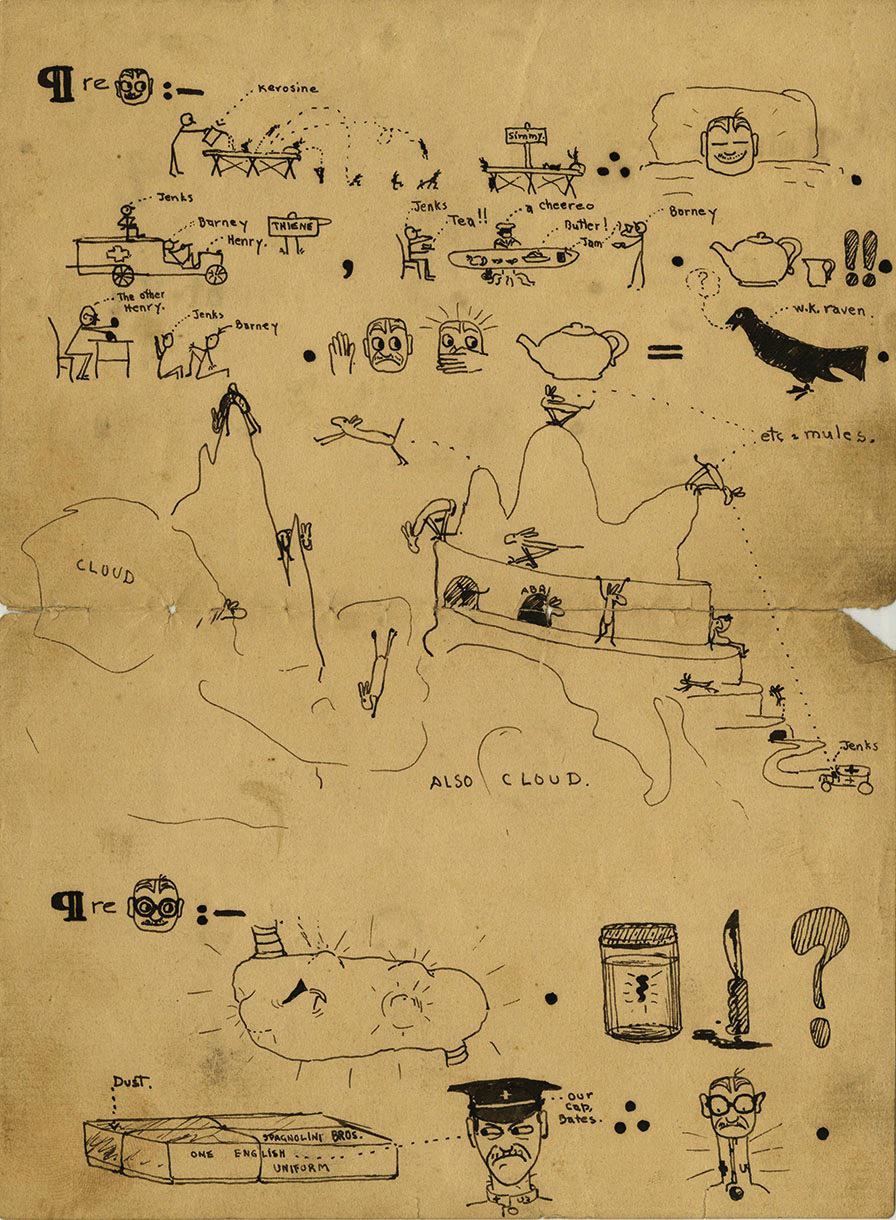
Hemingway wrote that novel years after Kurowsky had left him for an Italian officer, but when their prospects still looked good, they received this curious letter, which at first glance looks like nothing more than a few pages of doodles. “We think it may be a rebus or another type of pictogram that uses pictures to represent words, parts of words, or phrases,” wrote Jessica Green, an intern at the John F. Kennedy Presidential Library where it turned up, in 2012. “Can you help us solve this puzzle?” Quite a few Hemingway-enthusiast commenters dutifully got to their interpretive work below Green’s post, bringing to bear their knowledge of the writer’s life and work on these animals, musical notes, grinning faces, and mugs of beer, all strung together with logic symbols.
If you need a hint, you might start with the apparent fact that the letter came from three of Hemingway’s ambulance-driver buddies. “The letter is a cheerful narrative of the three friends’ recent hijinks,” writes Slate’s Rebecca Onion. “In the salutation, the writers used a foaming mug of beer to represent Hemingway’s name (he was often called ‘Hemingstein’); clearly, these were men who shared Hemingway’s love for inebriation.” But even before they addressed good old Hemingstein, they addressed Kurowsky — as, in the visual language invented for their purposes, a frying pan with an egg in it. “Ag sounds like egg,” explains the decipherment Green later posted to the JFK Library’s blog.
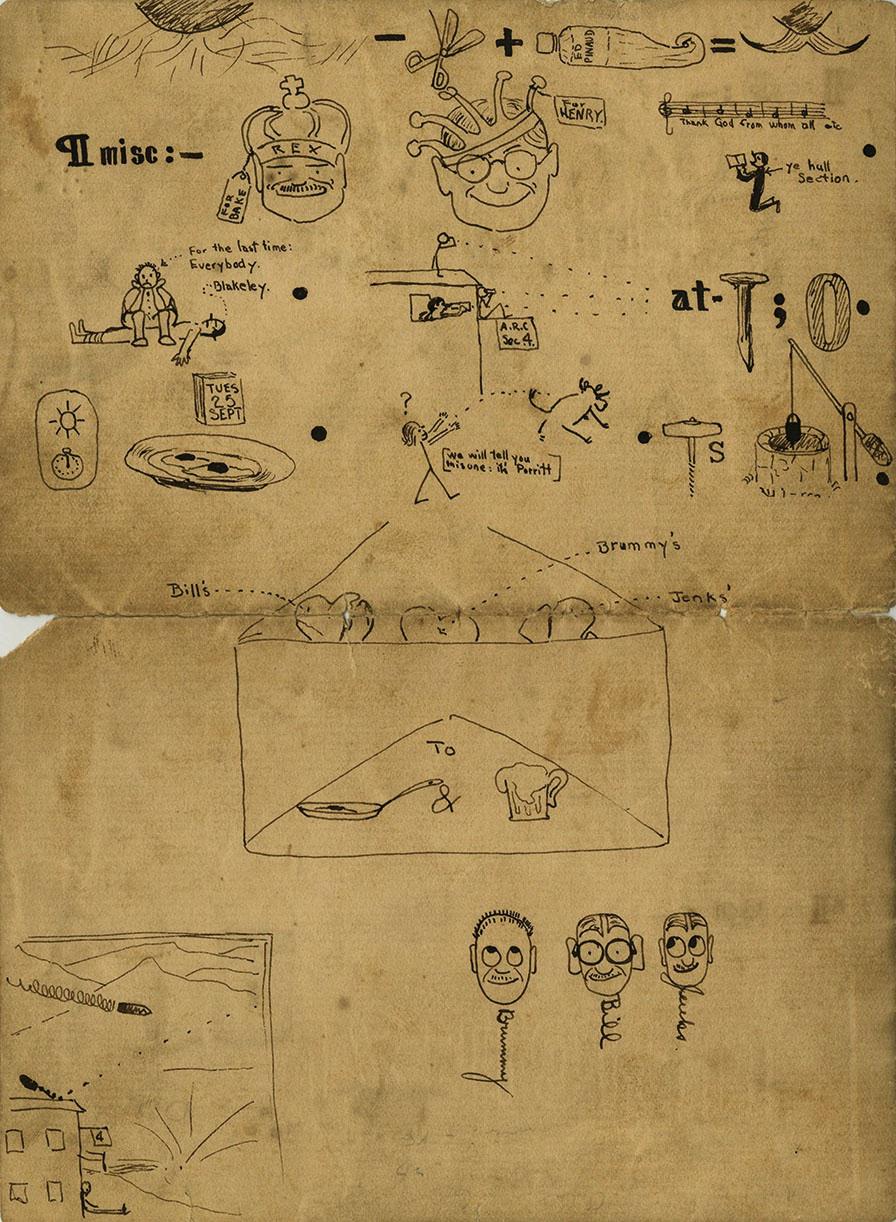
Green goes on to break down the pictographic letter section by section, from Brummy, Bill, and Jenks’ plans to take leave time and come to Milan, Brummy’s unfortunate recent experience with “mixed drinks made from Asti Spumanti, Rum, Cognac, Marsala, and Rock Syrup,” Jenks’ driving of the bedbugs in his bed into that of another driver, and the glorious results of Bill’s trimming and waxing of his mustache, and more besides. To modern readers, the letter offers not just a glimpse into the sensibilities of Hemingway’s social circle but life on the Italian front in 1918. And for Hemingway himself, receiving such an amusing piece of correspondence during six long months of recuperation in the hospital must surely have done something to lift the spirits, though what effect its distinctive compositional style may have had on his own writing seemingly remains to be studied.
Click here to read a decoding of this pictogram from 1918.
Related Content:
Ernest Hemingway’s Very First Published Stories, Free as an eBook
Ernest Hemingway Creates a Reading List for a Young Writer (1934)
Seven Tips From Ernest Hemingway on How to Write Fiction
Hear Hemingway Read Hemingway, and Faulkner Read Faulkner (90 Minutes of Classic Audio)
Ernest Hemingway’s Favorite Hamburger Recipe
Based in Seoul, Colin Marshall writes and broadcasts on cities, language, and culture. His projects include the book The Stateless City: a Walk through 21st-Century Los Angeles and the video series The City in Cinema. Follow him on Twitter at @colinmarshall or on Facebook.
Read More...Support Us
We're hoping to rely on loyal readers, rather than erratic ads. Please click the Donate button and support Open Culture. You can use Paypal, Venmo, Patreon, even Crypto! We thank you!

About Us

Open Culture scours the web for the best educational media. We find the free courses and audio books you need, the language lessons & educational videos you want, and plenty of enlightenment in between.
Advertise With Us

FREE UPDATES!
GET OUR DAILY EMAIL
Get the best cultural and educational resources on the web curated for you in a daily email. We never spam. Unsubscribe at any time.
FOLLOW ON SOCIAL MEDIA

Open Culture editor Dan Colman scours the web for the best educational media. He finds the free courses and audio books you need, the language lessons & movies you want, and plenty of enlightenment in between.
Advertise With Us


