Download 10,000+ Books in Arabic, All Completely Free, Digitized and Put Online

If you’ve considered learning a new language to open up a new realm of reading, you could do much worse than Arabic. Though its mastery may demand a considerable amount of time, it repays the investment as the language of not just a country but an entire region of the world, and a region with a deep textual history at that. Anyone interested in becoming a student of Arabic, casually or seriously, can get their start at our collection of Arabic lessons available free online, and when up to speed on reading might consider a visit to Arabic Collections Online (ACO), a digital library of Arabic-language texts now boasting 10,042 volumes across 6,265 subjects, all of them also available free online.

With a list of contributing partners including institutions in both America (New York University, Princeton, Cornell, Columbia) and the Middle East (the American University in Cairo, the American University of Beirut and United Arab Emirates National Archives) — and, as ArabLit notes, a $1.34 million grant received last August — ACO “aims to digitize, preserve, and provide free open access to a wide variety of Arabic language books in subjects such as literature, philosophy, law, religion, and more.”
This mission addresses not just a lack of widely available Arabic texts on the web, but the condition of much of the material digitized, as “many older Arabic books are out-of-print, in fragile condition, and are otherwise rare materials that are in danger of being lost.”

Though clearly an ever more valuable resource for students of Arabic, ACO has much more to offer those already acquainted with the joys of the language. ArabLit specifically points out two of its featured Egyptian titles this month, Tawfiq al-Hakim’s Return of the Spirit (عودة الروح), which English translator William Maynard Hutchins describes as “a gloriously Romantic tribute to the solidarity of the Egyptian people of all classes and religions and to their good taste and excellent sense of humor,” andColors (ألوان) by Taha Hussein, one of the country’s most influential intellectuals of the 20th century. But the full scope of Arabic-language literature, as the already vast holdings of Arabic Collections Online reveals, extends beyond Egypt, and far indeed beyond the past couple of centuries. To those about to explore it,bil-tawfiq.

Related Content:
How Arabic Translators Helped Preserve Greek Philosophy … and the Classical Tradition
A Map Showing How Much Time It Takes to Learn Foreign Languages: From Easiest to Hardest
Based in Seoul, Colin Marshall writes and broadcasts on cities, language, and culture. His projects include the book The Stateless City: a Walk through 21st-Century Los Angeles and the video series The City in Cinema. Follow him on Twitter at @colinmarshall or on Facebook.
Read More...Hear Underground 12, the Earliest Known Case of Musicians Recording While Under the Influence of LSD (1966)
Music and LSD: after “Tomorrow Never Knows” and Sgt. Pepper, we knew what an acid trip should sound like. Other folks needed to know more. Somewhere in Los Angeles in 1966 a group of musicians were dosing and recording while tripping.
The resulting recording–credited to “Underground 12” and considered the earliest known case of musicians recording while under the influence of LSD–was only available, as the legend goes, by mail order–you can see a copy of it here on discogs, a plain red label with only an address: 12457 Ventura Blvd. in Studio City, CA. A little bit of Google snooping revealed this to be an office for Huntington Park First Savings and Loan in 1966, but assuming there was another office there, an issue of Billboard from that year also mentions an artist manager called Bob Reed at the same address. (Bob, we’re on to you!).
There’s nothing particularly groovy about this music. There’s no sitars, no fuzz pedals, no incense, no peppermints. There is, however, a lot of echo and delay, a lot of sped up tape (which in parts sounds a bit like Zappa’s “King Kong”), plenty of atonal laughing, and welp, that’s about it for side one.
Side two is a bit better, with an actual piano played at normal speed, and an electric guitar soloing against it. This sounds a bit proggy, about five years ahead of its time. But then the producer (Bob Reed, is that you again?) starts speeding up the tape again.
Con job or bad trip? Did these musicians know what they were in for? Did they really dose, or was studio trickery seen as a good enough placebo? Did the LSD produce some pretty ordinary studio jamming and the LP is a salvage job? So many mysteries, so little time.
Lysergia, a Swedish label that re-releases rare grooves such as this has also put out The Psychedelic Experience: The Ultimate Journey Through Late 60s Psychedelia, Acid Burns and Druggy Grooves by Patrick Lundborg, a Swedish writer whose subject was LSD, and rereleased the only album by Madrigal, a Morristown, New Jersey twosome which has a 13-minute track called “Stoned Freakout.”
However if the above sampler thrills you and you would like to own an original copy of this dubious classic by the Underground 12, it will set you back $666. The seller, obviously, knows what’s up.
Related Content:
Ted Mills is a freelance writer on the arts who currently hosts the artist interview-based FunkZone Podcast and is the producer of KCRW’s Curious Coast. You can also follow him on Twitter at @tedmills, read his other arts writing at tedmills.com and/or watch his films here.
Read More...The 100 Top Punk Songs of All Time, Curated by Readers of the UK’s Sounds Magazine in 1981
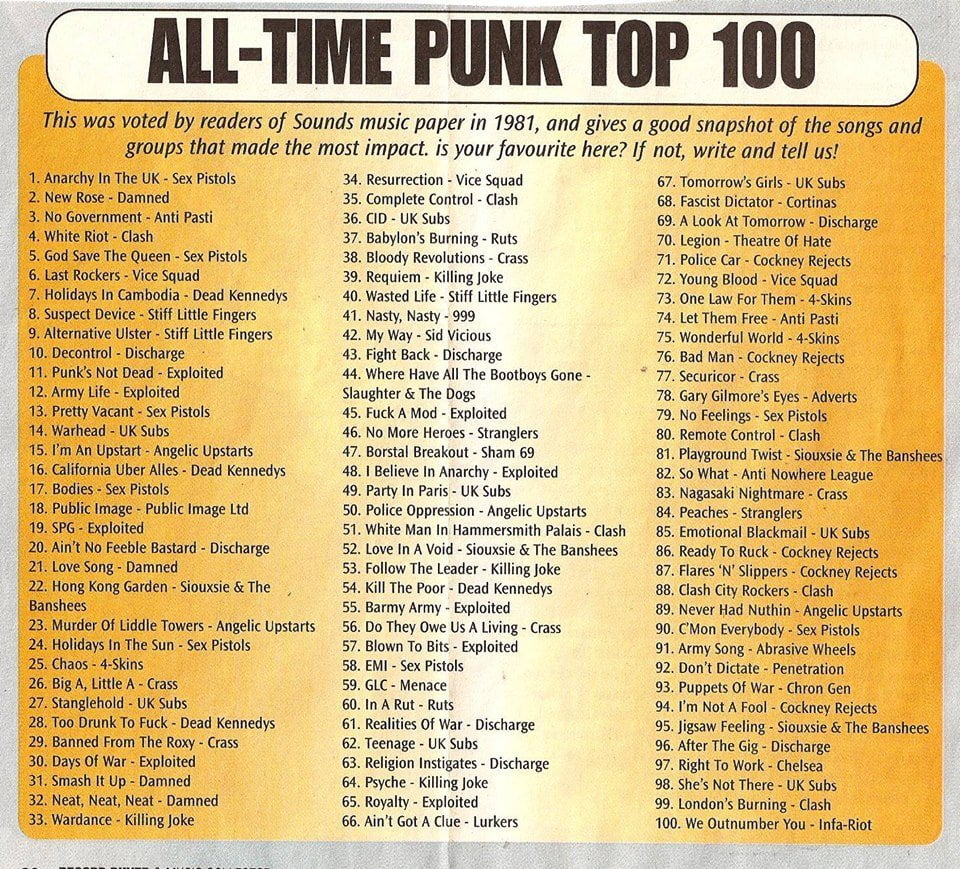
When did punk rock die? Everyone knows it happened sometime in recent history, but few people agree on when. The music still exists, in knowing quotation marks, but its winning combination of unforced abrasiveness and calculated offensiveness seems to have disappeared. Maybe pick a year at random; say, 2010, the year the last great punk songwriter, Jay Reatard, died. It also happens to be the year the last great punk band, OFF!, formed, but they’re a supergroup of classic punk musicians.
One could push that date back into any decade and make reasoned arguments. One snarling purist even once wrote that punk died in 1977 when the Clash signed to CBS. Maybe he was on to something. The following year, it was post-punk, with Johnny Rotten, aka Lydon, releasing his post-Sex Pistol’s project Public Image Limited’s first album, First Issue. Also in 1978, Siouxsie and the Banshees released their debut album, a statement for the spikiness and melodrama of post punk if there ever was one.
By 1981, a year someone might also choose to etch on punk’s tombstone, surviving members of post-punk darlings Joy Division had reformed into New Order and released their first album, Movement. Declaring the death of punk sounds like a bummer, but many people found solace in the arms of new wave synthpop and acid house. Still, 1981 didn’t care about anyone’s punk opinions. A slew of now-classic punk and hardcore albums coexisted with the likes of Gary Numan—Black Flag’s Damaged and D.O.A.’s Hardcore ’81, classic albums from Crass, The Adicts, Adolescents, T.S.O.L., and, of course, The Exploited’s Punk’s Not Dead.
The list above (view it in a larger format here), the “All-Time Punk Top 100”—voted on in 1981 by readers of the “music paper” Sounds—contains a handful of songs from Siouxsie and the Banshees and Public Image Limited. Some people might choose to split hairs. The Exploited make many appearances, as do the Sex Pistols, The Clash, UK Subs, Discharge and other British stalwarts. The heavy UK lean is to be expected from readers of the short-lived UK music mag, but the fact that there are no Ramones, no Dead Boys, no Stooges, no Blondie, no Black Flag even… can begin to feel downright insulting.
Maybe punk just looked different on the other side of the pond in 1981. If it looked like the all-time top 100 list, then it sounded like the playlist above (stream it on Spotify here), which collects these 100 best-ofs, or greats, or not so greats, or clearly misguided choices, or whatever. Enjoy it as you furiously correct it with your own picks.
Related Content:
The History of Punk Rock in 200 Tracks: An 11-Hour Playlist Takes You From 1965 to 2016
Stream a Playlist of 68 Punk Rock Christmas Songs: The Ramones, The Damned, Bad Religion & More
Josh Jones is a writer and musician based in Durham, NC. Follow him at @jdmagness
Read More...All the Rembrandts: The Rijksmuseum Puts All 400 Rembrandts It Owns on Display for the First Time
If you’ve wanted to see some Rembrandts, as most every art lover has, you’ve wanted to go to the Rijksmuseum. The jewel in the crown of the Netherlands’ most popular museum must surely be Rembrandt’s masterpiece The Night Watch, whose latest restoration will stream live this summer. But Rembrandt enthusiasts planning their first trip to the Rijksmuseum only after the completion of that restoration may want to reconsider, given that between now and June, they can see not just some Rembrandts, but all the Rembrandts.
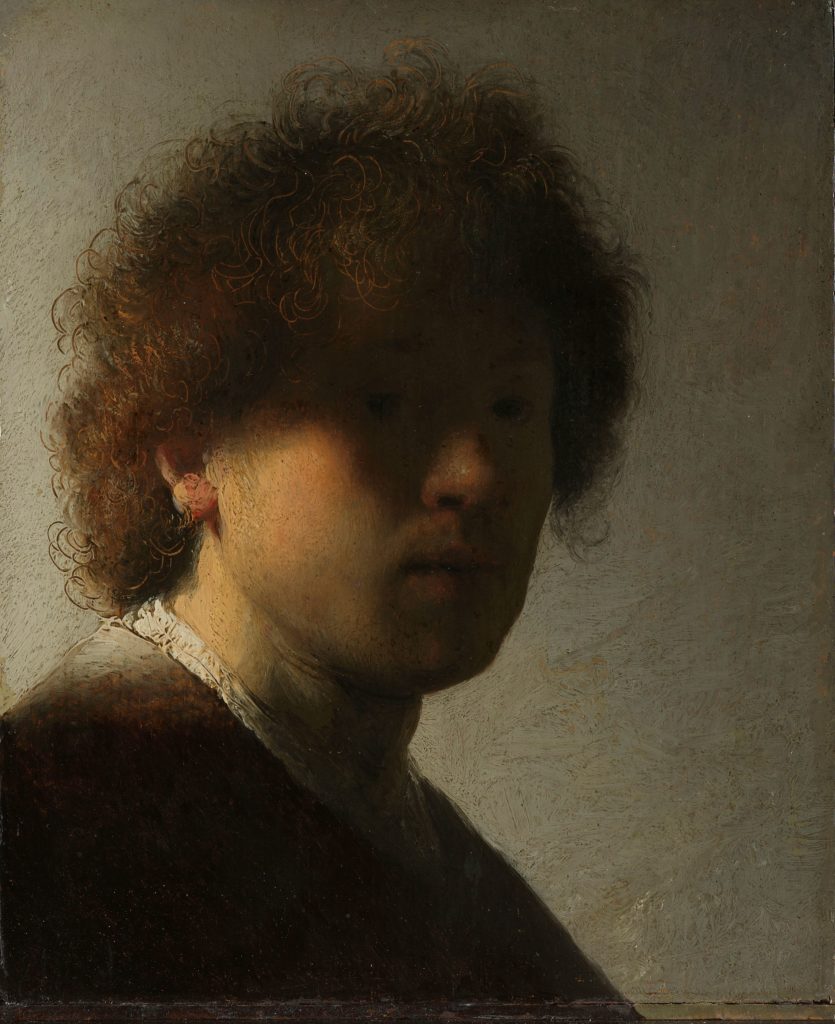
“Rijksmuseum marks the 350th anniversary of Rembrandt’s death in 2019 with ‘Year of Rembrandt,’” says the museum’s site. “The year-long celebration opens with All the Rembrandts, in which the Rijksmuseum will present for the first time an exhibition of all 22 paintings, 60 drawings and more than 300 best examples of Rembrandt’s prints in its collection.”
And “given the extreme rarity that many of these delicate drawings and prints go on display, All the Rembrandts offers a once-in-a-lifetime opportunity to glean an unparalleled perspective on Rembrandt the artist, the human, the storyteller, the innovator.”
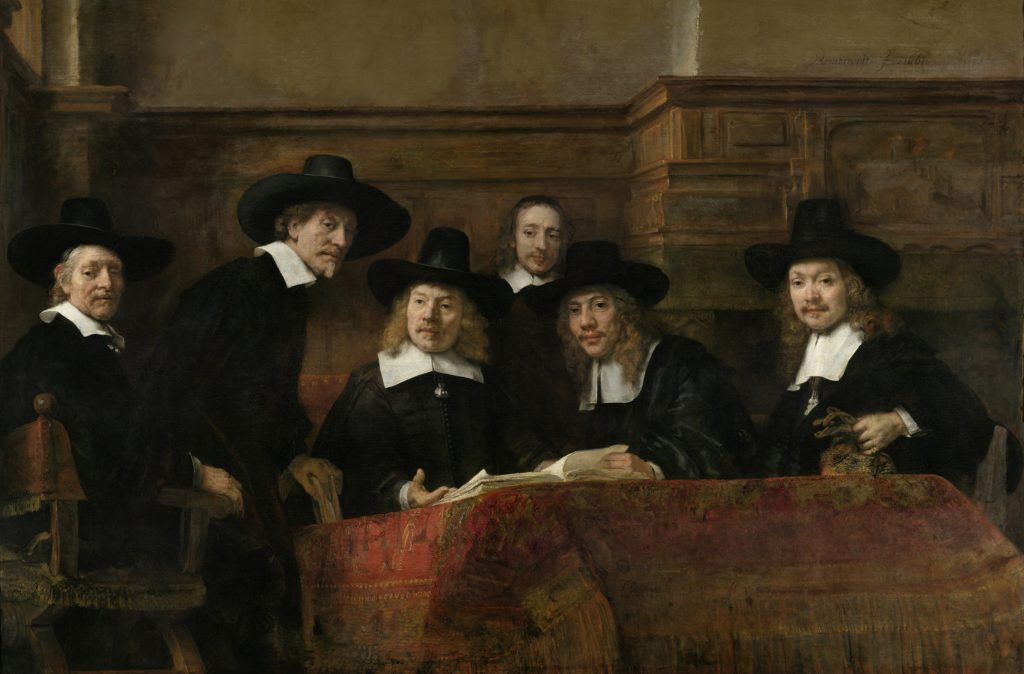
As a project, assembling all 400 of its Rembrandts into a single coherent exhibition aligns with the impressive ambition the Rijksmuseum has shown in other areas, from restoration to digitization. Visitors will experience not just the scope of the work of that Dutch master among Dutch masters, but the span of his life. The first section, featuring Rembrandt’s self-portraits, “presents the milestones of his career as a young artist”; the second “focuses on Rembrandt’s surroundings and the people in his life,” family, friends, his wife, and even the variety of characters that populated the 17th-century Amsterdam around him; the third and final section reveals Rembrandt the storyteller, as seen in his paintings inspired by the Old Testament. But he may never have told a more enduringly fascinating story than he did in The Night Watch, which will naturally retain its pride of place amid All the Rembrandts.
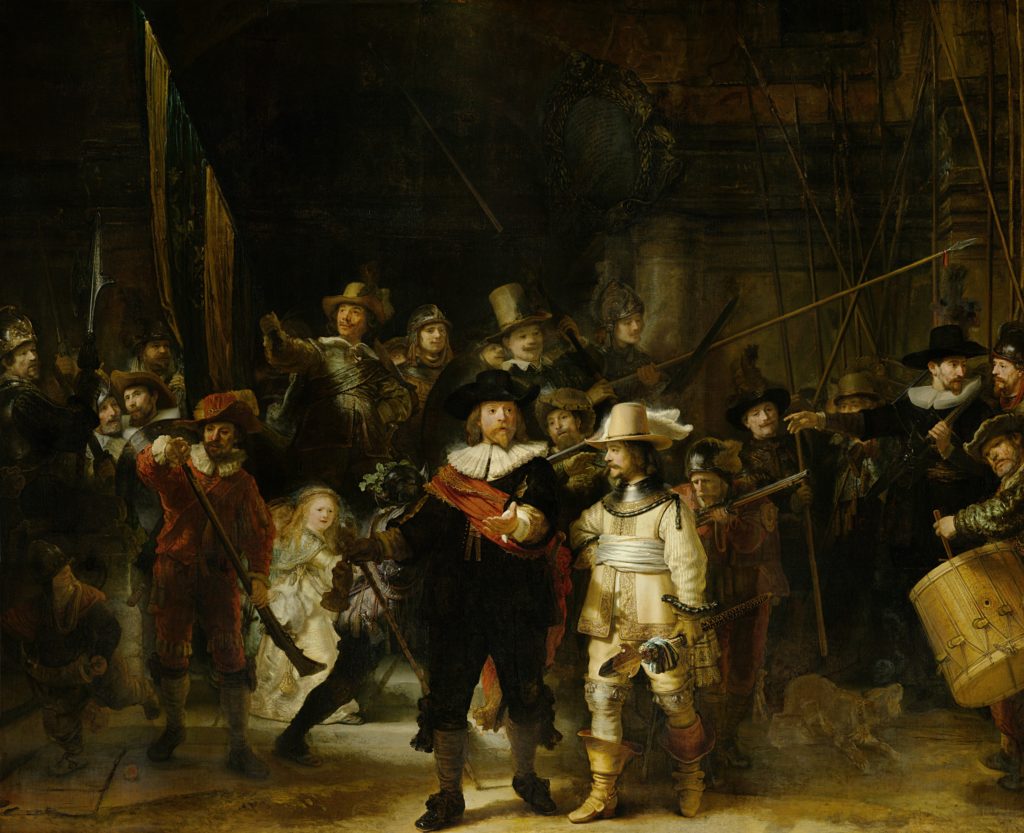
“The 11- by 15-foot large painting shows a flurry of activity,” Smithsonian.com’s Marissa Fessenden writes of that painting. “In the center of the scene, a captain gives orders to a lieutenant as the two stride forward. A musket goes off just behind the lieutenant’s hat, additional figures behind the main ones are visible only as limbs or partial faces. A boy runs off to the side with a gunpowder horn and a dog cowers near a drummer beating out a rhythm.” That same degree of excitement will no doubt be on display among the crowds drawn by All the Rembrandts itself. If you plan on joining them, consider downloading the Rijksmuseum’s audio tour app first. If you can’t make it — or if you must insist on waiting to see the fully restored Night Watch — you can still view all the Rijksmuseum’s Rembrandts online.
Related Content:
The Rijksmuseum Puts 125,000 Dutch Masterpieces Online, and Lets You Remix Its Art
What Makes The Night Watch Rembrandt’s Masterpiece
300+ Etchings by Rembrandt Now Free Online, Thanks to the Morgan Library & Museum
Based in Seoul, Colin Marshall writes and broadcasts on cities, language, and culture. His projects include the book The Stateless City: a Walk through 21st-Century Los Angeles and the video series The City in Cinema. Follow him on Twitter at @colinmarshall or on Facebook.
Read More...A Brief Animated Introduction to Noam Chomsky’s Linguistic Theory, Narrated by The X‑Files’ Gillian Anderson
How is it that children just entering toddlerhood pick up the structure of their respective languages with ease? They are not formally taught to use speech; they have limited cognitive abilities and a “poverty of stimulus,” given their highly circumscribed environments. And yet, they learn the function and order of subjects, verbs, and objects, and learn to recognize improper usage. Children might make routine mistakes, but they understand and can be understood from a very early age, and for the most part without very much difficulty. How?
These are the questions that confronted Noam Chomsky in the early years of his career in linguistics. His answers produced a theory of Universal Grammar in the 1960s, and for decades, it has been the reigning theory in the field to beat, initiating what is often referred to as the “Chomskyan Era,” a phrase the man himself dislikes but which nonetheless sums up the kinds of issues that have been at stake in linguistics for over fifty years.
Questions about language acquisition have always been the subject of intense philosophical speculation. They were folded into general theories of epistemology, like Plato’s theory of forms or John Locke’s so-called “blank slate” hypothesis. Variations on these positions surface in different forms throughout Western intellectual history. Descartes picks up Plato’s dualism, arguing that humans speak and animals don’t because of the existence of an immortal “rational soul.” Behaviorist B.F. Skinner suggests that operant conditioning writes language onto a totally impressionable mind. (“Give me a child,” said Skinner, “and I will shape him into anything.”)
Chomsky “gave a twist” to this age-old debate over the existence of innate ideas, as Gillian Anderson tells us in the animated video above from BBC 4’s History of Ideas series. Chomsky’s theory is biolinguistic: it situates language acquisition in the structures of the brain. Not being himself a neurobiologist, he talks of those theoretical structures, responsible for reproducing accurate syntax, as a metaphorical “language acquisition device” (LAD), a hardwired faculty that separates the human brain from that of a dog or cat.
Chomsky’s theory has little to do with the content of language, but rather with its structure, which he says is universally encoded in our neural architecture. Children, he writes, “develop language because they’re pre-programmed to do this.” Syntax is prior to and independent of specific meaning, a point he demonstrated with the poetic sentence “Colorless green ideas sleep furiously.” Every English speaker can recognize the sentence as grammatical, even very small children, though it refers to no real objects and would never occur in conversation.
Conversely, we recognize “Furiously sleep ideas green colorless” as ungrammatical, though it means no more nor less than the first sentence. The regional variations on word order only underline his point since, in every case, children quickly understand how to use the version they’re presented with at roughly the same developmental age and in the same way. The existence of a theoretical Language Acquisition Device solves the chicken-egg problem of how children with no understanding of and only a very limited exposure to language, can learn to speak just by listening to language.
Chomsky’s theory was revolutionary in large part because it was testable, and researchers at the professor’s longtime employer, MIT, recently published evidence of a “language universal” they discovered in a comparative study of 37 languages. It’s compelling research that just might anticipate the discovery of a physical Language Acquisition Device, or its neurobiological equivalent, in every human brain.
Related Content:
Watch Michel Gondry Animate Philosopher, Linguist & Activist Noam Chomsky
The Ideas of Noam Chomsky: An Introduction to His Theories on Language & Knowledge (1977)
Noam Chomsky Defines What It Means to Be a Truly Educated Person
Josh Jones is a writer and musician based in Durham, NC. Follow him at @jdmagness
Read More...Watch Marc Martel, Who Supplied Vocals for the Award-Winning Queen Film, Sing Just Like Freddie Mercury: “Bohemian Rhapsody,” “We Are The Champions” & More
Understandably, given a moviegoing public seemingly starved for reality, all of the biggest winners at this year’s Academy Awards were based on true events. And nearly all of them have generated huge controversies for the liberties they took with those true stories. While some of the criticism can sound censorious, none of it is about censorship, but about the larger social question of how much truth we should sacrifice for the sake of commerce and entertainment, two human endeavors with which education cannot compete.
One of those big Oscar contenders, the Freddie Mercury biopic Bohemian Rhapsody, strays from the facts in ways some have even deemed “harmful.” But in one respect, at least—and perhaps the most important given its subject—it is faithful.
The film gets the music right, in part by syncing best actor-winner Rami Malek’s onstage performances as Mercury with Mercury’s actual voice, and sometimes with the voice of Marc Martel, “a vocal doppelgänger for the Queen frontman,” as Gavin Edwards writes at The New York Times, with a “prominent but invisible role in Bohemian Rhapsody.”
Audiences will not know when it’s Mercury or Martel, though the singer has received “fleeting ‘additional vocals’ billing” in the film. A nondisclosure agreement keeps Martel from telling—and he didn’t know until the film premiered which scenes would feature his voice. But the fact that audiences will likely never tell the difference is remarkable. Even Queen drummer Roger Taylor told Martel, “When I listen to you sing it’s like Freddie walked into the room.” This was the moment, the singer says, when he embraced the likeness, which he hadn’t thought very much of in the past. “It’s different from what I envisioned doing as a young musician.”
Martel’s other gig was as the lead singer of a Christian rock band called Downhere (he says nothing about how his particular sect views Mercury’s sexuality). He began performing Queen covers during a hiatus and has since appeared on American Idol, released an album of Queen covers, and is now touring in a tribute show, “The Ultimate Queen Celebration.” Martel is not a Mercury clone, nor has he ever attempted to be. He can “itemize the subtle differences” between his voice and Freddie’s, Edwards writes:
I’m not British, so I don’t usually sing with an accent. I don’t have extra teeth like he did, so my Ss come out normally — his were very piercing. But even if I don’t try to sing like Freddie Mercury, people still hear him in my voice, no matter what I do. I have this weird unique thing where I can sound like him, so why wouldn’t I?
It has become a highly marketable skill that’s “paying the bills right now,” as his manager put it, though Martel is eager to get back to his own songwriting. But even if he wasn’t celebrated at the Oscars, he’s proud of his contribution to the film, and to the lives of Queen fans. “It brings people so much joy and nostalgia,” Martel says, “and frequently I see people tearing up in the front row.” Whether or not you are a fan of Bohemian Rhapsody, the movie, you’ll be bowled over by the uncanny fidelity of Martel’s Mercury renditions (his features even resemble Mercury’s when he starts singing). Here, see Martel sing “Bohemian Rhapsody,” at the top, “We Are the Champions,” further up, and, above, a stunning rendition of “Love of My Life.”
Related Content:
Hear Freddie Mercury’s Vocals Soar in the Isolated Vocal Track for “Somebody to Love”
Josh Jones is a writer and musician based in Durham, NC. Follow him at @jdmagness
Read More...The New Normal: Spike Jonze Creates a Very Short Film About America’s Complex History with Cannabis
In two short minutes, director Spike Jonze takes you from the hemp farms of George Washington to Reefer Madness and America’s long, costly prohibition against cannabis–a prohibition that’s now getting dismantled state by state. Narrated by actor Jesse Williams, the short was made for MedMen, an American publicly traded company that provides “a wide range of … high quality cannabis products.” Welcome to the new normal.…
Related Content:
Carl Sagan on the Virtues of Marijuana (1969)
Read More...The Life & Work of Edvard Munch, Explored by Patti Smith and Charlotte Gainsbourg
Look beyond the highly distressed genderless figure in the foreground of The Scream, one of the most famous painting in existence, and you’ll find plenty of women. While its painter Edvard Munch was a man, as his name might suggest, the rest of his body of work featured not a few female bodies: 1895’s Woman in Three Stages, 1896’s Young Woman on the Beach, and in 1907’s The Sick Child, a highly personal work by an artist whose mother and sister both died of tuberculosis. Or take 1895’s Madonna: “However dramatically effective Munch’s use of color was,” writes Michael Spens of its black-printed version, “this option for black to express a mood of despair persisted, and worked with many successful results.”
It was significant, Spens adds, that Munch’s “depressive tendency was frequently induced by women, or by Munch’s personal lack of success in love thereby, as reflected in his own affairs.” The painter may have had plenty of “trouble with women” in life, as the title of Spens’ essay puts it, and even now, 75 years after his death, he may find himself occasionally charged with possessing an objectifying male gaze.
But that hardly stops artistically powerful women from admiring and even championing his work: singer-songwriter, poet, and visual artist Patti Smith and actress and singer Charlotte Gainsbourg, for instance, both appear in the short Nowness documentary above to “delve into the proto-existentialist ideas and psychological themes” of that work at “Between the Clock and the Bed,” a Munch exhibition that toured a few years ago.
Walking through the gallery, Smith says she’s been “looking at Munch paintings for maybe 60 years, since I was very young.” Looking at 1913–14’s Weeping Nude, another of Munch’s women, Gainsbourg comments that “the choice of colors is incredible, because they’re quite ugly, but the whole thing is incredibly beautiful.” To describe the beauty of 1895’s Death in the Sickroom, Smith explains that the painting “expresses not the death as much as the effect the death has on others.” But for all he understood about others, Munch remained a man isolated, “convinced that in order to be able to fully express yourself artistically you have to be alone,” in the words of Munch Museum art historian Nikita Mathias. “You have to be an outsider, you need a certain distance to society in order to be able to describe what’s going on there” — a sentiment that can’t but resonate with Smith, Gainsbourg, and other creators so fully themselves.
Related Content:
Explore 7,600 Works of Art by Edvard Munch: They’re Now Digitized and Free Online
30,000 Works of Art by Edvard Munch & Other Artists Put Online by Norway’s National Museum of Art
Edvard Munch’s Famous Painting “The Scream” Animated to the Sound of Pink Floyd’s Primal Music
The Edvard Munch Scream Action Figure
Patti Smith, The Godmother of Punk, Is Now Putting Her Pictures on Instagram
Patti Smith’s 40 Favorite Books
Based in Seoul, Colin Marshall writes and broadcasts on cities, language, and culture. His projects include the book The Stateless City: a Walk through 21st-Century Los Angeles and the video series The City in Cinema. Follow him on Twitter at @colinmarshall or on Facebook.
Read More...The Lifespan of Ancient Civilizations Detailed in a Handy Infographic: Are We Headed Towards Our Own Collapse?
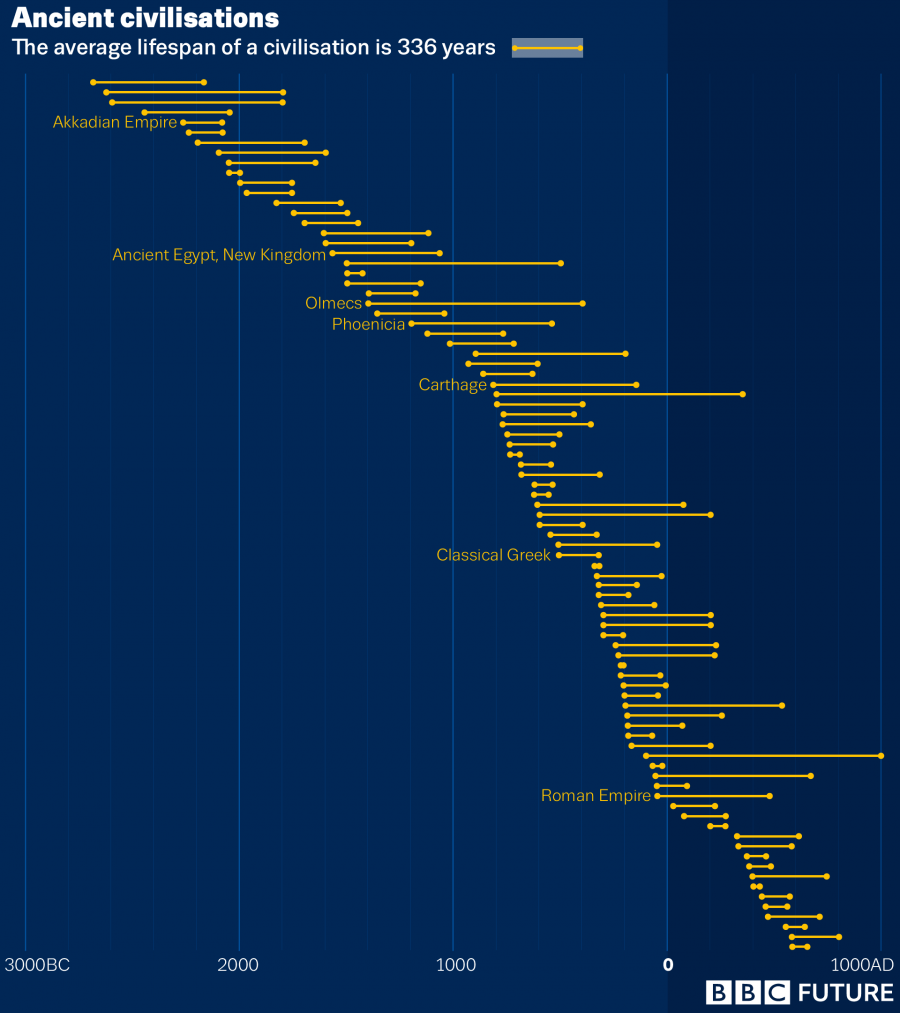
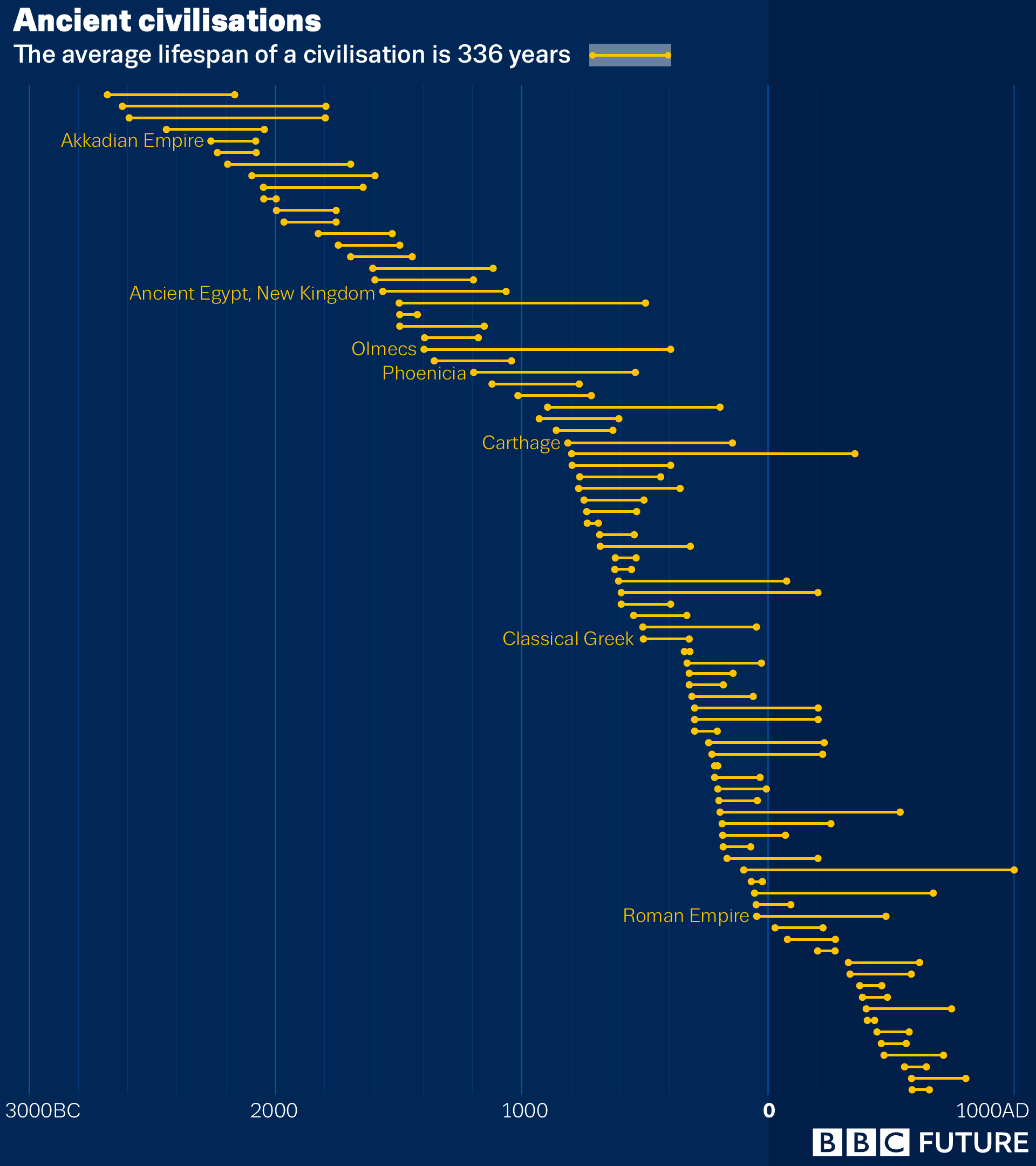
Anyone living in the West today surely feels they’ve heard quite enough about its decline. (Unless, of course, they’re fans of 1980s punk rock.) Given how long civilizations usually outlive individuals, how can an individual grasp the prospects for longevity of the civilization in which they find themselves? History, a discipline which has long had everything to do with charting the rise and fall of settlements, cultures, and empires, can provide the context necessary for understanding, but more of it has been written than even a human with the lifespan of a civilization can digest. Come to provide some clarity is Luke Kemp of Cambridge’s Centre for the Study of Existential Risk, creator of the infographic above. View it here in a larger format, courtesy of the BBC.
“There is no strict definition of civilisation,” Kemp admits, “nor an overarching database of their births and deaths.” This forced him to come up with his own definition for this infographic: “as a society with agriculture, multiple cities, military dominance in its geographical region and a continuous political structure. Given this definition, all empires are civilisations, but not all civilisations are empires.”
What comes at the end of virtually all of them, he calls a collapse: “a rapid and enduring loss of population, identity and socio-economic complexity. Public services crumble and disorder ensues as government loses control of its monopoly on violence.”
When civilizations have collapsed, as they’ve done with fair frequency over the past five millennia, “some recovered or transformed, such as the Chinese and Egyptian. Other collapses were permanent, as was the case of Easter Island. Sometimes the cities at the epicentre of collapse are revived, as was the case with Rome. In other cases, such as the Mayan ruins, they are left abandoned as a mausoleum for future tourists.” The Roman Empire, “the victim of many ills including overexpansion, climatic change, environmental degradation and poor leadership” before its sacking by the Visigoths in the year 410 and the Vandals in 455, has come up especially often in current discussions about the fate of the America-led Western — or even global — order.
The Roman Empire, as we can see on Kemp’s infographic, lasted 525 years: much longer than the Akkadian Empire, which lasted 187 years, but less than half as long as the African Aksumite Empire, which lasted 1100. “We may be more technologically advanced now,” Kemp writes,” but this gives little ground to believe that we are immune to the threats that undid our ancestors. Our newfound technological abilities even bring new, unprecedented challenges to the mix. ” Kemp names among the possible factors in the next big collapse climate change, environmental degradation, inequality and oligarchy, as well as plain randomness and bad luck. Given the inevitability of collapse, perhaps we can only hope that our civilization is ultimately succeeded by a superior one. But then, Kemp adds, ” “We will only march into collapse if we advance blindly. We are only doomed if we are unwilling to listen to the past.”
Related Content:
M.I.T. Computer Program Alarmingly Predicts in 1973 That Civilization Will End by 2040
In 1704, Isaac Newton Predicts the World Will End in 2060
The Rise & Fall of the Romans: Every Year Shown in a Timelapse Map Animation (753 BC ‑1479 AD)
The Western Tradition by Eugen Weber: 52 Video Lectures
Stewart Brand’s List of 76 Books for Rebuilding Civilization
The History of Civilization Mapped in 13 Minutes: 5000 BC to 2014 AD
Based in Seoul, Colin Marshall writes and broadcasts on cities, language, and culture. His projects include the book The Stateless City: a Walk through 21st-Century Los Angeles and the video series The City in Cinema. Follow him on Twitter at @colinmarshall or on Facebook.
Read More...To Save Civilization, the Rich Need to Pay Their Taxes: Historian Rutger Bregman Speaks Truth to Power at Davos and to Fox’s Tucker Carlson
Certain economists may have downgraded the labor theory of value, but most of us can agree on the basic moral intuition that no one person is worth millions, even billions, more than almost everyone else on the planet. Yet we live in a society that allows individuals to hoard millions and billions of dollars in cash, assets, and capital gains, without even the presumption that they demonstrate why they should have it–especially to the degree that the top 1% now holds more wealth than 90% in the U.S.
What social contract allows for this situation? I’m not personally interested in the answer from economists, though I imagine there are many excellently accredited proponents. The dominant assumptions in economics come from fantasies like ceteris paribus, “all else being equal,” and the concept of “externalities.” World historical inequality, political instability, and ecological devastation do not seem to pose serious problems for most mainstream economic thinking. But what do historians say? This is, after all, a historical question.
Many similar situations have obtained in the past. Sometimes they have resulted in bloody revolutions, sometimes sacking and pillaging, sometimes redistribution schemes. Noblesse oblige: land grants, endowments, hospitals, museums, universities… these have not only eased the consciences of the rich but have stood out as appeasing acts of public generosity. But the only thing that has really mitigated the conditions for societal collapse under capitalism?
According to Dutch historian and writer Rutger Bregman, it’s high taxes on high incomes and estates. It just so happened, however, at this year’s Davos World Economic Forum, as Bregman lamented in a Davos panel discussion, taxes were the one thing billionaires would not discuss. This was so, he observes, at a conference that features Sir David Attenborough “talking about how we’re wrecking the planet.”
I mean, I hear people talking the language of participation and justice and equality and transparency, but then, I mean, almost no one raises the real issue of tax avoidance, right? And of the rich are just not paying their fair share. I mean, it feels like I’m at a firefighter’s conference and no one’s allowed to speak about water.
Picturing firefighters hoarding water and refusing to share it while the planet is going up in flames is a sinister image, but maybe the intentions are beside the point. Even where tax rates are high(ish), governments go out of their way to allow companies and individuals to avoid paying them. Surely, many people believe this is necessary to create jobs? So what if those jobs lack security, benefits, or a living wage?
Bregman pulls back from the inflammatory metaphor to concede that one panel did address the issue. He was one of fifteen participants. We have to “stop talking about philanthropy,” he says, “and start talking about taxes,” just like Americans did in the supposedly halcyon days of the 1950s, when under Republican president Dwight D. Eisenhower the top marginal tax rate was 91%. He says this to people like Michael Dell, who once asked Bregman for an example of a 70% tax rate ever working.
Oxfam’s executive director Winnie Byanyima substantiates his polemic, noting globally “we have a tax system that leaks so much, that $170 billion” annually ends up in tax havens. This is wealth that is extracted from the planet’s resources, from government subsidies and the labor hours and health of grossly underpaid workers. Then it is disappeared. If you’ve seen this video, you’ve seen the charges of “one-sidedness” lobbed by former Yahoo CFO Ken Goldman from the audience. Byanyima’s response rebuts all of his talking points. She deserves her own cheerleading video edit.
Bregman took the same confrontational stance in an unaired interview with Fox’s Tucker Carlson. After Carlson seemed to agree with him, the historian bristled and pointed out that as “a millionaire funded by billionaires,” Carlson has faithfully represented and communicated the interests of his employers for decades, whether that’s the brutal scapegoating of immigrants or the defense of unlimited profiteering and huge tax cuts for the wealthy (and tax raises for everyone else). The host ends the interview sputtering insults and obscenities and sneers “I was willing to give you a hearing.” The problem requires more than a condescending pat on the head, Bregman argues.
His solution to massive inequality and unrest, universal basic income, is one that, like high marginal tax rates, once appealed to Republicans. The proposal has a long history, many serious detractors, and it’s also politically ignored. You can hear Bregman’s argument for it above, and against Margaret Thatcher’s ruthlessly ahistorical characterization of poverty as a “personality defect.” If you think UBI goes too far, or not nearly far enough, maybe you’d be interested in other ideas, like a 15-hour workweek and open borders, part of the “ideal world” Bregman says is possible in his book Utopia for Realists. You can download it as a free audiobook if you sign up for Audible’s free trial program.
Related Content:
Hear Alan Watts’s 1960s Prediction That Automation Will Necessitate a Universal Basic Income
Bertrand Russell & Buckminster Fuller on Why We Should Work Less, and Live & Learn More
Josh Jones is a writer and musician based in Durham, NC. Follow him at @jdmagness
Read More...Support Us
We're hoping to rely on loyal readers, rather than erratic ads. Please click the Donate button and support Open Culture. You can use Paypal, Venmo, Patreon, even Crypto! We thank you!

About Us

Open Culture scours the web for the best educational media. We find the free courses and audio books you need, the language lessons & educational videos you want, and plenty of enlightenment in between.
Advertise With Us

FREE UPDATES!
GET OUR DAILY EMAIL
Get the best cultural and educational resources on the web curated for you in a daily email. We never spam. Unsubscribe at any time.
FOLLOW ON SOCIAL MEDIA

Open Culture editor Dan Colman scours the web for the best educational media. He finds the free courses and audio books you need, the language lessons & movies you want, and plenty of enlightenment in between.
Advertise With Us