Discover the KattenKabinet: Amsterdam’s Museum Devoted to Works of Art Featuring Cats

Image by T_Marjorie, via Flickr Commons
There’s been quite a bit of barking in the media lately to herald the reopening of the American Kennel Club Museum of the Dog, relocating from St. Louis to New York City’s Park Avenue.
What’s a cat person to do?
Perhaps decompress within Amsterdam’s KattenKabinet…
In contrast to the Museum of the Dog’s glitzy, glass-fronted HQ, the Cat Cabinet maintains a fairly low profile inside a 17th-century canal house. (Several visitors have noted in their Trip Advisor reviews that the 3‑room museum’s grand environs help justify the €7 admission.)
The Museum of the Dog’s highly toted “digital experiences” and redesigned atrium suggest a certain eagerness to establish itself as a major 21st-century institution.
The KattenKabinet is more of a stealth operation, created as an homage to one J.P. Morgan, a dearly departed ginger tom, who lived upstairs with his owner.
The inaugural collection took shape around presents the formidable Morgan received during his 17 years on earth—paintings, a bronze cat statue, and a facsimile of a dollar bill featuring his likeness and the motto, “We Trust No Dog.”
In spirit, the Kabinet hews closely to America’s eclectic (and fast disappearing) roadside museums.
No apps, no interactive kiosks, a stolidly old fashioned approach when it comes to display…
It does have a gift shop, where one can purchase logo t‑shirts featuring an extremely cat-like specimen, viewed from the rear, tail aloft.
While the KattenKabinet’s holdings include some marquee names—Picasso, Toulouse-Lautrec, and Rembrandt—there’s something compelling about the collection’s less well known artists, many of whom embraced the museum’s pet subject again and again.
Museum founder Bob Meijer rewards virtual visitors with some juicy biographical tidbits about his artists, cat-related and otherwise. Take, for example, Leonor Fini, whose Ubu glowers below:

Fini had a three-way relationship with the Italian diplomat-cum-artist Stanislao LePri, who, like Fini, was difficult to pin into a certain style, and the Polish literary writer Constantin Jelenski. The two men were not, however, her only housemates: Fini had dozens of Persian cats around her. Indoors you rarely see a photo of her without a cat in her arms. In the Cat Cabinet you can find many of her works, from cheerfully colored cats to highly detailed portraits of cats. The women depicted in the paintings have that iconic mystique characteristic of Fini’s work.

Tsuguharu Foujita, whose work is a staple of the museum, is another cat-loving-artist-turned-art-himself, by virtue of Dora Kalmus’ 1927 portrait, above.
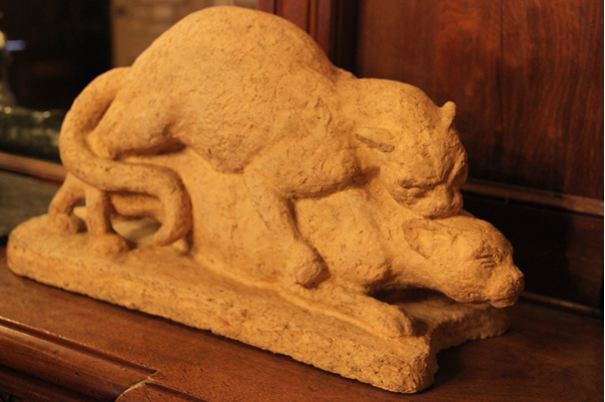
Hildo Krop is well represented throughout Amsterdam, his sculptures adorning bridges and buildings. Two Cats Making Love, on view at the Kabinet, is, Meijer comments,” clearly one of his smaller projects and probably falls into the category of “free work.” One of his most famous works, and of a different order of magnitude, is the Berlage monument on Victorieplein in Amsterdam.”
In addition to fine art, the Kabinet showcases other feline appearances—in vintage advertising, Tadaaki Narita’s Lucky cat pinball machine, and in the person, er, form of 5 live specimens who have the run of the place.
Those visiting in the flesh can cat around to some of Amsterdam’s other feline-themed attractions, including two cat cafes, a cat-centric boutique, and the floating shelter, De Poezenboot.
And let’s not forget the other cat museums ‘round the globe, from Minsk and Malaysia to Sylva, North Carolina’s American Museum of the House Cat.
Begin your exploration of the collection here.
Related Content:
Edward Gorey Talks About His Love Cats & More in the Animated Series, “Goreytelling”
Ayun Halliday is an author, illustrator, theater maker and Chief Primatologist of the East Village Inky zine. Join her in New York City for the next installment of her book-based variety show, Necromancers of the Public Domain, this March. Follow her @AyunHalliday.E
Read More...Hear a Six-Hour Mix Tape of Hunter S. Thompson’s Favorite Music & the Songs Name-Checked in His Gonzo Journalism
Of all the musical moments in Hunter S. Thompson’s formidable corpus of “gonzo journalism,” which one comes most readily to mind? I would elect the scene in Fear and Loathing in Las Vegas when Thompson’s alter-ego Raoul Duke finds his attorney “Dr. Gonzo” in the bathtub, “submerged in green water — the oily product of some Japanese bath salts he’d picked up in the hotel gift shop, along with a new AM/FM radio plugged into the electric razor socket. Top volume. Some gibberish by a thing called ‘Three Dog Night,’ about a frog named Jeremiah who wanted ‘Joy to the World.’ First Lennon, now this, I thought. Next we’ll have Glenn Campbell screaming ‘Where Have All the Flowers Gone?’ ”
But Dr. Gonzo, his state even more altered than usual, really wants to hear only one song: Jefferson Airplane’s “White Rabbit.” He wants “a rising sound,” and what’s more, he demands that “when it comes to that fantastic note where the rabbit bites its own head off,” Duke throw the radio in the tub with him.
Duke refuses, explaining that “it would blast you right through the wall — stone-dead in ten seconds.” Yet Dr. Gonzo, who insists he just wants to get “higher,” will have none of it, forcing Duke to engage in trickery that takes to a new depth the book’s already-deep level of craziness. Such, at the time, was the power of not just drugs but of the even more mind-altering product known as music.
Nothing evokes a period of recent history more vividly than its songs, especially in the case of the 1960s and early 1970s that Thompson’s prose captured with such improbable eloquence. Now, thanks to London’s NTS Radio (they of the spiritual jazz and Haruki Murakami mixes), you can spend a good six hours in that Thompsonian period whenever you like by streaming their Hunter S. Thompson Day, consisting of two three-hour mixes composed by Edu Villarroel, creator of the Spotify playlist “Gonzo Tapes: Too Weird To Live, Too Rare To Die!” Both that playlist and these mixes feature many of the 60s names you might expect: not just Jefferson Airplane but Buffalo Springfield, Jimi Hendrix, the Rolling Stones, Bob Dylan, Cream, Captain Beefheart, and many more besides.
Those artists appear on one particularly important source for these mixes, Thompson’s list of the ten best albums of the 60s. But Hunter S. Thompson Day also offers deeper cuts of Thompsoniana as well, including pieces of Terry Gilliam’s 1998 film adaptation of Fear and Loathing in Las Vegas as well as clips from other media in which the real Thompson appeared, in fully gonzo character as always. Villarroel describes these mixes as “best served with a couple tabs of sunshine acid, tall glass of Wild Turkey with ice and Mezcal on the side,” but you may well derive a similar experience from listening while partaking of another powerful substance: Thompson’s writing, still so often imitated without ever replicating its effect, which you can get started reading here on Open Culture.
Related Content:
Hear the 10 Best Albums of the 1960s as Selected by Hunter S. Thompson
Hunter S. Thompson Remembers Jimmy Carter’s Captivating Bob Dylan Speech (1974)
Hunter S. Thompson Interviews Keith Richards, and Very Little Makes Sense
Read 11 Free Articles by Hunter S. Thompson That Span His Gonzo Journalist Career (1965–2005)
Based in Seoul, Colin Marshall writes and broadcasts on cities, language, and culture. His projects include the book The Stateless City: a Walk through 21st-Century Los Angeles and the video series The City in Cinema. Follow him on Twitter at @colinmarshall or on Facebook.
Read More...18 Classic Myths Explained with Animation: Pandora’s Box, Sisyphus & More
Greek myths have an incredible shelf life.
We may not retain all the players’ names or the intricacies of the various plot lines, but the creative punishments the gods—Zeus, in particular—visited upon those who displeased them have provided modern mortals with an enduring shorthand for describing our own woes.
Tempted to sneak a peek inside a lover’s diary? Take a teeny swig from the liquor cabinet whilst housesitting? Go snooping in your teenager’s Internet history?
DON’T DO IT, PANDORA!!!
But if curiosity compels you to explore beyond the famous punchlines of mythology’s greatest hits, TED-Ed’s animated Myths from Around the World series is a recommended rummage.
Averaging around five minutes per tale, each episode is packed tight as a snake in a can of mixed nuts. Prepare to be surprised by some of the tidbits that come springing out.
Take Pandora’s box, above.
(Actually it was a jar, but why quibble?)
Not to unleash too many major spoilers, but how many of us remembered that the thing contained a bit of good along with all that evil?
Or that the vessel she wasn’t allowed to open was but one of many gifts the gods bestowed upon her at birth? In fact, Zeus gave her two presents, that pretty box, jar, whatever, and—wait for it—an irrepressibly inquisitive nature.
Or the close connection between Pandora and Prometheus? Zeus conceived of Pandora as a retribution for Prometheus stealing fire and returning it to earth.
Remember Prometheus?
No, not the guy who’s doomed to spend his life rolling a massive rock uphill, only to have it roll back down before he reaches the top. That’s Sisyphus, as in Sisyphean task, like laundry or cleaning the cat litter.
Prometheus is the Titan who winds up chained to a rock so Zeus can send a hungry vulture—some say eagle—to devour his liver once a day.
(Which kind of puts the cat litter in perspective.)
In addition to ancient Greek crowd pleasers, the 18-episode Myths from Around the World playlist delves into the familiar stuff of Norse, Chinese, and ancient Egyptian legends, as well as less widely known Cambodian and Irish tales.
Each video’s description has a link to a full Ted-Ed lesson, with the usual complement of quizzes, resources and opportunities for teacher customization.
Watch the full playlist here.
Related Content:
The Myth of Sisyphus Wonderfully Animated in an Oscar-Nominated Short Film (1974)
Greek Myth Comix Presents Homer’s Iliad & Odyssey Using Stick-Man Drawings
Concepts of the Hero in Greek Civilization (A Free Harvard Course)
Ayun Halliday is an author, illustrator, theater maker and Chief Primatologist of the East Village Inky zine. Join her in New York City for the next installment of her book-based variety show, Necromancers of the Public Domain, this March. Follow her @AyunHalliday.
Read More...Watch the Last Time Peter Tork (RIP) & The Monkees Played Together During Their 1960s Heyday: It’s a Psychedelic Freakout
Peter Tork died yesterday at age 77. You might not have heard the news over the deafening alarms in your social media feeds lately. But a muted response is also noteworthy because of the way Tork’s fame imploded at the end of the sixties, at a time when he might have become the kind of rock star he and his fellow Monkees had proved they could become, all on their own, without the help of any studio trickery, thanks very much. The irony of making this bold statement with a feature film was not lost on the band at all.
The film was Head, co-written and co-produced by Jack Nicholson, who appears alongside the Monkees, Teri Garr, Annette Funicello, Frank Zappa, Sonny Liston, Jerry Lee Lewis, Fats Domino, and Little Richard, among many other famous guest stars and musicians. Dennis Hopper and Toni Basil pop up, and the soundtrack, largely written and played by the band, is a truly groovy psych rock masterpiece and their last album to feature Tork until a reunion in the mid-80s.
Head was a weird, cynical, embittered, yet brilliant, attempt to torpedo everything the Monkees had been to their fans—teen pop idols and goofy Beatles rip-offs at a time when The Beatles had maybe gotten too edgy for some folks. And while it may have taken too much of a toll on the band, especially Tork, for them to recover, it’s clear that they had an absolute blast making both the movie and the record, even as their professional relationships collapsed.
Tork’s best songwriting contribution to Head, and maybe to the Monkees catalog on the whole, is “Can You Dig It,” a meditation on “it” that takes what might have been cheap hipster appropriation in a funky, pseudo-deep, vaguely Eastern direction free of guile—it’s light and breezy, like the Monkees, but also sinister and slinky, like Donovan or the folk rock of Brian Jones, and also spidery and jangly like Roger McGuinn. In the estimation of many a psychedelic rock fan, this is music that deserves a place beside its obvious influences. That Monkees fans could not dig it at the time only reflects poorly on them, but since some of them were fans of what they thought was a slapstick comedy troupe or a backup act for dreamy Davy Jones, they can hardly be blamed.
Cast as the Ringo of the gang (The Monkees and Head director Bob Rafelson compared him to Harpo Marx), Tork brought to it a similarly serious whimsy, and when he was finally allowed to show what he could do—both as a musician and a songwriter—he more than acquitted himself. Where Ringo mastered idiot savant one-liners, Tork excelled in the kind of oblique riffs that characterized his playing—he was the least talented vocalist in the band, but the most talented musician and the only one allowed to play on the band’s first two records. Tork played bass, guitar, keyboards, banjo, harpsichord, and other instruments fluently. He honed his craft, and his “lovable dummy” persona on Greenwich Village coffeehouse stages.
It’s not hard to argue that the Monkees rose above their TV origins to become bona fide pop stars with the songwriting and promotional instincts to match, but Head, both film and album, make them a band worth revisiting for all sorts of other reasons. Now a widely-admired cult classic, in 1968, the movie “surfaced briefly and then sank like a costumed dummy falling into a California canal,” writes Petra Mayer at NPR, in reference to Head’s first scene, in which Micky Dolenz appears to commit suicide. If the Monkees had been trying in earnest to do the same to their careers, they couldn’t have had more success. Head cost $750,000 and made back $16,000. “It was clear they were in free fall,” Andy Greene writes at Rolling Stone.
“After that debacle,” writes Greene, they could have tried a return to the original formula to recoup their losses, but instead “they decided to double down on psychedelic insanity” in an NBC television special, 33⅓ Revolutions per Monkee, greenlighted that year after the huge chart success of “Daydream Believer.” Tork had already announced that he was leaving the band as the cameras rolled on the very loosely plotted variety show. He stuck around till the end of filming, however, and played the last live performance with The Monkees for almost 20 years in the bang-up finale of “Listen to the Band” (top) which “quickly devolves into a wild psychedelic freakout crammed with guest stars.” Tork, behind the keys, first turns the downbeat Neil Young-like, Nesmith-penned tune into the rave-up it becomes. It’s a glorious send-off for a version of the Monkees people weren’t ready to hear in ’68.
Related Content:
Watch Frank Zappa Play Michael Nesmith on The Monkees (1967)
Josh Jones is a writer and musician based in Durham, NC. Follow him at @jdmagness
Read More...Has the Voynich Manuscript Finally Been Decoded?: Researchers Claim That the Mysterious Text Was Written in Phonetic Old Turkish
There are still several ancient languages modern scholars cannot decipher, like Minoan hieroglyphics (called Linear A) or Khipu, the intricate Incan system of writing in knots. These symbols contain within them the wisdom of civilizations, and there’s no telling what might be revealed should we learn to translate them. Maybe scholars will only find accounting logs and inventories, or maybe entirely new ways of perceiving reality. When it comes, however, to a singularly indecipherable text, the Voynich Manuscript, the language it contains encodes the wisdom of a solitary intelligence, or an obscure, hermitic community that seems to have left no other trace behind.
Composed around the year 1420, the 240-page manuscript appears to be in dialogue with medieval medical and alchemical texts of the time, with its zodiacs and illustrations botanical, pharmaceutical, and anatomical. But its script only vaguely resembles known European languages.
So it has seemed for the 300 years during which scholars have tried to solve its riddles, assuming it to be the work of mystics, magicians, witches, or hoaxers. Its language has been variously said to come from Latin, Sino-Tibetan, Arabic, and ancient Hebrew, or to have been invented out of whole cloth. None of these theories (the Hebrew one proposed by Artificial Intelligence) has proven conclusive.
Maybe that’s because everyone’s got the basic approach all wrong, seeing the Voynich’s script as a written language rather than a phonetic transliteration of speech. So says the Ardiç family, a father and sons team of Turkish researchers who call themselves Ata Team Alberta (ATA) and claim in the video above to have “deciphered and translated over 30% of the manuscript.” Father Ahmet Ardiç, an electrical engineer by trade and scholar of Turkish language by passionate calling, claims the Voynich script is a kind of Old Turkic, “written in a ‘poetic’ style,” notes Nick Pelling at the site Cipher Mysteries, “that often displays ‘phonemic orthography,’” meaning the author spelled out words the way he, or she, heard them.
Ahmet noticed that the words often began with the same characters, then had different endings, a pattern that corresponds with the linguistic structure of Turkish. Furthermore, Ozan Ardiç informs us, the language of the Voynich has a “rhythmic structure,” a formal, poetic regularity. As for why scholars, and computers, have seen so many other ancient languages in the Voynich, Ahmet explains, “some of the Voynich characters are also used in several proto-European and early Semitic languages.” The Ardiç family will have their research vetted by professionals. They’ve submitted a formal paper to an academic journal at Johns Hopkins University.
Their theory, as Pelling puts it, may be one more “to throw onto the (already blazing) hearth” of Voynich speculation. Or it may turn out to be the final word on the translation. Prominent Medieval scholar Lisa Fagin Davis, head of the Medieval Academy of America—who has herself cast doubt on another recent translation attempt—calls the Ardiçs’ work “one of the few solutions I’ve seen that is consistent, is repeatable, and results in sensical text.”
We don’t learn many specifics of that text in the video above, but if this effort succeeds, and it seems promising, we could see an authoritative translation of the Voynich, though there will still remain many unanswered questions, such as who wrote this strange, sometimes fantastical manuscript, and to what end?
Related Content:
Josh Jones is a writer and musician based in Durham, NC. Follow him at @jdmagness
Read More...Hear the First Musical Composition Created by a Computer: The Illiac Suite (1956)
Think “Generative Music” and what may come to mind is Brian Eno, pushing a button and letting music flow from his studio computer. But the idea is much older than that.
The “Illiac Suite” from 1952 is named after the cash-register-looking ILLIAC computer on which it was composed, and is one of the first examples of bringing computer programming into the task of creating music within some well defined parameters. The resulting score was then played by humans. You can hear the first experiment above.
The programmers were Lejaren Hiller and Leonard Isaacson, who met at the University of Illinois at Urbana-Champagne, where the ILLIAC computer was built. Interestingly, Hiller considered himself a chemist first, a composer second. He had studied classical composition under Milton Babbitt and, even while working at DuPont labs in Virginia, was composing string quartets and vocal works. Babbitt and other teachers had encouraged him to keep composing even while he turned to chemistry. Perhaps they knew that the art and the science would dovetail?
Because indeed they did. While working on the ILLIAC, Hiller realized that the methodology he was using in chemistry problems were the same as those used by composers, and decided to experiment. Isaacson would help program the new computer.
The first experiment sounds the most traditional, the most like Bach. The two created simple rules: a melody that only used notes within an octave, harmonies that tended towards the major and the minor with no dissonance, and a few other parameters.
The second experiment featured four-voice polyphony with slightly more complex rules. The third experiment is where it gets interesting, and starts to sound very “modern,” very Penderecki. Here Hiller and Isaacson tried to introduce rhythm and dynamics, although admittedly they had to shape a lot of the decisions outside the program and introduce some corrective algorithms.
The fourth and final experiment was to then replace the “musical” rules of the first three with rules from non-musical disciplines, and to show that a score could be created from pretty much anything. Hiller and Isaacson used Markov Chains to compose the final more repetitive and pulsing piece. (Markov Chains are beyond the scope of this article, but we encounter them when Google ranks search results or when our iPhones predict what we are going to type next.)
The first three scores were then performed by members of the University’s student orchestra in August of 1956 while the fourth was being completed. The finished works caught the interest of Vladimir Ussachevsky, who would set up the influential Columbia-Princeton Electronic Music Center in New York City and begin releasing his own compositions the following year.
Related Content:
An Impressive Audio Archive of John Cage Lectures & Interviews: Hear Recordings from 1963–1991
Peefeeyatko: A Look Inside the Creative World of Frank Zappa
Ted Mills is a freelance writer on the arts who currently hosts the artist interview-based FunkZone Podcast and is the producer of KCRW’s Curious Coast. You can also follow him on Twitter at @tedmills, read his other arts writing at tedmills.com and/or watch his films here.
Read More...23 Million Patrons of California’s Public Libraries Can Now Read The New York Times for Free Online

More and more, you can get access to valuable electronic resources through your friendly local library. In the past, we’ve mentioned how anyone with a New York Public Library card can get free access to thousands of ebooks, more than 30,000 movies (including many classics from the Criterion Collection), and even suits and briefcases for job interviews.
Many public libraries also now give patrons access to Kanopy, the provider of high-quality documentaries, indie and classic films. Take for example this collection of classic and contemporary German films.
Now consider this: The New York Times announced this week that nearly 1,200 public libraries across California will offer their 23 million patrons free access to the New York Times online. They write:
California’s 23 million library card holders in the state may access NYTimes.com by visiting nytimes.com/register on a library computer, or on their own device while connected to the library’s Wi-Fi. Library card holders can access nytimes.com from anywhere through their library’s website.” Residents without a library card may visit their local branch to apply for one. The program will also include monthly events at select library branches.
For more information, visit this page. And if you know of other great deals offered by public libraries, please mention them in the comments section below.
If you would like to support the mission of Open Culture, consider making a donation to our site. It’s hard to rely 100% on ads, and your contributions will help us continue providing the best free cultural and educational materials to learners everywhere. You can contribute through PayPal, Patreon, and Venmo (@openculture). Thanks!
Related Content:
The New York Public Library Lets Patrons Download 300,000 eBooks
The New York Public Library Lets Patrons Download 300,000 eBooks
Read More...The History of Ancient Greece in 18 Minutes: A Brisk Primer Narrated by Brian Cox
Ancient Greece never existed. Before you click away, fearing a truly brazen attempt at historical revisionism, let’s put that statement in context. Ancient Greece “was no state with an established border or capital, but rather a multitude of distinct and completely independent cities.” So says the video above, “Ancient Greece in 18 Minutes,” which makes historical corrections — and often humorous ones — to that and a variety of other common misperceptions about perhaps the main civilizations to give rise to Western culture as we know it.
“We might think we already know everything about Ancient Greece,” says the video’s narrator, actor Brian Cox. “The Parthenon, the 300 Spartans, and blind Homer’s Iliad and Odyssey are familiar to all, yet there were far more than 300 Spartans, the Parthenon was actually built as a kind of central bank, and no such unified state as ancient Greece, with Athens as its capital, ever existed.”
Some of our unwarranted intellectual confidence about Ancient Greece surely comes from the movies that draw on its history and its stories, such as the comic-book Battle of Thermopylae dramatization 300 or, a couple years earlier, Troy, which delivered Homer’s Iliad in true Hollywood fashion — with Cox himself as Agamemnon, commander of the united Greek forces in the Trojan War.
That nine-year long siege, of course, figures into “Ancient Greece in 18 Minutes” as one of its most important episodes. The other chapters cover the Creto-Mycenaean era that preceded Ancient Greece, the barbarian attacks that plunged the region into a 400-year dark age, the Archaic Period that saw the beginning of Greece’s far-flung agriculture-driven colonization, the rise of the famous Athens and Sparta, the Graeco-Persian Wars (as seen, in a sense, in 300), the Golden Age of Athens (the age of the construction of the Parthenon, without which “the Greek classics wouldn’t have existed at all: no sculpture, drama, philosophy”), the Peloponnesian War, and the time of Alexander the Great.
Alexander the Great died young in 323 BC, and Ancient Greece as we conceive of it today is thought not to have survived him. But in another sense, it not only survived but thrived: the Romans conquered Greece in 146 BC, but “Greek culture was victorious even here: spread by the Romans, it finally conquered the world. Romans began to read The Iliad and Odyssey in Greek, followed by the Greek New Testament.” (You can find out much more about the Romans in the same creators’ video “Ancient Rome in 20 Minutes.”) When in 330 the Roman emperor Constantine built his new capital on the site of the Greek colony of Byzantium, he started the Byzantine Empire, “which extended the life of Greek culture another thousand years.” This left a formidable cultural legacy of its own — including, as this Russian-made video makes a special point of telling us, “the weird Russian alphabet.”
Related Content:
Introduction to Ancient Greek History: A Free Online Course from Yale
How Ancient Greek Statues Really Looked: Research Reveals their Bold, Bright Colors and Patterns
Watch Art on Ancient Greek Vases Come to Life with 21st Century Animation
Ancient Greek Punishments: The Retro Video Game
Concepts of the Hero in Greek Civilization (A Free Harvard Course)
Based in Seoul, Colin Marshall writes and broadcasts on cities, language, and culture. His projects include the book The Stateless City: a Walk through 21st-Century Los Angeles and the video series The City in Cinema. Follow him on Twitter at @colinmarshall or on Facebook.
Read More...The History of Ancient Rome in 20 Quick Minutes: A Primer Narrated by Brian Cox
Two thousand years ago, Rome was half the world. A thousand years before that, it was “a tiny tribal settlement of the Latins by the river Tiber.” So, what happened? An awful lot. But narrator Brian Cox makes the history and longevity of Ancient Rome seem simple in 20 minutes in the Arzamas video above, which brings the same talent for narrative compression as we saw in an earlier video we featured with Cox describing the history of Russian Art.
This is a far more sprawling subject, but it’s one you can absorb in 20 minutes, if you’re satisfied with very broad outlines. Or, like one YouTube commenter, you can spend six hours, or more, pausing for reading and research after each morsel of information Cox tosses out. The story begins with trade—cultural and economic—between the Latins and the Etruscans to the north and Greeks to the south. Rome grows by adding populations from all over the world, allowing migrants and refugees to become citizens.
Indeed, the great Roman epic, the Aeneid, relates its founding by refugees from Troy. From these beginnings come monumental innovations in building and engineering, as well as an alphabet that spread around the world and a language that spawned dozens of others. The Roman numeral system, an unwieldy way to do mathematics, nonetheless gave to the world the stateliest means of writing numbers. Rome gets the credit for these gifts to world civilization, but they originated with the Etruscans, along with famed Roman military discipline and style of government.
After Tarquin, the last Roman king, committed one abuse too many, the Republic began to form, as did new class divides. Plebs fought Patricians for expanded rights, Senatus Populusque Romanus (SPQR)—the senate and the people of Rome—expressed an ideal of unity and political equality, of a sort. An age of imperial war ensues, conquered peoples are ostensibly made allies, not colonials, though they are also made slaves and supply the legions with “a never ending supply of recruits.”
These sketches of major campaigns you may remember from your World Civ class: The Punic Wars with Carthage, and their commander Hannibal, conducted under the motto of Cato, the senator who beat the drums of war by repeating Carthago delenda est—Carthage must be destroyed. The conquering of Corinth and the absorption of Alexander’s Hellenist empire into Rome.
The story of the Empire resembles that of so many others: tales of hubris, ferocious brutality, genocide, and endless building. But it is also a story of political genius, in which, gradually, those peoples brought under the banners of Rome by force were given citizenship and rights, ensuring their loyalty. Relative peace—within the borders of Rome, at least—could not hold, and the Republic imploded in civil wars and the ruination of a slave economy and extreme inequality.
The wealthy gobbled up arable land. The tribunes of the people, the Gracchi brothers, suggested a redistribution scheme. The senators responded with force, killing thousands. Two mass-murdering conquering generals, Pompey and Julius Caesar, fought over Rome. Caesar crossed the Rubicon with his legions to take the city, assuming the title Imperator, a move that cost him his life.
But his murder didn’t stop the march of Empire. Under his nephew Augustus, a dictator who called himself a senator, Rome spread, flourished, and established a 200-year Pax Romana, a time of thriving arts and culture, popular entertainments, and a well-fed populace.
Augustus had learned from the Gracchi what neither the venal senatorial class nor so many subsequent emperors could. In order to rule effectively, you’ve got to have the people on your side, or have them so distracted, at least, by bread and circuses, that they won’t bother to revolt. Watch the full video to learn about the next few hundred years, and learn more about Ancient Rome at the links below.
Related Content:
Play Caesar: Travel Ancient Rome with Stanford’s Interactive Map
Rome Reborn: Take a Virtual Tour of Ancient Rome, Circa 320 C.E.
An Interactive Map Shows Just How Many Roads Actually Lead to Rome
Josh Jones is a writer and musician based in Durham, NC. Follow him at @jdmagness
Read More...How the Mona Lisa Went From Being Barely Known, to Suddenly the Most Famous Painting in the World (1911)
Is the Mona Lisa really “ten times better than every other painting”? No one seriously believes this, and how would anyone measure such a thing? There may be no such critical scale, but there is a popular one. The Louvre, where the famous Leonardo da Vinci—maybe the most famous painting of all time—hangs, says that 80 percent of its visitors come just to see the Mona Lisa. Her enigmatic smile adorns merchandise the world wide. Books, essays, documentaries, songs, coffee mugs—hers may be the most recognizable face in Western art.
Learn in the Vox video above, however, how that fame came about as the result of a different kind of publicity—coverage of the Mona Lisa theft in 1911. It became an overnight sensation. “Before its theft,” notes NPR, “the ‘Mona Lisa’ was not widely known outside the art world. Leonardo da Vinci painted it in 1507, but it wasn’t until the 1860s that critics began to hail it as a masterwork of Renaissance painting. And that judgment didn’t filter outside a thin slice of French intelligentsia.”
Though the painting once hung in the bedroom of Napoleon, in the 19th century, it “wasn’t even the most famous painting in its gallery, let alone in the Louvre,” historian James Zug tells All Things Considered. Writing at Vox, Phil Edwards describes how an essay by Victorian art critic Walter Pater elevated the Mona Lisa among art critics and intellectuals like Oscar Wilde. His overwrought prose “popped up in guidebooks to the Louvre and reading clubs in Paducah.” Yet it was not art criticism that sold the painting to the general public. It was the intrigue of an art heist.
In 1911, an Italian construction worker, Vincenzo Perugia, was working for the firm Cobier, engaged in putting several paintings, including the Mona Lisa, under glass. While at the Louvre, he hatched a plan to steal the painting with two accomplices, brothers Vincenzo and Michele Lancelotti. The crime was literally notorious overnight. The theft occurred on Monday morning, August 21. By late Tuesday, the story had been picked up by major newspapers all over the world.
Pablo Picasso and poet Guillaume Apollinaire went on trial for the theft (their case was dismissed). Conspiracy theories popped up all over the place, claiming, as per usual, that the whole thing was a hoax or a distraction engineered by the French government. “Wanted posters for the painting appeared on Parisian walls,” Zug writes at Smithsonian. “Crowds massed at police headquarters. Thousands of spectators, including Franz Kafka, flooded the Salon Carré when the Louvre reopened after a week to stare at the empty wall with its four lonely iron hooks.”
Once the painting was restored, the crowds kept coming. Newspaper photos and police posters gave way to t‑shirts and mousepads. The painting’s undoubted excellence seemed incidental; it became, like Andy Warhol’s soup cans, famous for being famous. Learn more about the Mona Lisa’s long strange trip through history in the short Great Big Story video above.
Related Content:
When Pablo Picasso and Guillaume Apollinaire Were Accused of Stealing the Mona Lisa (1911)
Mona Lisa Selfie: A Montage of Social Media Photos Taken at the Louvre and Put on Instagram
Original Portrait of the Mona Lisa Found Beneath the Paint Layers of da Vinci’s Masterpiece
Josh Jones is a writer and musician based in Durham, NC. Follow him at @jdmagness
Read More...Support Us
We're hoping to rely on loyal readers, rather than erratic ads. Please click the Donate button and support Open Culture. You can use Paypal, Venmo, Patreon, even Crypto! We thank you!

About Us

Open Culture scours the web for the best educational media. We find the free courses and audio books you need, the language lessons & educational videos you want, and plenty of enlightenment in between.
Advertise With Us

FREE UPDATES!
GET OUR DAILY EMAIL
Get the best cultural and educational resources on the web curated for you in a daily email. We never spam. Unsubscribe at any time.
FOLLOW ON SOCIAL MEDIA

Open Culture editor Dan Colman scours the web for the best educational media. He finds the free courses and audio books you need, the language lessons & movies you want, and plenty of enlightenment in between.
Advertise With Us

