Behold the Anciente Mappe of Fairyland, a Fantastical 1917 Mashup of Tales from Homer’s Odyssey, King Arthur, the Brothers Grimm & More
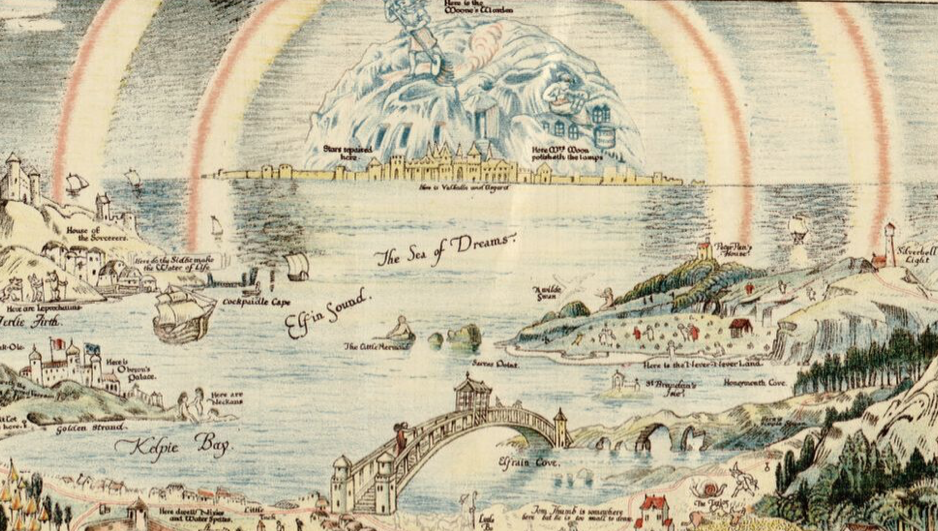
For most of publishing history, books for children meant primers and preachy religious texts, not mythical worlds invented just for kids. It’s true that fairy tales may have been specifically targeted to the young, but they were never childish. (See the original Grimms’ tales.) By the 19th century, however, the situation had dramatically changed. And by the turn of the century, childlike fairy stories and fantasies enjoyed wide popularity among grown-ups and children alike, just as they do today. Witness the tremendous success of Peter Pan.
The character first appeared as a seven-day-old baby in a satirical 1902 fantasy novel by Scottish writer J.M. Barrie. The novel became a play. Pan was so beloved that Barrie’s publisher excerpted his chapters and published them as Peter Pan in Kensington Gardens.
Then followed Barrie’s 1904 play, Peter Pan, or The Boy Who Wouldn’t Grow Up, in which baby Pan had grown up at least just a little. Only after this history of Pan entertainments did Barrie write Peter and Wendy, the story we learned as children through Disney adaptations or the 1911 original.
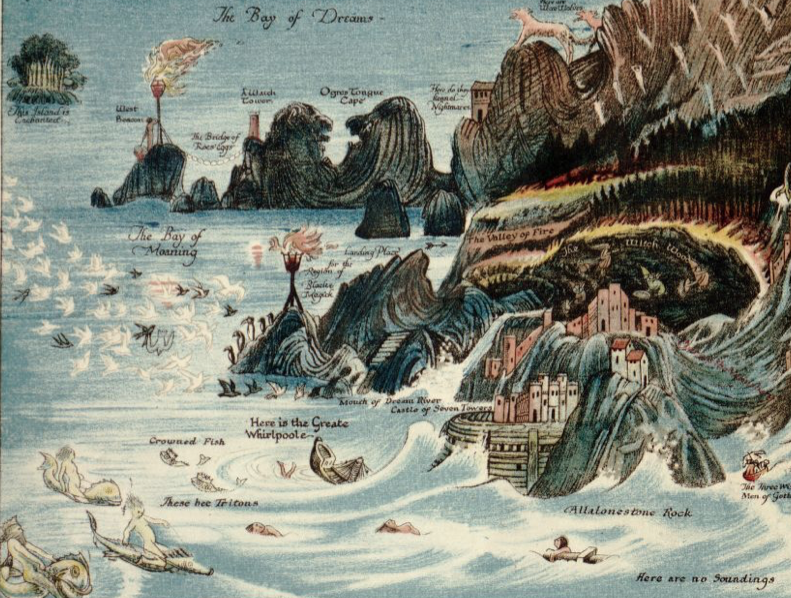
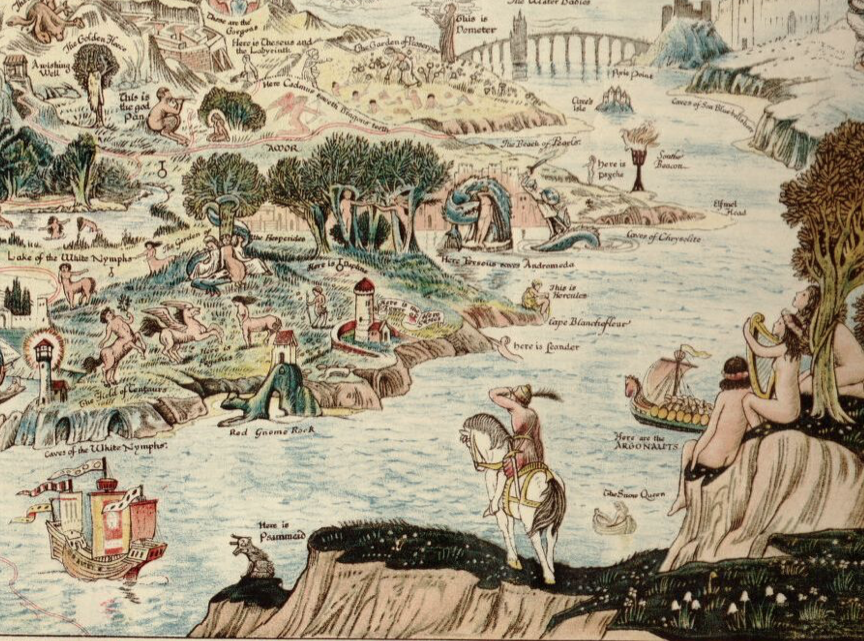
Pan’s influence is wide and deep, and over a century long. In 1917, one of the early adopters of Barrie’s Neverland fantasy concept expanded on its world with a version called “Fairyland,” described in an illustrated map of such a place. The artist, Bernard Sleigh, “begins with a stormy sea,” writes Jessica Leigh Hester at Atlas Obscura. (That is, if we read the map from left to right.) “There, waves lash the shore and tritons ride piscine steeds, while a wooden ship and an unfortunate soul are half-sunk nearby, in a white whirlpool.” The influence of J.M. Barrie’s descriptions is readily apparent.
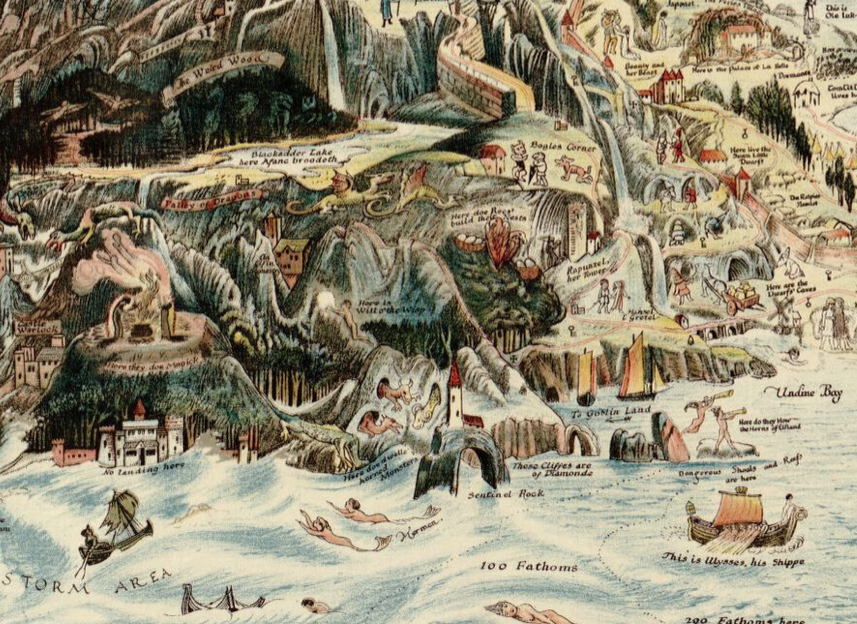
The Anciente Mappe of Fairyland (see the map in full here) “mashes up dozens of stories to make a comprehensive geography of make-believe,” writes Slate’s Rebecca Onion: “Rapunzel’s tower, cheek by jowl with Belle’s palace from ‘Beauty and the Beast’; Humpty Dumpty on a roof, overlooking Red Riding Hood’s house; Ulysses’ ship, sailing past Goblin Land.” It’s a “Where’s Waldo of Fantasy Easter Eggs,” by an English landscape painter “who wrote extensively about fairies in England.” Sleigh was not only a fantasist, he was also a true believer.
Like Arthur Conan Doyle, Sleigh promoted the existence of fairies, and wrote an earnest work of fiction called The Gates of Horn: Being Sundry Records from the Proceedings of the Society for the Investigation of Fairy Fact and Fallacy in 1926. Like Doyle, he was a talented and popular artist looking for magic in a world of machinery. “The ancient map of Fairyland,” with its visual anthology of literature, folk tale, and mythology, “is said to have been his most famous work,” writes the David Rumsey Map Collection. It was designed “during the ‘Arts & Crafts’ movement, which was in reaction to the Industrial revolution.”
Like J.R.R. Tolkien, another artist who found inspiration in Barrie’s fantasy world, Sleigh worked against a backdrop of world war. Onion quotes historians Tim Bryars and Tom Harper’s comment that “compared with the devastated, bomb-blasted landscape of northern France, this vision of a make-believe land may have seemed a seductive escape for a European society bearing the psychological and physical scars of mass conflict.”
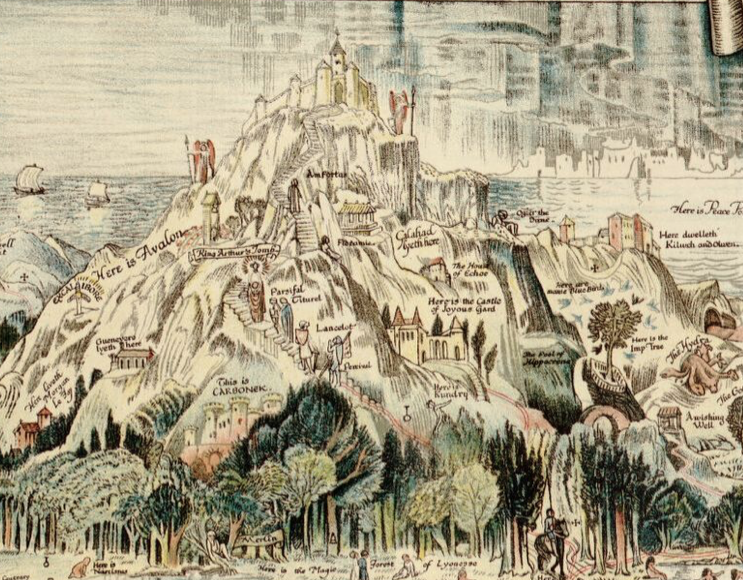
Unlike Tolkien, however, or contemporary inheritors of the Peter Pan tradition like J.K. Rowling a century later, or the earlier Romantic lovers of mythology and folk tale, Sleigh’s map invites a light reprieve from the horrors of war. “Any small amount of violence or trauma you might find in ‘Fairyland’ could easily be evaded,” writes Onion, “by moving on to the next area of the map, where a new set of stories unfolds.”
Download high resolution scans of An Anciente Mappe of Fairyland: newly discovered and set forth from the Library of Congress and the David Rumsey Map Collection, where you can also purchase a print. (The map physically resides at the British Library.) Zoom into Fairyland’s intricate fantasy landscape and maybe take a break from the dark realities of yet another industrial revolution and a world at war.
Related Content:
Map of Middle-Earth Annotated by Tolkien Found in a Copy of Lord of the Rings
A Digital Archive of 1,800+ Children’s Books from UCLA
Josh Jones is a writer and musician based in Durham, NC. Follow him at @jdmagness
Read More...Isaac Asimov Predicts the Future of Civilization–and Recommends Ways to Ensure That It Survives (1978)
When we talk about what could put an end to civilization today, we usually talk about climate change. The frightening scientific research behind that phenomenon has, apart from providing a seemingly infinite source of fuel for the blaze of countless political debates, also inspired a variety of dystopian visions, credible and otherwise, of no small number of science-fiction writers. One wonders what a science-fictional mind of, say, Isaac Asimov’s caliber would make of it. Asimov died in 1992, a few years before climate change attained the presence in the zeitgeist it has today, but we can still get a sense of his approach to thinking about these kinds of literally existential questions from his 1978 talk above.
When people talked about what could put an end to civilization in 1978, they talked about overpopulation. A decade earlier, Stanford biologist Paul Ehrlich published The Population Bomb, whose early editions opened with these words: “The battle to feed all of humanity is over. In the 1970s hundreds of millions of people will starve to death in spite of any crash programs embarked upon now. At this late date nothing can prevent a substantial increase in the world death rate.” With these and other grim pronouncements lodged in their minds, the bestselling book’s many readers saw humanity faced with a stark choice: let that death rate increase, or proactively lower the birth rate.
A decade later, Asimov frames the situation in the same basic terms, though he shows more optimism — or at least inventiveness — in addressing it, supported by the workings of his powerful imagination. This isn’t to say that the images he throws out are exactly utopian: he sees humanity, growing at then-current rates, ultimately housed in “one world-girdling skyscraper, partially apartment houses, partially factories, partially all kinds of things — schools, colleges — and the entire ocean taken out of its bed and placed on the roof, and growing algae or something like that. Because all those people will have to be fed, and the only way they can be fed is to allow no waste whatever.”
This necessity will be the mother of such inventions as “thick conduits leading down into the ocean water from which you take out the algae and all the other plankton, or whatever the heck it is, and you pound it and you separate it and you flavor it and you cook it, and finally you have your pseudo-steak and your mock veal and your healthful sub-vegetables and so on.” Where to get the nutrients to fertilize the growth of more algae? “Only from chopped-up corpses and human wastes.” It would probably interest Asimov, and certainly amuse him, to see how much research into algae-based food goes on here in the 21st century (let alone the popularity of an algae-utilizing meal replacement beverage called Soylent). But however delicious all those become, humanity will need more to live: energy, space, and yes, a comfortable ambient temperature.
Asimov’s suite of proposed solutions, the explanation of which he spins into high and often prescient entertainment, includes birth control, solar power, lunar mining, and the repurposing of some of the immense budget spent on “war machines.” The volume of applause in the room shows how heartily some agreed with him then, and perspectives like Asimov’s have drawn more adherents in the more than 40 years since, about a decade after Asimov confidently predicted that the world would run out of oil, a time when an increasing number of developed countries have begun to worry about their falling birthrates. But then, Asimov also imagined that Mount Everest was unconquerable because Martians lived on top of it in a story published a seven months after Edmund Hillary and Tenzing Norgay made it up there — a fact he made a rule of cheerfully admitting whenever he started with the predictions.
Related Content:
Isaac Asimov’s Favorite Story “The Last Question” Read by Isaac Asimov— and by Leonard Nimoy
Isaac Asimov Explains His Three Laws of Robots
Free: Isaac Asimov’s Epic Foundation Trilogy Dramatized in Classic Audio
Based in Seoul, Colin Marshall writes and broadcasts on cities, language, and culture. His projects include the book The Stateless City: a Walk through 21st-Century Los Angeles and the video series The City in Cinema. Follow him on Twitter at @colinmarshall or on Facebook.
Read More...Virginia Woolf & Friends Name Their Favorite and Least Favorite Writers in a Newly Unearthed 1923 Survey
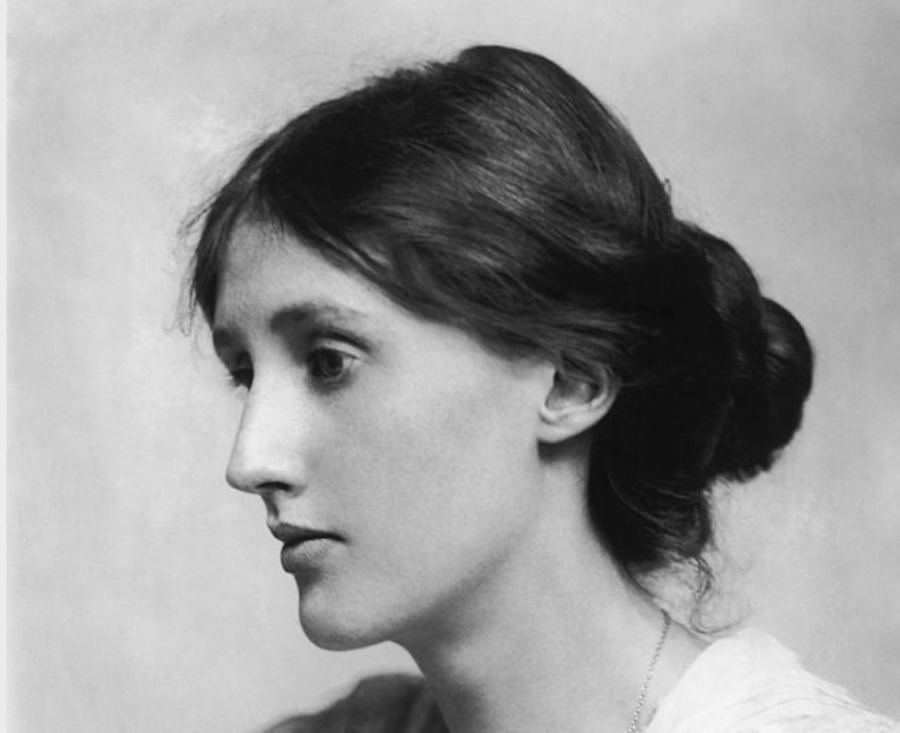
Celebrity Twitter can be fun… sometimes…. Tabloids still have mass appeal, albeit mainly on the web. But for those who want to see the introverted and bookish caught off-guard and off the cuff, times are a little tough. Writers can more easily control their image than actors or pop stars, naturally. Most aren’t nearly as recognizable and subject to constant pop culture surveillance. Literary scandals rarely go beyond plagiarism or politics. Sometimes one might wish—as in the days of mean drunks like Norman Mailer, Ernest Hemingway, or Hunter S. Thompson—for a good old-fashioned literary brawl….
Or maybe not. After all, there’s that thing about pens and swords. The sharpest weapons, the tools that cut the deepest, are wielded by wit, whether it’s the flashing of rhetorical steel or the fine needling of elevated pettiness. No clumsy violence can stand up to the literary put-downs we find in the correspondence of, say Flannery O’Connor—who wrote that Ayn Rand “makes Mickey Spillane look like Dostoevsky”—or Virginia Woolf, who found Joyce “a bore… ultimately nauseating. When one can have cooked flesh, why have the raw?”
This is wonderfully nasty stuff: gut-level low blows from the high road of a well-turned phrase. If it’s the kind of thing you enjoy, you’ll love the “bitchy literary burn book,” reports Vox, “featuring the unvarnished opinions of Virginia Woof, Margaret Kennedy, and others” which has recently come to light. A collection of answers to 39-questions, “its yellow and curling title page” announces it as “’Really and Truly: A Book of Literary Confessions,” notes William Mackesy, grandson and literary executor of novelist Kennedy.
It was passed around and filled in by hand by a group of ten writers total, also including Rose Macaulay, Rebecca West, Hilaire Belloc, and Stella Benson, between 1923 and 1927. “Each contribution was sealed up,” Mackesy writes, “presumably to await a distant thriller-opening, which gave safe space for barbs and jokes at contemporaries’ expense.” With their similarities to our own quick-take cultural products, the questionnaires are sure to be a hit on the internet.
These secret literary confessions get prickly, thanks to “waspish” questions like “the most overrated English writer living” and “a deceased writer whose character you most dislike.” Unsurprisingly, Woolf’s answers are some of the sharpest. In answer to the latter question, she wrote “I like all dead men of letters.” As for the living, one unnamed respondent “called T.S. Eliot the worst living English poet as well as the worst living literary critic.”
Rebecca West dismissed the whole thing as “silly… it’s like being asked to select the best sunset.” Nonetheless, in answer to a question about which writer would still be read in 25 years, she simply answered, “me.” Belloc did the same. Kennedy called Woolf the most overrated writer (but greatest living critic), Woolf and West named Belloc most overrated. Joyce appears more than once in that category, as does D.H. Lawrence.
It’s all great fun, but maybe the “bitchy” headline oversells this aspect a little and undersells the less sensational but more informative parts of the exercise. For instance, all of the writers except one (with one write-in for “I don’t know”) cast the same vote for greatest literary genius (spoiler: it’s Shakespeare). They revered James Boswell, Thomas Hardy, Max Beerbohm, Plato, Jane Austen, Homer, Catullus. They ignored many others. “There is no mention anywhere,” Mackesy points out, “of Virgil or Donne, and only one of Chaucer, Dickens, George Eliot and Henry James.”
No matter how forward-looking some of their work turned out to be, they were writers of their time, with typical attitudes, beliefs, and opinions when it came to literature. That said, the casual narcissism and snark some of the questions elicit are timeless qualities. Learn more about the book, including its like origins and mysterious provenance, from Mackesy at the Independent.
Related Content:
Marcel Proust Fills Out a Questionnaire in 1890: The Manuscript of the ‘Proust Questionnaire’
Flannery O’Connor Renders Her Verdict on Ayn Rand’s Fiction: It’s As “Low As You Can Get”
Josh Jones is a writer and musician based in Durham, NC. Follow him at @jdmagness
Read More...Artificial Intelligence for Everyone: An Introductory Course from Andrew Ng, the Co-Founder of Coursera

If you follow edtech, you know the name Andrew Ng. He’s the Stanford computer science professor who co-founded MOOC-provider Coursera and later became chief scientist at Baidu. Since leaving Baidu, he’s been working on several artificial intelligence projects, including a series of Deep Learning courses that he unveiled in 2017. And now comes AI for Everyone–an online course that makes artificial intelligence intelligible to a broad audience.
In this largely non-technical course, students will learn:
- The meaning behind common AI terminology, including neural networks, machine learning, deep learning, and data science.
- What AI realistically can–and cannot–do.
- How to spot opportunities to apply AI to problems in your own organization.
- What it feels like to build machine learning and data science projects.
- How to work with an AI team and build an AI strategy in an organization.
- How to navigate ethical and societal discussions surrounding AI.
The four-week course takes about eight hours to complete. You can audit it for free. However if you want to earn a certificate–which you can then share on your LinkedIn profile, printed resumes and CVs–the course will run $49.
AI for Everyone will be added to our list of Free Computer Science courses, a subset of our larger collection, 1,700 Free Online Courses from Top Universities.
Related Content:
Artificial Intelligence Brings Salvador Dalí Back to Life: “Greetings, I Am Back”
Read More...The Gnarly Surf Rock of Dick Dale (RIP): Watch the Legend Play “Misirlou,” Surfin’ the Wedge,” and “Pipeline” (with Stevie Ray Vaughan)
The Endless Summer is over. The archetypal 1966 surf documentary might have been scored by The Sandals, but the sound and the cultural dominance of surf culture would perhaps never come into being, and may not have survived the decade, without Dick Dale, who died on March 18th at the age of 81. His gnarly, menacing guitar on songs like “Miserlou” and “Pipeline” turned a fad dominated by the teen anthems of The Beach Boys and Annette Funicello’s post-Mouseketeers bikini and beehive into genuinely gritty rock and roll.
Dale’s sound defined the risky wanderlust of surfing that early skateboarders picked up on in the 70s and 80s, snowboarders in the 90s, and so on. Hundreds of guitarists stole from his distinctive technique long after the 60s surf rock craze died at the hands of British invaders. Dale rode the sound into the 21st century, touring and performing across a United States whose popular culture he helped invent by appearing on (where else) The Ed Sullivan Show.
But it’s arguable whether his fame would have survived as long without Quentin Tarantino’s shrewd use of “Misirlou” in Pulp Fiction’s opening credits. It so happens that Dale almost didn’t survive past the sixties himself. If he had died from what seemed like a terminal cancer in 1965, it’s possible surf guitar would have died with him, become a curious relic rather than a living tradition.
Jimi Hendrix thought so—at least according to Dale in the liner notes to 1997’s Better Shred Than Dead: The Dick Dale Anthology. “Then you’ll never hear surf music again,” Hendrix supposedly said. Maybe in the purest sense, it’s true. Only Dale truly “transferred,” as he put it, the “tremendous amount of power” of surfing into the guitar. His playing was an extreme sport; his shows were “stomps”; the audience never stopped moving for a minute, whooping and hollering along with him.
And still, his cavernous guitar filled ballrooms. He pushed Fender to build louder and louder amplifiers, and everyone else along with them. Like Hendrix, he was a lefty who played a flipped-over right-handed Fender Strat. Yet Dale didn’t restring the guitar, effectively playing it upside-down. He used the heaviest strings he could find, the loudest amps that could be made, and more reverb than anyone had previously thought advisable. “Bands like the Beach Boys,” writes Amanda Petrusich at The New Yorker, “often sang about surfing,” but the genre Dale invented “was wet and gnarly and unconcerned with romance or sweetness.”
His style earned Dale the title of “King of the Surf Guitar,” also the title of his second album and a fact he liked to trumpet as often as he could, along with claims that he was called the “Father of Heavy Metal.” (Link Wray might like a word.) He was a tireless promoter and performer without whose influence there may’ve been no Endless Summer-scoring Sandals or Surfaris’ “Wipe Out”—surf culture essentials that traveled the world.
Surf rock became a niche sound, popular with increasingly specialized audiences, before Quentin Tarantino made it cool again. Pulp Fiction’s use of the song was not an ironic detournement, but a genuine reminder of how dangerous Dale sounded. He buzzsawed through the early-sixties scene of skinny ties and big hair. The footage of him above playing “Misirlou” with The Del Tones—all of whom wear terrified smiles and identical suits, above—is strangely Lynchian.
Part of the incongruity comes from watching square white Americans bounce through a haunting Egyptian folk song, while looking like they should be playing “Mr. Sandman.” Dale made 50s pop seem childish, and sound-tracked the entry of mildly adult situations in 60s surf movies. He deserved to have fared better from his influence and fame.
Dale’s last couple decades were spent like too many other people in the U.S. He couldn’t stop touring, he said, “because I will die. Physically and literally, I will die.” After his first recovery from colorectal cancer in 1965, he continued to battle the disease,” writes The Washington Post. “Up until the end of his life, Dale was explicit that he toured to fund his treatment” after his cancer returned. He couldn’t retire even when his career rebounded, twice after his early sixties’ heyday: first in 1987 when he recorded “Pipeline” (further up) with Stevie Ray Vaughan and again after Pulp Fiction.
His fans continued to support him not because he was a hip nostalgia act, but, he said, because he grew and branched out as a guitar player and he was honest about his difficulties, and people connected. He was an American original. The son of Lebanese immigrants, he took the music of his parents’ home country, blended it with country swing and blues, and played it dirty, wet, and as loud as it could go, something no one had quite done before and thousands have done since.
Related Content:
Quentin Tarantino Explains The Art of the Music in His Films
The Beach Party Film: A Short Appreciation of One of the Oddest Subgenres in Film History
A History of Rock ‘n’ Roll in 100 Riffs
Josh Jones is a writer and musician based in Durham, NC. Follow him at @jdmagness
Read More...Take a Journey Inside Vincent Van Gogh’s Paintings with a New Digital Exhibition
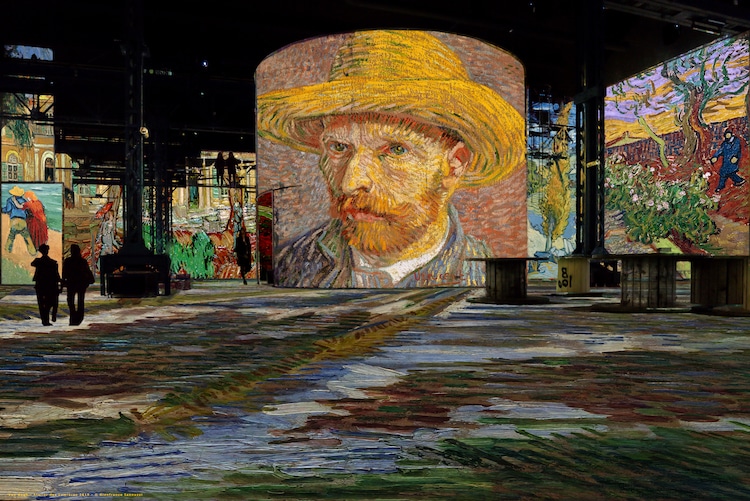
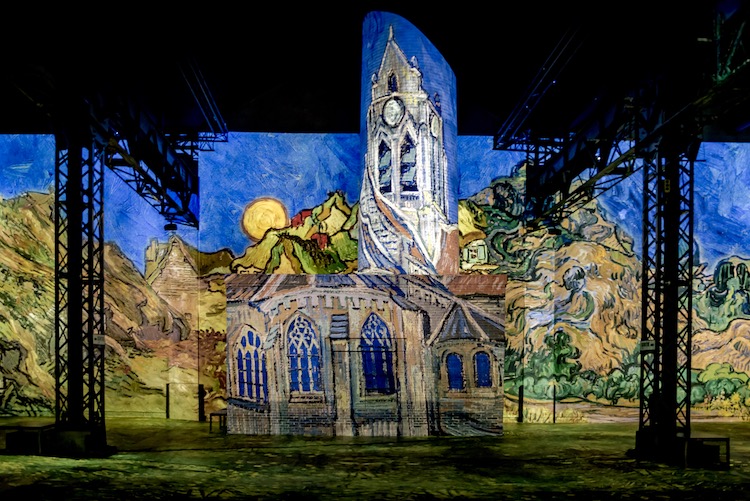
Vincent van Gogh died in 1890, long before the emergence of any of the visual technologies that impress us here in the 21st century. But the distinctive vision of reality expressed through paintings still captivates us, and perhaps captivates us more than ever: the latest of the many tributes we continue to pay to van Gogh’s art takes the form Van Gogh, Starry Night, a “digital exhibition” at the Atelier des Lumières, a disused foundry turned projector- and sound system-laden multimedia space in Paris. “Projected on all the surfaces of the Atelier,” its site says of the exhibition, “this new visual and musical production retraces the intense life of the artist.”

Van Gogh’s intensity manifested in various ways, including more than 2,000 paintings painted in the last decade of his life alone. Van Gogh, Starry Night surrounds its visitors with the painter’s work, “which radically evolved over the years, from The Potato Eaters (1885), Sunflowers (1888) and Starry Night (1889) to Bedroom at Arles (1889), from his sunny landscapes and nightscapes to his portraits and still lives.”
It also takes them through the journey of his life itself, including his “sojourns in Neunen, Arles, Paris, Saint-Rémy-de-Provence, and Auvers-sur-Oise.” It will also take them to Japan, a land van Gogh dreamed of and that inspired him to create “the art of the future,” with a supplemental show titled Dreamed Japan: Images of the Floating World.

Both Van Gogh, Starry Night and Dreamed Japan run until the end of this year. If you happen to have a chance to make it out to the Atelier des Lumières, first consider downloading the exhibition’s smartphone and tablet application that provides recorded commentary on van Gogh’s masterpieces. That counts as one more layer of this elaborate audiovisual experience that, despite employing the height of modern museum technology, nevertheless draws all its aesthetic inspiration from 19th-century paintings — and will send those who experience it back to those 19th-century paintings with a heightened appreciation. Nearly 130 years after Van Gogh’s death, we’re still using all the ingenuity we can muster to see the world as he did.
Related Content:
13 Van Gogh’s Paintings Painstakingly Brought to Life with 3D Animation & Visual Mapping
Van Gogh’s 1888 Painting, “The Night Cafe,” Animated with Oculus Virtual Reality Software
Download Hundreds of Van Gogh Paintings, Sketches & Letters in High Resolution
Based in Seoul, Colin Marshall writes and broadcasts on cities, language, and culture. His projects include the book The Stateless City: a Walk through 21st-Century Los Angeles and the video series The City in Cinema. Follow him on Twitter at @colinmarshall or on Facebook.
Read More...The Lou Reed Archive Opens at the New York Public Library: Get Your Own Lou Reed Library Card and Check It Out
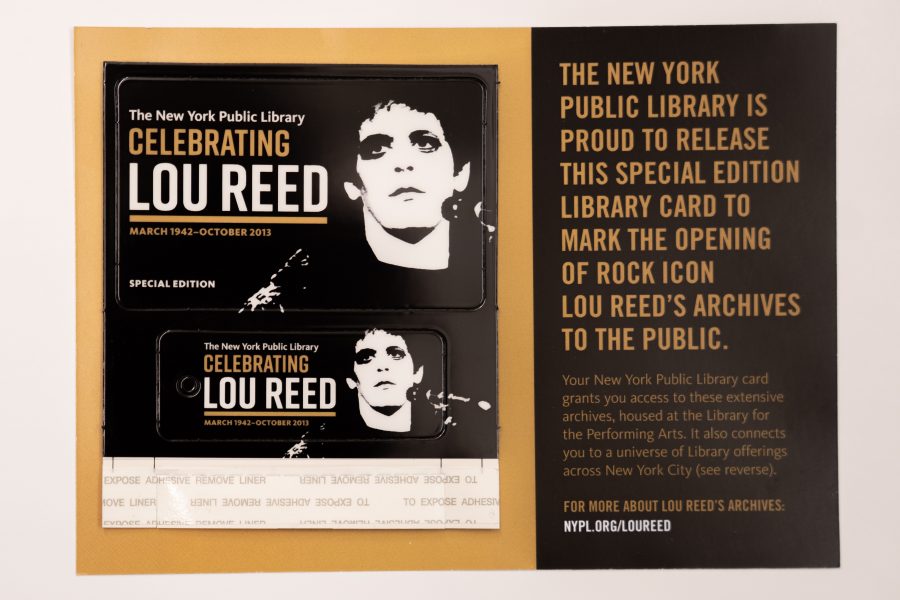
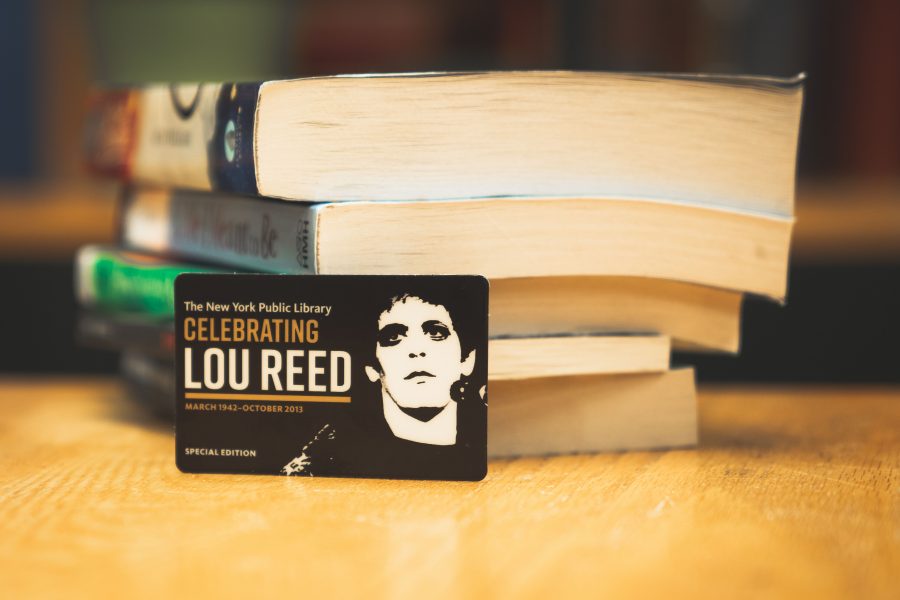
This past October marked the fifth anniversary of Lou Reed’s death. This month marks what would have been his 77th birthday. It seems like as good a time as any to revisit his legacy. As of this past Friday, anyone can do exactly that in person at the New York Public Library. And they can do so with their own special edition NYPL Lou Reed library card. The NYPL has just opened to the public the Lou Reed Archive, “approximately 300 linear feet,” the library writes in a press release, “of paper records, electronic records, and photographs, and approximately 3,600 audio and 1,300 video recordings.”
These artifacts span the musician, writer, photographer, and “tai-chi student”’s life from his 1958 high school band The Shades to “his job as a staff songwriter for the budget music label, Pickwick Records, and his rise to prominence through the Velvet Underground and subsequent solo career, to his final performance in 2013.”
It is more than fitting that they should find a home at the New York institution, in the city where Lou Reed became Lou Reed, “the most literary of rock stars,” writes Andrew Epstein for the Poetry Foundation, “one who aspired to make rock music that could stand on the same plane as works of literature.” See a list of the Lou Reed Archive collections below:
- Original manuscript, lyrics, poetry and handwritten tai-chi notes
- Photographs of Reed, including artist prints and inscriptions by the photographers
- Tour itineraries, agreements, road manager notes and paperwork
- 600+ hours of live recordings, demos, studio recordings and interviews
- Reed’s own extensive photography work
- Album, book, and tour artwork; mock-ups, proofs and match-prints
- Lou Reed album and concert posters, handbills, programs, and promotional items
- Lou Reed press for albums, tours, performances, books, and photography exhibits
- Fan mail
- Personal collections of books, LPs and 45s
Reed left his first “lasting legacy” at Syracuse University, as Syracuse itself affirmed after his death in 2013, as “a criminal, a dissident and a poet.” There, he studied under his literary hero, Delmore Schwartz, was reportedly expelled from ROTC for holding an unloaded gun to his superior’s head, and was supposedly turned away from his graduation by police. Once in New York, however, Reed not only piloted the Velvet Underground into everlasting cult infamy, jumpstarting waves of punk, post-punk, new wave, and a few dozen other subgenres. He also carried forth the legacy of the New York poetry, Epstein argues.
He had “serious connections to the poetry world”—not only to Schwartz, but also to the Beats and the New York School—to poets who “played a surprisingly large role in the emergence of the Velvet Underground.” Like all great art, Reed’s best work was more than the sum of its “multiple and complex influences.” But it should be appreciated alongside mid-century New York poets as much as jazz experimentalists like Ornette Coleman and Cecil Taylor who inspired his freeform approach. “Reed’s body of work,” writes Epstein, “represents a crucial but overlooked instance of poetry’s rich back-and-forth dialogue with popular culture.”
Similar things might be said about Reed’s engagements with film, theater, the visual arts, and the New York avant-garde generally, which he also transmuted and translated into his scuzzy brand of rock and roll. The NYPL archive documents his relationships with not only his bandmates and manager/patron Andy Warhol, but also Robert Quine, John Zorn, Robert Wilson, Julian Schnabel, and Laurie Anderson. And yet, despite the many rivers he waded into in his long career, immersing in some more deeply than others, it was the New York literary world whom he most wanted to embrace his work.
Accepting an award in 2007 from Syracuse, Reed said, “I hope, Delmore, if you’re listening you are finally proud as well. My name is finally linked to yours in the part of heaven reserved for Brooklyn poets.” Head over to The Library for the Performing Arts in Lincoln Center to get your own Lou Reed library card. If you’re lucky enough to spend some time with this extensive collection, maybe consider how all Reed’s work was, in some way or another, informed by a lifelong devotion to New York poetry.
Related Content:
Lou Reed Sings “Sweet Jane” Live, Julian Schnabel Films It (2006)
Josh Jones is a writer and musician based in Durham, NC. Follow him at @jdmagness
Read More...An Animated Introduction to Friedrich Nietzsche’s Life & Thought
There’s no shame if you’ve never known how to pronounce Friedrich Nietzsche’s name correctly. Even less if you never remember how to spell it. If these happen to be the case, you may be less than familiar with his philosophy. Let Alain de Botton’s animated School of Life video briefly introduce you, and you’ll never forget how to say it: “Knee Cha.” (As for remembering the spelling, you’re on your own.) You’ll also get a short biography of the disgruntled, dyspeptic German philosopher, who left a promising academic career at the University of Basel in his mid-20s and embarked to the Swiss Alps to write his violently original books in solitude before succumbing to a mental breakdown at 44 when he saw a cart driver beating a horse.
Nietzsche died after remaining almost entirely silent for 11 years. In these years and after his death, thanks to the machinations of his sister Elizabeth, his thought was twisted into a hateful caricature. He has since been rehabilitated from associations with the Nazis, but he still calls up fear and loathing for many people because of his relentless critiques of Christianity and reputation for staring too long into abysses. Maybe we can’t help but hear fascistic overtones in his concept of the ubermensch, and his ideas about slave morality can make for uncomfortable reading. Those steeped in Nietzsche’s thought may not feel that de Botton’s commentary gives these ideas their proper critical due.
Likewise, Nietzsche himself is treated as something of an ubermensch, an approach that pulls him out of his social world. Important figures who had a tremendous impact on his personal and intellectual life—like Arthur Schopenhauer, Richard and Cosima Wagner, Lou Salomé, and Nietzsche’s sister—don’t even receive a mention. But this is a lot to ask from a six-minute summary. De Botton hits some of philosophical highlights and explains some misconceptions. Yes, Nietzsche held no brief for Christianity at all, but this was because it caused tremendous suffering, he thought, by making people morally stunted and bitterly resentful.
Instead, he argued, we should embrace our desires, and use so-called sinful passions like envy to leverage our ambitions. Nietzsche is not a seducer, corrupting the youth with promises of greatness. You may very well fail, he admitted, and fail miserably. But to deny yourself is to never become who you are. Nietzsche scholar Babette Babich has described this aspect of the philosopher’s thought as the ethics of the supportive friend. She quotes David B. Allison, who writes that Nietzsche’s advice comes to us “like a friend who seems to share your every concern—and your aversions and suspicions as well. Like a true friend, he rarely tells you what you should do.”
Except that he often does. Babich also writes about Nietzsche as educator, and indeed he considered education one of the highest human goods, too precious to be squandered on those who do not appreciate it. His philosophy of education is consistent with his views on culture. Since God is Dead, we must replace scripture and liturgy with art, literature, and music. So far, so many a young Nietzsche enthusiast, pursuing their own form of Nietzschean education, will be on board with the philosopher’s program.
But as de Botton also explains, Nietzsche, who turned Dionysus into a philosophical ideal, might have issued one prescription too many for the average college student: no drinking. If that’s too much to stomach, we should at least take seriously that stuff about staring into abysses. Nietzsche meant it as a warning. Instead, writes Peter Prevos at The Horizon of Reason, “we should go beyond staring and bravely leap into the boundless chasm and practice philosophical base jumping.” No matter how much Nietzsche you read, he’s never going to tell you that means. We only become who we are, he suggests, when we figure it on our own.
Related Content:
Free Online Philosophy Courses
Josh Jones is a writer and musician based in Durham, NC. Follow him at @jdmagness
Read More...The CIA’s Rectal Tool Kit for Spies–Created for Truly Desperate Situations During The Cold War
Though global espionage remains a going concern in the 21st century, somehow the popular stories we tell about it return again and again to the Cold War. Maybe it has to do with the demand those mostly pre-digital decades made upon the physical ingenuity of spies as well as the tools of spycraft. Take, for instance, one particularly ingenious CIA-issued tool kit on display at the International Spy Museum in Washington, D.C. “Filled with escape tools,” says the Spy Museum’s web site, “this kit could be stashed inside the body where it would not be found during a search.” Take one guess as to where inside the body, exactly, it could be stashed.
You can get a closer look at the rectal tool kit in the Atlas Obscura video above. This “tightly sealed, pill-shaped container full of tools that could aid an escape from various sticky situations,” as that site’s Lizzie Philip describes it, “was issued to CIA operatives during the height of the Cold War.”
Built to contain a variety of escape tools like “drill bits, saws and knives,” it presented quite an engineering challenge: its materials, one needs hardly add, “could not splinter or create sharp edges that could injure users,” and “it had to seal tightly to not let anything seep in or poke out.” Upon seeing an item like this, which commands so much attention at the Spy Museum, one wonders whether all the spying that went on during Cold War was really so glamorous after all.
Has it crossed the mind of, say, John Le Carré, his writing career a nearly sixty-year-long deflation of the pretensions of spycraft, to write about the ins and outs of rectal tool kits? But then, personal experience has granted him much more knowledge about the tactics of British espionage than those of the American variety. As surely as he knows the MI5’s official motto, “Regnum Defende,” he must also know the unofficial motto that pokes fun at the organization’s aggressive culture of blame avoidance, “Rectum Defende” — words that, in light of the knowledge about just where the agents of Britain’s main ally were storing their tools, take on a whole new meaning.
via Atlas Obscura
Related Content:
The CIA’s Former Chief of Disguise Show How Spies Use Costumes in Undercover Operations
How the CIA Helped Shape the Creative Writing Scene in America
How the CIA Secretly Funded Abstract Expressionism During the Cold War
19-Year-Old Student Uses Early Spy Camera to Take Candid Street Photos (Circa 1895)
Based in Seoul, Colin Marshall writes and broadcasts on cities, language, and culture. His projects include the book The Stateless City: a Walk through 21st-Century Los Angeles and the video series The City in Cinema. Follow him on Twitter at @colinmarshall or on Facebook.
Read More...Leonard Bernstein Awkwardly Turns the Screws on Tenor Jose Carreras While Recording West Side Story (1984)
What have we here?
Evidence that the Maestro is a monster?
Or a behind the scenes reminder that Arrested Development’s wannabe actor Tobias Fünke is not too far off base when he says that to make it in “this business of show, you have to have the heart of an angel and the hide… of an elephant.”
Both? Neither? Any way you slice it, the recording session above is not for your typical cast album.
West Side Story, with a book by Arthur Laurents, music by Leonard Bernstein, and lyrics by Stephen Sondheim, opened on Broadway in 1957.
The film, starring Natalie Wood and Richard Beymer as star-crossed lovers Maria and Tony, came along four years later.
After which it’s been an endless round of community, college, and high school productions.
Are you a Jet or a Shark?
The celebrated tenor José Carreras does not make a particularly believable Jet.
While untold numbers of white kids have attempted Puerto Rican accents to play Maria, Bernardo, Anita, and Chino, that knife has seldom cut the other way.
Perhaps a dialect coach could have transformed Carreras’ thick Spanish accent into Tony’s New York street punk vernacular, but the prep time for these September 1984 recording sessions was minimal, and not tied to any actual production.
Carreras was also, at 38, a bit long in the tooth to be tackling the part.
But what might have been deal breakers for a Broadway revival were permissible for this weeklong special event in which world-caliber artists, “whose main reason for existing,” according to Bernstein, was their singing, would be laying down the score in the studio, backed by a full orchestra.
As he told his associate and eventual biographer, classical music television presenter Humphrey Burton:
l’d always thought of West Side Story in terms of teenagers and there are no teenage opera singers, it’s just a contradiction in terms. But this is a recording and people don’t have to look 16, they don’t have to be able to dance or act a rather difficult play eight times a week. And therefore we took this rather unorthodox step of casting number-one world-class opera singers. I suppose the only foreseeable problem was that they might sound too old—but they don’t, they just sound marvelous!
Bernstein’s approving mood is nowhere in evidence in the above clip, in which he hectors Carreras for screwing up the tempo, as the instrumentalists and sound engineers squirm.
Carreras’ discomfort and chagrin is so palpable that you can find the sequence on YouTube under the title “Tenor Keeps Screwing Up while Bernstein Conducts—Awkward Sequence,” as if he were some weedy upstart, still wet behind the ears, when in fact, he had just flown in from Verona, where he’d been appearing as Don José in Carmen.
Dame Kiri Te Kanawa, Carreras’ Maria, supplied a taste of what it was like to sing for the composer:
He’s a man of many emotions. You can see his moods, his frustrations, his happiness, his wanting to perform to people. That’s the thing that makes the man interesting. One is constantly trying to read him, but he’s on another planet!
In the end, Bernstein declared himself pleased with what had been accomplished, or at least with the enduring power of the material.
But readers with an anti-authoritarian streak may not feel satisfied until they’ve seen the clip below, in which a rogue BBC Orchestra trumpet isn’t quite so deferential in the face of the Maestro’s criticism.
Listen to the 1984 recording of West Side Story for free on Spotify.
Related Content:
Watch Leonard Bernstein Conduct the Vienna Philharmonic Using Only His Eyebrows
Leonard Bernstein Presents “The Greatest 5 Minutes in Music Education”
Ayun Halliday is an author, illustrator, theater maker and Chief Primatologist of the East Village Inky zine. Join her for the next installment of her book-based variety show, Necromancers of the Public Domain in New York City this April. Follow her @AyunHalliday.
Read More...Support Us
We're hoping to rely on loyal readers, rather than erratic ads. Please click the Donate button and support Open Culture. You can use Paypal, Venmo, Patreon, even Crypto! We thank you!

About Us

Open Culture scours the web for the best educational media. We find the free courses and audio books you need, the language lessons & educational videos you want, and plenty of enlightenment in between.
Advertise With Us

FREE UPDATES!
GET OUR DAILY EMAIL
Get the best cultural and educational resources on the web curated for you in a daily email. We never spam. Unsubscribe at any time.
FOLLOW ON SOCIAL MEDIA

Open Culture editor Dan Colman scours the web for the best educational media. He finds the free courses and audio books you need, the language lessons & movies you want, and plenty of enlightenment in between.
Advertise With Us

