Acclaimed Ruth Bader Ginsburg Documentary, RBG, Airing Tonight on CNN
Although still playing in cinemas throughout the country, the new Ruth Bader Ginsburg documentary–simply called RBG–will air tonight (Sunday) on CNN. Tune in at 8 p.m. Here’s a quick synopsis:
At the age of 84, U.S. Supreme Court Justice Ruth Bader Ginsburg has developed a breathtaking legal legacy while becoming an unexpected pop culture icon. But without a definitive Ginsburg biography, the unique personal journey of this diminutive, quiet warrior’s rise to the nation’s highest court has been largely unknown, even to some of her biggest fans – until now. RBG is a revelatory documentary exploring Ginsburg ‘s exceptional life and career from Betsy West and Julie Cohen.
Writing in the New York Times, film critic A.O. Scott observes that the “movie’s touch is light and its spirit buoyant, but there is no mistaking its seriousness or its passion. Those qualities resonate powerfully in the dissents that may prove to be Justice Ginsburg’s most enduring legacy, and RBG is, above all, a tribute to her voice.” Watch it tonight…
If you would like to support the mission of Open Culture, consider making a donation to our site. It’s hard to rely 100% on ads, and your contributions will help us continue providing the best free cultural and educational materials to learners everywhere. You can contribute through PayPal, Patreon, and Venmo (@openculture). Thanks!
Related Content
Google Puts Supreme Court Opinions Online
Free Online Political Science Courses
Read More...Dolly Parton’s “Jolene” Slowed Down to 33RPM Sounds Great and Takes on New, Unexpected Meanings
The Walrus is… Dolly Parton?
Not every record yields gold when played backwards or spun more slowly than recommended, but a 45 of Parton’s 1973 hit “Jolene” played at 33RPM not only sounds wonderful, it also manages to reframe the narrative.
As Andrea DenHoed notes in The New Yorker, “Slow Ass Jolene,” above, transforms Parton’s “baby-high soprano” into something deep, soulful and seemingly, male.
In its original version, the much-covered “Jolene” is a straight up woman-to-woman chest-baring. Our narrator knows her man is obsessed with the sexy, auburn-haired Jolene, to the point where he talks about her in his sleep.
Apparently she also knows better than to raise the subject with him. Instead, she appeals to Jolene’s sense of mercy:
You could have your choice of men
But I could never love again
He’s the only one for me, Jolene
The song is somewhat autobiographical, though the situation was nowhere near as dire as listeners might assume. In an interview with NPR, Parton recalled a red-haired bank teller who developed a big crush on her husband when she was a young bride:
And he just loved going to the bank because she paid him so much attention. It was kinda like a running joke between us — when I was saying, ‘Hell, you’re spending a lot of time at the bank. I don’t believe we’ve got that kind of money.’ So it’s really an innocent song all around, but sounds like a dreadful one.
For the record, the teller’s name wasn’t Jolene.
Jolene was a pretty little girl who attended an early Parton concert. Parton was so taken with the child, and her unusual name, that she resolved to write a song about her.
Yes, the kid had red hair and green eyes.
Wouldn’t it be wild if she grew up to be a bank teller?
I digress…
In the original version, the irresistible chorus wherein the soon-to-be-spurned party invokes Jolene’s name again and again is plaintive and fierce.
In the slow ass version, it’s plaintive and sad.
The pain is the same, but the situation in much less straightforward, thanks to blurrier gender lines.
Parton told NPR that women are “always threatened by other women, period.”
Jolene’s prodigious feminine assets could also prove worrisome to a gay man whose bisexual lover’s eye is prone to wander.
Or maybe the singer and his man live in a place where same sex unions are frowned on. Perhaps the singer’s man craves the comfort of a more socially acceptable domestic situation.
Or perhaps Jolene is one hot female-identified tomato, and as far as the singer’s man’s concerned, his pastor and his granny can go to hell! Jolene’s the only one for him.
Or, as one waggish Youtube commenter succinctly put it, “Jolene better stay the hell away from Roy Orbison’s man!”
Jolene, Jolene, Jolene, Jolene
I’m begging of you please don’t take my man
Jolene, Jolene, Jolene, Jolene
Please don’t take him just because you can
Your beauty is beyond compare
With flaming locks of auburn hair
With ivory skin and eyes of emerald green
Your smile is like a breath of spring
Your voice is soft like summer rain
And I cannot compete with you, Jolene
He talks about you in his sleep
There’s nothing I can do to keep
From crying when he calls your name, Jolene
And I can easily understand
How you could easily take my man
But you don’t know what he means to me, Jolene
Jolene, Jolene, Jolene, Jolene
I’m begging of you please don’t take my man
Jolene, Jolene, Jolene, Jolene
Please don’t take him just because you can
You could have your choice of men
But I could never love again
He’s the only one for me, Jolene
I had to have this talk with you
My happiness depends on you
And whatever you decide to do, Jolene
Jolene, Jolene, Jolene, Jolene
I’m begging of you please don’t take my man
Jolene, Jolene, Jolene, Jolene
Please don’t take him even though you can
Jolene, Jolene
Related Content:
R.E.M.’s “Losing My Religion” Reworked from Minor to Major Scale
Ayun Halliday is an author, illustrator, theater maker and Chief Primatologist of the East Village Inky zine. Join her in NYC on Monday, September 24 for another monthly installment of her book-based variety show, Necromancers of the Public Domain. Follow her @AyunHalliday.
Read More...When Steve Jobs Taught Andy Warhol to Make Art on the Very First Macintosh (1984)
When Andy Warhol first became famous, few knew what to make of his art. When Apple first released the Macintosh — dramatically promoted with that Ridley Scott Super Bowl commercial — few knew what to make of it either. The year was 1984, when almost nobody had seen a graphical user interface or even a mouse, let alone used them, and the Macintosh looked as strange and compelling when it entered the computing scene as Warhol did when he entered the art scene. Both seemed so casually to repudiate so many long-held assumptions, an act that tends to startle and confuse older people but makes immediate sense to younger ones. What happened, then, when Warhol and the Macintosh first crossed paths?
Journalist David Sheff, who wrote an early profile of Steve Jobs and conducted the last in-depth interview with John Lennon and Yoko Ono, remembers it well. In October 1984, he and Jobs attended the ninth-birthday party thrown by Ono for Sean, her son with Lennon. As a present, Jobs brought along one of his company’s new Macintoshes and set it up himself in young Sean’s bedroom. “Sean took control of the mouse, and rolled the small box along the floor,” Sheff writes. “Steve said, ‘Now hold the button down while you move it and see what happens.’ Sean did, and a thin, jagged, black line, appeared on the screen. Sean, entranced, said, ‘Cool!’ He clicked the mouse button, pushed it around, and on the screen appeared shapes and lines, which he erased, and then he drew a sort of lion-camel and then a figure that he said was Boy George.”
Though Boy George may not have been in attendance, the party’s unsurprisingly fabulous guest list also included Andy Warhol (an “eccentric uncle” to Sean) and Keith Haring, both of whom Sheff remembers coming into the room as part of a crowd wanting to catch a glimpse of Sean’s new toy. It wasn’t long before Warhol, presumably compelled by the artistic impulse as well as by his fascination for all things new, asked if he could give it a try:
Andy took Sean’s spot in front of the computer and Steve showed him how to maneuver and click the mouse. Warhol didn’t get it; he lifted and waved the mouse, as if it were a conductor’s baton. Jobs gently explained that the mouse worked when it was pushed along a surface. Warhol kept lifting it until Steve placed his hand on Warhol’s and guided it along the floor. Finally Warhol began drawing, staring at the “pencil” as it drew on the screen.
Warhol was spellbound – people who knew him know the way he tuned out everything extraneous when he was entranced by whatever it was – gliding the mouse, eyes affixed to the monitor. Haring was bent over watching. Andy, his eyes wide, looked up, stared at Haring, and said, “Look! Keith! I drew a circle!”
In his diary, Warhol writes of entering Sean’s room to find “a kid there setting up the Apple computer that Sean had gotten as a present, the Macintosh model. I said that once some man had been calling me a lot wanting to give me one, but that I’d never called him back or something, and then the kid looked up and said, ‘Yeah, that was me. I’m Steve Jobs.’ ” But Jobs, possessed of as keen a promotional instinct as Warhol’s own, assured him that the offer was still good, and that he would also give him a lesson in drawing on the Mac right then and there. “I felt so old and out of it with this young whiz guy right there who helped invent it,” writes Warhol, noting that “it only comes in black and white now, but they’ll make it soon in color.”
The Macintosh made an appearance in Warhol’s “Ads” series of paintings in 1984, the same year he also agreed, according to Artsy’s Abigail Cain, “to be a spokesperson for Apple’s rival in the personal computing sphere — Commodore. The artist was to promote the company’s new computer, the Amiga 1000, and its cutting-edge multimedia capabilities” that included a 4,096-color display. At the machine’s launch, Warhol “used ProPaint to sketch Blondie lead singer Debbie Harry in front of a crowd of eager tech enthusiasts,” which you can see in the video above. Just a few years ago, the efforts of digital artist Cory Arcangel and specialists at Carnegie Mellon University recovered 28 long-lost digital paintings Warhol made on his Amiga. Whether the artist ever made anything with or even took delivery of his promised Mac, we don’t know – or at least we don’t know yet.
Related Content:
Short Film Takes You Inside the Recovery of Andy Warhol’s Lost Computer Art
Andy Warhol Digitally Paints Debbie Harry with the Amiga 1000 Computer (1985)
Apple’s Guided Tour to Using the First Macintosh (1984)
Discover the Lost Early Computer Art of Telidon, Canada’s TV Proto-Internet from the 1970s
Based in Seoul, Colin Marshall writes and broadcasts on cities and culture. His projects include the book The Stateless City: a Walk through 21st-Century Los Angeles and the video series The City in Cinema. Follow him on Twitter at @colinmarshall or on Facebook.
Read More...Enter an Archive of William Blake’s Fantastical “Illuminated Books”: The Images Are Sublime, and in High Resolution
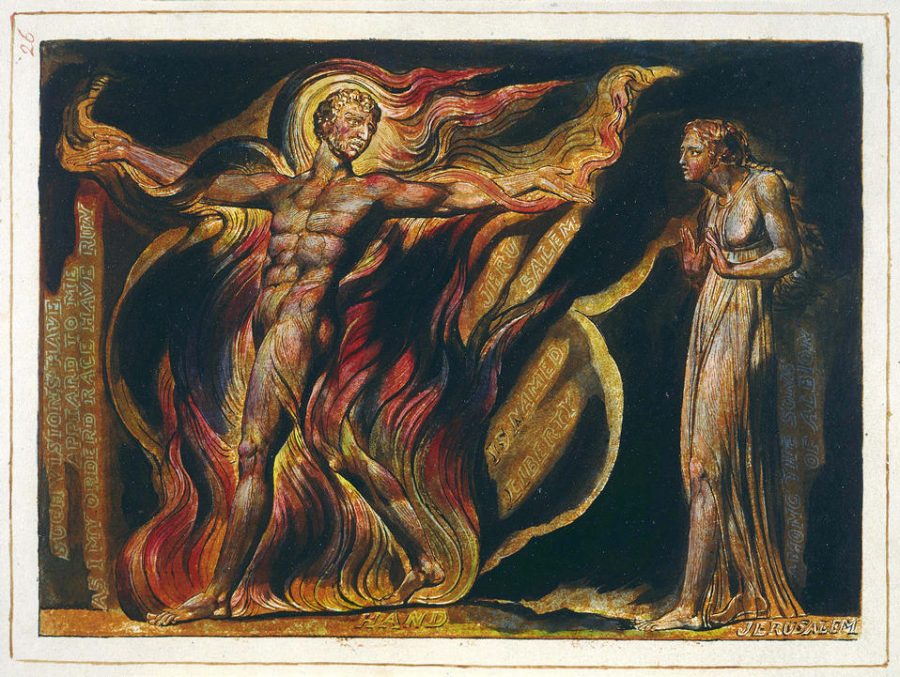
William Blake earned his place as the patron saint of all freethinking outsider artists. One might say he perfected the role as he perfected his art—or his arts rather, since his poetry inspires as much awe and acclaim as his visionary engravings and illustrations. Standing astride the Neoclassical eighteenth century and the Romantic era, Blake rejected the rationalism and classicism that surrounded him from birth and developed a prophetic style drawn from an earlier age.
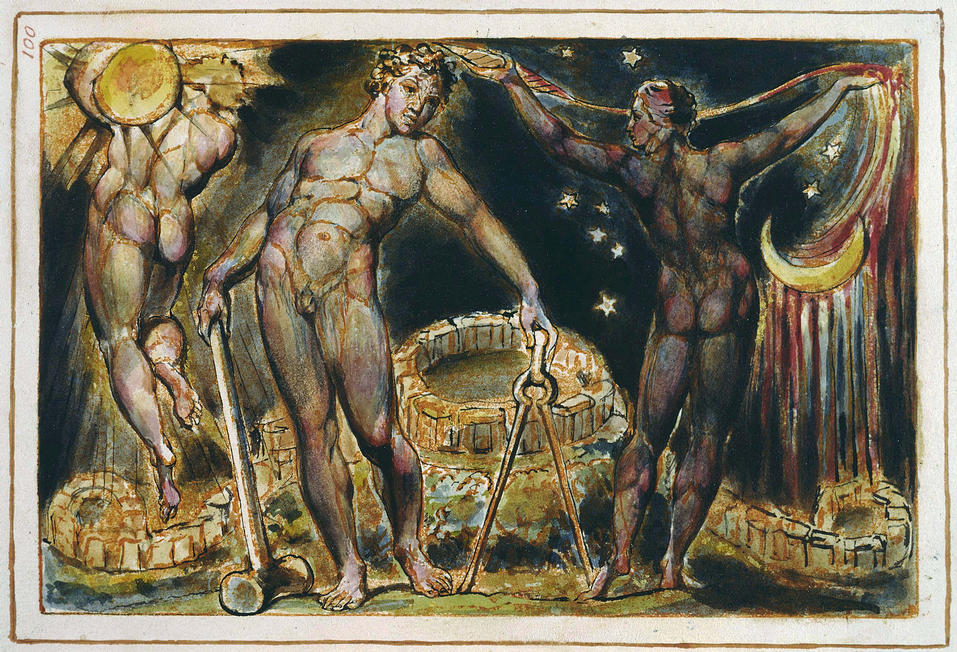
He “sought to emulate the example of artists such as Raphael, Michelangelo and Dürer in producing timeless, ‘Gothic’ art, infused with Christian spirituality and created with poetic genius,” writes the Met’s Elizabeth Barker. (“Blake described his painting technique as ‘fresco.’) But no one would ever mistake the works of Blake for anyone other than Blake, with their muscular, heroic figures, violently expressive faces, and tortured poses.
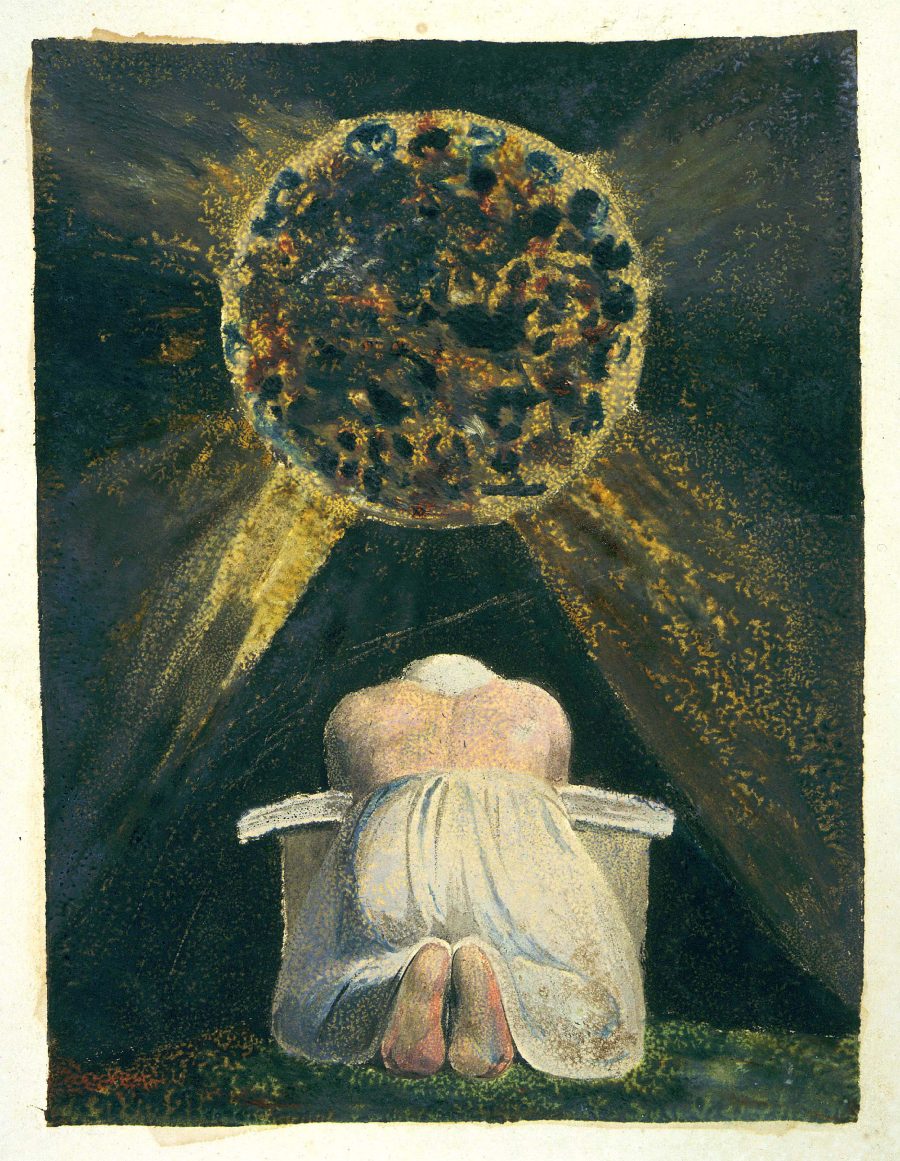
The William Blake Archive gives us access to a huge sampling of Blake’s work, from his book illustrations to his drawings and paintings, to his manuscripts, etc. The images are high resolution scans that users can add to a lightbox, rotate, zoom into, view “true size,” or enlarge.
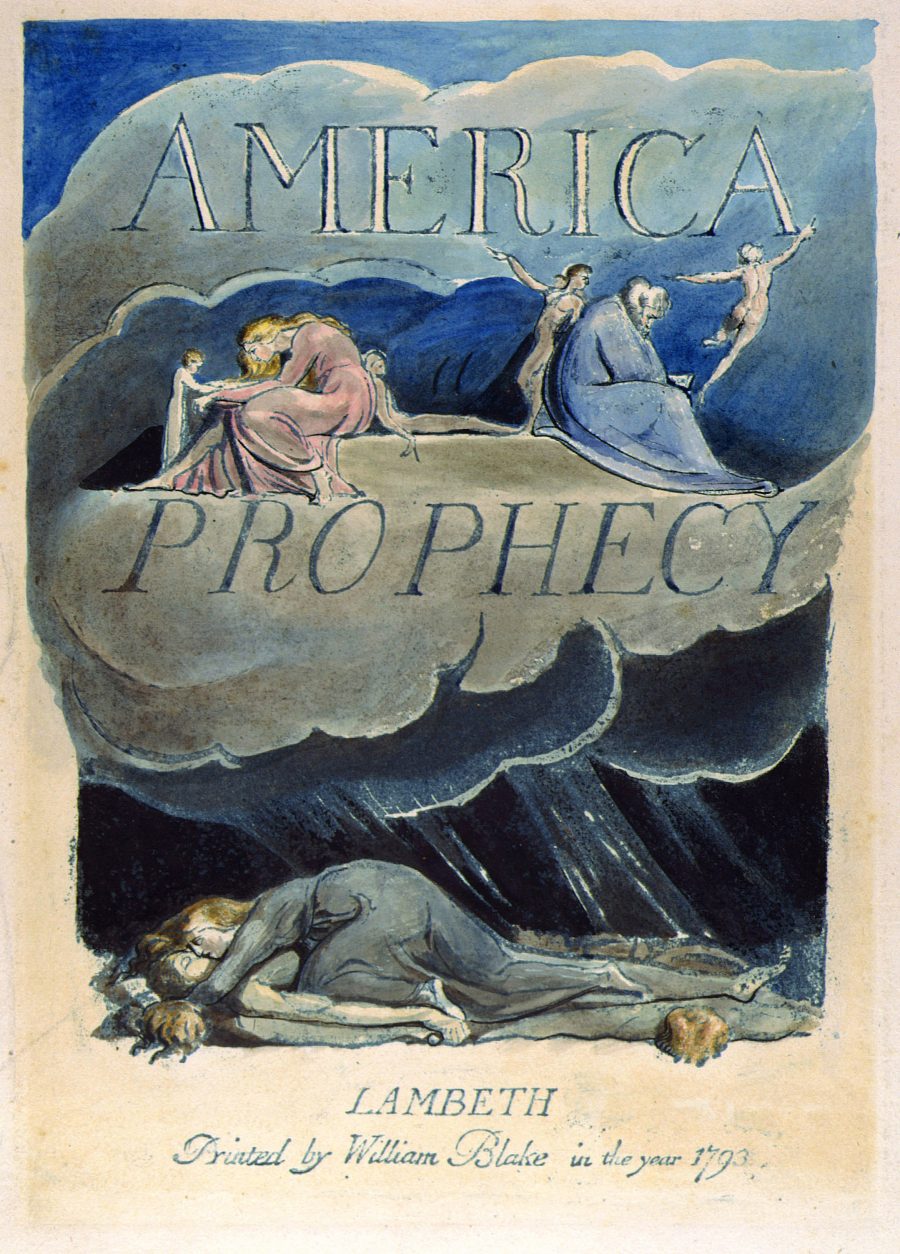
Perhaps most interesting are the images, like those here, from Blake’s “Illuminated Books,” a series of philosophical, religious, and mythological works composed from about 1788 to 1822. The archive contains dozens of variant printings of these endlessly fascinating hand-lettered books.
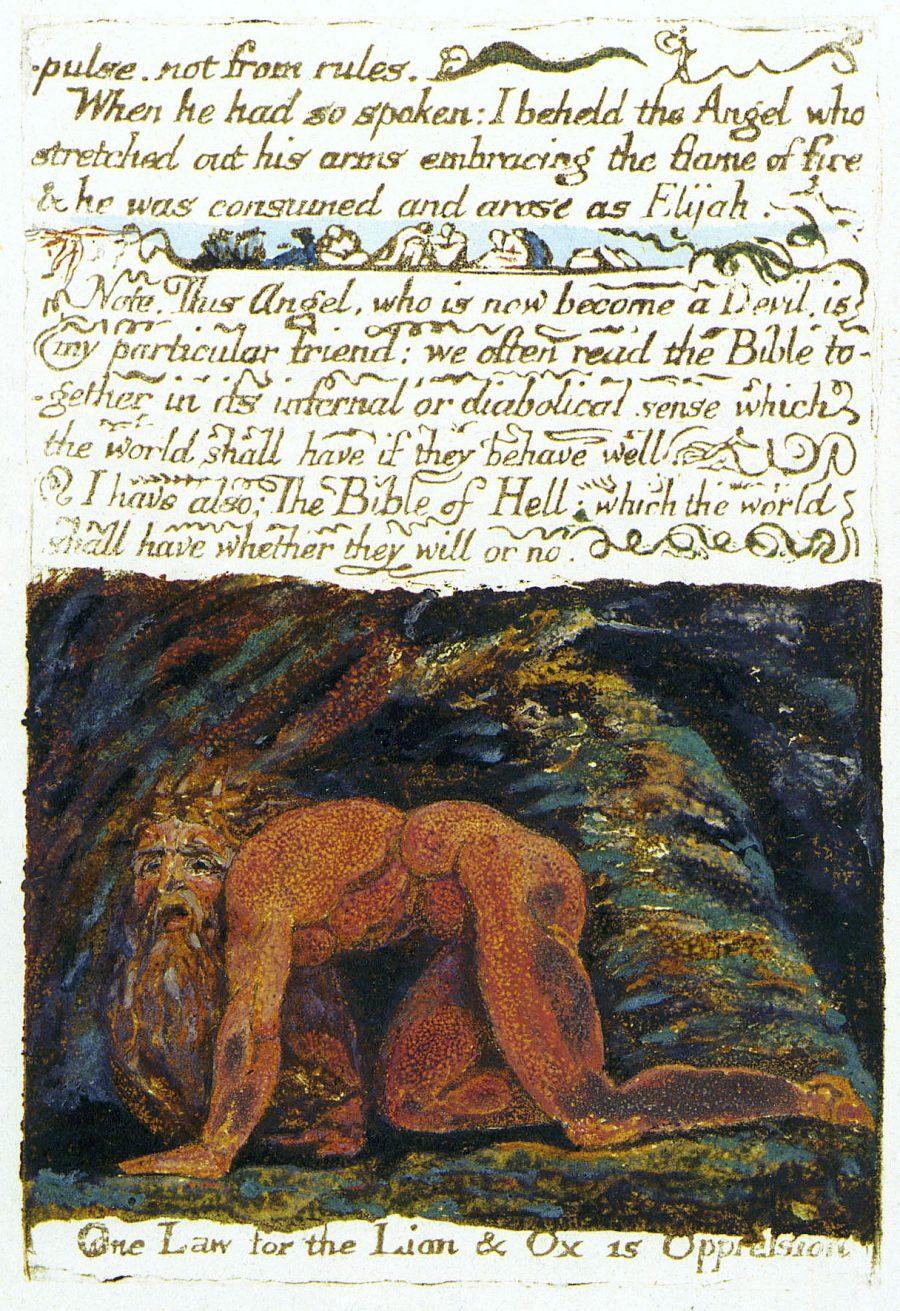
Becoming a furiously prolific, mystically inspired artist while living in poverty and near-obscurity—“considered insane and largely disregarded by his peers,” as BBC History puts it—required fortitude and almost superhuman belief in himself, especially since his belief system was largely self-created. While Blake considered the Bible “the greatest work of poetry ever written,” and its themes and narratives spoke to him throughout his career, his own religious tendencies took the form of the mythology he elaborated through the fantastical illuminated books.
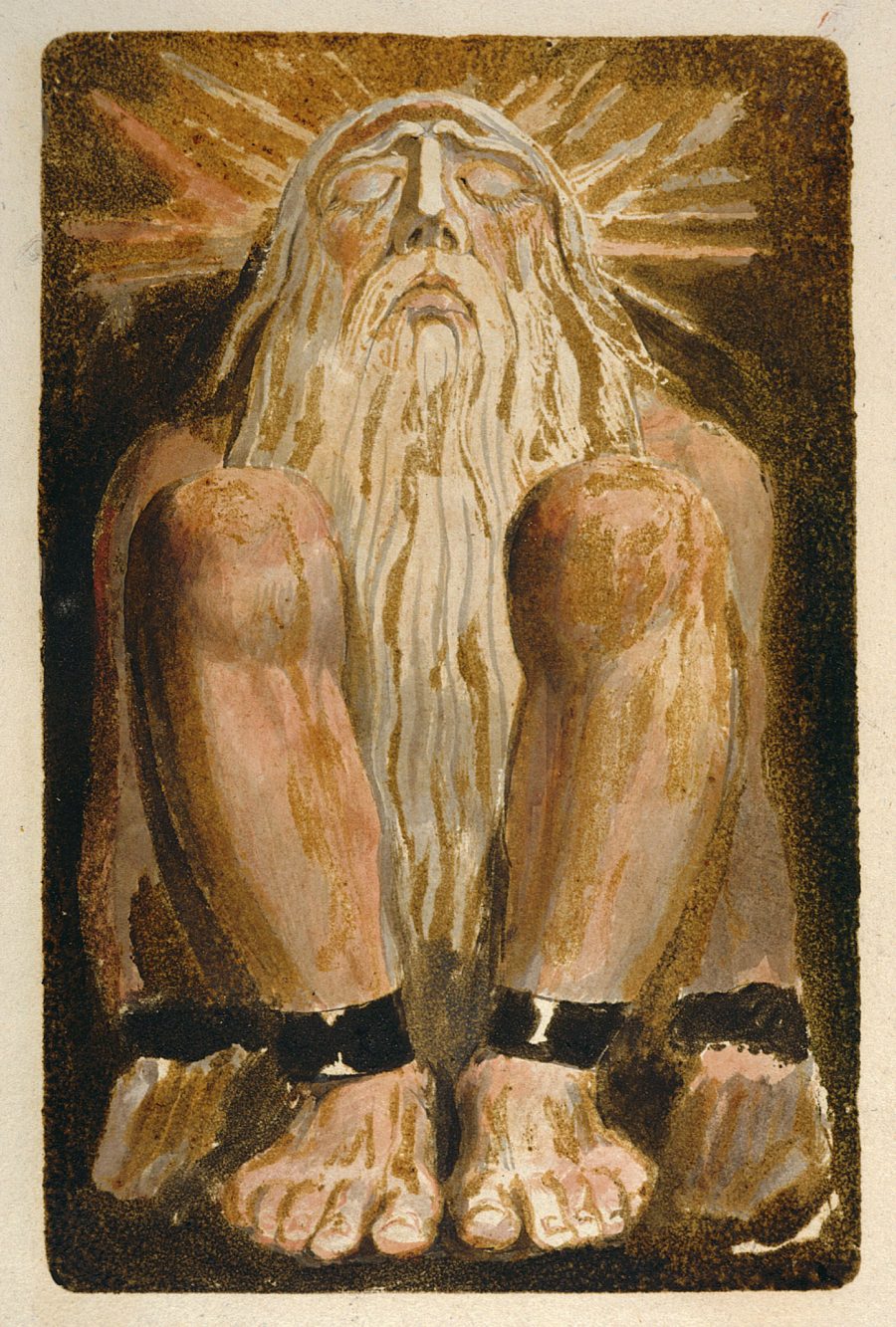
“I must Create a System,” he wrote in Jerusalem, composed between 1804 and 1820, “or be enslav’d by another Mans,” and so he did, inventing figures like Los, Urizen (the oppressive, suppressive God of the Old Testament), Albion, the personification of England, and his daughters, Bromion, Oothoon, and Theotormon. While working on these unorthodox projects, he barely “eked out a living as an engraver and illustrator” of commercial books. He also drew and painted several Biblical subjects and scenes from literary texts by his favorite authors, Milton and Dante.
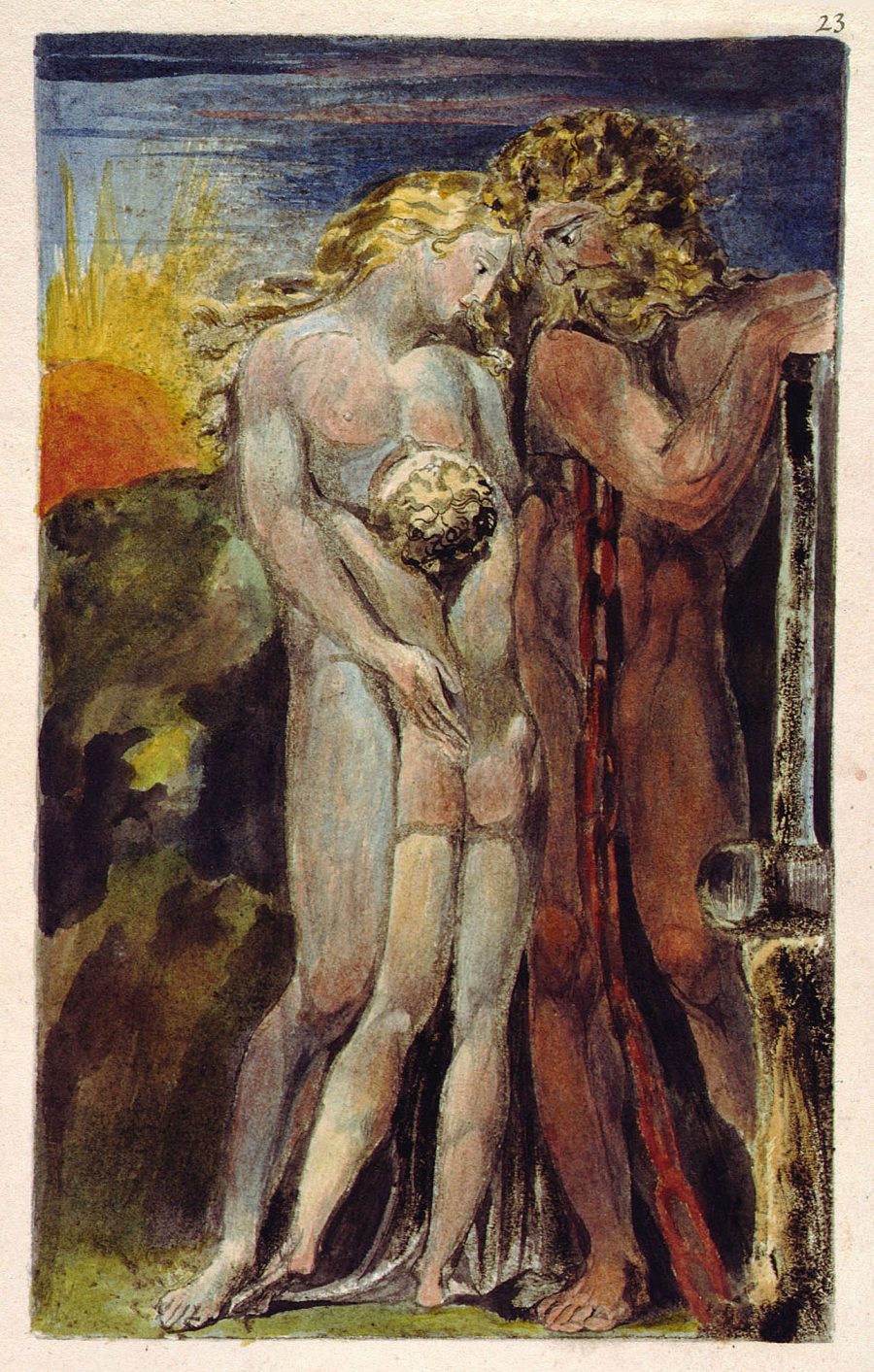
The illuminated books, Barker writes “rank among Blake’s most celebrated achievements.” Written “in a range of forms—prophecies, emblems, pastoral verses, biblical satire, and children’s books,” these eclectic works “addressed various timely subjects—poverty, child exploitation, racial inequality, tyranny, religious hypocrisy.” With literary vigor, moral clarity, and emotional insight, Blake harshly critiqued what he saw as the evils of his age, and moreover, offered an alternative—an anti-Enlightenment, radically egalitarian, free love vision, composed of patchwork elements of the Bible, Milton, Emanuel Swedenborg, and pagan and druidic sources.
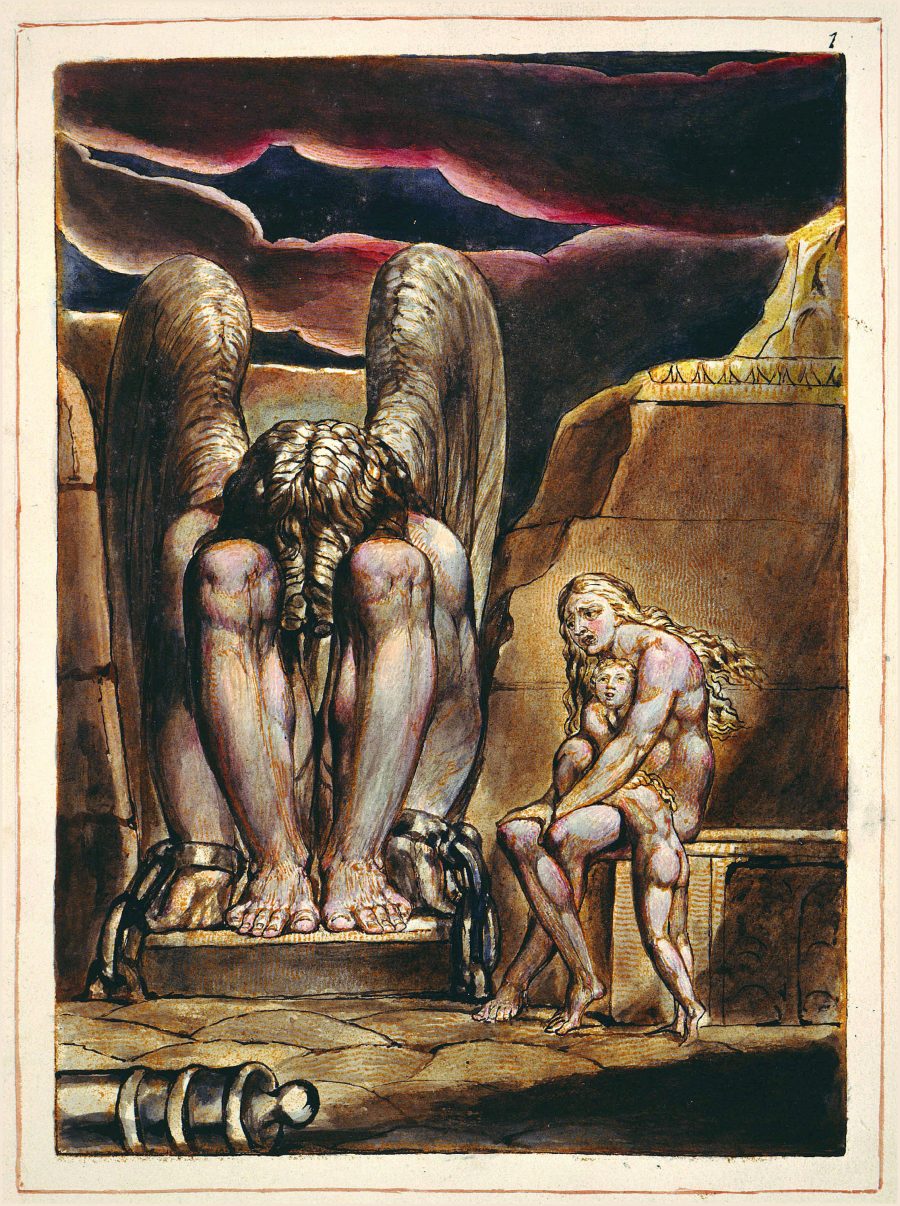
Two of the most famous of Blake’s illuminated books show the influence of Milton’s Il Penseroso and L’Allegro, studies in the contrast of melancholy and mirth, which Blake once illustrated. In Blake’s hands, these become Songs of Innocence, “the gentlest of his lyrics,” writes BBC, and Songs of Experience, “containing a profound expression of adult corruption and repression.” Blake also found in Dante “a seemingly inexhaustible source of inspiration in his own fertile mind,” Barker explains. But just as he transformed his artistic influences, he took his literary inspirations in directions no one else but Blake would think to do. And for that, he remains a singularly original artist, peerless in inventiveness and dedication to his work.
See the William Blake Archive here. The link to his “Illuminated Books” from which the images here come is at the top left-hand corner of the archive’s nav bar.
You can purchase a copy of William Blake: The Complete Illuminated Books in book format here.
Related Content:
William Blake’s Hallucinatory Illustrations of John Milton’s Paradise Lost
William Blake’s Masterpiece Illustrations of the Book of Job (1793–1827)
Josh Jones is a writer and musician based in Durham, NC. Follow him at @jdmagness
Read More...Watch Willem Dafoe Become Vincent Van Gogh in Julian Schnabel’s New Film, At Eternity’s Gate
We know Julian Schnabel for working in two forms: painting and film. His work in both has more connection than it might at first seem, since most of his films are about art, or at least about artists. After making it big in the art world himself in the late 1970s and 1980s with his signature large-scale canvasses incorporating a wide variety of materials, he got behind the camera in 1996 to direct Basquiat, a biopic on the eponymous graffiti-artist-turned-painter. In the 2000s he followed it up with Before Night Falls, about Cuban poet Reinaldo Arenas, and The Diving Bell and the Butterfly, about a French magazine editor turned writer after a stroke left him “locked” inside his own head. (At that same time he also shot a Lou Reed concert film, a song from which we’ve previously featured here on Open Culture.)
Now Schnabel has brought his filmmaking career back to where he started it with another film about another painter, a controversial figure in his day, whose influence grew after his early death. At Eternity’s Gate depicts the final days in the life of Dutch Post-Impressionist Vincent van Gogh, casting in the role no less a thespian than Willem Dafoe, known for playing everyone from T.S. Eliot to Pier Paolo Pasolini to Jesus of Nazareth.
Though he has already lived a much longer life than Van Gogh ever did, Dafoe no doubt has the skills to use that in the performance’s favor, transmitting the way that the painter saw more deeply into the world around him than anyone else did and got labeled a madman for it. And yes, there was also the matter of his ear, from which the trailer above assures us that Schnabel’s film doesn’t shy away.
But At Eternity’s Gate clearly focuses on Van Gogh’s struggle to pursue his art, according to his personal vision, in an unreceptive time and place. “Rather than simply suggest that madness and genius are inextricably linked, as countless movies of this sort have already done, the filmmaker portrays the act of creating art as less an action and more a state of being, an ever-flowing stream that the man holding the paintbrush is powerless to stop or even control,” writes Indiewire’s Michael Nordine. “Watching the artist at work and hearing nothing but his rapid brushstrokes as the wind howls in the background is meditative, even mesmeric.” Schnabel’s film follows last year’s Loving Vincent, which told Van Gogh’s story with animation made entirely of oil paintings. Its success, and the acclaim that has so far come in for At Eternity’s Gate in advance of its wide release in November, supports one observation in particular made by Dafoe-as-Van Gogh: “Maybe God made me a painter for people who aren’t born yet.”
Related Content:
Watch as Van Gogh’s Famous Self-Portrait Morphs Into a Photograph
Van Gogh’s 1888 Painting, “The Night Cafe,” Animated with Oculus Virtual Reality Software
The Vincent Van Gogh Action Figure, Complete with Detachable Ear
Lou Reed Sings “Sweet Jane” Live, Julian Schnabel Films It (2006)
Based in Seoul, Colin Marshall writes and broadcasts on cities and culture. His projects include the book The Stateless City: a Walk through 21st-Century Los Angeles and the video series The City in Cinema. Follow him on Twitter at @colinmarshall or on Facebook.
Read More...To Make Great Films, You Must Read, Read, Read and Write, Write, Write, Say Akira Kurosawa and Werner Herzog
I wouldn’t presume to draw many comparisons between the work of Akira Kurosawa and Werner Herzog. There is, in both directors, a rough, masculinist daring that fully explores the tragic limitations and bloody consequences of rough, masculinist daring. This broad thematic commitment expresses itself in both artists’ films in wildly different ways. Maybe what most connects them, and connects them to their ardent fans, is a shared writerly sensibility. Film may be foremost a visual medium, yet—given the weight of thousands of years of oral and written storytelling that came before it—filmmakers cannot produce great work without steeping themselves in literature.
Or, at least, that’s what both Kurosawa and Herzog have argued—and who would contradict them? Filmmaking is a risky endeavor in the best of circumstances. “It costs a great deal of money to make a film these days,” and becoming a director is “not so easily accomplished,” says Kurosawa in his interview offering advice to aspiring filmmakers above. “If you genuinely want to make films,” he says, “then write screenplays.” Where did the ideas for his screenplays come from? From literature. It’s important, he says, that filmmakers “do a certain amount of reading. Unless you have a rich reserve within, you can’t create anything.”
Kurosawa adapted the 1951 Rashomon, perhaps his most widely acclaimed film, from two short stories by Japanese writer Ryūnosuke Akutagawa, “Rashomon” (1915) and “In a Grove” (1921). 1985’s Ran is famously “an Eastern retelling of Shakespeare’s King Lear,” an author from whom Kurosawa learned much. He adapted Dostoevsky, his favorite writer, in a Japanese context, and his 1957 film The Lower Depths adapts a play by Maxim Gorky. Even his films that do not directly translate another writer’s work still draw inspiration from literary sources. Reading leads to writing, and to become an accomplished filmmaker, Kurosawa says in no uncertain terms, you must write.
This advice does not always go over well, he admits. Writing is painful and difficult, often a thankless, unforgiving task with no immediate reward. “Still,” he says, paraphrasing Balzac, “for writers, including novelists, the most essential and necessary thing is the forbearance to face the dull task of writing one word at a time.” One only learns how to do this by doing it—and by immersing oneself in the work of others who have done it. To succeed as a storyteller, the basis of the director’s art, you must “write, write, write, and read.”
Herzog, implying the importance of writing more than stating it outright, begins and ends his advice to young aspirants above with the repeated injunction, “read, read, read, read,” and so on. “If you don’t read, you’ll never be a filmmaker.” Technical considerations are secondary. Herzog’s Rogue Film School encourages students to “go absolutely and completely wild”… by reading Hemingway, Virgil, The Poetic Edda, and J.A. Baker’s The Peregrine. (He also suggests The Warren Commission Report and Bernal Diaz del Castillo’s True History of the Conquest of New Spain.) Kurosawa does not offer specific suggestions. He grants that “current novels are fine, but one should read the classics too.” The kinds of stories these filmmakers recommend has much to do with their own temperaments and interests; whatever you might prefer to read in the course of your directorial training, Herzog says you must read as much as possible, and, Kurosawa adds, you must write, write, write, and write some more.
Related Content:
Werner Herzog Creates Required Reading & Movie Viewing Lists for Enrolling in His Film School
Werner Herzog’s Rogue Film School: Apply & Learn the Art of Guerilla Filmmaking & Lock-Picking
Akira Kurosawa’s List of His 100 Favorite Movies
Josh Jones is a writer and musician based in Durham, NC. Follow him at @jdmagness
Read More...How Michael Jackson Wrote a Song: A Close Look at How the King of Pop Crafted “Don’t Stop ‘Til You Get Enough”
First of all, happy belated birthday to Evan Puschak, the man behind Nerdwriter and some of the best video essays on the web that we often feature here on Open Culture. He recently turned 30, and if you’re in your 20s that’s some elder statesman business. If you’re older, well, remember how you felt when you turned 30? Wouldn’t you want that youthful anxiety back?
Anyway, Evan’s gift to us is this appreciation of Michael Jackson’s “Don’t Stop ‘Til You Get Enough,” the breakaway hit from his 1979 album Off the Wall, the one that began Jackson’s rise into the stratosphere, a journey that would end with an isolated man chasing the dragon’s tail of success. But that was far off in the future, and though Thriller was the blockbuster album, Off the Wall has so much more joy, sexuality, and heart than what was to come. “Rock with You” and the title track are smooth, soulful numbers, but as Puschak says, “Don’t Stop” is *the* single off that album, a song that still sounds fresh today, a cross-over pop hit par excellence, despite being overplayed at every wedding reception since the ‘80s. (Even when watching the video for this piece, I found myself clapping along, something I rarely do. But it’s just so. damn. catchy.)
So why is that? How does this song work?
Puschak makes a few salient points.
One is that the song comes heavily indebted to disco, yet it is not a disco song. The rhythm structure is closer to funk than disco–it’s really just a vamp on two chords–and the verse-chorus structure is from rock music. It’s “pure dance music,” as Puschak says, quoting writer Ann Danielson.
Another point is that the rhythm mix is all about syncopation, with bass, shakers, strings, horns, and even a Coke bottle (played by Jackson himself) filling in the spaces between the beat. (Those that find, say, house music boring can put a lot of it down to the lack of syncopation).
And finally, there’s Jackson’s vocals, the top of each verse being two notes in a tritone interval. The tritone has been called the “devil’s interval”–there’s a nice video essay here on its history–but there’s nothing devilish about Jackson’s falsetto. As Puschak says, quoting Ethan Hein, “the relationship between these notes is somewhat off kilter, and your mind notices that. And that infuses the song with an urgency that it wouldn’t otherwise have.”
Interestingly, the lyrics are not discussed. And probably for good reason–apart from the song’s title in the chorus, Jackson’s lyrics are sung so high they are inscrutable. Be honest, until you read the lyric sheet, did you know what he was singing? My point would be–it doesn’t matter. The point is in the title; the meaning is in the mood.
Jackson would try to catch lighting in a bottle again on Thriller with “You Wanna Be Startin’ Something,” a pretty blatant rewrite. It’s still a great single, but that song, along with “Beat It” started Jackson along the path of lryics about aggression and posturing. (A few years later, we’d have “Bad,” “Smooth Criminal,” and more.)
Hence my point about the magic of Off the Wall–before the fame, before the insanity, before the “King of Pop” business, Jackson was a sensual, androgynous angel sent down to bring love to the dance floor, or your bedroom, and all spaces in between. It didn’t last long, but it’s a beautiful single, a beautiful album, and a beautiful moment in pop.
Related Content:
Miles Davis Covers Michael Jackson’s “Human Nature” (1983)
Ted Mills is a freelance writer on the arts who currently hosts the artist interview-based FunkZone Podcast and is the producer of KCRW’s Curious Coast. You can also follow him on Twitter at @tedmills, read his other arts writing at tedmills.com and/or watch his films here.
Read More...Why You Should Read One Hundred Years of Solitude: An Animated Video Makes the Case
Maybe we read some celebrated literary works the way we eat kale or quinoa—you don’t exactly love it but they say it’s, like, a superfood. Not so Gabriel Garcia Marquez’s One Hundred Years of Solitude. When I first started reading the novel, I couldn’t stop. Twelve hours and a couple pots of coffee later, I wanted to read it again right away. It’s a page-turner—not something one often says of literary fiction beloved by highbrow critics and academics—but I mean it as the highest possible compliment.
The book has every feature of a binge-worthy soap opera: characters we love and love to hate, doomed affairs, sex, violence, endless family squabbling, tragedy, intrigue, melodrama…. Again, this is no criticism; Marquez loved telenovelas and even wrote a script for one. He wanted his work to reach as many people as possible, to thrill and entertain. But he didn’t withhold any literary nutrients either.
The novel’s poetic language, historical scope, and thematic and symbolic complexity has led critics like William Kennedy to compare it to the book of Genesis, and led no small number of readers to wildly prefer it to the Bible or any other ancient book of mythology.
If you’re one of the two or three people who hasn’t read the novel, and you don’t find all this praise fully convincing, consider the case made by Francisco Díez-Buzo in the TED-Ed animated video above.
The story, we learn, arrived as an epiphany Marquez had while he and his family were on the road to a vacation destination. He turned the car around, abandoned the trip, and started writing immediately—an example of the total commitment many writers promise themselves they’ll one day get around to maybe working on. Eighteen months and many pots of coffee later, One Hundred Years of Solitude appeared, introducing a worldwide readership to Marquez, magical realism, and Latin American literature, politics, and history.
Most every reader now has a volume of Octavio Paz or Pablo Neruda on the shelf, and novels by Marquez, Mario Vargas Llosa, or Isabelle Allende. Before Cien años de soledad arrived, however, this was rarely so outside of Spanish-speaking countries. The novel created a global appetite for rich Latin American traditions of storytelling and lyrical poetry. New translations from the region began appearing everywhere.
Like Faulkner’s entire corpus compressed into one volume, the epic tale of seven generations of Buendías in the fictional Colombian town of Macondo is vast and sprawling. It “is not an easy book to read,” says Díez-Buzo. Here, as you might expect, I disagree. It is harder not to read it once you’ve picked it up. But you will need to read it again, and again, and again.
So packed is the book with detail, allusion, historical reference, and narrative that you could read it for the rest of your life and never exhaust its layers of meaning. As Harold Bloom put it, “every page is rammed full of life beyond the capacity of any single reader to absorb… There are no wasted sentences, no mere transitions, in this novel, and you must notice everything at the moment you read it.” Pablo Neruda called it “the greatest revelation in the Spanish language since Don Quixote of Cervantes”—the founding text of Spanish-language literature and, indeed, of the novel form itself.
The supernatural and the surreal suffuse each page, raising even mundane encounters to a mythic dimension, staging history as timeless drama, played out over and over again through each generation. In each repetition, fantastic and fatal changes also “produce a sense of history,” says Díez-Buzo, “as a downward spiral the characters seem powerless to escape.”
It is this history that Marquez described, when he accepted the Nobel Prize in 1982, as “a boundless realm of haunted men and historic women, whose unending obstinacy blurs into legend.” Marquez’s own family history, full of “haunted men and historic women,” served as a model for his succession of fictional ancestors. Latin Americans, he said, “have not had a moment’s rest,” yet in the face of colonialist brutality, civil war, dictatorships, “oppression, plundering and abandonment,” he declared, “we respond with life.” By some strange act of magic, Marquez contained all of that life in one extraordinary novel.
Related Content:
Josh Jones is a writer and musician based in Durham, NC. Follow him at @jdmagness
Read More...Discover “Journey of the Universe,” a Multimedia Project That Explores Humanity’s Place in the Epic History of the Cosmos
Today we know what no previous generation knew: the history of the universe and of the unfolding of life on Earth. Through the astonishing achievements of natural scientists worldwide, we now have a detailed account of how galaxies and stars, planets and living organisms, human beings and human consciousness came to be.
With this knowledge, the question of what role we play in the 14-billion-year history of the universe imposes itself with greater poignancy than ever before. In asking ourselves how we will tell the story of Earth to our children, we must inevitably consider the role of humanity in its history, and how we connect with the intricate web of life on Earth.
In Journey of the Universe–a multimedia educational project that features a book, film and free online courses–evolutionary philosopher Brian Thomas Swimme and historian of religions Mary Evelyn Tucker provide an elegant, science-based narrative to tell this epic story, leading up to the challenges of our present moment. The authors describe the origins of humans on Earth, how we developed a symbolic consciousness, and how our ability to communicate using symbols make humans a “planetary presence.”
We are now faced with a new dynamic—one where the survival of the species and entire ecosystems depend primarily on human activity, and the choices humans make.
Weaving together the findings of modern science together with enduring wisdom found in the humanistic traditions of the West, Asia, and indigenous peoples, the authors explore cosmic evolution as a profoundly wondrous process based on creativity, connection, and interdependence, and they envision an unprecedented opportunity for the world’s people to address the daunting ecological and social challenges of our times.
Developed over several decades, and inspired by the authors’ long collaboration with Thomas Berry, Journey of the Universe boasts an impressive roster of science advisors including Ursula Goodenough, Craig Kochel, and Terry Deacon.
Journey of the Universe is a multimedia educational project that includes:
1.) The Journey of the Universe: A Story for Our Time Specialization available on Coursera, created by Yale. This is a collection of three Massive Online Open Courses that take students through the scientific and cultural cosmology found throughout Journey of the Universe, as well as deep into its lineage with cultural historian and cosmologist Thomas Berry:
Course 1: Journey of the Universe: The Unfolding of Life
Course 2: Journey of the Universe: Weaving Knowledge and Action
Course 3: The Worldview of Thomas Berry: The Flourishing of the Earth Community
2) The Journey of the Universe Film, winner of the 2012 San Francisco/Northern California Emmy® Award for best documentary. You can watch the trailer for the film above
3) The Journey of the Universe Book, published by Yale University Press. Translated into French, Italian, Spanish, German, Turkish, Chinese, Korean, Indonesian.
4) The Journey of the Universe Conversation Series, a twenty-part educational series integrates the perspectives of the sciences and the humanities into a retelling of our 13.7 billion year story. In a series of one-on-one interviews, scientists, historians, and environmentalists explore the unfolding story of the universe and Earth and the role of the human in responding to our present challenges.
Hear Langston Hughes Read His Poetry Over Original Compositions by Charles Mingus & Leonard Feather: A Classic Collaboration from 1958
Have you looked up Charles Mingus lately? You should. Mingus, who died in 1979, has a “lost” album coming out—live recordings made in ‘73, aired on the radio once, then disappeared into obscurity until now. Seems there’s always something new to learn about our favorite jazz musicians—and our favorite jazz poets. Newly-discovered poems from Langston Hughes, for example, appeared a few years back, written in “depths of the crisis” of the Great Depression.
These poems are dark and bitter, “some of the harshest political verse ever penned by an American,” writes Hughes scholar Arnold Rampersad. They are not the celebratory Hughes we read in school. While angry conservatives and McCarthyism may have forced this side of him into hiding, in Hughes’ view, poetry, like jazz, had room for everything, whether it be love or rage.
“Jazz is a great big sea,” he wrote in his 1956 essay “Jazz as Communication.” The music “washes up all kinds of fish and shells and spume and waves with a steady old beat, or off-beat.” His task, in poems like “The Weary Blues” had been to put “jazz into words,” with all of its wild mood swings, lovers’ quarrels, rapid-fire conversations, and heated arguments.
Throughout his career, Mingus had been moving in the other direction, taking storms of ideas—angry, melancholy, joyful, etc.—and turning them into sounds. But his music, always “supremely vocal,” notes The Nation’s Adam Shatz, spoke in one way or another. Mingus “collaborated with poets in East Village Coffeehouses” and won his only Grammy for a piece of writing, the liner notes for his 1971 album Let My Children Hear Music.
For Mingus, critic Whitney Balliett remarked, jazz “was another way of talking.” For another composer, pianist and journalist Leonard Feather, language and music played equal roles. Feather, notes Jason Ankeny, was known both as “the acknowledged dean of American jazz critics” and author of “perennial” standards “Evil Gal Blues,” “Blowtop Blues,” and “How Blue Can You Get?”
Two years after Hughes read “Jazz as Communication” at the Newport Jazz Festival, he collaborated with Feather’s All-Star Sextet and Mingus and the Horace Parlan Quintet on an album first released as The Weary Blues. It has recently been re-released by Fingertips as Harlem in Vogue—22 tracks of Hughes reading poems like “The Weary Blues,” “Blues at Dawn,” and “Same in Blues/Comment on Curb” (top) over original compositions by Feather and Mingus, with six additional tracks of Hughes reading solo and two original songs by Bob Dorough with the Bob Dorough Quintet. (Mingus plays bass on tracks 11–18.)
You can stream the album in full above (and buy it here). Here, listen to the Poetry Foundation’s Curtis Fox, jazz musician Charley Gerard, and poet Holly Bass discuss the record and Hughes’ relationship to jazz and blues. Hughes’ poems, notes Gerard, are “structured just like blues,” their meters, rhymes, and rhythms always invoking the sounds of Harlem’s musical scene. In these recordings, Feather and Mingus transpose Hughes’ language into music, just as he had turned jazz into words.
Related Content:
Watch Langston Hughes Read Poetry from His First Collection, The Weary Blues (1958)
Charles Mingus Explains in His Grammy-Winning Essay “What is a Jazz Composer?”
Poems as Short Films: Langston Hughes, Pablo Neruda and More
Josh Jones is a writer and musician based in Washington, DC. Follow him at @jdmagness
Read More...Support Us
We're hoping to rely on loyal readers, rather than erratic ads. Please click the Donate button and support Open Culture. You can use Paypal, Venmo, Patreon, even Crypto! We thank you!

About Us

Open Culture scours the web for the best educational media. We find the free courses and audio books you need, the language lessons & educational videos you want, and plenty of enlightenment in between.
Advertise With Us

FREE UPDATES!
GET OUR DAILY EMAIL
Get the best cultural and educational resources on the web curated for you in a daily email. We never spam. Unsubscribe at any time.
FOLLOW ON SOCIAL MEDIA

Open Culture editor Dan Colman scours the web for the best educational media. He finds the free courses and audio books you need, the language lessons & movies you want, and plenty of enlightenment in between.
Advertise With Us

