A First Look at The Animated Mind of Oliver Sacks, a Feature-Length Journey Into the Mind of the Famed Neurologist
“Every day a word surprises me,” famed neurologist Oliver Sacks once told Bill Hayes, with whom he spent the final six years of his life. The comment came “apropos of nothing other than that a word had suddenly popped into his head,” writes Hayes in a recent New York Times piece on Sacks’ love of language. “Often this happened while swimming — ‘ideas and paragraphs’ would develop as he backstroked, after which he’d rush to the dock or pool’s edge to get the words down on paper — as Dempsey Rice has captured in an enchanting forthcoming film, The Animated Mind of Oliver Sacks.” You can get a glimpse of that film, and its portrayal of Sacks’ habit of getting ideas while swimming, in the trailer above.
“In 1982 I wrote a section of A Leg to Stand On” — his memoir of his experience recovering from a mountaineering accident that left him without awareness of his left leg — “by a lake.” We watch his animated form making its way across the water in cap and speedo, a wake of words trailing behind them.
After the swim, “dripping, I would write.” We then see James Silberman, then president and editor at Summit Books, reading Sacks’ handwritten, still-soggy manuscript. The sogginess might be artistic license, but the handwritten-ness wasn’t: Silberman “wrote me back saying, did I think this was the 19th century? No one has sent him a manuscript for thirty years. And besides, this one looked like it had been dropped in the bath.”
So maybe the animators didn’t get quite as creative drawing those pages as it might seem, but they still must have had to get creative indeed to keep up with Sacks himself, a decade of whose conversations with Rice provide the film’s narration. “Oliver saw his patients as whole people, rather than isolated disorders,” she says by way of explaining what made Sacks’ books, like Awakenings, The Man Who Mistook His Wife for a Hat, and many more besides, so resonant with readers the world over. “He wasn’t afraid to openly inquire of the patient with autism or amnesia, ‘What is it like to be you?’ ” The Animated Mind of Oliver Sacks finished a successful Kickstarter campaign in July, but you can still donate and keep up with release details at its official site. As a viewing experience, it should confirm what readers have long suspected: though they come for a look into the unusual minds of Oliver Sacks’ patients, they stay to inhabit the even more unusual mind of Oliver Sacks.
Related Content:
A Fascinating Case Study by Oliver Sacks Inspires a Short Animated Film, The Lost Mariner
This is What Oliver Sacks Learned on LSD and Amphetamines
Oliver Sacks’ Final Interview: A First Look
Based in Seoul, Colin Marshall writes and broadcasts on cities and culture. His projects include the book The Stateless City: a Walk through 21st-Century Los Angeles and the video series The City in Cinema. Follow him on Twitter at @colinmarshall or on Facebook.
Read More...“The Long Tomorrow”: Discover Mœbius’ Hard-Boiled Detective Comic That Inspired Blade Runner (1975)

Alejandro Jodorowsky may never have made his film adaptation of Frank Herbert’s Dune, but plenty came out of the attempt — including, one might well argue, Blade Runner. Making that still hugely influential adaptation of Philip K. Dick’s Do Androids Dream of Electric Sheep?, Ridley Scott and his collaborators looked to a few key visual sources, one of them a two-part short story in comic form called “The Long Tomorrow.”
Illustrated by none other than French artist Mœbius, one of the richest visual imaginations of our time, it tells the futuristic hard-boiled story of a private detective in a dense, vertical underground city filled with androids, rowdy bars, assassins, and flying cars. “I’m a confidential nose,” says the protagonist by way of introduction. “My office is on the 97th level. Club’s the name, Pete Club.”
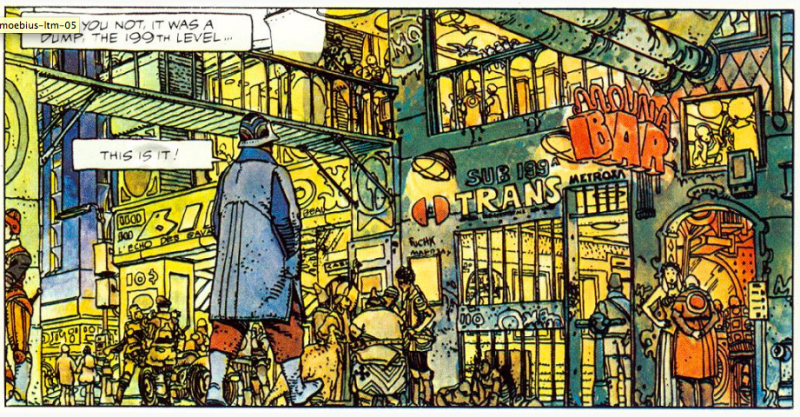
Then comes the fateful piece of narration that begins any detective story worth its salt: “It started out a day like any other day.” But by the end of that day, Club has taken a job from a classic dame in need, fended off both a four-armed thug and a hired assassin, slain an alien monster with whom he finds himself in bed, and recovered the president’s missing brain.
The story was written written by Dan O’Bannon, then known mainly for the film Dark Star, a science-fiction comedy he’d made with his University of Southern California classmate John Carpenter. On the strength of that, Jodorowsky had brought him onto Dune to work on its special effects, just as he’d brought Mœbius on to create its storyboards and concept art. With nothing to do before shooting began — which it never did — O’Bannon first drew “The Long Tomorrow” himself as a way of keeping busy. Mœbius took one look at it and immediately saw its promise.
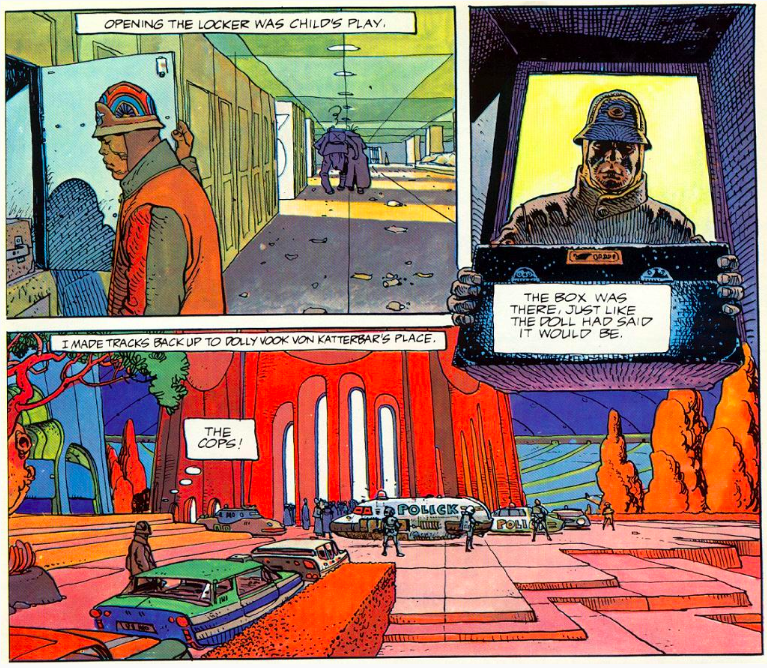
The French may have coined the term film noir, but this early work of future noir benefited from having an American writer. “When Europeans try this kind of parody, it is never entirely satisfactory,” Mœbius writes in the introduction to the book version of “The Long Tomorrow.” “The French are too French, the Italians are too Italian … so, under my nose was a pastiche that was more original than the originals.” It also, with Mœbius’ art, laid the visual groundwork for generations of sci-fi stories to come.
“The way Neuromancer-the-novel ‘looks’ was influenced in large part by some of the artwork I saw in Heavy Metal,” said William Gibson, referring to the English version of Métal hurlant, the magazine that popularized Mœbius’ work. (O’Bannon also worked on the animated Heavy Metal anthology film, released in 1981.) But perhaps Ridley Scott, who started working with the artist on 1979’s O’Bannon-scripted Alien, described the influence of Mœbius’ art on our visions of the future best: “You see it everywhere, it runs through so much you can’t get away from it.” In a cultural sense, all of us live in Pete Club’s city now.
Related Content:
Moebius’ Storyboards & Concept Art for Jodorowsky’s Dune
The Blade Runner Sketchbook Features The Original Art of Syd Mead & Ridley Scott (1982)
Based in Seoul, Colin Marshall writes and broadcasts on cities and culture. His projects include the book The Stateless City: a Walk through 21st-Century Los Angeles and the video series The City in Cinema. Follow him on Twitter at @colinmarshall or on Facebook.
Read More...Nirvana Refuses to Fake It on Top of the Pops, Gives a Big “Middle Finger” to the Tradition of Bands Miming on TV (1991)
The better-safe-than-sorry approach to musicians pretending to play on TV while viewers hear a pre-recorded track seems like the antithesis of rock and roll. Yet since the earliest days of The Ed Sullivan Show, audiences have accepted the convention without complaint. When the fakery unintentionally fails, reactions tend toward mockery, not outrage. Critics rail, the UK’s Musician’s Union has often balked, but bands and fans play along, everyone operating under the presumption that the banal charade is harmless.
Leave it to those spoilsports Nirvana to refuse this pleasant fiction on their Top of the Pops appearance in 1991.
Like American counterparts from American Bandstand to Soul Train, Britain’s Top of the Pops had a long tradition: “For over 40 years,” writes Rolling Stone, “everyone from the Rolling Stones to Madonna to Beyoncé stopped by… to perform their latest single as either a lip-sync or sing along with a prerecorded backing track.” All musicians were expected to mime playing their instruments, a comical sight, for instance, in appearances by The Smiths, in which viewers hear Johnny Marr’s multiple overdubbed guitars but see him playing unaccompanied.
The Smiths approached their Top of the Pops appearances with tongue-in-cheek irreverence. At their 1983 debut performance, Morrissey mimed “This Charming Man” using a fern as a microphone. Still, the band gamely pretended to play, like everyone else did. But when Nirvana hit the TOTP stage, with Cobain singing to a backing track of “Smells Like Teen Spirit,” they wouldn’t observe any of the niceties. YouTube channel That Time Punk Rocked writes:
Cobain opts for slow, exaggerated strums during the few times he touches his guitar, sings an octave lower (he later confirmed he was imitating Morrisey from The Smiths), and attempts to eat his microphone at one point. He also changes some of the lyrics, exchanging the opening line “load up on guns, bring your friends,” for “load up on drugs, kill your friends.” Dave Grohl hits cymbals and skins at random, doing more dancing than drumming. Krist Novoselic even swings his bass above his head. And despite these ridiculous antics, the crowd goes absolutely insane.
Maybe the crowd went wild because of those ridiculous antics, or maybe no one even noticed, as when a crowd of thousands in Argentina hardly seemed to notice when Nirvana openly mocked them after the audience abused their opening act. This may be one burden of stardom Cobain came to know too well—protests register as performance and sticking it the man onstage just makes the man more money. But the video remains “one of the greatest middle fingers” to musical miming captured on camera—recommended viewing for every salty young band preparing for their first TV gig.
Related Content:
The First Live Performance of Nirvana’s “Smells Like Teen Spirit” (1991)
Josh Jones is a writer and musician based in Durham, NC. Follow him at @jdmagness
Read More...Classic Songs by Bob Dylan Re-Imagined as Pulp Fiction Book Covers: “Like a Rolling Stone,” “A Hard Rain’s A‑Gonna Fall” & More
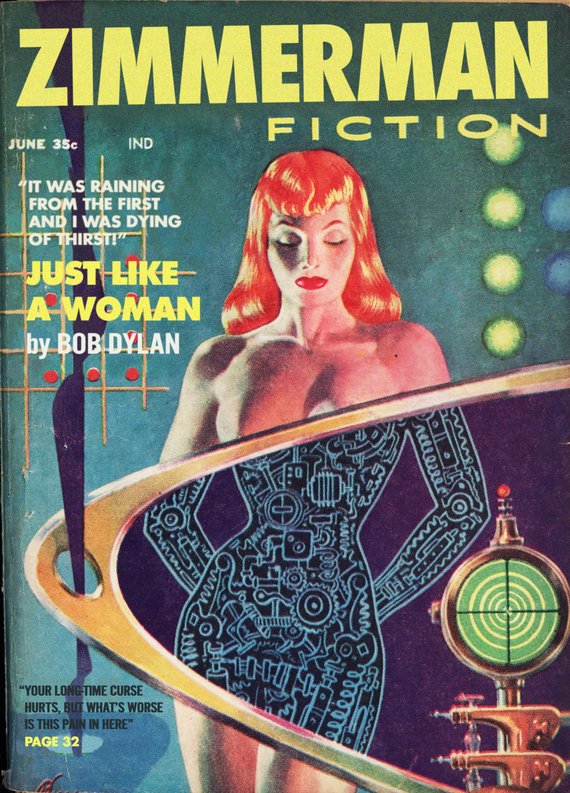
Screenwriter Todd Alcott has been very busy since we introduced you to his hilarious Mid-Century Pulp Fiction Cover project last month.
To restate what should be obvious from the second, if not first glance, none of Alcott’s titles are real. His aesthetically convincing mock-ups pay tribute to favorite songs by favorite artists: David Bowie, Talking Heads, Joy Division, Elvis Costello…
The start of the school year finds him in a Dylan mood, rendering some of his best known hits in a variety of pulp genre formats:
Bob Dylan is the perfect subject for this project, because his work has always been all about quotation and repurposing. From the very beginning, he took old songs, changed the lyrics and called them his own…. And it’s not just the melodies, he’s also not shy about lifting phrases and whole lines from other sources. One of the fun things about being a Bob Dylan fan is being able to spot the influences. It’s not just lifting lines from classic blues songs, where we don’t really know who “wrote” the originals, it’s real, identifiable, copyright-protected material. And you never know where it’s going to come from, a book about the Yakuza from Japan, a cookbook, an old Time Magazine article, or 1940s noir pictures.
I was watching a classic Robert Mitchum noir, Out of the Past, and Mitchum is talking to someone, and they mention San Francisco, and Mitchum says “I always liked San Francisco, I was there for a party once.”
And I was like “Wait, what?” Because that’s a line from a really obscure Dylan song, “Maybe Someday,” off his album Knocked-Out Loaded.
I was like “Wait, why did that line stick in Dylan’s mind? Why did he decide to quote that? Is it just the way Mitchum says it? What happened there?” And suddenly a song I hadn’t thought about much became a lot more interesting.
So for my Dylan covers, I try to carry on that tradition of taking quotes and repurposing them. So “Just Like a Woman” becomes a story in a science-fiction pulp, and “Like a Rolling Stone” becomes an expose on juvenile delinquency, and “Rainy Day Women” becomes a post-apocalyptic adventure story.
In a way, it’s what this project is all about, taking discarded pieces of culture and sticking them back together with new references to make them breathe again.
“Just Like a Woman”’s lyrics have never sat particularly well with feminists. (“There’s no more complete catalogue of sexist slurs,” author Marion Meade wrote in The New York Times.)
I think it’s fair to say that Alcott’s buxom flame-haired cyborg leans in to that criticism. The cover of this faux science fiction mag also harkens back to a time when the depiction of sexy female robots left something to the imagination.
From a design standpoint, it’s a great illustration of the heavy lifting a single well-chosen punctuation change can do.
The magazine’s title is an extra gift to Dylan fans.

The Blonde-on-Blonde Chronicles continue with Rainy Day Women #12 & 35. Does it matter that the breast-plated, and for all practical purposes bottomless warriors are raven tressed?
Only if tongue’s not firmly in cheek.
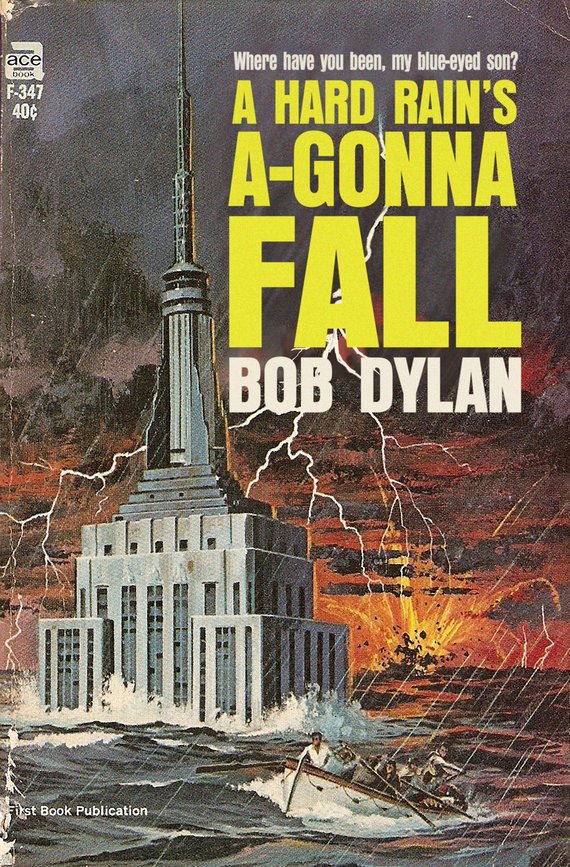
The nightmare vision of Dylan’s seven-minute protest song “A Hard Rain’s A‑Gonna Fall” makes for a smooth transition to a disaster novel of the 1970s.
In a 1963 radio interview with author Studs Terkel, Dylan asserted that the song wasn’t directly related to the nuclear fears all-pervasive at the time:
It’s not the fallout rain. It isn’t that at all. The hard rain’s gonna fall is in the last verse…That means all the lies, you know, that people get told on their radios and in newspapers. All you have to think for a minute, you know. Trying to take people’s brains away, you know. Which maybe has been done already. I hate to think it’s been done. All the lies, which I consider poison.
This writer can think of another reason citizens might find themselves fighting for their lives in a rowboat level with the very tippy top of the Empire State Building. So, I suspect, can Alcott.
Or maybe we’re wrong and climate change is nothing but fake news.
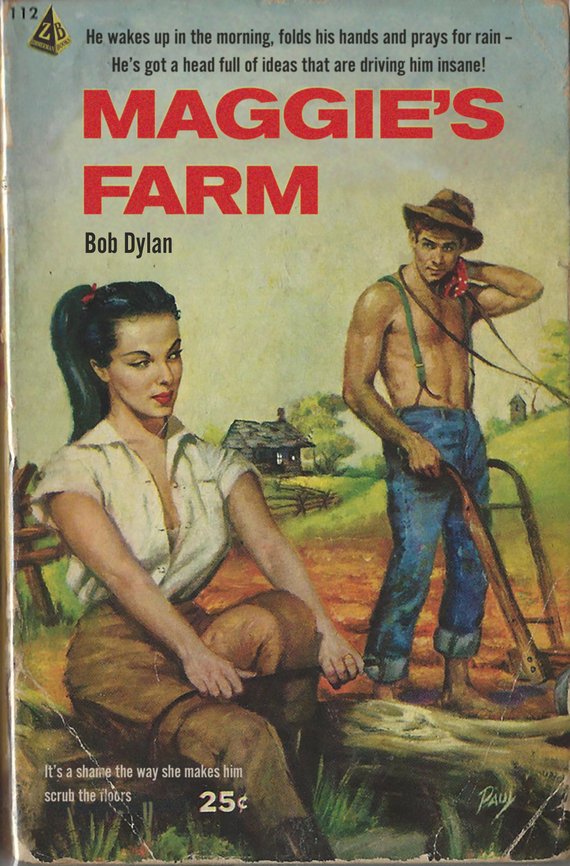
Alcott gets some mileage out of another rain-based lyric on Maggie’s Farm, a steamy rural romp whose creased cover is also part and parcel of the genre.
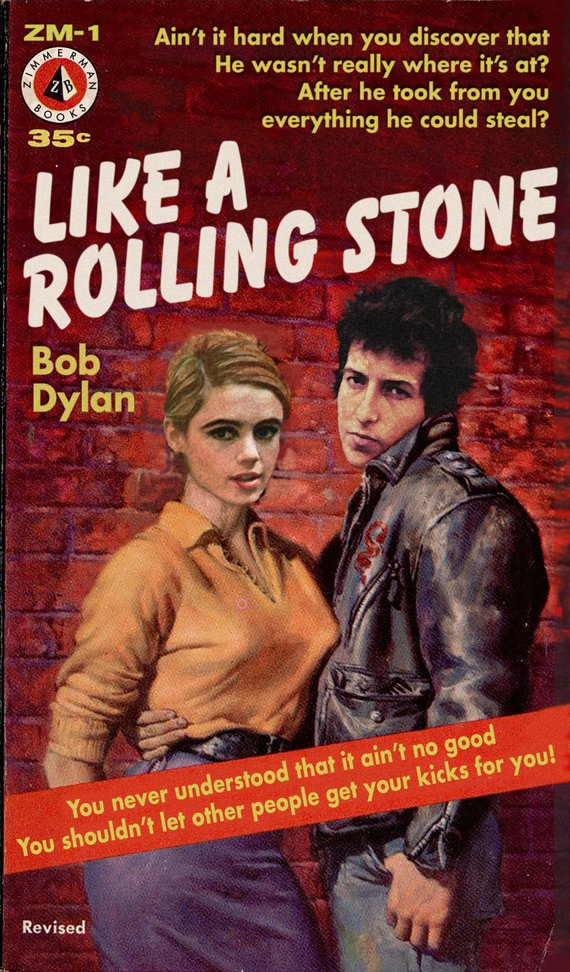
Who’s that young punk on the cover of Like a Rolling Stone? Beats me, but the girl’s a dead ringer for Warhol superstar, Edie Sedgwick, the purported inspiration for the song that shares the novel’s name. Ms. Sedgwick’s real life figure was much less voluptuous, but if the genre covers that sparked this project demonstrate anything, it’s that sex sells.
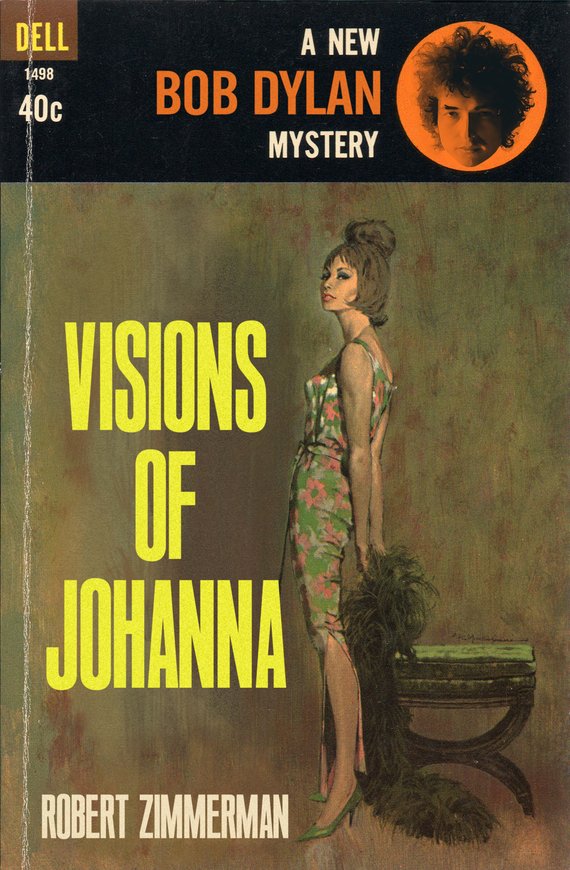
Visions of Johanna is positively understated in comparison. While many pulp authors toiled in obscurity, let us pretend that Nobel Prize winner and (faux) pulp-novelist Dylan wouldn’t have. Especially if he had a series like the pseudonymous Brett Halliday’s popular Mike Shayne mysteries. At that level, the cover wouldn’t really need quotes.
Though what harm would there be? There’s plenty of negative space here. Readers, which line would you splash across the cover if you were this prankster, Alcott?
Ain’t it just like the night to play tricks when you’re tryin’ to be so quiet?
We sit here stranded, though we’re all doin’ our best to deny it
And Louise holds a handful of rain, temptin’ you to defy it
Lights flicker from the opposite loft
In this room the heat pipes just cough
The country music station plays soft
But there’s nothing, really nothing to turn off
Just Louise and her lover so entwined
And these visions of Johanna that conquer my mind
In the empty lot where the ladies play blindman’s bluff with the key chain
And the all-night girls they whisper of escapades out on the “D” train
We can hear the night watchman click his flashlight
Ask himself if it’s him or them that’s really insane
Louise, she’s all right, she’s just near
She’s delicate and seems like the mirror
But she just makes it all too concise and too clear
That Johanna’s not here
The ghost of ’lectricity howls in the bones of her face
Where these visions of Johanna have now taken my place
Now, little boy lost, he takes himself so seriously
He brags of his misery, he likes to live dangerously
And when bringing her name up
He speaks of a farewell kiss to me
He’s sure got a lotta gall to be so useless and all
Muttering small talk at the wall while I’m in the hall
How can I explain?
Oh, it’s so hard to get on
And these visions of Johanna, they kept me up past the dawn
Inside the museums, Infinity goes up on trial
Voices echo this is what salvation must be like after a while
But Mona Lisa musta had the highway blues
You can tell by the way she smiles
See the primitive wallflower freeze
When the jelly-faced women all sneeze
Hear the one with the mustache say, “Jeeze
I can’t find my knees”
Oh, jewels and binoculars hang from the head of the mule
But these visions of Johanna, they make it all seem so cruel
The peddler now speaks to the countess who’s pretending to care for him
Sayin’, “Name me someone that’s not a parasite and I’ll go out and say a prayer for him”
But like Louise always says
“Ya can’t look at much, can ya man?”
As she, herself, prepares for him
And Madonna, she still has not showed
We see this empty cage now corrode
Where her cape of the stage once had flowed
The fiddler, he now steps to the road
He writes ev’rything’s been returned which was owed
On the back of the fish truck that loads
While my conscience explodes
The harmonicas play the skeleton keys and the rain
And these visions of Johanna are now all that remain
You can see more of Todd Alcott’s Mid-Century Pulp Fiction Cover project, and pick up archival quality prints from his Etsy shop.
Related Content:
Bob Dylan Potato Chips, Anyone?: What They’re Snacking on in China
Bob Dylan Hates Me: An Animation
Ayun Halliday - no relation to Brett — is an author, illustrator, theater maker and Chief Primatologist of the East Village Inky zine. Join her in NYC on Monday, September 24 for another monthly installment of her book-based variety show, Necromancers of the Public Domain. Follow her @AyunHalliday.
Read More...MIT Students Solve the Spaghetti Breaking Mystery That Stumped Richard Feynman

Even thirty years after his death, Richard Feynman remains one of the most beloved minds in physics in part because of how much attention he paid to things other than physics: drawing and painting, cracking safes, playing the bongos, breaking spaghetti. But a physics enthusiast might object, and reasonably so, that all those activities actually have a great deal to do with physics, given the physical phenomena they all demonstrate and on which they all depend. In recent years, considerable scientific attention has even gone toward spaghetti-breaking, inspiring as it did Feynman — and computer scientist Danny Hillis, who happened to be in the kitchen with him — to pose a long-unanswerable question: How come it always breaks into a million pieces when you snap it?
Maybe spaghetti doesn’t always break into a million pieces, exactly, but it never breaks in two. Discovering the secret to a clean two-part break did require a million of something: a million frames per second, specifically, shot by a camera aimed at a purpose-built spaghetti-breaking device. The results of the research, a project of students Ronald Heisser and Vishal Patil during their time at MIT, came out in a paper co-authored by MIT’s Norbert Stoop and Université Aix Marseille’s Emmanuel Villermaux, just published in the Proceedings of the National Academy of Sciences. The team found, writes MIT News’ Jennifer Chu, “that if a stick [of spaghetti] is twisted past a certain critical degree, then slowly bent in half, it will, against all odds, break in two.”
As for why spaghetti breaks into so many pieces without the twist, a question taken on by the Smarter Every Day video just above, French scientists Basile Audoly and Sebastien Neukirch won the Ig Nobel Prize by figuring that out in 2005: “When a stick is bent evenly from both ends, it will break near the center, where it is most curved. This initial break triggers a ‘snap-back’ effect and a bending wave, or vibration, that further fractures the stick.” If you twist the stick first, “the snap-back, in which the stick will spring back in the opposite direction from which it was bent, is weakened in the presence of twist. And, the twist-back, where the stick will essentially unwind to its original straightened configuration, releases energy from the rod, preventing additional fractures.”
So now we know. But the fruits of what might strike some as an obsessive and pointless quest could well further the science of fracturing, which Patil describes to the Washington Post as an outwardly “chaotic and random” process. This research could lead, as Chu writes, to a better “understanding of crack formation and how to control fractures in other rod-like materials such as multifiber structures, engineered nanotubes, or even microtubules in cells.” That’s all a long way from the kitchen, certainly, but even the most revolutionary advancements of knowledge grow out of simple curiosity, an impulse felt even in the most mundane or frivolous situations. Richard Feynman understood that better than most, hence subsequent generations of scientists’ desire to pick up whatever piqued his interest — even broken bits of Barilla No. 5.
Related Content:
The Drawings & Paintings of Richard Feynman: Art Expresses a Dramatic “Feeling of Awe”
Learn How Richard Feynman Cracked the Safes with Atomic Secrets at Los Alamos
Richard Feynman on the Bongos
What Ignited Richard Feynman’s Love of Science Revealed in an Animated Video
A Free Course from MIT Teaches You How to Speak Italian & Cook Italian Food All at Once
Based in Seoul, Colin Marshall writes and broadcasts on cities and culture. His projects include the book The Stateless City: a Walk through 21st-Century Los Angeles and the video series The City in Cinema. Follow him on Twitter at @colinmarshall or on Facebook.
Read More...Leonardo da Vinci’s Earliest Notebooks Now Digitized and Made Free Online: Explore His Ingenious Drawings, Diagrams, Mirror Writing & More

Do a search on the word “polymath” and you will see an image or reference to Leonardo da Vinci in nearly every result. Many historical figures—not all of them world famous, not all Europeans, men, or from the Italian Renaissance—fit the description. But few such recorded individuals were as feverishly active, restlessly inventive, and astonishingly prolific as Leonardo, who left riddles enough for scholars to solve for many lifetimes.
Leonardo himself, though world-renowned for his talents in the fine arts, spent more of his time conceiving scientific studies and engineering projects. “When he wrote in the early 1480s to Ludovico Sforza, then ruler of Milan, to offer him his services,” remarks Catherine Yvard, Special Collections curator at the Victoria and Albert National Art Library, “he advertised himself as a military engineer, only briefly mentioning his artistic skills at the end of the list.”
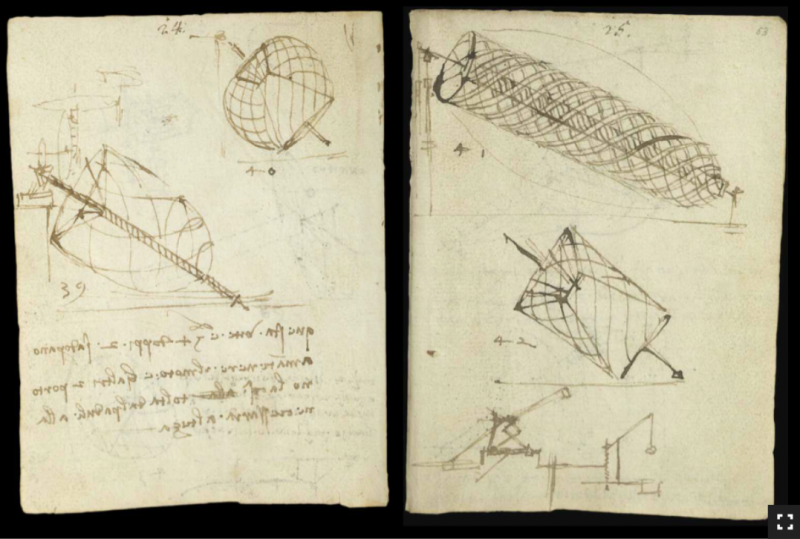
But since so few of his projects were, or could be, realized in his lifetime, we can only experience them through his mostly inaccessible, and generally indecipherable, notebooks, which he began keeping after the Duke accepted his application. “None of Leonardo’s predecessors, contemporaries or successors used paper quite like he did,” notes the Victoria and Albert Museum site, “a single sheet contains an unpredictable pattern of ideas and inventions—the workings of both a designer and a scientist.”
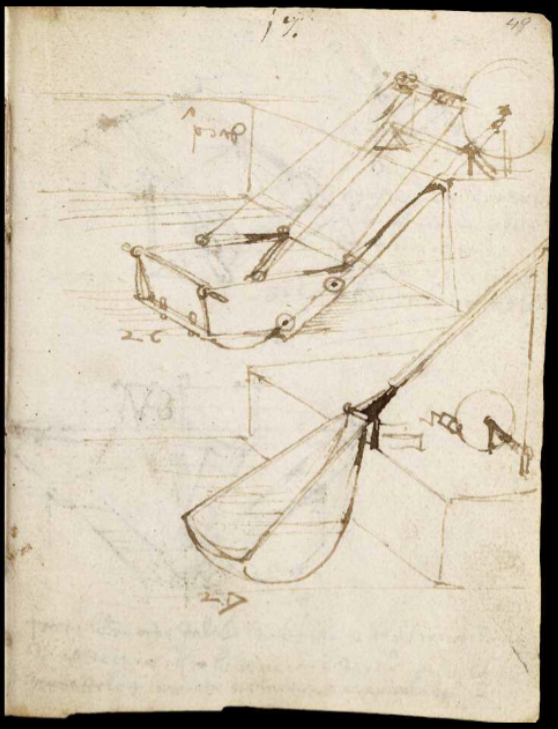
Part of the difficulty of piecing his legacy together stems from the fact that his hundreds of pages of notes have been distributed across several institutions and private collections, not all of them accessible to researchers. But ambitious digitization projects are erasing those barriers. We recently featured one, a joint effort of the British Library and Microsoft that brought 570 pages from the Codex Arundel collection to the web. As The Art Newspaper reports, the Victoria and Albert has now launched a similar endeavor, digitizing the Codex Forster notebooks, so named because they came from the private collection of John Forster in 1876.

This collection includes some of Leonardo’s earliest notebooks. Codex Forster I, now online, contains the earliest notebook the V&A holds, dating from about 1487, and the latest, from 1505. “Written in Leonardo’s famous ‘mirror-writing,’” the V&A notes, “the subjects explored within range from hydraulic engineering to a treatise on measuring solids.” Forster II and III should come online soon. “We are planning to make these two other volumes also fully accessible online in 2019 to celebrate the 500th anniversary of Leonardo’s death,” says Yvard.

The most innovative aspect of this particular project is the use of IIIF (International Image Interoperability Framework), a technology that “has enabled us to present the codex in a new way,” remarks Kati Price, V&A’s head of digital media. “We’ve used deep-zoom functionality… to present some of the most spectacular and detailed items in our collection.” Scholars and laypeople alike can take a very close-up look at the many schematics and technical diagrams in the notebooks and see Leonardo’s mind and hand at work.
But while all of us can marvel at the sight of his engineering genius, when it comes to reading his handwriting, we’ll have to rely on experts. Let’s hope the museum will someday supply translations for nonspecialists. In the meantime, explore the digitized manuscripts here.
Related Content:
Leonardo da Vinci’s Visionary Notebooks Now Online: Browse 570 Digitized Pages
Leonardo Da Vinci’s To Do List (Circa 1490) Is Much Cooler Than Yours
Josh Jones is a writer and musician based in Durham, NC. Follow him at @jdmagness
Read More...Don’t Call 911 If You See a Coyote, Unless It’s Carrying ACME-Branded Products: The Office of Sheriff, Monroe County, New York

Someone in the Office of Sheriff, in Monroe County, New York, has a good sense of humor. And if you’re from the Looney Tunes/Merrie Melodies generation, you will get a good laugh.
In other news, Warner Bros. just announced that it’s developing an animated Wile E. Coyote movie, some 70 years after he first appeared on the screen. Appropriately the film is called, Coyote vs. Acme. Somehow that pummeled coyote manages to endure.
Related Content:
The Strange Day When Bugs Bunny Saved the Life of Mel Blanc
Read More...The Last Great Moment of Elvis Presley’s Musical Career: Watch His Extraordinary Performance of “Unchained Melody” (1977)
As the “King” of American pop culture in the mid-20th century, Elvis embodied so many of his country’s contradictions. Revivalist of the “love and theft” of black American music and performance; humble, small town mama’s boy and dutiful soldier who built a cult of modern celebrity and a garish temple to conspicuous excess; self-appointed crusader who railed against “the drug culture” while his “legal” addiction to opiates and amphetamines laid waste to his career and health.
Maybe in these conflicts between humility and fame-seeking, all-American wholesomeness and transgressive seduction, playacting lawlessness and moralizing law and order, his legions of fans saw their own split selves. His hip-shaking confidence seemed particularly suited to both inflaming and soothing anxieties and safely channeling pent-up passions. Certain inconsistencies in his persona did not seem to trouble him overmuch.
But he was not a well man in the last several years of his short life and his tenure in the glittering faux-palaces of Las Vegas dramatically hastened the decline. While the reality of Elvis in Vegas was tacky and sad, the mythos of Elvis in Vegas made it “cool for fading superstar performers to find a second (or even third) act of their career in Vegas,” writes Mike Sager at Billboard. “Elvis paved the way for the likes of Britney Spears,” whose big American rise and fall resembles his in many ways.
Elvis’ own attempt at a third (or fourth) act is predictably tragic. Exploitative manager Colonel Tom Parker pushed him out on tour in 1977, notes Andy Greene at Rolling Stone, “despite his horrid shape.” Parker “arranged a camera crew to film the June 19th show in Omaha” in order to “get more product in to the stores”—perhaps sensing that Presley did not have much further to go. The cameras kept rolling in stops throughout the Midwest.
He was an absolute mess. He was only 42, but years of prescription drug abuse and horrifying dietary habits had left him bloated, depressed and near death. He had an enlarged heart, an enlarged intestine, hypertension and incredibly painful bowel problems. He was barely sleeping and should have probably been in the hospital, but he was still a huge draw on the concert circuit and the money was too good to turn down.
It is ugly to dwell on this period, except that somehow those final concerts produced the extraordinarily poignant footage of “Unchained Melody” at the top in Rapid City, South Dakota. “Without a doubt,” writes Greene, “it’s the last great moment of his career.” He digs deep, his voice is clear and strong. The jarring contrast between how good he sounds and how terrible he looks underlines and bolds the lines—“time can do so much…”
At the last tour stop in Indianapolis, he barely pulled off a rendition of “Are You Lonesome Tonight,” above. The song starts off really strong but soon devolves into Elvis muttering gibberish, sweating, and giggling to himself. This is hard to watch and it’s no wonder the tour footage, aired once on CBS, “has yet to resurface in any official capacity. This isn’t the Elvis that his estate wants the fans to remember.” Surely those fans themselves prefer the kitschy fantasy. Less than two months later, he was gone.
via Boing Boing
Related Content:
Watch George Harrison’s Final Interview and Performance (1997)
Watch John Lennon’s Last Live Performance (1975): “Imagine,” “Stand By Me” & More
Josh Jones is a writer and musician based in Durham, NC. Follow him at @jdmagness
Read More...John Turturro Introduces America to the World Wide Web in 1999: Watch A Beginner’s Guide To The Internet
There are only two kinds of story, holds a quote often attributed to Leo Tolstoy: a man goes on a journey, or a stranger comes to town. When it set about producing A Beginner’s Guide to the Internet, a “community service video” geared to viewers unfamiliar with the World Wide Web, internet portal company Lycos went with the latter. That stranger, a history teacher and aspiring comedian named Sam Levin, comes to a town named Tick Neck, Pennsylvania, his car having broken down early in a cross-country drive to a gig in Las Vegas. In order to update his manager/sister on the situation, he stops into the rural hamlet’s only diner and orders “coffee, half regular and half decaf — and the telephone book.”
Sam doesn’t make a call; instead he unplugs the diner’s phone, connects the line to his computer, looks up his internet service provider’s local number, and (after the requisite modem sounds) gets on the information superhighway. Today we know few activities as mundane as going online at a coffee shop, but the townspeople, innocent even of e‑mail, are transfixed. Sam shows a couple of kids how to search for information on haunted houses and college scholarships, and soon the students become the teachers, demonstrating online games to friends, chat rooms to a cranky old-timer (“I don’t like this word network at all. Network of what? Spies, probably”) and even state government feedback forms to the mayor of Tick Neck (who describes herself as “not much with a keyboard”).
Though at times it feels like the 1950s, the year was 1999, perhaps the last moment before America’s complete internet saturation — before social media, before streaming video, before blogs, before almost everything popular online today. “The video for Internet ‘newbies’ starring John Turturro was made available for free rental on the community service shelf of over 4,000 Blockbuster Video stores, West Coast Video stores, public school libraries and classrooms across the United States,” says a contemporary article at Newenglandfilm.com. “The production was funded by Lycos who has instituted a campaign to better educate the public about the World Wide Web.”
Those of us on the Web in the 1990s will remember Lycos, which ran one of the popular search engines before the age of Google. Launched in 1994 as a research project at Carnegie Mellon University in Pittsburgh (which might explain A Beginner’s Guide to the Internet’s setting), Lycos was in 1999 the most visited online destination in the world, and the next year Spanish telecommunications company Telefónica acquired it for a cool $12.5 billion. Turturro, not to be outdone, had in 1998 ascended to a high level of the countercultural zeitgeist with his role in the Coen brothers’ The Big Lebowski, the purple-clad bowler Jesus Quintana — very much not a stranger anyone would want going online with their kids, but Turturro has always had a formidable range.
History hasn’t recorded how many newbies A Beginner’s Guide to the Internet helped to start surfing the Web, but the video remains a fascinating artifact of attitudes to the internet during its first period of enormous growth. “My family doesn’t own a computer,” the young boy tells Sam, “and my dad doesn’t like ’em. He says facts are facts.” (That last sentence, innocuous at the time, does take on a new resonance today.) The boy’s teenage sister excitedly describes the internet as “like going to the library, department store, and post office, all at the same time.” Entering his credit card number to buy an auto-repair manual for the skeptical mechanic, Sam says (with a strange defensiveness) that “it’s completely private. I’ve done it before and it’s not a problem.” As with any stranger of legend who comes to town, Sam leaves Tick Neck a changed place — though not nearly as much as the Tick Necks of the world have since been changed by the internet itself.
Related Content:
How to Send an E‑mail: A 1984 British Television Broadcast Explains This “Simple” Process
From the Annals of Optimism: The Newspaper Industry in 1981 Imagines its Digital Future
In 1999, David Bowie Predicts the Good and Bad of the Internet
What’s the Internet? That’s So 1994…
Based in Seoul, Colin Marshall writes and broadcasts on cities and culture. His projects include the book The Stateless City: a Walk through 21st-Century Los Angeles and the video series The City in Cinema. Follow him on Twitter at @colinmarshall or on Facebook.
Read More...David Lynch Muses About the Magic of Cinema & Meditation in a New Abstract Short Film
One of the wonderful things about David Lynch is that, despite interviews, several documentaries on his creative process, plenty of behind-the-scenes footage of him directing, and the release of a whole memoir/biography told both subjectively *and* objectively…despite all that, the man is still an enigma. Even when he returned 25 years later to familiar ground with the third season of Twin Peaks, there was no sign of self-parody, and he delivered some of the most brilliant work of his career. How the hell does he do it?
That being said, if you have read his book Catching the Big Fish or have heard him in interviews, this short film directed by his son Austin Lynch and Case Simmons, and presented by Stella McCartney, might not be anything new. If you are just now discovering Lynch, then this is a quick primer on his creative process and his devotion to Transcendental Meditation as a way to dive into that creativity and, eventually, bring peace to the world.
Austin Lynch is one of three Lynch children to work in entertainment. The eldest Jennifer Lynch directed Boxing Helena and wrote the Twin Peaks spin-off book The Secret Diary of Laura Palmer. Riley Lynch is a musician and appeared in two episodes of the recent Twin Peaks.
Given the pedigree, Lynch and Simmons manage to honor David Lynch without copying his style. The short abstract profile also features very short cameos by Stella McCartney, Børns, Lola Kirk, and several others.
The director appears here and there during the nine minutes, backlit by subtle colored lights in a private screening room, watching a movie. What movie? It doesn’t matter.
“It’s so magical, I don’t know why, to go into a theater and have the lights go down,” Lynch says. “It’s very quiet and then the curtains start to open. And then you go into a world.”
The directors link this to a familiar Lynch tale of the beginning of his film career, when Lynch was painting at the beginning of his art school years and the canvas started to move and make sounds. No matter how many times Lynch tells this story, there’s something so odd about it. Is he talking in metaphor? Did he hallucinate? Did he get visited by a force beyond this reality? Are his greatest Lynchian moments his way of trying to make sense of that one episode?
He also talks about the circle that goes from the film to the audience and back, a feedback loop that musicians also talk about, and is the reason Lynch still loves the cinema as an event space. Performance spaces figure prominently in his works, whether it’s the Club Silencio in Mulholland Dr., the Lady in the Radiator in Eraserhead, or the various lodges and performance areas in Twin Peaks. (It’s also why he despises watching films on iPhones, apart from the size.)
Lynch explains here how he became a filmmaker through studying meditation, how it saved him from anger and despair, and how these techniques led to landing bigger creative fish from “the ocean of solutions” and expanding artistic intuition.
Is Lynch enlightened? No, but he’s closer than most of us:
“Every day for me gets better and better,” he concludes. “And I believe that enlivening unity in the world will bring peace on earth. So I say peace to all of you.”
Related Content:
What Makes a David Lynch Film Lynchian: A Video Essay
Hear David Lynch Read from His New Memoir Room to Dream, and Browse His New Online T‑Shirt Store
Watch All of the Commercials That David Lynch Has Directed: A Big 30-Minute Compilation
Ted Mills is a freelance writer on the arts who currently hosts the artist interview-based FunkZone Podcast and is the producer of KCRW’s Curious Coast. You can also follow him on Twitter at @tedmills, read his other arts writing at tedmills.com and/or watch his films here.
Read More...Support Us
We're hoping to rely on loyal readers, rather than erratic ads. Please click the Donate button and support Open Culture. You can use Paypal, Venmo, Patreon, even Crypto! We thank you!

About Us

Open Culture scours the web for the best educational media. We find the free courses and audio books you need, the language lessons & educational videos you want, and plenty of enlightenment in between.
Advertise With Us

FREE UPDATES!
GET OUR DAILY EMAIL
Get the best cultural and educational resources on the web curated for you in a daily email. We never spam. Unsubscribe at any time.
FOLLOW ON SOCIAL MEDIA

Open Culture editor Dan Colman scours the web for the best educational media. He finds the free courses and audio books you need, the language lessons & movies you want, and plenty of enlightenment in between.
Advertise With Us

