A Touching Animated Documentary About the Rise, Fall & Second Coming of the 60s Psych-Folk Musician Richard Atkins
One wonders what might have become of Richard Atkins’ musical career had he come of age in this millennium, when youngsters suffering from acute stage fright regularly attract stadium-sized followings on Youtube.
This was most definitely not the case in 1968, when Atkins, aged 19, took the stage in a small Hollywood club filled with music industry brass, there specifically to see him.
Unfortunately, talent could only take him so far. Having learned to play guitar only a couple of years earlier in the wake of a disfiguring motorcycle accident, he and partner Richard Manning had recorded an album, Richard Twice, for Mercury Records. The presence on that record of several members of the Wrecking Crew, an informal, but legendary group of LA session musicians, conferred extra pop pedigree. The Acid Archives later called it “a virtually perfect pop album, the kind of thing that would have ruled the charts if the wind had been blowing the right way that month.”
Alas, one tiny technical difficulty at the start of the gig caused Manning to flee, leaving the freaked out and frighteningly ill equipped Atkins to deal with the yawning chasm that had opened between him and the audience. The only fix that occurred to him was a Bugs Bunny-inspired soft shoe, a move that apparently went over big with his Mom, prior to the accident, when he had two legs and could balance without a crutch.
As recounted in Matthew Salton’s animated documentary, above, this soul crushing moment is not without humor. Atkins, affably narrating his own story, has had 50 years to mull that night over, and realizes that blown opportunities are probably more universal than successfully snagged brass rings (American Idol, anyone?)
Over the ensuing years, Atkins found fulfillment as a woodworker and family man, but music remained a painful what-if, addressed largely through avoidance.
Salton’s exuberantly scratchy animation comes as Atkins is taking steps to conquer his stage fright, performing out at small cafes, festivals, and potluck suppers near his Pacific Northwest home.
He’s been posting old songs, gently reminding listeners, “before I’m judged too harshly, remember that I was 18 and living in North Hollywood, probably raging hormones and in the music business to boot!”
He’s also writing and sharing new songs, including the touching “Life Is A Rollercoaster,” above.
Performing on Facebook Live in conjunction with Salton’s New York Times Op-Doc essay, he tears up when the interviewer informs him that his daughter has just posted an encouraging comment, and eagerly confirms his availability when another commenter asks if he’d be up for a gig.
It’s only too late when you’re in the grave.
Travel back in time with a couple more psych-folk cuts from Richard Twice, above, or buy the album in digital form on Amazon.
Related Content:
Syd Barrett’s “Effervescing Elephant” Comes to Life in a New Retro-Style Animation
Ayun Halliday is an author, illustrator, theater maker and Chief Primatologist of the East Village Inky zine. Follow her @AyunHalliday.
Read More...Watch Classical Music Come to Life in Artfully Animated Scores: Stravinsky, Debussy, Bach, Beethoven, Mozart & More
Stephen Malinowski has cultivated his own patch of YouTube ground over the years with the Music Animation Machine, slowly scrolling visual representations of classical music. The videos, like the one above, use shape and color to interpret pitch, duration, and more recently dynamics and intervals in a hypnotic style that references both Oskar Fischinger and Guitar Hero.
Personally, I’ve been a fan for years and watched his style evolve from the basics of a “piano roll” scroll to these much more complex animations, just as smalin (his YouTube name) has gone from working with solo piano works to the density of Beethoven’s symphony scores or the chaos of Stravinsky’s Rite of Spring.
Many music lovers who are not musicians but understand enough about composition will often follow a printed score when listening to classical music; I would suggest that this is one better than the traditional notation, as smalin’s method makes individual instruments in a quartet easy to follow; or show the interplay between left and right hands in a Debussy piece; or lay out in visual terms the variations on a theme or pattern (especially in Bach). For those who love but “don’t get” classical music, these videos are a step towards clarity.
The Music Animation Machine started long before the Internet. Malinowski (a graduate of my alma maters SBCC and UCSB!) dates the beginning to 1982, and the inspiration came from a “hallucination” he had while listening to Bach’s Sonatas and Partitas for Unaccompanied Violin.
“As I listened to the music, the notes on the page were dancing to the music — but at the same time, they were the music. It was so charming and graceful — the flag of an eighth note extending like a ballet dancer’s arm; pairs of notes, moving in parallel thirds and sixths, like dancers stepping hand-in-hand … I was delighted!”
The idea to animate was suggested by a friend and dovetailed into the technology of the time, especially the birth of MIDI. Too self-critical to be a performer and too forgetful to be a composer, Malinowski turned to computer programming and visualizing scores as the listener, not the performer, understands them. It’s been his life’s work. Explore his big collection of animations and also his animation techniques.
Be wary, though. Watching one isn’t enough–writing this article was a continual struggle between the deadline and animated bliss. You just may find yourself similarly and pleasantly lost.
Note: Here’s a list of Malinowski favorite and most popular videos:
Grainger, Children’s March
Mozart, Sonata for Two Pianos, K 448, first movement
Bach, “Little” Fugue in G minor, Organ
Debussy, First Arabesque
Rimsky-Korsakov, Flight of the Bumblebee
Debussy, Prelude to ‘The Afternoon of a Faun’
Beethoven, Symphony 7, Allegretto, mvt. 2
Stravinsky, The Rite of Spring
Bach, Toccata and Fugue in D minor
Sousa, Semper Fidelis
Debussy, Syrinx
Ligeti, 6 Bagatelles, III. Allegro grazioso
Bach, Brandenburg Concerto 4, 3rd mvt.
Related Posts:
Optical Poems by Oskar Fischinger, the Avant-Garde Animator Hated by Hitler, Dissed by Disney
The Genius of J.S. Bach’s “Crab Canon” Visualized on a Möbius Strip
Ted Mills is a freelance writer on the arts who currently hosts the artist interview-based FunkZone Podcast and is the producer of KCRW’s Curious Coast. You can also follow him on Twitter at @tedmills, read his other arts writing at tedmills.com and/or watch his films here.
Read More...Herbie Hancock Is Now Teaching His First Online Course on Jazz
FYI: If you sign up for a MasterClass course by clicking on the affiliate links in this post, Open Culture will receive a small fee that helps support our operation.
A quick update to something we first mentioned last June. On Masterclass, jazz legend Herbie Hancock is now teaching his first online course on jazz. In 25 video lessons, the 14-time Grammy winner shares his approach to improvisation, composition, and harmony, and gives students access to 10+ original piano transcriptions, including 5 exclusive solo performances. Plus there’s a downloadable workbook.
You can take this class by signing up for a MasterClass’ All Access Pass. The All Access Pass will give you instant access to this course and 85 others for a 12-month period.
If you would like to support the mission of Open Culture, consider making a donation to our site. It’s hard to rely 100% on ads, and your contributions will help us continue providing the best free cultural and educational materials to learners everywhere. You can contribute through PayPal, Patreon, and Venmo (@openculture). Thanks!
Related Content:
Watch Herbie Hancock Rock Out on an Early Synthesizer on Sesame Street (1983)
Read More...Beautiful & Outlandish Color Illustrations Let Europeans See Exotic Fish for the First Time (1754)
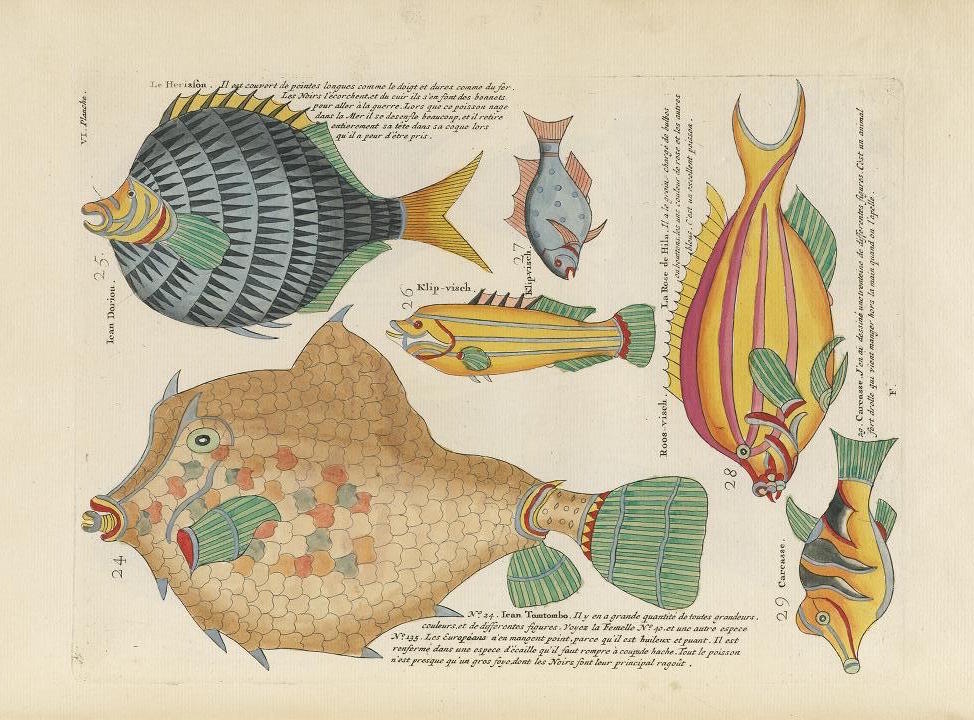
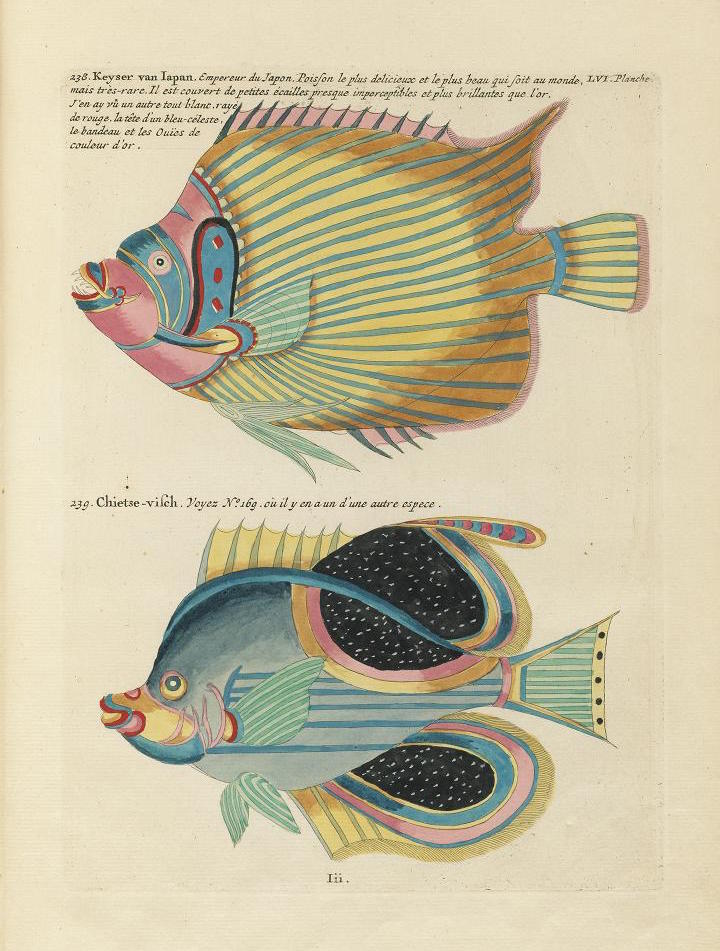
Whether in the tanks into which we gaze at the aquarium or the CGI-intensive wildlife-based gagfests at which we gaze in the theater, most of us in the 21st century have seen more than a few funny fish. Eighteenth-century Europeans couldn’t have said the same. The great majority passed their entire lives without so much as a glance at the form of even one live exotic creature of the deep, and most of those who have a sense of what such a sight looked like probably got it from an illustration. But even so, some of the illustrated fish of the day must have proven unforgettable, especially the ones in Louis Renard’s Poissons, Ecrevisses et Crabes.
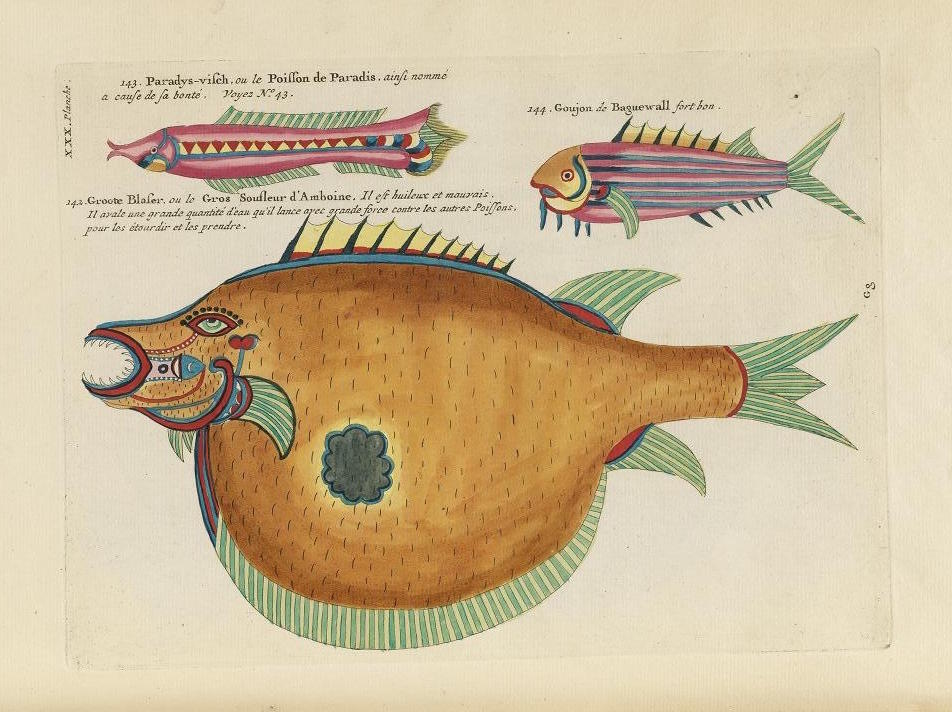
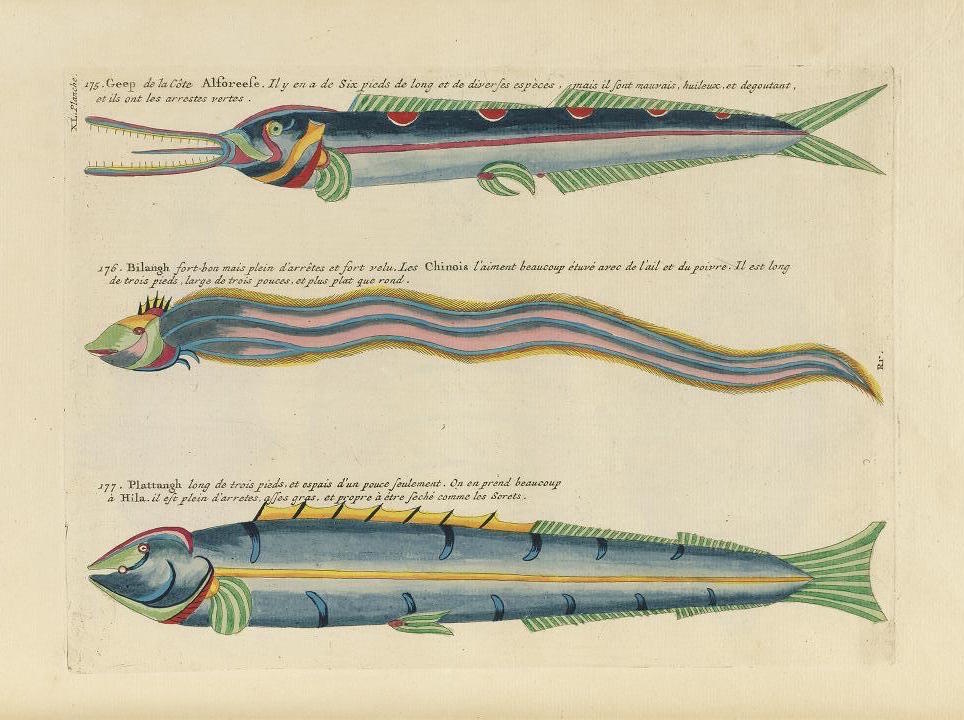
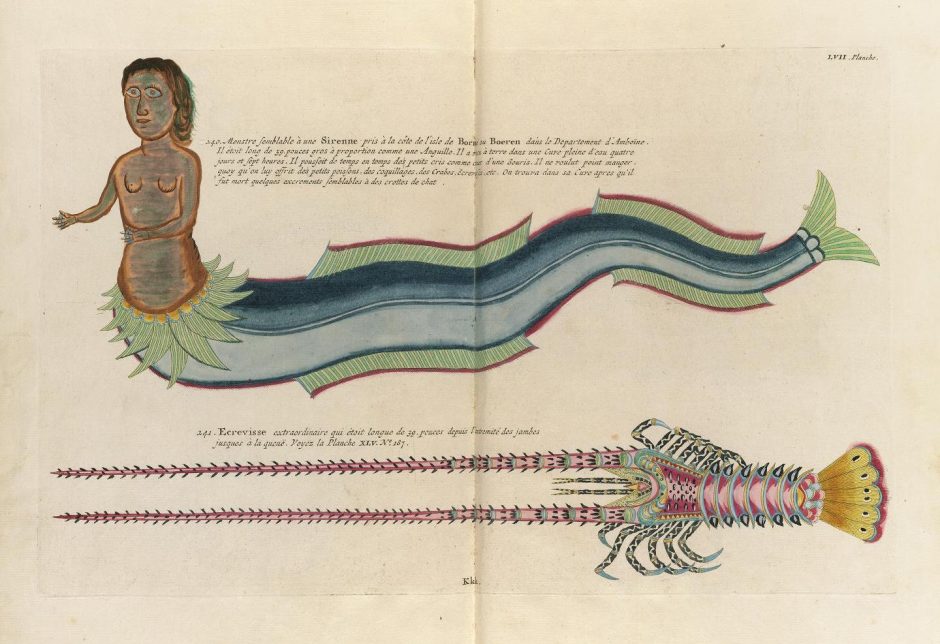
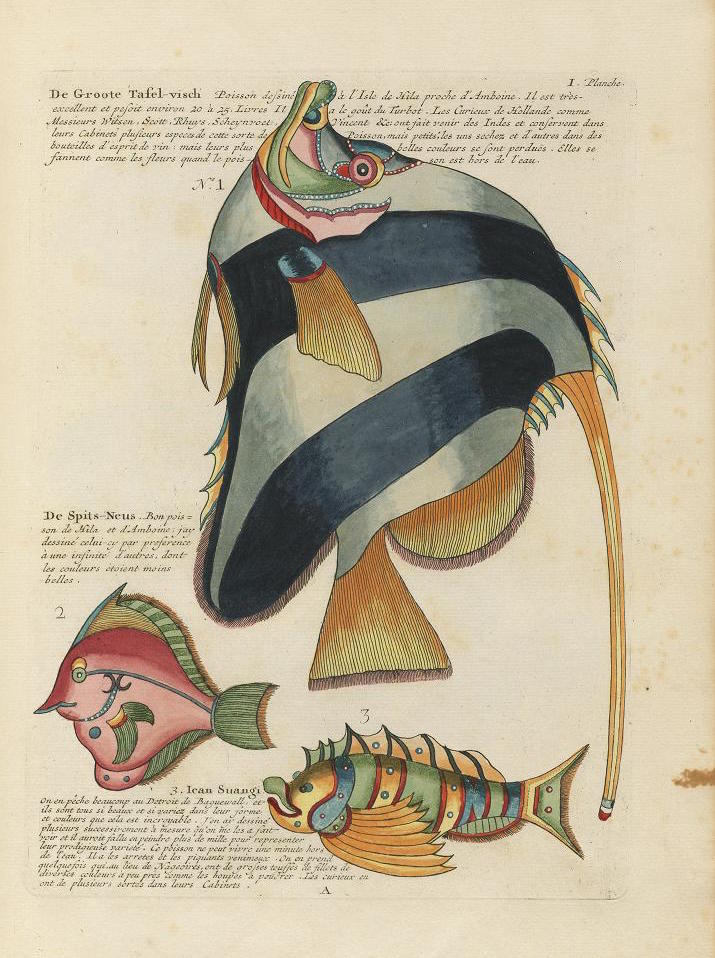
First published in 1719 with a second edition, seen here, in 1754, Renard’s book, whose full title translates to Fishes, Crayfishes, and Crabs, of Diverse Colors and Extraordinary Form, that Are Found Around the Islands of the Moluccas and on the Coasts of the Southern Lands, showed its readers, in full color for the very first time, creatures the likes of which they’d never have had occasion even to imagine. The book’s 460 hand-colored copper engravings depict, according to the Glasgow University Library, “415 fishes, 41 crustaceans, two stick insects, a dugong and a mermaid.”

The specimens in the first part of the book tend toward the realistic, while those of the second “verge on the surreal,” many of which “bear no similarity to any living creatures,” some of which bear “small human faces, suns, moons and stars” on their flanks and carapaces, most possessed of colors “applied in a rather arbitrary fashion,” though brilliantly so. In the short accompanying texts, “several of the fish” — presumably not the mermaid — “are assessed in terms of their edibility and are accompanied by brief recipes.”
Renard himself, who lived from 1678 to 1746, seems to have had a career as colorful as the fish in his book. “As well as spending some seventeen years as a publisher and bookdealer,” he also “sold medicines, brokered English bonds and, more intriguingly, acted as a spy for the British Crown, being employed by Queen Anne, George I and George II.” Far from keeping that part of his life a secret, “Renard used his status as an ‘agent’ to help advertise his books. This particular work is actually dedicated to George I while the title-page describes the publisher as ‘Louis Renard, Agent de Sa Majesté Britannique.’ ”
You can behold more of Poissons, Ecrevisses et Crabes at the Public Domain Review. “If the illustrations are breathtaking to us now, with all the hours of David Attenborough documentaries under our belts,” they write, “one can only imagine the impact this would have had on a European audience of the eighteenth century, to which the exotic ocean life of the East would have been virtually unknown.”
Though received as a respectable scientific work in its day — and even, as the Glasgow University Library puts it, “a product of the Enlightenment” — the book now stands as an enchanting tribute to the combination of a little knowledge and a lot of human imagination.
Related Content:
1,000-Year-Old Illustrated Guide to the Medicinal Use of Plants Now Digitized & Put Online
Wonderfully Weird & Ingenious Medieval Books
Based in Seoul, Colin Marshall writes and broadcasts on cities and culture. His projects include the book The Stateless City: a Walk through 21st-Century Los Angeles and the video series The City in Cinema. Follow him on Twitter at @colinmarshall or on Facebook.
Read More...Mona Lisa Selfie: A Montage of Social Media Photos Taken at the Louvre and Put on Instagram
“Over 6 million people visit the Mona Lisa at the Louvre each year. Many share their visit on social media.” Created by Daniel McKee, this dizzying video gathers together hundreds of the photos that get taken at the museum and then wind up on Instagram. Only a minute long, it’s a nice succinct commentary on our time…
Related Content:
Leonardo da Vinci’s Visionary Notebooks Now Online: Browse 570 Digitized Pages
Leonardo Da Vinci’s To Do List (Circa 1490) Is Much Cooler Than Yours
Did Leonardo da Vinci Paint a First Mona Lisa Before The Mona Lisa?
Original Portrait of the Mona Lisa Found Beneath the Paint Layers of da Vinci’s Masterpiece
Read More...How a Korean Potter Found a “Beautiful Life” Through His Art: A Short, Life-Affirming Documentary
I like to think I appreciate all aspects of the culture of South Korea, where I live, but different attractions bring different foreigners here. Some come for the food, some come for the music (pop, traditional, or somewhere in between), some come for the medical tourism. Others, like British ceramicist Roger Law, come for the pottery. The half-hour documentary above will give you an idea of what makes Korean pottery, and the Korean potters who craft it, so distinctive, taking viewers into the workshop of Lee Kang-hyo, who has become famous by there bringing together the distinct traditions of onggi glazed earthenware pottery and buncheong white slip decoration.
“As a high school student, I asked myself some fundamental questions,” says Lee in voiceover as we watch him beat the clay of what looks more and more like a large jar into shape. “What would be good to do for a living? What is my best talent? How can I enjoy a life of peace? It was then I decided to become an artist.” As he creates, he tells us about the long history of pottery in Korea and his experience practicing and mastering the traditions in which he works. Looked at onggi, he says, “I never thought they were simply big jars. I thought they were great sculpture.”
“My documentary tells the story of Lee Kang-hyo’s search for a beautiful life, through his work with clay and the love of his family,” says director Alex Wright, a story that “gives an insight into the spiritual journey that plays a vital part in his artistic practice.” For Lee, this had to do as much with the heart and mind as with the hand, loosening up and lightening up even as he grew more skilled, a realization that first occurred when he became friendly with Japanese master potter Koie Ryoji. “Kang-hyo, why don’t you try to change your thinking?’ ” Lee remembers Koie asking after he presented him with his latest piece. “And he lifted it up and crushed it. He said: ‘Form doesn’t always have to be straight. It can be beautiful.’ ”
That lesson holds in other cultural spheres as well. “Ceramic culture is very closely connected to dietary life and food culture,” Lee observes. “Korea has developed a fermented food culture. A lot of foods are fermented and stored, such as sauces and kimchi,” which might stay in their ceramic jars for years before consumption. And so “Korea has developed the skills to make big jars, more than any other country” with the “quickest and most perfect forms.” This might sound like the makings of a rustic, utilitarian pottery — and indeed cuisine — but in fact the work of Lee and other Korean masters increasingly aligns with the growing global taste for things outwardly simple but inwardly refined. In that particular sensibility, whether expressed as pottery or food or music or anything else, Korea might well lead the world.
Lee Kang-hyo ‘Onggi Master will be added to our collection of Free Documentaries, a subset of our collection, 4,000+ Free Movies Online: Great Classics, Indies, Noir, Westerns, Documentaries & More.
Related content:
Based in Seoul, Colin Marshall writes and broadcasts on cities and culture. His projects include the book The Stateless City: a Walk through 21st-Century Los Angeles and the video series The City in Cinema. Follow him on Twitter at @colinmarshall or on Facebook.
Read More...Research Finds That Intellectual Humility Can Make Us Better Thinkers & People; Good Thing There’s a Free Course on Intellectual Humility
We may have grown used to hearing about the importance of critical thinking, and stowed away knowledge of logical fallacies and cognitive biases in our argumentative toolkit. But were we to return to the philosophical sources of informal logic, we would find that we only grasped at some of the principles of reason. The others involve questions of what we might call virtue or character—what for the Greeks fell into the categories of ethos and pathos. The principle of charity, for example, in which we give our opponents a fair hearing and respond to the best version of their arguments as we understand them. And the principle, exemplified by Plato’s Socrates, of intellectual humility. Or as one punk band put it in their Socratic tribute. “All I know is that I don’t know. All I know is that I don’t know nothing.”
Intellectual humility is not, contrary to most popular appearances, reflexively according equal weight to “both sides” of every argument or assuming that everyone’s opinion is equally valid. These are forms of mental laziness and ethical abdication. It is, however, believing in our own fallibility and opening ourselves up to hearing arguments without immediately forming a judgment about them or the people who make them. We do not abandon our reason and values, we strengthen them, argues Mark Leary, by “not being afraid of being wrong.” Leary, professor of psychology and neuroscience at Duke University, is the lead author of a new study on intellectual humility that found “essentially no difference between liberals and conservatives or between religious and nonreligious people” when it comes to intellectual humility.
The study challenges many ideas that can prevent dialogue. “There are stereotypes about conservatives and religiously conservative people being less intellectually humble about their beliefs,” says Leary. But he and his colleagues “didn’t find a shred of evidence to support that.” This doesn’t necessarily mean that such people have high degrees of intellectual humility, only that all of us, perhaps equally, possess fairly low levels of the trait. I’ll be the first to admit that it is not an easy one to develop, especially when we’re on the defensive for some seemingly good reasons—and when we live in a culture that encourages us to make decisions and take actions on the strength of an image, some minimal text, and a few buttons that lead us right to our bank accounts. (To quote Operation Ivy again, “We get told to decide. Just like as if I’m not gonna change my mind.”)
But in the Duke study, reports Alison Jones at Duke Today, “those who displayed intellectual humility did a better job of evaluating the quality of evidence.” They took their time to make careful considerations. And they were generally more charitable and “less likely to judge a writer’s character based on his or her views.” By contrast, “intellectually arrogant” people gave writers with whom they disagreed “low scores in morality, honesty, competence, and warmth.” As a former teacher of rhetoric, I wonder whether the researchers accounted for the quality and persuasiveness of the writing itself. Nonetheless, this observation underscores the problem of conflating an author’s work with his or her character. Moral judgment can inhibit intellectual curiosity and open-mindedness. Intellectually arrogant people often resort to insults and personal attacks over thoughtful analysis.
The enormous number of assumptions we bring to almost every conversation with people who differ from us can blind us to our own faults and to other people’s strengths. But intellectual humility is not genetically determined—it is a skill that can be learned, Leary believes. Big Think recommends a free MOOC from the University of Edinburgh on intellectual humility (see an introduction to the concept at the top and a series of lectures here). “Faced with difficult questions,” explains course lecturer Dr. Ian Church, “people often tend to dismiss and marginalize dissent…. The world needs more people who are sensitive to reasons both for and against their beliefs, and are willing to consider the possibility that their political, religious and moral beliefs might be mistaken.” The course offers three different levels of engagement, from casual to quite involved, and three separate class sections at Coursera: Theory, Practice, and Science.
It’s likely that many of us need some serious preparation before we’re willing to listen to those who hold certain views. And perhaps certain views don’t actually deserve a hearing. But in most cases, if we can let our guard down, set aside feelings of hostility, and become willing to learn something even from those with whom we disagree, we might be able to do what so many psychologists continue to recommend. As Cindy Lamothe writes at New York Magazine’s Science of Us blog, “we have to be willing to expose ourselves to opposing perspectives in the first place—which means that, as daunting as it may seem, listening to friends and family with radically different views can be beneficial to our long-term intellectual progress.” The holidays are soon upon us. Let the healing—or at least the charitable tolerance if you can manage it—begin.
Related Content:
Stephen Fry Identifies the Cognitive Biases That Make Trump Tick
32 Animated Videos by Wireless Philosophy Teach You the Essentials of Critical Thinking
Why We Need to Teach Kids Philosophy & Safeguard Society from Authoritarian Control
Josh Jones is a writer and musician based in Durham, NC. Follow him at @jdmagness
Read More...Meet the World’s Worst Orchestra, the Portsmouth Sinfonia, Featuring Brian Eno
What is it about objectively terrible works of art that so captivates? Cults form around Tommy Wiseau’s The Room, the “Citizen Kane of bad movies,” or amateur girl-group The Shaggs, “the best—or worst—band of all time.” Such utter artlessness cannot be faked, but it can, composer Gavin Bryars found, be deliberately orchestrated, to quite enjoyably terrible effect. In 1970, Bryars staged a three-day talent show at the Portsmouth School of Art, with comedians, ventriloquists, musicians, etc. His own entry was the Portsmouth Sinfonia, now rightly known as the “world’s worst orchestra.” The Sinfonia, writes Dangerous Minds, “welcomed musicians and non-musicians alike, though people of talent were expected to play instruments on which they were not proficient.” The first iteration of the group consisted of 13 students who could hardly play at all.
Later ensembles featured more dramatic disparities in talent. But no matter their level of ability, “all members were expected to play the repertoire to the best of their abilities. The result was a special kind of cacophony: every familiar theme (Also sprach Zarathustra, the William Tell Overture, Beethoven’s Fifth), though played as ineptly as possible, was approached with respect and even care. You will instantly recognize every tune they attempt, and you will probably bust a gut,” adds Dangerous Minds.
Maybe it’s the earnestness that gets us, the best of intentions producing the most ridiculous of results. Though formed as a “one-off joke,” Atlas Obscura notes, the Sinfonia continued after an “outpouring of enthusiasm,” and even attracted Brian Eno, who joined on clarinet, an instrument he’d never played, and produced and recorded with the group on their debut 1974 album, Portsmouth Sinfonia Plays the Popular Classics.
The group’s numbers swelled by the mid-seventies to include, Eno wrote in the album’s liner notes, “a membership of about fifty.” He lets us know in his deadpan introduction that the Sinfonia took its work seriously. The orchestra “tends to generate an extra-ordinary and unique musical situation where the inevitable errors must be considered as a crucial, if inadvertent, element of the music.”
It is important to stress the main characteristic of the orchestra: that all members of the Sinfonia share the desire to play the pieces as accurately as possible. One supposes that the possibility of professional accuracy will forever elude us since there is a constant influx of new members and a continual desire to attempt more ambitious pieces from the realms of the popular classics.
This is difficult to read with a straight face, but Bryars “was adamant,” the blog Classical Music Reimagined explains, “that the musicians shouldn’t play for laughs – they honestly had to play to the best of their ability, and attendance at rehearsal was mandatory. Footage of the orchestra in action shows an incredible level of concentration and focus (if not results).” A few members do seem be having fun with Handel’s Messiah in the short clip of a live performance below, featuring a serious Eno. But most of them are genuinely giving it their all.
Experimental theater, conceptual art, or practical joke, it makes no difference. There is truly something “extra-ordinary and unique” about this “musical situation,” you must agree. The so-bad-it’s‑goodness of the Sinfonia comes not only from their lack of talent, but also from the enormous gap between intentions and results—a universally recognizable condition of the human comedy. We celebrate the exceptions, those whose great efforts truly produce greatness. But in the Sinfonia, we may encounter the less-great parts of ourselves, ennobled in their ineptitude by the foolhardiness of this tragicomic daring.
via Atlas Obscura + Dangerous Minds
Related Content:
Hear the Experimental Piano Jazz Album by Comedian H. Jon Benjamin — Who Can’t Play Piano
Josh Jones is a writer and musician based in Durham, NC. Follow him at @jdmagness
Read More...Atheist Stanford Biologist Robert Sapolsky Explains How Religious Beliefs Reduce Stress
Let’s put aside for a moment the question of whether, or which, religion is “true.” If you think this question is answerable, you are likely already a partisan and have taken certain claims on faith. Say we ask whether religion is good for you? What say the scientists? As always, it depends. For one thing, the kind of religion matters. A 2013 study in the Journal of Religion and Health, for example, found that “belief in a punitive God was positively associated with four psychiatric symptoms,” including general anxiety and paranoia, while “belief in a benevolent God was negatively associated with four psychiatric symptoms.”
So, a certain kind of religion may not be particularly good for us—psychologically and socially—but other kinds of faith can have very beneficial mental health effects. Author Robert Wright, visiting professor of religion and psychology at Princeton, has argued in his lectures and his bestselling book Why Buddhism is True that the 2500-year-old Eastern religion can lead to enlightenment, of a sort. (He also argues that Buddhism and science mostly agree.)
And famed Stanford neuroendocrinologist and atheist Robert Sapolsky, author of Why Zebras Don’t Get Ulcers, makes an interesting case in the Big Think video above that “this religion business” humans have come up with—this form of “metamagical thinking”—has provided a distinct evolutionary advantage.
Religion seems to be an almost universal phenomenon, as Sapolsky—who is himself an atheist—freely admits. “90 to 95% of people,” he says, “believe in some sort of omnipotent something or other, every culture out there has it.” Rarely do two cultures agree on any of the specifics, but religions in general, he claims, “are wonderful mechanisms for reducing stress.”
It is an awful, terrifying world out there where bad things happen, we’re all going to die eventually. And believing that there is something, someone, responsible for it at least gives some stress reducing attributes built around understanding causality. If on top of that, you believe that there is not only something out there responsible for all this, but that there is a larger purpose to it, that’s another level of stress-reducing explanation.
Furthermore, says Sapolsky, a benevolent deity offers yet another level of stress reduction due to feelings of “control and predictability.” But benevolence can be partial to specific in-groups. If you think you belong to one of them, you’ll feel even safer and more reassured. For its ability to create social groups and explain reality in tidy ways, Religion has “undeniable health benefits.” This is borne out by the research—a fact Sapolsky admits he finds “infuriating.” He understands why religion exists, and cannot deny its benefits. He also cannot believe any of it.
Sapolsky grudgingly admits in the short clip above that he is awed by the faith of people like Sister Helen Prejean of Dead Man Walking fame, despite and because of her “irrational, nutty,” and stubborn insistence on the impossible. He has also previously argued that many forms of religiosity can be indistinguishable from mental illness, but they are, paradoxically, highly adaptive in a chaotic, world we know very little about.
In his interview at the top, he pursues another line of thought. If 95% of the human population believes in some kind form of supernatural agency, “a much more biologically interesting question to me is, ‘what’s up with the 5% of atheists who don’t do that?’”
It’s a question he doesn’t answer, and one that may assume too much about that 95%—a significant number of whom may simply be riding the bandwagon or keeping their heads down in highly religious environments rather than truly believing religious truth claims. In any case, on balance, the answer to our question of whether religion is good for us, may be a qualified yes. Believers in benevolence can rejoice in the stress-reducing properties of their faith. It might just save their lives, if not their souls. Stress, as Sapolsky explains in the documentary above, is exponentially harder on the human organism than belief in invisible all-powerful beings. Whether or not such beings exist is another question entirely.
Related Content:
Biology That Makes Us Tick: Free Stanford Course by Robert Sapolsky
Josh Jones is a writer and musician based in Durham, NC. Follow him at @jdmagness
Read More...China’s New Luminous White Library: A Striking Visual Introduction
MVRDV, a Dutch architecture and urban design firm, teamed up with Chinese architects to create the Tianjin Binhai Library, a massive cultural center featuring “a luminous spherical auditorium around which floor-to-ceiling bookcases cascade.” Located not far from Beijing, the library was built quickly by any standards. It took only three years to move from “the first sketch to the [grand] opening” on October 1. Elaborating on the library, which can house 1.2 million books, MVRDV notes:
The building’s mass extrudes upwards from the site and is ‘punctured’ by a spherical auditorium in the centre. Bookshelves are arrayed on either side of the sphere and act as everything from stairs to seating, even continuing along the ceiling to create an illuminated topography. These contours also continue along the two full glass facades that connect the library to the park outside and the public corridor inside, serving as louvres to protect the interior against excessive sunlight whilst also creating a bright and evenly lit interior.
The video above gives you a visual introduction to the building. And, on the MRDV website, you can view a gallery of photos that let you see the library’s shapely design.
If you would like to support the mission of Open Culture, consider making a donation to our site. It’s hard to rely 100% on ads, and your contributions will help us continue providing the best free cultural and educational materials to learners everywhere. You can contribute through PayPal, Patreon, and Venmo (@openculture). Thanks!
Related Content:
A Virtual Tour of Japan’s Inflatable Concert Hall
Read More...Support Us
We're hoping to rely on loyal readers, rather than erratic ads. Please click the Donate button and support Open Culture. You can use Paypal, Venmo, Patreon, even Crypto! We thank you!

About Us

Open Culture scours the web for the best educational media. We find the free courses and audio books you need, the language lessons & educational videos you want, and plenty of enlightenment in between.
Advertise With Us

FREE UPDATES!
GET OUR DAILY EMAIL
Get the best cultural and educational resources on the web curated for you in a daily email. We never spam. Unsubscribe at any time.
FOLLOW ON SOCIAL MEDIA

Open Culture editor Dan Colman scours the web for the best educational media. He finds the free courses and audio books you need, the language lessons & movies you want, and plenty of enlightenment in between.
Advertise With Us

