Christopher Hitchens Dismisses the Cult of Ayn Rand: There’s No “Need to Have Essays Advocating Selfishness Among Human Beings; It Requires No Reinforcement”
Charges of hypocrisy, contradiction, “flip-flopping,” etc. in politics are so much mud thrown at the castle walls. Unless the peasants gather in large enough numbers to storm the palace and depose their lords, their righteousness avails them nothing. What does it matter to the current party in power, for example—who wears the national flag like a cape and has decided the civil religion and its Evangelical variety are one in the same—that its most-admired role model and (alleged) fixer is a corrupt Russian autocrat who murders journalists (or a Confederate general who led the armies of a treasonous slave state)?
So it is, on and on, with the political class.
Take Alan Greenspan, chairman of the Federal Reserve from 1987 to 2006. During these years, he was widely hailed as a major power behind the throne, no matter the policies of those who occupied it. He was “obliged to report,” Christopher Hitchens wrote in Vanity Fair in 2000, “to Congress only twice a year, at formal occasions where he is received with the deference that was once accorded the Emperor of Japan.” I well remember the dowdy frisson accompanying those appearances in the 90s, the Bill Clinton bubble years. Hitchens only slightly exaggerates. But somehow, Greenspan retained this guru-like aura despite the fact that his position violated his sincerely-held beliefs as a member, he himself told Hitchens, of Ayn Rand’s “inner circle”
As Hitchens notes in the grainy video clip above, “a state Federal Reserve Bank is not part of the Libertarian program, though Mr. Greenspan seems a bit iffy about this self-evident proposition.” In addition to championing atheism and abortion rights, Rand, Greenspan’s “intellectual guru,” defined the rigid ideological disdain for government meddling in markets and social spending of any kind. Yet she ended her days on the government dime. But there are no contradictions for purveyors of theodicies. Randians, or “Objectivists,” if they prefer, must know that to everyone outside the circle, the philosophy looks like ethically-bankrupt cult logic, wishful thinking easily discarded when inconvenient. Still, adepts will write to tell us that if we only grasped the gnostic reasoning of such-and-such argument, then we too could pierce the veil.
Hitchens dispenses with this pretense, not as an anarcho-communist radical but as a sometime neoconservative hawk and sometime admirer of Rand (or at least a knowledgeable reader of her work). “I have some respect for the ‘Virtue of Selfishness,’” he goes on to say in his aside on Rand above—which occurred during a lecture called “The Moral Necessity of Atheism” at Sewanee University in 2004. (In his Vanity Fair essay, Hitchens pronounced himself a “Rand buff.”) And yet, the title of Rand’s collection of essays provides him with the rhetorical essence of his critique, one drawn from a different strain of virtue—of a religious variety, even. After dismissing Rand on literary grounds, he says:
I don’t think there’s any need to have essays advocating selfishness among human beings; I don’t know what your impression has been, but some things require no further reinforcement.
The urbane Hitchens goes on to tell an off-color anecdote about Lillian Hellman with a moralistic undertone, gets a laugh, and pivots to a much older theological conflict to bring his point home.
So to have a book strenuously recommending that people be more self-centered seems to me, as the Anglican Church used to say in its critique of Catholicism, a work of super-arrogation. It’s too strenuous.
It’s trying too hard, that is, to convince us, and itself, perhaps, that its superstitions, self-defenses, and desires are natural law. Rand’s belief system has so little intellectual currency among thinkers on the left that few people spend any time bothering to refute it. But Hitchens did the political center a service when he took on defenders of Randianism in the media, such as he does in the debate below with David Frum, the now infamous neoconservative Canadian speechwriter for George W. Bush. Those who think the healthcare debate began with the election of Barack Obama may be surprised to see it conducted in almost the very same terms in 1996.
Frum defends a version of the libertarian view, Hitchens a social democratic perspective. When Rand’s name inevitably comes up near the end of the discussion (4:40), Hitchens articulates the same views: “I always thought it quaint, and rather touching,” he says with dry irony, “that there is in America a movement that thinks people are not yet selfish enough…. It’s somewhat refreshing to meet people who manage to get through their day actually believing that.” Like many others, Hitchens embodied a number of contradictions. Among them, perhaps, was his staunch, almost Catholic belief—despite his strenuous objection to religion—that selfishness… too much selfishness, a valorization of selfishness, a cult of selfishness… is self-evidently a rather sinful thing.
Related Content:
When Ayn Rand Collected Social Security & Medicare, After Years of Opposing Benefit Programs
Christopher Hitchens Creates a Revised List of The 10 Commandments for the 21st Century
Flannery O’Connor: Friends Don’t Let Friends Read Ayn Rand (1960)
Josh Jones is a writer and musician based in Durham, NC. Follow him at @jdmagness
Read More...What Do Aliens Look Like? Oxford Astrobiologists Draw a Picture, Based on Darwinian Theories of Evolution
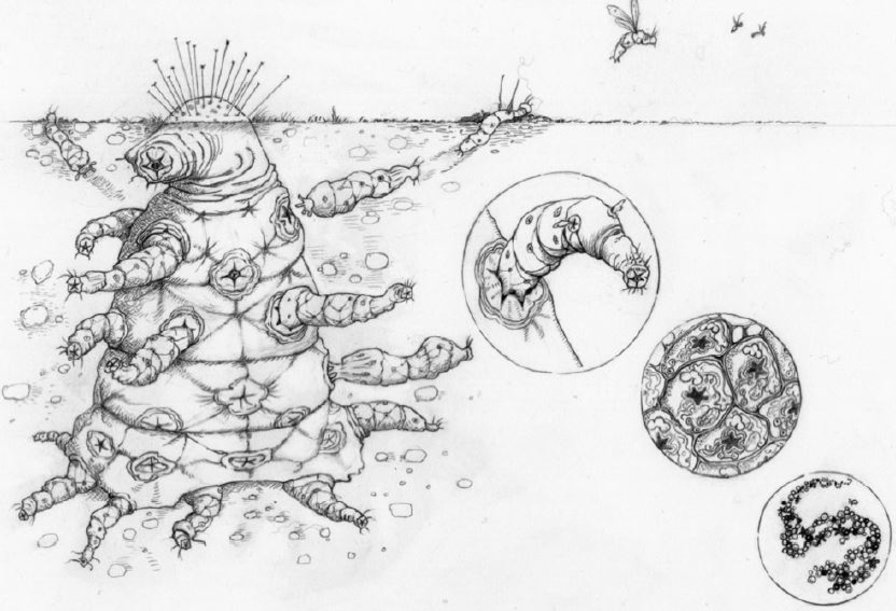
When Charles Darwin laid out his theory of natural selection in 1859, little could he have imagined that, a good 150 years later, this cornerstone of evolutionary theory might help us form a mental picture of what alien life looks like. But that’s precisely how a group of researchers from Oxford University have done: In a research paper called “Darwin’s Aliens,” they’ve applied Darwin’s theory to alien life, positing that aliens–like humans–adapt to their environment, undergo natural selection, and move from simple to complex life forms. And, by the end, they could plausibly look something like a “colony of Ewoks from Star Wars or the Octomite” pictured above.
You can read “Darwin’s Aliens” in the International Journal of Astrobiology. It’s published on the Cambridge Core website.
If you would like to support the mission of Open Culture, consider making a donation to our site. It’s hard to rely 100% on ads, and your contributions will help us continue providing the best free cultural and educational materials to learners everywhere. You can contribute through PayPal, Patreon, and Venmo (@openculture). Thanks!
Related Content:
Free NASA eBook Theorizes How We Will Communicate with Aliens
Carl Jung’s Fascinating 1957 Letter on UFOs
Read More...Hear the Highest Note Sung in the 137-Year History of the Metropolitan Opera
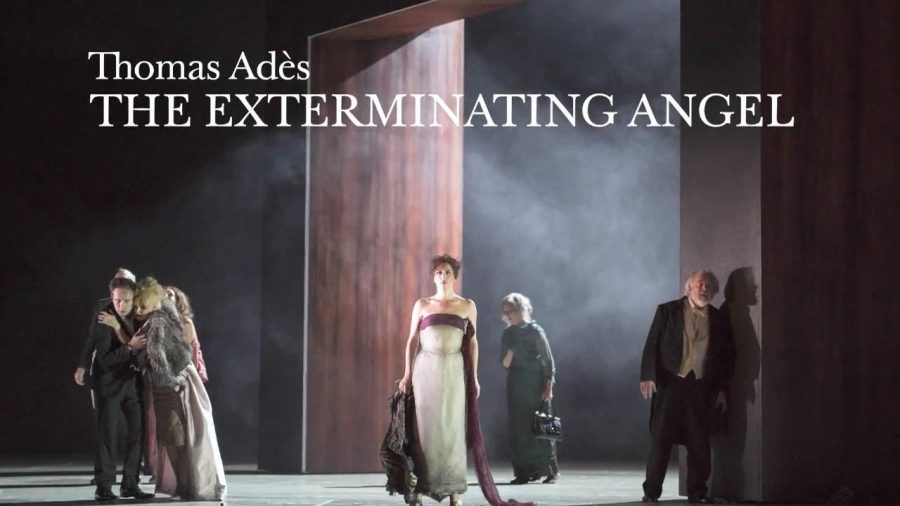
You may have heard an A above high C the last time you accidentally stepped on your cat’s tail, but it takes a combination of rigorous training, genetic luck, and sheer grit for a human to produce this note on cue.
According to all known records, the coloratura soprano, Audrey Luna, is the first such being in the Metropolitan Opera’s 137-year history to do so on its stage, an achievement that has all the opera dogs barking. Hear it in the NPR clip below.
Some purists view the rare note as a distasteful stunt on the part of composer Thomas Adès. The score of his new opera, The Exterminating Angel, based on the Luis Buñuel film, also calls for miniature 1/32-size violins, a pair of rocks, a wooden salad bowl, a door, and an ondes Martenot—an electronic instrument from 1928.
Others are bedazzled by Luna’s history-making pipes. She makes her entrance on that high A, and hits it again shortly thereafter, as Leticia, a diva who rolls up to a dinner party following a performance of Donizetti’s Lucia di Lammermoor. (The title role of that one—a part Luna has played, natch—is another that demands stratospheric notes of its performers, setting records at opera houses around the world.)
See below for more of Luna’s dizzying highs, including her somewhat NSFW performance as Olympia, the mechanical doll in Offenbach’s Les Contes d’Hoffmann
If you’re mad enough to try it yourself, please let us know how high you get in the comments below.
Related Content:
The Enchanting Opera Performances of Klaus Nomi
Alan Turing Gets Channeled in a New Opera: Hear Audio from The Life And Death(S) Of Alan Turing
Ayun Halliday is an author, illustrator, theater maker and Chief Primatologist of the East Village Inky zine. Follow her @AyunHalliday.
Read More...Why Did Leonardo da Vinci Write Backwards? A Look Into the Ultimate Renaissance Man’s “Mirror Writing”
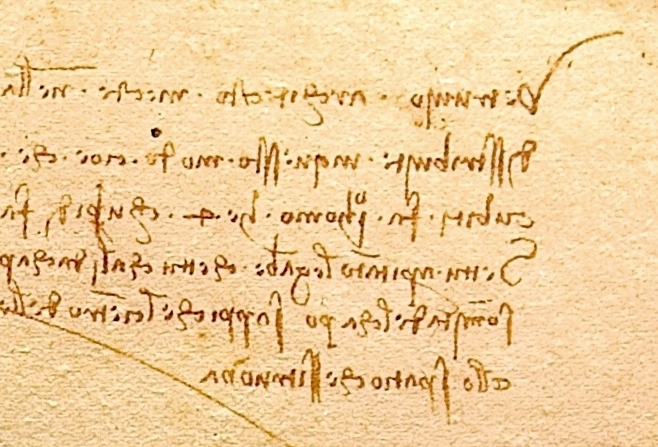
As the standout example of the “Renaissance Man” ideal, Leonardo da Vinci racked up no small number of accomplishments in his life. He also had his eccentricities, and tried his hand at a number of experiments that might look a bit odd even to his admirers today. In the case of one practice he eventually mastered and with which he stuck, he tried his hand in a more literal sense than usual: Leonardo, the evidence clearly shows, had a habit of writing backwards, starting at the right side of the page and moving to the left.
“Only when he was writing something intended for other people did he write in the normal direction,” says the Museum of Science. Why did he write backwards? That remains one of the host of so far unanswerable questions about Leonardo’s remarkable life, but “one idea is that it may have kept his hands clean. People who were contemporaries of Leonardo left records that they saw him write and paint left handed. He also made sketches showing his own left hand at work. As a lefty, this mirrored writing style would have prevented him from smudging his ink as he wrote.”
Or Leonardo could have developed his “mirror writing” out of fear, a hypothesis acknowledged even by books for young readers: “Throughout his life, he was worried about the possibility of others stealing his ideas,” writes Rachel A. Koestler-Grack in Leonardo Da Vinci: Artist, Inventor, and Renaissance Man. “The observations in his notebooks were written in such a way that they could be read only by holding the books up to a mirror.” The blog Walker’s Chapters makes a representative counterargument: “Do you really think that a man as clever as Leonardo thought it was a good way to prevent people from reading his notes? This man, this genius, if he truly wanted to make his notes readable only to himself, he would’ve invented an entirely new language for this purpose. We’re talking about a dude who conceptualized parachutes even before helicopters were a thing.”
Perhaps the most widely seen piece of Leonardo’s mirror writing is his notes on Vitruvian Man (a piece of which appears at the top of the post), his enormously famous drawing that fits the proportions of the human body into the geometry of both a circle and a square (and whose elegant mathematics we featured last week). Many examples of mirror writing exist after Leonardo, from his countryman Matteo Zaccolini’s 17th-century treatise on color to the 18th- and 19th-century calligraphy of the Ottoman Empire to the front of ambulances today. Each of those has its function, but one wonders whether as curious a mind as Leonardo’s would want to write backwards simply for the joy of mastering and using a skill, any skill, however much it might baffle others — or indeed, because it might baffle them.
If you’re interested in all things da Vinci, make sure you check out the new bestselling biography, Leonardo da Vinci, by Walter Isaacson.
Related Content:
Leonardo da Vinci’s Bizarre Caricatures & Monster Drawings
Leonardo da Vinci’s Visionary Notebooks Now Online: Browse 570 Digitized Pages
Leonardo da Vinci’s Handwritten Resume (1482)
Leonardo Da Vinci’s To Do List (Circa 1490) Is Much Cooler Than Yours
Based in Seoul, Colin Marshall writes and broadcasts on cities and culture. His projects include the book The Stateless City: a Walk through 21st-Century Los Angeles and the video series The City in Cinema. Follow him on Twitter at @colinmarshall or on Facebook.
Read More...Filmmaker Creates a Luxury-Style Car Commercial to Sell a 21-Year-Old Used Honda Accord
This is not your average car commercial. It has the look and feel of the luxury car commercials you’ve seen so many times. And yet it features a car with 141,095 miles on it. Filmmaker Max Lanman created the ad to help his girlfriend sell her used 1996 Honda Accord. For reasons you’ll quickly understand, the video went viral, clocked more than 5 million views this past week, and when the car was listed on eBay, bids soared to $150,000–before eBay apparently pulled the plug “due to concerns around illegitimate bidding.” Enjoy the ad. And remember, “Luxury is a state of mind.”
If you would like to support the mission of Open Culture, consider making a donation to our site. It’s hard to rely 100% on ads, and your contributions will help us continue providing the best free cultural and educational materials to learners everywhere. You can contribute through PayPal, Patreon, and Venmo (@openculture). Thanks!
Related Content:
178,000 Images Documenting the History of the Car Now Available on a New Stanford Web Site
Read More...
What the Future Sounded Like: Documentary Tells the Forgotten 1960s History of Britain’s Avant-Garde Electronic Musicians
It really is impossible to overstate the fact that most of the music around us sounds the way it does today because of an electronic revolution that happened primarily in the 1960s and 70s (with roots stretching back to the turn of the century). While folk and rock and roll solidified the sound of the present on home hi-fis and coffee shop and festival stages, the sound of the future was crafted behind studio doors and in scientific laboratories. What the Future Sounded Like, the short documentary above, transports us back to that time, specifically in Britain, where some of the finest recording technology developed to meet the increasing demands of bands like the Beatles and Pink Floyd.
Much less well-known are entities like the BBC’s Radiophonic Workshop, whose crew of engineers and audio scientists made what sounded like magic to the ears of radio and television audiences. “Think of a sound, now make it,” says Peter Zinovieff “any sound is now possible, any combination of sounds is now possible.” Zinovieff, London-born son of an émigré Russian princess and inventor of the hugely influential VCS3 synthesizer in 1969, opens the documentary—fittingly, since his technology helped power the futuristic sound of progressive rock, and since, together with the Radiophonic Workshop’s Delia Derbyshire and Brian Hodgson, he ran Unit Delta Plus, a studio group that created and promoted electronic music.
Also appearing in the documentary is Tristram Cary, who, with Zinovieff, founded Electronic Music Studios, one of four makers of commercial synthesizers in the late sixties, along with ARP, Buchla, and Moog. Zinovieff and Carey are not household names in part because they didn’t particularly strive to be, preferring to work behind the scenes on experimental forms and eschewing popular music even as their technology gave birth to so much of it. The aristocratic Zinovieff and pipe-smoking, professorial Carey hardly fit in with the crowd of rock and pop stars they inspired.
In hindsight, however, Zinovieff desires more recognition for their work. “One thing which is odd, is that there’s a missing chapter, which is EMS, in all the books about electronic music. People do not know what incredible mechanical adventures we were up to.” Those adventures included not only creating new technology, but composing never-before-heard music. Both Zinovieff and Carey continue to create electronic scores, and Carey happens to be one of the first adopters in Britain of musique concrète, the proto-electronic music pioneered in the 1940s using tape machines, microphones, filters, and other recording devices, along with found sounds, field recordings, and ad hoc instruments made from non-instrument objects. (See examples of these techniques in the clip above from the 1979 BBC documentary The New Sound of Music.)
Many of the sounds that emerged from Britain’s electronic music founders came out of the detritus of World War II. Carey’s first serious studio design, he says, “coincided with the post-war appearance of an enormous amount of junk from the army, navy, and air force. For someone who knew what to do, and could handle a soldering iron, and could design audio equipment, even if you only had 30 shillings in your pocket, you could get something.” With their knowledge of electronics and hodge-podge of technology, Carey and his compatriots were designing an avant-garde electronic “high modernity,” author Trevor Pinch declares. “I think you can think of people like Tristan Carey as dreaming of a future soundscape of London.” Nowadays, those sounds are as familiar to us as the music piped over the speakers in restaurants and shops. One wonders what the future after the future these pioneers designed will sound like?
What the Future Sounded Like will be added to our collection of Documentaries, a subset of our collection, 4,000+ Free Movies Online: Great Classics, Indies, Noir, Westerns, Documentaries & More.
Related Content:
Two Documentaries Introduce Delia Derbyshire, the Pioneer in Electronic Music
Josh Jones is a writer and musician based in Durham, NC. Follow him at @jdmagness.
Read More...Bob Woodward Is Now Teaching an Online Course on Investigative Journalism–a Course for Our Time
FYI: If you sign up for a MasterClass course by clicking on the affiliate links in this post, Open Culture will receive a small fee that helps support our operation.
Bob Woodward made his bones as an investigative journalist when he and fellow Washington Post reporter Carl Bernstein blew open the Watergate scandal in 1972. Their reporting exposed the “dirty tricks” of Richard Nixon’s re-election committee. Government investigations followed and the president eventually resigned.
Today we’re living in another age when investigative journalism is of paramount importance. Only now it’s under attack. But, take heart, Bob Woodward is now teaching an online course on investigative journalism. In 24 video lessons, he’ll teach you the importance of human sources, how to gather information, how to interview people, establish facts, and build a story. He reminds us, “This is the time when we’re being tested. Let’s tell the truth, let’s not be chickenshit.” Amen to that.
You can now enroll in his course, which costs $90. But, for $180, you can get an annual pass to every course in the MasterClass catalogue. Other courses in the Masterclass catalogue include:
- Herbie Hancock on Jazz
- Garry Kasparov on Chess
- Dr. Jane Goodall on the Environment
- David Mamet on Dramatic Writing
- Judy Blume on Writing
- Steve Martin on Comedy
- Aaron Sorkin on Screenwriting
- Helen Mirren on Acting
- Gordon Ramsay on Cooking
- Werner Herzog on Filmmaking
If you would like to support the mission of Open Culture, consider making a donation to our site. It’s hard to rely 100% on ads, and your contributions will help us continue providing the best free cultural and educational materials to learners everywhere. You can contribute through PayPal, Patreon, and Venmo (@openculture). Thanks!
Related Content:
How to Download Bob Woodward’s Fear: Trump in the White House as a Free Audiobook
Bob Woodward: How Investigative Journalism Gets Done
Read More...Interactive Map Lets You Take a Literary Journey Through the Historic Monuments of Rome
Arches on arches! as it were that Rome,
Collecting the chief trophies of her line,
Would build up all her triumphs in one dome,
Her Coliseum stands; the moonbeams shine
As ’twere its natural torches, for divine
Should be the light which streams here, to illume
This long-explored but still exhaustless mine
Of contemplation; and the azure gloom
Of an Italian night, where the deep skies assume
Hues which have words, and speak to ye of heaven,
Floats o’er this vast and wondrous monument,
And shadows forth its glory.
—Lord Byron, Childe Harold’s Pilgrimage (1818)
A modern visitor to Rome, drawn to the Coliseum on a moonlit night, is unlikely to be so bewitched, sandwiched between his or her fellow tourists and an army of vendors aggressively peddling light-up whirligigs, knock off designer scarves, and acrylic columns etched with the Eternal City’s must-see attractions.
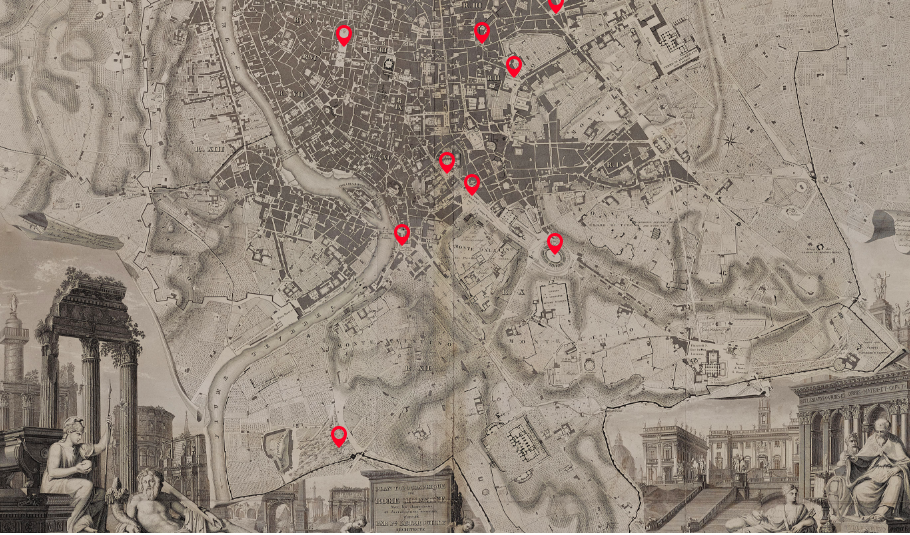
These days, your best bet for touring Rome’s best known landmarks in peace may be an interactive map, compliments of the Morgan Library and Museum. Based on Paul-Marie Letarouilly’s picturesque 1841 city plan, each digital pin can be expanded to reveal descriptions by nineteenth-century authors and side-by-side, then-and-now comparisons of the featured monuments.
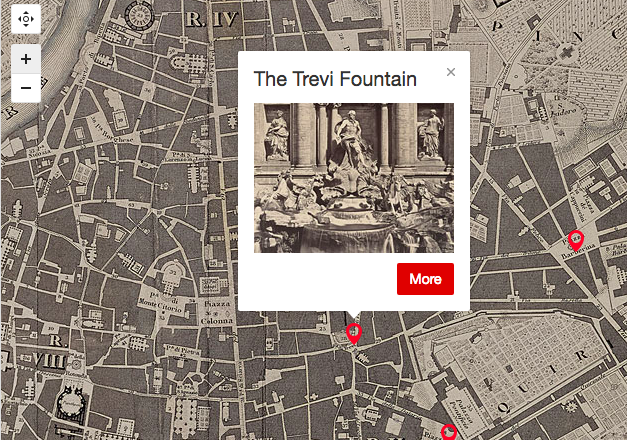
The enduring popularity of the film Three Coins in the Fountain, coupled with the invention of the selfie stick has turned the area around the Trevi Fountain into a pickpocket’s dream and a claustrophobe’s worst nightmare.
Not so in Nathaniel Hawthorne’s day, though unlike Lord Byron, he cultivated a cool remove, at least at first:
They and the rest of the party descended some steps to the water’s brim, and, after a sip or two, stood gazing at the absurd design of the fountain, where some sculptor of Bernini’s school had gone absolutely mad in marble. It was a great palace-front, with niches and many bas-reliefs, out of which looked Agrippa’s legendary virgin, and several of the allegoric sisterhood; while, at the base, appeared Neptune, with his floundering steeds and Tritons blowing their horns about him, and twenty other artificial fantasies, which the calm moonlight soothed into better taste than was native to them. And, after all, it was as magnificent a piece of work as ever human skill contrived. At the foot of the palatial façade was strown, with careful art and ordered irregularity, a broad and broken heap of massive rock, looking as if it might have lain there since the deluge. Over a central precipice fell the water, in a semicircular cascade; and from a hundred crevices, on all sides, snowy jets gushed up, and streams spouted out of the mouths and nostrils of stone monsters, and fell in glistening drops; while other rivulets, that had run wild, came leaping from one rude step to another, over stones that were mossy, slimy, and green with sedge, because in a century of their wild play, Nature had adopted the Fountain of Trevi, with all its elaborate devices, for her own.
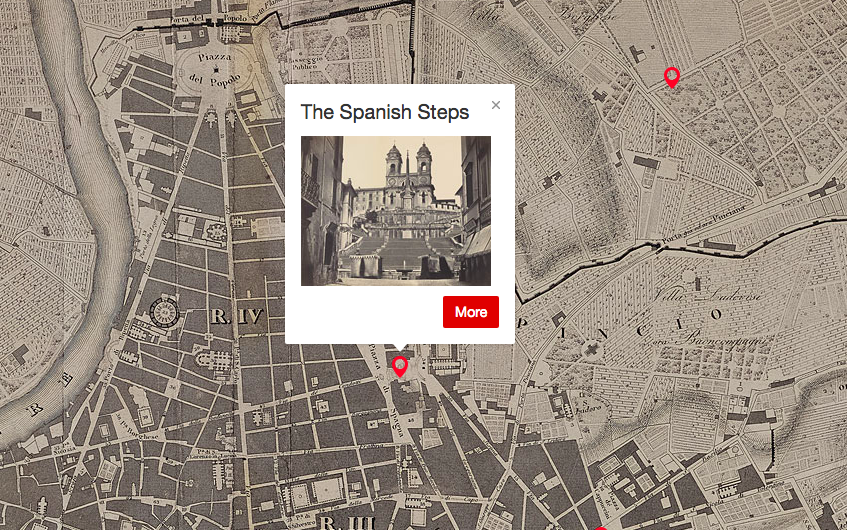
The human statues garbed as gladiators and charioteers spend hours in the blazing sun at the foot of the Spanish Steps—the heirs to the artists and models who populated William Wetmore Story’s Roba di Roma:
All day long, these steps are flooded with sunshine in which, stretched at length, or gathered in picturesque groups, models of every age and both sexes bask away the hours when they are free from employment in the studios. … Sometimes a group of artists, passing by, will pause and steadily examine one of these models, turn him about, pose him, point out his defects and excellences, give him a baiocco, and pass on. It is, in fact, a models’ exchange.
The Medici Villa houses the Académie de France, and its gardens remain a pleasant respite, even in 2017. Visitors who aren’t wholly consumed with finding a wifi signal may find themselves fantasizing about a different life, much as Henry James did in his Italian Hours:
Such a dim light as of a fabled, haunted place, such a soft suffusion of tender grey-green tones, such a company of gnarled and twisted little miniature trunks—dwarfs playing with each other at being giants—and such a shower of golden sparkles drifting in from the vivid West! … I should name for my own first wish that one didn’t have to be a Frenchman to come and live and dream and work at the Académie de France. Can there be for a while a happier destiny than that of a young artist conscious of talent and of no errand but to educate, polish and perfect it, transplanted to these sacred shades?…What mornings and afternoons one might spend there, brush in hand, unpreoccupied, untormented, pensioned, satisfied—either persuading one’s self that one would be “doing something” in consequence or not caring if one shouldn’t be.
The interactive map was created to accompany the Morgan’s 2016 exhibition City of the Soul: Rome and the Romantics. Other pitstops include St. Peter’s, the Roman Forum, and The Equestrian Monument of Marcus Aurelius on the Capitol. Begin your explorations here.
Related Content:
Ancient Rome’s System of Roads Visualized in the Style of Modern Subway Maps
Rome Reborn: Take a Virtual Tour of Ancient Rome, Circa 320 C.E.
Ayun Halliday is an author, illustrator, theater maker and Chief Primatologist of the East Village Inky zine. Follow her @AyunHalliday.
Read More...Bryan Cranston Gives Advice to the Young: Find Yourself by Traveling and Getting Lost
I don’t know what time you’re reading this post but “What do you really want to do in life?” is a question that can wake you up right fast, or make you want to pack it in and sleep on it.
It’s also a question asked maybe a bit too early of our young people, which starts with fantasy (“What do you want to be when you grow up?” “A spaceman!”) and by our teens it turns into a more serious, fate-deciding inquiry by people who may not be happy with their station in life.
Actor Bryan Cranston takes on this question in this Big Think video, and extolls the virtues of travel and wandering.
“Traveling forces you to be social,” Cranston says. “You have to get directions.You have to learn where things are. You’re attuned to your environment.”
Cranston thought he was going to be a policeman when he entered college. Then he took an acting class. So, at 19, Cranston explored America for two years by motorcycle with his brother, in essence to find themselves by getting lost. He says he’s passed on this directionless wandering to his now 24 year-old daughter.
That idea of letting go and just wandering also dovetails nicely into his other advice about auditions. You don’t go there to get a job, you go to create a character and present it. The rest is out of your control.
Now, Cranston says that the period between high school/college and the “real world” is the best time to do it, but there’s really no time like right now. To quote Nigerian author Chimamanda Ngozi Adichie, “I think you travel to search and you come back home to find yourself there,” and the boats are always leaving. Just jump on.
Related Content:
Ray Bradbury Gives 12 Pieces of Writing Advice to Young Authors (2001)
John Cleese’s Advice to Young Artists: “Steal Anything You Think Is Really Good”
Ursula Le Guin Gives Insightful Writing Advice in Her Free Online Workshop
Akira Kurosawa’s Advice to Aspiring Filmmakers: Write, Write, Write and Read
Ted Mills is a freelance writer on the arts who currently hosts the artist interview-based FunkZone Podcast and is the producer of KCRW’s Curious Coast. You can also follow him on Twitter at @tedmills, read his other arts writing at tedmills.com and/or watch his films here.
Read More...Yale Presents a Free Online Course on Miguel de Cervantes’ Masterpiece Don Quixote
Among the literary works that emerged in the so-called Golden Age of Spanish culture in the 16th and 17th centuries, one shines so brightly that it seems to eclipse all others, and indeed is said to not only be the foundation of modern Spanish writing, but of the modern novel itself. Miguel de Cervantes’ Don Quixote synthesized the Medieval and Renaissance literature that had come before it in a brilliantly satirical work, writes popular academic Harold Bloom, with “cosmological scope and reverberation.” But in such high praise of a great work, we can lose sight of the work itself. Don Quixote is hardly an exception.
“The notion of ‘literary classic,’” Simon Leys writes at the New York Review of Books, “has a solemn ring about it. But Don Quixote, which is the classic par excellence, was written for a flatly practical purpose: to amuse the largest possible number of readers, in order to make a lot of money for the author (who needed it badly).” To mention these intentions is not to diminish the work, but perhaps even to burnish it further. To have created, as Yale’s Roberto González Echevarría says in his introductory lecture above, “one of the unquestioned masterpieces of world literature, let alone the Western Canon,” while seeking primarily to entertain and make a buck says quite a lot about Cervantes’ considerable talents, and, perhaps, about his modernism.
Rather than write for a feudal patron, monarch, or deity, he wrote for what he hoped would be a profitable mass-market. In so doing, says Professor González, quoting Gabriel García Márquez, Cervantes wrote “a novel in which there is already everything that novelists would attempt to do in the future until today.” González’s course, “Cervantes’ Don Quixote,” is now available online in a series of 24 lectures, available on YouTube and iTunes. (Stream all 24 lectures below.) You can download all of the course materials, including the syllabus and overview of each class, here. There is a good deal of reading involved, and you’ll need to get your hands on a few extra books. In addition to the weighty Quixote, “students are also expected to read four of Cervantes’ Exemplary Stories, Cervantes’ Don Quixote: A Casebook, and J.H. Elliott’s Imperial Spain.” It would seem well worth the effort.
Professor González goes on in his introduction to discuss the novel’s importance to such figures as Sigmund Freud, Jorge Luis Borges, and British scholar Ian Watt, who called Don Quixote “one of four myths of modern individualism, the others being Faust, Don Juan, and Robinson Crusoe.” The novel’s historical resume is tremendously impressive, but the most important thing about it, says González, is that it has been read and enjoyed by millions of people around the world for hundreds of years. Just why is that?
The professor quotes from his own introduction to the Penguin Classics edition he asks students to read in providing his answer: “Miguel de Cervantes Saavedra’s masterpiece has endured because it focuses on literature’s foremost appeal: to become another, to leave a typically embattled self for another closer to one’s desires and aspirations. This is why Don Quixote has often been read as a children’s book, and continues to be read by and to children.” Critics might be prone to dismiss such enjoyable wish fulfilment as trivial, but the centuries-long success of Don Quixote shows it may be the foundation of all modern literary writing.
Don Quixote will be added to our collection of Free Online Literature courses, a subset of our larger collection, 1,700 Free Online Courses from Top Universities.
Related Content:
Gustave Doré’s Exquisite Engravings of Cervantes’ Don Quixote
Free Online Literature Courses
Josh Jones is a writer and musician based in Durham, NC. Follow him at @jdmagness
Read More...Support Us
We're hoping to rely on loyal readers, rather than erratic ads. Please click the Donate button and support Open Culture. You can use Paypal, Venmo, Patreon, even Crypto! We thank you!

About Us

Open Culture scours the web for the best educational media. We find the free courses and audio books you need, the language lessons & educational videos you want, and plenty of enlightenment in between.
Advertise With Us

FREE UPDATES!
GET OUR DAILY EMAIL
Get the best cultural and educational resources on the web curated for you in a daily email. We never spam. Unsubscribe at any time.
FOLLOW ON SOCIAL MEDIA

Open Culture editor Dan Colman scours the web for the best educational media. He finds the free courses and audio books you need, the language lessons & movies you want, and plenty of enlightenment in between.
Advertise With Us


