Women Have Always Worked: A New Online Course Premieres Today
It’s been said that the greatest achievement in American history in the 20th century is the progress that was made – although the journey continues – toward woman’s equality, what with women’s right to vote codified in the 19th amendment (1920), women’s reproductive rights affirmed by the Supreme Court over a half century later (1973), and every advance in between and since. Our national government has done what it can to recognize that progress, and to remind us whence we came. The National Park Service, for example, tells us that when our country started:
The religious doctrine, written laws, and social customs that colonists brought with them from Europe asserted women’s subordinate position. Women were to marry, tend the house, and raise a family. Education beyond basic reading and writing was unusual. When a woman took a husband she lost what limited freedom she might have had as a single adult. Those few married women who worked for pay could not control their own earnings. Most could neither buy nor sell property or sign contracts; none could vote, sue when wronged, defend themselves in court, or serve on juries. In the rare case of divorce, women lost custody of their children and any family possessions.…
And that … “Women actually lost legal ground as a result of the new United States Constitution.”
What if there were an opportunity to study this struggle and the progress we have made in great depth – in an online course from Columbia University and the New-York Historical Society featuring its star women’s historian, Alice Kessler-Harris, now emerita, and a lineup of guest voices from all around the country interviewed under her leadership to provide their expertise on matters of progress and equality? And what if there were a new Center for the Study of Women’s History launching at the same time, even on the same day – March 8, 2017 – to provide a more permanent place for examining and understanding how to make this progress even more expansive?
Women Have Always Worked, a 20-week online class, premieres its first 10 weeks today – free on the edX platform. The offering (enroll here) is unique in the history of education. The course introduces the first collaboration between a university and a historical society to present knowledge to the world – with extended video-recorded conversations and artifact and document discussions with renowned scholars and authors including Baruch’s Carol Berkin; Deborah Gray White from Rutgers; Iowa’s Linda Kerber; Carroll Smith Rosenberg from Michigan; Thavolia Glymph from Duke; St. John’s Lara Vapnek; Blanche Wiesen Cook from CUNY; Louise Bernikow; Harvard’s Nancy Cott; Elaine Tyler May at the University of Minnesota; NYU’s Linda Gordon; the great New York writer Vivian Gornick; and more.
The course page lists some of the questions covered:
• How women’s participation in, exclusion from, and impact on American economic, political, and social life have altered American history.
• How key figures and events have challenged the role of women in the home and workplace.
• How ideas, such as democracy, citizenship, liberty, patriotism, and equality have differently shaped the lives of women and men.
• How women of different races and classes have experienced work, both inside and outside the home.
• How historians of women and gender study America’s past, including hands-on opportunities to practice analyzing primary sources from the present and the past.
• How women’s history has developed and changed over time.
And did we say it’s free?
The second part of the course will launch in June, in association with the annual meeting of the Berkshire Women’s History Conference at Hofstra University – the largest meeting of women’s historians anywhere. The MOOC is inspired by Kessler-Harris’s book, Women Have Always Worked: A Historical Overview, first published by the Feminist Press in 1981 and coming out in a newly updated edition also in 2017 from the University of Illinois, publisher of Kessler-Harris’s landmark Gendering Labor History (2007). The original book brings forth a million gems of knowledge and analysis in text and images; the online course brings forward video and audio and documents and artifacts such as few media can accomplish. Intelligent Television had the opportunity to produce many of the video interviews, conversations, and testimonials.
The struggle of women at work is the struggle of all who seek a better and more just world. The course is a little miracle alight within it.
Peter B. Kaufman runs Intelligent Television (www.intelligenttelevision.com) and twice served as Associate Director of the Center for Teaching and Learning at Columbia.
Related Content:
Odd Vintage Postcards Document the Propaganda Against Women’s Rights 100 Years Ago
Download Images From Rad American Women A‑Z: A New Picture Book on the History of Feminism
The First Feminist Film, Germaine Dulac’s The Smiling Madame Beudet (1922)
1,700 Free Online Courses from Top Universities
Read More...When East Meets West: Hear What Happened When Ravi Shankar & Philip Glass Composed Music Together
There were the Beats, with their interest in Buddhism and Eastern philosophy. Then the Beatles and Rolling Stones mined Eastern music and traditions for their psychedelic head trips, and turned a lot of people on to the sitar and the Nehru jacket. But in many significant East meets West moments, the emphasis skewed heavily toward Western artists. These cultural moments created some truly inspired rock and roll and writing, but not much in the way of a genuine congress of artists of equal recognition.
Though we might expect to find something like this in the Collaborations box set, credited to Ravi Shankar and George Harrison, what we get instead are four discs of mostly Shankar compositions and classical Indian interpretations, which Harrison produced and played on as a guest artist. These albums refreshingly reverse the usual dynamic: “The music here,” writes the Beatles Bible, “is far from Western pop musicians dabbling with sitars in the 1960s.” But for a truly collaborative work, we should look elsewhere, and we’ll perhaps find few finer examples than Shankar’s work with Philip Glass.
The two giants of their respective musical worlds first met in Paris in 1965, but it was only 25 years later that they decided to work together on an album. You can hear the result, Passages, at the top of the post and in the Spotify playlist just above. Although it took over two decades for Glass and Shankar to record together, their collaboration began even “before The Beatles had met Ravi,” remembered Glass in a lecture at the Red Bull Music Academy. “This music would’ve been very exotic, at that time… in the ‘60s, this was the first time this kind of music had been heard. At least in the West.”
In his mid-twenties at the time, Glass was hired to transcribe Shankar’s score for the cult film Chappaqua. He began to combine what he had been learning in his master’s program at Juilliard “with the work I had been doing with Ravi Shankar. Almost immediately I began doing that.” And so audiences heard Shankar’s influence on Western minimalism before they heard it in pop music. “It was through Shankar’s music,” NPR notes, “that the American composer came to realize that music could be constructed with rhythm as its very foundation…. That realization became a cornerstone of Glass’ own work.”
Since his first meeting with Glass, Shankar influenced and collaborated with many other Western musicians in his long and varied career, inspiring John Coltrane and other jazz greats and releasing three albums with violinist Yehudi Menuhin, each called West Meets East, in 1967, 1968, and 1976. Passages is a sharing of both musical vocabularies and compositional methods: Shankar and Glass each composed themes that the other arranged. “There is a great deal of technical data involved here,” writes Jim Brenholts at Allmusic. “Both of these artists have long taken intellectual approaches to music.”
Theory aside, “the music is brilliant,” whether we understand its virtuosity or not, though it trends largely in a symphonic direction. Those interested in a more beat-oriented but also brilliant “East meets West” collaboration would do well to check out table player Zakir Hussain and bassist Bill Laswell’s project Tabla Beat Science, which, Allmusic writes, fuses the “rich and time-honored tradition of the tabla” with “contemporary electronica studio wizardry.” And, of course, don’t miss Hussain’s work with guitarist extraordinaire John McLaughlin.
Related Content:
Ravi Shankar Gives George Harrison a Sitar Lesson … and Other Vintage Footage
Watch “Geometry of Circles,” the Abstract Sesame Street Animation Scored by Philip Glass (1979)
Josh Jones is a writer and musician based in Durham, NC. Follow him at @jdmagness
Read More...All of the Music from Martin Scorsese’s Movies: Listen to a 326-Track, 20-Hour Playlist
Martin Scorsese’s cinematic reality, populated by hustlers, wise guys, prize fighters, vigilantes, lawmen, madmen, and moguls, demands settings as vivid as its characters. His movies, often period pieces rooted in particular parts of 20th-century America (and increasingly, earlier eras and farther-flung lands), evoke their times and places most notably with songs. Among their twenty greatest musical moments Indiewire lists Warren Zevon’s “Werewolves of London” in The Color of Money, The Clash’s “Janie Jones” in Bringing out the Dead, Mickey & Sylvia’s “Love Is Strange” in Casino, and the Rolling Stones’ “Gimme Shelter” in The Departed (one of its three uses so far in Scorsese’s filmography).
But Scorsese’s involvement with music goes far beyond layering it below, or indeed above, the scenes he shoots. In addition to directing his widely acclaimed features from the “New Hollywood” 1970s to the present day, he’s also led something of a parallel career making films wholly dedicated to music and musicians, including 1978’s The Last Waltz, which captured The Band’s “farewell concert appearance”; the 2003 multi-director documentary series The Blues on that venerable American musical tradition; 2005’s No Direction Home on Bob Dylan, 2008’s Rolling Stones biographical concert film Shine a Light, and 2011’s Living in the Material World on George Harrison.
Some of the power of Scorsese’s musical selections owes to his long friendship with The Band’s guitarist Robbie Robertson, which began with The Last Waltz and continues to this day. “We’ve always had this relationship going back and forth,” a Telegram article on their quasi-collaboration quotes the director as saying. “We started a kind of relationship in which we’d touch base as to every film I was doing and the type of music I was using.”
In his new memoir Testimony, Robertson touches on a particularly important job in Scorsese’s career that surely did something to shape his friend’s musical-cinematic consciousness: assistant-directing and partially editing his NYU film school classmate Michael Wadleigh’s Woodstock. “We were all, naturally, passionate about film-making, but Wadleigh and I were equally passionate about rock music,” Scorsese writes in the foreword to Woodstock: Three Days that Rocked the World. “I thought then, and I still think, that it formed the score for many of our lives; we moved through the days to its swaggering rhythms.”
Now you can move to all the rhythms of Scorsese’s days, and therefore of his filmography to date, in a 326-Track, 20-Hour Spotify playlist. (If you don’t have Spotify’s free software, you can download it here.) It comes assembled by Thrillist, whose Anna Silman writes that, “as might be expected, The Rolling Stones take the crown for most featured artist with a total of 14 appearances,” but “Ray Charles, Eric Clapton, and Louis Prima all put up some decent numbers, too.” She suggests you enjoy it “on shuffle with some egg noodles and ketchup,” and if you get the reference right away, the playlist will certainly bring back some of your most vivid cinematic memories — and maybe even a few historical ones.
Related Content:
Mavis Staples and The Band Sing “The Weight” In Martin Scorsese’s The Last Waltz (1978)
The Filmmaking of Martin Scorsese Demystified in 6 Video Essays
Martin Scorsese Reveals His 12 Favorite Movies (and Writes a New Essay on Film Preservation)
Martin Scorsese’s Very First Films: Three Imaginative Short Works
Based in Seoul, Colin Marshall writes and broadcasts on cities and culture. He’s at work on a book about Los Angeles, A Los Angeles Primer, the video series The City in Cinema, the crowdfunded journalism project Where Is the City of the Future?, and the Los Angeles Review of Books’ Korea Blog. Follow him on Twitter at @colinmarshall or on Facebook.
Read More...Sinclair Lewis’ Chilling Play, It Can’t Happen Here: A Read-Through by the Berkeley Repertory Theatre
As a number of commentators have noted, it has already happened here in the past—that is, the fervid nativism, immigration bans, and mass deportations, the nationalist, fanatically religious, anti-democratic militancy… many of the characteristics of American authoritarianism, in other words. In the political climate we face today, these strains have come together in some very overt ways, under the leadership of a purportedly charismatic leader who swayed millions of followers with the promise of renewed “greatness.”
The questions that now arise are those once asked by It Can’t Happen Here, the 1935 novel by Sinclair Lewis that imagined the election of a charismatic leader who promises greatness, “then quickly becomes a dictator,” writes the American Library Association’s Public Programs Office, “enacting martial law and throwing dissenters into labor camps.” The novel resonated with a public increasingly concerned about rising dictatorships in Europe, as well as the growing power of the presidency at home. “Shortly after it was published,” the ALA notes, “the novel was recreated as a play and opened in 21 cities nationwide on October 27, 1936.”
You can see some still images of an original It Can’t Happen Here production in the video above about the Federal Theater Project. Last year—almost eighty years after the play’s debut and just days before the presidential election—several dozen theaters, universities, and libraries across the country held readings of Lewis’ theatrical adaptation. See one such reading at the top of the post, performed on October 24 at the Yolo County Library in Northern California by the Berkeley Repertory Theatre, who at the time also staged a full, two part production of It Can’t Happen Here that was both “thrilling and grim,” as Alexander Nazaryan writes at The New Yorker. (See a trailer below)
The Berkeley Rep’s production significantly rewrote Lewis’ adaptation, which they decided was “terrible.” But the novel itself is not quite a literary masterpiece. “Lewis was never much of an artist,” Nanaryan notes, “but what he lacked in style he made up for with social observation.” While his skills as a close observer of American political tendencies may still be unmatched, the prescience of his novel in imagining the situation we find ourselves in today may have as much to do with Lewis’ abilities as with the recurrence of certain depressing themes in American political life. As Alex Wagner writes at The Atlantic, the mass deportations and raids on immigrant populations that have now increased in cities nationwide saw a chilling precedent in the 1920s and 30s, “a time of economic struggle, racial resentment and increasing xenophobia.”
Then, Herbert Hoover, “promised jobs for Americans—and made good on that promise by slashing immigration by nearly 90 percent” and deporting as many as “1.8 million men, women and children” of Mexican descent or with “a Mexican-sounding name.” As many as sixty percent of those deported were U.S. citizens. We’ve seen in recent months numerous comparisons of our current political situation to Nazi Germany and Fascist Italy. While these may be warranted in many respects, they may also be superfluous. To understand the origins of racist authoritarianism in America, we need only look back to several moments in our own history, those that Lewis closely observed and satirized in a novel that once again shows us an image of the country that many people have chosen not to see.
This reading will be added to our list, 1,000 Free Audio Books: Download Great Books for Free.
Related Content:
How to Recognize a Dystopia: Watch an Animated Introduction to Dystopian Fiction
George Orwell’s Final Warning: Don’t Let This Nightmare Situation Happen. It Depends on You!
Philosopher Richard Rorty Chillingly Predicts the Results of the 2016 Election … Back in 1998
1,000 Free Audio Books: Download Great Books for FreeJosh Jones is a writer and musician based in Durham, NC. Follow him at @jdmagness
Read More...Free Download: The Book Lover’s Guide to Coffee

FYI: Courtesy of Penguin Random House, you can download The Book Lover’s Guide to Coffee. This free guide–a “celebration of ideas that make coffee and literature inseparable”–features:
- 6 authors on coffee’s cultural significance ;
- The rituals of 7 famous coffee-obsessed authors;
- Infographics rich with caffeinated, bookish data;
- Tips on taking the perfect coffee;
- Brewing guides from Birch Coffee.
You can download the coffee guide here. (They do require an email address.) Meanwhile, find more good coffee items in the Relateds below.
Related Content:
A Rollicking French Animation on the Perils of Drinking a Little Too Much Coffee
Philosophers Drinking Coffee: The Excessive Habits of Kant, Voltaire & Kierkegaard
David Lynch Directs a Mini-Season of Twin Peaks in the Form of Japanese Coffee Commercials
“The Virtues of Coffee” Explained in 1690 Ad: The Cure for Lethargy, Scurvy, Dropsy, Gout & More
10 Essential Tips for Making Great Coffee at Home
800 Free eBooks for iPad, Kindle & Other Devices
1,000 Free Audio Books: Download Great Books for Free Read More...How Mindfulness Makes Us Happier & Better Able to Meet Life’s Challenges: Two Animated Primers Explain
The West has very rich contemplative tradition. Monastics of the early Christian church practiced forms of meditation that have been adopted by many people seeking a deeper, more serene experience of life. Given the wealth of contemplative literature and practice in European history, why have so many Western people turned to the East, and toward Buddhist contemplative forms in particular?
The answer is complicated and involves many strains of philosophical and countercultural history. Some of the greatest influence in the U.S. has come from Tibetan monks like the Dalai Lama and Chögyam Trungpa Rinpoche, onetime teacher of Allen Ginsberg, and founder of Naropa University and the ecumenical Shambhala school of Buddhism. Trungpa Rinpoche contrasted theistic forms of meditation, both Hindu and Christian, with the mindfulness and concentration practices of Buddhism, writing that the first one, focused on a “higher being” or beings, is “inward or introverted” and dualistic.
Buddhist mindfulness meditation, on the other hand, is “what one might call ‘working meditation’ or extroverted meditation. This is not a question of trying to retreat from the world.” Mindfulness “is concerned with trying to see what is,” he writes, and to do so without prejudice: “there is no belief in higher and lower; the idea of different levels, or of being in an underdeveloped state, does not arise.” In other words, all of the imported concepts that push us one way or another, drive our rigid opinions about ourselves and others, and make us feel superior or inferior, become irrelevant. We take ownership of the contents of our own minds.
How is this relevant for the modern person? Consider the videos here. These explainers, like many other contemporary uses of the word “mindfulness,” peel the concept away from its Buddhist origins. But secular and Buddhist ideas of mindfulness are not as different as some might think. “Mindfulness,” says Dan Harris in the video at the top, “is the ability to know what’s happening in your head at any given moment without getting carried away by it.” (Some might prefer the more succinct Vipassana definition “nonjudgmental awareness.”) Without mindfulness, “there’s no buffer between the stimulus and your reaction.” With it, however, we “learn to respond wisely” to what happens to us instead of being pushed and pulled around by habitual reactivity.
As the video above has it—using the Cherokee parable of the two wolves—mindfulness provides us with the space we need to observe our sensations, emotions, and ideas. From a critical distance, we can see causes and effects, and create different conditions. We can learn, in short, to be happy, even in difficult circumstances, without denying or fighting with reality. The Dalai Lama refers to this as observing “the principle of causality… a natural law.” “In dealing with reality,” he says, “you have to take that law into account…. If you desire happiness, you should seek the causes that give rise to it.” Likewise, we must understand the mental causes of our suffering if we want to prevent it.
How do we do that? Is there an app for it? Well, yes, and no. One app is Happify—who produced these videos with animator Katy Davis, meditation instructor Sharon Salzberg, and Harris, creator of the mindfulness course (and app) 10% Happier. Happify offers “Science-based Activities and Games, and “a highly secularized, some might say decontextualized, form of mindfulness training—including the “Meditation 101” primer video above. For those who reject everything that smacks of religion, secular mindfulness practices have been rigorously put to many a peer-reviewed test. They are widely accepted as evidence-based ways to reduce anxiety and depression, improve focus and concentration, and manage pain. These practices have been used in hospitals, medical schools, and even public elementary schools for many years.
But whether we are Buddhists or other religious people practicing mindfulness meditation, or secular humanists and atheists using modified, “science-based”—or app-based—techniques, the fact remains that we have to build the discipline into our daily life in order for it to work. No app will do that for us, any more than a fitness app will make us toned and healthy. Nor will reading books or articles about meditation make us meditators. (To paraphrase Augustine, we might say that endless reading or staring at screens amounts to an attitude of “give me mindfulness, but not yet.”)
Harris, in character as a mouse in a V‑neck sweater, says in the video above that meditation is “exercise for your brain.” And like exercise, Trungpa Rinpoche writes, meditation can be “painful in the beginning.” We may not always like what we find knocking around in our heads. And yet without acknowledging, and even befriending, the feelings and thoughts that make us feel terrible, we can’t learn to nurture and “feed” those that make us feel good. If you’re inspired to get started, you’ll find several free online guided meditations at the links below.
Related Content:
Philosopher Sam Harris Leads You Through a 26-Minute Guided Meditation
Free Guided Meditations From UCLA: Boost Your Awareness & Ease Your Stress
Stream 18 Hours of Free Guided Meditations
Daily Meditation Boosts & Revitalizes the Brain and Reduces Stress, Harvard Study Finds
Josh Jones is a writer and musician based in Durham, NC. Follow him at @jdmagness
Read More...Talking Heads Featured on The South Bank Show in 1979: How the Groundbreaking New Wave Band Made Normality Strange Again
“I think suburban life is something that almost any American can understand,” says Talking Heads drummer Chris Frantz near the beginning of The South Bank Show’s 1979 episode on the band. “They might dislike or like it, but they can relate to it. It’s a nice metaphor, or whatever, for modern life.” That observation functions as well as any as an introduction to the band who, after having debuted as openers for the Ramones just four years earlier at CBGB, went on to build a worldwide fan base enthralled with the way their music, their performances, and even their self-presentation rendered American normality and banality new and strange.
Originally called “The Artistics,” the band found its true name through a dissolution, reformation, and glance at the pages of TV Guide. “All of us could immediately relate to that name,” says bassist Tina Weymouth. “We also thought it could have many connotations, the most important of which was that it had no connotation with any existing music form. It’s TV, video — supposedly the most boring format.” This ethos extended to the songwriting procedure of lead vocalist and guitarist David Byrne, who deliberately used language and references “that were no more interesting than normal speech and no more dramatic and yet somehow, in the song context, might become more interesting.”
The result: albums like 1978’s More Songs About Buildings and Food. From a distance of nearly forty years, the Talking Heads of those days look a bit like pioneers of “normcore,” the fashion, much discussed in recent years, of deliberately looking as aesthetically average as possible. “I’m glad we don’t have to dress up in uniforms every day,” says Frantz of their refusal of the dueling “punk” and “glam” modes of dress sported by so many rockers at the time. Byrne speaks of originally wanting to wear the most normal outfits possible, as determined by observing people out on the street, but it turned out that “a lot of average clothes require more upkeep than I’m willing to do. Like, they need ironing and things like that.”
The idea of normcore draws its power from the contradiction at its core, and Talking Heads never feared contradiction. “We write songs that have a particular point of view, and we’re not worried if the next song has the opposite point of view,” says keyboard and guitar player Jerry Harrison. “We feel that people have different ideas, feel different at different times of the day as well as at different times of their life, and we don’t really want to have a manifesto or, you know, an ideology.” (“We’ve gone through so many ideologies lately,” he adds.)
Despite that, Talking Heads always seemed to adhere to certain principles: “I believe a lot of those moral cliches,” admits Byrne, “like ‘Two wrongs don’t make a right’ or ‘There’s no free lunch’ or ‘If you do bad things it’ll come back to you,’ and all those sort of stupid things.” But they never really inhabited mainstream America; culturally hyper-aware urbanites made up much of their audience, and the band members themselves — players, one says, of quintessentially “city music” — were very much denizens of pre-gentrification Manhattan. “It’s stimulating to go out and see dirt everywhere and people falling over,” says Byrne. “I lived out in the suburbs and had a nice place with a big lawn or whatever — although I can’t afford that — if I did live somewhere like that, I would be afraid that I would get too comfortable and wouldn’t work.”
But work they did, so diligently and wholly without the extravagances of the rock star lifestyle that Frantz, after describing his early-to-rise lifestyle, says he sometimes considers himself “just a glorified manual laborer, and that if anybody it’s the other members of the band that are that artists. Another day I’ll think, wow, these people, the Talking Heads, working together — some day it’s going to be remembered in music history, and I think it’s a very artistic thing we’re doing. I’m not trying to sound highfalutin’, but this is the way I really feel sometimes.”
Related Content:
Watch Talking Heads Play Live in Dortmund, Germany During Their Heyday (1980)
Watch Talking Heads Play a Vintage Concert in Syracuse (1978)
Hear the Earliest Known Talking Heads Recordings (1975)
Talking Heads Live in Rome, 1980: The Concert Film You Haven’t Seen
Talking Heads Play CBGB, the New York Club that Shaped Their Sound (1975)
Based in Seoul, Colin Marshall writes and broadcasts on cities and culture. He’s at work on a book about Los Angeles, A Los Angeles Primer, the video series The City in Cinema, the crowdfunded journalism project Where Is the City of the Future?, and the Los Angeles Review of Books’ Korea Blog. Follow him on Twitter at @colinmarshall or on Facebook.
Read More...42 Hours of Ambient Sounds from Blade Runner, Alien, Star Trek and Doctor Who Will Help You Relax & Sleep
Back in 2009, the musician who goes by the name “Cheesy Nirvosa” began experimenting with ambient music, before eventually launching a YouTube channel where he “composes longform space and scifi ambience.” Or what he otherwise calls “ambient geek sleep aids.” Click on the video above, and you can get lulled to sleep listening to the ambient droning sound–get ready Blade Runner fans!– heard in Rich Deckard’s apartment. It runs a good continuous 12 hours.
You’re more a Star Trek fan? Ok, try nodding off to the idling engine noise of a ship featured in Star Trek: The Next Generation. Mr. Nirvosa cleaned up a sample from the show and then looped it for 24 hours. That makes for one long sleep.
Or how about 12 hours of ambient engine noise generated by the USCSS Nostromo in Alien?
Finally, and perhaps my favorite, Cheesy created a 12 hour clip of the ambient sounds made by the Tardis, the time machine made famous by the British sci-fi TV show, Doctor Who. But watch out. You might wake up living in a different time and place.
For lots more ambient sci-fi sounds (Star Wars, The Matrix, Battlestar Galactica, etc. ) check out this super long playlist here.
If you would like to support the mission of Open Culture, consider making a donation to our site. It’s hard to rely 100% on ads, and your contributions will help us continue providing the best free cultural and educational materials to learners everywhere. You can contribute through PayPal, Patreon, and Venmo (@openculture). Thanks!
Looking for free, professionally-read audio books from Audible.com? Here’s a great, no-strings-attached deal. If you start a 30 day free trial with Audible.com, you can download two free audio books of your choice. Get more details on the offer here.
Related Content:
10 Hours of Ambient Arctic Sounds Will Help You Relax, Meditate, Study & Sleep
Read More...Download Influential Avant-Garde Magazines from the Early 20th Century: Dadaism, Surrealism, Futurism & More
“I’m tired of politics, I just want to talk about my art,” I sometimes hear artists—and musicians, actors, writers, etc.—say. And I sometimes see their fans say, “you should shut up about politics and just talk about your art.” Given the current onslaught of political news, commentary, scandal, and alarm, these are both understandable sentiments. But anyone who thinks that art and politics once occupied separate spheres harbors a historically naïve belief. The arts have always been political, and all the more so during times of high drama and tension like the one we live in now. We can look, for example, to John Milton’s Paradise Lost, Jacques-Louis David’s Death of Marat, or Pablo Picasso’s Guernica, just to mention three particularly striking historical examples.
The political acts of avant-garde artists like Picasso in the 20th century were as much revolutions in form as in content, and we begin to see the most radical statements emerge in the teens and twenties with Dada, Surrealism, and other modernisms: sometimes explicitly political in their orientation—spanning the gamut from anarchism to fascism—sometimes more subtly partisan.
This period was also, perhaps not coincidentally, the Golden Age of the arts journal, when every movement, circle, and splinter group in Europe and the U.S. had its own publication. For many years now, Princeton University’s Blue Mountain Project, a joint effort from “scholars, librarians, curators, and digital humanities researchers,” has archived complete issues of several such journals, and we’ve featured a couple notable examples in previous posts.

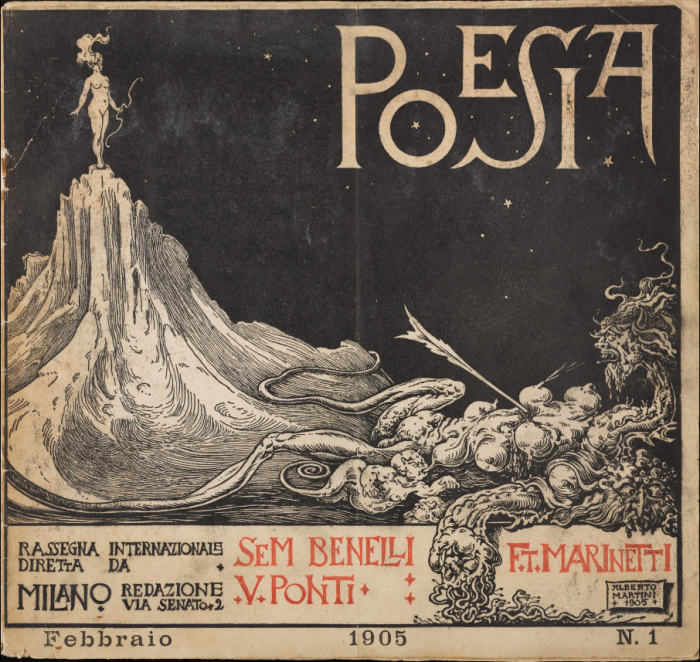
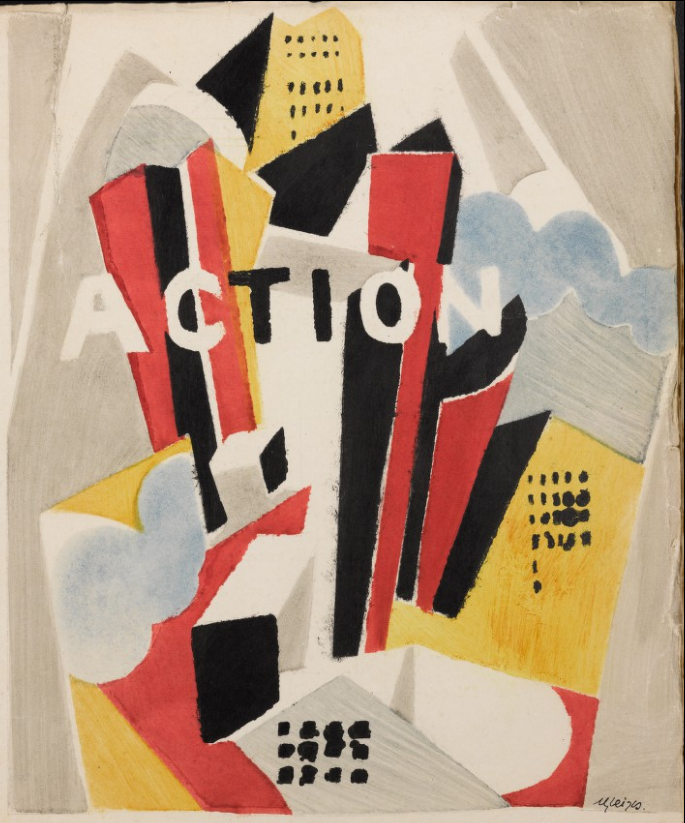
Now we direct your attention to the full online library, where you’ll find issues of Poesia (top), published by F.T. Marinetti between 1905 and 1920. This magazine represents “the transition from Italy’s engagement with an international Symbolist movement to an increasingly nationalist Futurism” and features the work of Marinetti, Alfred Jarry, W.B. Yeats, Paolo Buzzi, Emilio Notte, and James Joyce. Below Poesia, from the other side of the spectrum, we see the cover of a 1920 issue of Action, a “literary and artistic magazine associated with Individualist Anarchism,” and featuring work from writers like André Malraux, Antonin Artaud, and Paul Éluard, and artwork from Demetrios Galanis and Robert Mortier, to name just a few.
Not every avant-garde arts journal had a clear ideological mission, but they all represented aesthetic programs that strongly reacted against the status quo. The artists of the so-called Vienna Secession broke away from Association of Austrian Artists to protest its conservatism. Their journal, Ver Sacrum, further up, joined the flowing, intricate, and passionate designs of Art Nouveau and German Jugendstil artists, who created the look of the Weimar Republic and the Jazz Age. Contributors included Gustav Klimt, Koloman Moser, and Josef Hoffmann.
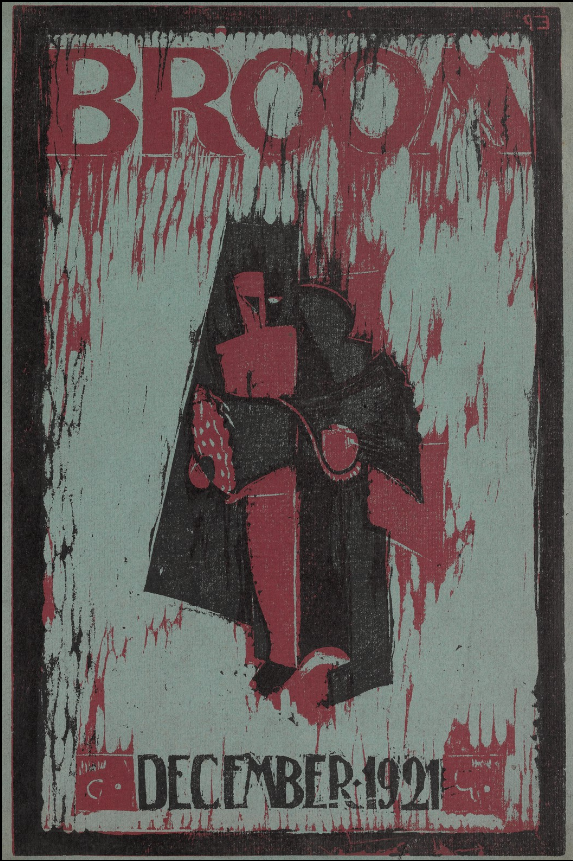
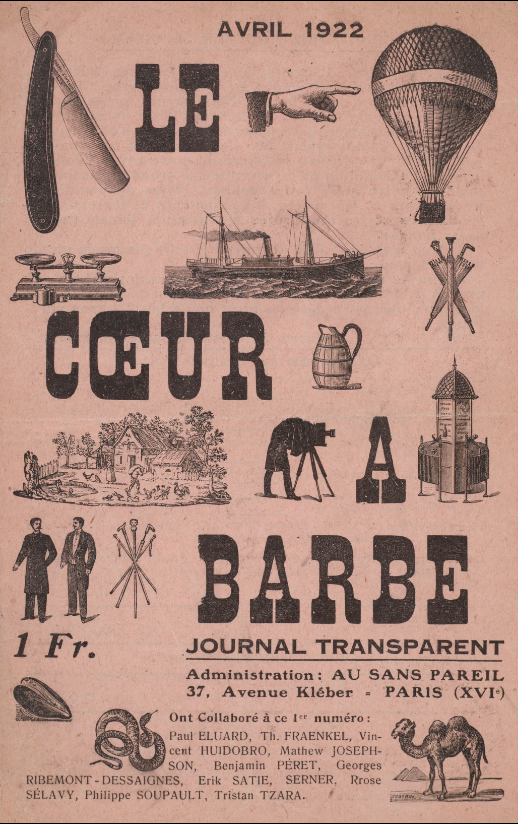
Sometimes avant-garde journals reflected political conflicts between warring factions of artists, as in the example of Le coeur à barbe: journal transparent, “produced by Tristan Tzara as a response to the attacks on him by Francis Picabia and André Breton about the future of the Dada movement.” Other publications aimed to expand the boundaries of national culture, as with Broom, above, a “self-proclaimed international magazine of arts and literature… a sumptuous journal that introduced American audiences to the European avant-garde.” Whatever their stated mission and implicit or explicit slant, it’s fair to say that the radical art published in avant-garde journals between the turn of the century and the end of the 1920s did everything but stand on the sidelines.
You can view … and download … more avant-garde magazines at Princeton’s Blue Mountain Project.
Related Content:
Extensive Archive of Avant-Garde & Modernist Magazines (1890–1939) Now Available Online
Josh Jones is a writer and musician based in Durham, NC. Follow him at @jdmagness
Read More...Leni Riefenstahl’s Triumph of the Will Wasn’t a Cinematic Masterpiece; It Was a Staggeringly Effective Piece of Propaganda
“Triumph of the Will,” says Dan Olson of the analytical video series Folding Ideas, “is not a triumph of cinema.” Already the proposition runs counter to what many of us learned in film studies classes, whose professors assured us that Leni Riefenstahl’s 1935 glorification of Nazi Germany, despite its thoroughly propagandistic nature, still counts as a serious achievement in film art. “None of the ideas or techniques were new,” Olson explains. “It is simply that no one had previously thrown enough money and resources at propaganda on this scale before.”
If it has value as nothing but sheer spectacle, does Triumph of the Will (watch it below) amount to the Transformers of its day — and with motives that make Michael Bay blockbusters look like noble, altruistic endeavors at that? Despite doing nothing new with its medium, the film does still showcase certain qualities of propaganda that, more than 70 years after the fall of the Third Reich, we’d all do well to keep in mind and keep an eye on.
Olson quotes “Ur-Fascism,” an essay by Umberto Eco (who spent a couple formative years “among the SS, Fascists, Republicans, and partisans shooting at one another”) explaining that, for fascist leaders to convince people to follow them,
the followers must feel humiliated by the ostentatious wealth and force of their enemies. When I was a boy I was taught to think of Englishmen as the five-meal people. They ate more frequently than the poor but sober Italians. Jews are rich and help each other through a secret web of mutual assistance. However, the followers must be convinced that they can overwhelm the enemies. Thus, by a continuous shifting of rhetorical focus, the enemies are at the same time too strong and too weak. Fascist governments are condemned to lose wars because they are constitutionally incapable of objectively evaluating the force of the enemy.
Here we have summarized both a message that Triumph of the Will wants to convey and the intellectual Achilles’ heel of fascist propaganda. It must imply the strength of the enemies even as it makes the strength of the regime crushingly explicit. “To the modern viewer it may seem aimless and shoddily paced,” says Olson, “with montages that just go on and on and on long after the point has been made, but that’s the point: it is not merely a demonstration of presence, but of volume. The indulgence of it, the conspicuous cost, is as much a message of the film as any other.”
The words of Hannah Arendt, who once called science “only a surrogate for power,” also enter into the analysis. Olson uses the quote to get into the idea that “one of the main mechanisms of propaganda is to plant the idea of precedent, to alter the audience’s own sense of history and the world and appeal to the seemingly objective authorities of god, history and science” in order to, through what Eco called the “cult of tradition,” make “new institutions seem older than they really are.”
We might find all this a bit funny, given the highly premature termination of a reign the Nazis insisted could endure for a thousand years, but in some sense their propagandists had the last laugh. Whatever its cinematic merits or lack thereof, Riefenstahl’s film remains essentially effective. “To this day we continue to use Triumph of the Will as a reference point for our mental construct of the Nazi regime,” says Olson. “Our idea of the Nazis is deeply informed by a propaganda film produced by the Nazis for the explicit purpose of creating that mental construct.” When we think of the Nazis, in other words, we still think of the images manufactured more than eighty years ago by Triumph of the Will — “exactly the image they wanted you to think of when you thought of them.”
Related Content:
Watch Lambeth Walk—Nazi Style: The Early Propaganda Mash Up That Enraged Joseph Goebbels
Umberto Eco Makes a List of the 14 Common Features of Fascism
Noam Chomsky on Whether the Rise of Trump Resembles the Rise of Fascism in 1930s Germany
Based in Seoul, Colin Marshall writes and broadcasts on cities and culture. He’s at work on a book about Los Angeles, A Los Angeles Primer, the video series The City in Cinema, the crowdfunded journalism project Where Is the City of the Future?, and the Los Angeles Review of Books’ Korea Blog. Follow him on Twitter at @colinmarshall or on Facebook.
Read More...Support Us
We're hoping to rely on loyal readers, rather than erratic ads. Please click the Donate button and support Open Culture. You can use Paypal, Venmo, Patreon, even Crypto! We thank you!

About Us

Open Culture scours the web for the best educational media. We find the free courses and audio books you need, the language lessons & educational videos you want, and plenty of enlightenment in between.
Advertise With Us

FREE UPDATES!
GET OUR DAILY EMAIL
Get the best cultural and educational resources on the web curated for you in a daily email. We never spam. Unsubscribe at any time.
FOLLOW ON SOCIAL MEDIA

Open Culture editor Dan Colman scours the web for the best educational media. He finds the free courses and audio books you need, the language lessons & movies you want, and plenty of enlightenment in between.
Advertise With Us

