Hear the First Jazz Record, Which Launched the Jazz Age: “Livery Stable Blues” (1917)
Through turn-of-the-century America meandered blues, bluegrass, and “old time” music. Gospel hymns, waltzes, and marches. Perhaps the first truly national musical style, Ragtime took a little bit from all of these and fused them together, influencing everything from the crudest vaudeville to the work of some of Europe’s most innovative composers, including Antonin Dvořák, Claude Debussy, and Erik Satie. But ragtime was still very much tied to the past, to its late 19th roots in minstrelsy and marches.
Then in 1917, a sound arrived that was so perfectly in tune with the age that it became singularly evocative of next decade to come. This was jazz, of course, or “jass,” as it was spelled on “Livery Stable Blues,” the first record of such music ever released, composed and played by the Original Dixieland ‘Jass’ Band. The music arrived with the force of the “garage rock of the 1960s…. It was simple music played with so much irreverence that it proved irresistible” to Americans caught up in the country’s rapid urbanization and modernizing.
The first jazz record was transitional music—not necessarily a jazz big bang moment; “looser and more spontaneous than the ragtime that had swept the country at the turn of the century,” writes Geoffrey Himes at Smithsonian, “but lacking the improvised solos and elastic rhythm of jazz to come.” Just as in the emergence of rock and roll in the 1950s, most jazz fans first came to know white groups like the Original Dixieland ‘Jass’ Band before they met the black New Orleanians who invented the music.
But immediately after “Livery Stable Blues” the market was awash with both “jass” and “jazz” releases, including the first by a black American jazz act, Wilbur Sweatman and his Jass Band, and a jazz record from the legendary blues pioneer W.C. Handy from Memphis. Between 1916 and 1917, jazz went nationwide: New York, Chicago, St. Louis, San Francisco, and just about everywhere else in-between. As it spread its origins became muddled. “Just how the Jazz Band originated and where it came from is very hard to say,” wrote the sleeve of one later 1917 release.
Music historians agree that jazz was born in the nightclubs and on the streets of New Orleans, the home town of the Original Dixieland ‘Jass’ Band. But “the question of who did what first,” writes Scott Alexander, “and what was ragtime and what was jazz is often a divisive question among those who are interested in early jazz.” Yet when it comes to making pop history, “Livery Stable Blues” had greater impact than somewhat similar-sounding records released around the same time. “The band was a sensation” writes Himes. And almost overnight the sound of jazz became the sound of 20th-century America.
If you would like to support the mission of Open Culture, consider making a donation to our site. It’s hard to rely 100% on ads, and your contributions will help us continue providing the best free cultural and educational materials to learners everywhere. You can contribute through PayPal, Patreon, and Venmo (@openculture). Thanks!
Related Content:
Langston Hughes Presents the History of Jazz in an Illustrated Children’s Book (1955)
1959: The Year That Changed Jazz
Josh Jones is a writer and musician based in Durham, NC. Follow him at @jdmagness
Read More...Why We Love Vivaldi’s “Four Seasons”: An Animated Music Lesson
Remember listening to Peter and the Wolf as a child, how the narrator would explain that certain instruments correspond to particular characters: the duck — an oboe, the wolf — three horns, and so on?
In the above TED-Ed lesson (memorably animated by Compote Collective), music historian Betsy Schwarm fulfills much the same role for The Four Seasons by Antonio Vivaldi. (Stream it here.)
Why are we so drawn to this Baroque concerto? Is it because we associate it with brunch?
The hundreds of movies and commercials that have featured it?
(Director Robert Benton chose Vivaldi rather than an original composer for the score of Kramer vs. Kramer, arguing that “Concerto in C Major for Mandolin & Strings” captured the troubled Manhattan couple’s refined lifestyle far better than the John Williams-esque bombast the ear associates with some many other cinematic hits of the period. The 1979 film’s success sent “The Four Seasons” to the top of the charts.)
These pleasant associations no doubt account for some of our fondness, but Professor Schwarm posits that the stories contained in the melodies are what really reel us in.
Basically, we’re in the thrall of a musical weather report, reveling in the way Vivaldi manages to bring to life both the birdies’ sunny spring song and the sudden thunderstorm that disrupts it.
Summer rolls out the meteorological big guns with a hailstorm.
Autumn’s cooler nighttime temperatures keep the wine-flushed peasants from turning their harvest celebrations into a full-on bacchanal.
Winter? Well perhaps you’re tucked up contentedly in front of the fireplace right now, gratified to be hearing your own comfort echoed in the largo section.
Inspired by the landscape paintings of artist, Marco Ricci, Vivaldi penned four poems that drive the movements of his most famous work. Their translations, below, are nowhere near as eloquent to the modern listener’s ear, but you’ll find that reading them along with your favorite recording of the Four Seasons will corroborate Professor Schwarm’s thesis.
Spring – Concerto in E Major
Allegro
Springtime is upon us.
The birds celebrate her return with festive song,
and murmuring streams are softly caressed by the breezes.
Thunderstorms, those heralds of Spring, roar, casting their dark mantle over heaven,
Then they die away to silence, and the birds take up their charming songs once more.
Largo
On the flower-strewn meadow, with leafy branches rustling overhead, the goat-herd sleeps, his faithful dog beside him.
Allegro
Led by the festive sound of rustic bagpipes, nymphs and shepherds lightly dance beneath the brilliant canopy of spring.
Summer – Concerto in g‑minor
Allegro non molto
Beneath the blazing sun’s relentless heat
men and flocks are sweltering,
pines are scorched.
We hear the cuckoo’s voice; then sweet songs of the turtle dove and finch are heard.
Soft breezes stir the air….but threatening north wind sweeps them suddenly aside. The shepherd trembles, fearful of violent storm and what may lie ahead.
Adagio e piano — Presto e forte
His limbs are now awakened from their repose by fear of lightning’s flash and thunder’s roar, as gnats and flies buzz furiously around.
Presto
Alas, his worst fears were justified, as the heavens roar and great hailstones beat down upon the proudly standing corn.
Autumn – Concerto in F Major
Allegro
The peasant celebrates with song and dance the harvest safely gathered in.
The cup of Bacchus flows freely, and many find their relief in deep slumber.
Adagio molto
The singing and the dancing die away
as cooling breezes fan the pleasant air,
inviting all to sleep
without a care.
Allegro
The hunters emerge at dawn,
ready for the chase,
with horns and dogs and cries.
Their quarry flees while they give chase.
Terrified and wounded, the prey struggles on,
but, harried, dies
Winter – Concerto in F‑minor
Allegro non molto
Shivering, frozen mid the frosty snow in biting, stinging winds;
running to and fro to stamp one’s icy feet, teeth chattering in the bitter chill.
Largo
To rest contentedly beside the hearth, while those outside are drenched by pouring rain.
Allegro
We tread the icy path slowly and cautiously, for fear of tripping and falling.
Then turn abruptly, slip, crash on the ground and, rising, hasten on across the ice lest it cracks up.
We feel the chill north winds coarse through the home despite the locked and bolted doors…
this is winter, which nonetheless brings its own delights.
You can download the Wichita State University Chamber Players’ recording of Vivaldi’s “Four Seasons” for free here.
See how well you retained your TED-ED lesson with a multiple choice quiz, then read more here.
Related Content:
Why We Love Repetition in Music: Explained in a New TED-Ed Animation
Stream 58 Hours of Free Classical Music Selected to Help You Study, Work, or Simply Relax
The World Concert Hall: Listen To The Best Live Classical Music Concerts for Free
Ayun Halliday is an author, illustrator, theater maker and Chief Primatologist of the East Village Inky zine. Her play Zamboni Godot is opening in New York City in less than three weeks. Follow her @AyunHalliday.
Read More...Abstract: Netflix’s New Documentary Series About “the Art of Design” Premieres Today
All over the world, so many kids growing up, students looking for a major, and even adults angling for a career change say they want to get into “design.” But what do they mean? The word encompasses a bewilderingly wide (and ever-expanding) range of disciplines, respected and experienced practitioners of eight of which the new Netflix documentary series Abstract takes as its subjects: architect Bjarke Ingels, illustrator Christoph Niemann, interior designer Ilse Crawford, stage designer Es Devlin, graphic designer Paula Scher, photographer Platon, automobile designer Ralph Gilles, and shoe designer Tinker Hatfield.
“I can guess what you’re thinking, because I have watched a lot of design documentaries,” writes Abstract creator (and WIRED editor-in-chief) Scott Dadich. “Restrained, polished, pretty — so many of them look like a moving version of a coffee table book. You’ve got softly lit interviews, esoteric conversations, and subtle tracking shots of wide landscapes beneath unobtrusive music. Most of it is clean, minimal, and boring as hell.”
Instead, he and his collaborators have matched each of the designers this series profiles with a different documentarian with their own distinct style: the directorial roster includes Morgan Neville (who made Best of Enemies, the recent documentary on Gore Vidal and William F. Buckley) and Brian Oakes (director of Jim: The James Foley Story).
Indiewire’s Liz Shannon Miller describes the series as documenting, among other things, the workspaces of these designers in a kind of detail “on the level of MTV’s Cribs.” Though “personal lives are kept relatively out of the picture, Abstract manages to get surprisingly intimate with the creators at its center.” You can get a taste of that from the clip just above of Ingels’ episode in which he explains what his team wanted to do with the game of “urban Tetris” that was building the VM Houses in Copenhagen. “It created a lot of noise,” he says of the housing project’s daring design, one that still catches the attention of passersby today.
All of Abstract’s episodes come out today, but before you binge on them (and if you don’t have a Netflix membership, you can always sign up for their free one-month trial), you can read this Architectural Digest interview on it with Ingels and Neville. “This show is about people who are intensely curious and trying to understand, in a very practical way, how to make the world we live in a better place, whether it’s a more comfortable place or a more efficient place or a more egalitarian place,” says Neville. And what does that require? “Understanding that life is always evolving, the world is always evolving, and that means that yesterday’s answers might be the answers to a different question than what the question is today,” says Ingels. “So it always starts with asking questions and reframing the question” — and of course, as you’ll witness countless times throughout the length of the show, venturing an answer.
Abstract is a RadicalMedia production made in association with Tremolo Productions. It was executive produced by Morgan Neville, Scott Dadich (Editor in Chief of WIRED), and Dave O’Connor, Jon Kamen and Justin Wilkes.
via Kottke
Related Content:
Paola Antonelli on Design as the Interface Between Progress and Humanity
Saul Bass’ Oscar-Winning Animated Short Ponders Why Man Creates
Saul Bass’ Advice for Designers: Make Something Beautiful and Don’t Worry About the Money
Powers of Ten: The 1968 Documentary by Legendary Designers Ray and Charles Eames
Sketches of Artists by the Late New Media Designer Hillman Curtis
Based in Seoul, Colin Marshall writes and broadcasts on cities and culture. He’s at work on a book about Los Angeles, A Los Angeles Primer, the video series The City in Cinema, the crowdfunded journalism project Where Is the City of the Future?, and the Los Angeles Review of Books’ Korea Blog. Follow him on Twitter at @colinmarshall or on Facebook.
Read More...Watch Tears In the Rain: A Blade Runner Short Film–A New, Unofficial Prequel to the Ridley Scott Film
Christopher Grant Harvey spent the better part of five years making Tears In The Rain: A Blade Runner Short Film. Unwilling to settle for something merely average, Harvey labored away, especially in post-production, “trying to get the perfect original visual effects and [a] fitting score to bring the story to life.” Set in the world of Philip K. Dick’s novel Do Androids Dream of Electric Sheep? (1968) and the motion picture Blade Runner (1982), Tears In The Rain is a loose prequel to Ridley Scott’s motion picture, and it’s also a “what if” story. It asks what “if a ‘Blade Runner’ retired a human by mistake, what happens then?”
Here’s more on the plot:
In a dystopian Los Angeles future, replicants or genetically engineered humanoids are created to work forced labour on off-world colonies. The latest generation, the Nexus 3 series, begins to display erratic and violent behaviour. Replicants were not designed to experience complex emotions or develop long-term memories. In the wake of corporate scandals of the previous decade, the Tyrell Corporation quietly attempts to remove Nexus 3 from circulation.
John Kampff (Sean Cameron Michael), a senior engineer, heads up the Tyrell Retirement Division. With the primary objectives, detect and remove Replicants, John has suspected Nexus 3 Andy Smith (Russel Savadier) firmly in his sights. As John soon learns, Replicant detection is nearly impossible without specialist equipment. The Voight-Kampff, a polygraph-like machine used by retirement engineers to help in the testing of an individual to learn if they are a replicant, is a distant thought in John Kampff’s mind.
The 11-minute film was made at a cost of $1500. Not too shabby. Find more information about Tears In The Rain here.
If you would like to support the mission of Open Culture, consider making a donation to our site. It’s hard to rely 100% on ads, and your contributions will help us continue providing the best free cultural and educational materials to learners everywhere. You can contribute through PayPal, Patreon, and Venmo (@openculture). Thanks!
Related Content:
Watch an Animated Version of Ridley Scott’s Blade Runner Made of 12,597 Watercolor Paintings
The Blade Runner Sketchbook Features The Original Art of Syd Mead & Ridley Scott (1982)
Blade Runner is a Waste of Time: Siskel & Ebert in 1982
Read More...Browse Every Art Exhibition Held at MoMA Since 1929 with the New “MoMA Exhibition Spelunker”
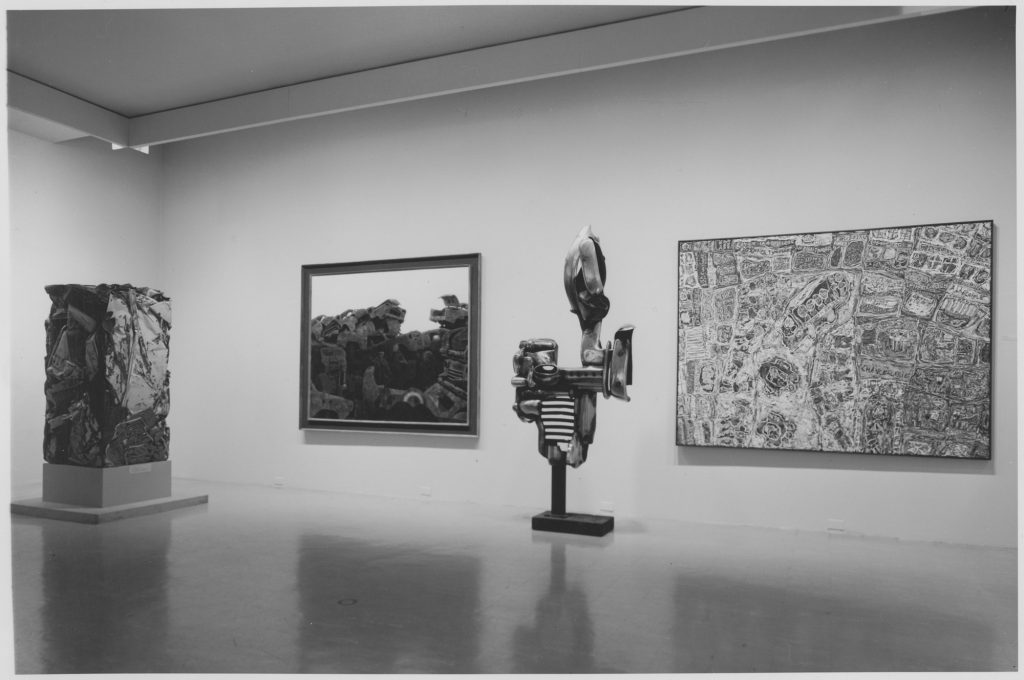
More and more, museums around the world are opening up their vast archives for free on the internet. We can browse broad collections, or dig down deep into collections and examine individual works, or we can download hi-resolution jpgs of famous works and slap them on our new desktop as wallpaper. (Discussion: does this trivialize a work or help us appreciate it?)
Indeed, OpenCulture has linked to many of these and I’ve followed. And I’ve often returned overwhelmed or disappointed, not by the art, but by bad web design. Good intentions are one thing, but institutions often turn to coders first, not designers. And there’s a difference.
Recently we told you how the Metropolitan Museum of Art has put most of its nearly 90 years of exhibitions online. Our own Colin Marshall said:
The archive offers, in the words of Chief of Archives Michelle Elligott, “free and unprecedented access to The Museum of Modern Art’s ever-evolving exhibition history” in the form of “thousands of unique and vital materials including installation photographs, out-of-print exhibition catalogues, and more, beginning with MoMA’s very first exhibition in 1929.”
Yet the interface is quite lacking, showing a blank search bar with no clue to how much lies beneath. Where to start, if you just want to browse?
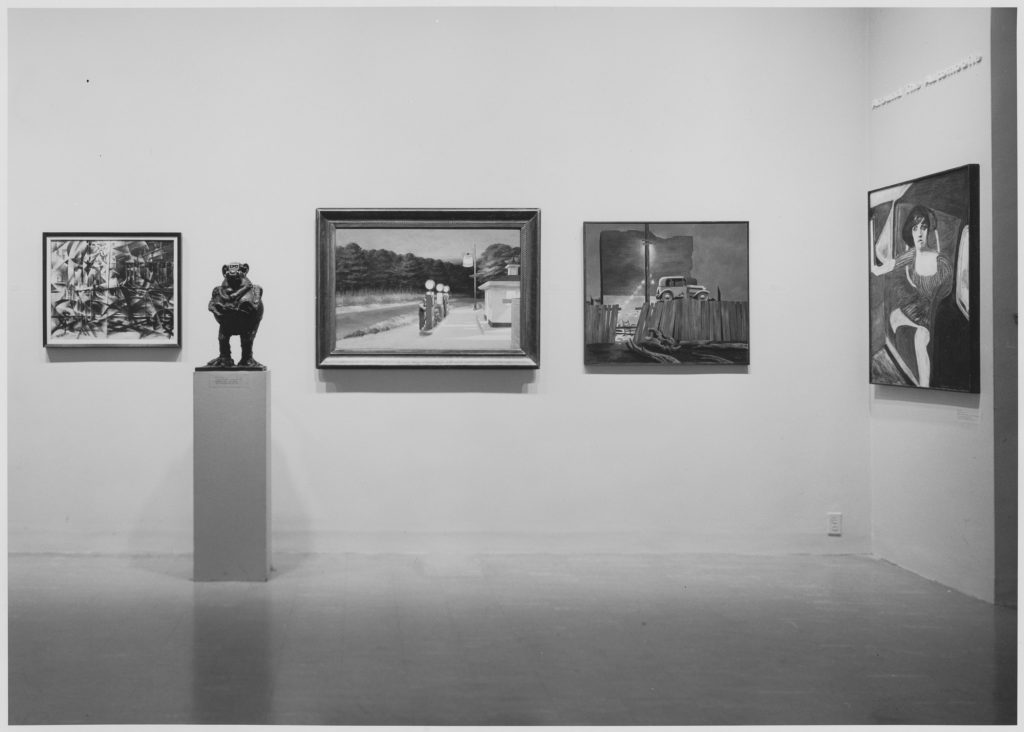
Enter the data visualization firm of Good, Form & Spectacle, who excel at presenting archives in different ways. Commissioned by MoMA to make something from the data, the firm’s “MoMA Exhibition Spelunker” offers 60 years of exhibition data that can then be searched by “curators, arrangers, designers, artists, and others” with connections available at every level.
For example, the second ever MoMA exhibit, “Painters by 19 Living Americans” (1929 — 1930), featured Edward Hopper. The official archive will show you the exhibition catalog and press release. But go spelunking and we discover that up until 1989 (the end of the archive for now), Hopper was featured in 61 exhibitions, including 1943 where he was featured in four exhibits in one year. What were those exhibits? Well, down the rabbit hole you go.
Coder (and, full disclosure, friend since high school) Phil Gyford spoke about his work on the page:
A spelunker, according to Chambers, is “a person who explores caves as a hobby” and we aimed to explore MoMA’s raw data and make it more visible and penetrable by everyone else. It’s hard to get a decent sense of the shape of lists of data so we set off to explore.
Good, Form & Spectacle have worked on other sleek and minimal sites, including a Netflix recommendation engine, a smaller spelunker for the Victoria & Albert Museum, and a larger one for the British Museum.
But if you’re interested in exploring a century of exhibitions at MoMA, then spend as much time as you like with the “MoMA Exhibition Spelunker.”
Related Content:
1.8 Million Free Works of Art from World-Class Museums: A Meta List of Great Art Available Online
Download 464 Free Art Books from The Metropolitan Museum of Art
Google Art Project Expands, Bringing 30,000 Works of Art from 151 Museums to the Web
Download 397 Free Art Catalogs from The Metropolitan Museum of Art
The Museum of Modern Art (MoMA) Puts Online 65,000 Works of Modern Art
Ted Mills is a freelance writer on the arts who currently hosts the FunkZone Podcast. You can also follow him on Twitter at @tedmills, read his other arts writing at tedmills.com and/or watch his films here.
Read More...A Sonic Introduction to Avant-Garde Music: Stream 145 Minutes of 20th Century Art Music, Including Modernism, Futurism, Dadaism & Beyond
Avant-garde composers of the 20th century have left a vexing legacy, beginning perhaps with one of the century’s first minimalists, Erik Satie (1866 –1925), whose career illustrates a central paradox of experimental music: it can seem to most of us totally inaccessible, alien, and frustrating, yet it is also a pervasive influence on the sound of our everyday life.
For example, we are likely to never encounter, much less could most of us endure, the full measure of Satie’s 1893 Vexations, a short piece “melancholic yet deadpan, ecclesiastical yet demonic, strangely lacking direction,” and meant, writes Nick Shave at The Guardian, to be “repeated 840 times.” Long thought an ironic joke, in 1963 John Cage took up the challenge and with a “relay team of pianists, including John Cale,” staged a marathon performance at the end of which only one person remained in the audience.
Then we have the Satie of Gymnopédie No.1, a moving composition we’ve heard countless times in films, television shows, dinner parties, restaurants, etc. This piece and others like it, argues WFMU’s Kenneth Goldsmith, mark the birth of Ambient music, or what Satie puckishly called Furniture Music. “Today,” Goldsmith writes, “Furniture Music is unavoidable,” and everyone from Brian Eno to Aphex Twin to “the entire Muzak phenomenon… owes a debt to The Velvet Gentleman.”
Both the accessible and difficult strains of the eccentric French composer have been equally influential, and “just about every radical musical movement” of the previous century “can trace its roots back to Satie.” As we move through the century—encountering the work of Dada artists, Futurists, symphonic modernists, and musique concrète and early electronic pioneers—we find an enormous breadth of experimentation, both strangely intimidating and often strangely familiar, given how pervasive its influence on film and “furniture” music as well as on contemporary composers.
If you’re new to the dissonant and playful innovations of artists like Satie, F.T. Marinetti, Kurt Schwitters, Arnold Schoenberg, Karlheinz Stockhausen, György Ligeti and other provocateurs and radicals of the early decades of the last century, you could hardly do worse by way of introduction than the double compilation album above from LTM Recordings. Titled A Young Person’s Guide to the Avant-Garde and consisting of 26 tracks in total, the compilation includes an excerpt of Igor Stravinsky’s scandalous—for the time—1913 The Rite of Spring, and John Cage’s perplexing 1952 work of silence, 4’33” and begins with a mercifully brief 3‑minute rendition of Satie’s Vexations. (If you need Spotify’s free software, download it here. If you have any problems playing the embedded playlist, please click on this link.)
We also have music from names we typically associate with visual art (Marcel Duchamp, Francis Picabia) and film (Jean Cocteau). And you will surely recognize the final piece, Ligeti’s “Atmospheres,” from Stanley Kubrick’s 2001: A Space Odyssey. The collection, writes The Trebuchet in their review, “subtly hints at the fact that film soundtracks are the closest thing we have to grand compositions these days, and in fact the seeds for change were planted long ago during the era when Continental artists and musicians took an interest in the emerging technologies of automobiles, planes, and film.”
Then, of course, there were emerging technologies of sound. A Young Person’s Guide (purchase a copy online here) ends with Ligeti in 1961, and only hints at the electronic avant-garde to come with a 1953 composition from Stockhausen. This is a shame, since the electronic revolution in music opened doors for so many female experimentalists like Pauline Oliveros, Daphne Oram, and Eliane Radigue. As it stands, the collection gives us an all-male lineup of artists—and one sure to provoke exclamations of “What about [insert name here]!”
It’s an understandable reaction to an ambitious but limited survey. For the amateur or “young person” just discovering this musical history, however, A Young Person’s Guide to the Avant-Garde offers a rich, compelling, and frequently confounding selection that can serve as a sturdy springboard for further study and exploration. Those so inspired to hear more can find it in the massive archive of The Avant-Garde Project.
Related Content:
The Music of Avant-Garde Composer John Cage Now Available in a Free Online Archive
Hear the Experimental Music of the Dada Movement: Avant-Garde Sounds from a Century Ago
Josh Jones is a writer and musician based in Durham, NC. Follow him at @jdmagness
Read More...Hunter S. Thompson Gets in a Gunfight with His Neighbor & Dispenses Political Wisdom: “In a Democracy, You Have to Be a Player”
What would Hunter S. Thompson, in many ways the ultimate American, have made of his country’s political scene today? Having lived, in the words of his 2005 suicide note, “17 years past 50. 17 more than I needed or wanted,” the self-styled and always uncompromising “gonzo journalist” didn’t stick around to observe much of the 21st century, and even as grimly vivid a political imagination as his could hardly have foreseen many of its developments. Yet like the longer-gone Alexis de Tocqueville, also very much a man of his own time, Thompson’s perspective on democracy in America has in some sense only grown more relevant over the years without him.
Thompson would, in life, offer this perspective on any and all occasions, including during a shootout with his neighbor. In his final decades, his biographical blurbs referenced both a love of firearms and a 42.5‑acre “fortified compound,” known as Owl Farm, in Woody Creek, Colorado.
One might assume that such a remote and secluded location would rule out the possibility of conflicts with neighbors, but Thompson’s experience (as often it did) proved an exception. In the recently released footage above, we see him exchanging gunfire with a newly arrived resident in a dispute having something to do with livestock. “If this son of a bitch wants to bitch about his cows over here and shoot at me, well… it’s our country. It’s not theirs. It’s not a bunch of used car dealers from southern California.”
No matter how impulsive or reckless it might seem, Thompson’s behavior arose organically, from a foundational political philosophy. “The people who did this Declaration of Independence and the Constitution were, uh, good people,” he says in voiceover as we watch him assume a combat stance and fire off a few rounds. “And it’s a good place. Here we are in the middle of it, up on the mountain,” from his perch on which he came to see himself as a kind of ultra-libertarian defender of the mission of the Founding Fathers, or at least the mission of the Founding Fathers as he interpreted it. The author of Fear and Loathing in Las Vegas ends by reminding Americans of something they tend to forget until plunged into one crisis or another: “In a democracy, you have to be a player.”
Related Content:
Hunter S. Thompson Sets His Christmas Tree on Fire, Nearly Burns His House Down (1990)
Playing Golf on LSD With Hunter S. Thompson: Esquire Editor Remembers the Oddest Game of Golf
Hunter S. Thompson’s Harrowing, Chemical-Filled Daily Routine
Hunter S. Thompson, Existentialist Life Coach, Gives Tips for Finding Meaning in Life
Read 10 Free Articles by Hunter S. Thompson That Span His Gonzo Journalist Career (1965–2005)
Based in Seoul, Colin Marshall writes and broadcasts on cities and culture. He’s at work on a book about Los Angeles, A Los Angeles Primer, the video series The City in Cinema, the crowdfunded journalism project Where Is the City of the Future?, and the Los Angeles Review of Books’ Korea Blog. Follow him on Twitter at @colinmarshall or on Facebook.
Read More...The Metropolitan Museum of Art Makes 375,000 Images of Fine Art Available Under a Creative Commons License: Download, Use & Remix
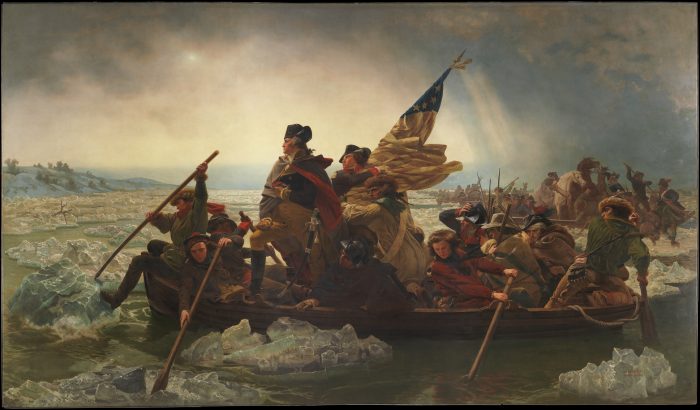
What do you need to make art? Why, art, of course: the works that have come before provide inspiration, establish a tradition to follow and expand, and now, in our digital age, even provide the very materials to work with. The Metropolitan Museum of Art has assured us that we should feel free to “use, remix, and share” their latest batch of 375,000 digitized artworks of a variety of forms and from a variety of eras in any which way we like. In partnership with Creative Commons, they’ve released them all under the latter’s CC0, or “no rights reserved” license, which places them “as completely as possible in the public domain, so that others may freely build upon, enhance and reuse the works for any purposes without restriction under copyright or database law.”
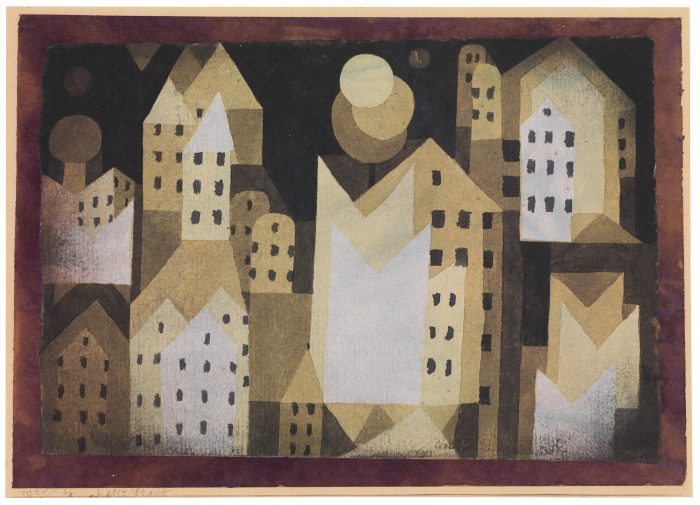
But featuring these sorts of projects often here on Open Culture, we know that a trove of art images, no matter how open, is only as good as its search tools. A new search tool comes newly developed by Creative Commons, and in fact they still describe it as “in beta,” but it shows promise as a means to, as promoted, “explore this beautiful collection, create content lists, share, collaborate, and learn.” You can get started using it here, but if you want to focus specifically on the contents of the Metropolitan Museum of Art collection, make sure to uncheck the other search options, which include the New York Public Library and the Rijksmuseum. Or you can first have a look at three curated galleries, one of masterpiece paintings, one of Impressionism and Post-Impressionism, and one “cabal of cats from the Met’s cabinets, compiled by the curious curators of the collection.”
You can also assemble and share galleries of your own, in just the way you might on other image-oriented social-media sites such as Pinterest, which, along with Wikimedia, Artstor, and the Digital Public Library of America, also calls itself a partner in the Met’s broader Open Access Initiative, and which offers its own users the ability to search this digital collection. (The Met has also created a public GitHub repository.) And given the ever-expanding breadth of the artworks already digitized and made free, you’ll surely find many you’re interested in — but its real revolutionary appeal lies in what you’ll find, and what you’ll do with, the art you don’t know you’re interested in yet.
Related Content:
1.8 Million Free Works of Art from World-Class Museums: A Meta List of Great Art Available Online
The Metropolitan Museum of Art Puts 400,000 High-Res Images Online & Makes Them Free to Use
Download 464 Free Art Books from The Metropolitan Museum of Art
Download Hundreds of Free Art Catalogs from The Metropolitan Museum of Art
Download Over 250 Free Art Books From the Getty Museum
LA County Museum Makes 20,000 Artistic Images Available for Free Download
Download 100,000 Free Art Images in High-Resolution from The Getty
Based in Seoul, Colin Marshall writes and broadcasts on cities and culture. He’s at work on a book about Los Angeles, A Los Angeles Primer, the video series The City in Cinema, the crowdfunded journalism project Where Is the City of the Future?, and the Los Angeles Review of Books’ Korea Blog. Follow him on Twitter at @colinmarshall or on Facebook.
Read More...Did Plato’s Republic Predict the Rise of Donald Trump?: A Chilling Animated Video Narrated by Andrew Sullivan
We stand, perhaps, at the threshold of the singularity, that great event when machine intelligence overtakes our own. The writhing of late capitalism may in fact be the death throes of Western modernity and, for both good and ill, much of its Enlightenment legacy. Institutions like the press and the polling industry have stumbled badly. No amount of denialism will stop the climate crisis. Something entirely new seems poised for its emergence into the world, though what it might be no one seems fully equipped to say. Why, then, should we look back to Plato to explain our epoch, a philosopher who had no familiarity with modern weaponry, artificial intelligence, or information systems?
Perhaps a better question is: do we and should we still value the contributions of European philosophy in contemporary life? If so, then we must allow that Plato may be perpetually relevant to learned discourse. Alfred North Whitehead famously characterized “the European philosophical tradition” as “a series of footnotes to Plato.” Suggesting his agreement with the sentiment, Massimo Pigliucci titled his regular column at The Philosopher’s Magazine, “Footnotes to Plato.” Though he did not invent his mode of inquiry, and often got it very wrong, Plato, he writes, “is a towering figure for an entire way of thinking about fundamental questions.”
There may be few questions more fundamental than those we now ask in the U.S. about tyranny, its origins and remedy—about how we arrived at where we are and what ethical and practical matters lie in the hands of the citizenry. These questions were central to the thought of Socrates, Plato’s mentor and primary character in his dialogues, who had some surprisingly contrarian ideas on the matter in The Republic. Here, as Andrew Sullivan tells us in the BBC Newsnight video above, Socrates theorizes that “Tyranny is probably established out of no other regime than democracy.”
The statement shocks us, but it also ran counter to the Athenian sentiments of Plato’s day. The picture Socrates paints of democracy’s ills finds its echo in the contemporary conservative’s worldview, but we should point out that Sullivan misrepresents the text he reads as one continuous passage, when it is actually a series of excerpted quotations. And as always, we should be careful not to try and see our own partisan divides in ancient thought. Socrates also had many other things to say the modern right finds truly objectionable.
The problem with democracy, Socrates thought, was too much freedom. Its “freedoms multiply,” he says,
until it becomes a many-colored clock decorated in all hues. Men are interchangeable with women, and all their natural differences forgotten. Animals have rights. Foreigners can come and work just like citizens. Children boss their parents around. Teachers are afraid of their students. The rich try to look just like the poor.
Soon every kind of inequality is despised. The wealthy are particularly loathed. And elites in general are treated as suspect, perpetuating inequality and representing injustice.
Under such presumably decadent conditions, “a would-be tyrant would seize his moment”:
He is usually of the elite but is in tune with the time. Given over to random pleasures and whims. Feasting on food, and especially sex.
He makes his move by taking over a particularly obedient mob, and attacking his wealthy peers as corrupt. He is a traitor to his class, and soon his elite enemies find a way to appease him or are forced to flee.
Eventually he stands alone, offering the addled, distracted, self-indulgent citizens a kind of relief from democracy’s endless choices and insecurities.
He rides a backlash to success. Too much freedom seems to change into nothing but too much slavery. He offers himself as the personified answer to all problems. To replace the elites, and rule alone on behalf of the masses. And as the people thrill to him as a kind of solution, a democracy willingly, impetuously, repeals itself.
The grim, dramatic animated video that accompanies Sullivan’s narration of this chillingly prescient ancient text is not subtle about the modern parallels. We can heartily debate the diagnosis of “too much freedom” as the cause of democracy’s yielding to tyranny. But whatever democracy’s failings, the effects Plato describes above are as evident today as they were almost 2300 years ago, though we may flatter ourselves in thinking that the mechanics of our political systems have evolved since then. In any case, our technological evolution means that unlike in Plato’s day, the rise of a tyrant like Donald Trump, as Sullivan wrote last year, may be “an extinction-level event.”
Related Content:
Introduction to Political Philosophy: A Free Yale Course
Philosophy Bites: Podcasting Ideas From Plato to Singularity Since 2007
Josh Jones is a writer and musician based in Durham, NC. Follow him at @jdmagness
Read More...Introduction to Political Philosophy: A Free Yale Course
Taught by professor Steven B. Smith, this course from Yale University offers an Introduction to Political Philosophy, and covers the following ground:
This course is intended as an introduction to political philosophy as seen through an examination of some of the major texts and thinkers of the Western political tradition. Three broad themes that are central to understanding political life are focused upon: the polis experience (Plato, Aristotle), the sovereign state (Machiavelli, Hobbes), constitutional government (Locke), and democracy (Rousseau, Tocqueville). The way in which different political philosophies have given expression to various forms of political institutions and our ways of life are examined throughout the course.
You can watch the 24 lectures from the course above, or find them on YouTube. To get more information on the course, including the syllabus, visit this Yale website.
The main texts used in this course include the following. You can find them in our collection of Free eBooks.
- Plato, Trial and Death of Socrates
- Plato, Republic
- Aristotle, Politics
- Machiavelli, The Prince
- Thomas Hobbes, Leviathan
- John Locke, Second Treatise of Government
- Jean-Jacques Rousseau, Political Writings
- Alexis de Tocqueville, Democracy in America
Introduction to Political Philosophy will be added to our collection, 1,700 Free Online Courses from Top Universities. There you can find a specialized list of Free Online Philosophy Courses.
If you would like to support the mission of Open Culture, consider making a donation to our site. It’s hard to rely 100% on ads, and your contributions will help us continue providing the best free cultural and educational materials to learners everywhere. You can contribute through PayPal, Patreon, and Venmo (@openculture). Thanks!
Read More...Support Us
We're hoping to rely on loyal readers, rather than erratic ads. Please click the Donate button and support Open Culture. You can use Paypal, Venmo, Patreon, even Crypto! We thank you!

About Us

Open Culture scours the web for the best educational media. We find the free courses and audio books you need, the language lessons & educational videos you want, and plenty of enlightenment in between.
Advertise With Us

FREE UPDATES!
GET OUR DAILY EMAIL
Get the best cultural and educational resources on the web curated for you in a daily email. We never spam. Unsubscribe at any time.
FOLLOW ON SOCIAL MEDIA

Open Culture editor Dan Colman scours the web for the best educational media. He finds the free courses and audio books you need, the language lessons & movies you want, and plenty of enlightenment in between.
Advertise With Us

