An Introduction to the Life & Thought of Hannah Arendt: Presented by the BBC Radio’s In Our Time
Unsettling historical parallels between the newly-developing world order and the terrors that scourged Europe in the 1930s and 40s now seem undeniable to most informed observers of contemporary geopolitics. Europeans have their own political crises to weather, but all eyes currently seem trained on the military behemoth that is my own country. “These are not normal times,” admits Jane Chong at Lawfare. Though she critiques Nazi comparisons as needlessly alarmist, she “sees no reason for optimism.” While references to history’s greatest villain abound, we’ve also seen Australian scientist Alan Finkel compare the U.S. leader to Joseph Stalin for the suppression and censorship of environmental data.
The devastation Hitler and Stalin visited upon Western and Eastern Europe can hardly be overstated—and we still find it nearly impossible to comprehend. But not soon after the end of World War II, one of the 20th century’s most probing analysts of political thought attempted to do just that.
Hannah Arendt’s 1951 The Origins of Totalitarianism remains one of “several seminal works on tyranny and oppression that have recently gained popularity among readers,” notes Alison Griswold at Quartz. And Arendt’s 1963 classic Eichmann in Jerusalem also continues to inform the moment, offering a “sobering reflection,” writes Maria Popova, on what Arendt called “the fearsome, word-and-thought-defying banality of evil.”
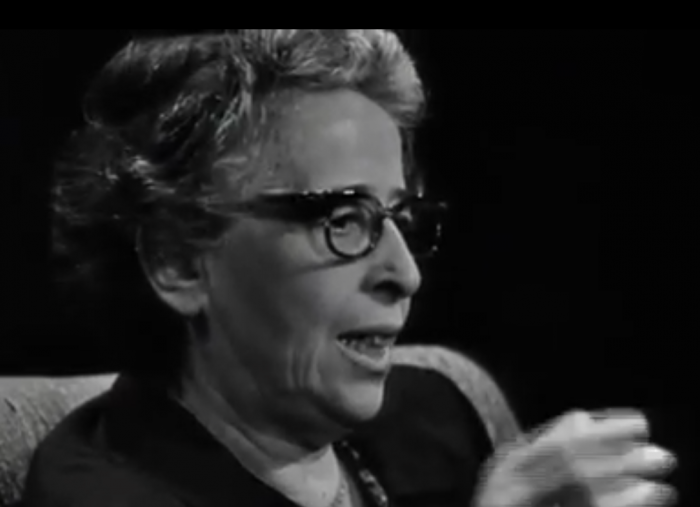
Arendt’s renewed relevance recently prompted Melvyn Bragg, host of the excellent BBC Radio program In Our Time, to bring three guest philosophy professors—Robert Eaglestone, Frisbee Sheffield, and Lyndsey Stonebridge—on air to discuss her ideas and influence. Bragg begins with a brief outline of Arendt’s biography, then turns to Sheffield, a lecturer at Girton College, Cambridge, for elaboration. They immediately address one of the most controversial aspects of Arendt’s young life, her affair with her mentor, Martin Heidegger, who joined the Nazi party and remained a true believer in its ideology.
But the conversation quickly moves on from there to encompass Arendt’s multi-dimensional thought. “There’s a great range to her writings,” says Sheffield. A trained classicist, Arendt wrote her dissertation on the idea of love in St. Augustine. Her most philosophical work, The Human Condition, drew on classical concepts to rank human activity into a hierarchy of labor, work, and action. She “wrote on a great range of topics,” Sheffield notes, though “there is a consistent interest in politics and political themes throughout her work.”
Yet Arendt rejected the label of political philosopher and is herself “hard to pin down” politically. Her 1963 book On Revolution, critiqued leftist and Marxist thought and praised the American Revolution for its constitutionalism. She was skeptical of the notion of universal human rights, and her essay On Violence made the argument that violence appears only in the absence of political power, not its ascendency. As we learn from listening to Bragg’s assembled panel of guests, Arendt consistently emphasized two classical concepts: the value of a civic and political order and the importance of the “life of the mind,” also the title of a two-volume work published posthumously in 1978.
In Our Time’s short, lively conversation provides an excellent introduction to Arendt’s life and work. To dive more deeply into the Arendt corpus, visit Bard College’s Hannah Arendt Center for Politics and Humanities, browse the Library of Congress’s Hannah Arendt Papers, and read Lyndsey Stonebridge’s short online essay “Hannah Arendt’s Refugee History.” You’ll also find an extensive reading list of primary and secondary sources at the In Our Time BBC page.
Related Content:
Hannah Arendt Discusses Philosophy, Politics & Eichmann in Rare 1964 TV Interview
Hannah Arendt’s Original Articles on “the Banality of Evil” in the New Yorker Archive
Josh Jones is a writer and musician based in Durham, NC. Follow him at @jdmagness
Read More...Free Coloring Books from World-Class Libraries & Museums: The Met, New York Public Library, Smithsonian & More
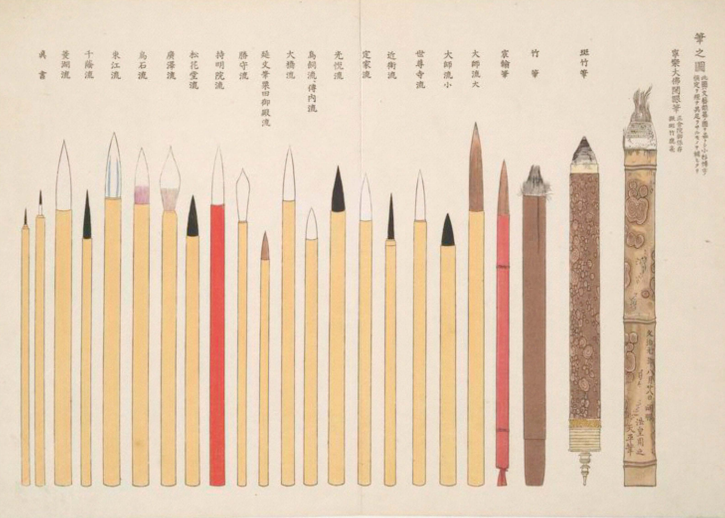
Calling all coloring book lovers. You can now take part in #ColorOurCollections 2017–a campaign where museums and libraries worldwide will make available free coloring books, letting you color artwork from their collections and then share it on Twitter and other social media platforms. When sharing, use the hashtag #ColorOurCollections.
Below you can find a collection of free coloring books, which you can download and continue to enjoy. If you see any that we’re missing, please let us know in the comments, and we’ll do our best to update the page. To see the free coloring books that were offered up in 2016, click here.
Color Our Collections is organized by The New York Academy of Medicine Library. So please give them thanks.
- New York Academy of Medicine
- The New York Botanical Garden Coloring Book
- The New York Public Library Coloring Book
- Smithsonian Libraries Coloring Book
- Cambridge University Library Coloring Book
- Chemical Heritage Foundation Coloring Book
- The Metropolitan Museum of Art Coloring Book
- Newberry Library Coloring Book
- American Bookbinders Museum Coloring Book
- Auraria Library Coloring Book
- Bibliothèque interuniversitaire de Santé, Paris Coloring Book
- Biodiversity Heritage Library Coloring Book Part 1
- Biodiversity Heritage Library Coloring Book Part 2
- Biodiversity Heritage Library Coloring Book Part 3
- Biodiversity Heritage Library Coloring Book Part 4
- Biodiversity Heritage Library Coloring Book Part 5
- Bodleian Library at Oxford University
- Brooklyn Public Library, Brooklyn Collection Coloring Sheets
- Dittrick Medical History Center Coloring Book
- Digital Library@Villanova University Coloring Books
- Digita Vaticana Coloring Book
- Europeana Art Nouveau Color Book
- Europeana Colouring Book
- Frances Willard Memorial Library and Archives Coloring Sheet
- Health Sciences Library, University of North Carolina at Chapel Hill Coloring Book
- Hunter College Libraries – City University of New York Coloring Book
- The Huntington Library, Art Collections, and Botanical Gardens
- James Madison University Libraries Coloring Book
- Marian Library, University of Dayton
- National Library of Medicine Coloring Book
- National Museum Wales Coloring Book
- New York Academy of Medicine Famous Women Coloring Sheet
- OHSU Historical Collections & Archives Coloring Sheets
- Royal College of Physicians
- Special Collections and Archives, Trexler Library, Muhlenberg College Coloring Books
- The Rosenbach Coloring Sheets
- University of Calgary Libraries and Cultural Resources
- University of Houston Special Collections Coloring Book
- University of Oregon Coloring Book
- University of Scranton Archives and McHugh Special Collections Coloring Book
- University of Puget Sound, Collins Memorial Library, Archives & Special Collections Coloring Book
- University of Reading Museums and Collections Coloring Book
- Wangensteen Historical Library of Biology and Medicine, University of Minnesota Libraries
- Williams College Libraries Coloring Sheets
Looking for free, professionally-read audio books from Audible.com? Here’s a great, no-strings-attached deal. If you start a 30 day free trial with Audible.com, you can download two free audio books of your choice. Get more details on the offer here.
If you would like to support the mission of Open Culture, consider making a donation to our site. It’s hard to rely 100% on ads, and your contributions will help us continue providing the best free cultural and educational materials to learners everywhere. You can contribute through PayPal, Patreon, and Venmo (@openculture). Thanks!
Related Content:
The First Adult Coloring Book: See the Subversive Executive Coloring Book From 1961
Download 15,000+ Free Golden Age Comics from the Digital Comic Museum
Dr. Seuss Draws Anti-Japanese Cartoons During WWII, Then Atones with Horton Hears a Who!
Read More...Bruce Springsteen and the E Street Band Improvises and Plays, Completely Unrehearsed, Chuck Berry’s “You Never Can Tell,” Live Onstage (2013)
Most musicians have little chance of achieving lasting wealth and fame. It’s a profession in which only a tiny percentage of people ever “make it”—at least according to the impossibly high standards of celebrity we tend to apply. So why do people stick with it, year after year, through health scares, financial crises, and all the other grown-up hardships that kill many a childhood dream?
We often morbidly focus on rock and roll casualties. Look, however, at the stars who do survive the business decade after decade. Though music may not stave off aging, it clearly has the power to preserve youthful enthusiasm long into what some still call retirement years. The examples are too numerous to list; we could hardly do better than to look at the late career of Bruce Springsteen.
Like many of his generation, Springsteen was turned on to rock and roll by seeing Elvis, then later the Beatles, on The Ed Sullivan Show. And like budding musicians still today, he received his first guitar at 16 as a gift from his mother. (He later wrote a song about it.) Over 50 years later, he’s still got the wide-eyed wonder of his sixteen-year-old self. Or at least he’s willing to take teenage risks, pulling out one song every night during a recent tour with the E Street Band “that we haven’t played since we were, I don’t know, sixteen, or maybe never.”
It takes a youthful degree of fearlessness—or recklessness—to stand on stage in front of thousands of fans and play a totally unrehearsed tune, especially one as wordy and finely-tuned as Chuck Berry’s “You Never Can Tell.” We know Bruce and the band have chops, so watching them run through a few different keys before they dig in doesn’t produce too much anxiety. Nonetheless, their ability to throw themselves into the total unknown, just for fun, makes the performance seem like the kind of stunt most of us only attempt before we’re taught to settle into much more predictable grown-up routines.
How well do they pull off the Berry classic on the spot and unrehearsed? See for yourself, and then compare it to the eternally youthful man himself, who at 90 years of age will soon release his first new album in 38 years.
Related Content:
Josh Jones is a writer and musician based in Durham, NC. Follow him at @jdmagness
Read More...How to Respond to the Challenges of Our Time?: Jazz Legends Herbie Hancock & Wayne Shorter Give 10 Pieces of Advice to Young Artists, and Everyone Else
Some moments in history strike us as dramatic ruptures. Certainties are superseded, thrown into chaos by a seismic event, and we find ourselves adrift and anxious. What are artists to do? Gripped by the same fears as everyone else, the same sense of urgency, writers, musicians, filmmakers, painters, etc. may find themselves unable to “breathe with unconditional breath / the unconditioned air,” as Wendell Berry once described the creative process.
We might remember the radical break with tradition when the shocking carnage of World War I sent poets and painters into frightening places they had previously left unexplored. Virginia Woolf summed up the situation in her essay The Leaning Tower: “suddenly like a chasm in a smooth road, the [Great] war came.” Shattered as they were, her generation overcame their paralysis. Modernists of the early 20th century were able to speak to their broken age in ways that continue to speak to ours.
But we should temper our belief that bad times make good art by noting that the most visionary creative minds are not simply reactive, responding to tragedy like reporters on a crime scene. As Wayne Shorter and Herbie Hancock— two of the 20th century’s most consistently innovative musicians—suggest, artists at all times need a set of guiding principles. (See the two play “Memory of Enchantment” above in 2002.) There is always a lot of personal work to do. And in “turbulent and unpredictable times,” the two jazz greats advise, “the answer to peace is simple; it begins with you.”
A platitude, perhaps, but one they illustrated nearly a year ago in an open letter at Nest HQ with some profound, if challenging, prescriptions for our present cultural illnesses. Shorter and Hancock’s counsel is not a reaction to the rupture of the presidential election, but a response to the events that preceded it, “the horror at the Bataclan… the upheaval in Syria and the senseless bloodshed in San Bernardino.” Not passively waiting to find out where the past few years’ violence and unrest would lead, the two have made ethical, philosophical, and spiritual interventions, presenting their philosophy and ethics through jazz, Buddhism, science, art, and literature.
Below, you can read their ten pieces of advice “to the next generation of artists,” or at least excerpts thereof. They begin with a reassuring preface: “As an artist, creator and dreamer of this world, we ask you not to be discouraged by what you see but to use your own lives, and by extension your art, as vehicles for the construction of peace…. You matter, your actions matter, your art matters.” That said, they also want to assure readers that “these thoughts transcend professional boundaries and apply to all people, regardless of profession.”
First, awaken to your humanity
You cannot hide behind a profession or instrument; you have to be human. Focus your energy on becoming the best human you can be. Focus on developing empathy and compassion. Through the process you’ll tap into a wealth of inspiration rooted in the complexity and curiosity of what it means to simply exist on this planet.
Embrace and conquer the road less traveled
Don’t allow yourself to be hijacked by common rhetoric, or false beliefs and illusions about how life should be lived. It’s up to you to be the pioneers.
Welcome to the Unknown
Every relationship, obstacle, interaction, etc. is a rehearsal for the next adventure in life. Everything is connected. Everything builds. Nothing is ever wasted. This type of thinking requires courage. Be courageous and do not lose your sense of exhilaration and reverence for this wonderful world around you.
Understand the True Nature of Obstacles
We have this idea of failure, but it’s not real; it’s an illusion. There is no such thing as failure. What you perceive as failure is really a new opportunity, a new hand of cards, or a new canvas to create upon.
Don’t Be Afraid to Interact with Those Who Are Different from You
The world needs more one-on-one interaction among people of diverse origins with a greater emphasis on art, culture and education. Our differences are what we have in common…. We need to be connecting with one another, learning about one another, and experiencing life with one another. We can never have peace if we cannot understand the pain in each other’s hearts.
Strive to Create Agenda-Free Dialogue
Art in any form is a medium for dialogue, which is a powerful tool… we’re talking about reflecting and challenging the fears, which prevent us from discovering our unlimited access to the courage inherent in us all.
Be Wary of Ego
Creativity cannot flow when only the ego is served.
Work Towards a Business without Borders
The medical field has an organization called Doctors Without Borders. This lofty effort can serve as a model for transcending the limitations and strategies of old business formulas which are designed to perpetuate old systems in the guise of new ones.
Appreciate the Generation that Walked Before You
Your elders can help you. They are a source of wealth in the form of wisdom…. Don’t waste time repeating their mistakes.
Lastly, We Hope that You Live in a State of Constant Wonder
As we accumulate years, parts of our imagination tend to dull. Whether from sadness, prolonged struggle, or social conditioning, somewhere along the way people forget how to tap into the inherent magic that exists within our minds. Don’t let that part of your imagination fade away.
Whether you’re a jazz fan, musician, artist, writer, accountant, cashier, trucker, teacher, or whatever, I can’t think of a wiser set of guidelines with which to confront the suffocating epidemic of cynicism, delusional thinking, rampant bigotry, hatred, and self-absorption of our time. Read Shorter and Hancock’s full open letter at Nest HQ.
Related Content:
Josh Jones is a writer and musician based in Durham, NC. Follow him at @jdmagness
Read More...Discover the 1126 Books in John Cage’s Personal Library: Foucault, Joyce, Wittgenstein, Virginia Woolf, Buckminster Fuller & More
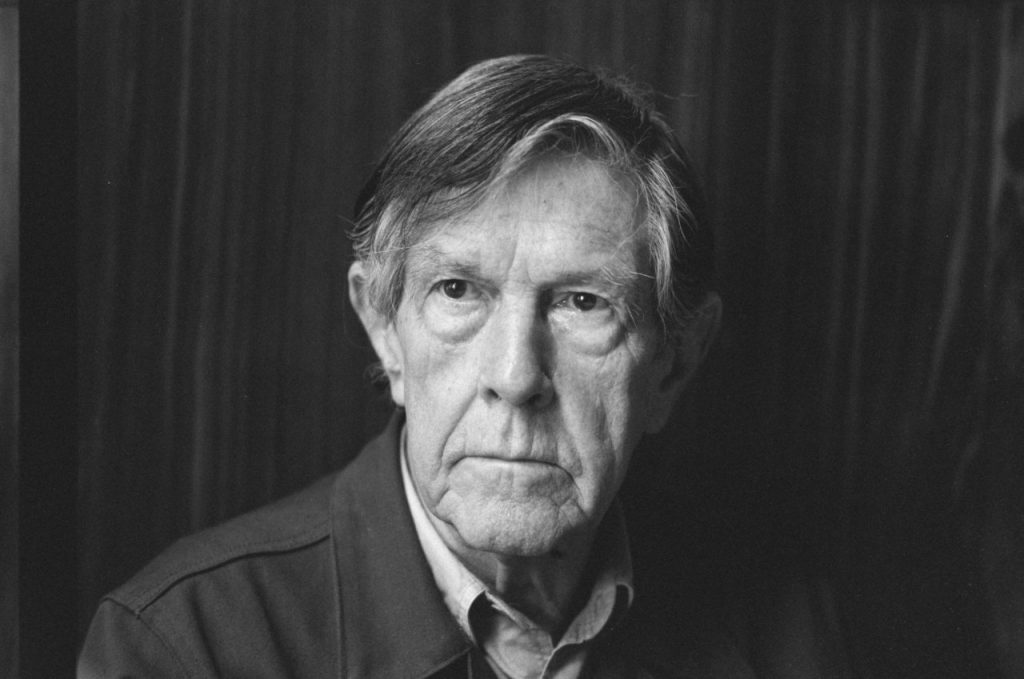
Image by or Rob Bogaerts/Fotocollectie Anefo
To properly honor your cultural role models, don’t try to do what they did, or even to think what they thought, but to think how they thought. This goes at least double for John Cage, the experimental composer whose innovative works can be, and often are, re-staged (go on, have four minutes and 33 seconds of silence to yourself), but it takes a different kind of effort altogether to cultivate the kind of mind that would come up with them in the first place. As a means of activating your own inner Cageness, you could do much worse than read through his personal library, a list of whose books you’ll find at johncage.org.
The volumes number 1126 in total, and if you load the library’s main page, it will present you with a list of ten randomly selected books. (You can get a list of all of them by selecting the “See Entire Library” option on the left sidebar.)
Hitting refresh a few times will give you a sense of the breadth of Cage’s reading: Emma Goldman on anarchism, Chinese poetry gathered by Kenneth Rexroth, M. Conrad Hyers’ Zen and the Comic Spirit (two of Cage’s driving forces if ever I’ve heard them), How to Play Backgammon, essays on Ulysses (an interest shared with Marilyn Monroe), and even essays on John Cage. Here we’ve assembled a list of ten books from Cage’s library of particular interest to the Open Culture reader:
- Fundamentals of Music Composition by Arnold Schoenberg
- Education Automation: Freeing the Scholar to Return to His Studies by R. Buckminster Fuller
-
Aveline Kushi’s Complete Guide to Macrobiotic Cooking by Aveline Kushi
-
A Skeleton Key to Finnegans Wake by Joseph Campbell and Henry Morton Robinson
- The Virginia Woolf Poems edited by Jackson Mac Low
- Alice in Wonderland & Through the Looking Glass by Lewis Carroll
- Philosophical Investigations by Ludwig Wittgenstein
- An Introduction to Metaphysics by Martin Heidegger
- The Narrow Road to the Deep North and Other Travel Sketches by Matsuo Basho
- The Poetics of Indeterminacy: Rimbaud to Cage by Marjorie Perloff
- Dubliners by James Joyce
- The Notebooks of Leonardo Da Vinci by Leonard Da Vinci
- The Order of Things: An Archaeology of the Human Sciences by Michel Foucault
To those who know anything of Cage’s life and interests, his shelves on healthy eating—on which Dining Naturally in Japan: A Restaurant Guide to Wholesome Food also appears, as, naturally given the era and Cage’s acquired northern-Californianness, The Tassajara Bread Book—and especially the eating of mushrooms, come as no surprise, nor might his inclination toward philosophy. But we should note what looks like a particular fascination with the work of Ludwig Wittgenstein, evidenced by 22 of the books in his library: his best-known works like the Tractatus Logico-Philosophicus, but also his letters, lectures, and notebooks, as well as biographies, commentaries, and Wittgenstein and Buddhism, which Cage must have considered an exciting find indeed.
In one of his most quotable quotes, Cage describes college as “two hundred people reading the same book. An obvious mistake. Two hundred people can read two hundred books.” And indeed, 1126 people can read 1126 books—or many more people can each read a different subset of those books. While you could methodically read your way through Cage’s entire library, and would surely learn a great deal in the process, wouldn’t making use of the unthinking guidance of the ten-random-books function, surrendering the direction of this informal education to the kind of chance that places Paul Bowles next to the common fungi of North American and Charles Ives next to Italian futurism, be a much more Cagean way of going about it?
(h/t @lrlarson)
Related Content:
The Music of Avant-Garde Composer John Cage Now Available in a Free Online Archive
John Cage Unbound: A New Digital Archive Presented by The New York Public Library
Jorge Luis Borges Selects 74 Books for Your Personal Library
The 430 Books in Marilyn Monroe’s Library: How Many Have You Read?
Darwin’s Personal Library Goes Digital: 330 Books Online
Based in Seoul, Colin Marshall writes and broadcasts on cities and culture. He’s at work on a book about Los Angeles, A Los Angeles Primer, the video series The City in Cinema, the crowdfunded journalism project Where Is the City of the Future?, and the Los Angeles Review of Books’ Korea Blog. Follow him on Twitter at @colinmarshall or on Facebook.
Read More...Hear a 4 Hour Playlist of Great Protest Songs: Bob Dylan, Nina Simone, Bob Marley, Public Enemy, Billy Bragg & More
When I was growing up, protest music meant Public Enemy, Rage Against the Machine, and—for some few Americans and very many Brits—Billy Bragg: an artist “at home with both socialist politics and heartbreak,” writes Allmusic, “styled on the solo attack of early Dylan and the passion of the Clash.” Known for his pro-labor, anti-Thatcher, anti-war, pro “Sexuality” stances, Bragg has been a stalwart campaigner for peace and justice since the 1980s.
A veteran activist who made appearances at Occupy Wall Street and the recent Women’s March in London, Bragg lately lamented the state of protest music. “Look at what’s happening in the world,” he told The Guardian in 2011, “When I was first plying my trade, people were willing to talk about these issues. Now they’d rather write about getting blasted than changing the world.”
Much has changed since 2011, I don’t need to tell you. And the protest song has returned, from Anohni’s beautiful, haunting 2016 album Hopeless (see “Drone Bomb Me” above) to Pussy Riot’s frighteningly prescient “Make America Great Again,” released just before the election. We’ve heard it said that “protest songs are pointless,” but they’ve carried many a movement through many a seemingly hopeless moment. Bragg himself, still plying his trade, rewrote the lyrics to Bob Dylan’s classic “The Times They Are A‑Changing” as “The Times They Are A‑Changing Back” (at the top), just thirty minutes after the inaugural speech, and “with apologies” to Dylan.
Bragg clearly has deep roots in the genre, but are Anohni and Pussy Riot’s melodic provocations protest music? What about the empowering anthems of Beyoncé or the poetic ruminations of Solange? Just what makes a protest song? Every generation will have their own criteria, and their own pantheon of political artists. Whether you look back to the wry folk songs of Woody Guthrie, to the Golden Age of Dylan, Odetta, Joan Baez, and Pete Seeger; to the Beatles or Neil Young; or to punk rock, hip-hop, reggae, or the funk soul of Marvin Gaye, you will find a few favorites on the Spotify playlist above. It features 58 tracks and runs about 4 hours and 15 minutes. If you want a direct link to the playlist, click here. If you need Spotify’s software, please download it here.
To produce the playlist, we culled through best-of lists from Radio X, Rolling Stone, Amnesty International, the Rock and Roll Hall of Fame, the Council on Foreign Relations, and the blog Music to Die For, who in 2007 created some strict definitions of a protest song:
– A piece of music that is a great song in its own right. Good words and fine sentiments are not enough. The music must move us.
– A song that has a purpose. A song that doesn’t confine itself to commenting on or bemoaning the ills of the world, but seeks in some small way to change things. It may do this by calling directly for something to happen – “free Nelson Mandela”, by informing us, by appealing to our hearts and our emotions, or by challenging commonly held ideas.
– It follows from this that a true protest song should address a specific issue or issues that are current. Songs about wars and revolutions in days long gone are not included here.
– Finally the song should provoke the listener : shock us, unsettle us, amaze us, inspire us, make us angry, make us sad or make us optimistic. If it doesn’t do any of these things, it hardly deserves to be called a protest song. So be warned : there’s a lot of anger and a lot of emotion in these songs.
I’ll admit, I take issue with some of these criteria—I’d argue, for example, that Black Sabbath’s “War Pigs” is a timeless protest song that doesn’t reference any specific event or offer a solution (except “judgment day”). But you are free to disagree. Some of the songs on our playlist came from reader suggestions. We’d love to hear some others. What would you add to the list? And how do you define a “protest song”? Feel free to add your thoughts and suggestions in the comments section below.
Related Content:
Bed Peace Revisits John Lennon & Yoko Ono’s Famous Anti-Vietnam Protests
Josh Jones is a writer and musician based in Durham, NC. Follow him at @jdmagness
Read More...1950s Batman Cartoon Tells Kids: “Don’t Believe Those Crackpot Lies About People Who Worship Differently”
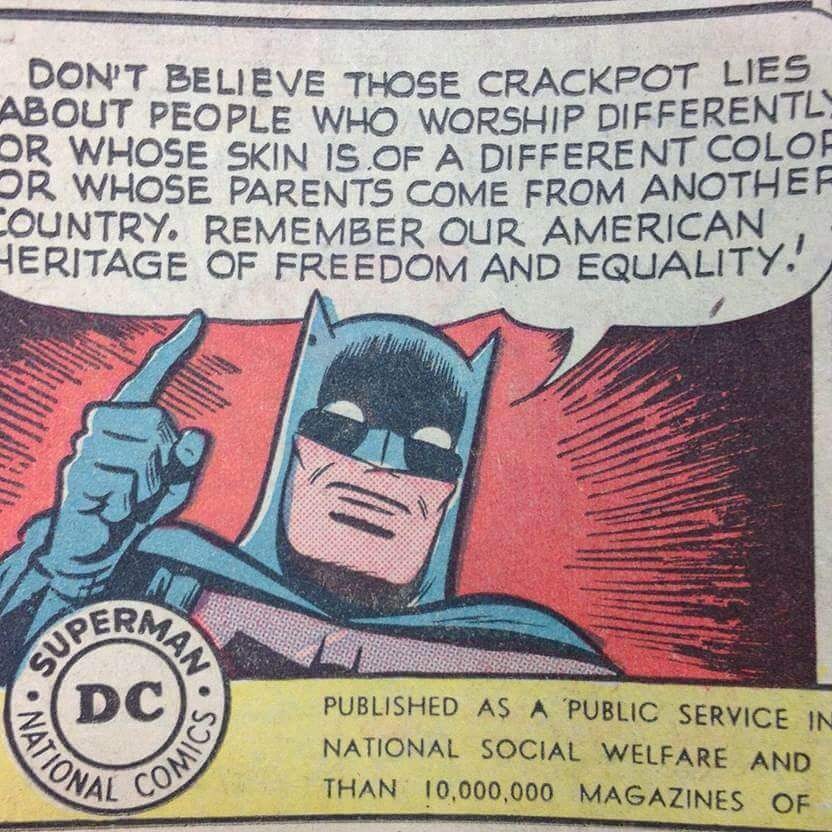
“Don’t believe those crackpot lies about people who worship differently, or whose skin is of a different color, or whose parents come from another country. Remember our American heritage of freedom and equality!”
Blow the dust off the vintage 1950s Public Service Announcement (PSA) from Batman.
Back during the Eisenhower era, refugees from World War II didn’t exactly get a warm reception in the United States. And so the forces of good, DC Comics, created some PSAs designed to encourage kids to treat new citizens with kindness and understanding. You can see one frame from a larger cartoon above. The makers of Superman cartoon also created their own tolerance poster. Check it out here. And hopefully you’ll help spread the same message today.
Related Content
Batman Stars in an Unusual Cartoon Adaptation of Dostoyevsky’s Crime and Punishment
The Evolution of Batman in Cinema: From 1939 to Present
Read More...Kraftwerk Plays a Live 40-Minute Version of their Signature Song “Autobahn:” A Soundtrack for a Long Road Trip (1974)
“The joys of motoring are more or less fictional,” wrote Zelda Fitzgerald to Ludlow Fowler, a friend of her husband F. Scott, in 1920. But what an inspiring breadth of fiction they’ve inspired on the page and screen, mostly set along the seemingly endless road-miles of America. But look over to Germany, a land of drivers renowned for their love of and respect for the automobile, and you find a whole other sort of, as it were, driving-driven creativity. Most famously, 34 years after Fitzgerald wrote to Fowler, a young Düsseldorf band by the name of Kraftwerk looked to the joys of motoring and laid down their signature song: “Autobahn.”
Taking up 22 full minutes of the eponymous 1974 album (though less than three and a half as a single), “Autobahn,” which rock critic Robert Christgau described as emanating from “a machine determined to rule all music with a steel hand and some mylar,” uses the kind of electronic composition techniques Kraftwerk would go on to popularize to evoke the feeling of movement on the titular German highway system.
“We used to drive a lot,” percussionist Wolfgang Flür once recalled. “We used to listen to the sound of driving, the wind, passing cars and lorries, the rain, every moment the sounds around you are changing, and the idea was to rebuild those sounds on the synth.”
But as veteran road-trippers know, you aren’t really driving unless the driving hypnotizes you: not only should you spend prolonged stretches of time on the road, you should ideally do it to a rhythmically and temporally suitable sonic backdrop. And so we offer you this live 40-minute version of “Autobahn” which, in the words of Electronic Beats, “demonstrates what a musical force the group was back in the day,” taken from “a show in the German city of Leverkusen that fuses the group’s latter-era techno-futurism with its earlier free-jazz psychedelic freakiness.” To keep the road-robot mood rolling, why not fire up the animated “Autobahn” music video from 1979 we featured last year? But please, don’t watch while you drive — especially if there’s no speed limit.
Related Content:
The Psychedelic Animated Video for Kraftwerk’s “Autobahn” from 1979
Kraftwerk’s “The Robots” Performed by German First Graders in Adorable Cardboard Robot Outfits
Kraftwerk’s First Concert: The Beginning of the Endlessly Influential Band (1970)
Based in Seoul, Colin Marshall writes and broadcasts on cities and culture. He’s at work on a book about Los Angeles, A Los Angeles Primer, the video series The City in Cinema, the crowdfunded journalism project Where Is the City of the Future?, and the Los Angeles Review of Books’ Korea Blog. Follow him on Twitter at @colinmarshall or on Facebook.
Read More...20,000 Letters, Manuscripts & Artifacts From Sigmund Freud Get Digitized and Made Available Online
In his introduction to the 2010 essay collection Freud and Fundamentalism, Stathis Gourgouris defines fundamentalism as “thought that disavows multiplicities of meaning, abhors allegorical elements, and strives toward an exclusionary orthodoxy.” While there may be both religious and secular versions of such ideologies worldwide, we can trace the word itself to an Evangelical movement in the U.S., and to a set of beliefs that endures today among around a third of all Americans and has “animated America’s culture wars for over eighty years,” writes David Adams. The fundamentalist movement first took shape in 1920, just as Sigmund Freud wrote and published his Beyond the Pleasure Principle.
It was in that book that Freud introduced the concept of the “death drive.” Adams argues that “the ‘fundamentalist’ and the ‘death drive,’ are twins: they came into being simultaneously,” and “their simultaneity is not merely an accident. Both of these concepts are responding to the profound cultural and psychological crisis resulting from the First World War.” Every calamity since World War I has seemed to reanimate that early 20th century struggle between modernism—with its pluralist values and emphasis on creativity and experiment—and fundamentalism, with its compulsion for rigid hierarchy and destruction. And we might see, as Adams does, such cultural conflicts as analogous to those Freud wrote of between Eros—the pleasure principle—and the drive toward death.
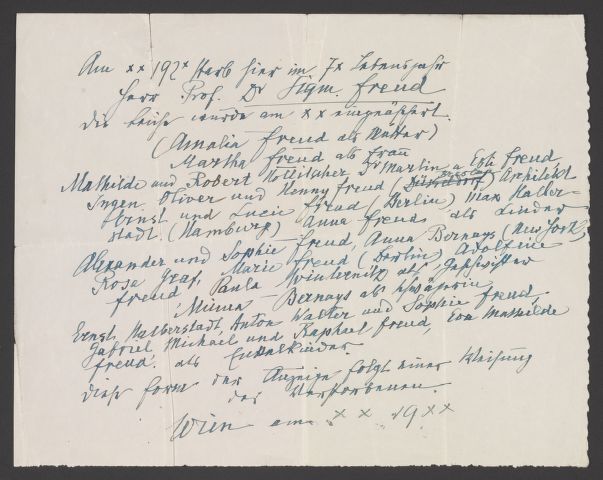
The Great War turned Freud’s thoughts in this direction, as did the racism and anti-Semitism taking hold in both Europe and the U.S. His theory of an instinctual drive toward the destruction of self and others seemed to anticipate the horror of the World War yet to come. Freud integrated the concept into his social theory ten years later in Civilization and its Discontents, in which he wrote that “the inclination to aggression” was “the greatest impediment to civilization.” While meditating on the death instinct as a psychoanalytic and social concept, Freud also pondered his own mortality. Just above, you can see the draft of a death notice that he wrote for himself during the 1920s. This comes to us from the Library of Congress’s new collection of Sigmund Freud papers, which contains artifacts and manuscripts dating from the 6th century B.C.E. (a Greek statue) to correspondence discovered in the late 90s.
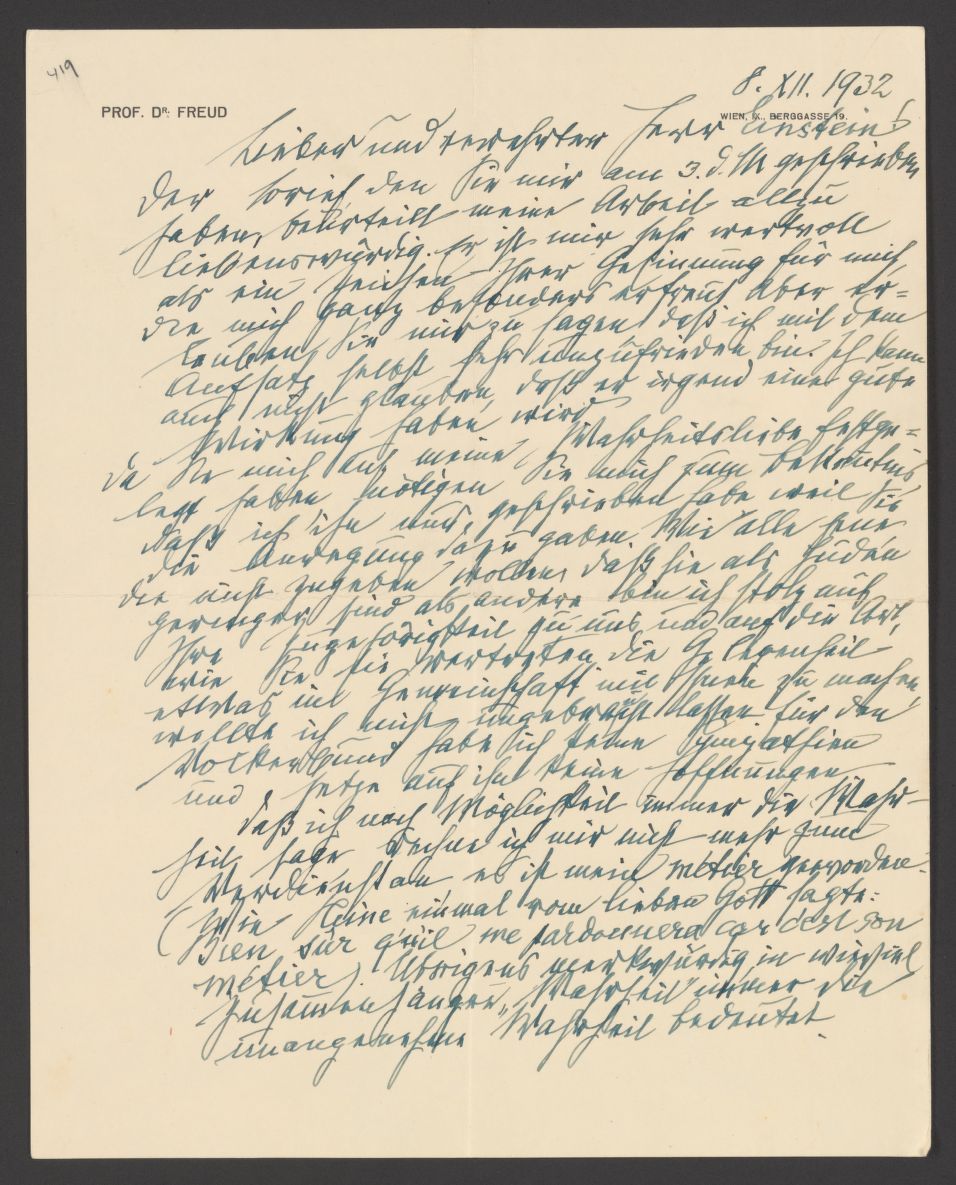
The “bulk of the material,” writes the LoC, dates “from 1891 to 1939,” and the “digitized collection documents Freud’s founding of psychoanalysis, the maturation of psychoanalytic theory, the refinement of its clinical technique, and the proliferation of its adherents and critics.” Much of this archive may be of interest only to the specialist scholar of Freud’s life and work, with “legal documents, estate records… school records” of the Freud children, and other mundane bureaucratic paperwork. But there are also letters representing “nearly six hundred correspondents,” such as Freud’s onetime protégé Carl Jung and Albert Einstein, with whom Freud corresponded in 1932 on the subject of “Why war?” (See Freud’s letter to Einstein above.)
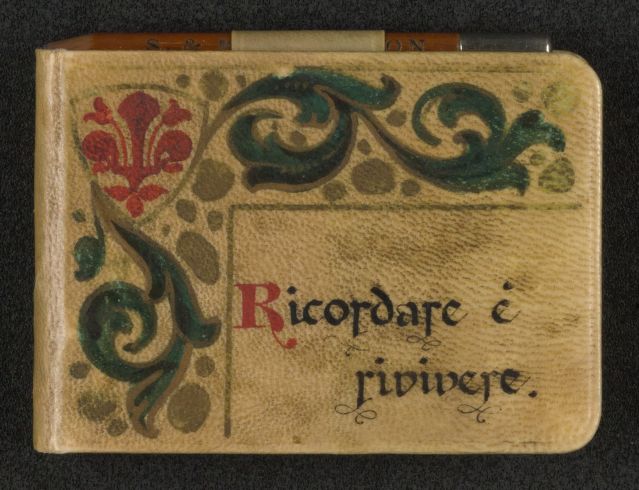
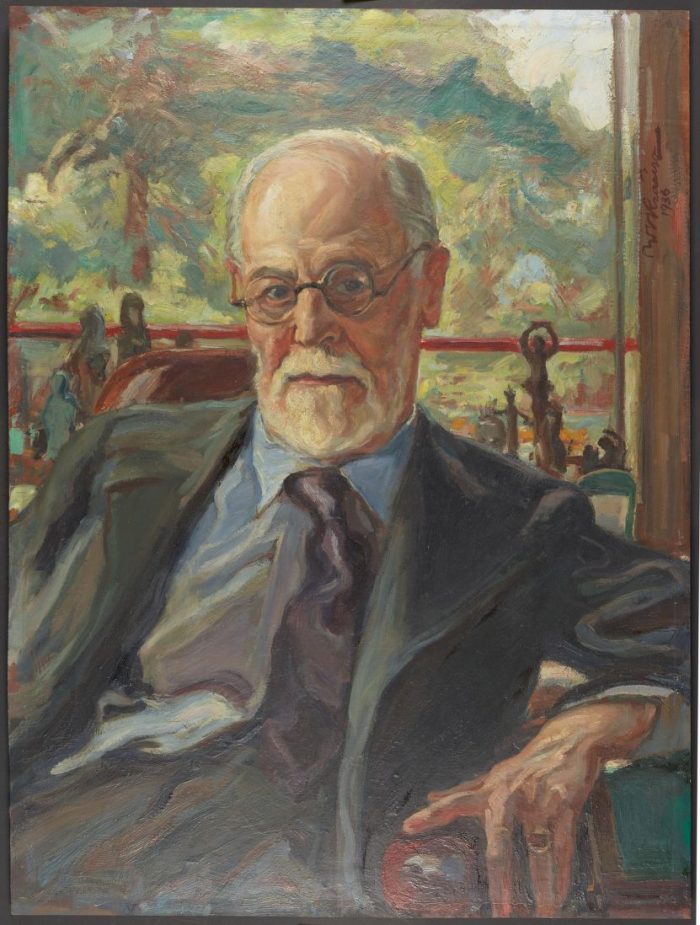
The documents are nearly all in German and the handwritten letters, notes, and drafts will be difficult to read even for speakers of the language. Yet, there are also artifacts like the 1936 portrait of Freud at the top, by Victor Krausz, the pocket notebook Freud carried between 1907 and 1908, just above, and—below—a picture of a pocket watch given to Freud by physician Max Schur, whose family left Austria with Freud’s in 1938. You can browse the online collection of over 20,000 items by date, name, location, and other indices, and all images are downloadable in high resolution scans.

Related Content:
Sigmund Freud Speaks: The Only Known Recording of His Voice, 1938
The Famous Letter Where Freud Breaks His Relationship with Jung (1913)
Josh Jones is a writer and musician based in Durham, NC. Follow him at @jdmagness
Read More...Animated Video Tells the Story of Jean-Paul Sartre & Albert Camus’ Famous Falling Out (1952)
Yesterday we wrote about Albert Camus’ role as the editor of Combat, a newspaper that emerged from a French Resistance cell and played a central role in the ideological conflicts of post-war France. Camus wrote essay after essay about the problems of violent extremism and the complications inherent in forming a new democratic civil order. Although he briefly fought alongside Communists in the resistance, and stood in solidarity with their cause, Camus would split with his Marxist allies after the war and come to define his own anarchist political philosophy, one he described as “modest… free of all messianic elements and devoid of any nostalgia for an earthly paradise.”
Camus gave the fullest exposition of his position in The Rebel, a critique of revolutionary violence on both the left and right. Published in 1951, this compelling, impressionistic work is an ethics as much as a politics–indeed, the two were inseparable for Camus. To proceed otherwise was a form of nihilism that would only end in profound unfreedom. “Nihilist thought,” he wrote in the chapter on “Moderation and Excess,” ignores the limits of human nature; “nothing any longer checks it in its course and it reaches the point of justifying total destruction or unlimited conquest.”
Fascism and Nazism were not far from Camus’ mind when he wrote these words. But he also referred to the increasingly doctrinaire Stalinism of his close friend and fellow existentialist Jean-Paul Sartre, who, writes Sam Dresser at Aeon, read The Rebel with “disgust.” Sartre published a scathing review in his journal, Les Temps Modernes. Camus sent a long reply, and Sartre countered with what Volker Hage in Der Spiegel calls a “merciless” response. “The split between the two friends,” writes Dresser, “was a media sensation,” the kind of popular feud between public intellectuals that may only happen in France.
Animated by Andrew Khosravani, the Aeon video above gives us a brief narrative of the famous falling-out. There may be “no better bust-up in the annals of philosophy than the row between” these “two titans of Existentialism.” The two fought not only over ideas, but over women, including Sartre’s famous partner Simone de Beauvoir. (Camus offended Sartre by turning down her advances.) Both Sartre and Camus “worried about how to make meaning in an essentially absurd, godless world.” But Sartre, Camus thought, abrogated the radical freedom he had written of in works like Being and Nothingness with his acceptance of dialectical materialism and his admiration for an authoritarian regime that imprisoned and murdered its own people.
Camus found the contradictions in Sartre’s thought intolerable, and he begins The Rebel with a philosophical inquiry into the ethics of killing. Can murder be justified in the name of a utopian ideal? Camus was not a pacifist—he had no problem fighting the Nazi occupation. But he categorically rejected revolutionary violence and all forms of extremism in the name of some “earthly paradise.” Sartre and Camus could not agree to disagree and went their separate ways, and Camus died in a car accident in 1960. In a heartfelt appreciation that Sartre penned shortly before his own death 20 years later, he called Camus, “probably my only good friend.”
Read more about Sartre-Camus rift at Aeon.
NOTE: The creator of this video is now looking to raise funds to produce new animations about philosophical feuds. Please consider contributing to their Kickstarter campaign.
Related Content:
Josh Jones is a writer and musician based in Durham, NC. Follow him at @jdmagness
Read More...Support Us
We're hoping to rely on loyal readers, rather than erratic ads. Please click the Donate button and support Open Culture. You can use Paypal, Venmo, Patreon, even Crypto! We thank you!

About Us

Open Culture scours the web for the best educational media. We find the free courses and audio books you need, the language lessons & educational videos you want, and plenty of enlightenment in between.
Advertise With Us

FREE UPDATES!
GET OUR DAILY EMAIL
Get the best cultural and educational resources on the web curated for you in a daily email. We never spam. Unsubscribe at any time.
FOLLOW ON SOCIAL MEDIA

Open Culture editor Dan Colman scours the web for the best educational media. He finds the free courses and audio books you need, the language lessons & movies you want, and plenty of enlightenment in between.
Advertise With Us


