T.S. Eliot’s Classic Poem “The Love Song of J. Alfred Prufrock” Gets Adapted into a Hip Modern Film
T.S. Eliot’s modernist poem “The Love Song of J. Alfred Prufrock” gives us a psychological portrait of a neurotic character who eloquently perseverates on the nature of his existence and the weakness of his will. The poem is a dream, but not an erotic one. Prufrock’s libido is too tied up in knots of self-doubt and self-consciousness for that. Though he moves through a high class brothel, he hardly ever seems to touch another person, asking himself repeatedly, “Do I dare?”
“I am no prophet,” muses Prufrock, his name conjuring a kind of gaunt Puritanical figure who fears that “the eternal Footman” and the women who come and go are laughing at him. Prufrock is pathetic and ridiculous, and he knows it. He escapes from the hell that is his life (the poem opens with an epigraph from Dante’s Inferno) with elaborate symbolist daydreams. He is a dandyish version of James Thurber’s Walter Mitty.
You may be forgiven for seeing few of these qualities in the central character of “A Lovesong,” a short film by director Laura Scrivano and starring Daniel Henshall (from the AMC series TURN: Washington’s Spies). They are not there. The project supposedly arose from Henshall’s own fascination with the poem. But in this adaptation of it, Prufrock—if we can call Henshall’s character by that name—seems to have no trouble with his libido.
Henshall’s solitary figure is pensive, brooding, and hip—a whiskey-sipping Brooklyn flâneur—moving between a seductive nighttime New York and a sleeping lover in bed, recalling perhaps Prufrock’s reference to “one-night cheap hotels.” The film is a unique interpretation of Eliot’s commentary on modern alienation, one perhaps suited to our moment. Yet, we would half-expect that any contemporary Prufrock would wander the streets lost in his smartphone, fretting over his lack of sufficient “likes.”
For contrast to this stylish reimaging of “Prufrock,” we can hear Eliot himself read from the poem just above.
Related Content:
Josh Jones is a writer and musician based in Durham, NC. Follow him at @jdmagness
Read More...John Cage Had a Surprising Mushroom Obsession (Which Began with His Poverty in the Depression)
“You know that my hobby is hunting wild mushrooms,” says John Cage in the 1990 reading at Harvard University you can hear above. “I was sure there was a haiku poem — Japanese — that would have to do with mushrooms, because haikus are related to the seasons: spring, summer, fall, and winter, and fall is the period for mushrooms.” Having found a suitably autumnal piece of verse by seventeenth-century poet-saint Matsuo Bashō featuring a mushroom and a leaf, Cage first reads the Japanese-language original, then offers translations, his favorite being this loose interpretation: “What leaf? What mushroom?” Perhaps we’d expect that from a more-zen-than-zen avant-garde composer best known for four minutes and thirty-three seconds without music.
But Cage’s mushroom hobby may come as more of a surprise, let alone the fact that it turns out to have gone much deeper than a hobby. “He won a mushroom quiz contest in 1958 on Italian television,” writes the New York Times’ Edward Rothstein in a review of For the Birds, Cage’s book of conversations with philosopher Daniel Charles. “In the 1960s he supplied a New York restaurant with edible fungi. He led mushroom outings at the New School. He knows a Lactarius Piperatus burns the tongue when raw but is delicious when cooked. He has even had his stomach pumped. As Marcel Duchamp wrote, inscribing a chess book for his cagey friend, ‘Dear John look out: yet another poisonous mushroom.’ ”
Cage happened upon mushrooms, quite literally, while living in Carmel during the Depression. “I didn’t have anything to eat,” he tells composer and filmmaker Henning Lohner in a conversation collected in Writings through John Cage’s Music, Poetry, and Art. But he knew from “tradition” that “mushrooms were edible and that some of them are deadly. So I picked one of the mushrooms and went in the public library and satisfied myself that it was not deadly, that it was edible, and I ate nothing else for a week.” So began his journey to the status he called “amateur mushroom hunter,” albeit one with a professional breadth of working mycological knowledge.
“Fascinated by their haphazard growth, the artist went on mushroom hunts, studied fungi identification, and even collected them,” writes Artsy’s Sarah Gottesman. He “crystallized his mushroom obsession by co-founding the New York Mycological Society, along with some of his students from the New School,” and even “made a living by regularly supplying New York restaurants like the Four Seasons with the pickings from his mushroom hunts.” His Mushroom Book, a collaboration with mycologist Alexander H. Smith and artist Lois Long, came out in 1972, the year after he gifted his fungi collection to the University of California, Santa Cruz.
And yet in his beloved mushrooms, Cage found the same escape from the pre-cast strictures of logic and reason that he did in sound (or indeed in the brief burst of sense impression distilled in haiku): “It’s useless to pretend to know mushrooms,” he says to Charles in For the Birds. ”They escape your erudition.” Hyperallergic’s Allison Meier, in a piece on the Horticultural Society of New York exhibition of his work as a naturalist, also sees the possibility of “parallels between his free-thinking music and the unstructured way mushrooms sprout up haphazardly,” but points out that, in images of “Cage frolicking with his mushroom basket” or “the playful wind of words in the Mushroom Book,” we see that “this really was a passion in its own right” — and one, like his passion for music, that could produce unpredictably delicious results.
via Artsy
Related Content:
Hear the One Night Sun Ra & John Cage Played Together in Concert (1986)
The Music of Avant-Garde Composer John Cage Now Available in a Free Online Archive
The Curious Score for John Cage’s “Silent” Zen Composition 4’33”
How to Get Started: John Cage’s Approach to Starting the Difficult Creative Process
John Cage Unbound: A New Digital Archive Presented by The New York Public Library
Based in Seoul, Colin Marshall writes and broadcasts on cities and culture. He’s at work on a book about Los Angeles, A Los Angeles Primer, the video series The City in Cinema, the crowdfunded journalism project Where Is the City of the Future?, and the Los Angeles Review of Books’ Korea Blog. Follow him on Twitter at @colinmarshall or on Facebook.
Read More...Willie Nelson and His Famous Guitar: The Tale of Trigger: Watch the Short Film Narrated by Woody Harrelson
There are those albums that can change someone’s perception of an entire genre of music. Willie Nelson’s Red Headed Stranger was such an album for me. But Nelson’s approach on his 1975 concept record not only challenged my preconceptions, it challenged the sureties of the country scene of the time. By perfecting the music’s capacity for aching beauty and sadness in spare, austere folk songs, Nelson paradoxically expanded its possibilities. His fellow artists thought it was “practically blasphemous and insubordinate,” notes Kelsey Butterworth, “to record country in so sparing a manner.”
Record buyers disagreed. Nelson fans loved Red-Headed Stranger’s dusty, wide open spaces, its ballads full of loneliness and regret. Without the overwrought production so many country singers received at the time, the songs became showcases for the plaintive cragginess of Nelson’s voice, and for the unmistakable sound of Trigger, his famous Martin N‑20 classical, “a gorgeous instrument,” writes Texas Monthly, “with a warm, sweet tone,” bought in 1969 by “a struggling country singer, a guy who had a pig farm, a failing marriage, and a crappy record deal.”
Trigger has been with Willie Nelson ever since, a companion as faithful as the horse it’s named after. The instrument is famous, mostly, for its beat-up condition, including a large hole near the bridge. But in the video above from Rolling Stone (narrated by Woody Harrelson) we learn much more about the relationship between man and guitar. The love was first kindled by Nelson finding in Trigger the tone he had been searching for—the tone of his guitar hero Django Reinhardt, “the best guitar player ever.”
But in Nelson’s hands, and playing his songs, Trigger became the distinctive sound of so much Outlaw Country, the “blasphemous and insubordinate” subgenre pioneered by Nelson, Waylon Jennings, Johnny Cash and others. “You hear that guitar,” says luthier Mark Erlewine, “even without him singing, and you go, ‘That’s Trigger.’” I think even casual fans of Nelson who only know his greatest hits can instantly pick up on the distinctiveness of his guitar’s mellow voice. “There’s a Hoodoo about Trigger,” says Erlewine, “that you just can’t mess with it.”
The biography of Trigger is inseparable from the story of Willie Nelson’s rise to fame, and we get a brief tour of his career above. Nelson began as a traditional buttoned-up Nashville crooner, but he decided to retire his act and move back to Texas to farm. Then he found Trigger. That meeting of player and guitar possibly reinvigorated Nelson’s entire career, inspiring his move to Austin and his complete reinvention of country music.
“Willie Nelson and His Famous Guitar: The Tale of Trigger” will be added to our collection, 4,000+ Free Movies Online: Great Classics, Indies, Noir, Westerns, Documentaries & More.
Related Content:
Willie Nelson–Young, Clean-Shaven & Wearing a Suit–Sings Early Hits at the Grand Ole Opry (1962)
Willie Nelson Auditions for The Hobbit Film Sequel, Turns 80 Today
Johnny Cash: Singer, Outlaw, and, Briefly, Television Host
Josh Jones is a writer and musician based in Durham, NC. Follow him at @jdmagness
Read More...Albert Camus, Editor of the French Resistance Newspaper Combat, Writes Movingly About Life, Politics & War (1944–47)
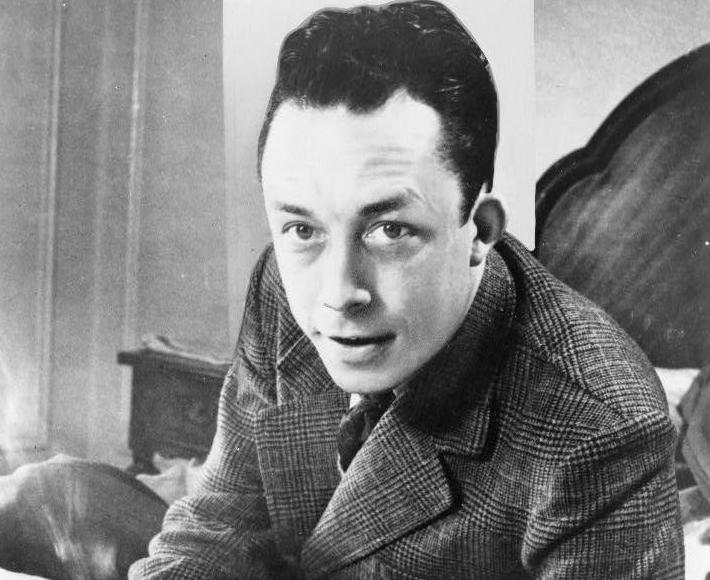
Image by United Press International, via Wikimedia Commons
When totalitarian regimes around the world are in power, writing that tells the truth—whether literary, journalistic, scientific, or legal—effectively serves as counter-propaganda. To write honestly is to expose: to uncover what is hidden, stand apart from it, and observe. These actions are anathema to dictatorships. But they are integral to resistance movements, which must develop their own press in order to disseminate ideas other than official state dogma.
For the French Resistance during World War II, one such publication that served the purpose came from a cell called “Combat,” which gave its name to the underground newspaper to which Jean-Paul Sartre and Albert Camus both contributed during and after the war. Camus became Combat’s editor and editorial writer between 1944 and 1947. During his tenure, he “was suspicious,” writes Michael McDonald, and he urged his readers to “be suspicious of those who speak the loudest in defense of democratic ideals and absolutes but whose goal is to instill fear in opponents and to silence dissent.”
Camus witnessed and recorded the liberation of France from the Nazi occupation in moving passages like this one:
Paris is firing all its ammunition into the August night. Against a vast backdrop of water and stone, on both sides of a river awash with history, freedom’s barricades are once again being erected. Once again justice must be redeemed with men’s blood.
After the previously unthinkable event that ended the war in the Pacific, the 1945 bombings of Hiroshima and Nagasaki, Camus explicitly critiqued the “formidable concert” of opinion impressed with fact that “any average city can be wiped out by a bomb the size of a football.” Against these “eloquent essays,” he wrote darkly,
We can sum it up in one sentence: our technical civilization has just reached its greatest level of savagery. We will have to choose, in the more or less near future, between collective suicide and the intelligent use of our scientific conquests.
Camus heavily documented the early post-war years in France, as the country slowly reconstituted itself, and as coalitions formerly united in resistance collapsed into competing factions. He was alarmed by not only by the fascists on the right, but by the many French socialists seduced by Stalinism. The very next month after the liberation of Paris, Camus began addressing the “problem of government” in an essay titled “To Make Democracy.” Government, writes Camus, “is, to a great extent our problem, as it is indeed the problem of everyone,” but he prefaced his own position with, “we do not believe in politics without clear language.”
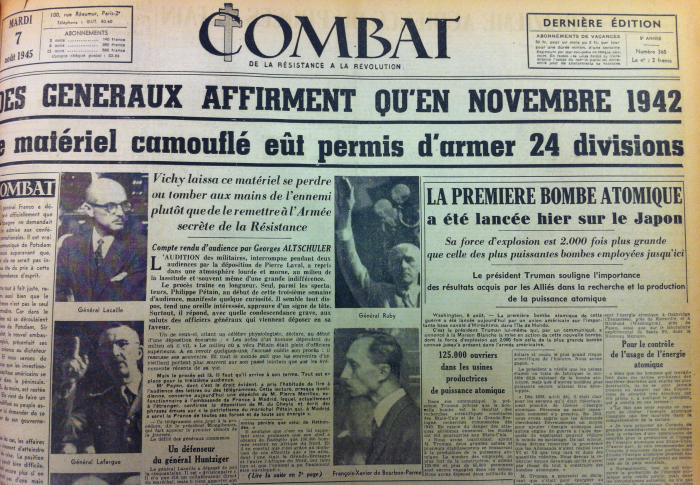
By December of 1944, a few months before the fall of Berlin, Camus had grown deeply reflective, expressing attitudes found in many eyewitness accounts. “France has lived through many tragedies,” he wrote, and “will live through many more.” The tragedy of the war, he wrote, was “the tragedy of separation.”
Who would dare speak the word “happiness” in these tortured times? Yet millions today continue to seek happiness. These years have been for them only a prolonged postponement, at the end of which they hope to find that the possibility for happiness has been renewed. Who could blame them? … We entered this war not because of any love of conquest, but to defend a certain notion of happiness. Our desire for happiness was so fierce and pure that it seemed to justify all the years of unhappiness. Let us retain the memory of this happiness and of those who have lost it.
These lucid, passionate essays “include little that is obsolete,” wrote Stanley Hoffman at Foreign Affairs in 2006. “Indeed it is shocking to find how current Camus’ fears, exhortations, and aspirations still are.” Hoffman particularly found Camus’ demand “for morality in politics” compelling. Though “deemed naïve… [by] many other philosophers and writers of his time,” Camus’ insistence on clarity of thought and ethical choice made for what he called “a modest political philosophy… free of all messianic elements and devoid of any nostalgia for an earthly paradise.” How sobering those words sound in our current moment.
Camus’ Combat essays have been collected in Princeton University Press’s Camus at Combat: Writing 1944–1947 and in Between Hell and Reason: Essays from the Resistance Newspaper Combat, 1944–1947 from Wesleyan.
Related Content:
Albert Camus Talks About Nihilism & Adapting Dostoyevsky’s The Possessed for the Theatre, 1959
Albert Camus’ Historic Lecture, “The Human Crisis,” Performed by Actor Viggo Mortensen
Josh Jones is a writer and musician based in Durham, NC. Follow him at @jdmagness
Read More...1,000 Musicians Play Nirvana’s “Smells Like Teen Spirit” Live, at the Same Time
In July of 2015, 1,000 musicians gathered together in Cesena, Italy and performed in unison a rollicking version of the Foo Fighters’ song “Learn to Fly.”
Now, they’re back and playing the best-known song from Dave Grohl’s earlier band. We’re talking, of course, about Nirvana’s hit, “Smells Like Teen Spirit.”
Here we are now. Entertain us. Ladies and gentlemen, the world’s largest rock band.
If you would like to support the mission of Open Culture, consider making a donation to our site. It’s hard to rely 100% on ads, and your contributions will help us continue providing the best free cultural and educational materials to learners everywhere. You can contribute through PayPal, Patreon, and Venmo (@openculture). Thanks!
Related Content:
Patti Smith’s Cover of Nirvana’s “Smells Like Teen Spirit” Strips the Song Down to its Heart
Kurt Cobain’s Isolated Vocal Track From ‘Smells Like Teen Spirit,’ 1991
Read More...Henry David Thoreau on When Civil Disobedience Against Bad Governments Is Justified: An Animated Introduction
“In March 1845, the United States acquired a new president – James K. Polk – a forceful, aggressive political outsider intent on strengthening his country and asserting its pre-eminence in front of other world powers, especially Mexico and Great Britain,” says The Book of Life. “Within a year of his inauguration, he had declared full-scale war on Mexico because of squabbles over the Texan border, and was soon rattling his saber at Britain over the ownership of Oregon. To complete the picture, Polk was a vigorous defender of slavery, who dismissed the arguments of abolitionists as naive and sentimental.” How did Americans who disagreed with this vicious-sounding character endure his term?
Though Polk did enjoy popular support, “a sizeable minority of the citizenry disliked him intensely,” especially a certain citizen by the name of Henry David Thoreau. The author of Walden; or, Life in the Woods believed that “true patriots were not those who blindly followed their administration” but “those who followed their own consciences and in particular, the principles of reason,” even when it meant publicly standing against not just the man in office but the many who agree with him, or even when it meant running afoul of the laws of the land. He elucidated the principles behind this position in the 1849 essay “Civil Disobedience,” which Josh Jones wrote about here last November.
The animated video above from Alain de Botton’s School of Life, also the producer of The Book of Life, places Thoreau’s ideas on the role of the individual versus the state in the context of Thoreau’s life — one he lived without fear of, say, getting thrown into jail for refusing to pay taxes to what he saw as an immoral state. “Under a government which imprisons any unjustly,” the transcendentalist figurehead declares in “Civil Disobedience,” “the true place for a just man is a prison.” Well over a century and half on, Thoreau still reminds us that political systems, no matter how long they last, remain ever subject to breakdown, adjustment, and even dismantling and rebuilding at the hands of the rulers and the ruled alike. Politics, as history occasionally and forcefully reminds us, is negotiation without end, and sometimes negotiations have to get ugly.
Related Content:
Henry David Thoreau on When Civil Disobedience and Resistance Are Justified (1849)
Henry David Thoreau’s Hand-Drawn Map of Cape Cod (1866)
Based in Seoul, Colin Marshall writes and broadcasts on cities and culture. He’s at work on a book about Los Angeles, A Los Angeles Primer, the video series The City in Cinema, the crowdfunded journalism project Where Is the City of the Future?, and the Los Angeles Review of Books’ Korea Blog. Follow him on Twitter at @colinmarshall or on Facebook.
Read More...Hannah Arendt on “Personal Responsibility Under Dictatorship:” Better to Suffer Than Collaborate

Image by Bernd Schwabe, via Wikimedia Commons
When Eichmann in Jerusalem—Hannah Arendt’s book about Nazi officer Adolf Eichmann’s trial—came out in 1963, it contributed one of the most famous of post-war ideas to the discourse, the “banality of evil.” And the concept at first caused a critical furor. “Enormous controversy centered on what Arendt had written about the conduct of the trial, her depiction of Eichmann, and her discussion of the role of the Jewish Councils,” writes Michael Ezra at Dissent magazine “Eichmann, she claimed, was not a ‘monster’; instead, she suspected, he was a ‘clown.’”
Arendt blamed victims who were forced to collaborate, critics charged, and made the Nazi officer seem ordinary and unremarkable, relieving him of the extreme moral weight of his responsibility. She answered these charges in an essay titled “Personal Responsibility Under Dictatorship,” published in 1964. Here, she aims to clarify the question in her title by arguing that if Eichmann were allowed to represent a monstrous and inhuman system, rather than shockingly ordinary human beings, his conviction would make him a scapegoat and let others off the hook. Instead, she believes that everyone who worked for the regime, whatever their motives, is complicit and morally culpable.
But although most people are culpable of great moral crimes, those who collaborated were not, in fact, criminals. On the contrary, they chose to follow the rules in a demonstrably criminal regime. It’s a nuance that becomes a stark moral challenge. Arendt points out that everyone who served the regime agreed to degrees of violence when they had other options, even if those might be fatal. Quoting Mary McCarthy, she writes, “If somebody points a gun at you and says, ‘Kill your friend or I will kill you,’ he is tempting you, that is all.”
While this circumstance may provide a “legal excuse,” for killing, Arendt seeks to define a “moral issue,” a Socratic principle she had “taken for granted” that we all believed: “It is better to suffer than do wrong,” even when doing wrong is the law. People like Eichmann were not criminals and psychopaths, Arendt argued, but rule-followers protected by social privilege. “It was precisely the members of respectable society,” she writes, “who had not been touched by the intellectual and moral upheaval in the early stages of the Nazi period, who were the first to yield. They simply exchanged one system of values against another,” without reflecting on the morality of the entire new system.
Those who refused, on the other hand, who even “chose to die,” rather than kill, did not have “highly developed intelligence or sophistication in moral matters.” But they were critical thinkers practicing what Socrates called a “silent dialogue between me and myself,” and they refused to face a future where they would have to live with themselves after committing or enabling atrocities. We must remember, Arendt writes, that “whatever else happens, as long as we live we shall have to live together with ourselves.”
Such refusals to participate might be small and private and seemingly ineffectual, but in large enough numbers, they would matter. “All governments,” Arendt writes, quoting James Madison, “rest on consent,” rather than abject obedience. Without the consent of government and corporate employees, the “leader… would be helpless.” Arendt admits the unlikely effectiveness of active opposition to a one-party authoritarian state. And yet when people feel most powerless, most under duress, she writes, an honest “admission of one’s own impotence” can give us “a last remnant of strength” to refuse.
We have only for a moment to imagine what would happen to any of these forms of government if enough people would act “irresponsibly” and refuse support, even without active resistance and rebellion, to see how effective a weapon this could be. It is in fact one of the many variations of nonviolent action and resistance—for instance the power that is potential in civil disobedience.
We have example after example of these kinds of refusals to participate in a murderous system or further its aims. Arendt was aware these actions can come at great cost. The alternatives, she argues, may be far worse.
Related Content:
Hannah Arendt’s Original Articles on “the Banality of Evil” in the New Yorker Archive
Henry David Thoreau on When Civil Disobedience and Resistance Are Justified (1849)
Josh Jones is a writer and musician based in Durham, NC. Follow him at @jdmagness
Read More...Pakistani Immigrant Goes to a Led Zeppelin Concert, Gets Inspired to Become a Musician & Then Sells 30 Million Albums
Salman Ahmad, the guitarist who founded the acclaimed Sufi rock band Junoon, has sold over 30 million albums worldwide, performed at the Nobel Peace Prize ceremony, and continued making music despite threats from The Taliban. He also teaches courses on Muslim music and poetry at Queens College of the City University of New York.
Above, in a video produced by The Moth, the boundary-breaking musician recounts his inspirational life story. Born in Lahore, Pakistan, he moved to New York at the age of 11. Being the “only overweight, brown, Muslim kid” in school, he lived in relative isolation–that is until Dan Spitz (later the guitarist of Anthrax) urged him “to get cool.” Cool came in the form of a ticket to a Led Zeppelin concert at Madison Square Garden, which kicked off, oddly enough, with “Kashmir.”
I’ll let Ahmad tell the rest of his story. It’s also a story about how America does good (for the world and itself) when it remains open in heart, mind, and law.
To get better acquainted with Ahmad’s journey, read his recent book, Rock & Roll Jihad: A Muslim Rock Star’s Revolution.
To keep America open, make a donation to the ACLU.
Related Content
Pakistani Musicians Play a Delightful Version of Dave Brubeck’s Jazz Classic, “Take Five”
Pakistani Orchestra Plays Enchanting Rendition of The Beatles’ “Eleanor Rigby”
Read More...“Calling Bullshit”: See the Syllabus for a College Course Designed to Identify & Combat Bullshit
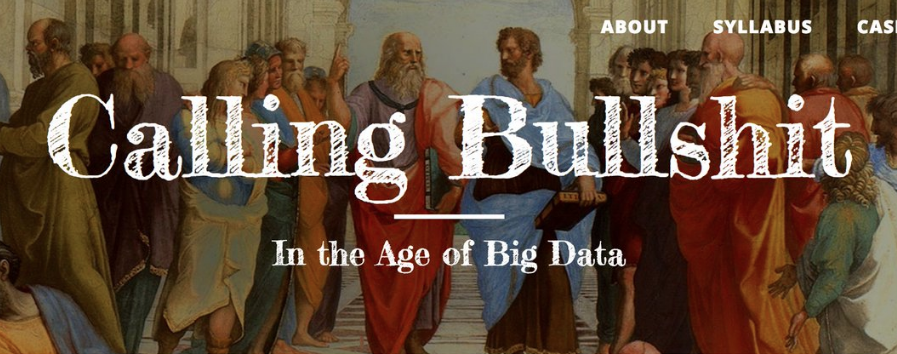
Two professors at the University of Washington, Carl Bergstrom and Jevin West, have created a website meant to accompany a potential college seminar entitled “Calling Bullshit.” Here’s how Bergstrom and West explain the premise of their course. It’s worth quoting them at length.
The world is awash in bullshit. Politicians are unconstrained by facts. Science is conducted by press release. Higher education rewards bullshit over analytic thought. Startup culture elevates bullshit to high art. Advertisers wink conspiratorially and invite us to join them in seeing through all the bullshit — and take advantage of our lowered guard to bombard us with bullshit of the second order. The majority of administrative activity, whether in private business or the public sphere, seems to be little more than a sophisticated exercise in the combinatorial reassembly of bullshit.
We’re sick of it. It’s time to do something, and as educators, one constructive thing we know how to do is to teach people. So, the aim of this course is to help students navigate the bullshit-rich modern environment by identifying bullshit, seeing through it, and combating it with effective analysis and argument.
What do we mean, exactly, by the term bullshit? As a first approximation, bullshit is language, statistical figures, data graphics, and other forms of presentation intended to persuade by impressing and overwhelming a reader or listener, with a blatant disregard for truth and logical coherence.
While bullshit may reach its apogee in the political domain, this is not a course on political bullshit. Instead, we will focus on bullshit that comes clad in the trappings of scholarly discourse. Traditionally, such highbrow nonsense has come couched in big words and fancy rhetoric, but more and more we see it presented instead in the guise of big data and fancy algorithms — and these quantitative, statistical, and computational forms of bullshit are those that we will be addressing in the present course.…
Our aim in this course is to teach you how to think critically about the data and models that constitute evidence in the social and natural sciences.
The “Calling Bullshit” course would sit nicely alongside the work of Princeton philosopher Harry Frankfurt, the author of the fairly recent book, On Bullshit. (In fact, On Bullshit would be read during Week 1 of the “Calling Bullshit“course. See the syllabus here.) There’s a lot of bullshit freely flowing through our world, and it may well take a cross-disciplinary team to help us cut through the crap.
To learn more about the envisioned Calling Bullshit course, visit Bergstrom and West’s website, where they have an FAQ that explains what a study of bullshit might look like.
Update: You can now view the lectures for the course here.
Note: You can download Harry Frankfurt’s “On Bullshit” as a free audiobook (or any other two free audiobooks) if you sign up for Audible.com’s free trial program. Learn more about Audible’s free trial program here.
If you would like to support the mission of Open Culture, consider making a donation to our site. It’s hard to rely 100% on ads, and your contributions will help us continue providing the best free cultural and educational materials to learners everywhere. You can contribute through PayPal, Patreon, and Venmo (@openculture). Thanks!
Related Content:
How to Spot Bullshit: A Primer by Princeton Philosopher Harry Frankfurt
1,700 Free Online Courses from Top Universities
Read More...Female Samurai Warriors Immortalized in 19th Century Japanese Photos

Most of my generation’s exposure to Japanese culture came heavily mediated by anime and samurai films. One cultural artifact that stands out for me is TV miniseries Shogun, an adaptation of James Clavell’s popular novel, which gives us a view of Japan through the eyes of a British novelist and his British hero (played by Richard Chamberlain in the film). Shogun depicts a feudal Japanese warrior culture centered on exaggerated displays of masculinity, with women operating in the margins or behind the scenes.
Even the great Akira Kurosawa’s visions of feudal Japan, like The Seven Samurai, are “not exactly inundated with the stunning power of female warriors brandishing katanas,” writes Dangerous Minds, “it’s a bit of a ソーセージ-fest.”
And yet, it turns out, “such women did exist.” Known as onna bugeisha, these fighters “find their earliest precursor in Empress Jingū, who in 200 A.D. led an invasion of Korea after her husband Emperor Chūai, the fourteenth emperor of Japan, perished in battle.” Empress Jingū’s example endured. In 1881, she became the first woman on Japanese currency.

Preceding the all-male samurai class depicted in Clavell and Kurosawa, the onna bugeisha “learned to use naginata, kaiken, and the art of tanto Jutso in battle,” the Vintage News tells us. Rather than pay mercenaries to defend them, as the terrified townsfolk do in Seven Samurai, these women trained in battle to protect “communities that lacked male fighters.”

The onna bugeisha’s ethic was as purportedly as uncompromising as the samurai, and it shows in these fierce portraits from the 1800s. Although many tales of prominent onna bugeisha come from the 12th-13th centuries, one famous figure, Nakano Takeko lived in the 19th century, writes Dangerous Minds, and died quite the warrior’s death:
While she was leading a charge against Imperial Japanese Army troops she was shot in the chest. Knowing her remaining time on earth to be short, Takeko asked her sister, Yūko, to cut her head off and have it buried rather than permit the enemy to seize it as a trophy. It was taken to Hōkai Temple and buried underneath a pine tree.
Another revered fighter, Tomoe Gozen, appears in The Tale of the Heike (often called the “Japanese Iliad). She is described as “especially beautiful,” and also as “a remarkably strong archer… as a swordswoman she was a warrior worth a thousand, ready to confront a demon or a god, mounted or on foot.”

In the photos here—and many more at The Vintage News—we get a sense of what such a legendary badass may have looked like.

via Vintage News/Dangerous Minds
Related Content:
Hand-Colored 1860s Photographs Reveal the Last Days of Samurai Japan
How Akira Kurosawa’s Seven Samurai Perfected the Cinematic Action Scene: A New Video Essay
Josh Jones is a writer and musician based in Durham, NC. Follow him at @jdmagness
Read More...Support Us
We're hoping to rely on loyal readers, rather than erratic ads. Please click the Donate button and support Open Culture. You can use Paypal, Venmo, Patreon, even Crypto! We thank you!

About Us

Open Culture scours the web for the best educational media. We find the free courses and audio books you need, the language lessons & educational videos you want, and plenty of enlightenment in between.
Advertise With Us

FREE UPDATES!
GET OUR DAILY EMAIL
Get the best cultural and educational resources on the web curated for you in a daily email. We never spam. Unsubscribe at any time.
FOLLOW ON SOCIAL MEDIA

Open Culture editor Dan Colman scours the web for the best educational media. He finds the free courses and audio books you need, the language lessons & movies you want, and plenty of enlightenment in between.
Advertise With Us


