The Theater Dictionary: A Free Video Guide to Theatre Lingo
It’s 11 o’clock. Do you know where your showstoppers are? Or, more to the point, do you know why a musical-comedy writing team seeks to orient its showstopping number at “eleven o’clock”?
The Theater Development Fund’s Theatre Dictionary is an ongoing attempt to define and document theater terms for both the rabble and any budding practitioners who’ve yet to master the lingo.
Each term is accompanied by a loopy slapdash skit. Not all of the performers exhibit the pedigree Veronica J. Kuehn and Nick Kohn of Avenue Q bring to “Eleven O’Clock Number,” above, but casting administrators and ticket booth reps in starring roles lend a homey egalitarianism, such as when students from the Yale School of Drama’s Department of Dramaturgy and Dramatic Criticism are given free license to explore the origins of “vom.”
(This loosey goosey approach also allows for uncredited appearances by other theatrical tropes—the marathon rehearsals where popcorn constitutes lunch and one actor repeatedly complains that his work has been insufficiently acknowledged.)
A “What Does This Word Mean” tab for each term anchors the video silliness, providing historical and anecdotal context. It’s in keeping with the Dictionary’s greater goal of bringing theater to the people, letting everyone play with the toys.
Some of the definitions are practical shorthand…
Others are couched in longtime, possibly archaic theater lore…
I’d exercise caution with some of this lingo. Even though many of these terms are born of practicality, overusing them may cause others to view you as the most obnoxious of self-declared Triple Threats, the kid in the comedy-tragedy mask sweatshirt, prone to belting out the entire soundtrack of CATS at the slightest provocation. (“Thanks, 5!!!”)
Some of these terms have unexpected crossover appeal, most recently Ghost Light, above. Knowing the meaning of the term will help you better appreciate the power of the Ghostlight Project, a post-election coming together of theater artists and audiences in defense and support of vulnerable communities.
You can browse the Theater Dictionary complete glossary here or watch the videos on TDF’s Youtube channel.
The Theater Dictionary’s FAQ contains information on how professional theatre companies and organizations and college-level theatre programs can apply to contribute a video.
Related Content:
100,000+ Wonderful Pieces of Theater Ephemera Digitized by The New York Public Library
Take a “Breath” and Watch Samuel Beckett’s One-Minute Play
Ayun Halliday is an author, illustrator, theater maker and Chief Primatologist of the East Village Inky zine. Her play Zamboni Godot is opening in New York City in March 2017. Follow her @AyunHalliday.
Read More...A Free Online Course on Dante’s Divine Comedy from Yale University
Over the years, we’ve featured the many drawings that have adorned the pages of Dante’s Divine Comedy, from medieval times to modern. Illustrations by Botticelli, Gustave Doré, William Blake and Mœbius, they’ve all gotten their due. Less has been said here, however, about the actual text itself. Perhaps the most important work in Italian literature, Dante Alighieri (1265–1321) wrote the Divine Comedy (consisting of Inferno, Purgatorio, and Paradiso) between the years 1308 and 1320. And that text is largely the subject of Dante in Translation, a free online course taught by Yale’s Giuseppe Mazzotta. The course description reads as follows:
The course is an introduction to Dante and his cultural milieu through a critical reading of the Divine Comedy and selected minor works (Vita nuova, Convivio, De vulgari eloquentia, Epistle to Cangrande). An analysis of Dante’s autobiography, the Vita nuova, establishes the poetic and political circumstances of the Comedy’s composition. Readings of Inferno, Purgatory and Paradise seek to situate Dante’s work within the intellectual and social context of the late Middle Ages, with special attention paid to political, philosophical and theological concerns. Topics in the Divine Comedy explored over the course of the semester include the relationship between ethics and aesthetics; love and knowledge; and exile and history.
You can watch the 24 lectures from the course above, or find them on YouTube and iTunes in video and audio formats. To get more information on the course, including the syllabus, visit this Yale website.
Primary texts used in this course include:
- Dante. Divine Comedy. Translated by John D. Sinclair. New York: Oxford University Press, 1968.
- Dante. Vita Nuova. Translated by Mark Musa. Bloomington: Indiana University Press, 1973.
Dante in Translation will be added to our list of Free Online Literature courses, a subset of our collection, 1,700 Free Online Courses from Top Universities.
If you would like to support the mission of Open Culture, consider making a donation to our site. It’s hard to rely 100% on ads, and your contributions will help us continue providing the best free cultural and educational materials to learners everywhere. You can contribute through PayPal, Patreon, and Venmo (@openculture). Thanks!
Related Content:
Dante’s Divine Comedy: A Free Course from Columbia University
William Blake’s Last Work: Illustrations for Dante’s Divine Comedy (1827)
Botticelli’s 92 Illustrations of Dante’s Divine Comedy
Alberto Martini’s Haunting Illustrations of Dante’s Divine Comedy (1901–1944)
Hear Dante’s Inferno Read Aloud by Influential Poet & Translator John Ciardi (1954)
Physics from Hell: How Dante’s Inferno Inspired Galileo’s Physics
Read More...Why Time Seems to Speed Up as We Get Older: What the Research Says
No matter what age we’ve attained, we can think back to childhood and feel just how agonizingly long it then took for Christmas to come, for the school day to end, for a tray of cookies to come out of the oven. Mysterious as this apparent change in the speed of time may at first seem, it actually makes a kind of intuitive sense: one day represents, at the age of fifty, a tenth of the proportion of the time we’ve experienced so far than it does at the age of five. As our timeline lengthens, our perception of certain fixed units on that timeline — a minute, a year, a decade — shortens.
But there are other factors in play as well. “Individual perceptions of time are strongly influenced by our level of focus, physical state and mood,” write The Independent’s Muireann Irish and Claire O’Callaghan. “Just as ‘a watched pot never boils,’ when we are concentrating on an event, time occasionally appears to pass more slowly than usual. This is also the case when we’re bored; time can seem to drag endlessly.” This might well contribute to the childhood perception of slow time, since kids have to spend so many of their days in the classroom, an environment that strikes most of them as expressly designed to induce boredom.
In addition, according to Scientific American, “our brain encodes new experiences, but not familiar ones, into memory, and our retrospective judgment of time is based on how many new memories we create over a certain period. In other words, the more new memories we build on a weekend getaway, the longer that trip will seem in hindsight.” The relatively high frequency of distinctive memories created earlier in life and low frequency of distinctive memories created later in life means that “our early years tend to be relatively overrepresented in our autobiographical memory and, on reflection, seem to have lasted longer.”
You can see some of the ideas and theories behind this almost universally agreed-on sense that time speeds up as we grow older in the video from the National Geographic Channel show Brain Games above. It also introduces a few new ones into the mix, connecting them all with how much energy the brain uses to record which kinds of experiences, suggesting that even a sense as fundamental as the one we use to mark time has a great deal more complexity to it than we understand. Ultimately, though, it all comes back to the words of no less a thinker on relativity than Albert Einstein: “Put your hand on a hot stove for a minute, and it seems like an hour. Sit with a pretty girl for an hour, and it seems like a minute.”
Related Content:
How Clocks Changed Humanity Forever, Making Us Masters and Slaves of Time
The Neuroscience & Psychology of Procrastination, and How to Overcome It
Free Online Psychology & Neuroscience Courses
Based in Seoul, Colin Marshall writes and broadcasts on cities and culture. He’s at work on a book about Los Angeles, A Los Angeles Primer, the video series The City in Cinema, the crowdfunded journalism project Where Is the City of the Future?, and the Los Angeles Review of Books’ Korea Blog. Follow him on Twitter at @colinmarshall or on Facebook.
Read More...George Orwell Explains How “Newspeak” Works, the Official Language of His Totalitarian Dystopia in 1984
As we noted yesterday, and you likely noticed elsewhere, George Orwell’s classic dystopian novel 1984 shot to the top of the charts—or the Amazon bestseller list—in the wake of “alternative facts,” the latest Orwellian coinage for bald-faced lying. The ridiculous phrase immediately produced a barrage of parodies, hashtags, and memes; healthy ways of venting rage and disbelief. But maybe there is a danger there too, letting such words sink into the discourse, lest they become what Orwell called “Newspeak.”
It’s easy to hear “Newspeak,” the “official language of Oceania,” as “news speak.” This is perfectly reasonable, but it gives us the impression that it relates strictly to its appearance in mass media. Orwell obviously intended the ambiguity—it is the language of official propaganda after all—but the portmanteau actually comes from the words “new speak”—and it has been created to supersede “Oldspeak,” Orwell writes, “or Standard English, as we should call it.”
In other words, Newspeak isn’t just a set of buzzwords, but the deliberate replacement of one set of words in the language for another. The transition is still in progress in the fictional 1984, but is expected to be completed “by about the year 2050.” Students of history and linguistics will recognize that this is a ludicrously accelerated pace for the complete replacement of one vocabulary and syntax by another. (We might call Orwell’s English Socialists “accelerationsts.”) Newspeak appears not through history or social change but through the will of the Party.
The purpose of Newspeak was not only to provide a medium of expression for the world-view and mental habits proper to the devotees of Ingsoc, but to make all other modes of thought impossible.
It’s entirely plausible that “alternative facts,” or “altfacts,” would fit right into the “Ninth and Tenth Editions of the Newspeak Dictionary,” though it might easily fall out of favor and “be suppressed later.” No telling if it would make the cut for “the final, perfected version” of Newspeak, “as embodied in the Eleventh Edition of the Dictionary.”
These quotations come not from the main text of 1984 but from an appendix called “The Principles of Newspeak,” which you can hear read at the top of the post. Here, Orwell dispassionately discusses the “perfected” form of Newspeak, including its grammatical “peculiarities,” such as “an almost complete interchangeability between different parts of speech” (an issue current translators have encountered). He then introduces its vocabulary, divided into “three distinct classes,” A, B, and C.
The A class contains “everyday life” words that have been mutated with cumbersome prefixes and intensifiers: “uncold” for warm, “pluscold and doublepluscold” for “very cold” and “superlatively cold.” The B class contains the compound words: sinister doublethink coinages like “joycamp (forced-labor camp)” and “Minipax (Ministry of Peace, i.e. Ministry of War).” These, Orwell explains, are similar to “the characteristic features of political language… in totalitarian countries” of the early 20th century.
The citizen of Oceania, Orwell tells us, must have “an outlook similar to that of the ancient Hebrew who knew, without knowing much else, that all nations other than his own worshipped ‘false gods’.… His sexual life, for example, was entirely regulated by the two Newspeak words sexcrime (sexual immorality) and goodsex (chastity).” The latter included only “intercourse between man and wife, for the sole purpose of begetting children, and without physical pleasure on the part of he woman: all else was sexcrime.”
The C class of words may be the most insidious of all. While it “consisted entirely of scientific and technical terms” that “resembled the scientific terms in use today,” the Party took care “to define them rigidly and strip them of undesirable meanings.” For example,
There was no vocabulary expressing the function of Science as a habit of mind, or a method of thought irrespective of its particular branches. There was, indeed, no word for ‘Science,’ any meaning that it could possibly bear being already sufficiently covered by the word Ingsoc.
Orwell then goes on to discuss the difficulty of translating the work of the past into Newspeak. He uses as an example the Declaration of Independence: “All mans are equal was a possible Newspeak sentence,” but only in that “it expressed a palpable untruth—i.e. that all men are of equal size, weight, or strength.” As for the rest of Thomas Jefferson’s rousing preamble, “it would have been quite impossible to render this into Newspeak,” writes Orwell. “The nearest one could come to doing so would be to swallow the whole passage up in the single word crimethink.”
Related Content:
George Orwell’s 1984 Is Now the #1 Bestselling Book on Amazon
Huxley to Orwell: My Hellish Vision of the Future is Better Than Yours (1949)
Josh Jones is a writer and musician based in Durham, NC. Follow him at @jdmagness
Read More...81-Year-Old Man Walks into a Guitar Shop & Starts Playing a Sublime Solo: Ignore the Talents of the Elderly at Your Own Peril
Last spring, I caught a Who concert in Oakland, California, on what happened to be songwriter/guitarist Pete Townshend’s 71st birthday. Five songs into their set, the band played “My Generation”–yes, the song best known for the line “I hope I die before I get old”–and I couldn’t help but think: Townshend’s playing with more inspiration now than when I first saw The Who play in 1982. Biologically, he’s supposed to be over the hill. Musically, he’s still playing a very fine rock guitar.
The same thought crossed my mind at Desert Trip, the October mega concert held in Indio, California. Featuring The Rolling Stones, The Who (again), Paul McCartney, Neil Young and Roger Waters–in short, musicians all over the age of 70–Desert Trip became more colloquially known as “Oldchella.”
Even, Mick Jagger called it “the come and see us before we die tour.” And yet. And yet. Despite the jokes, they’re all still playing with verve, putting on tight, rousing shows. (I’ll admit that Bob Dylan is the notable exception.)
So what’s the takeaway? We can’t stop the clock. Eventually, we get old. Nothing we can do about that. But if you’ve got your health, if you’ve got the desire, if you’ve spent decades refining your craft, then there’s no reason you can’t still do great work. That applies to musicians. (Witness 81-year-old Bob Wood above). It also applies to other parts of life, including our professional lives. Our culture hastily writes off the talents and accumulated experience of an entire generation of people. But stop for a second. Watch the video above and extrapolate it to other parts of life. Then think about all that gets needlessly lost.
If you would like to support the mission of Open Culture, consider making a donation to our site. It’s hard to rely 100% on ads, and your contributions will help us continue providing the best free cultural and educational materials to learners everywhere. You can contribute through PayPal, Patreon, and Venmo (@openculture). Thanks!
Related Content:
How to Age Gracefully: No Matter What Your Age, You Can Get Life Advice from Your Elders
Dementia Patients Find Some Eternal Youth in the Sounds of AC/DC
Read More...Watch Eero Saarinen: The Architect Who Saw the Future: Free for a Limited Time
A quick heads up. For the next few days (until January 27) you can watch Eero Saarinen: The Architect Who Saw the Future, the latest installment from the PBS American Masters series. Here’s the PBS blurb for the episode.
Best known for designing National Historic Landmarks such as St. Louis’ iconic Gateway Arch and the General Motors Technical Center, Saarinen also designed New York’s TWA Flight Center at John F. Kennedy International Airport, Yale University’s Ingalls Rink and Morse and Ezra Stiles Colleges, Virginia’s Dulles Airport, and modernist pedestal furniture like the Tulip chair.
In the film, Saarinen’s son, Eric Saarinen, “visits the sites of his father’s work on a cathartic journey, shot in 6K with the latest in drone technology that showcases the architect’s body of timeless work for the first time. The documentary also features rare archival interviews with Eero and his second wife, The New York Times art critic Aline Saarinen, as well as letters and quotations from Aline’s memoirs voiced respectively by Peter Franzén and Blythe Danner.”
You can get more background on the film here. Copies of the film can be purchased online here.
Related Content:
32,000+ Bauhaus Art Objects Made Available Online by Harvard Museum Website
Roman Architecture: A Free Online Course from Yale University
Read More...
Hear Kurt Vonnegut Visit the Afterlife & Interview Dead Historical Figures: Isaac Newton, Adolf Hitler, Eugene Debs & More (Audio, 1998)
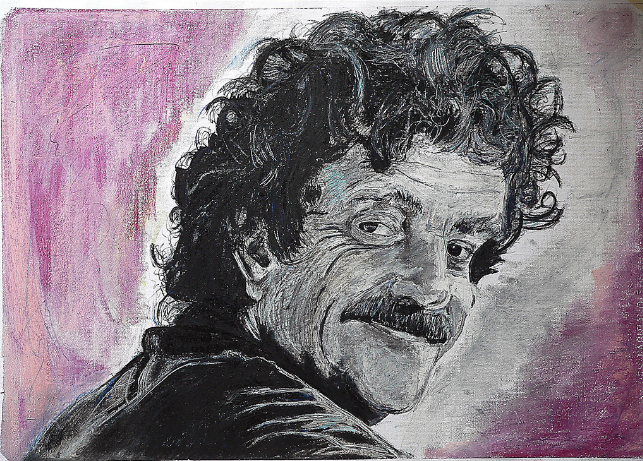
Image by Daniele Prati, via Flickr Commons
Kurt Vonnegut wrote novels, of course, but also short stories, essays, and — briefly, suitably late in his career — correspondence from the afterlife. He did that last gig in 1998, composing for broadcast on the formidable WNYC, by undergoing a series of what he called “controlled near-death experiences” orchestrated, so he claimed, by “Dr. Jack Kevorkian and the facilities of a Huntsville, Texas execution chamber.” These made possible “more than one hundred visits to Heaven and my returning to life to tell the tale,” or rather, to tell the tales of the more permanently deceased with whom he’d sat down for a chat.
Vonnegut’s roster of afterlife interviewees included personages he personally admired such as Eugene Debs (listen), Isaac Newton (listen), and Clarence Darrow (listen), as well as historical villains like James Earl Ray (listen) and Adolf Hitler (listen). Other of the dead with whom he spoke, while they may not qualify as household names, nevertheless went to the grave with some sort of achievement under their belts: Olestra inventor Fred H. Mattson, for instance, or John Wesley Joyce, owner of the famed Greenwich Village literary watering hole The Lion’s Head. Only the Slaughterhouse-Five author’s courageous and impossible reportage has saved the names of a few, like that of retired construction worker Salvatore Biagini, from total obscurity.
Famous or not, people interested Vonnegut, who claimed to get his ideas from “disgust with civilization” but also served as honorary president of the National Humanist Association. This aspect of his personality comes up in the Brian Lehrer Show segment just above, a listen back to Vonnegut’s “Reports on the Afterlife” segments for WNYC’s 90th anniversary. (You can listen to all the segments individually here.)
Producer Marty Goldensohn talks about recording them at Vonnegut’s apartment, where the famous writer would answer the phone every few minutes for a brief talk with one curious fan after another, none of whom he’d taken any pains whatsoever to keep from finding his phone number. “It was a wonderful thing,” says Goldensohn. “He had a way of talking, hearing what he wanted to hear, thanking, and hanging up very nicely. Sixty seconds.” He’d also mastered, adds Lehrer, the art of the one-minute trip to the afterlife, and the stories this unusual radio format allowed him to tell surely drew from the vast range of experiences and emotions to which Vonnegut had exposed his mind not just through reading, but also with such frequent and brief yet very real human connections he’d make on a seemingly near-constant basis.
A little bit less than a decade after these recordings and the subsequent publication of their print collection God Bless You, Dr. Kevorkian, the unceasingly smoking and drinking Vonnegut would, at the age of 84, make his own final trip to the afterlife. There he now presumably awaits (possibly beside Kevorkian himself) the next correspondent intrepid enough to come up and interview him. Given the events of the past decade, listeners could certainly use whatever dose of his characteristically clear-eyed and sardonic perspective he might have to offer.
Related Content:
Hear Kurt Vonnegut Read Slaughterhouse-Five, Cat’s Cradle & Other Novels
Hear Kurt Vonnegut’s Very First Public Reading from Breakfast of Champions (1970)
An Animated Kurt Vonnegut Visits NYU, Riffs, Rambles, and Blows the Kids’ Minds (1970)
Kurt Vonnegut Diagrams the Shape of All Stories in a Master’s Thesis Rejected by U. Chicago
In 1988, Kurt Vonnegut Writes a Letter to People Living in 2088, Giving 7 Pieces of Advice
Based in Seoul, Colin Marshall writes and broadcasts on cities and culture. He’s at work on a book about Los Angeles, A Los Angeles Primer, the video series The City in Cinema, the crowdfunded journalism project Where Is the City of the Future?, and the Los Angeles Review of Books’ Korea Blog. Follow him on Twitter at @colinmarshall or on Facebook.
Read More...An Introduction to Hegel’s Philosophy of History: The Road to Progress Runs First Through Dark Times
The question of whether or not genuine human progress is possible, or desirable, lies at the heart of many a radical post-Enlightenment philosophical project. More pessimistic philosophers have, unsurprisingly, doubted it. Arthur Schopenhauer, cast baleful suspicion on the idea. Danish Existentialist Soren Kierkegaard thought of collective progress toward a more enlightened state an unlikely prospect. One modern critic of progress, pessimistic English philosopher John Gray, writes in his book Straw Dogs that “the pursuit of progress” is an idealist illusion ending in “mass murder.” (Gray has been unimpressed by Steven Pinker’s optimistic arguments in The Better Angels of Our Nature.)
These skeptics of progress all in some way write in response to the towering 19th century figure G.W.F. Hegel, the German logician and philosopher of history, politics, and phenomenology whose systematic thinking provided Karl Marx with the basis of his dialectical materialism. Hegel saw the mass murder brought about by massive political and economic change in his revolutionary and imperial age, but in his estimation, such man-made disasters were necessary occurrences, the “slaughter bench of history,” as he famously wrote in the Philosophy of History.
This suggests a very brutal view, and yet Hegel believed overall that “Reason is the Sovereign of the World; that the history of the world therefore, presents us with a rational process.” For Hegel, the individual personality was not important, only collective entities: peoples, states, empires. These moved against each other according to a metaphysical reasoning process working through history which Hegel called the dialectic. In his animated School of Life video above, Alain de Botton describes the dialectic in the terms we usually use—thesis, antithesis, synthesis—though Hegel himself did not exactly formulate the principle this way.
This is the common shorthand way of understanding how Hegel’s nonlinear explanation of history works: “the world makes progress,” summarizes de Botton, “by lurching from one extreme to the other, as it seeks to overcompensate for a previous mistake, and generally requires three moves before the right balance on any issue can be found.” One particularly bloody example is the terror of the French Revolution as an extreme corrective for the monarchy’s oppression. This gave way to the antithesis, the brutal autocratic empire of Napoleon in another extreme swing. Only decades later could these be reconciled in modern French civil society.
In our own time, we have encountered the progressive ideas of Hegel not only through Marx, but through the work of Martin Luther King, Jr., who studied Hegel as a graduate student at Harvard and Boston University and found much inspiration in the Philosophy of History. Though critical of Hegel’s idealism, which, “tended to swallow up the many in the one,” King discovered important first principles there as well: “His analysis of the dialectical process, in spite of its shortcomings, helped me to see that growth comes through struggle.”
We endlessly quote King’s statement, “the arc of history is long, but it bends toward justice,” but we forget his corresponding emphasis on the necessity of struggle to achieve the goal. As Hegel theorized, says de Botton above, “the dark moments aren’t the end, they are a challenging but in some ways necessary part… imminently compatible with events broadly moving forward in the right direction.” King found his own historical synthesis in the principle of nonviolent resistance, which “seeks to reconcile the truths of two opposites,” he wrote in 1954’s Stride Toward Freedom, “acquiescence and violence.” Nonviolent resistance is not passive compliance, but neither is it intentional aggression.
Hegel and his socially influential students like Martin Luther King and John Dewey have generally operated on the basis of some faith—in reason, divine justice, or secular humanism. There are much harsher, more pessimistic ways of viewing history than as a swinging pendulum moving toward some greater end. Pessimistic thinkers may be more rigorously honest about the staggering moral challenge posed by increasingly efficient means of mass killing and the perpetuation of ideologies that commit it. Yet it is partly through the influence of Hegel that modern social movements have embraced the necessity of struggle and believed progress was possible, even inevitable, when it seemed least likely to occur.
Related Content:
How Martin Luther King, Jr. Used Hegel, Kant & Nietzsche to Overturn Segregation in America
Josh Jones is a writer and musician based in Durham, NC. Follow him at @jdmagness
Read More...Musician Lugs a Cello Up a Mountain, Then Plays Bach at 10,000 Feet, at the “Top of the World”
After this inspiring weekend, I didn’t need anything particularly energizing to start my week. But, then again, it’s hard to refuse a shot inspiration when it falls right into your lap. Above, watch “Andante,” which the website Aeon describes as follows:
Andante (a musical term meaning ‘at walking pace’) follows the cellist Ruth Boden as she climbs 10,000 feet to a peak in Oregon’s Wallowa Mountains for a deeply personal, yet breathtakingly public solo performance. With her prized cello strapped to her back, Boden reflects on how she wants to do something with music that transcends the commonplace, and on the particular joy of playing from Bach’s cello suite at ‘the top of the world’.
Hope this helps you get to Wednesday. And, to reach Friday, we’ve added some other fine Bach material in the Relateds below.
Related Content:
All of Bach is Putting Bach’s Complete Works Online: 150 Done, 930 to Come
Download the Complete Organ Works of J.S. Bach for Free
Watch a 27-Year-Old Glenn Gould Play Bach & Put His Musical Genius on Display (1959)
The Genius of J.S. Bach’s “Crab Canon” Visualized on a Möbius Strip
Stream the Complete Works of Bach & Beethoven: 250 Free Hours of Music
Read More...Before Siri & Alexa: Hear the First Attempt to Use a Synthesizer to Recreate the Human Voice (1939)
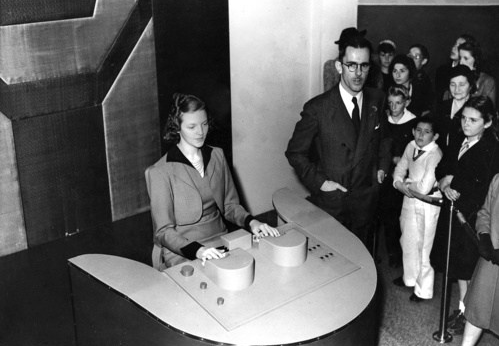
Whether from Stephen Hawking, Siri, or anyone in between, we’ve all heard quite a lot of electronically synthesized speech by now. But less than eighty years ago, the very idea of a human-sounding voice produced in a mechanical manner inspired wonder and disturbance in equal measure. The everyman and everywoman got their first chance to hear such a technology at the 1939 New York World’s Fair, during its hourly demonstrations of the very first speech synthesizer, the “Voder.” Who, they must have imagined as they stood before its booming square-jawed-Art-Deco-hero logo, could have invented such a thing?
Homer Dudley, an electronic and acoustic engineer at Bell Labs, had in the 1920s invented the “Vocoder” (or “Voice Operated reCorDER”), a device that could convert human speech into an electronic signal and then, somewhere else down the like, turn that signal back into speech again.
For the Voder (or “Voice Operation DEmonstratoR”) he took the initial voice out of the signal, creating a kind of synthesizer dedicated to the sounds of speech that one could operate manually, through an interface somewhat resembling that of an organ. Its controls (which you can see diagrammed at 120 Years of Electonic Music) presented a steep enough learning curve that fewer than thirty people, mostly the “girls” employed for the Voder’s demonstrations, ever learned to play it.
Though impressive for the time (the other feat of artificial humanity at that World’s Fair being Electro the Smoking Robot), “the Voder’s speech came out a little hard to understand, and even a bit unsettling,” according to Atlas Obscura. “The Voder was shown again during San Francisco’s Golden Gate International Exposition in late 1939, but after that, the machine disappeared almost instantly.” Speech synthesis itself, by contrast, had come to stay, though progress would remain relatively slow for the next four or five decades. Now, in the 21st century, it exists all around us, and despite considerable improvements in realism, its voices still retain a bit of the unearthly awkwardness of the Voder — and we probably wouldn’t have it any other way.
Related Content:
Download the Software That Provides Stephen Hawking’s Voice
Based in Seoul, Colin Marshall writes and broadcasts on cities and culture. He’s at work on a book about Los Angeles, A Los Angeles Primer, the video series The City in Cinema, the crowdfunded journalism project Where Is the City of the Future?, and the Los Angeles Review of Books’ Korea Blog. Follow him on Twitter at @colinmarshall or on Facebook.
Read More...Support Us
We're hoping to rely on loyal readers, rather than erratic ads. Please click the Donate button and support Open Culture. You can use Paypal, Venmo, Patreon, even Crypto! We thank you!

About Us

Open Culture scours the web for the best educational media. We find the free courses and audio books you need, the language lessons & educational videos you want, and plenty of enlightenment in between.
Advertise With Us

FREE UPDATES!
GET OUR DAILY EMAIL
Get the best cultural and educational resources on the web curated for you in a daily email. We never spam. Unsubscribe at any time.
FOLLOW ON SOCIAL MEDIA

Open Culture editor Dan Colman scours the web for the best educational media. He finds the free courses and audio books you need, the language lessons & movies you want, and plenty of enlightenment in between.
Advertise With Us

