Henry David Thoreau on When Civil Disobedience and Resistance Are Justified (1849)
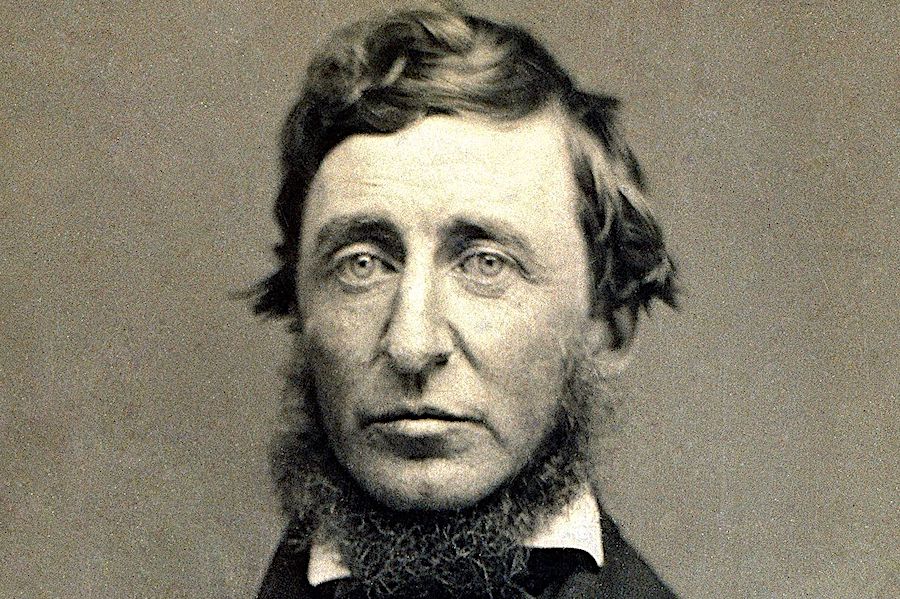
History is rife with examples of oppressive governments. The present is rife with examples of oppressive governments. You can name your own examples. The question that presents itself to any opposition is what is to be done? Go underground? Sabotage? Take up arms? The likelihood of success in such cases—depending on the belligerence of the opposition and the capabilities of the government—varies widely. But I see no moral reason to condemn people for fighting injustice, provided their cause itself is just. Neither, of course, did Henry David Thoreau, author of the 1849 essay “Civil Disobedience,” a document that every student of Political Philosophy 101 knows as an ur-text of modern democratic protest movements.
This is an essay we have become all-too familiar with by reputation rather than by reading. Thoreau’s political philosophy is not passive, as in the phrase “passive resistance.” It is not middle-of-the-road centrism disguised as radicalism. It lies instead at the watering hole where right libertarianism and left anarchism meet to have a drink. “I heartily accept the motto, ‘That government is best which governs least,’” wrote Thoreau, and ultimately “’That government is best which governs not at all.’”
Like many utopian theorists of the 19th century, Thoreau saw this as the inevitable future: “when men are prepared for it, that will be the kind of government they will have.” Thoreau laments all restrictions on trade and regulations on commerce. He also denounces the use of a standing army by “a comparatively… few individuals.” And yet—despite these radical positions—Thoreau has been enshrined in the history of political thought both for his radical tactics and his defense of preserving government, for the present.
“To speak practically and as a citizen,” he wrote, “unlike those who call themselves no-government men, I ask for, not at once no government, but at once a better government.” He does not go to great lengths, as classical philosophers were wont, to define the ideal government. It is radically democratic, that we know. But as to what constitutes injustice, Thoreau is clear:
When the friction comes to have its machine, and oppression and robbery are organized, I say, let us not have such a machine any longer. In other words, when a sixth of the population of a nation which has undertaken to be the refuge of liberty are slaves, and a whole country is unjustly overrun and conquered by a foreign army, and subjected to military law, I think that it is not too soon for honest men to rebel and revolutionize. What makes this duty the more urgent is the fact that the country so overrun is not our own, but ours is the invading army.
This people must cease to hold slaves, and to make war on Mexico, though it cost them their existence as a people.
The figure he cites of “a sixth of the population” is not erroneous. As W.E.B. Du Bois showed in one of his revolutionary 1900 sociological visualizations, during the time of Thoreau’s essay, one-sixth of the country’s population was indeed comprised of people of African descent, most of them enslaved. Thoreau wrote during debates over the impeding Fugitive Slave Act, a law that put every person of color in the expanding country—free or escaped, in every state and territory—at risk of enslavement or imprisonment without any due process.
Thoreau found both this developing nightmare and the Mexican-American war too intolerably unjust for the country to bear. And he recognized the limitations of elections to resolve them: “All voting is a sort of gaming… with a slight moral tinge to it,” he wrote, then observed with devastating irony, given total disenfranchisement of people who were property, that “Only his vote can hasten the abolition of slavery who asserts his own freedom by his vote.”
“Unjust laws exist,” writes Thoreau, “I say, break the law. Let your life be a counter-friction to stop the machine. What I have to do is to see, at any rate, that I do not lend myself to the wrong which I condemn.” Thoreau had put his dicta into practice already many years before. He had stopped paying his poll tax in 1842 to protest the war and the expansion of slavery. He was finally arrested and jailed for the offense in 1846. The incident hardly sparked a movement. He was bailed out, perhaps by his aunt, the following day. And as we well know, the Mexican-American war and the crisis of slavery were both resolved with… war.
But Thoreau used his experience as the basis for “Civil Disobedience,” which he wrote to a local audience in his home state of Massachusetts, and which went on to directly inspire the massively successful, national grassroots movements of Gandhi, Martin Luther King, Jr. and other non-violent Human Rights and Anti-War leaders around the world. So what did he recommend dissenters do? Here are the basics of his prescriptions, with his words in quotes:
“I do not hesitate to say, that those who call themselves Abolitionists should at once effectually withdraw their support, both in person and property, from the government of Massachusetts.” Thoreau then goes on to describe his particular form of resistance, the non-payment of tax. His thesis here, however, allows for any just refusals to recognize government authority.
“Under a government which imprisons any unjustly, the true place for a just man is also in prison.” Thoreau himself suffered little, it’s true, but millions who came after him—dissidents on all continents save Antarctica—have endured imprisonment, beating, and death. “Suppose blood should flow,” writes Thoreau, “Is there not a sort of blood shed when the conscience is wounded?” As for the justness of disobedience, Thoreau makes a very logical case: “If a thousand men were not to pay their tax-bills this year, that would not be a violent and bloody measure, as it would be to pay them, and enable the State to commit violence and shed innocent blood.”
Thoreau goes on to introduce a good deal of nuance into the argument, writing that community taxes supporting highways and schools are ethical, but those supporting unjust war and enslavement are not. He recommends discerning, thoughtful action. And he expected that the poor would undertake most of the resistance, because the burdens fell heaviest on them, and “because they who assert the purest right, and consequently are the most dangerous to a corrupt State, commonly have not spent much time in accumulating property.” This has generally, throughout history, been true.
The best thing a person of means can do, he writes, is “to endeavor to carry out those schemes which he entertained when he was poor.” Or, presumably, if one has never been so, to follow the poors’ lead. The paradox of Thoreau’s assertion that the least powerful present the greatest threat to the State resolves in his recognition that the State’s power rests not in its appeal to “sense, intellectual or moral” but in its “superior physical strength.” By simply refusing to yield to threats, anyone—even ordinary, powerless people—can deny the government’s authority, “until the State comes to recognize the individual as a higher and independent power, from which all its own power and authority are derived.”
Read Thoreau’s complete essay, “Civil Disobedience,” here.
Related Content:
Josh Jones is a writer and musician based in Durham, NC. Follow him at @jdmagness
Read More...An Animated, Monty Python-Style Introduction to the Søren Kierkegaard, the First Existentialist
When first I visited Copenhagen, I went over, as many tourists do, to the Assistens Cemetery to find the grave of Søren Kierkegaard. But for all of us who know the name of that 19th-century Danish philosopher, how many can claim even an acquaintance with the ideas that made his into a near-household name? The introductory video from Alain de Botton’s School of Life just above gets us started on forming that acquaintance with this “brilliant, gloomy, anxiety-ridden, often hilarious” thinker in a manner relevant to the problems of modern life, highlighting three of Kierkegaard’s best-known works: 1843’s Either/Or and Fear and Trembling and 1849’s The Sickness Unto Death.
In the first two, says de Botton in the role of the narrator, “what Kierkegaard wants us to do, above all, is wake up, and give up our cozy, sentimental illusions. He systematically attacks the pillars of modern life: our faith in family, our trust in work, our attachment to love, and our general sense that life has purpose and meaning.” He quotes the philosopher himself and his realization that “the meaning of life was to get a livelihood. That the goal of life was to be a high-court judge. That the brightest joy of love was to marry a well-off girl. That wisdom was what the majority said it was. That passion was to give a speech. That courage was to risk being fined $10. That cordiality was to say ‘You’re welcome’ after a meal, and that the fear of God was to go to Communion once a year. That’s what I saw, and I laughed.”
The direction in which this realization took Kierkegaard’s thought produced a body of work considered a precedent of the Existentialism explored in the 20th century by the likes of Martin Heidegger, Albert Camus, and Jean-Paul Sartre. “Marry, and you will regret it,” Kierkegaard wrote in Either/Or. “Don’t marry, you will also regret it. Marry or don’t marry, you will regret it either way. Laugh at the world’s foolishness, you will regret it. Weep over it, you’ll regret that, too. Hang yourself, you’ll regret it. Don’t hang yourself, and you’ll regret that, too. Whether you hang yourself or don’t hang yourself, you will regret both. This, gentlemen, is the essence of all philosophy.”
Kierkegaard stressed the then-new idea of angst, “a condition where we understand how many choices we face, and how little understanding we can ever have, of how to exercise these choices wisely.” Some might turn to religion for the solution, and so, in a way, did Kierkegaard, who “adored the simple truths of the Gospels” but “loathed the Christianity of the established Danish Church.” What an irony that his family name means “churchyard” in Danish, let alone that he should be buried in such a famous one himself. (Kierkegaard’s nephew protested the burial, which resulted in a fine for disrupting a funeral.) But to the extent that the philosopher’s presence there causes its pilgrims both casual and devoted to reflect seriously on the irresolvable contradictions still at the core of our lives, his mission (in de Botton’s words) “to save himself and, he thought, humanity,” continues.
Related Content:
Free Online Philosophy Courses
Download Walter Kaufmann’s Lectures on Nietzsche, Kierkegaard, Sartre & Modern Thought (1960)
Existential Philosophy of Kierkegaard, Sartre, Camus Explained with 8‑Bit Video Games
Philosophers Drinking Coffee: The Excessive Habits of Kant, Voltaire & Kierkegaard
Who Wrote at Standing Desks? Kierkegaard, Dickens and Ernest Hemingway Too
Based in Seoul, Colin Marshall writes and broadcasts on cities and culture. He’s at work on a book about Los Angeles, A Los Angeles Primer, the video series The City in Cinema, the crowdfunded journalism project Where Is the City of the Future?, and the Los Angeles Review of Books’ Korea Blog. Follow him on Twitter at @colinmarshall or on Facebook.
Read More...Free: Watch 92 Episodes of the Surrealist Cartoon, Space Ghost Coast to Coast, Featuring Björk, Thom Yorke & More
Head over to AdultSwim.com and you can watch online 92 episodes of Space Ghost Coast to Coast. Not familiar with the show? Here’s how Vox frames it:
One of the most deceptively influential series of the past several decades, Space Ghost took the characters from a junky old Hanna-Barbera series and inserted them into the middle of a talk-show setting, where they could have the most possibility for utter strangeness. Celebrities dropped by to be interviewed, while the rest of the show’s backstage shenanigans played out with an utterly straight face, even though one of the major characters was an evil praying mantis named Zorak. Was it terribly sophisticated? No. But it invented a whole new programming bloc — Adult Swim — and proved surrealism could sell in late-night TV.
Consequence of Sound is also quick to note that Space Ghost Coast to Coast “brought an impressive lineup of musical guests to the table, including Pavement, Dave Grohl, Thurston Moore, David Byrne, Thom Yorke, Willie Nelson, and Space Ghost’s “wife”, Björk.”
You can catch Björk and Radiohead’s Thom Yorke in the clips above. Watch all episodes here. And spend a moment thinking about the show’s animator, Clay Martin Croker, who recently died at the all-too-young age of 54.
If you would like to support the mission of Open Culture, consider making a donation to our site. It’s hard to rely 100% on ads, and your contributions will help us continue providing the best free cultural and educational materials to learners everywhere. You can contribute through PayPal, Patreon, and Venmo (@openculture). Thanks!
Related Content:
Download Over 22,000 Golden & Silver Age Comic Books from the Comic Book Plus Archive
Download 15,000+ Free Golden Age Comics from the Digital Comic Museum
Free Comic Books Turn Kids Onto Physics: Start with the Adventures of Nikola Tesla
Read More...Carl Sagan’s Ambitious College Reading List: Plato, Shakespeare, Gide, and Plenty of Philosophy, Math & Physics (1954)
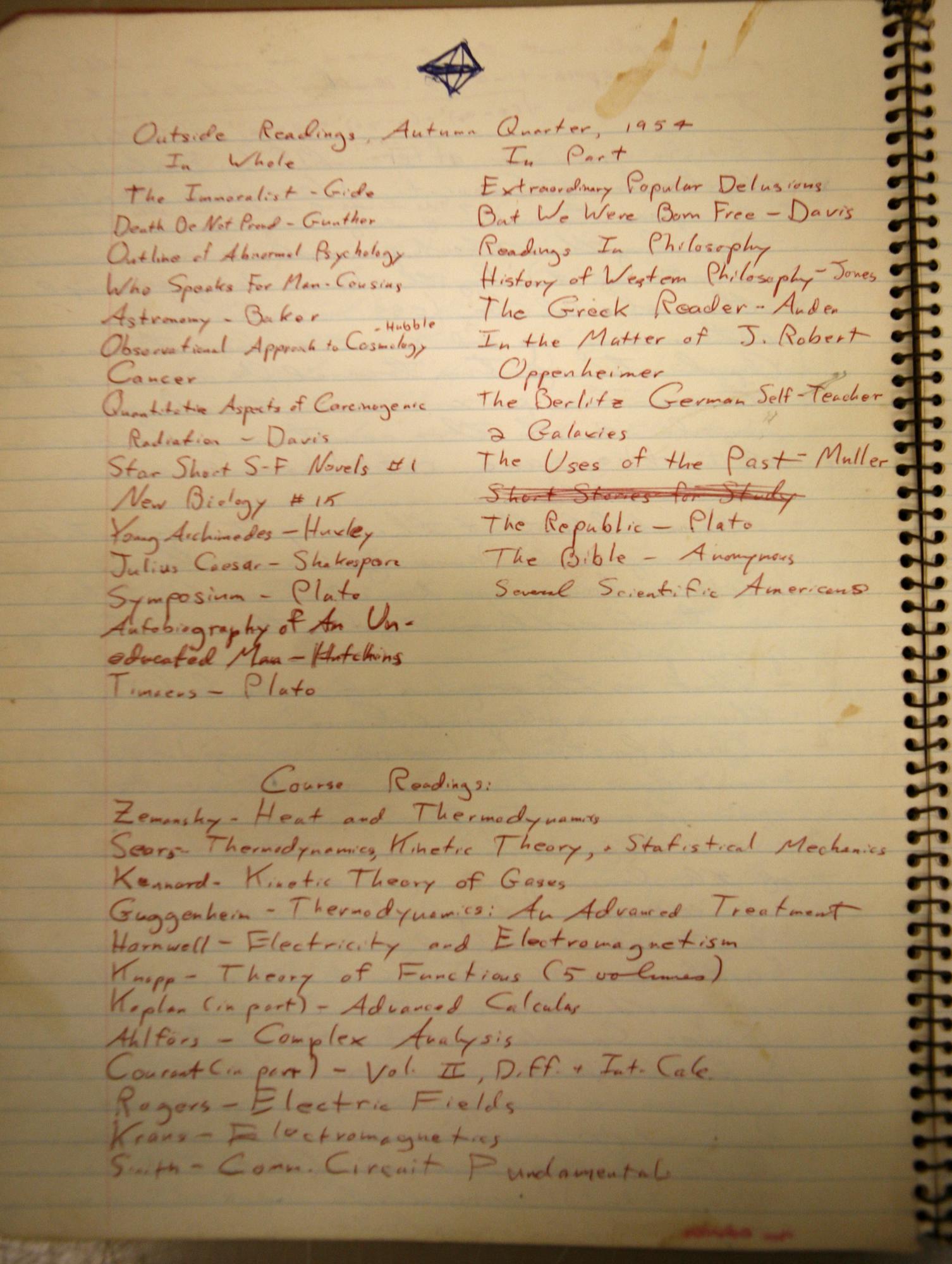
Carl Sagan may have passed away almost twenty years ago, but he continues to influence minds of all generations through intellectual heirs like Neil DeGrasse Tyson (host of the remake of Sagan’s beloved 1980 TV series Cosmos) as well as through the books he wrote in his lifetime. But what books influenced Sagan, launching him on the journey toward astronomy, cosmology, astrophysics, astrobiology, and global celebrity? Thanks to the Library of Congress’ Carl Sagan Archive, we now know at least forty titles from the no doubt voluminous amount of reading material he digested during his youth and education.
Sagan wrote this reading list (which a fan has transcribed with links and posted to Reddit) in 1954, as an undergraduate at the University of Chicago. On it he identifies the books, as a young Charles Darwin once wrote on his own list, to be read, whether wholly, partially, or as a part of his coursework:
In Whole
- The Immoralist — Andre Gide
- Death, Be Not Proud — John Gunther
- Outline of Abnormal Psychology - Gardner Murphy
- Who Speaks For Man — Norman Cousins
- Astronomy — Robert Baker
- Observational Approach to Cosmology — Robert Hubble
- Cancer
- Quantitative Aspects of Carcinogenic Radiation — Harold Thayer Davis
- Star Short Science Fiction Novels #1
- New Biology #15
- Young Archimedes — Aldous Huxley
- Julius Caesar — Shakespeare
- Symposium — Plato
- Autobiography of An Uneducated Man — Hutchins
- Timaeus — Plato
In Part
- Extraordinary Popular Delusions — Charles MacKay
- But We Were Born Free — Elmer Davis
- Readings In Philosophy
- History of Western Philosophy — W.T. Jones
- The Greek Reader — W.H. Auden
- In the Matter of J. Robert Oppenheimer
- The Berlitz German Self-Teacher
- Sigma Galaxies
- The Uses of the Past — Herbert J. Muller
- Short Stories for Study
- The Republic — Plato
- The Bible — Anonymous
- Several Scientific Americans
Course Readings:
- Heat and Thermodynamics - Mark Waldo Zemansky
- Thermodynamics, Kinetic Theory, Statistical Theory - Francis W. Sears
- Kinetic Theory of Gases — E.H. Kennard
- Thermodynamics: An Advanced Treatment — E.A. Guggenheim
- Electricity and Electromagnetism — Hornwell
- Theory of Functions (5 Volumes) — Konrad Knopp
- Advanced Calculus (in part) — Wilfred Kaplan
- Complex Analysis — Lars Ahlfors
- Vol. II, Differential and Integral Calculus — Richard Courant (Author)
- Electric Fields — Rugers
- Electromagnetics — John Daniel Kraus
- Communication Circuit Fundamentals — Carl Edwin Smith
Pretty ambitious material for a twenty-year-old, but remember: we’re talking about someone who, around a decade earlier, had already sketched out his ideas for humanity’s spacefaring future. It makes sense that such a child would grow up to read science fiction — and with the publication of Contact thirty years after that, write it — and even that he would take up mathematics and physics as a course of academic study.
But it takes a mind like Sagan’s not to lose sight of the importance of communicating with the nonspecialist public, as evidenced by the presence on his list of Scientific American and Extraordinary Popular Delusions. Nor did he neglect, even before his career began, the need to contextualize scientific discoveries in the realm of human thought and feeling, which extends from Plato and the Bible to Shakespeare, André Gide, and John Gunther — that last writer’s work, and certain other volumes on his list, also showing an advanced consciousness of human limitations and mortality. All of it placed Sagan well, despite his truncated time on Earth, to do work that will outlast us all.
Related Content:
See Carl Sagan’s Childhood Sketches of The Future of Space Travel
Carl Sagan Presents His “Baloney Detection Kit”: 8 Tools for Skeptical Thinking
Carl Sagan on the Virtues of Marijuana (1969)
Neil deGrasse Tyson Lists 8 (Free) Books Every Intelligent Person Should Read
Based in Seoul, Colin Marshall writes and broadcasts on cities and culture. He’s at work on a book about Los Angeles, A Los Angeles Primer, the video series The City in Cinema, the crowdfunded journalism project Where Is the City of the Future?, and the Los Angeles Review of Books’ Korea Blog. Follow him on Twitter at @colinmarshall or on Facebook.
Read More...Watch Dave Chappelle’s Saturday Night Live Monologue: “We’ve Elected an Internet Troll as Our President”
Dave Chappelle hosted SNL last night and gave us the comic relief we needed. And also a few heartfelt thoughts about what a Trump presidency means for our imperiled nation. The most poignant part comes at the very end:
You know, before I go, I do want to say one thing, and this is not a joke. But I think it’s important that I say this, ’cause they’re marching up the street right now as we speak.
A few weeks ago I went to the White House for a party. It was the first time I’ve been there in many years and it was very exciting. And BET sponsored the party, so everyone there was black. And it was beautiful. I walked through the gates — you know, I’m from Washington, so I saw the bus stop, or the corner where the bus stop used to be, where I used to catch the bus to school and dream about nights like tonight.
It was a really, really beautiful night. At the end of the night everyone went into the West Wing of the White House and it was a huge party. And everybody in there was black — except for Bradley Cooper, for some reason.
And on the walls were pictures of all the presidents, of the past. Now, I’m not sure if this is true, but to my knowledge the first black person that was officially invited to the White House was Frederick Douglass. They stopped him at the gates. Abraham Lincoln had to walk out himself and escort Frederick Douglass into the White House, and it didn’t happen again, as far as I know, until Roosevelt was president. Roosevelt was president, he had a black guy over and got so much flack from the media that he literally said, “I will never have a n—-r in this house again.”
I thought about that, and I looked at that black room, and saw all those black faces, and Bradley, and I saw how happy everybody was. These people who had been historically disenfranchised. It made me feel hopeful and it made me feel proud to be an American and it made me very happy about the prospects of our country.
So, in that spirit, I’m wishing Donald Trump luck. And I’m going to give him a chance, and we, the historically disenfranchised, demand that he give us one too. Thank you very much.
You also shouldn’t miss Kate McKinnon’s two-for-one tribute to Hillary Clinton and Leonard Cohen. What a talent she is.
And for any educated white liberal, this skit will surely hit home:
Looking for free, professionally-read audio books from Audible.com? Here’s a great, no-strings-attached deal. If you start a 30 day free trial with Audible.com, you can download two free audio books of your choice. Get more details on the offer here.
If you would like to support the mission of Open Culture, consider making a donation to our site. It’s hard to rely 100% on ads, and your contributions will help us continue providing the best free cultural and educational materials to learners everywhere. You can contribute through PayPal, Patreon, and Venmo (@openculture). Thanks!
Related Content:
President Obama’s 2016 Stand-Up Comedy Routine
William S. Burroughs on Saturday Night Live, 1981
Alec Baldwin Does a Perfect Donald Trump: Watch SNL’s Spoof of the Trump-Clinton Debate
Read More...David Bowie’s “Rebel Rebel” Performed Live by The Biggest Rock Band on Earth (1,000 Musicians in Total)
Feeling a little rebellious today? Ready to take on the great con? This will help get you going.
Above, watch the biggest rock band on earth–1,000 members strong–perform a rousing version of David Bowie’s “Rebel Rebel” (1974). This cracking performance took place last summer in Cesena, Italy–roughly a year after the collective gave a similar treatment to the Foo Fighters’ “Learning to Fly.” Hopefully other songs recorded that night will eventually appear on Rockin’ 1000’s YouTube channel. Who knows, maybe there’s a version of the Stones’ “Street Fighting Man” still to come.
Looking for free, professionally-read audio books from Audible.com? Here’s a great, no-strings-attached deal. If you start a 30 day free trial with Audible.com, you can download two free audio books of your choice. Get more details on the offer here.
Related Content:
1,000 Musicians Perform Foo Fighters’ “Learn to Fly” in Unison in Italy
Dave: The Best Tribute to David Bowie That You’re Going to See
David Bowie & Brian Eno’s Collaboration on “Warszawa” Reimagined in Comic Animation
Read More...Watch Moebius and Miyazaki, Two of the Most Imaginative Artists, in Conversation (2004)
The worlds so thoroughly imagined by the French comic artist Jean Giraud, better known as Moebius, and the Japanese animator Hayao Miyazaki, immediately recognized the world over by his family name alone, could have arisen from no other artistic minds. It stands to reason not only that appreciators of one would appreciate the other, but that the two men would hold each other’s work in high regard. “Japanese animation is impressive,” Moebius once said to Miyazaki as the two expressed their mutual appreciation. “I really think it is the best in the world, and Miyazaki’s work is top in Japan.”
“Moebius first discovered Miyazaki’s work in 1986, when his son Julien (then a schoolboy) showed him a pirate copy of a video containing a titleless, authorless, and undubbed animated feature,” writes Dani Cavallaro in The Anime Art of Hayao Miyazaki. “The French artist was instantly seduced by the film’s graphic vigor and technical inventiveness but took it to be the one-off accomplishment of an unfamed animator. When he eventually discovered that the film’s name was Nausicaä of the Valley of the Wind and that its creator’s name was Hayao Miyazaki, Moebius endeavored to delve deeper into the Japanese animator’s oeuvre and to publicly voice his admiration.”
And Miyazaki turns out to have drawn inspiration from Moebius when he focused on animation. Miyazaki, who began as a comic artist himself, remembers discovering Moebius through Arzach, his series of wordless visual stories of a hero who rides a pterodactyl through otherwordly and forbiddingly sublime landscapes. “It was a big shock,” says Miyazaki. “Not only for me. All manga authors were shaken by this work. Unfortunately when I discovered it, I already had a consolidated style. So I couldn’t use his influence to enrich my drawing. Though, even today, I think he has an awesome sense of space. I directed Nausicaä under Moebius’ influence.”
In 2004, the exhibition Miyazaki/Moebius presented brought them together in Paris. Cavallaro describes it as “a panoramic survey of the two artists’ careers through 300 works including watercolors storyboards, cels and concept designs, thematically arranged, drawn from their personal collections,” including a drawing of Nausicaä by Moebius and one of Arzach by Miyazaki. They also sat down there for the conversation recorded in the video above. “The 21st century is a tricky time,” says Miyazaki. “Our future isn’t clear. We need to re-examine many things we’ve taken for granted, whether it’s our common sense or our way of thinking.” The sheer imaginative power of artists like the both of them continues to show us the way forward.
You can read transcripts of their recorded conversations here and here.
Related Content:
Moebius Gives 18 Wisdom-Filled Tips to Aspiring Artists (1996)
Watch Hayao Miyazaki Animate the Final Shot of His Final Feature Film, The Wind Rises
Watch Groundbreaking Comic Artist Mœbius Draw His Characters in Real Time
Based in Seoul, Colin Marshall writes and broadcasts on cities and culture. He’s at work on a book about Los Angeles, A Los Angeles Primer, the video series The City in Cinema, the crowdfunded journalism project Where Is the City of the Future?, and the Los Angeles Review of Books’ Korea Blog. Follow him on Twitter at @colinmarshall or on Facebook.
Read More...Say Goodbye to Leonard Cohen Through Some of His Best-Loved Songs: “Hallelujah,” “Suzanne” and 235 Other Tracks
Another epitaph for another fallen star, another beloved icon, another brilliant musician who was also a brilliant human being. I do not want to tell you what you already know, that Leonard Cohen died last night at age 82. Cohen, it seems, accepted it, just as David Bowie accepted his death, and both poured their acceptance into one final record. Will we talk about You Want It Darker in the same awed tones as David Bowie’s Blackstar—as a knowing last letter of mixed hope and despair, a cryptic time capsule that opens a little bit more as the months ahead wear on?
If you are the dealer, I’m out of the game
If you are the healer, it means I’m broken and lame
If thine is the glory then mine must be the shame
You want it darker
We kill the flame
.… I’m ready, my lord
No matter what he had in mind, we cannot but see these lines now as a last testament. Cohen not only faced his own mortality, but this year lost his longtime lover and muse Marianne Ihlen to cancer. “I think I will follow you soon,” he wrote to her just before her death. “You Want It Darker” ties together the personal, the political, the spiritual, and the literary in a prophetic lament, weaving his struggle into all of ours. There are no answers, but “There’s a lullaby for suffering,” Cohen writes, then warns, “And a paradox to blame.” The compression of these lines belies a tremendous depth of religious and philosophical sentiment, the weight—it feels in Cohen’s last album—of the world.
But then this describes the music he made 30 years ago. And 50 years ago. “Cohen’s songs are death-haunted,” writes David Remnick, “but then they have been since his earliest verses.” He released his first album in 1967, followed two years later by Songs from a Room, the hallowed document of some of his best-loved songs: “Bird on the Wire,” “Story of Isaac,” “Tonight Will Be Fine,” and “The Partisan.” Cohen did not write that last one, and yet, though he “is often incorrectly credited as the composer of the song,” writes Alex Young at Consequence of Sound, “he is certainly responsible for its survival.”
Cohen universalizes the original French version; “the English lyrics contain no references to France or the Nazi occupation.” It spoke directly to the broken partisans in both France and the U.S. post-1968, a year very much like this one, wracked with violence, upheaval, tragedy, and resistance. Few songwriters have been able to consistently address the irrational passion, violence, and almost crushing determination of so much human experience with as much wisdom as Cohen, even if he downplayed what Remnick calls “the mysteries of creation” in his work, telling the New Yorker editor in one of his final interviews last month, “I have no idea what I am doing.”
Yet, almost no songwriter has inspired so much volubility from Bob Dylan, who spoke to Remnick at length about the fine intricacies of Cohen’s “counterpoint lines.” “His gift or genius,” said Dylan, “is in his connection to the music of the spheres.” Cohen’s lyrical sophistication charted his heterodox embrace of Judaism and Zen Buddhism, and his fascination with Christianity. But before he arrived in New York as a “musical novice” at thirty-two and became a mystical folk troubadour, he was a highly-regarded and controversial poet and novelist, a “bohemian with a cushion” from a Montreal Jewish family “both prominent and cultivated.” He even had a documentary about him made in 1965.
Cohen began publishing poetry in college and put out his first collection at 22, then moved to the Greek island of Hydra, where he met Marianne and published several more collections and two novels. Later while living in London, he wrote to his publisher about his desire to write for “inner-directed adolescents, lovers in all degree of anguish, disappointed Platonists, pornography-peepers, hair-handed monks and Popists.” (His onetime lover Joni Mitchell dismissed him as a “boudoir poet.”) Cohen more than achieved this aim as a songwriter, doing as much, perhaps, as Nico—whom he once pined for and maybe partly imitated—to inspire 80s Goths and New Romantics.
The dark eroticism in his work did not recede when, “frustrated by poor book sales,” writes Rolling Stone, “Cohen visited New York in 1966 to investigate the city’s robust folk-rock scene.” There, under the encouragement of Judy Collins, he “quickly became the songwriter’s songwriter of choice for artists like Collins, James Taylor, Willie Nelson and many others.” His first hit, “Suzanne,” above, vividly imagines Renaissance love scenes and echoes with the refrain “her perfect body,” while also imbuing its fleeting moments with the depth of sadness Cohen’s spacious baritone contained. Later albums like the Phil Spector-produced (and uncharacteristically loud) Death of a Ladies’ Man treat with sneering irony his “unbridled sexuality and brutal voyeurism.”
Cohen looked unflinchingly and with monkish intensity at his own excesses and weakness, and at ours, and saw them, tragic and beautiful, as our only strengths. “There is a crack in everything,” he sang in 1992’s “Anthem”—live in London below—“that’s how the light gets in.” No tribute can leave out his most beloved and most covered song—one of the most covered and beloved songs ever written— “Hallelujah.” From its best-known Jeff Buckley version in 1994 to Rufus Wainwright’s and countless others, the song instantly conjures gravitas and stirs deep wells of emotion in the secular and religious alike. First released in 1984 on Cohen’s album Various Positions, it attracted little attention at first.
His version lacks the high gospel drama of many interpretations, despite the backing gospel choir, but his loping barroom delivery and lounge-pop backing music work in hypnotic dissonance. It’s a song that took him five years to write. (Malcolm Gladwell has a whole podcast dedicated to the writing of the song.) “He drafted dozens of verses,” writes Remnick, around 80, “and then it was years before he settled on a final version.” Dylan performed the song in the late eighties, “as a roughshod blues.” In conversation with Remnick, Dylan paused his very detached evaluation of Cohen’s technical genius to remark it’s “the point-blank I‑know-you-better-than-you-know-yourself aspect of the song [that] has plenty of resonance for me.” I think we’ll find that to be true of Leonard Cohen the more we unpack his austere, sensual, profoundly lyrical-in-the-most-ancient-of-ways body of work.
Related Content:
Ladies and Gentlemen… Mr. Leonard Cohen: The Poet-Musician Featured in a 1965 Documentary
Leonard Cohen Recounts “How I Got My Song,” or When His Love Affair with Music Began
The Poetry of Leonard Cohen Illustrated by Two Short Films
Rufus Wainwright and 1,500 Singers Sing Leonard Cohen’s “Hallelujah”
Leonard Cohen Reads The Great World War I Poem, “In Flanders Fields”
Josh Jones is a writer and musician based in Durham, NC. Follow him at @jdmagness
Read More...An Animated Version of Ridley Scott’s Blade Runner Made of 12,597 Watercolor Paintings
Three years ago Swedish artist Anders Ramsell created this 35 minute condensed version of Blade Runner, frame by frame, using watercolors. Blade Runner: The Aquarelle Edition contains 12,597 impressionistic works on waterlogged artist paper that together present, if not a faithful representation of Ridley Scott’s film, then a remembrance of the film.
It’s as if you booted up a replicant film fan and had them try to reconstruct Blade Runner from memory. (Ramsell himself calls it a “paraphrase” of the film.) It’s recognizable, but due to the lightness and fuzzy lines of watercolor, there’s also a magic to these images. (This is also due to the small size of each frame, 1.5 x 3 cm.)
The film is a jump forward from Ramsell’s other works. Before 2011, he was dabbling in various media: nudes in ink on canvas, abstract acrylic splotches, surreal drawings that explore horses and pregnancy. Diving into Blade Runner and the amazing amount of work to produce this film did the trick. Ramsell has taken on this technique as worthy of further exploration and made a newer film, Genderness, which explores transsexuality, and features a narration by none other than Rutger Hauer, who decided to work with Ramsell after seeing, Blade Runner: The Aquarelle Edition. Watch it above.
Related Content:
The Blade Runner Sketchbook Features The Original Art of Syd Mead & Ridley Scott (1982)
Blade Runner is a Waste of Time: Siskel & Ebert in 1982
Wes Anderson Movie Sets Recreated in Cute, Miniature Dioramas
Ted Mills is a freelance writer on the arts who currently hosts the artist interview-based FunkZone Podcast. You can also follow him on Twitter at @tedmills, read his other arts writing at tedmills.com and/or watch his films here.
Read More...Young Frank Zappa Plays the Bicycle on The Steven Allen Show (1963)
Artists in turbulent times often must resort to extreme measures to compensate for the general state of cultural disorder. How can one be heard over the sounds of civil unrest? Dada and surrealist artists adopted an archly gibberish music hall idiom during World War I. Amidst the tumult of the 60s, some avant-gardists like Frank Zappa used more populist means, an ostensibly rock and roll format and image, as a vehicle for his influential classical-prog-jazz.
Like the first Dadaists, however, Zappa was a physical artist. He started small in the early sixties, if you can call an appearance on the Steve Allen Show small. The act certainly seems so at first. A young Zappa, clean-shaven with a well-tailored suit and dapper haircut, appears solo on Allen’s show. He’s taciturn at first during the interview, admitting that he can play guitar, vibes, bass, and drums. He has chosen, however, to help the audience recover what he suggests is a childhood delight, playing the bicycle. “How long have you been playing bike, Frank?” Allen asks. “About two weeks,” says Zappa, getting his first big laugh.
Zappa also talks about an early, pre-Mothers of Invention project, scoring the 1962 film The World’s Greatest Sinner, which he calls “the world’s worst movie.” The film, it turned out, didn’t air until 50 years later (Martin Scorsese names it as a favorite). But the mention gives Zappa a chance to show off how much he knows about composing for a 55-piece orchestra. Allen seems unimpressed, and remains so when Zappa begins his performance art. Then the gag strays into a Salvador Dali spoof via a John Cage performance, with Zappa as the weird, debonair straight man to Allen’s mouthy comic.
Zappa plays both the right-side-up and the upside-down bike, which involve different techniques. Though it all, he keeps up the patter of a seasoned showman, the directness of a determined bandleader, and a straight face. And perhaps that’s really what’s on display here—not the bicycle as a musical instrument, but the physical act of playing and conducting, using precise movements and sequences to elicit specific effects. For all the humor, there’s no reason not to think Zappa isn’t completely serious about all of this, as it expands into the kind of organized chaos only he could so masterly orchestrate.
Related Content:
Hear the Musical Evolution of Frank Zappa in 401 Songs
Josh Jones is a writer and musician based in Durham, NC. Follow him at @jdmagness
Read More...Support Us
We're hoping to rely on loyal readers, rather than erratic ads. Please click the Donate button and support Open Culture. You can use Paypal, Venmo, Patreon, even Crypto! We thank you!

About Us

Open Culture scours the web for the best educational media. We find the free courses and audio books you need, the language lessons & educational videos you want, and plenty of enlightenment in between.
Advertise With Us

FREE UPDATES!
GET OUR DAILY EMAIL
Get the best cultural and educational resources on the web curated for you in a daily email. We never spam. Unsubscribe at any time.
FOLLOW ON SOCIAL MEDIA

Open Culture editor Dan Colman scours the web for the best educational media. He finds the free courses and audio books you need, the language lessons & movies you want, and plenty of enlightenment in between.
Advertise With Us

