Franz Kafka Story Gets Adapted into an Award-Winning Australian Short Film: Watch Two Men
“When you go walking by night up a street and a man, visible a long way off — for the street mounts uphill and there is a full moon — comes running toward you, well, you don’t catch hold of him, not even if he is a feeble and ragged creature, not even if someone chases yelling at his heels, but you let him run on.” Good advice, you might think, “for it is night, and you can’t help it if the street goes uphill before you in the moonlight, and besides, these two have maybe started that chase to amuse themselves, or perhaps they are both chasing a third, perhaps the first is an innocent man and the second wants to murder him and you would become an accessory.”
Or “perhaps they don’t know anything about each other and are merely running separately home to bed, perhaps they are night birds, perhaps the first man is armed. And anyhow, haven’t you a right to be tired, haven’t you been drinking a lot of wine? You’re thankful that the second man is now long out of sight.” So goes the entirety of “Passers-by,” a very short story — one might now use the label “flash fiction” — written sometime between 1908 and 1913 by none other than Franz Kafka. If short stories make more suitable bases for feature-length films than novels do, surely extra-short stories do the same for short films. Director Dominic Allen tested that idea in 2009 with Two Men, the adaptation of “Passers-by” above.
Allen has also made the bold move of transplanting the story from Kafka’s home turf of a vague and allegorical Europe to the Kimberley, the northern tip of Western Australia and one of the first settled parts of the continent — not by Europeans, but probably by pre-Indonesians of 41,000 years ago. “My hope was that by retelling a hundred year old philosophical tale set in European city at night in such a different context as deep in the Australian Kimberley in the heat of a sunny day and by having it retold by a modern Indigenous thinker,” writes Allen, “I would affirm an element of humanity’s commonality.”
Two Men also happened to win him the Emerging Australian Filmmaker Award at the Melbourne International Film Festival and the 2009 Inside Film Rising Talent Award, but his other more immediate goals included celebrating “the robust and healthy youth of Fitzroy Crossing,” the town in which he and his collaborators filmed, and to “reinforce Kafka’s point that it’s impossible to ever truly know another’s motivations.” Or, in the locally inflected words of the short’s motionless observer-narrator, “You just bloody never know.”
Two Men will be added to our collection, 4,000+ Free Movies Online: Great Classics, Indies, Noir, Westerns, Documentaries & More.
Related Content:
Franz Kafka: An Animated Introduction to His Literary Genius
Franz Kafka: The Animated Short Film
Orson Welles Narrates Animated Version of Kafka’s Parable, “Before the Law”
Kafka’s Nightmare Tale, ‘A Country Doctor,’ Told in Award-Winning Japanese Animation
Vladimir Nabokov (Channelled by Christopher Plummer) Teaches Kafka at Cornell
Prague’s Franz Kafka International Named World’s Most Alienating Airport
Based in Seoul, Colin Marshall writes and broadcasts on cities and culture. He’s at work on a book about Los Angeles, A Los Angeles Primer, the video series The City in Cinema, the crowdfunded journalism project Where Is the City of the Future?, and the Los Angeles Review of Books’ Korea Blog. Follow him on Twitter at @colinmarshall or on Facebook.
Read More...Watch Soundbreaking, PBS’ 8‑Part Documentary Exploring the History of Recorded Music (Free for a Limited Time)
Update: After making the videos available for a couple of weeks, PBS has now taken them down. If you’re really interested in watching Soundbreaking, you can purchase it in DVD format. It’s worth it.
From November 14 through November 23, PBS is airing an eight-part series, Soundbreaking, which explores the art of recording music and the moments when new sounds were born. The series features “more than 160 original interviews with some of the most celebrated recording artists of all time,” highlighting the “cutting-edge technology” that transformed the way we make music. You can now stream 3 of the first 8 episodes online, with the rest soon to come. If there are any geo-restrictions, we apologize in advance.
Watch the first episode, “The Art of Recording,” up top. Legendary producers like Brian Eno, Daniel Lanois, Quincy Jones, Tony Visconti, Rick Rubin and George Martin all make appearances.
A new episode should appear each day. To find them, click here and then scroll down.
If you would like to support the mission of Open Culture, consider making a donation to our site. It’s hard to rely 100% on ads, and your contributions will help us continue providing the best free cultural and educational materials to learners everywhere. You can contribute through PayPal, Patreon, and Venmo (@openculture). Thanks!
Related Content:
265 Free Documentaries Online
All Hail the Beat: How the 1980 Roland TR-808 Drum Machine Changed Pop Music
Take a Virtual Tour of Abbey Road Studios, Courtesy of the New Google Site “Inside Abbey Road”
Read More...Zen Master Alan Watts Explains What Made Carl Jung Such an Influential Thinker
The twentieth century produced a fair few thinkers on the human mind whose observations still resonate today. The Swiss psychiatrist and psychotherapist Carl Gustav Jung certainly appears in that group, as does the British philosopher and interpreter of Buddhism Alan Watts, and though not a week goes by when I don’t hear their words cited, I seldom hear the words of both of them cited by the same person. Though nearly two generations (among other things) separated Watts and Jung, the two men did once meet, in 1958, as Watts traveled through Europe with his father. Three years later, Jung passed on and Watts recorded the lecture above.
What made Jung such an important observer of humanity? Watts points to “one fundamental principle that underlay all his work and that was most extraordinarily exemplified in Jung himself as a person,” which he calls Jung’s “recognition of the polarity of life. That is to say, his resistance to what is to my mind the disastrous and absurd hypothesis, that there is in this universe a radical and absolute conflict between good and evil, light and darkness that can never never never be harmonized.”
He goes on to talk for a little under an hour about about Jung himself, Jung’s influence on his own work as a “comparative philosopher,” and the continuing relevance of Jung’s ideas to the modern world — all of which he ties together in an integrated tribute to this “integrated character.”
“There is a nice German word, hintergedanken, which means a thought in the very far far back of your mind,” says Watts. “Jung had a hintergedanken in the back of his mind that showed in the twinkle in his eye. It showed that he knew and recognized what I sometimes call the element of irreducible rascality in himself. And he knew it so strongly and so clearly, and in a way so lovingly, that he would not condemn the same thing in others, and would therefore not be led into those thoughts, feelings, and acts of violence towards others which are always characteristic of the people who project the devil in themselves upon the outside, upon somebody else, upon the scapegoat.” And so, whether we enter into this field of thought through Watts, through Jung, or through anyone else, it always seems to comes back to the ancient Greeks: “Know thyself.”
Related Content:
Carl Jung’s Hand-Drawn, Rarely-Seen Manuscript The Red Book: A Whispered Introduction
Carl Jung Explains His Groundbreaking Theories About Psychology in Rare Interview (1957)
Carl Jung’s Fascinating 1957 Letter on UFOs
Based in Seoul, Colin Marshall writes and broadcasts on cities and culture. He’s at work on a book about Los Angeles, A Los Angeles Primer, the video series The City in Cinema, the crowdfunded journalism project Where Is the City of the Future?, and the Los Angeles Review of Books’ Korea Blog. Follow him on Twitter at @colinmarshall or on Facebook.
Read More...Philosopher Richard Rorty Chillingly Predicts the Results of the 2016 Election … Back in 1998
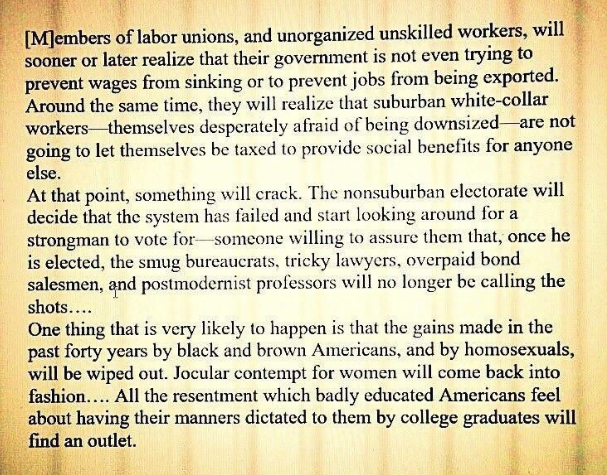
Twenty years ago a strong academic left in universities all over the world spoke to political culture the way that a globalized nationalist far-right seems to now. Among public intellectuals in the U.S., Richard Rorty’s name held particular sway. Yet in his contrarian 1998 book Achieving Our Country, Rorty argued against the participation of philosophy in politics. A member of the so-called “Old Left,” or what he called the “reformist left,” Rorty took on the “Cultural Left” in ways we now hear in (often bitter) debates between similar camps. In the course of his attacks, he made the uncanny prediction above.
The cultural left, wrote Rorty, had come “to give cultural politics preference over real politics, and to mock the very idea that democratic institutions might once again be made to serve social justice.” He foresaw cultural politics on the left as contributing to a tidal wave of resentment that would one day result in a time when “all the sadism which the academic left has tried to make unacceptable to its students will come flooding back.”
As democratic institutions fail, he writes in the quote above:
[M]embers of labor unions, and unorganized unskilled workers, will sooner or later realize that their government is not even trying to prevent wages from sinking or to prevent jobs from being exported. Around the same time, they will realize that suburban white-collar workers—themselves desperately afraid of being downsized—are not going to let themselves be taxed to provide social benefits for anyone else.
At that point, something will crack. The nonsuburban electorate will decide that the system has failed and start looking around for a strongman to vote for—someone willing to assure them that, once he is elected, the smug bureaucrats, tricky lawyers, overpaid bond salesmen, and postmodernist professors will no longer be calling the shots. A scenario like that of Sinclair Lewis’ novel It Can’t Happen Here may then be played out. For once a strongman takes office, nobody can predict what will happen. In 1932, most of the predictions made about what would happen if Hindenburg named Hitler chancellor were wildly overoptimistic.
One thing that is very likely to happen is that the gains made in the past forty years by black and brown Americans, and by homosexuals, will be wiped out. Jocular contempt for women will come back into fashion. The words [slur for an African-American that begins with “n”] and [slur for a Jewish person that begins with “k”] will once again be heard in the workplace. All the sadism which the academic Left has tried to make unacceptable to its students will come flooding back. All the resentment which badly educated Americans feel about having their manners dictated to them by college graduates will find an outlet.
He also then argues, however, that this sadism will not solely be the result of “economic inequality and insecurity,” and that such explanations would be “too simplistic.” Nor would the strongman who comes to power do anything but worsen economic conditions. He writes next, “after my imagined strongman takes charge, he will quickly make his peace with the international superrich.”
Rorty blamed the Marxist New Left for “retreating from pragmatism into theory,” wrote The New York Times in its review of Achieving Our Country. He felt the cultural left had abandoned the “American experiment as secular, anti-authoritarian and infinite in possibilities,” such as “Whitman idealized as loving relationships and Dewey as good citizenship.” The Times wrote then that Rorty’s predictions above were a form of “intellectual bullying.” We can take our dystopian futures from sci-fi novelists and filmmakers, but when philosophers “haruspicate or scry,” as T.S. Eliot wrote in “The Dry Salvages,” we tend to dismiss it as the “usual / Pastimes and drugs, and features of the press.”
The eminent Stanford professor exhorted his contemporaries to leave behind “semiconscious anti-Americanism” and embrace pragmatic civil engagement, and did so by offering up examples from American literature and philosophy that all had fierce activist strains. Excoriating one kind of life of the mind, Rorty can’t help but offer another. “What does Rorty offer as a solution?” asked the Times review, “Not really very much.” Perhaps not to politicians. But to the postmodern academics and writers he accused, he offers up as counter examples Walt Whitman, John Dewey, and—as Rorty noted in an interview—James Baldwin, whose “use of the phrase… achieving our country” inspired his book’s title, Achieving Our Country.
Related Content:
John Searle on Foucault and the Obscurantism in French Philosophy
Huxley to Orwell: My Hellish Vision of the Future is Better Than Yours (1949)
Josh Jones is a writer and musician based in Durham, NC. Follow him at @jdmagness.
Read More...Metallica Playing “Enter Sandman” on Classroom Toy Instruments
Things getting too serious around here? You want it lighter? Here’s Metallica playing “Enter Sandman” on classroom toy instruments. It features James Hetfield on the toy clarinet, Lars Ulrich on the Fisher Price Drum and toy cymbals, Kirk Hammett on the Melodica, and Robert Trujillo on the Baby Electric Axe. They’re joined by Jimmy Fallon on the kazoo. Next up, stunning, breathtaking timelapse films of boats sailing through Venetian canals.
If you would like to support the mission of Open Culture, consider making a donation to our site. It’s hard to rely 100% on ads, and your contributions will help us continue providing the best free cultural and educational materials to learners everywhere. You can contribute through PayPal, Patreon, and Venmo (@openculture). Thanks!
Related Content
A Bluegrass Version of Metallica’s Heavy Metal Hit, “Enter Sandman”
Finnish Musicians Play Bluegrass Versions of AC/DC, Iron Maiden & Ronnie James Dio
Read More...Iconic Footage of Jimi Hendrix Playing “Hey Joe” Rendered in the Style of Moebius, with the Help of Neural Network Technology
We are less than a year into neural network technology, and Google’s Deep Dream software is already yielding impressive results beyond the dog-slugs of its first videos. YouTuber Lulu xXX has been playing around with blending art with music videos, and is onto something with this clip that meshes iconic live footage of the Jimi Hendrix Experience (featured below) with the art of Jean Giraud aka Moebius.
The French cartoonist and illustrator was a big fan of Hendrix. He designed the covers of a French compilation LP of Hendrix’s first two albums, and included him in several art prints, where the musician is a cool, often angelic presence.
So Lulu xXX rightly chose Moebius’ particular style through which to process this iconic “Hey Joe” footage recorded in 1967. As you see, when the neural network is fed more line-based work, it truly does get close to “Moebius animates Hendrix.” Watch the side-by-side version below and let us know what you thinks works best.
In a few more years, this video may seem charmingly naive as neural networking improves. Think how Pixar evolved, or how video games developed. The results may be so good that we won’t know if we’re seeing something handmade or a perfect simulation. We might have to lean over and ask our Jimi Hendrix hologram to tell us the truth.
via Laughing Squid
Related content:
Moebius Gives 18 Wisdom-Filled Tips to Aspiring Artists (1996)
Moebius’ Storyboards & Concept Art for Jodorowsky’s Dune
Jimi Hendrix Wreaks Havoc on the Lulu Show, Gets Banned From BBC (1969)
Ted Mills is a freelance writer on the arts who currently hosts the FunkZone Podcast. You can also follow him on Twitter at @tedmills, read his other arts writing at tedmills.com and/or watch his films here.
Read More...The New York Times’ First Profile of Hitler: His Anti-Semitism Is Not as “Genuine or Violent” as It Sounds (1922)
I’ve heard it again and again. The now President-elect made vicious and belittling attacks on African-Americans, Muslims, immigrants, women, the disabled, etc. during the campaign season (and for several decades before), but he didn’t mean it. And I have many questions. For example, why should anyone assume—given the history of country after country after country—that a bullying nativist autocrat doesn’t mean what he says?
We know celebrity breeds trivialization. But we also know well that in some of the most famous—but by no means only—cases of demagogues who rose to power with hate speech, the rhetoric quickly turned to many years of incomprehensible, yet calculated, brutality. At least in the U.S., hardly anyone believed that the melodramatic vitriol Hitler and Mussolini spat at scapegoats of all kinds, especially Jews, should be taken very seriously.
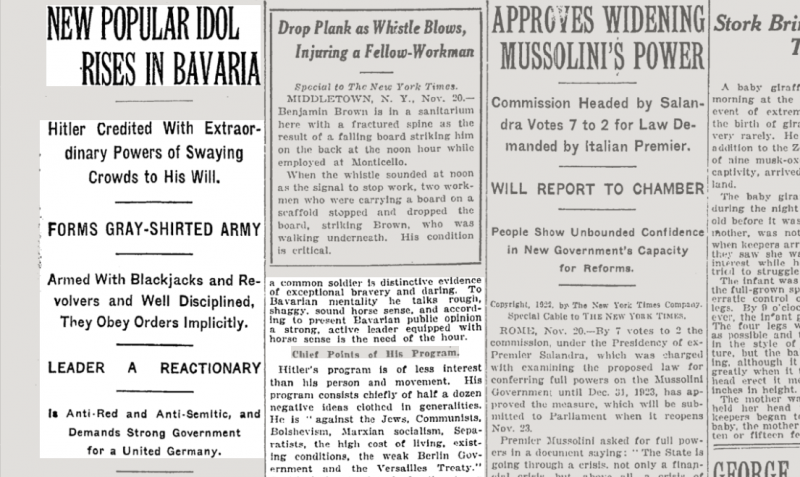
In 1922—at the dawn of Hitler’s budding nationalist movement—The New York Times published its first profile, and explained his demagoguery away. The article, titled “New Popular Idol Rises in Bavaria,” begins with several alarming subheadings: “Hitler credited with extraordinary powers of swaying crowds to his will,” “forms gray-shirted army… They obey orders implicitly,” “Leader a reactionary,” “Anti-Red and Anti-Semitic.” It then goes on to undermine these charges.
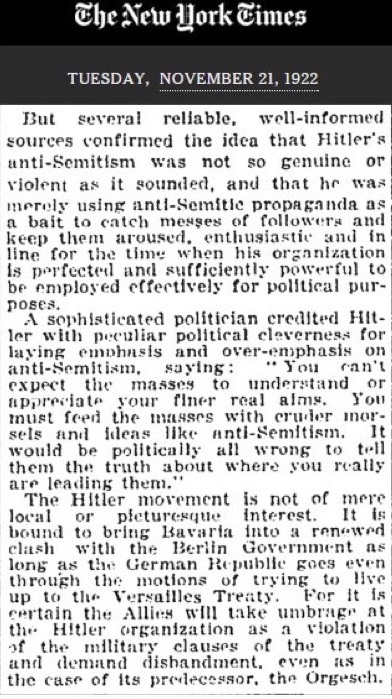
According to “several reliable, well-informed [unnamed] sources,” we’re told, “Hitler’s anti-Semitism was not so genuine or violent as it sounded,” though “the Hitler movement is not of a mere local or picturesque interest.”
He was merely using anti-Semitic propaganda as a bait to catch masses of followers and keep them aroused, enthusiastic and in line for the time when his organization is perfected and sufficiently powerful to be employed effectively for political purposes.
What purposes? The paper quotes one admiring “sophisticated politician” as saying, “You can’t expect the masses to understand or appreciate your finer real aims. You must feed the masses with cruder morsels and ideas like anti-Semitism. It would be politically all wrong to tell them the truth about where you really are leading them.” Where might this be? The shadowy source did not say. We cynically expect all politicians to lie, to feed us “cruder morsels.” But assuming that racism, bigotry, and scapegoating—whether sincere or not—will go down so easily with so many people constitutes a very dark view of “the masses.”
Ten years later, after Hitler was released from prison for treason and had begun his candidacy for president, many, even more complimentary, articles would follow—as Rafael Medoff documents in The Daily Beast—all the way up to Time magazine’s naming him “Man of the Year” for 1938. “Why did many mainstream American newspapers portray the Hitler regime positively,” asks Medoff, “especially in its early months? How could they publish warm human-interest stories about a brutal dictator? Why did they excuse or rationalize Nazi anti-Semitism? These are questions that should haunt the conscience of U.S. journalism to this day.”
One reporter in a 1933 Christian Science Monitor dispatch from Germany informed his readers that “the train arrived punctually”—indulging a trope about fascists making the “trains run on time” that has astonishingly come back in circulation via former Cincinnati mayor Ken Blackwell. “Traffic was well regulated.” The correspondent found “not the slightest sign of anything unusual afoot.” The word we often hear for what happened during the 30s is “normalization,” a process by which the most harrowing portents were blended into the landscape, rendered signs of nothing “unusual afoot.”
The normalization of Nazism in Germany involved a tremendous propaganda effort, much of it aimed at children. In the U.S., the press seemed more than willing to turn an ethno-nationalist movement with frightening—and plainly stated—objectives into an ordinary, rational state actor. Anti-Semitism was described as legitimate political resentment or reasonable anger at German Jews’ “commercial clannishness.” Somehow the victims of Nazism had to be responsible for their own murder and persecution. “There must be some reason,” wrote The Christian Century in an April, 1933 editorial, “other than race or creed—just what is that reason?” Few people, it seems, could or would allow themselves to imagine that the new German Führer actually meant what he said.
via Boing Boing
Related Content:
Free Online History Courses, a subset of our collection, 1,700 Free Online Courses from Top Universities
George Orwell Reviews Mein Kampf: “He Envisages a Horrible Brainless Empire” (1940)
Josh Jones is a writer and musician based in Durham, NC. Follow him at @jdmagness.
Read More...Stewart Brand’s List of 76 Books for Rebuilding Civilization
When the future looks dim, we can attend to the present with furious agency, spinning from task to task, forgetting for days on end to practice forethought. How much of this comes from tech-addled information overload and how much from physiological responses to real impending danger is anyone’s guess. But both sources of anxiety drive away thoughts of what Stewart Brand— futurist, founder of the Whole Earth Catalog, and one of Ken Kesey’s band of Merry Pranksters—calls the “Long Now,” also the name of his foundation advocating “the long view and the taking of long-term responsibility.”
But, you may object, we think of our children, and maybe of our grandchildren, too. Yet when Brand says long, he doesn’t mean 25, 50, or 100 years in the future. Inspired by an imagined clock that ticks away years, centuries, and millennia (and which Long Now is actually building) the foundation aims to create a version of Isaac Asimov’s “library of the deep future.” Long Now—whose board includes Brian Eno, Wired founder Kevin Kelly, and digital map maven David Rumsey—refers to their library as the “Manual for Civilization,” a somewhat grandiose title for a very ambitious project: an archive to help rebuild civilization in case of decimation or catastrophic collapse.
Many of the board members—like Kelly and Eno—have submitted their own lists of recommendations for titles to add to the collection of 3,500 books. (We’ve featured Eno’s list in a previous post.) The sampling of contributors so far is hardly a diverse group, and readers have pointed out that the sampling of authors (it’s overwhelmingly male) isn’t either. That perfectly legitimate criticism aside, these lists do provide us with ways of thinking about the kinds of books some possible future might need to rebuild. Would ancient Greek epics like The Iliad and The Odyssey have much relevance if the world lost its cultural wealth, along with the millions of references to Homer?
These epics, and those of Gilgamesh and Beowulf, have much more to contribute than just historical value. What about the science fiction of Ian Banks? Stoic philosophy of Marcus Aurelius and Lucretius? Edward Gibbon’s The History of the Decline and Fall of the Roman Empire (all six volumes)? All of these appear on Stewart Brand’s list, but so do practical and entertaining surveys like Peter Barber’s The Map Book, and scientific texts like Paul G. Hewitt’s Conceptual Physics and Theodore Gray’s The Elements: A Visual Exploration of Every Known Atom in the Universe.
Whether we can reasonably expect these books to survive hundreds or thousands of years from now is maybe beside the point. It’s an exercise in futurology. Long Now represents both “a mechanism and a myth,” Brand has written. His heavy emphasis on illustrated nonfiction suggests some critical acknowledgement that future readers may not be fluent and may have few memories of what things once looked like (especially through microscopes and telescopes). His heavy emphasis on classical literature and almost exclusively European history shows a particular cultural bias that may have little justification.
See a selected list of 20 titles from Brand’s list below, and see the full list of 76 books at the Long Now Foundation site here. Find his list myopic or missing some key areas of knowledge? Suggest your own additions in the comments.
The Story of Writing: Alphabets, Hieroglyphs & Pictograms by Andrew Robinson
Brave New World (The Folio Society) by Aldous Huxley and illustrated by Leonard Rosoman
Dune by Frank Herbert
The Singularity is Near: When Humans Transcend Biology by Ray Kurzweil
One True God: Historical Consequences of Monotheism by Rodney Stark
The Clash of Civilizations and the Remaking of World Order by Samuel P. Huntington
The Idea of Decline in Western History by Arthur Herman
What Technology Wants by Kevin Kelly
The Long Summer: How Climate Changed Civilization by Brian Fagan
A History of Civilizations by Fernand Braudel
The Foundation Trilogy by Isaac Asimov
The Prince by Machiavelli, translated by George Bull, published by Folio Society
The Nature of Things by Lucretius
The Iliad by Homer translated by Robert Fagles
The Memory of the World: The Treasures That Record Our History from 1700 BC to the Present Day by UNESCO
The Landmark Herodotus: The Histories edited by Robert B. Strassler
Brand is not so modest as to exclude his own work, listing his How Buildings Learn: What Happens After They’re Built as a candidate for a declining or post-apocalyptic world. That book is also a six-part BBC series, with music by Brian Eno. You can watch the first episode at the top of the post and find all six parts at our previous post on Brand here.
Again, Brand’s complete list of 76 books can be found here.
Related Content:
Watch Stewart Brand’s 6‑Part Series How Buildings Learn, With Music by Brian Eno
Josh Jones is a writer and musician based in Durham, NC. Follow him at @jdmagness
Read More...Thomas Edison’s Hugely Ambitious “To-Do” List from 1888
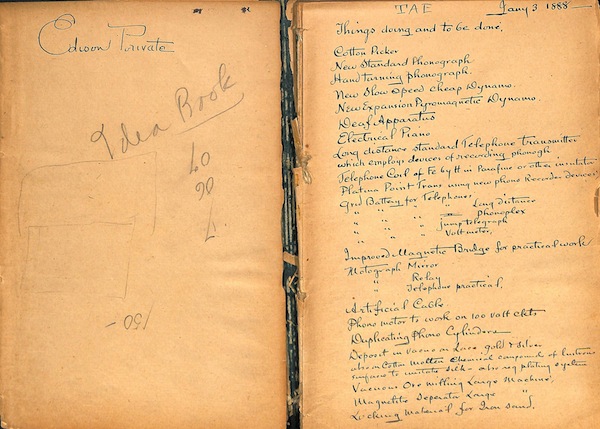
Even beyond developing the phonograph, the motion picture camera, light bulb, and the creepy talking doll, Thomas Edison got a lot done in life. With his even greater knack for enterprise than for invention, he might, had he lived in the 21st century, traded on his reputation for productivity and industry by selling us his personal “life hacks.” Alas, those in search of Edisonian tips and tricks for living must infer them from all the materials he left behind after a life that stretched from the mid-19th century to nearly the mid-20th, such as this extensive to-do list from January 3, 1888.
“Throughout his life, Thomas Edison kept ‘idea books’ filled with to-do lists, sketches and other notes on current and future projects,” says the site of PBS’ American Experience. Just over a month after opening his new lab in West Orange, New Jersey, “Edison created a five-page list of ‘Things doing and to be done.’
That year alone, Edison would execute 45 patents, primarily concerned with the phonograph and cylinder records. Alexander Graham Bell and his associates had begun to make improvements on Edison’s decade-old phonograph, which pushed Edison into action. Despite this competition, Edison’s ‘To Do’ list shows that the phonograph wasn’t the only thing on the inventor’s mind.”
These five pages of things to acquire or create (see the full list below) include not just the “New Standard Phonograph” but an “Improved Magnetic Bridge for practical work,” “Uninflammable Insulating Material,” a “Box balancing System,” “Artificial Mother Pearl,” “Butter direct from Milk,” “Artificial Ivory,” “Marine Telegraphy,” and a “Long distance standard Telephone Transmitter which employs devices of recording phonograph.” While not all the ideas that inspired, or were inspired by, the items on this long list came to fruition, Edison clearly saw value in getting them all out of his head and on paper. One wonders what the man who declared that “genius is one percent inspiration, ninety-nine percent perspiration” would make of the countless organization and productivity tools now on the market. Nobody ever perspired because of using an app, after all — but plenty have perspired developing them.
Things doing and to be done:
Cotton Picker
New Standard Phonograph
Hand turning phonograph
New Slow speed cheap Dynamo
New Expansion Pyromagnetic Dynamo
Deaf Apparatus
Electrical Piano
Long distance standard Telephone Transmitter which employs devices of recording phonogh
Telephone Coil of Fe [iron] by tt in Parafine or other insulator
Platina Point Trans using new phono Recorder devices
Gred Battery for Telephones
“ “ “ “ Long Distance
“ “ “ — Phonoplex
“ “ “ Jump Telegraph
“ “ “ Voltmeter
Improved Magnetic Bridge for practical work
Motograph Mirror
“ Relay
“ Telephone practical
Artificial Cable
Phone motor to work on 100 volt ckts
Duplicating Phono Cylinders
Deposit in vacuo on lace, gold + silver also on cotton molten chemical compound of lustrous surfaces to imitate silk— also reg plating system
Vacuous Ore milling Large Machine
Magnetic Separator Large
Locking material for Iron sand
Artificial Silk
Artificial filiments [sic]
New [illeg.]
Uninflammable Insulating Material
Good wax for phonograph
Phonographic Clock
Large Phonograph for Novels, etc.
Pig Iron Expmts with Electricity + Magnetism
Malleablizing Cast now in Vacuo
Drawing fine wire
Joy phonograph for Dolls
Cable Motograph
Very Loud Motograph telephone with 1/3 siz phonogh motor.
Magneto telephone with actual contact end magnet compression of an adjustable rubber press as in new phones
Snow Compressor
Glass plate water ore repeator
Tinned faced [illeg.] for Stove Castings
Refining Copper Electrically
Quad neutral relay
Cheap low induct Cop Insulating material for Lead Cable people
Constant moved for nonfoundry
200 volt 20 cp lamp
Cheap [illeg.] Indicator
Recording Valt Indicator
Box balancing System
Alternating Machine + Transformer
Sifua Surface Switches
Vulcanizing [illeg.] African Rubber adullement
Platinum wire [illeg.] cutting Machine
Silver wire wood cutting system
Silvering or Coppering bathing cloth in Vac for durability
S Mater attend own with new devices for c speed
Expansion mirror plat… wire in vacuo
Photoghy
Photoghy by camping heat after central points
Boron fil.
Hg [mercury] out of Lamp
Phonaplex Repeater
Squirting glass sheet tube etc. Nickel [illeg.]
Artificial Mother Pearl
Red Lead pencils equal to graphite
India Ink
Tracing Cloth
Ink for blind
Fluffy Incandescent Burner for gas
Regenerative Kerosene Burner
Centralized arc in arc Lamp
Cai–[illeg.] Tesla arc lamp test
Strengthening alternating cli by sternt Dynamo
ERR Cont [illeg.] reducers
Electroplating Machines for Schenectady
Condenser Transformer
Sqr ft difraction gratings in silver by 5000 [illeg.] tool special [illeg.] lathe for ornamental purposes
Photo Scant–[illeg.]
Cheap plan produce Mimeograph surfaces
Miners battery + lamp
Sorting Coal from Slate Machine
Butter direct from Milk
Burning asphalt Candles by high chimney
Magnets RR signals
Soften [illeg.] of books transfer to Cop plate + plate to [illeg.] matrix
Telephone Repeater
Substitute for Hard rubber
Artificial Ivory
Soften Vegetable Ivory to press in sheets
Various batteries on [illeg.] Type
Revolving Thermo
Caller Indicator for Jump Telegh
Marine Telegraphy
Long distance speaking tube filled H20 2 dia pressure
Lend plate battery for modifying attending Current
Two revolving bands in battery Lead faced press in liquid close together + out into separate chambers to [illeg.]reduce by gas the other
Siren phonogh
Perm mag like an electromag of [illeg.] hand steel high polish separately magnetized + forced together powerfully[illeg.]
Telephone working more [illeg.]
Eartubes formed crescent [illeg.] wire
Long strip 50 cp carbon under stress [illeg.] for
Cheap Voltmeter
Chalk Battery
Dynamo or motor long tube in long magnetic field top + bottom contacts forcing water through generator current by – passage.
[Illeg.]
Thermo battery slick Copper oxidized then plated over surface oxide nailed to make good contact [illeg.]
Disk Phonogh
Related Content:
A Brief, Animated Introduction to Thomas Edison (and Nikola Tesla)
Thomas Edison & His Trusty Kinetoscope Create the First Movie Filmed In The US (c. 1889)
Hear Thomas Edison’s Creepy Talking Dolls: An Invention That Scared Kids & Flopped on the Market
Take the 146-Question Knowledge Test Thomas Edison Gave to Prospective Employees (1921)
Based in Seoul, Colin Marshall writes and broadcasts on cities and culture. He’s at work on a book about Los Angeles, A Los Angeles Primer, the video series The City in Cinema, the crowdfunded journalism project Where Is the City of the Future?, and the Los Angeles Review of Books’ Korea Blog. Follow him on Twitter at @colinmarshall or on Facebook.
Read More...Frank Zappa’s Amazing Final Concerts: Prague and Budapest, 1991
We say goodbye to musical icons in many different ways, from flashmobs, SNL intros, and long retrospectives to live concert tributes featuring the biggest cover band on earth. No matter how outsized the gesture, it never quite seems out of place when it comes to artists of a certain stature. In the case of Frank Zappa, we’ve recently seen jazz orchestra tributes, a “monumental live performance” of one of his own orchestral works, and several Zappa tribute concerts by his son Dweezil.
For all their heart and stamina, however, no tribute can compete with the power of those artists’ farewells to us. Both David Bowie and Leonard Cohen, too fragile to perform in their last years, left phenomenal albums we’ll pore over for decades to come. Southern rock great Leon Russell, who just passed away this week at 74, put on rollicking live shows into his final years, and had concerts booked into 2017 when he died. Prince’s final performance was, like all of his performances, stunning.
And Zappa? Well see for yourself. Zappa played his way out of the world as he’d played his way into it, with sardonic humor and blistering virtuosity.
As you can see at the top and above, Zappa and band delivered on every promise in their last concerts in Prague and Budapest in 1991. In the 10-minute clip at the top, Zappa’s improvisatory prog guitar runs soar and dive over the band’s slinking jazz-reggae, then get more technical as he trades licks with another virtuoso guitarist. In the lower-quality video above, with clips from both concerts, Zappa and band display their mastery of an Eastern European-sounding march with their guest musician “gypsy friends” in Hungary (at 9:00).
In the following two years, until his death in 1993, Zappa would become too weak to play as he succumbed to prostate cancer. In his final interviews, he pronounced himself “totally unrepentant” for his life and career and insisted he had only ever been an “entertainer.” And it’s true, whatever else Zappa was—incredibly skilled guitarist, composer, and industry innovator—he was always, to the last couple years of his life, an incredible showman.
Related Content:
In One of his Final Interviews, Frank Zappa Pronounces Himself “Totally Unrepentant”
Frank Zappa Debates Censorship on CNN’s Crossfire (1986)
A Young Frank Zappa Turns the Bicycle into a Musical Instrument on The Steve Allen Show (1963)
Josh Jones is a writer and musician based in Durham, NC. Follow him at @jdmagness.
Read More...Support Us
We're hoping to rely on loyal readers, rather than erratic ads. Please click the Donate button and support Open Culture. You can use Paypal, Venmo, Patreon, even Crypto! We thank you!

About Us

Open Culture scours the web for the best educational media. We find the free courses and audio books you need, the language lessons & educational videos you want, and plenty of enlightenment in between.
Advertise With Us

FREE UPDATES!
GET OUR DAILY EMAIL
Get the best cultural and educational resources on the web curated for you in a daily email. We never spam. Unsubscribe at any time.
FOLLOW ON SOCIAL MEDIA

Open Culture editor Dan Colman scours the web for the best educational media. He finds the free courses and audio books you need, the language lessons & movies you want, and plenty of enlightenment in between.
Advertise With Us

