Hear the Brilliant Guitar Work of Charlie Christian, Inventor of the Electric Guitar Solo (1939)
On a recent visit to Seattle’s Museum of Popular Culture (formerly EMP), I found myself transfixed for well over an hour by the Guitar Gallery, a veritable shrine for guitar players, with “55 vintage, world changing guitars from the 1770s to the present.” In addition to illustrating a few hundred years of music history, the exhibit represents the slow development of the electric guitar, and the many ungainly stages in-between. What we learn in studying the history is that guitar innovations have always been player-driven.
Guitarists have modified and built their own guitars, and many have taken models and adapted them so fully to their style that they become iconic mainstays as other models drop away. Such is the case with the ES-150, Gibson’s first “Electric Spanish” archtop guitar, and its most famous player, Charlie Christian, who has inspired some of the best-known guitarists in jazz, like Barney Kessel and Wes Montgomery, and who also may have invented the electric guitar solo. Gibson goes so far as to bestow on Christian the honorific of “the first guitar hero.”
Before Christian, guitar soloists in jazz ensembles and orchestras were rare, since the acoustic instrument couldn’t be heard loudly enough over horns, woodwinds, double bass, and drums. The first electric guitar, the “Frying Pan,” arrived in 1931, built for Hawaiian jazz lap steel players. Rapid development of the electric pickup proceeded throughout the decade, and Christian bought his ES-150 the year after it went into production in 1936.
By 1938, when he had found steady work at a club in Bismarck, North Dakota, “a local music store displayed the Gibson ES-150 with a sign reading ‘As featured by Charlie Christian.’” By this point, writes Riff Interactive, Christian was “a regional hero.”
In 1939, Christian joined the Benny Goodman orchestra, but the story of his audition tells us as much about the electric guitar’s importance as it does about Christian’s playing. It seems that “Goodman was initially unimpressed” by Christian’s strumming of an “unamplified rhythm guitar behind ‘Tea for Two.’” (hear him play the song, electrified, below.) But when jazz impresario John Hammond snuck him and his electric guitar onstage with Goodman’s Quintet later at the Victor Hugo Restaurant, “Christian matched Goodman riff for riff and improvised over 20 choruses. He was hired on the spot.” He could play some of Django Reinhardt’s most difficult songs note-for-note, and “many of the figures he worked into his solos evolved later into Benny Goodman tunes.”
“Some argue he wasn’t the first” electric soloist, writes the site Justice through Music, but “he made the electric guitar lead solo ‘popular,’ and in essence ‘invented’ it,” leading the way for “Eric Clapton, Jimmy Page, Buddy Guy, Eddie Van Halen and all the great guitar shredders.” Jazz critic Kevin Whitehead agrees, telling Terry Gross that Christian “was the single greatest influence on the signature 20th century instrument, the electric guitar, even though he died at age 25 and did all his recording in under two years.”
Beginning in his hometown of Oklahoma City as a ukulele player, Christian picked up many of his “slingshot rhythms” on the guitar from saxophonist Lester Young (hear him play with Young just above). “Amplified slide guitarists in white western swing bands showed Christian how electric guitar could project,” Whitehead notes. “He wasn’t the first electric picker who played on the frets. He dug Chicago pioneer George Barnes. But Christian had the most imposing sound.”
We have a representative sampling of the imposing sound of Christian and his ES-150 in the recordings here. At the top of the post, hear him live with Goodman (who introduces him as “our new discovery, Charles Christian”) in 1939, playing “Flying Home.” Further down listen to “Rose Room” with Goodman’s Sextet, with whom he made most of his records, Whitehead tells us, “compet[ing] for space with other good soloists.” Further down, hear Christian play “Stompin’ at the Savoy” live at Minton’s in 1941 and “Tea for Two” with Jerry Jerome in 1939.
Further up, in “Solo Flight” with Goodman’s orchestra, Christian demonstrates his “impeccable” timing and “heavy, front-loaded attack” in a two-and-a-half-minute showcase. Christian’s phenomenal playing “inspired untold jazz, blues, and rock-guitar players.” In some of his last recordings, before his death from tuberculosis in 1942, he “laid the groundwork for the new music that Christian started calling bebop.” Hear him reshape the sound of jazz with Dizzy Gillespie, Thelonious Monk, Don Byas, and Kenny Clarke above in “Groovin’ High.” “You can hear a lot of guitar’s future coming” in these recordings, Whitehead argues, “Chuck Berry included.”
Related Content:
Behold the First Electric Guitar: The 1931 “Frying Pan”
Jazz ‘Hot’: The Rare 1938 Short Film With Jazz Legend Django Reinhardt
The Story of the Guitar: The Complete Three-Part Documentary
Josh Jones is a writer and musician based in Durham, NC. Follow him at @jdmagness
Read More...Watch the Evolution of Ringo Starr, Dave Grohl, Tré Cool & 19 Other Drummers in Short 5‑Minute Videos
I’ve always been more than happy to admit that I think Ringo Starr is a fantastic drummer and don’t find it much worth arguing over. Then again, more and more people seem to have come around to that point of view. Or at least that’s been my experience. Maybe it has something to do with the length of exposure. Once you’ve lived with the Beatles’ music for, say, twenty to fifty years, you’d had a lot of time to reflect on your favorite songs, or favorite moments (like the breakdowns in “Hello, Goodbye” and “Strawberry Fields,” for example). A lot of time to appreciate just how well so many of those songs, and Ringo’s drumming, have aged.
But not all of them. I haven’t always found the very early Beatles albums to hold up well for me. There’s something about… well… okay, maybe Ringo wasn’t always a great drummer. But he became one. The thing about a retrospective appreciation is that it’s highly selective.
However, if we were to select elements of Ringo’s technique from songs spanning the whole of his Beatles career, we would be able to see how his playing refined from 1962 to 1995, when he made his last recordings with George, Paul, and John—who left several home demo tapes over which his bandmates layered harmonies and rhythms. (Hear “Free as a Bird” from those sessions here.)
You could take the time to edit together several seconds, chronologically, of famous Beatles songs throughout the sixties and seventies. Or you could do that and play all those parts yourself, and shoot and edit a thoroughly engaging, high-quality video of yourself playing them. That’s what Kye Smith does in the videos here, part of a long series of 22 exercises he calls “5 Minute Drum Chronology.” As you’ll see in his Beatles video at the top, Smith has made some very thoughtful selections from the canon, showing how thoroughly versatile Ringo’s playing became; how well he came to understand nuanced dynamics: when to attack and when not to play at all.
In his Nirvana “5 Minute Drum Chronology,” above, Smith not only duplicates the huge, booming sound of Dave Grohl’s drumkit, but he also perfectly captures Grohl’s tremendous energy. With the focus squarely on the drums, Grohl (through Smith) seems even more the hardcore punk drummer that he was for years before he joined Nirvana. But by the time we get to “You Know You’re Right,” the last song the band recorded in 1994, we see how he had discovered a much lighter touch as well, one he developed even further as a drummer for indie stars like Cat Power.
Smith’s other twenty 5 Minute Drum Chronologies track bands who made it in the nineties, like The Offspring, NOFX, Blink-182, and Foo Fighters. In many cases, none but ardent fans will know the drummers of these bands or have a sense of their full discography. But at least by the time we get to their breakout 1994 album Dookie, many of us will be familiar with a song or two from all of Green Day’s releases. And we’re likely to know the name and face of drummer Tré Cool. (The band’s first drummer, Al Sobrante, takes up the first 20 seconds of the video above.)
Is Tré Cool a drummer who has evolved over the years, developed better feel and more finesse? At least the way Kye Smith plays him. Smith is such a talented drumming impressionist that one can look away and forget that it’s him on the drums and not Cool. Which raises other critical issues with the impressive artifice of these chronologies. These are, of course, interpretations. And in any case, musicians have good nights and bad nights, great takes and not so great takes, and their style might vary more across a single album than between songs on different records.
And in the case of a band like the Red Hot Chili Peppers, we’ve seen three different drummers by the time the band released their fourth album, Mother’s Milk and took on highly skilled Will Ferrell lookalike Chad Smith. Nonetheless, Kye Smith gives us a lot to chew on as we watch, by proxy, these drummers adapt to the evolution of their bands’ songwriting. Some of those journeys are naturally more interesting than others. See the complete collection of 22 5 Minute Drum Chronologies here, or down below.
Related Content:
The Neuroscience of Drumming: Researchers Discover the Secrets of Drumming & The Human Brain
Isolated Drum Tracks From Six of Rock’s Greatest: Bonham, Moon, Peart, Copeland, Grohl & Starr
The Fundamentals of Jazz & Rock Drumming Explained in Five Creative Minutes
Josh Jones is a writer and musician based in Durham, NC. Follow him at @jdmagness
Read More...Three Pink Floyd Songs Played on the Traditional Korean Gayageum: “Comfortably Numb,” “Another Brick in the Wall” & “Great Gig in the Sky”
If you come visit South Korea, where I live, you’ll more than likely pass through Incheon International Airport, and there quite possibly witness a variety of displays of traditional Korean culture, from acrobatics to aristocratic processions to a variety of musical performances. Since the rebuilding of the country after the Korean War, attention has turned to recovering the arts and customs of the past and, in one way or another, making them relevant to the present. Placing them in the middle of an ultramodern transportation facility is one; interpreting the stuff of relatively recent popular culture with them is another.
A few years ago we featured the skills of Luna Lee, a player of the gayageum, a twelve-stringed Korean instrument dating back to the sixth century. Specifically, we featured her renditions of Jimi Hendrix’s “Voodoo Chile” and Stevie Ray Vaughan’s “Little Wing,” meetings of modern composition and traditional East Asian performance reminiscent of what Japanese koto player June Kuramoto and her band Hiroshima pioneered in the 1970s.
But the Korean musical sensibility brings a different set of emotions into play, and now you can hear them hybridized with the psychedelic, operatic, virtuosic rock of Pink Floyd in Lee’s versions of “Another Brick in the Wall,” “Comfortably Numb,” and “The Great Gig in the Sky,” all of which must have posed a formidable challenge to convert into gayageum music.
“My ancestors played the gayageum in a small room, so the sound did not need to be loud,” writes Lee on her Patreon page, “but my music is performed with modern instruments such as the drums, bass and the guitar. So I had to redevelop my gayageum so that the sound would match that of the modern instrument. I had to increase the volume and pressure, develop tone and increase the sustain sound. And hoping to express the sound of gayageum more diversely like that of the guitar, I had to study guitar effectors and amplifiers and test them to see if they would fit to the sound of the gayageum.”
Lee’s work of pushing the gayageum into new musical realms continues: in other videos, she tries her hand at adapting songs by everyone from the Rolling Stones to R. Kelly to Tiny Tim to the late Leonard Cohen. But something about her multiple visits to the territory of Pink Floyd feels right. Perhaps, should we find ourselves in another great progressive rock era, the gayageum will be the first instrument to join the subsequently expanded field of instruments — in both a technological and historical sense — let onto the stage. Stranger things have happened there, as the Floyd well know.
Related Content:
Watch Jimi Hendrix’s ‘Voodoo Chile’ Performed on a Gayageum, a Traditional Korean Instrument
Ultra Orthodox Rabbis Sing Pink Floyd’s “Wish You Were Here” on the Streets of Jerusalem
Based in Seoul, Colin Marshall writes and broadcasts on cities and culture. He’s at work on a book about Los Angeles, A Los Angeles Primer, the video series The City in Cinema, the crowdfunded journalism project Where Is the City of the Future?, and the Los Angeles Review of Books’ Korea Blog. Follow him on Twitter at @colinmarshall or on Facebook.
Read More...Download Ralph Ellison’s Invisible Man as a Free Audiobook (Available for a Limited Time)
When Ralph Ellison published his first novel, Invisible Man, in 1952, it took the literary world by storm. Orville Prescott, a literary critic at The New York Times, wrote in April of ’52:
Ralph Ellison’s first novel, “The Invisible Man,” is the most impressive work of fiction by an American Negro which I have ever read. Unlike Richard Wright and Willard Motley, who achieve their best effects by overpowering their readers with documentary detail, Mr. Ellison is a finished novelist who uses words with great skill, who writes with poetic intensity and immense narrative drive. “Invisible Man” has many flaws. It is a sensational and feverishly emotional book. It will shock and sicken some of its readers. But, whatever the final verdict on “Invisible Man” may be, it does mark the appearance of a richly talented writer.
Invisible Man won the U.S. National Book Award for Fiction the following year. And the belief that Ellison wrote something special hasn’t diminished since. Case in point: When Modern Library created a list of the 100 best English-language novels of the 20th century, they placed Invisible Man at number 19.
As Don Katz tells us above, the book touched him deeply during his college years at NYU. Now the founder and CEO of Audible.com, he’s letting you download Invisible Man as a free audiobook. The free download is available at Audible and at Amazon until December 31st. (Audible is an Amazon subsidiary). Please note that you’ll need to create an account to get the download. But apparently no payment/credit card info is required.
Separately, I should also mention that Audible offers a free 30-day trial program, where they let you download two professionally-read audiobooks. At the end of 30 days, you can decide whether to become an Audible subscriber or not. Either way, you can keep the two free audiobooks. Find more information on that free trial program here.
Again, the links to download Invisible Man are here: Audible — Amazon. And remember, we have more free audiobooks in our collection, 1,000 Free Audio Books: Download Great Books for Free. Mostly classics.
If you would like to support the mission of Open Culture, consider making a donation to our site. It’s hard to rely 100% on ads, and your contributions will help us continue providing the best free cultural and educational materials to learners everywhere. You can contribute through PayPal, Patreon, and Venmo (@openculture). Thanks!
Related Content
Ralph Ellison Reads from His Novel-in-Progress,Juneteenth, in Rare Video Footage (1966)
Flannery O’Connor Reads ‘A Good Man is Hard to Find’ in Rare 1959 Audio
Read More...How to Recognize a Dystopia: Watch an Animated Introduction to Dystopian Fiction
Literature and film can open up to the depth and immensity of social truths we find profoundly difficult, if not impossible, to articulate. If our political vocabulary (as Oxford Dictionaries suggested in their word of the year) has become “post-truth,” it can seem like the only honest representations of reality are found in the imaginary.
Amidst the violent upheavals of the last couple decades, for example, we have seen an explosion of the dystopian, that venerable yet modern genre we use to explain our contemporary political conditions to ourselves. It has become common practice in serious debate to gesture toward the outsized cinematic scenarios of Snowpiercer, or The Hunger Games and Harry Potter series, as stand-ins for disturbing present realities.
You may have also encountered recent references to literary speculative fiction like William Gibson’s The Peripheral, Margaret Atwood’s The Handmaid’s Tale, Olivia Butler’s Parable series, and Philip K. Dick’s Radio Free Albemuth, the first novel Dick wrote before VALIS about his supposed religious experience. Drafted in 1976 but only published posthumously in 1985, Dick’s prescient novel takes place in an alternate U.S. (like The Man in the High Castle), in which paranoid right-wing zealot Ferris Fremont, a Joseph McCarthy/Richard Nixon-like figure, succeeds Lyndon Johnson as president.
There is no point in dwelling on the ethics of Ferris Fremont.… The Soviets backed him, the right-wingers backed him, and finally just about everyone… Fremont had the backing of the US intelligence community, as they liked to call themselves, and exigents played an effective role in decimating political opposition. In a one-party system there is always a landslide.
The stifling totalitarian control Fremont exercises is very much a hallmark of dystopian fiction. But does Dick’s novel—set in an alternate present rather than a frightening future, and with an alien/supernatural invasion—qualify as dystopian? What about Harry Potter, with its fairy tale intrusions of the magical into the present? The TED Ed video at the top, narrated by Alex Gendler, sets flexible boundaries for a category we’ve mostly come to associate with prophetic, futuristic science fiction, and offers a broadly comprehensive definition.
The word dystopia, a Greek coinage for “bad place,” dates to 1868, from a usage by John Stuart Mill to characterize the industrial world’s moral inversion of Sir Thomas More’s Utopia. That word, Gendler points out, is a term More invented to mean either “no place” or “good place.” Gendler dates the emergence of the dystopian to Jonathan Swift’s satire Gulliver’s Travels, a book, like Harry Potter, set in an alternate present featuring many monstrous intrusions of the fantastic into the real. Unlike the boy wizard’s saga, however, the monsters in Gulliver serve as allegories for us.
Swift, Gendler argues, “established a blueprint for dystopia.” His Lilliputians, Bobdingnagians, Laputions, and Houyhnhnms all represent “certain trends in contemporary society… taken to extremes.” In later examples, the form continued to reflect the pernicious thought and science of the age: the extreme eugenics of H.G. Wells’ The Time Machine, the prison-like factory conditions of Fritz Lang’s film Metropolis, the repressive hyper-rationalization in Yevgeny Zamyatin’s 1924 Soviet-based dystopia We, and the medical technocracy of Aldous Huxley’s Brave New World.
Borrowing liberally from Zamyatin and competing with Huxley, George Orwell’s 1984 set a new standard of verisimilitude for dystopian fiction, starkly reminding thousands of post-war readers that “the best-known dystopias were not imaginary at all,” Gendler says. The historical nightmares of World War II and the following Cold War dictatorships birthed horrors for which we can never find appropriate language. And so we turn to novels like 1984 and Kurt Vonnegut’s Cat’s Cradle, both of which aptly show us worlds where language has ceased to function in any ordinary communicative sense.
Perhaps one of the most-referenced of dystopian novels in U.S. political discourse, Sinclair Lewis’ 1935 It Can’t Happen Here, gave little but its title to the popular lexicon. “Lewis,” writes Alexander Nazaryan in The New Yorker, “was never much of an artist, but what he lacked in style he made up for with social observation.” The novel “envisioned how easily,” Gendler says, “democracy gives way to fascism.” The crisis point comes when the people want “safety and conservatism again,” as Roosevelt observed that same year—a year in which “the promise of the New Deal,” Nazaryan remarks, “remained unfulfilled for many.”
The irony of Lewis’ scenario is that those left behind by Roosevelt’s policies are those who suffer most under the fictional presidency of authoritarian Senator Berzelius “Buzz” Windrip. Meanwhile, the more comfortable console themselves with hollow denials: “it can’t happen here.” Extreme economic inequality and social stratification have been an essential feature of classical utopian fiction since its first appearance in Plato’s Republic. In the modern literary dystopia, the science, technology, and political mechanization that philosophers once celebrated become implacable weapons of war against the citizenry.
For all the malleable boundaries of the genre—which strays into science fiction, fantasy, surrealism, and satire—dystopian fictions all have one unifying theme: “At their heart,” says Gendler, “dystopias are cautionary tales, not about some particular government or technology, but the very idea that humanity can be molded into an ideal shape.”
Related Content:
Huxley to Orwell: My Hellish Vision of the Future is Better Than Yours (1949)
Josh Jones is a writer and musician based in Durham, NC. Follow him at @jdmagness
Read More...Hieronymus Bosch’s Medieval Painting, “The Garden of Earthly Delights,” Comes to Life in a Gigantic, Modern Animation
For the 500-year anniversary of Hieronymus Bosch’s death, the MOTI Museum in Holland commissioned a modern re-interpretation of the Dutch painter’s famous medieval painting, “The Garden of Earthly Delights” (circa 1490). If you’re not familiar with Bosch’s enigmatic creation, explore these two items before you do anything else:
Then check out the video above, which gives you a glimpse of the gigantic video installation that’s on display at the MOTI through December 31st.
Here’s how the Dutch animators behind this project explain what’s unfolding before your eyes:
[We] cleared the original landscape of the middle panel of Bosch’s painting and reconstructed it into a hallucinatory 4K animation. The creatures that populate this indoor playground embody the excesses and desires of 21st century Western civilization. Consumerism, selfishness, escapism, the lure of eroticism, vanity and decadence. All characters are metaphors for our society where loners swarm their digital dream world. They are symbolic reflections of egos and an imagination of people as they see themselves — unlike Bosch’s version, where all individuals more or less look the same. From a horny Hello Kitty to a coke hunting penis snake. From an incarnate spybot to headless fried chickens. These characters, once precisely painted dream figures, are now digitally created 3D models. All of them have been given their own animation loop to wander through the landscape. By placing them altogether in this synthetic fresco, the picture is never the same. What the animation and Bosch’s triptych have in common is that you’ll hardly be able to take it all in, you can watch it for hours.
If you happen to find yourself in Holland, you can experience the installation firsthand (again before 12/31). Find directions to the MOTI here.
If you would like to support the mission of Open Culture, consider making a donation to our site. It’s hard to rely 100% on ads, and your contributions will help us continue providing the best free cultural and educational materials to learners everywhere. You can contribute through PayPal, Patreon, and Venmo (@openculture). Thanks!
Related Content:
Rijksmuseum Digitizes & Makes Free Online 273,000 Works of Art, Masterpieces Included!
Discover 100 Important Paintings with Videos Created by Khan Academy & Google Art Project
Free Course: An Introduction to the Art of the Italian Renaissance
1.8 Million Free Works of Art from World-Class Museums: A Meta List of Great Art Available Online
Download 464 Free Art Books from The Metropolitan Museum of Art
Read More...We’re Gonna Build a Fourth Wall, and Make the Brechtians Pay for It

By now, you undoubtedly know what happened when Mike Pence went to see Hamilton on Friday night. And the brouhaha that unfolded from there, particularly on Twitter.
Tweets came and went throughout the weekend. But, if you’re keeping score at home, none outfunnied this tweet from Jeremy Noel-Tod. We’re suckers around here for Brechtian humor.
Find us on Twitter at @openculture.
If you would like to support the mission of Open Culture, consider making a donation to our site. It’s hard to rely 100% on ads, and your contributions will help us continue providing the best free cultural and educational materials to learners everywhere. You can contribute through PayPal, Patreon, and Venmo (@openculture). Thanks!
Related Content:
Watch Them Watch Us: A History of Breaking the “Fourth Wall” in Film
The Cast of Hamilton Sends a Strong Message to Mike Pence (After the Crowd Jeers Him)
Read More...Five Short Stories by Leo Tolstoy: A Free AudioBook

Though known for his long epic novels War and Peace and Anna Karenina, Leo Tolstoy wrote short stories too. Below, you can stream readings of five such stories, “The Three Hermits,” “Three Deaths,” “Albert,” “Ernak, and “God Sees the Truth But Waits.” They’re read by Bart Wolfe, and made freely available on Spotify. (If you need Spotify’s software, download it here.) If you want to get it from iTunes, it will run you $6.95.
This three-hour recording will be added to our collection, 1,000 Free Audio Books: Download Great Books for Free. Meanwhile, if you’d like to download two professionally-read audiobooks from Audible for free, get more information on that here.
Related Content:
Leo Tolstoy Creates a List of the 50+ Books That Influenced Him Most (1891)
Leo Tolstoy’s 17 “Rules of Life:” Wake at 5am, Help the Poor, & Only Two Brothel Visits Per Month
Free Online Literature Courses
Read More...Leonard Cohen’s “Hallelujah” Lovely Sung in Yiddish: A Tribute
Leonard Cohen grew up in an influential Jewish family in Montreal. And, during his final interview, he reminisced with The New Yorker’s David Remnick about how the elder men in his family were the “dons” of Jewish Montreal, and how his grandfather “was probably the most significant Jew in Canada”–someone who established numerous Jewish institutions there, and helped countless refugees escape the anti-Semitic pogroms in Eastern Europe.
Immigrants from Eastern Europe themselves, Leonard Cohen’s family undoubtedly spoke some Yiddish, the language once spoken by 11 million Jews, mostly in central and eastern Europe. (Today it’s spoken by 600,000 people at best.) And that’s what makes this Yiddish rendition of “Hallelujah” so fitting. Translated and performed by Klezmer musician Daniel Kahn, it was posted to YouTube on the night of Cohen’s passing.
For anyone interested, it’s worth reading this other The New Yorker piece, “Leonard Cohen’s Montreal.”
If you would like to support the mission of Open Culture, consider making a donation to our site. It’s hard to rely 100% on ads, and your contributions will help us continue providing the best free cultural and educational materials to learners everywhere. You can contribute through PayPal, Patreon, and Venmo (@openculture). Thanks!
Related Content:
Rufus Wainwright and 1,500 Singers Sing Leonard Cohen’s “Hallelujah”
Street Artist Plays Leonard Cohen’s “Hallelujah” With Crystal Glasses
Leonard Nimoy Recites Famous Soliloquy from Hamlet in Yiddish: “To Be or Not To Be”
Watch Classic Seinfeld Scenes Dubbed in …. Yiddish
Read More...Hear Kurt Vonnegut’s Novel, Cat’s Cradle, Get Turned into Avant-Garde Music (Featuring Kurt Himself)
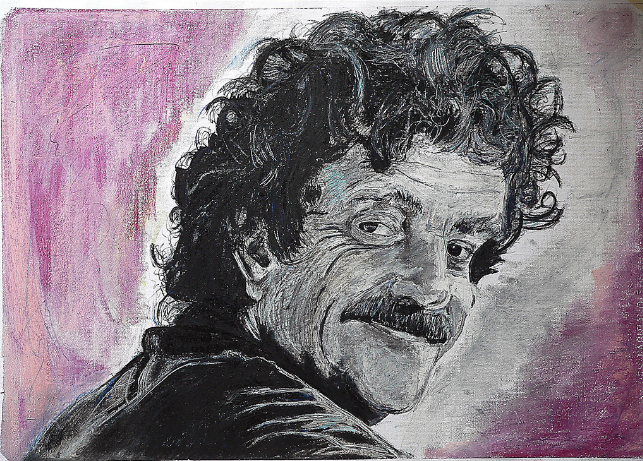
Image by Daniele Prati, via Flickr Commons
Kurt Vonnegut’s 1963 novel Cat’s Cradle resembles its title, a web of overlapping and entangled stories, all of which have huge holes in the middle. And the book—as have many of his slim, surrealist pop masterpieces—was read by many critics as lightweight—whimsical and sentimental. One reviewer in The New York Review of Books, for example, called Vonnegut a “compiler of easy to read truisms about society who allows everyone’s heart to be in the right place.”
Not so, argues University of Puerto Rico scholar Mark Wekander Voigt. For all its silliness—such as its Calypso-heavy “parody of a modern invented religion that will make everyone happy”—Cat’s Cradle, writes Voigt, “is essentially about the moral issues involved in a democratic government using the atom bomb.” Vonnegut’s novel suggests that “to be really ethical, to think about right and wrong, means that we must dispense with the authorities who tell us what is right and wrong.”
John, the hero of Cat’s Cradle, begins his absurdist hero’s quest by intending to write a “factual” accounting of what “important Americans had done on the day when the first atomic bomb was dropped on Hiroshima, Japan.” The references would not have been lost on Vonnegut’s contemporary readers, who would all have been familiar with John Hersey’s harrowing 1946 Hiroshima, the most popular book ever written about the dropping of the bomb, with six survivor’s stories told in a thrilling, engaging style and “all the entertainment of a well-written novel.”
Vonnegut, however, writes an alienating anti-novel, in part to demonstrate his point that “to discuss the ethical implications of dropping the bomb on Hiroshima, one should not look at the victims, but at those who were involved in developing such a bomb and their government.” Increasingly, however, it becomes harder and harder to look at anything directly. In the novel’s parody religion, Bokononism, all lies are potentially truths, all truths potentially lies. Language in the military-industrial-complex world of the bomb, Vonnegut suggests, had become as changeable and potentially deadly as the substance called “Ice‑9,” a polymorph of water that can instantly turn rivers, lakes, and even whole oceans into ice.
Evoking the novel’s high-wire balancing act of goofy songs and rituals and metaphors for the global annihilation of the earth by nuclear weapons, the 2001 album above, Ice‑9 Ballads, pairs Vonnegut with composer Dave Soldier and the Manhattan Chamber orchestra for an adaptation, of sorts, of Cat’s Cradle. Vonnegut narrates evocative snatches of the book, and the songs illustrate key themes, such as the strained patois the inhabitants of the fictional island of San Lorenzo speak. One example, the phrase “Dyot meet mat” (“God made mud”), gives us the title and refrain of the second track on the album.
“The music switches tones throughout to match the tone of the novel at some level,” writes Allmusic, and there are also two additional, vaguely-related pieces at the end. “A Soldier’s Story” is a “faux-radio opera,” notes Time Out New York’s Molly Sheridan, with a libretto, written by Vonnegut, about Eddie Slovik, the only soldier executed for desertion during World War II. A later 2005 release of “A Soldier’s Story” bore a Parental Advisory warning, though it is “not the obscenities that cause alarm, but the way in which moral contradictions inherent in the tale resonate against present-day military involvements.”
The final piece, “East St. Louis, 1968,” is a surprisingly experimental, orchestral-backed pastiche of soul, hip-hop and gospel. Truly, like many a Vonnegut novel, Ice‑9 Ballads, writes Allmusic, is “getting the avant-garde label from the eclecticism in it, but providing decidedly non-avant garde bits and pieces throughout that make the whole.… Don’t go in expecting something bland or predictable.” See more credits for the album at its label’s website here.
You can stream Ice‑9 Ballads on Spotify for free (get Spotify’s free software here) or purchase a copy online.
Related Content:
In 1988, Kurt Vonnegut Writes a Letter to People Living in 2088, Giving 7 Pieces of Advice
Kurt Vonnegut Diagrams the Shape of All Stories in a Master’s Thesis Rejected by U. Chicago
Josh Jones is a writer and musician based in Durham, NC. Follow him at @jdmagness.
Read More...Support Us
We're hoping to rely on loyal readers, rather than erratic ads. Please click the Donate button and support Open Culture. You can use Paypal, Venmo, Patreon, even Crypto! We thank you!

About Us

Open Culture scours the web for the best educational media. We find the free courses and audio books you need, the language lessons & educational videos you want, and plenty of enlightenment in between.
Advertise With Us

FREE UPDATES!
GET OUR DAILY EMAIL
Get the best cultural and educational resources on the web curated for you in a daily email. We never spam. Unsubscribe at any time.
FOLLOW ON SOCIAL MEDIA

Open Culture editor Dan Colman scours the web for the best educational media. He finds the free courses and audio books you need, the language lessons & movies you want, and plenty of enlightenment in between.
Advertise With Us

