The Only Surviving Behind-the-Scenes Footage of I Love Lucy, and It’s in Color! (1951)
The enduring popularity of comedian Lucille Ball’s 6‑season sitcom, I Love Lucy, has resulted in so many full-color collectibles, occasional viewers may forget that the show was filmed in black and white.
More ardent fans may have tuned in for the special colorized episodes CBS aired a couple of years ago, but the only existing color footage of Lucy and her husband and co-star, Desi Arnaz, was captured by a stealthy studio audience member.
The ubiquity of smart phones have made unauthorized celebrity shots commonplace, but consider that this regular Joe managed to smuggle a 16mm movie camera into the bleachers of producer Jess Oppenheimer’s tightly controlled set. This covert operation on October 12, 1951 shed light on the true colors of both the Tropicana nightclub and Ricardo apartment sets.
Oppenheimer’s son, Jess, eventually obtained the footage, inserting it into the appropriate scenes from “The Audition,” the episode from which they were snagged.
The Harpo Marx-esque Professor character Lucy plays is a holdover from both the pilot and the vaudeville show she and Arnaz created and toured nationally in 1950, in an attempt to convince CBS that audiences were ready for a comedy based on a “mixed marriage” such as their own.
In addition to Arnaz’ unbridled conga playing, the home movie, above, contains a lovely, unguarded moment at the 2:40 mark, of the stars calmly awaiting slating, side by side on the soundstage.
Related Content:
Batgirl Fights for Equal Pay in a 1960s Television Ad Supporting The Equal Pay Act
Watch the First Commercial Ever Shown on American TV, 1941
Watch Dragnet’s 1967 LSD Episode: #85 on TV Guide’s List of the Greatest Episodes of All Time
Ayun Halliday is an author, illustrator, theater maker and Chief Primatologist of the East Village Inky zine. Her play Zamboni Godot is opening in New York City in March 2017. Follow her @AyunHalliday.
Read More...1905 Fairground Organ Plays Queen’s “Bohemian Rhapsody,” and It Works Like a Charm
First built in Paris by Charles Marenghi in 1905, the organ above quickly found a home in a Belgian restaurant. And there it remained for many years … until 1967, when it traveled abroad, to a Texas fairground. Imagine the culture shock it must have felt. But that’s not where it ends.
Nowadays, you can watch the 81-key organ play Queen’s 1975 hit “Bohemian Rhapsody,” quite different than whatever it was playing in Antwerp a century ago. Alexey Rom wrote the arrangement for the song, and programmed it using the strip of cards being fed through the instrument. Hopefully this isn’t the last stop on this organ’s grand journey.
If you would like to support the mission of Open Culture, consider making a donation to our site. It’s hard to rely 100% on ads, and your contributions will help us continue providing the best free cultural and educational materials to learners everywhere. You can contribute through PayPal, Patreon, and Venmo (@openculture). Thanks!
Related Content:
Guitarist Brian May Explains the Making of Queen’s Classic Song, ‘Bohemian Rhapsody’
Queen Documentary Pays Tribute to the Rock Band That Conquered the World
The Music of Queen Re-Imagined by “Extraordinary” Classical Pianist, Natalia Posnova
Read More...The Physics of Playing a Guitar Visualized: Metallica’s “Nothing Else Matters” Viewed from Inside the Guitar
Give it a chance, you won’t be disappointed. While the first 30 seconds of the video above may resemble an amateur iPhone prank, it soon becomes something unexpectedly enchanting—a visualization of the physics of music in real-time. The Youtuber places his phone inside an acoustic guitar, then plays Metallica’s “Nothing Else Matters” against a backdrop of clouds and blue sky. Due to what Twisted Sifter identifies as the phone camera’s rolling shutter effect, the actual waves of the vibrating guitar strings are as clearly visible as if they were on an oscilloscope.
The comparison is an apt one, since we might use exactly such a device to measure and visualize the acoustic properties of stringed instruments. “A guitar string”—writes physicist and musician Sam Hokin in his short explanation—is a common example of a string fixed at both ends which is elastic and can vibrate.
The vibrations of such a string are called standing waves, and they satisfy the relationship between wavelength and frequency that comes from the definition of waves.”
Those with a physics background might appreciate The Physics Classroom’s technical description of guitar string vibration, with several technical diagrams. For others, the video above by Youtube physics teacher Doc Shuster may be a better format. Shuster explains such entities as nodes and antinodes (you’ll have to tell me if you get any of his jokes). And at about 2:25, he digresses from his musings on these phenomena to talk about guitar strings specifically, which “make one note for a given tightness of the string, a given weight of the string, and a given length of the string.”
This is, of course, why changing the length of the string by pressing down on it changes the note the string produces, and it applies to all stringed instruments and the piano. Other factors, says Shuster, like the body of the guitar, use of pickups, etc., have a much smaller effect on the frequency of a guitar string than tightness, weight, and length. We see how the complexity of different standing wave forms relates to harmonics (or overtones). And when we return to the Metallica video at the top, we’ll have a better understanding of how the strings vibrate differently as they produce different frequencies at different harmonics.
Shuster’s video quickly lapses into calculus, and you may or may not be lost by his explanations. The Physics Classroom has some excellent, free tutorials on various types of waves, pitch frequency, vibration, and resonance. Perhaps all we need to keep in mind to understand the very basics of the science is this, from their introduction: “As a guitar string vibrates, it sets surrounding air molecules into vibrational motion. The frequency at which these air molecules vibrate is equal to the frequency of vibration of the guitar string.” The action of the string produces an equal and opposite reaction in the air, which then creates “a pressure wave which travels outward from its source.” The pressure waves strike our eardrums, our brains interpret sound, and there you have it.
via Twisted Sifter
Related Content:
Oxford Scientist Explains the Physics of Playing Electric Guitar Solos
The Math Behind Beethoven’s Music
Josh Jones is a writer and musician based in Durham, NC. Follow him at @jdmagness
Read More...J.M. Coetzee on the Pleasures of Writing: Total Engagement, Hard Thought & Productiveness
Martin Amis once criticized his fellow novelist J.M. Coetzee for writing in a style “predicated on transmitting absolutely no pleasure.” This confused those of us readers who enjoy both men’s books, but then British tradition, of which Amis has been an inheritor as well as a critic, says that if someone gets put on a pedestal, you must at least try to knock them down. The South African Coetzee, winner of one Nobel Prize and two Bookers, doesn’t exactly want for acclaim, but his stark prose and ascetic, ultra-serious images hardly make him seem like an author drunk on his own literary power.
In a controversial profile, Coetzee’s countryman Rian Malan wrote that “a colleague who has worked with him for more than a decade claims to have seen him laugh just once.” We might expect the author of books like Waiting for the Barbarians, Disgrace, and Elizabeth Costello to declare what he declares in the interview clip above: “Writing, in itself, as an activity, is neither beautiful nor consoling. It’s industry.” Yet he does credit it with certain pleasures, “the pleasures of total engagement, hard thought, verifiable activity, verifiable results. Productiveness.”
“Having written the book, being able to look back on having completed the book, may or may not be consoling, but writing a book is quite different.” Work, asks the interviewer? “Yes. It’s good work.” And why do this work in the first place? Coetzee would advise against the mission of “transforming the world into the world as it should be. That would be too much of a task if one undertook it every time.” He finds “grasping the world as it is, putting it within a certain frame, taming it to a certain extent” — taming “its wildness, its disorder, its chaos” — “quite enough of an ambition.”
These words come from an episode of the Dutch documentary series Of Beauty and Consolation on Coetzee which aired in 2000, after the publication of Boyhood but before that of Youth and Summertime, the books of his trilogy of partially fictionalized “autrebiography” in which he grasps frames, and tames the events of his own experience. “I haven’t forgotten the miseries of my childhood,” he says, going on to insist that misery has no beauty in itself. “I have plenty of happy moments in my childhood, many of which are in the book. The richness of those moments depends very heavily on their being embedded in a certain life. A book is a way to bring that life to life,” in its pleasures and sorrows alike.
Related Content:
Lists of the Best Sentences — Opening, Closing, and Otherwise — in English-Language Novels
The Reader: A Touching South African TV Commercial Celebrates Literacy and Scotch
Based in Seoul, Colin Marshall writes and broadcasts on cities and culture. He’s at work on a book about Los Angeles, A Los Angeles Primer, the video series The City in Cinema, the crowdfunded journalism project Where Is the City of the Future?, and the Los Angeles Review of Books’ Korea Blog. Follow him on Twitter at @colinmarshall or on Facebook.
Read More...Leonard Cohen’s “Hallelujah” Played on Korean Instrument Dating Back to 6th Century
Gayageum player Luna Lee has been on a bit of a viral video roll recently. First it was her cover of “Space Oddity” by David Bowie that earned her 110,000 plus views, and just two days ago we featured her covers of Pink Floyd’s “Another Brick in the Wall,” “Great Gig in the Sky,” and “Comfortably Numb.” Back in her archives from a year ago, we’ve also found the above video of her cover of Leonard Cohen’s “Hallelujah.”
Although Lee’s rock covers add bass and drums to keep the energy up, this version just features three overdubbed gayageums and a very subtle synth string line, leaving the bittersweet melody to come to the fore. No pyrotechnics here.
The best known of Cohen’s songs and the most covered, thanks mostly to Jeff Buckley’s version, “Hallelujah” was not considered a classic originally. In this fine story of the song told by Malcolm Gladwell on his Revisionist History podcast (stream it below), it took 15 years for its genius to be unveiled, by which time it just seemed obvious, like we had known it all along.
Gladwell interviews Alan Light, who wrote an entire book on the evolution of the song, the composition of which “bedeviled” Cohen the most, resulting in 80 or so verses that Cohen wrote and rejected until he found the perfect combo. The song took years to complete. (This segment of the podcast starts at 18:54 in, but you should really listen to the whole thing as it also explores Cezanne’s art and Elvis Costello’s writing methods.) The story also involves Bob Dylan, a failed original recording described as “turgid”, and the endless tinkering in Cohen’s live concerts. The twists and turns that follow are both coincidental and tragic, and we will let you discover all of them by listening to the podcast.
Alan Light also spoke to NPR about the song following Cohen’s death earlier this month.
“September 11 comes,” he says, “and Jeff Buckley’s recording of “Hallelujah” really became sort of an anthem in the aftermath, emotional shorthand for melancholy and for sadness.”
Sounds like that time of darkness has come around again, and we still have “Hallelujah,” needed more than ever.
Related Content:
A‑ha’s “Take On Me” Performed by North Korean Kids with Accordions
Pakistani Musicians Play a Delightful Version of Dave Brubeck’s Jazz Classic, “Take Five”
Ted Mills is a freelance writer on the arts who currently hosts the artist interview-based FunkZone Podcast. You can also follow him on Twitter at @tedmills, read his other arts writing at tedmills.com and/or watch his films here.
Read More...Alice’s Restaurant: An Illustrated Version of Arlo Guthrie’s Thanksgiving Counterculture Classic
Alice’s Restaurant. It’s now a Thanksgiving classic, and something of a tradition around here. Recorded in 1967, the 18+ minute counterculture song recounts Arlo Guthrie’s real encounter with the law, starting on Thanksgiving Day 1965. As the long song unfolds, we hear all about how a hippie-bating police officer, by the name of William “Obie” Obanhein, arrested Arlo for littering. (Cultural footnote: Obie previously posed for several Norman Rockwell paintings, including the well-known painting, “The Runaway,” that graced a 1958 cover of The Saturday Evening Post.) In fairly short order, Arlo pleads guilty to a misdemeanor charge, pays a $25 fine, and cleans up the thrash. But the story isn’t over. Not by a long shot. Later, when Arlo (son of Woody Guthrie) gets called up for the draft, the petty crime ironically becomes a basis for disqualifying him from military service in the Vietnam War. Guthrie recounts this with some bitterness as the song builds into a satirical protest against the war: “I’m sittin’ here on the Group W bench ’cause you want to know if I’m moral enough to join the Army, burn women, kids, houses and villages after bein’ a litterbug.” And then we’re back to the cheery chorus again: “You can get anything you want, at Alice’s Restaurant.”
We have featured Guthrie’s classic during past years. But, for this Thanksgiving, we give you the illustrated version. Happy Thanksgiving to everyone who plans to celebrate the holiday today.
Follow Open Culture on Facebook and Twitter and share intelligent media with your friends. Or better yet, sign up for our daily email and get a daily dose of Open Culture in your inbox. And if you want to make sure that our posts definitely appear in your Facebook newsfeed, just follow these simple steps.
Related Content:
Bed Peace Revisits John Lennon & Yoko Ono’s Famous Anti-Vietnam War Protest
Willie Nelson, Pete Seeger, and Arlo Guthrie at Occupy Wall Street
The Alan Lomax Sound Archive Now Online: Features 17,000 Recordings
Read More...Hear a 9‑Hour Tribute to John Peel: A Collection of His Best “Peel Sessions”
If you took a job as a radio DJ at the BBC prior to 1988, you had to labor under something called “needle time,” a law promoted by the Musicians’ Union and Phonographic Performance Limited (and ultimately the major record labels) that put a cap on the amount of recorded music transmissible over the airwaves. Before 1967, the BBC could legally drop the needles of their turntables onto record albums for a mere five hours per day. This may sound positively draconian in our time when music flows freely from all directions, but it did create jobs for in-house radio-station musicians who could cover the hits of the day — and, more importantly, gave rise to DJ John Peel’s legendary Peel Sessions.
“A lot of the things that I listened to and that had a big influence on me I first heard on John Peel,” said artist and music producer Brian Eno, who describes Peel’s first playing of a Velvet Underground record nearly fifty years ago as “like a lightning bolt for me.” In an interview we featured a few years back, Eno named the “two things that really make for good records: deadlines and small budgets,” one of his many eloquent statements on not just the importance but the necessity of limitations to art. The limitation of needle time made Peel get creative as well, overcoming his inability to spin all the records he wanted by inviting the musicians he’d discovered into the radio station to lay down tracks right there in its studios.
The fruits of these Peel Sessions often came out with an energy altogether different than that of the original album, and during Peel’s 37 years on BBC Radio 1, he oversaw the recording of over 4000 of them. They and other efforts at the innovative edges of popular music made Peel a cultural force, and indeed one of British music’s most influential figures, whose broadcasts gave thousands of listeners their first taste of the likes of David Bowie, Joy Division, Bob Marley, and Nirvana. Peel died in 2004, but his legacy has lived on in several forms, including the John Peel Center for Creative Arts and the annual John Peel Lecture, delivered last year by Eno himself.
London-based online radio station NTS, in its own way very much a continuation of Peel’s project, has put together a tribute to Britain’s most astute DJ in the form of a nine-hour broadcast of some of the best Peel Sessions. Broken into four parts, it gathers performances captured at the BBC from artists like Gang of Four, The Fall, My Bloody Valentine, The Pixies, Aphex Twin, Cabaret Voltaire, and many others. “Blimey, he was really at the center of everything,” says Eno. “He was putting so many things together. He was the first person who realized pop music was serious, and that it was a place people could really meet and talk to each other. It became the center of a conversation.” A dozen years after Peel’s passing, the conversation continues.
Related Content:
Revisit the Radio Sessions and Record Collection of Groundbreaking BBC DJ John Peel
Brian Eno on Why Do We Make Art & What’s It Good For?: Download His 2015 John Peel Lecture
Based in Seoul, Colin Marshall writes and broadcasts on cities and culture. He’s at work on a book about Los Angeles, A Los Angeles Primer, the video series The City in Cinema, the crowdfunded journalism project Where Is the City of the Future?, and the Los Angeles Review of Books’ Korea Blog. Follow him on Twitter at @colinmarshall or on Facebook.
Read More...How Can You Tell a Good Drummer from a Bad Drummer?: Ringo Starr as Case Study
Yesterday Josh Jones made the case for appreciating the subtle genius of Ringo Starr. And as if to second that, Dirk K. sent this video (above) our way.
Asked what separate good drummers from bad, drummer Brandon Khoo gives a short demonstration that puts Ringo’s talents in the right light. It’s not about the flash, the shock-and-awe display of technique. It’s about his ability–as Dave Grohl echoes below–to “sit in the song” and “find the right feel,” true to the philosophy that sometimes less is more.
Thanks Dirk for sending this our way. And thanks Ringo for putting on a great show in Marin on Saturday night.
If you would like to support the mission of Open Culture, consider making a donation to our site. It’s hard to rely 100% on ads, and your contributions will help us continue providing the best free cultural and educational materials to learners everywhere. You can contribute through PayPal, Patreon, and Venmo (@openculture). Thanks!
Related Content:
John Cleese, Ringo Starr and Peter Sellers Trash Priceless Art (1969)
Hear the Beatles Play Their Final Concert (August 29, 1966)
The Neuroscience of Drumming: Researchers Discover the Secrets of Drumming & The Human Brain
Isolated Drum Tracks From Six of Rock’s Greatest: Bonham, Moon, Peart, Copeland, Grohl & Starr
Read More...How to Know if Your Country Is Heading Toward Despotism: An Educational Film from 1946
Nobody likes a despot — even despots know it. But actually identifying despotism can pose a certain difficulty — which despots also know, and they’d surely like to keep it that way. Hence Encyclopedia Britannica’s Despotism, a ten-minute Erpi Classroom Film on how a country slides into that eponymous state. It uses the example of Nazi Germany (which might strike us today as the most obvious one but back in 1946 must have felt almost too fresh), but generalizes the concept by looking back into more distant history, as far as Louis XIV’s immortal remark, “L’état, c’est moi.”
“You can roughly locate any community in the world somewhere along a scale running all the way from democracy to despotism,” says Despotism’s standard-issue mannered narrator before turning it over to a standard-issue sack-suited and Brylcreemed expert. And how can we know where our own society places on that scale? “Well, for one,” says the expert, “avoid the comfortable idea that the mere form of government can of itself safeguard a nation against despotism.” The film introduces a series of sub-scales usable to gauge a community’s despotic potential: the respect scale, the power scale, the economic distribution scale, and the information scale.
The respect scale measures “how many citizens get an even break,” and on the despotic end, “common courtesy is withheld from large groups of people on account of their political attitudes; if people are rude to others because they think their wealth and position gives them that right, or because they don’t like a man’s race or his religion.” The power scale “gauges the citizen’s share in making the community’s decisions. Communities which concentrate decision making in a few hands rate low on a power scale and are moving towards despotism,” and even “today democracy can ebb away in communities whose citizens allow power to become concentrated in the hands of bosses.”
The economic distribution scale turns into a warning sign when a society’s “economic distribution becomes slanted, its middle income groups grow smaller and despotism stands a better chance to gain a foothold.” If “the concentration of land ownership in the hands of a very small number of people” and “control of jobs and business opportunities is in a few hands, despotism stands a good chance.” So it also does in a society which rates low on the information scale, where “the press, radio, and other channels of communication are controlled by only a few people and when citizens have to accept what they are told,” a process that renders its citizens ultimately unable to evaluate claims and ideas for themselves.
The opposite of despotism, so Despotism proposes, is democracy, a type of government explained in the previous year’s Erpi Classroom Film of that name. Germany, a republic where once “an aggressive despotism took root and flourished under Adolf Hitler,” now performs admirably on the respect, power, economic distribution, and information scales — not perfectly, of course, but no country can ever completely escape the threat of despotism. Much about the economy and the nature of information may have changed over the past 70 years, but nothing about respect and power have. Whichever society we live in, and wherever on the spectrum between democracy and despotism it now stands, we’ll do well to keep an eye on the scales. Both films were made by Encyclopedia Britannica, in conjunction with Yale University’s then prominent political scientist Harold Lasswell.
Related Content:
How to Spot a Communist Using Literary Criticism: A 1955 Manual from the U.S. Military
Rare 1940 Audio: Thomas Mann Explains the Nazis’ Ulterior Motive for Spreading Anti-Semitism
Donald Duck’s Bad Nazi Dream and Four Other Disney Propaganda Cartoons from World War II
George Orwell’s Final Warning: Don’t Let This Nightmare Situation Happen. It Depends on You!
Umberto Eco Makes a List of the 14 Common Features of Fascism
Slavoj Žižek Calls Political Correctness a Form of “Modern Totalitarianism”
Based in Seoul, Colin Marshall writes and broadcasts on cities and culture. He’s at work on a book about Los Angeles, A Los Angeles Primer, the video series The City in Cinema, the crowdfunded journalism project Where Is the City of the Future?, and the Los Angeles Review of Books’ Korea Blog. Follow him on Twitter at @colinmarshall or on Facebook.
Read More...Browse & Download 1,198 Free High Resolution Maps of U.S. National Parks
I cannot, and do not wish to, imagine the U.S. without its National Park system. The sale and/or despoliation of this more than 80 million acres of mountain, forest, stream, ocean, geyser, cavern, canyon, and every other natural formation North America contains would diminish the country immeasurably. “National parks,” wrote novelist Wallace Stegner, “are the best idea we ever had. Absolutely American, absolutely democratic, they reflect us at our best rather than our worst.”

Stegner’s quote—which gave Ken Burns’ National Parks documentary its subtitle–can sound overoptimistic when we study the parks’ history. Though not officially designated until the 20th century, the idea stretches back to 1851, when a battalion, intent on finding and destroying an Indian village, also found Yosemite. Named for what the soldiers thought was the tribe they killed and burned, the word actually translates as “they are killers.”
Westward expansion and the annexation of Hawaii have left us many sobering stories like that of Yosemite’s “discovery.” And during their development in the early- to mid-20th century, the parks often required the mass displacement of people, many of whom had lived on the land for decades—or centuries. But despite the bloody history, the creation of these sanctuaries has preserved much of the country’s embarrassment of natural beauty and irreplaceable biodiversity for a century now. (The National Park Service celebrated its 100th anniversary just this past August.)
The National Park Service and its allies have acted as bulwarks against privateers who would turn places like Yosemite into prohibitively expensive resorts, and perhaps fell the ancient Redwood National forests or blast away the Smokey Mountains. Instead, the parks remain “absolutely democratic,” open to all Americans and international visitors, the pride of conservationists, scientists, hikers, bird watchers, and nature-lovers of all kinds. Given the sprawling, idealistic, and violent history of the National Parks, it may be fair to say that these natural preserves reflect the country at both its worst and its best. And in that sense, they are indeed “absolutely American.”

There are many ways to experience the National Parks without long car rides or flights across the country or the world, though none of them can match the awe and grandeur of the real thing. Ansel Adams photographed the parks religiously, and in 1941 received a commission from the National Parks Service (NPS) to create a photo mural. World War II scrapped the project, but the 200 plus photos he took are all freely available online. The NPS has also made available 100,000 photographs, blueprints, and drawings of the National Parks throughout their history with its Open Parks Network.
We can add to these already incredible free resources the online project National Parks Maps. Begun in 2013 by Colorado park ranger Matt Holly, the site currently hosts “1,198 free high-resolution national park maps to view, save, and download.” Holly created the site for purely practical reasons. “I’ve always found it time-consuming to visit each park’s web page and use an embedded map viewer or muddle through the website to find a nice printable map,” he writes. “So I’ve done the dirty work for you.”
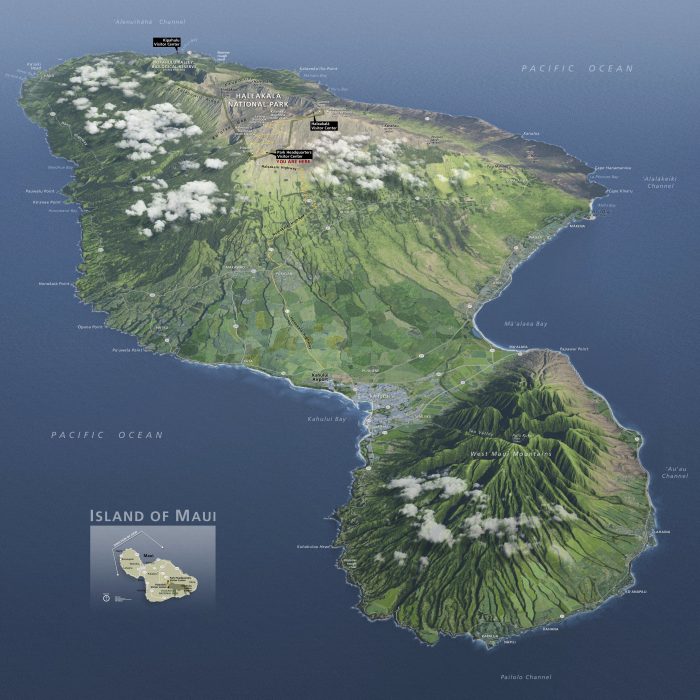
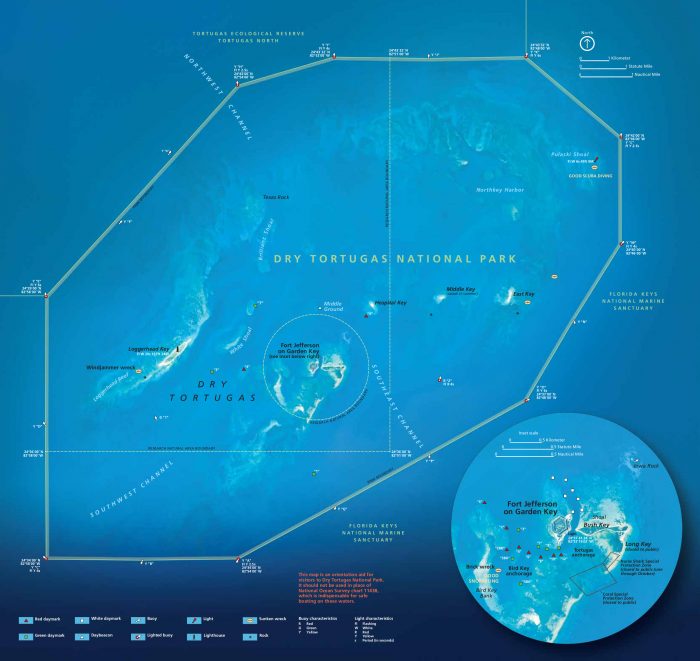
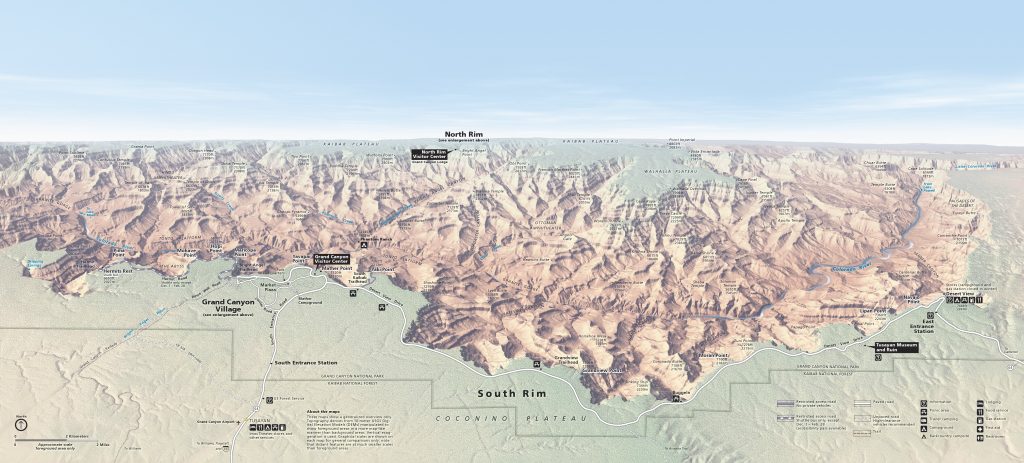
That said, we find this collection is filled with aesthetic pleasures, and no small number of geographical and historical curiosities. At the top see a 3D map of Hawaii’s Haleakala National Park, with a “stunning overview of Maui.” Below it, see a map of “the range of the Coast Redwood, stretching from southern Oregon to south of Big Sur.” (Redwood National and State Parks appear as a tiny area on the left, just below the Oregon state border.) Further down is a bright blue aerial map of Florida’s Dry Tortugas National Park, and below it, a map of the historical Wilderness Road through the Cumberland Gap, the “path of the famous road used by settlers to reach Kentucky.” Plus, then the Southern Rim of the Grand Canyon.

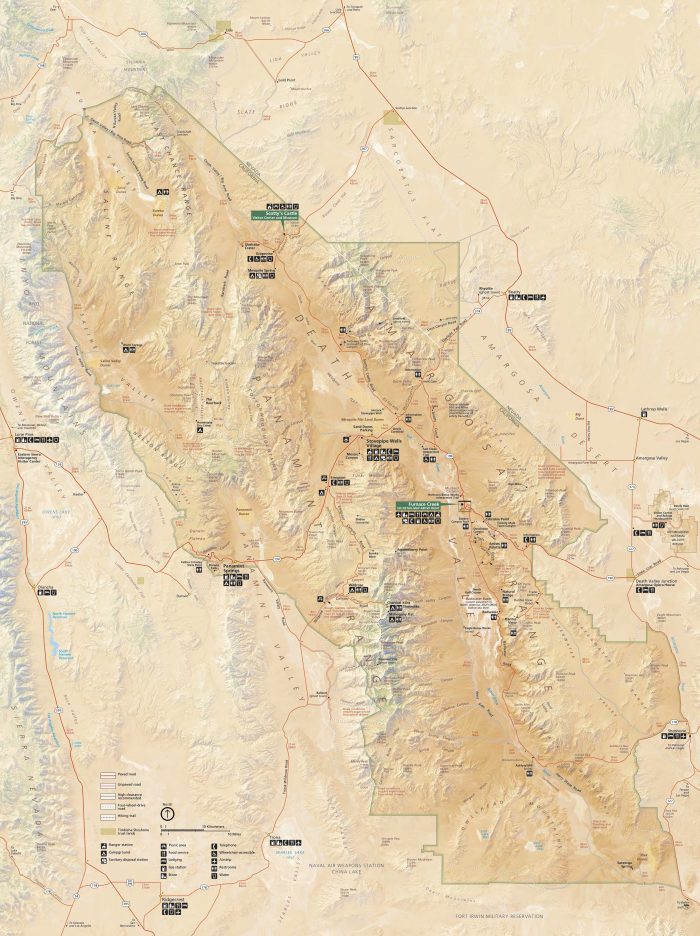
Further up, see a map of Death Valley, and just above, a floor plan of the U.S. Penitentiary on Alcatraz Island. This tiny sampling of the more than one-thousand maps at Holly’s National Parks Maps site shows just some of the natural (and man-made) wonders the National Parks Service stewards. For more, visit the site, where you can browse by state or alphabetically by park. Holly has also uploaded brochures and trail and lodging maps, and included links to other resources as well as gifts and prints. The site more than accomplishes its practical purpose of centralizing all the cartographic info travelers might need. But it also makes an implicit case for the National Parks by showing us how well they have kept intact the country’s defining features, which will, one hopes, still be here long after we are gone.
via Mental Floss
Related Content:
Yosemite National Park in All of Its Time-Lapse Splendor
226 Ansel Adams Photographs of Great American National Parks Are Now Online
Josh Jones is a writer and musician based in Durham, NC. Follow him at @jdmagness
Read More...Support Us
We're hoping to rely on loyal readers, rather than erratic ads. Please click the Donate button and support Open Culture. You can use Paypal, Venmo, Patreon, even Crypto! We thank you!

About Us

Open Culture scours the web for the best educational media. We find the free courses and audio books you need, the language lessons & educational videos you want, and plenty of enlightenment in between.
Advertise With Us

FREE UPDATES!
GET OUR DAILY EMAIL
Get the best cultural and educational resources on the web curated for you in a daily email. We never spam. Unsubscribe at any time.
FOLLOW ON SOCIAL MEDIA

Open Culture editor Dan Colman scours the web for the best educational media. He finds the free courses and audio books you need, the language lessons & movies you want, and plenty of enlightenment in between.
Advertise With Us


