When Ursula K. Le Guin & Philip K. Dick Went to High School Together
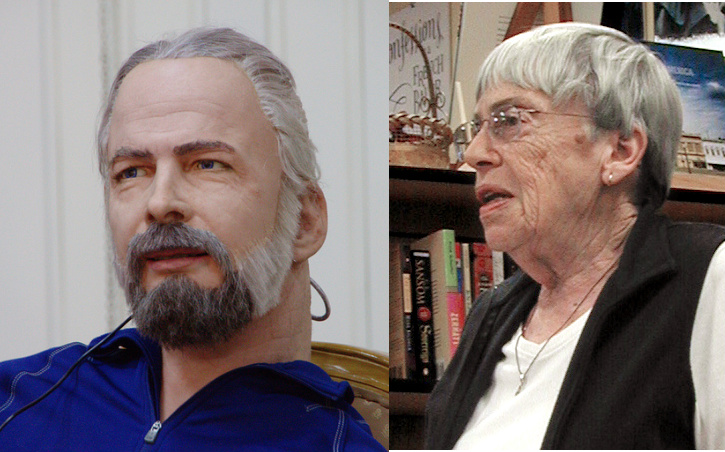
Creative commons images are by Rasmus Lerdorf and Gorthian , via Wikimedia Commons
When you run a site like this, you learn all kinds of unexpected things–most of it rich and rewarding, some of it strange, trivial and still nonetheless intriguing. Discovering that Adolf Hitler and Ludwig Wittgenstein went to the same Austrian middle school, likely at the same time, fits into the latter category. And so too does this:
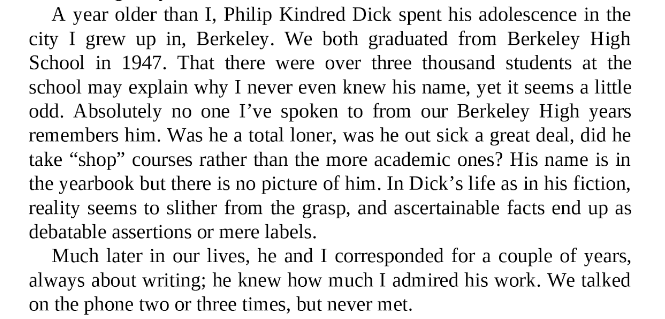
On Twitter, jazz critic Ted Gioia recently highlighted a curious passage from Ursula K. Le Guin’s new book, where she mentions attending high school with another seminal figure in sci-fi literature, Philip K. Dick (Do Androids Dream of Electric Sheep?, Total Recall, Minority Report, A Scanner Darkly etc.).
As she separately told The Paris Review, Berkeley High had 5,300 kids during the 1940s. It was a big high school. And yet “Nobody knew Phil Dick. I have not found one person from Berkeley High who knew him. He was the invisible classmate.” Years later, the two authors talked. But never met. PKD always remained something of a ghost.
Related Content:
Ursula Le Guin Gives Insightful Writing Advice in Her Free Online Workshop
Hear Inventive Stories from Ursula LeGuin & J.G. Ballard Turned Into CBC Radio Dramas
33 Sci-Fi Stories by Philip K. Dick as Free Audio Books & Free eBooks
Hear 6 Classic Philip K. Dick Stories Adapted as Vintage Radio Plays
Hear VALIS, an Opera Based on Philip K. Dick’s Metaphysical Novel
Read More...Hear 20 Hours of Romantic & Victorian Poetry Read by Ralph Fiennes, Dylan Thomas, James Mason & Many More
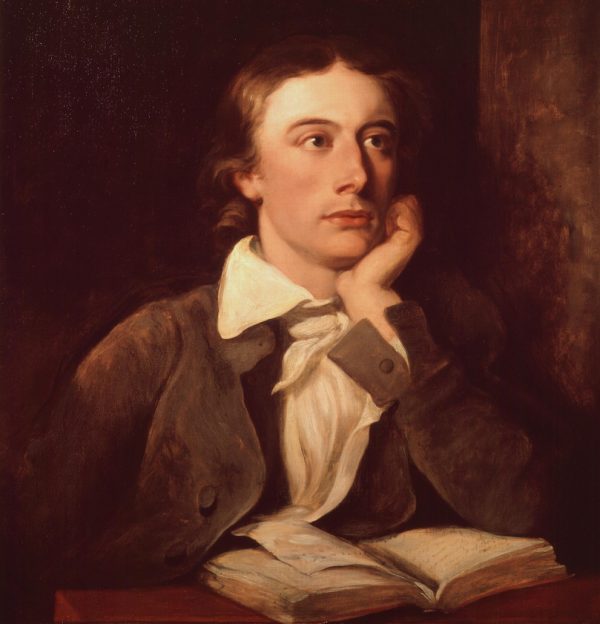
By the time William Wordsworth and Samuel Taylor Coleridge published their Lyrical Ballads in 1798, poets in England had long been celebrities and arbiters of taste in matters political and literary. The seventeenth century, for example, became known as the “Age of Dryden,” for poet and literary critic John Dryden’s tremendous influence. John Milton, Alexander Pope, Samuel Johnson… these were literary men whose writing vied with the era’s philosophers and advised its nobility and heads of state. By the Romantic period of Wordsworth and Coleridge, no poet held such a position of authority and influence as had those of the previous two centuries.
And yet, we might argue that poetry—and the exalted figure of the poet—became even more sacrosanct and indispensable to British culture throughout the nineteenth century; that poets became, as Percy Shelley wrote in 1821, the “unacknowledged legislators of the world.” Such a hyperbolic statement may seem to conflict with the aims Wordsworth stated for Romantic poetry in the Lyrical Ballads’ preface: “fitting to metrical arrangement a selection of the real language of men in a state of vivid sensation.” Yet when we think of Romantic poetry, we rarely think of the “real language of men.”
The nineteenth century saw the ascendency of the British Empire to its height during Victoria’s reign. Whether effect or cause of the hubris of the times, both Romantic and Victorian poetry—all the way to the end of Alfred Tennyson’s 12-cycle series Idylls of the King in 1885—gave us mythical epics filled with grandeur of expression and image, and no small amount of bombast. Coleridge’s The Rime of the Ancient Mariner (from the Lyrical Ballads) and strange “Kubla Khan” showed the way. Keats tells an outsized tale of the Titans’ fall from Olympus in Hyperion. Shelley gave us the bleak imperial relics of “Ozymandias.”
There were also, of course, the quiet love and nature poems of Wordsworth, Keats, John Clare, and Walter De La Mare, all wonderfully representative of a Romantic pastoral tradition reflecting a nostalgia for a rapidly transforming English countryside. There were the Orientalist poems of exotic wonder, and heroic poems of military valor and revolution. The later nineteenth century revealed even more variety as these strains yielded to greater specialization, and to expanded roles for women poets.
Kipling’s colonialist verses reassured British subjects of their superior status in the scheme of things, and entertained them with fables and morality plays. Oscar Wilde refined the aestheticism of Keats with a decadent eroticism. Brother and sister Dante Gabriel Rossetti and Christina Rossetti took the Romantics’ antiquarianism into the territory of medieval and Gothic revival. Husband and wife Robert and Elizabeth Barrett Browning looked also to the Middle Ages, and to Italy. Swinburne and Tennyson upheld the tradition of the epic, imbuing it with their own strange preoccupations. Gerard Manley Hopkins did things with language never attempted before.
All of these poets appear in the Spotify playlists here, titled “The Romantics” and “The Victorians,” though you’ll notice that these aren’t mutually exclusive categories. Elizabeth Barrett Browning appears in both lists. Tennyson, perhaps the longest-lived and most famous poet of the age, spans almost the entire century. Keats, whose early tragic death contributed to his rock star status with later readers, died most assuredly a Romantic. But the terms hardly tell us very much by themselves, marking conventional ways of dividing up the literature of the nineteenth century.
What we might notice about the English verse of these two periods on the whole is its tendency toward exaggerated, often florid and overly formal diction and syntax, and its sentimentalism, high seriousness, and decorum. These are qualities we often learn to associate with all poetry, or learn to think of as insincere and pretentious. In the nearly 20 hours of skilled readings here—including some by famous names like James Mason, Dylan Thomas, John Gielgud, Sir Ralph Richardson, Boris Karloff, and Ralph Fiennes—we hear a great deal of nuance, subtlety, irony, and beauty. Learning to appreciate the poetic voices of over a century past not only requires familiarity with unusual idioms and ideas; it also requires tuning our ears to very different kinds of English than our own.
Both playlists will be added to our collection, 1,000 Free Audio Books: Download Great Books for Free.
Related Content:
Stream Classic Poetry Readings from Harvard’s Rich Audio Archive: From W.H. Auden to Dylan Thomas
Rare 1930s Audio: W.B. Yeats Reads Four of His Poems
Josh Jones is a writer and musician based in Durham, NC. Follow him at @jdmagness
Read More...Man Ray Creates a “Surrealist Chessboard,” Featuring Portraits of Surrealist Icons: Dalí, Breton, Picasso, Magritte, Miró & Others (1934)
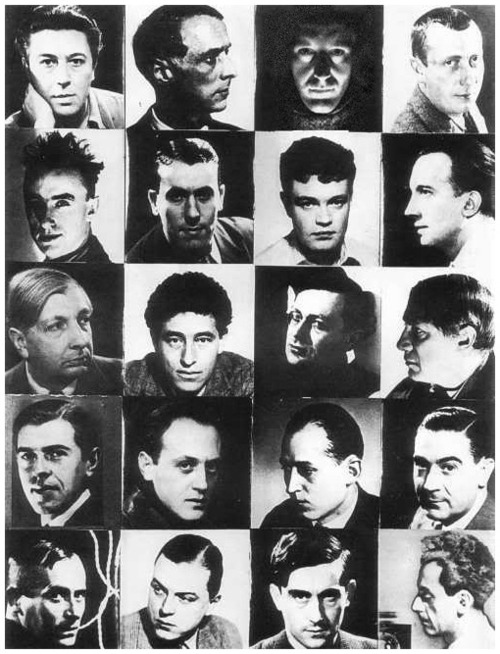
Like most artists, Emmanuel Radnitzky had more than one major interest in his life. We who know him as Man Ray usually first encounter him through his photography, such as the artist and writer portraits featured here at Open Culture last year. But Man Ray himself ultimately considered painting his main creative field. And, apart from his work, he had chess–or at least his friend and fellow conceptual artist Marcel Duchamp had chess. Duchamp seems to have turned Man Ray on to it as well, and they even appear playing together in Rene Clair’s 1924 film Entr’acte.
Duchamp’s passion for chess ran deep enough that, for a time, he all but abandoned art to devote himself to the game. Later he came to the realization that “chess was art; art was chess,” having pursued both of those interests at once in the creation of an art deco chessboard. Man Ray, for his part, brought art and chess together in 1934’s Surrealist Chessboard, a mosaic of his portraits of artists associated with the Surrealist movement, including Salvador Dalí, Andre Breton, Pablo Picasso, René Magritte, Joan Miró, and of course himself — but with the chess-loving Duchamp nowhere to be seen.
“Surrealist exhibition group photographs include the frequent participation of Man Ray but rarely Duchamp,” writes Lewis Kachur in aka Marcel Duchamp: Meditations on the Identities of an Artist, his non-appearance on the Surrealist Chessboard being the “most astonishing” example. “The structure is the democratic grid format of the chessboard, with each of twenty surrealists or fellow travelers as a head shot against a black or light-colored background, alternating to suggest the black and white squares of the board. Man Ray had a negative of an appropriate profile bust of Duchamp (1930), striking for its absence here.”
Kachur imagines that Duchamp “chose not to take part,” in keeping with his “somewhat shadowy” position in relation to the Surrealists, “on the margins of the movement group’s identity.” Or he may simply have wanted to save his friend the trouble of figuring out a shape in which to arrange 21 portraits instead of 20. Whatever Duchamp thought of this project that used the chessboard only as visual structure, he probably preferred the chess set Man Ray designed a decade earlier using historically inspired pure geometric forms — and one that he could actually play chess with. You can still purchase own copy of that chess set today.
Related Content:
Man Ray’s Portraits of Ernest Hemingway, Ezra Pound, Marcel Duchamp & Many Other 1920s Icons
Man Ray and the Cinéma Pur: Four Surrealist Films From the 1920s
Based in Seoul, Colin Marshall writes and broadcasts on cities and culture. He’s at work on a book about Los Angeles, A Los Angeles Primer, the video series The City in Cinema, the crowdfunded journalism project Where Is the City of the Future?, and the Los Angeles Review of Books’ Korea Blog. Follow him on Twitter at @colinmarshall or on Facebook.
Read More...The Psychology That Leads People to Vote for Extremists & Autocrats: The Theory of Cognitive Closure
There’s a political disconnect in the United States. We have two political parties, each now living in its own reality and working with its own set of facts. The common ground between them? Next to none.
How to explain this disconnect? Maybe the answer lies in the theory of “cognitive closure”–a theory first worked out by social psychologist Arie Kruglanski back in 1989.
“People’s politics are driven by their psychological needs,” Kruglanski explains in the short documentary above. “People who are anxious because of the uncertainty that surrounds them are going to be attracted to messages that offer certainty.”
He sips a soda, then continues, “The need for closure is the need for certainty, to have clear cut knowledge. You feel that you need to stop processing too much information, to stop listening to a variety of viewpoints, and zero in on what appears to be, to you, the truth.” “The need for closure tricks your mind to believe you have the truth, even though you haven’t examined the evidence very carefully.” And that, unfortunately, can be very dangerous.
Kruglanski’s theory could help explain the rise of Nazism in the economically-depressed Weimar Germany. And it’s perhaps why, across much of our economically stagnating world, we’re seeing populations lurch toward extreme ideologies and autocratic personalities. “The divisions, the polarization, it’s all part of the same psychological syndrome,” says Kruglanski.
So what’s the cure? Listen to other points of view. Look at all available information. And, most of all, be suspicious of your own sense of righteous.
If you would like to support the mission of Open Culture, consider making a donation to our site. It’s hard to rely 100% on ads, and your contributions will help us continue providing the best free cultural and educational materials to learners everywhere. You can contribute through PayPal, Patreon, and Venmo (@openculture). Thanks!
Related Content:
Free Online Psychology & Neuroscience Courses
Free Online Political Science Courses
Read More...The Photography of Poet Arthur Rimbaud (1883)
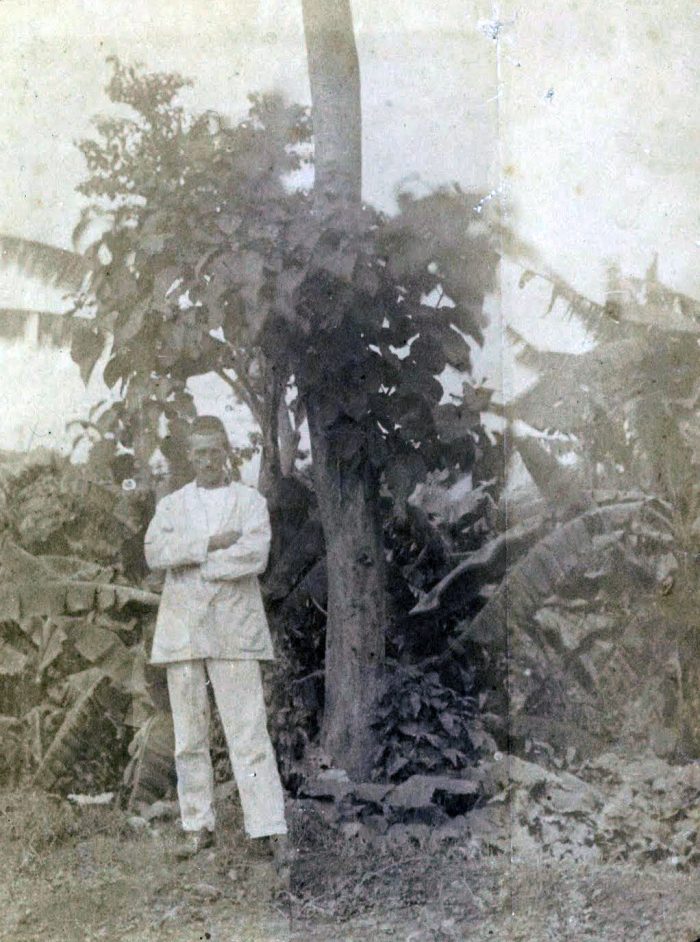
Arthur Rimbaud, far-seeing prodigy, “has been memorialized in song and story as few in history,” writes Wyatt Mason in an introduction to the poet’s complete works; “the thumbnail of his legend has proved irresistible.” The poet, we often hear, ended his brief but brilliant literary career when he ran off to the Horn of Africa and became a gunrunner… or some other sort of adventurous outlaw character many miles removed, it seems, from the intense symbolist hero of Illuminations and A Season in Hell.
Rimbaud’s break with poetry was so decisive, so abrupt, that critics have spent decades trying to account for what one “hyperbolic assessment” deemed as having “caused more lasting, widespread consternation than the break-up of the Beatles.” What could have caused the young libertine, so drawn to urban voyeurism and the skewering of the local bourgeoisie, to disappear from society for an anonymous, rootless life?
On the other hand, in revisiting the poetry we find—amidst the grotesque, hallucinogenic reveries—that “travel, adventure, and departure on various levels are thematic concerns that run through much of Rimbaud”: from 1871’s “The Drunken Boat” to A Season in Hell’s “Farewell,” in which the poet writes, “The time has come to bury my imagination and my memories! A fitting end for an artist and teller of tales.”
He was only 18 then, in 1873, when he wrote his farewell. Two years later, he would finally end his violent tumultuous relationship with Paul Verlaine, and embark on a series of voyages, first by foot all over Europe, then to the Dutch East Indies, Cyprus, Yemen, and finally Abyssinia (modern day Ethiopia), where he settled in Harar, struck up a friendship with the governor (the father of future Emperor Haile Selassie), and became a highly-regarded coffee trader, and yes, gun dealer.
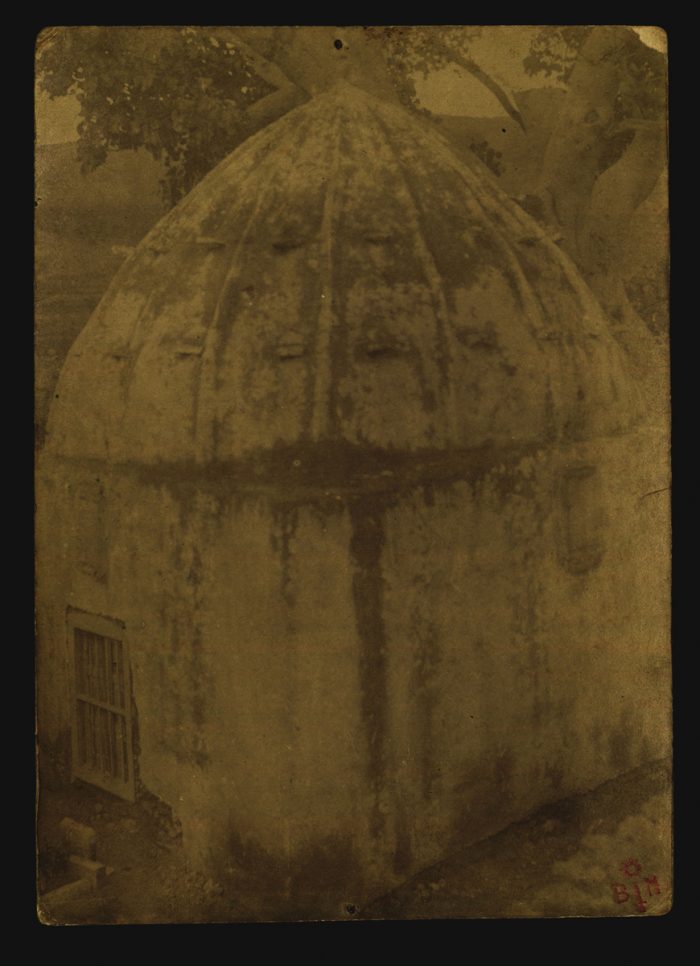
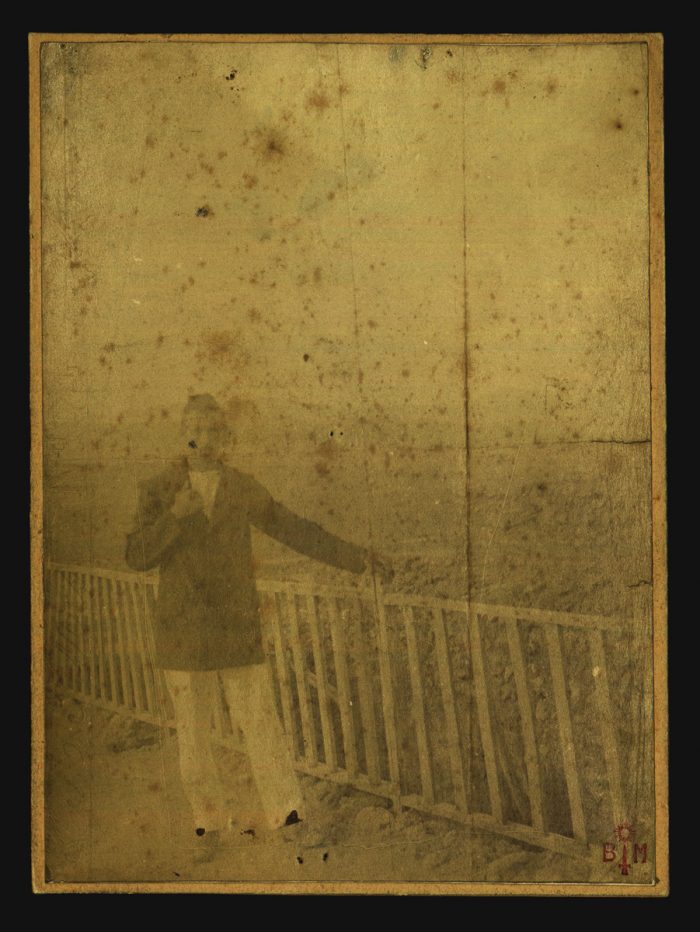
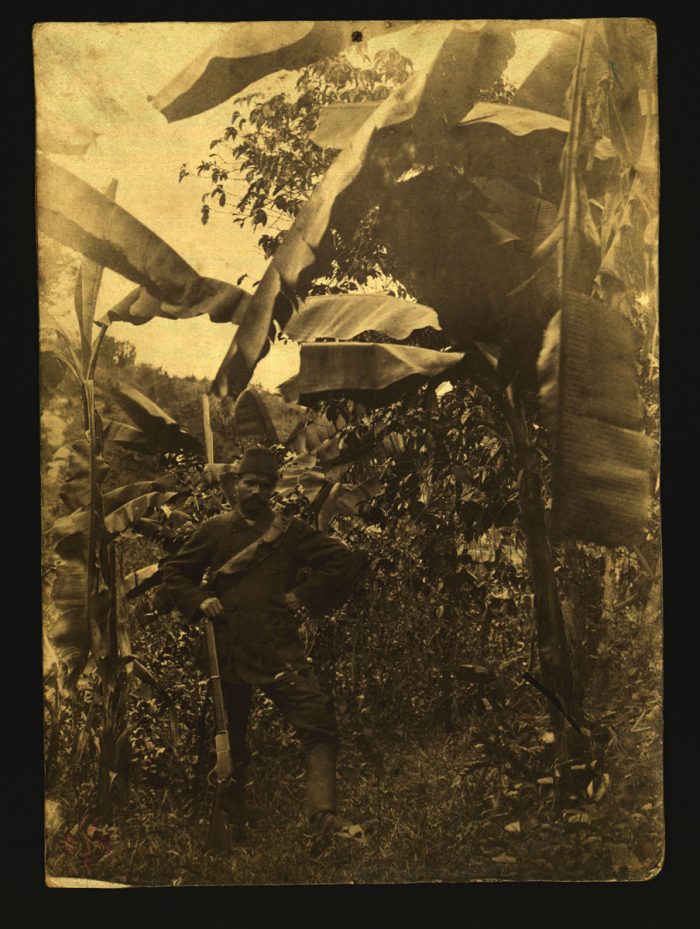
Rimbaud may have left poetry behind, deciding he had realized all he could in language. But he had not given up on approaching his experience aesthetically. Only, instead of trying “to invent new flowers, new stars, new flesh, new tongues,” as he wrote in “Farewell,” he had evidently decided to take the world in on its own terms. He documented his findings in essays on geography and travel accounts and, in 1883, several photographs, including two self-portraits he sent to his mother in May, writing, “Enclosed are two photographs of me which I took.”
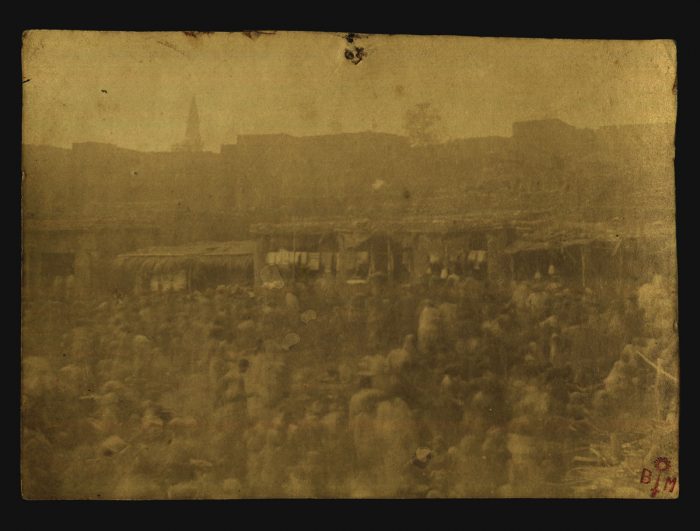
You can see one of those portraits at the top of the post, and the other, in much worse shape, below it, and a third self-portrait just below. The “circumstances in which the photographs were taken are quite mysterious,” writes Lucille Pennel at The Eye of Photography.
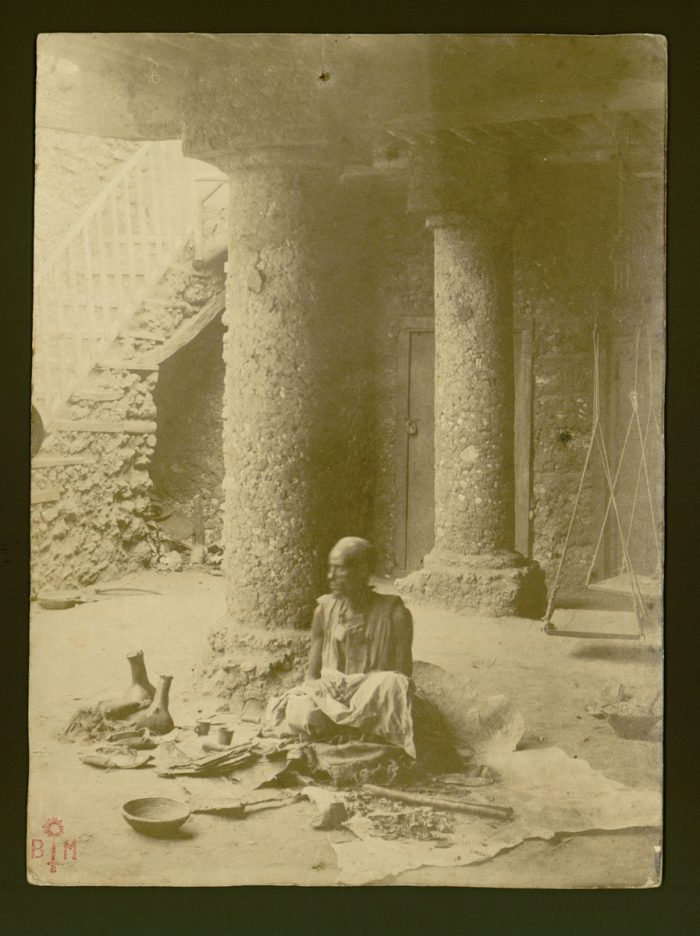
Starting in 1882, Rimbaud became fascinated with the new technology. He ordered a camera in Lyon in order to illustrate a book on “Harar and the Gallas country,” a camera he received only in early 1883. He also ordered specialized books and photo processing equipment. The planned scientific publication was never realized, and the six photographs are the only trace of Rimbaud’s activity.
“I am not yet well established, nor aware of things,” Rimbaud wrote in the letter to his mother, “But I will be soon, and I will send you some interesting things.” It’s not exactly clear why Rimbaud abandoned his photographic endeavors. He had approached the pursuit not only as hobby, but also as a commercial venture, writing in his letter, “Here everyone wants to be photographed. They even offer one guinea a photograph.”
The comment leads Pennel to conclude “there must have been other photographs, but any trace of them is lost, raising doubts about the degree of Rimbaud’s engagement with photography.”
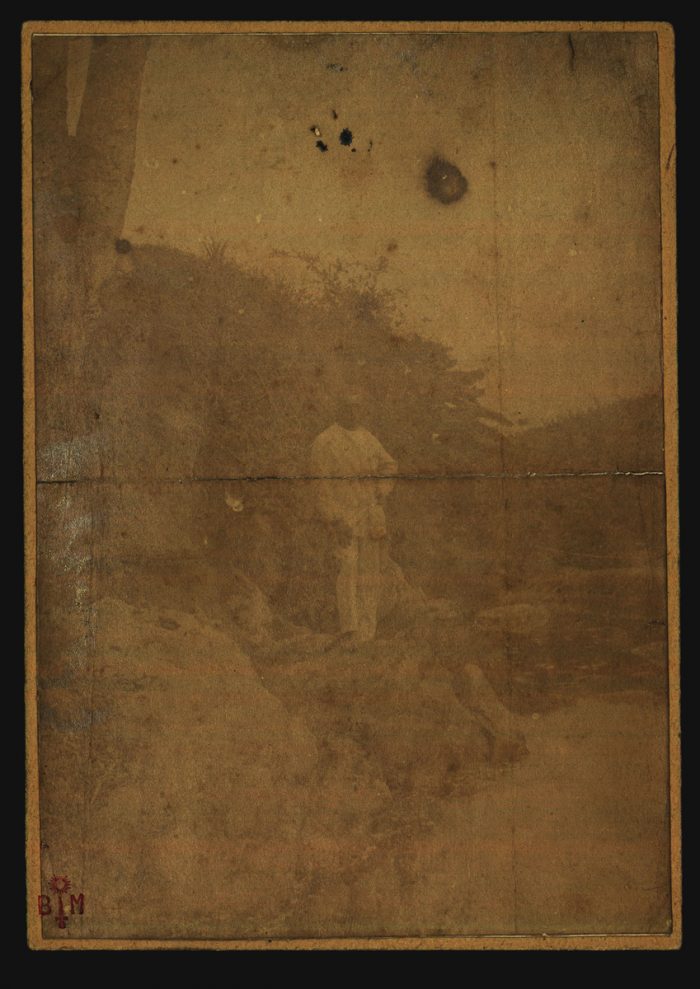
Perhaps, however, he’d simply decided that he’d done all he could do with the medium, and let it go with a graceful farewell. History, posterity, the cementing of a reputation—these are phenomena that seemed of little interest to Rimbaud. “What will become of the world when you leave?” he had written in “Youth, IV”—“No matter what happens, no trace of now will remain.” In a historical irony, Rimbaud’s photographs “were developed in ‘filthy water,’” notes Pennel, meaning they “will continue to fade until the images are all gone. They are as fleeting as the man with the soles of wind.”
If we wish to see them in person, the time is short. The photo at the top of the post now resides at the Bibliothèque Nationale de France. The other six are housed at the Arthur Rimbaud Museum in Charleville-Mézières.
via Vintage Anchor/The Eye of Photography.
Related Content:
The Brief Wondrous Career of Arthur Rimbaud (1870–1874)
Great 19 Century Poems Read in French: Baudelaire, Rimbaud, Verlaine & More
Patti Smith’s Polaroids of Artifacts from Virginia Woolf, Arthur Rimbaud, Roberto Bolaño & More
Josh Jones is a writer and musician based in Durham, NC. Follow him at @jdmagness
Read More...Why Socrates Hated Democracies: An Animated Case for Why Self-Government Requires Wisdom & Education
How often have you heard the quote in one form or another? “Democracy is the worst form of Government,” said Winston Churchill in 1947, “except for all those other forms that have been tried from time to time.…” The sentiment expresses two cultural values many Americans are trained to hold uncritically: the primacy of democracy and the burdensomeness of government as a necessary evil.
In his new book Toward Democracy, Harvard historian James T. Kloppenberg argues that these ideas arose fairly recently with “mostly Protestants, at least at first,” notes Kirkus, in whose hands “the idea of democracy as a dangerous doctrine of the mob was reshaped into an ideal.” Much of this transformation “occurred in the former British colonies that became the United States, where, at least from a British nobleman’s point of view, mob rule did take hold.”
The modern revamping of democracy into a sacred set of universal institutions has defined our understanding of the term. Just as the West has co-opted classical Athenian architecture as symbolic of democratic purity, it has often co-opted Greek philosophy. But as anyone who has ever read Plato’s Republic knows, Greek philosophers were highly suspicious of democracy, and could not conceive of a functioning egalitarian society with full suffrage and freedom of speech.
Socrates, especially, says Alain de Botton in the School of Life video above, “was portrayed in the dialogues of Plato as hugely pessimistic about the whole business of democracy.” In the ideal society Socrates constructs in the Republic, he famously argues for restricted freedom of movement, strict censorship according to moralistic civic virtues, and a guardian soldier class and the rule of philosopher kings.
In Book VI, Socrates points out the “flaws of democracy by comparing a society to a ship.” If you were going on a sea voyage, “who would you ideally want deciding who was in charge of the vessel, just anyone, or people educated in the rules and demands of seafaring?” Unless we wish to be obtusely contrarian, we must invariably answer the latter, as does Socrates’ interlocutor Adeimantus. Why then should just any of us, without regard to level of skill, experience, or education, be allowed to select the rulers of a country?
The grim irony of Socrates’ skepticism, de Botton observes, is that he himself was put to death after a vote by 500 Athenians. Rather than the typical elitism of purely aristocratic thinking, however, Socrates insisted that “only those who had thought about issues rationally and deeply should be let near a vote.” Says de Botton, “We have forgotten this distinction between an intellectual democracy and a democracy by birthright. We have given the vote to all without connecting it to wisdom.” (He does not tell us whom he means by “we.”)
For Socrates, so-called “birthright democracy” was inevitably susceptible to demagoguery. Socrates “knew how easily people seeking election could exploit our desire for easy answers” by telling us what we wanted to hear. We should heed Socrates’ warnings against mob rule and the dangers of demagoguery, de Botton argues, and consider democracy as “something that is only ever as good as the education system that surrounds it.” It’s a potent idea, and one often repeated with reference to a similar warning from Thomas Jefferson.
What de Botton does not mention in his short video, however, is that Socrates also advised that his rulers lie to the citizenry, securing their trust not with false promises and seductive blandishments, but with ideology. As the Internet Encyclopedia of Philosophy summarizes, Socrates “suggests that [the rulers] need to tell the citizens a myth that should be believed by subsequent generations in order for everyone to accept his position in the city”—and to accept the legitimacy of the rulers. The myth—like modern scientific racism and eugenics—divides the citizenry into an essential hierarchy, which Socrates symbolizes by the metals gold, silver, and bronze.
But who determines these categories, or which voters are the more “rational,” or what that category entails? How do we reconcile the egalitarian premises of democracy with the caste systems of the utopian Republic, in which voting “rationally” means voting for the interests of the class that gets the vote? What about the uses of propaganda to cultivate official state ideology in the populace (as Walter Lippman so well described in Public Opinion). And what are we to do with the deep suspicions of, say, Nietzsche when it comes to Socratic ideas of reason, many of which have been confirmed by the findings of neuroscience?
As cognitive scientist and linguist George Lakoff writes, “Most thought is unconscious, since we don’t have conscious access to our neural circuitry.… Estimates by neuroscientists vary between a general ‘most’ to as much as 98%, with consciousness as the tip of the mental iceberg.” That is to say that—despite our levels of education and specialized training—we “tend to make decisions unconsciously,” at the gut level, “before becoming consciously aware of them.” Even decisions like voting.
These considerations should also inform critiques of democracy, which have not only warned us of its dangers, but have also been used to justify widespread voter suppression and disenfranchisement for reasons that have nothing to do with objective rationality and everything to do with myth and political ideology.
Related Content:
Socrates on TV, Courtesy of Alain de Botton (2000)
How to Know if Your Country Is Heading Toward Despotism: An Educational Film from 1946
Josh Jones is a writer and musician based in Durham, NC. Follow him at @jdmagness
Read More...Hear a 20 Hour Playlist Featuring Recordings by Electronic Music Pioneer Pauline Oliveros (RIP)
We can all surely recite some version of the difference between listening and hearing. It’s usually explained by a parent or guardian, with the intent of making us better at following instructions. On the whole, it’s for our own good as children that we pay heed to our elders. But genuine, critical listening is about so much more than perceiving gestures of authority. The avant-garde composer Pauline Oliveros, who died this past Thursday at 84, would argue that true listening, what she called “deep listening,” opens us up in radical ways to the world around us, and frees us from the sociopolitical constraints that hem in our senses. “Take a walk at night,” says one Oliveros’ 1974 “Sonic Meditations,” a set of 25 instructions for deep listening, “Walk so silently that the bottom of your feet become ears.”
“Sonic Meditations” emerged after “a period of intense introspection prompted by the Vietnam War,” writes Steve Smith in a New York Times obituary, during which Oliveros “changed creative course” to begin favoring improvisatory works. “All societies admit the power of music or sound,” she wrote in the preface.
“Sonic Meditations,” wrote Oliveros, “are an attempt to return the control of sound to the individual alone, and within groups especially for humanitarian purposes; specifically healing.” Her approach represented the composer giving up control and the primacy of authorship in order to play other roles: healer, guide, and teacher, a role she inhabited for decades as a college professor and author of several books of musical theory.
As you can see in her TEDx lecture at the top of the post, Oliveros always returned from her sonic explorations—such as the 1989 recording titled Deep Listening (hear an excerpt below)—with lessons for us in how to become better, more engaged and empowered listeners, rather than distracted consumers, of music and sound. Even before the 70s, and her turn to music as a meditative discipline informed by Buddhism and Native American ritual, Oliveros’ work disrupted the usual hierarchies of sound. An early adopter of technology, she “was quickly at the vanguard of electronics,” wrote Tom Service in a 2012 Guardian profile, but her “relationship with technology is philosophically ambivalent” given the role of research and development in creating weapons of war.
In early compositions like 1965’s “Bye Bye Butterfly,“ the composer “manipulated a recording of Puccini’s opera ‘Madama Butterfly’ on a turntable,” Smith writes, “augmenting its sounds with oscillators and tape delay.” In the beautifully moving results, further up, she aimed for a critique that “bids farewell not only to the music of the 19th century,” she wrote, “but also to the system of polite morality of that age and its attendant institutionalized oppression of the female sex.” Music has always been produced and consumed within the social constructions of gender binaries, Oliveros maintained. In a 1970 New York Times essay “And Don’t Call Them ‘Lady’ Composers,” she observed that “unless she is super-excellent, the woman in music will always be subjugated, while men of the same or lesser talent will find places for themselves.”
Throughout her long career, Oliveros created a place for herself, with as much theoretical rigor, playfulness, elegance, and sophistication as her friend and contemporary John Cage. That her substantial body of work has received a fraction of the attention as his may offer an instructive gloss on her contentions of persistent bias. But Oliveros’ work was not reactive; it was constructive, such that her concepts gave rise to what she called a Deep Listening Institute, an “ever-growing community of musicians, artists, scientists, and certified Deep Listening practitioners,” who strive “for a heightened consciousness of the world of sound and the sound of the world.”
But you don’t need specialized certification or training to experience the meditative, consciousness-expanding techniques of Oliveros’ music. On the contrary, she sought to foster “creative innovation across boundaries and across abilities, among artists and audience, musicians and nonmusicians, healers and the physically or cognitively challenged, and children of all ages.” In the Spotify playlist above, hear—or rather listen to—20 hours of Oliveros compositions, many featuring her early experiments with analog electronics, her “expanded instrument system,” and her signature instrument, a digitally-enhanced accordion.
As in the orchestral movement of Deep Listening, the album, Oliveros frequently dialogues with musical traditions, but she refused to allow them any particularly elevated authority over her work. “I’m not dismissive of classical music and the Western canon,” she said in 2012, “It’s simply that I can’t be bound by it. I’ve been jumping out of categories all my life.” As listeners, and readers, of her work, we can all learn to do the same.
Related Content:
The Music of Avant-Garde Composer John Cage Now Available in a Free Online Archive
Josh Jones is a writer and musician based in Durham, NC. Follow him at @jdmagness
Read More...An Animated Introduction to George Orwell
When his short and (by his own account) often miserable life came to an end in 1950, could the English political writer Eric Arthur Blair have known that he would not just become a household name, but remain one well over half a century later? Given his adoption of the memorable nom de plume George Orwell, we might say he had an inkling of his literary legacy’s potential. Still, he claimed to choose it for no grander reason than that it sounded like “a good round English name,” and would have loathed the pretense he sensed in the use of the phrase “nom de plume,” or, for that matter, any other of conspicuously foreign provenance.
The attitudes that shaped the author of Animal Farm and 1984 come out in this animated introduction to Orwell’s life and work, newly published by Alain de Botton’s School of Life. In explaining the motivations of this “most famous English language writer of the 20th century,” de Botton quotes from the essay “Why I Write,” wherein Orwell, with characteristic clarity, lays out his mission “to make political writing into an art. My starting point is always a feeling of partisanship, a sense of injustice. When I sit down to write a book, I do not say to myself, ‘I am going to produce a work of art.’ I write it because there is some lie that I want to expose, some fact to which I want to draw attention, and my initial concern is to get a hearing.”
Orwell hated his fellow intellectuals, whom he accused of “a range of sins: a lack of patriotism, resentment of money and physical vigor, concealed sexual frustration, pretension, and dishonesty.” He loved “the ordinary person” and the lives led by those “not especially blessed by material goods, people who work in ordinary jobs, who don’t have much of an education, who won’t achieve greatness, and who nevertheless love, care for others, work, have fun, raise children, and have large thoughts about the deepest questions in ways Orwell thought especially admirable.” Though raised middle-class and educated at Eton, Orwell eschewed university and believed that “the average pub in a coal-mining village contained more intelligence and wisdom than the British Cabinet or the high table of an Oxbridge college.”
One might want to call such an intellectual a poseur or even a sort of fetishist, but Orwell backed up his pronouncements about the superiority of the working class with his years spent living and working in it, and, with books like Down and Out in Paris and London and The Road to Wigan Pier, writing about it. He praised newspaper comics, country walks, dancing, Charles Dickens, and straightforward language, all of which informed the attacks on ideology and authoritarianism that would keep his writing meaningful for future generations. The holiday season now upon us makes another work of Orwell’s especially relevant: his Christmas pudding recipe, one blow in his lesser-known struggle to, as the London-based de Botton puts it, write “bravely in defense of English cooking” — a project which would, by itself, qualify him as a champion of the underdog.
Related Content:
George Orwell Explains in a Revealing 1944 Letter Why He’d Write 1984
For 95 Minutes, the BBC Brings George Orwell to Life
George Orwell’s Final Warning: Don’t Let This Nightmare Situation Happen. It Depends on You!
What “Orwellian” Really Means: An Animated Lesson About the Use & Abuse of the Term
Try George Orwell’s Recipe for Christmas Pudding, from His Essay “British Cookery” (1945)
Based in Seoul, Colin Marshall writes and broadcasts on cities and culture. He’s at work on a book about Los Angeles, A Los Angeles Primer, the video series The City in Cinema, the crowdfunded journalism project Where Is the City of the Future?, and the Los Angeles Review of Books’ Korea Blog. Follow him on Twitter at @colinmarshall or on Facebook.
Read More...Watch Georges Méliès’ The Dreyfus Affair, the Controversial Film Censored by the French Government for 50 Years (1899)
History resounds with events so momentous they can be conjured with a single word: Waterloo, Watergate, Tiananmen, Brexit.…
In the late nineteenth century, one simple phrase, J’Accuse!—the title of an open letter published by novelist Emile Zola—stood for a serious injustice that inflamed the political passions of artists, journalists, and the public for decades afterward, and presaged some of the 20th century’s most incredible state crimes.
Zola wrote in defense of French artillery captain Alfred Dreyfus, who was accused, court-marshalled, and sentenced to life imprisonment on Devil’s Island for supposedly giving military secrets to the Germans. It was the trial of the century, writes Adam Gopnik at The New Yorker, and afterward, Dreyfus, “a young Jewish artillery officer and family man.… was publicly degraded before a gawking crowd.”
His insignia medals were stripped from him, his sword was broken over the knee of the degrader, and he was marched around the grounds in his ruined uniform to be jeered and spat at, while piteously declaring his innocence and his love of France above cries of “Jew” and “Judas!”
Two years later, compelling evidence came to light that showed another officer, Ferdinand Esterhazy, had committed the treasonous offence. But the evidence was buried, and the officer who found it transferred to North Africa and later imprisoned. The Dreyfus Affair marked a major turn in European civil society, “the moment where [Guy de] Maupassant’s world of ambition and pleasure met Kafka’s world of inexplicable bureaucratic suffering.” After a perfunctory two-day trial, Esterhazy was unanimously acquitted by a military court, and Dreyfus convicted of additional charges based on falsified documents.
Five years after Dreyfus’ conviction, his supporters, the “Dreyfusards,” including Zola, Henri Poincare, and Georges Clemenceau, forced the government to retry the case. Dreyfus was ultimately pardoned, and later fully exonerated and reinstated in the French army. He went on to serve with distinction in World War I.
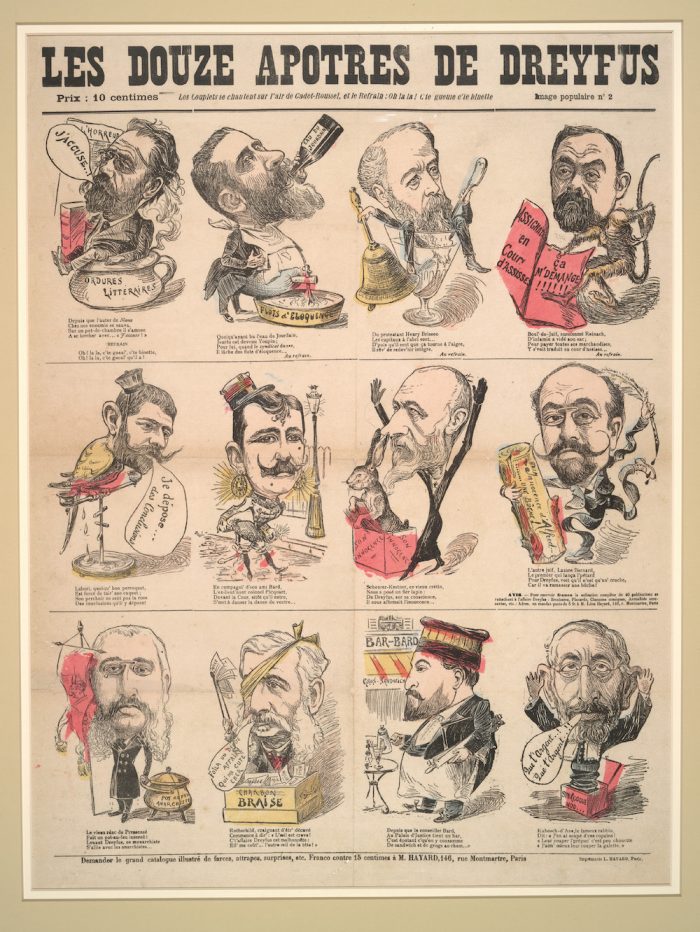
Dreyfus’ accusers’ have mostly sunk into obscurity. His supporters— some caricatured above as “the twelve apostles of Dreyfus”—included some of the most illustrious men of arts and letters in France. They can count among their number the great French director and cinematic visionary Georges Méliès. During the heated year of 1899, “Méliès made a series of eleven one-minute non-fiction films about the Dreyfus Affair as it was still unfolding,” writes Elizabth Ezra,” portraying sympathetically Dreyfus’ arrest,” imprisonment, and retrial. You can watch Méliès’ complete Dreyfus film at the top of the post.
It may be difficult to appreciate the daring of Méliès’ project from our historical distance, and in the somewhat alien idiom of silent film. “For today’s viewers,” writes Ezra, “it is not always easy to discern the sympathetic elements of the films, but the abundance of huffy gesturing and self-righteous facial expressions on the part of Dreyfus make of him a dignified hero who refuses to be degraded by the accusations made against him.” (In this respect, Méliès anticipated another silent film about another unjust trial in France, Carl Dreyer’s The Passion of Joan of Arc.)
Likewise, we may find it hard to understand the significant social import of “Méliès’ only known expression of political commitment.” But to understand the Dreyfus Affair, we must understand, as the National Library of Israel points out, that “France was already a divided country and the case acted as a casus belli.… ‘The Jew from Alsace’ encapsulated all that the nationalist right loathed, and therefore became the symbol of the nation’s profound division.” Landing in the middle of this political firestorm, Méliès’ Dreyfus series “provoked partisan fistfights,” writes Ezra.
Not only did the Dreyfus case introduce into the public eye a vicious anti-Semitic show-trial, but it also served as a test case for censorship and media sensationalism. Méliès’ film, says author Susan Daitch in the On the Media episode above, was the first docudrama, the “first recreation based on photographs and illustrations in weekly newspapers in France at the time.” And it proved so controversial that it was banned, along with all other Dreyfus films, for fifty years, and only shown again in France in 1974.
The film, says Daitch—who has written a novel based on the Dreyfus Affair—emerged within a partisan mass media war of the kind we’re far too familiar with today. “Both sides,” Daitch tells us, “used and altered the media,” and Dreyfus was both successfully railroaded into prison and successfully retried and exonerated partly on the strength of his supporters’ and accusers’ propaganda campaigns.
The Dreyfus Affair will be added to our list of Free Silent Films, a subset of our collection, 4,000+ Free Movies Online: Great Classics, Indies, Noir, Westerns, Documentaries & More.
The film is considered to be in the public domain in the United States and comes to us via Wikimedia Commons.
Related Content:
The First Horror Film, George Méliès’ The Haunted Castle (1896)
Watch After the Ball, the 1897 “Adult” Film by Pioneering Director Georges Méliès (Almost NSFW)
Josh Jones is a writer and musician based in Durham, NC. Follow him at @jdmagness
Read More...Great 19 Century Poems Read in French: Baudelaire, Rimbaud, Verlaine & More
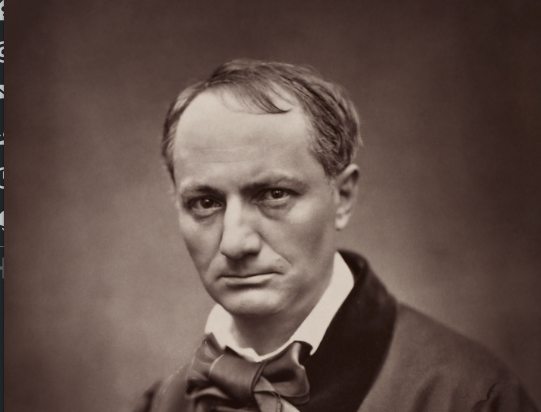
Here’s how Smithsonian Folkways describes this 1961 album now made available by Spotify. (If you need their free software, download it here):
Paul A. Mankin recites the most famous French poetry from the 19th Century. Gérard de Nerval, Victor Hugo and Alphonse de Lamartine, the main poets from the romantic period are represented, as well as precursors of Symbolism, Paul Verlaine and Stéphane Mallarmé. In addition, the album includes poems written by the tortured Charles Baudelaire and the unclassifiable Arthur Rimbaud.
Note: The image above is of Charles Baudelaire. This album will be added to our collection, 1,000 Free Audio Books: Download Great Books for Free. Other albums featuring Mankin’s readings can also be found there, including:
- Multiple Authors — 20th Century French Poetry, Narrated by Paul Mankin — Spotify
- Multiple Authors — French African Poetry, Read in French by Paul Mankin — Spotify
If you would like to support the mission of Open Culture, consider making a donation to our site. It’s hard to rely 100% on ads, and your contributions will help us continue providing the best free cultural and educational materials to learners everywhere. You can contribute through PayPal, Patreon, and Venmo (@openculture). Thanks!
Related Content:
13 Lectures from Allen Ginsberg’s “History of Poetry” Course (1975)
Hear Bill Murray’s Favorite Poems Read Aloud by Murray Himself & Their Authors
Read More...
Support Us
We're hoping to rely on loyal readers, rather than erratic ads. Please click the Donate button and support Open Culture. You can use Paypal, Venmo, Patreon, even Crypto! We thank you!

About Us

Open Culture scours the web for the best educational media. We find the free courses and audio books you need, the language lessons & educational videos you want, and plenty of enlightenment in between.
Advertise With Us

FREE UPDATES!
GET OUR DAILY EMAIL
Get the best cultural and educational resources on the web curated for you in a daily email. We never spam. Unsubscribe at any time.
FOLLOW ON SOCIAL MEDIA

Open Culture editor Dan Colman scours the web for the best educational media. He finds the free courses and audio books you need, the language lessons & movies you want, and plenty of enlightenment in between.
Advertise With Us


