An Introduction to Jean-Luc Godard’s Innovative Filmmaking Through Five Video Essays
Even though Jean-Luc Godard turned 86 this past Saturday, cinema scholar David Bordwell would no doubt still call him “the youngest filmmaker at work today” — as he did just two years ago, in an essay on Godard’s most recent picture Goodbye to Language. Over his more than 65-year-long career, which began in film criticism and arguably never left it, the man who directed the likes of Breathless, Alphaville, and Weekend in his very first decade of filmmaking has kept his work intellectually and aesthetically innovative when most movies seem resigned, and even content, to explore the same trampled patch of cinema’s creative space over and over again.
“Godard has been the liberator of weirdness,” wrote New Yorker film critic and Godard biographer Richard Brody on the occasion of the auteur’s 82nd birthday. “He was always ahead of the game in terms of movie-madness, recognizing that the habit of thinking in terms of images and sounds didn’t detach him from emotional engagement with his subjects but added a new dimension to it.”
He secured creative freedom for himself from the beginning when he “cast amateurs alongside professionals, mixed genres and tones, called attention to the artifices of movies he loved and of genres he rejuvenated, overturned convention with an anarchic fury and an analytical passion.”
Godard, Brody concludes, “hasn’t just rethought movies; he has reconceived the cinema, as a practice and as an experience.” But what does that look like for the audience? These five video essays plunge into Godard’s work, isolating and celebrating elements that have merited our close cinephilic attention. At the top of the post, we have a brief aesthetic overview in the Criterion Collection-sponsored “Godard in Fragments,” wherein video essayist kogonada (creator of pieces previously featured here on Wes Anderson, Alfred Hitchcock, Stanley Kubrick, Andrei Tarkovsky, and neorealism) spends six and a half minutes mesmerizingly “highlighting the iconic director’s signature themes and devices,” from cameras and handguns to women’s faces and bottoms to the very concept of death.
But to understand Godard requires first understanding Breathless, his 1960 debut feature and, in the words of the Nerdwriter in his video essay on the film, “an extended investigation of a French filmic identity in the shadow of Hollywood dominance — of, indeed, whether an identity informed by another nation’s culture can exist at all.” Godard and his collaborators made the movie a little more than a decade after the end of World War II, which meant just over a decade after French restrictions on the screening of American films had vanished, plunging Godard’s impressionable generation straight and deep into the sights, sounds, style, and tropes of Hollywood filmmaking.
Breathless, in all its low-budget excitement and illustration of the notion that the severest limitations create the most favorable conditions for art, also functions as a piece of film criticism: it interprets and repurposes all that Godard and his collaborators had learned, consciously as well as unconsciously, from and about American movies, and especially America’s breathless (as it were) genre pictures. “It wants to participate in the Hollywood filmmaking it admires, but it knows that such an identification is impossible, so it deals with this by being self-conscious, by using jump cuts, awkward transitions, by robbing the classic moments of their force or making the hero’s bloody final steps way longer that it could ever possibly be, forcing you outside the film’s text — or back into it again.”
Five years later came Alphaville, another simultaneous tribute to and assault on genre from Godard and company. In it, according to Patricia Pisters’ “Despair Has No Wings: a Tribute to Godard’s Alphaville,” he “plays with film noir elements to tell a science-fiction story that unfolds many other layers,” dropping the extant pulp-fiction detective Lemmy Caution into a new, “strange” context. “Popular audiences were shocked by this worn-out and alienating version of their hero,” turned by Godard into a “cosmonautic secret agent who travels in his Ford Galaxie” into a futuristic, authoritarian Paris of ruling supercomputers, seemingly mechanical citizens, “useless vending machines,” and stark, imposing modern architecture.
But Godard’s use of architecture started before Alphaville and continued after it, argues Richard Martin in the British Film Institute video essay “Jean-Luc Godard as Architect.” He uses the term in a broad sense to mean “someone interested in building, capturing, and arranging, spaces,” an interest manifest in Breathless’ “almost joyful” Paris of “people running through the Louvre, jukeboxes, cafés, diners, and bars,” Pierrot le Fou and Weekend’s presentation of “the car crash as a kind of architectural scenario,” and Contempt’s journey from the grandly “dilapidated lots of the Cinecittà film studios on the outskirts of Rome” to its thirty-minute centerpiece in one of that city’s new modern apartments to Capri’s Casa Malaparte, “one of the most thrilling pieces of architecture not just in Godard’s career, but in the whole history of cinema.”
Maybe it makes sense that someone who first got behind the camera to make a construction documentary (watch online here) would continue to pursue an interest in the organization of space. But as Godard’s attitudes, ideas, tastes, and even politics have changed, the other qualities of his movies have changed along with them. Having worked in black-and-white, color — its use examined in the supercut “Bleu, Blanc, Rouge” below — and with Goodbye to Language even in 3D, Godard has long shown a willingness to enter new visual territories as well.
Not only will his work past, present, and future continue to give video essays a wealth of material to work with, he himself, according to Richard Brody, made the form possible, having understood since the 1970s that “home video would be the basis for a newly analytical understanding of film history, because it would allow for the easy copying of clips and their manipulation via video editing with such techniques as slow motion, freeze-frame, and superimpositions of other images and text.” Thus “every video essay that turns up online owes him a debt of gratitude,” as do many of the other innovative types of visual media to which Godard has shown the way.
Related Content:
4,000+ Free Movies Online: Great Classics, Indies, Noir, Westerns, Documentaries & More
Jean-Luc Godard Takes Cannes’ Rejection of Breathless in Stride in 1960 Interview
The Entirety of Jean-Luc Godard’s Breathless Artfully Compressed Into a 3 Minute Film
Watch Meetin’ WA: Jean-Luc Godard Films Woody Allen in 1986 Short Film
Jean-Luc Godard’s Debut, Opération béton (1955) — a Construction Documentary
Jean-Luc Godard’s After-Shave Commercial for Schick (1971)
A Young Jean-Luc Godard Picks the 10 Best American Films Ever Made (1963)
Based in Seoul, Colin Marshall writes and broadcasts on cities and culture. He’s at work on a book about Los Angeles, A Los Angeles Primer, the video series The City in Cinema, the crowdfunded journalism project Where Is the City of the Future?, and the Los Angeles Review of Books’ Korea Blog. Follow him on Twitter at @colinmarshall or on Facebook.
Read More...Was There a First Human Language?: Theories from the Enlightenment Through Noam Chomsky
During the 17th and 18th centuries, European Enlightenment philosophers discarded the origin stories in religious texts as wildly implausible or simply allegorical. But they found themselves charged with coming up with their own, naturalistic explanations for the origins of life, law, morality, etc. And most pressingly for their inquiries into psychology and cognition, many of those thinkers sought to explain the origins of language.
The Biblical story of the Tower of Babel had long been widely accepted, either literally or metaphorically, as indicative that all humans once spoke the same language (The so-called “Adamic Language”). Many competing theories came from philosophers like Locke, Rousseau, Condillac, Herder, and the Scottish jurist and philosopher James Burnett, known by his hereditary title, Monboddo.
Anticipating Darwinian evolution as well as comparative linguistics, Monboddo argued that language arose as a response to a changing environment, and that it came into being, along with human beings, in one place, then diversified as humans spread across the globe and diverged culturally. This was known as the theory of monogenesis, or the “single-origin theory” of language.
As the narrator in the video above, from linguistics YouTube channel NativLang, puts it, even after the story had been naturalized—and the languages of the world mapped into proto-evolutionary family trees—“Babel still held one intriguing idea over us; that original language.” And yet, rather than search for the mystical Adamic Language—the revelation of a divinity—as many alchemists and occultists had done, natural philosophers like Monboddo used emerging comparative linguistics methods to attempt a historical reconstruction of the first human language.
They were less than successful. Giving it up as futile, in 1866, the Society of Linguistics in Paris banned all discussion of the issue. “Enter the late Joseph Greenberg” to begin the search anew, says NativLang. A 20th-century American linguist, Greenberg used mass comparison and typology to compare “superfamilies.” Later linguists took up the challenge, including Merritt Ruhlen, who “compared vocabulary from across the globe and reconstructed 27 proto-words” supposedly belonging to the first human language, called “Proto-World.” Ruhlen’s theory has since been critically savaged, says NativLang, and “confidently tossed… into the bins of fringe linguistics, pseudoscience… and yet, Babel’s first, and biggest claim lingers.”
The intellectual history in this five-minute video is obviously oversimplified, but it highlights some fascinating features of the current debate. As Avi Lifschitz, historian of Enlightenment theory of language, writes, we tend “to assume that our own cognitive theories are the latest word when compared with those of our predecessors. Yet in some areas, the questions we are now asking are not too different from those posed some two or three centuries ago.” In the case of the origins of language, that is most certainly so. Central to the theories of Locke and others, for example, “the precise role of language in the brain and in human perception” remains “one of the most topical questions in today’s cognitive science.”
Although many scholars have given up attempting to reconstruct the original language, linguists, cognitive scientists, and evolutionary biologists continue to find compelling evidence for the single-origin theory. The NativLang video omits perhaps the most famous modern linguist, Noam Chomsky, who argued that a chance mutation occurred some 100,000 years ago, giving rise to language. Even as languages have diverged into what’s currently estimated at around 6,000 different tongues, Chomsky claimed, they all retain a common structure, a “universal grammar.”
Whatever it might have sounded like, original language would likely have arisen in Sub-Saharan Africa, where modern humans evolved somewhere between 200,000 and 150,000 years ago. In 2011, University of Auckland biologist Quentin Atkinson used linguistic techniques somewhat like Monboddo’s to show that African languages—especially click languages like the South African Xu—have considerably more individual sounds (phonemes) than others. And that languages around the world have fewer and fewer phonemes the further they are from southern Africa.
Most scientists agree with the basic evolutionary history of human origins. But like Ruhlen’s “Proto-World,” Atkinson’s linguistic theory “caused something of a sensation,” writes Science Daily, and has since come in for severe critique. The debate over many of those Enlightenment questions about the origins of language continues. Barring some draconian ban, “the search for the site of origin of language,” and for the language itself and the evolutionary mechanisms that produced it, “remains very much alive.”
If you would like to support the mission of Open Culture, consider making a donation to our site. It’s hard to rely 100% on ads, and your contributions will help us continue providing the best free cultural and educational materials to learners everywhere. You can contribute through PayPal, Patreon, and Venmo (@openculture). Thanks!
Related Content:
The Tree of Languages Illustrated in a Big, Beautiful Infographic
How Languages Evolve: Explained in a Winning TED-Ed Animation
Noam Chomsky Talks About How Kids Acquire Language & Ideas in an Animated Video by Michel Gondry
Learn Latin, Old English, Sanskrit, Classical Greek & Other Ancient Languages in 10 Lessons
Josh Jones is a writer and musician based in Durham, NC. Follow him at @jdmagness
Read More...The Genius of Paul McCartney’s Bass Playing in 7 Isolated Tracks
In many a musical situation, one can communicate an entire playing style in a name. When it comes to the bass—in pop music, at least—one of the foremost of those names is Paul McCartney, whose soulful basslines have given us some of the most memorable melodies in music history.
McCartney started out—in the Quarrymen, then The Beatles—on rhythm guitar and piano, only taking over the bass when Stuart Sutcliffe left the band in 1961. And while it’s true that he’s distinguished himself in album after album over the past few decades on every instrument in the rock and roll arsenal, as a stylist, Sir Paul has always best used the bass to express his instrumental genius.
He became a bassist “somewhat reluctantly,” Joe Bosso of Music Radar notes, but soon “proved to be a natural on the instrument… The very image of McCartney with the violin-shaped Hofner 500/1 bass is one that will forever be burned into the minds of music lovers everywhere.”
The hollow-bodied Hofner’s resonant, woody sound is as recognizable as its look. But in recordings, McCartney also played a Rickenbacker and Fender Jazz bass. (Speculation about which bass he used on which song spans many years, and can get pretty contentious.) Even so, his tone is ever distinctive. Take Abbey Road’s sinister, seductive “Come Together,” a song with one of the most recognizable basslines in history. At the top of the post, you can hear the solo track.
On its own, it carries all the energy of the song, as does the isolated bass track from “Dear Prudence,” just above. McCartney begins with one resolutely plucked note that rings out for several bars, then launches into the song’s familiar walkdown. In his baseline, we can hear both the song’s trance-like melodies and harmonies, the bouncy rise and fall of its playful appeal. Here, the rhythmic texture of McCartney’s playing modulates from a plucky thump to a muted click.
“Speaking of mobile basslines,” writes Zach Blumenfeld at Consequence of Sound, “McCartney’s contributions to ‘Something’ are the most underrated aspect of the song. The bass “sets up a counter-melody” to the vocals and strings, “more like a lower vocal harmony than a bass. It’s also one of McCartney’s busiest bass lines, showcasing his dexterity on the instrument.”
Many of McCartney’s basslines work this way, creating counter-melodies and acting like another voice in the song. But while he can be a busy player, he just as often opts for simplicity and generally avoids what he calls “fiddly bits” in a recent video lesson. But his restraint is all the more striking when he does rock out, as above in “Hey Bulldog,” a song that poses a challenge to seasoned bass players. Even such a monster player as Geddy Lee credits McCartney as a seminal influence for his inventiveness and melodies. (As Susanna Hoffs says, “melodies just tumble out of him.”)
McCartney’s bass playing reached its apogee in the band’s best-known final albums, in songs like “Come Together” and “I Want You,” above, where the bass growls, moans, and throbs. But even in earlier hits like “Paperback Writer,” below, McCartney’s playing showcased explosive riffs, confident attack, and pregnant pauses and subtleties.
McCartney’s legendary melodicism on the bass, and his signature exploration of its upper ranges, is perhaps nowhere more evident than on “Rain,” the B‑side to “Paperback Writer” and, in general a highly underrated Beatles tune. While we don’t have the solo bass track from that recording, we do have the pleasure of seeing musician Wes Mitchell demonstrate the bassline in the video below, playing along to a bootleg version of the track without bass or lead vocal overdubs.
Mitchell nails McCartney’s tone and style. See him do so again here with the Abbey Road medley “Mean Mr. Mustard/Polythene Pam/She Came in Through the Bathroom Window,” a veritable buffet of McCartney styles, techniques, and moods.
Related Content:
Paul McCartney Offers a Short Tutorial on How to Play the Bass Guitar
John Lennon’s Raw, Soul-Baring Vocals From the Beatles’ ‘Don’t Let Me Down’ (1969)
Josh Jones is a writer and musician based in Durham, NC. Follow him at @jdmagness
Read More...Why Making Accurate World Maps Is Mathematically Impossible
Jorge Luis Borges once wrote of an empire wherein “the Art of Cartography attained such Perfection that the map of a single Province occupied the entirety of a City, and the map of the Empire, the entirety of a Province.” Still unsatisfied, “the Cartographers Guilds struck a Map of the Empire whose size was that of the Empire, and which coincided point for point with it.” But posterity, when they lost their ancestors’ obsession for cartography, judged “that vast Map was Useless, and not without some Pitilessness was it, that they delivered it up to the Inclemencies of Sun and Winters.” With that enormous map, in all its singular accuracy, cast out, smaller, imperfect ones presumably won the day again.
With that well-known story “On Exactitude in Science,” Borges illustrated the idea that all maps are wrong by imagining the preposterousness of a truly correct one. The Vox video “Why All World Maps Are Wrong” covers some of the same territory, as it were, first illustrating that idea by slitting open an inflatable globe and trying, futilely, to get the resulting plastic mess to lie flat.
“That right there is the eternal dilemma of mapmakers,” says the host in voiceover as the struggle continues onscreen. “The surface of a sphere cannot be represented as a plane without some form of distortion.” As a result, all of humanity’s paper maps of the world–which in the task of turning the surface of a sphere into a flat plane need to use a technique called “projection”–distort geographical reality by definition.
The Mercator projection has, since its invention by sixteenth-century Flemish cartographer Gerardus Mercator, produced the most widely-seen world maps. (If you grew up in America, you almost certainly spent a lot of time staring at Mercator maps in the classroom.) But we hardly live under the limitations of his day, nor those of the 1940s when Borges imagined his land-sized map. In our 21st century, the satellite-based Global Positioning System has “wiped out the need for paper maps as a means of navigating both the sea and the sky,” but even so, “most web mapping tools, like Google Maps, use the Mercator” due to its “ability to preserve shape and angles,” which “makes close-up views of cities more accurate.”
On the scale of a City, in more Borgesian words — and probably on the scale of a Province and even the Empire — Mercator projection still works just fine. “But the fact remains that there’s no right projection. Cartographers and mathematicians have created a huge library of available projections, each with a new perspective on the planet, and each useful for a different task.” You can compare and contrast a few of them for yourself here, or take a closer look of some of the Mercator projection’s size distortions (making Greenland, for example, look as big as the whole of Africa) here. These challenges and others have kept the Disciplines of Geography, unlike in Borges’ world, busy even today.
Related Content:
The History of Cartography, the “Most Ambitious Overview of Map Making Ever,” Now Free Online
New York Public Library Puts 20,000 Hi-Res Maps Online & Makes Them Free to Download and Use
Browse & Download 1,198 Free High Resolution Maps of U.S. National Parks
Based in Seoul, Colin Marshall writes and broadcasts on cities and culture. He’s at work on a book about Los Angeles, A Los Angeles Primer, the video series The City in Cinema, the crowdfunded journalism project Where Is the City of the Future?, and the Los Angeles Review of Books’ Korea Blog. Follow him on Twitter at @colinmarshall or on Facebook.
Read More...What’s the Fastest Way to Alphabetize Your Bookshelf?
We’ve told you about the great Japanese word “tsundoku,” which describes the act of buying books and letting them pile up unread. It’s an affliction–or state of affairs–I’m sure many of you are personally familiar with.
Now let’s say you move that huge pile of unread books to a new home. And you’re wondering what’s the quickest way to get them in alphabetical order. Above, a handy lifehack to save you time.
If you would like to support the mission of Open Culture, consider making a donation to our site. It’s hard to rely 100% on ads, and your contributions will help us continue providing the best free cultural and educational materials to learners everywhere. You can contribute through PayPal, Patreon, and Venmo (@openculture). Thanks!
Related Content:
800 Free eBooks for iPad, Kindle & Other Devices
700 Free Audio Books: Download Great Books for Free
Read More...29 Lists of Recommended Books Created by Well-Known Authors, Artists & Thinkers: Jorge Luis Borges, Patti Smith, Neil DeGrasse Tyson, David Bowie & More

Creative Commons image of Austrian National Library by Matl
At any given moment many of us can recommend a list of books to read. Books that have imprinted on us, named emotions we didn’t know we had, carved trails through our brains. Books that stand as a testament to a life lived as a reader. We may construct lists to pass on to a curious niece, nephew, son, daughter, student, or apprentice. “Life is perplexing,” we might say, “complex, wondrous, curious, painful, open to unimaginable possibilities. Read these, then go out and find the books that inspire, soothe, guide, challenge, and enlighten you.”
Of course, as you know from reading this site, we frequently bring you many such lists, from famous writers, artists, musicians, scientists, and other titans of their respective fields who have inspired millions of young students and apprentices. Today, we have compiled a master list of recommended reading lists, from writers like Jorge Luis Borges, musician-poets like Patti Smith, scientists like Neil DeGrasse Tyson, futurists like Stewart Brand, and many, many more.
- Jorge Luis Borges
- Jorge Luis Borges (second list)
- David Bowie
- Patti Smith
- Bruce Springsteen
- Stephen King
- Stephen King (second list)
- Gloria Steinem
- Brian Eno
- Ernest Hemingway
- Christopher Hitchens
- Laurie Anderson
- F. Scott Fitzgerald
- Joan Didion
- Tilda Swinton
- Ta-Nehisi Coates
- Neil DeGrasse Tyson
- Ursula K. Le Guin
- Leo Tolstoy
- Henry Miller
- Michael Stipe
- David Foster Wallace
- Mark Twain
- Lena Dunham and Miranda July
- Stewart Brand
- Erica Jong
- David Brooks
- Bill Gates
In fact, we have two lists from Borges, both predictably lengthy and eccentric. The first contains 33 books that could start a fictional Library of Babel, among which we find Jack London and Herman Melville alongside occult English writer Arthur Machen and Qing Dynasty Chinese writer Pu Songling. Borges’ second list spans 74 titles, and was intended, before his death, to expand to 100. Patti Smith also recommends Melville in her list, as well as Mikhail Bulgakov, Louisa May Alcott, and her hero, Arthur Rimbaud. Tyson’s list is short, only 8 titles, and he suggests these books not only for the avid reader but—in answer to a Redditor’s question—for “every single intelligent person on the planet.”
And Stewart Brand? Well, his list of 76 books is one of many such lists (including another one from Brian Eno) for his Long Now Foundation’s “Manual for Civilization,” a library meant to inspire and inform the few intelligent people left on Earth in the event of catastrophic collapse.
Find the complete list of lists above. 28 in total. In some cases, the titles in each post link to online text or audio books freely available online. And, separately, you should not miss our list of 74 essential books recommended by “a group of international women writers, artists and curators.” Please let us know in the comments if there are any especially good lists not mentioned here–ones you think our readers would do well to consult.
Related Content:
74 Essential Books for Your Personal Library: A List Curated by Female Creatives
100 Novels All Kids Should Read Before Leaving High School
Josh Jones is a writer and musician based in Durham, NC. Follow him at @jdmagness
Read More...Man Ray Designs a Supremely Elegant, Geometric Chess Set in 1920–and It Now Gets Re-Issued
Yesterday, Colin Marshall featured Man Ray’s “Surrealist Chessboard” from 1934, which paid homage to the leaders of the Surrealist movement. Though artistically significant, the chessboard had some practical limitations. Made up of only 20 squares (as compared to the traditional 64), the “Surrealist Chessboard” wouldn’t let you play an actual game of chess.
For that, we need to turn to Man Ray’s chess set fashioned in 1924. Made of abstract geometric forms, this set (on display above, jump to the 3:30 mark to really see it) featured some unconventional chess pieces: the king is a pyramid; the queen, a cone; the castle, a cube; the bishop, a bottle; the knight, the head scroll of a violin; and the pawn, an elegant sphere.
We said you could actually play chess on this board. And indeed you can. In 2012, the Man Ray Trust authorized a new edition of this set, making it available to chess enthusiasts looking for a handsome set. Crafted in Germany, it’s made of solid beech wood.
This chessboard you can obtain.

As for the other modern chessboard Man Ray designed in 1945, it may be out of your league. David Bowie owned one of the few existing copies of that 1945 board, and, earlier this month, it sold for $1.3 million at a Sotheby’s auction in London.
For more information on Man Ray’s chessboards, read this short article from Chess Collectors International (see page 18). Or see The Imagery of Chess Revisited, which covers Man Ray’s boards and beyond.
If you would like to support the mission of Open Culture, consider making a donation to our site. It’s hard to rely 100% on ads, and your contributions will help us continue providing the best free cultural and educational materials to learners everywhere. You can contribute through PayPal, Patreon, and Venmo (@openculture). Thanks!
Related Content:
Man Ray’s Portraits of Ernest Hemingway, Ezra Pound, Marcel Duchamp & Many Other 1920s Icons
Man Ray and the Cinéma Pur: Four Surrealist Films From the 1920s
Read More...Blade Runner Gets Re-Created, Shot for Shot, Using Only Microsoft Paint
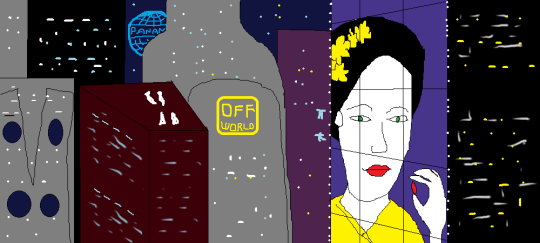
Blade Runner came out in June 1982. Microsoft’s Paint came out in November 1985. Little could the designers of that rebranded version of ZSoft’s PC Paintbrush packaged in with Windows 1.0 know that the paths of their humble graphics application and that elaborate sci-fi cinematic vision would cross just over 30 years later. Surely nobody involved in either project could have imagined the form the intersection would take: MSP Blade Runner, a fan’s shot-by-shot Tumblr “remake” (and gentle parody) of the film using only Microsoft Paint, starting with the Ladd Company tree logo.

Why make such a thing? “I like the idea of having a blog but basically feel as if I have very little to say about things, at least things that are original or interesting,” creator David MacGowan told Motherboard’s Rachel Pick. “I gravitated to Tumblr with some idea of just posting pictures, but still felt I needed to be posting something I’d actually made myself… [Y]ears ago I used to draw really crappy basic MS Paint pics for a favourite pop group’s fan site, and they always seemed to raise a smile. The idea of doing something else with MS Paint, a kind of celebration of my not being deterred by lack of artistic talent, never really went away.”
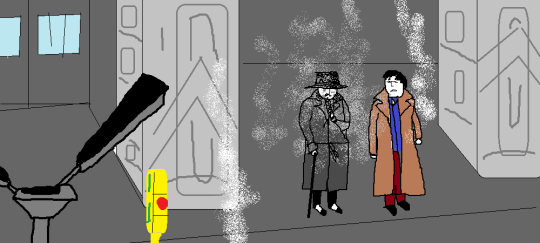
The mixture of technological and aesthetic sensibilities inherent in using a severely outdated but ever-present digital tool to re-create the enduringly compelling analog visuals of a movie from that same era goes well with the original Blade Runner’s project of updating the conventions of film noir to depict a then-newly imagined future. Even more fittingly, a work like MSP Blade Runner could only make sense in the 2010s, the very decade the movie tried to envision. Will it go all the way to the shot of Deckard and Rachel’s final exit into the elevator? “I don’t really think about giving up,” McGowan told Pick. “The idea of actually completing something I start out to do (for once in my life) is very appealing.” Spoken like a 21st-century man indeed.

You can find every frame painted so far, and every new one to come, here.
Related Content:
Watch an Animated Version of Ridley Scott’s Blade Runner Made of 12,597 Watercolor Paintings
Based in Seoul, Colin Marshall writes and broadcasts on cities and culture. He’s at work on a book about Los Angeles, A Los Angeles Primer, the video series The City in Cinema, the crowdfunded journalism project Where Is the City of the Future?, and the Los Angeles Review of Books’ Korea Blog. Follow him on Twitter at @colinmarshall or on Facebook.
Read More...A Whiskey-Fueled Lin-Manuel Miranda Reimagines Hamilton as a Girl on Drunk History
Back in July of 1804, when Vice President Aaron Burr fired a fatal round into the abdomen of former Secretary of the Treasury Alexander Hamilton, I wonder which scenario would have seemed more implausible: that these political rivals would one day be resurrected in the form of a black guy and a Nuyorican, or as two young women in revealingly snug breeches, above.
Time moves on. These days, your average Hamilton-obsessed pre-teen may have trouble accepting that there was a time—January 2015, to be exact—when most Americans couldn’t say what the guy on the ten dollar bill was famous for.
I confess, until quite recently, I was far more confident in Arrested Development’s fictional Bluth family’s exploits than any involving Hamilton and Burr. This explains, in part, why I’m so drawn to the casting instincts of Derek Waters’, creator of Drunk History.
The most recent episode features Alia Shawkat, one of my favorite Arrested Development players as a sardonic, potty mouthed Hamilton.
No worries that Drunk History, which bills itself as a “liquored-up narration of our nation’s history,” is the latest in a long line of Johnny-Come-Latelys, eagerly bellying up to the Hamilton trough.
Before Shawkat imbued him with her trademark edge, Drunk History’s Hamilton exuded the befuddled sweetness of Shawkat’s besotted Arrested Development cousin, Michael Cera, who originated the part in a video that gave rise to the series, below.
That one’s far sloppier, and not just in terms of production values. The inaugural narrator, Mark Gagliardi, was rendered a good deal more than three sheets to the wind by the bottle of scotch he downed on a sagging brown velour couch.
America would not want to see its current sweetheart, Hamilton’s playwright and original leading man, Lin-Manuel Miranda in such a condition.
Whereas Gagliardi seemed dangerously close to needing the bucket Waters thoughtfully positioned nearby, a whiskey-fuelled Miranda seems merely the tiniest bit buzzed, sitting cross legged in his parent’s living room, fleshing out Hamilton’s story with bits he didn’t manage to cram into his Pulitzer Prize-winning musical, such as a bewigged Tony Hale (aka Buster Bluth) as James Monroe.
On the other hand, he does describe the Reynolds Pamphlet as “Dick 101” (and failed to recall FaceTiming various friends post-recording) so…
You’ll need a Comedy Central subscription to view the complete episode online, but Shawkat’s earlier Drunk History turn as Grover Cleveland’s “It Girl” wife, Frances, is free for all, here.
Related Content:
“Alexander Hamilton” Performed with American Sign Language
Alexander Hamilton: Hip-Hop Hero at the White House Poetry Evening
Watch a Witty, Gritty, Hardboiled Retelling of the Famous Aaron Burr-Alexander Hamilton Duel
Ayun Halliday is an author, illustrator, theater maker and Chief Primatologist of the East Village Inky zine. Her play Zamboni Godot is opening in New York City in March 2017. Follow her @AyunHalliday.
Read More...How Stanley Kubrick Made His Masterpieces: An Introduction to His Obsessive Approach to Filmmaking
As each semester in my film course rolls around, it’s more and more apparent how time depletes the pop culture currency of those directors who did not make it into the 21st Century. A knowledge of Stanley Kubrick used to be a given, as was the understanding of what “A Stanley Kubrick Film” meant to film fans. Now he is a solution to a weird join-the-dots, as I watch students who know The Shining as a classic horror film grok suddenly that the same director made the headtrip 2001: A Space Odyssey. And what’s this Barry Lyndon film? And this Spartacus that looks like it’s from a completely different time? It can baffle a young cineaste, and it baffles them in a different way, I suppose, than how Kubrick baffled his contemporaries from film to film. Yes, there’s more of my students who have seen Dr. Strange than Dr. Strangelove, but the joy of discovery is still there, as is the thrill of being in a special fan club when you do discover Kubrick.
Fortunately, we are also having a renaissance in film critique in the medium of video, as followers of this site know. Along with Tony Zhou and Evan Puschak, Lewis Bond (aka Channel Criswell) has created some of the most in depth video essays on YouTube. Having authored overviews of the work of Hayao Miyazaki, Yasujiro Ozu, Andrei Tarkovsky, Lars von Trier, and David Lynch, Bond offers an excellent introduction above to Kubrick’s oeuvre.
Not content to use his knowledge of Kubrick’s films, Bond visited the Kubrick archives in London, learning firsthand the meticulous way the director created a film.
“His work ethic bordered on the obsessed,” he says. “This experience was how I imagined it is to see a great painter’s brushes. It was a way to gain a brief glimpse into the mind of a master at work.”
Bond makes the case that Kubrick’s attention to detail through all stages of production, including editing, distribution, and even attending screenings and checking the quality of the prints, is exactly what makes him one of the best directors. Every choice seen in the films, all the way down to the smallest prop, has Kubrick’s DNA on it. It’s no wonder that people pore over every frame of The Shining, reading into it all sorts of meaning.
“He changed the way visual stories were told,” says Bond, where Kubrick’s mise en scene and composition both deliver the essential narrative and the symbolism underneath.
Kubrick could only have reached these heights with the complete creative control his fame afforded him from the 1960s onward. There was time to plan, time and money to shoot, and time to edit, something directors–before or since–rarely get. And not all directors have the discipline to deliver when they get such freedom.
There’s much more in Bond’s essay so check it out. Side note: Lewis Bond’s girlfriend Luiza Lopes (aka Art Regard) also creates video essays on directors like David Cronenberg, Roman Polanski, and Ingmar Bergman. Could this be the first ‘celebrity couple’ of the video essay era?
Related Content:
Buster Keaton: The Wonderful Gags of the Founding Father of Visual Comedy
The Filmmaking Craft of David Fincher Demystified in Two Video Essays
The Geometric Beauty of Akira Kurosawa and Wes Anderson’s Films
Ted Mills is a freelance writer on the arts who currently hosts the FunkZone Podcast. You can also follow him on Twitter at @tedmills, read his other arts writing at tedmills.com and/or watch his films here.
Read More...Support Us
We're hoping to rely on loyal readers, rather than erratic ads. Please click the Donate button and support Open Culture. You can use Paypal, Venmo, Patreon, even Crypto! We thank you!

About Us

Open Culture scours the web for the best educational media. We find the free courses and audio books you need, the language lessons & educational videos you want, and plenty of enlightenment in between.
Advertise With Us

FREE UPDATES!
GET OUR DAILY EMAIL
Get the best cultural and educational resources on the web curated for you in a daily email. We never spam. Unsubscribe at any time.
FOLLOW ON SOCIAL MEDIA

Open Culture editor Dan Colman scours the web for the best educational media. He finds the free courses and audio books you need, the language lessons & movies you want, and plenty of enlightenment in between.
Advertise With Us


