Truman Capote Narrates “A Christmas Memory,” a 1966 TV Adaptation of His Autobiographical Story
It’s fruitcake weather, so bust out your hankies.
You’ll need them by the end of this 1966 television adaptation of Truman Capote’s autobiographical 1956 story, “A Christmas Memory,” above.
As holiday specials go, it’s blessedly free of razzle dazzle. Capote’s Depression-era Christmases in rural Alabama were short on tinsel and long on windfall pecans.
Combined with flour, sugar, dried fruit, and some hard-purchased whiskey, these gifts of nature yielded delicious cakes the main characters send to a long list of recipients ranging from FDR to a young man whose car broke down in front of their house, who snapped the only photograph of the two of them together.
The nostalgia may feel a bit thick at times. Both the story and the hour-long adaptation are a love letter to an eccentric, much older cousin, Nanny Rumbley Faulk, known as Sook. She was part of the household of distant relations where Capote’s mother, Lillie Mae, spent a portion of her childhood, and on whom she later dumped the 3‑year-old Truman.
Sook was “the only stable person” in his life, Capote told People magazine thirty years after her death.
And according to Capote’s aunt, Marie Rudisill, “the only person that Sook ever cared anything about was Truman.”
Her interests, while not in keeping with those of a lady of her time, place, race, and class, held enormous appeal for a lonely little boy with few playmates his own age. Believing in ghosts, taming hummingbirds and curing warts with an “old-time Indian cure” are just a few of Sook’s hobbies he mentions in the story, wherein her only name is “my friend.” She is:
small and sprightly, like a bantam hen; but due to a long youthful illness, her shoulders are pitifully hunched. Her face is remarkable–not unlike Lincoln’s, craggy like that, and tinted by sun and wind; but it is delicate too, finely boned, and her eyes are sherry-colored and timid.
Actress Geraldine Page, then 43 and a favorite of Capote’s contemporary, playwright Tennessee Williams, imbued the “sixty-something” Sook with wide eyes and wild hair.
But the real star of the show is Capote himself as narrator. That famous nasal whine sets his “Christmas Memory” apart from more golden-throated holiday voiceover work by Burl Ives, Greer Garson, and Fred Astaire. It also cuts through the treacle, as Bart Simpson would say.
You can find “A Christmas Memory” in this collection.
Related Content:
John Waters Makes Handmade Christmas Cards, Says the “Whole Purpose of Life is Christmas”
Bob Dylan Reads “‘Twas the Night Before Christmas” On His Holiday Radio Show (2006)
Ayun Halliday is an author, illustrator, theater maker and Chief Primatologist of the East Village Inky zine. Her play Zamboni Godot is opening in New York City in March 2017. Follow her @AyunHalliday.
Read More...Noam Chomsky & Harry Belafonte Speak on Stage for the First Time Together: Talk Trump, Klan & Having a Rebellious Heart
Noam Chomsky, now 88 years old, made his career studying linguistics at MIT. Harry Belafonte, 89, became the “King of Calypso,” popularizing Caribbean music in the 1950s. Yes, the two men come from different worlds, but they share something important in common–a long commitment to social justice and activism. Belafonte used his fame to champion the Civil Rights movement and Martin Luther King Jr., and also helped organize the March on Washington in 1963. Chomsky protested against the Vietnam War, putting his career on the line, and has since become one of America’s leading voices of political dissent.
On Monday, these two figures appeared onstage for the first time together. Speaking at Riverside Church in NYC, before a crowd of 2,000 people, Chomsky and Belafonte took stock of where America stands after the election of Donald Trump. Naturally, neither man looks forward to what Trump has to bring. But they’re not as glum about the future as many other voters on the left. Chomsky especially reminds us that America has made great strides since 1960. The United States is a far more civilized country overall. And it’s much easier–not to mention less dangerous–to effect change today than a half century ago. It’s just a matter of getting out there and putting in the hard work. Meanwhile, Belafonte urges us to have a “rebellious heart” and leaves with this spirited reminder, “there’s still some ass kicking to be done!”
Related Content:
Noam Chomsky vs. William F. Buckley, 1969
Read More...Horror Legend Boris Karloff Reads Dr. Seuss’ How The Grinch Stole Christmas (1966)
Premiering in 1966, the How the Grinch Stole Christmas TV special is a perfect (snow?) storm of creative folks working at the top of their game, with Theodor Geisel aka Dr. Seuss providing the original 1956 book on which it’s based, Chuck Jones brilliantly interpreting Geisel’s own drawings in his own animated style, and making the Grinch’s long-suffering dog companion Max much more of a moral sidekick. It also gave us several musical numbers written by Albert Hague using Geisel’s lyrics.
And then there’s Boris Karloff, who narrates the special from beginning to end and supplies the Grinch’s voice. The English actor was best known in his early career for portraying Frankenstein’s monster and The Mummy in the original Universal horror movies of the same names (and numerous sequels), and was a go-to character actor to play all sorts of nefarious criminals.
Later he would have a second career capitalizing on his horror pedigree, hosting anthology shows on television, and reading not just tales of Edgar Allan Poe on vinyl, but other not-so-scary children’s lit, like Rudyard Kipling’s Just So Stories and the fairy tales of Hans Christian Andersen. Unlike Bela Lugosi, who suffered from being typecast his entire career post-Dracula, Karloff was able to make a good career from that breakthrough performance with good humor.
Karloff’s reading of How the Grinch Stole Christmas is pretty much taken straight from the animated TV special with some judicious editing and no commercials to get in the way. Side note: It is not Karloff but Thurl Ravenscroft singing “You’re a Mean One, Mr. Grinch.” He was not credited in the original cartoon and Dr. Seuss profoundly apologized after the fact. The record would go on to earn Karloff a Spoken Word Grammy Award, the only such entertainment award he ever won. You can also listen to it on Spotify below:
If you have been feeling Grinchy in any way as we approach the holiday season, prepare to get your heart melted. This reading will be added to our collection, 1,000 Free Audio Books: Download Great Books for Free.
Related Content:
The Epistemology of Dr. Seuss & More Philosophy Lessons from Great Children’s Stories
Neil Gaiman Reads Dr. Seuss’ Green Eggs and Ham
Ted Mills is a freelance writer on the arts who currently hosts the artist interview-based FunkZone Podcast. You can also follow him on Twitter at @tedmills, read his other arts writing at tedmills.com and/or watch his films here.
Read More...The Birth Control Handbook: The Underground Student Publication That Let Women Take Control of Their Bodies (1968)
Central to Michel Foucault’s theory of “governmentality” is what he calls “biopower,” an “explosion of numerous and diverse techniques for achieving the subjugations of bodies and the control of populations.” Where debates over abortion and contraception generally coalesce around questions of religion and rights, the French theorist of power saw these issues as part of the bio-political struggle between “governing the self” and “governing others.”
Those who resist repressive biopower seize on the former definition of government. Take a very pointed example of both restrictive government biopower and creative resistance to the same: the 1968 Birth Control Handbook you see here, printed illegally by undergraduate students at Montreal’s McGill University. At the time of this text’s creation, notes Atlas Obscura, “under Canada’s Criminal Code, the dissemination, sale, and advertisement of birth control methods were all illegal, and abortion was punishable by life imprisonment.”
Despite facing the possible consequences of up to two years in prison, the McGill Student Society “sold millions of copies” of The Birth Control Handbook, writes Amanda Edgley, “in Canada and internationally.” Maya Koropatnitsky describes the tremendous social impact of the handbook:
Students at McGill as well as other Quebec campuses snapped up the first run of 17,000 copies. Due to its major success, the committee came out with a second issue of the handbook in 1969. This handbook is seen to be a major player in women’s liberation because it gave young women the knowledge and the ability to control reproductive functions.
The handbook furthermore “mobilized women into forming meetings and groups to talk about consciousness-raising issues.” This informal education was invaluable for millions of women, who were “desperate for this information,” writes author Laura Kaplan, “so starved for information. You wanted it, in as much detail as you could get it, as graphic as it could be made.”
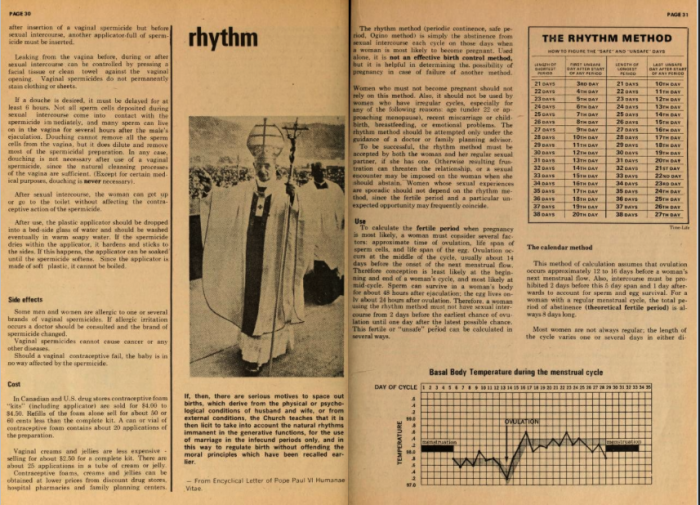
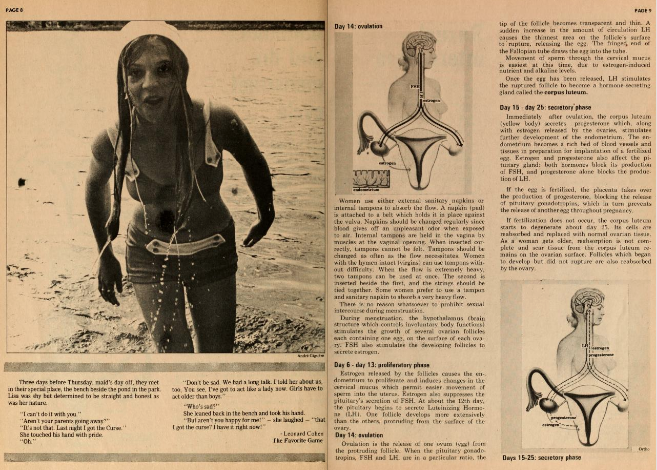
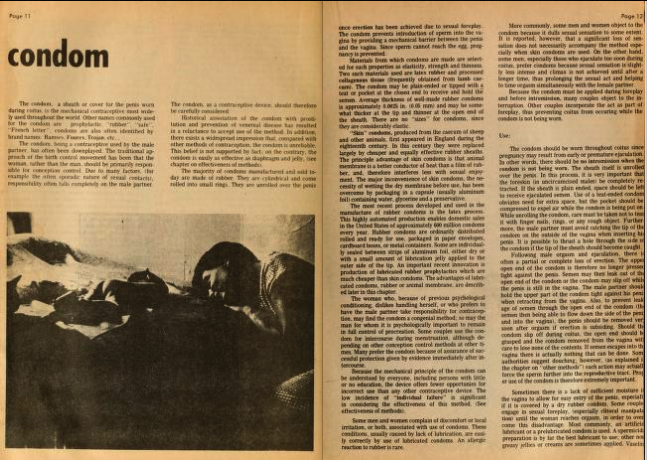
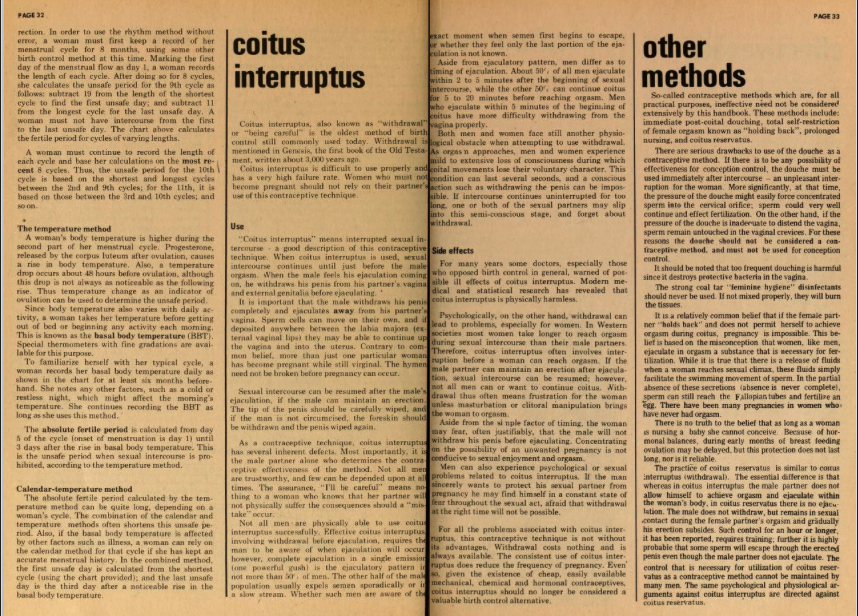
What the Canadian, and U.S., governments saw as sexually explicit will look to us like standard biology textbook illustrations, mundane charts and graphs, ordinary pictures of the birth experience, and tasteful, rather tame nude photos. Original authors Allan Feingold and Donna Cherniak “pored through books in the medical library,” Atlas Obscura writes, “and consulted medical advisors, compiling detailed information on topics like sexual intercourse, menstrual cycles, surgical abortion techniques (accompanied by prices and statistics), and how, exactly, to contact abortion providers.”
Illustrating another Foucauldian insight into the relationship between knowledge and power, not only were birth control methods under the strict control of mostly male doctors (and only available with permission from a husband), but even basic information on reproduction and birth control was difficult for most women to access. “To have all the information on the various methods of birth control in one place,” says Kaplan, “with pros and cons and what you needed to know about them, was a revelation.” Cherniak later remembered, “We joked that after the Bible, we were probably one of the most widely distributed publications in Canada.”
Both editions of the handbook addressed the controversial topic of abortion, citing the Canadian criminal code along the way. “Concerned with the problem of illegal abortion,” writes University of Ottowa professor Christabelle Sethna, “the council mandated the publication” of the handbook, which also “contained editorial commentary that took Western population-control experts to task for their racism and that supported women’s reproductive rights as a function of women’s liberation.” Sethna situates The Birth Control Handbook within a much larger Canadian movement, just “one of the ways,” writes Edgeley, “Canadians took control over their own bodies.” Its creators saw it as a means of changing the world. “Those were the years,” Cherniak says, “in which you thought you could do anything.”
Two years after the first print run of The Birth Control Handbook, the ur-text of feminist bio-politics, Our Bodies, Ourselves, was published by the Boston Women’s Health Book Collective. This book “became its own widely circulated women’s health text,” Atlas Obscura writes, “translated into 29 languages.” But while Our Bodies, Ourselves remains famous for its key role in spreading much-needed information about reproductive health, “its Canadian counterpart has been mostly forgotten.” The Birth Control Handbook gave millions of women the information they needed to govern their own lives. Rediscover the complete text of the first, 1968 edition and second, 1969 edition at the Internet Archive, where you can see a scan, read transcribed full text, and download PDF, Kindle, and other formats.
via Atlas Obscura
Related Content:
Download All 239 Issues of Landmark UK Feminist Magazine Spare Rib Free Online
Simone de Beauvoir Explains “Why I’m a Feminist” in a Rare TV Interview (1975)
The Story Of Menstruation: Watch Walt Disney’s Sex Ed Film from 1946
Watch Family Planning, Walt Disney’s 1967 Sex Ed Production, Starring Donald Duck
Josh Jones is a writer and musician based in Durham, NC. Follow him at @jdmagness
Read More...Infinity Minus Infinity Equals Pi: This Video Proves It
It sounds impossible. But it turns out that infinity minus infinity doesn’t necessarily equal zero. It can equal Pi, or 3.14159265359. Or so demonstrates the “Mathologer” in the video featured above.
In real life the Mathologer goes by the name of Burkard Polster, and he’s a math professor at Monash University in Melbourne, Australia. You can check out more of his videos on YouTube here.
If you would like to support the mission of Open Culture, consider making a donation to our site. It’s hard to rely 100% on ads, and your contributions will help us continue providing the best free cultural and educational materials to learners everywhere. You can contribute through PayPal, Patreon, and Venmo (@openculture). Thanks!
Related Content:
Citizen Maths: A Free Online Course That Teaches Adults the Math They Missed in High School
The Math in Good Will Hunting is Easy: How Do You Like Them Apples?
Read More...
The Velvet Underground & Andy Warhol Stage Proto-Punk Performance Art: Discover the Exploding Plastic Inevitable (1966)
Punk rock, an artless proletarian sneer, a working-class revolt against bourgeois tastes, good manners, and corrupt systems of consumption. Right? Sure… and also pure performance art. Or do we forget that its forebears were avant-garde fringe artists: whether Iggy Pop onstage fighting a vacuum cleaner and blender and smearing peanut butter on himself, or Patti Smith reading her Rimbaud-inspired poetry at CBGB’s. And before rock critic Dave Marsh first used the word “Punk” (to describe Question Mark and the Mysterians)—before even Sgt. Pepper’s and the death of Jimi Hendrix—there came the Velvet Underground, protégés of Andy Warhol and dark psychedelic pioneers whose early songs were as punk rock as it gets.
Some evidence: a dog-eared copy of Please Kill Me, the “uncensored oral history of punk,” which begins with the Velvets and, specifically John Cale remembering 1965: “I couldn’t give a shit about folk music… The first time Lou Played ‘Heroin’ for me it totally knocked me out. The words and music were so raunchy and devastating.… Lou had these songs where there was an element of character assassination going on.” Now these days, everyone from the mayor of London to Shakespeare has been associated with punk, but maybe Lou Reed first defined its raunchiness and devastation back in the mid-sixties. And the performances of those songs were sheer art-rock spectacle, thanks to Andy Warhol’s Exploding Plastic Inevitable, or EPI.
Critic Wayne McGuire described these Exploding Plastic Inevitable performances, organized in 1966 and 1967, as “electronic: intermedia: total scale.” The Exploding Plastic Inevitable enveloped the Velvets in a dark, hazy, strobe-lit circus. Writer Branden Joseph describes it in detail:
… the Exploding Plastic Inevitable included three to five film projectors, often showing different reels of the same film simultaneously: a similar number of slide projectors, movable by hand so that their images swept the auditorium; four variable-speed strobe lights; three moving spots with an assortment of coloured gels; several pistol lights; a mirror ball hung from the ceiling and another on the floor; as many as three loudspeakers blaring different pop records at once; one or two sets by the Velvet Underground and Nico…
… and so on. “It doesn’t go together,” wrote Larry McCombs in a 1966 review, “But sometimes it does.” Warhol had attempted to stage similar events since 1963, with a short-lived band called the Druids, which included New York avant-garde composer La Monte Young (“the best drug connection in New York,” remembered Billy Name). Then Warhol met the Velvet Underground at the Café Bizarre, forced the broody Nico on them, and it suddenly came together. The new, Warhol-managed band first launched at filmmaker Jonas Mekas’ Cinémathèque theater. “Andy would show his movies on us,” remembers Reed, “We wore black so you could see the movie. But we were all wearing black anyway.”
As you can see in the 1966 film at the top of an EPI/Velvets performance, Reed’s proto-punk odes to intravenous drugs and sadomasochism provided the ideal soundtrack to Warhol’s celebrations of the tragically hip and pretty. The experience (at least as recreated by the Warhol Museum) put art student Karen Lue in mind of “Wagner’s gesamtkunstwerk, or a total work of art.” The film we experience here was shot by director Ronald Nameth at an EPI happening at Poor Richards in Chicago.
The overdubbed soundtrack blends recordings of “I’ll Be Your Mirror” and “European Son,” “It Was a Pleasure” from Nico’s Chelsea Girl, and live versions of “Heroin” and “Venus in Furs,” with John Cale on vocals. This particular happening featured neither Reed nor Nico, so Cale took the lead. Nonetheless, as Ubuweb writes, Nameth’s film “is an experience” fully representative of “Warhol’s hellish sensorium… the most unique and effective discotheque environment prior to the Fillmore/Electric Circus era.” The short “rises above a mere graphic exercise,” making “kinetic empathy a new kind of poetry” and a visual record of how punk arose as much from art-house theaters and galleries as it did from dive bars and garages.
Related Content:
Nico, Lou Reed & John Cale Sing the Classic Velvet Underground Song ‘Femme Fatale’ (Paris, 1972)
Josh Jones is a writer and musician based in Durham, NC. Follow him at @jdmagness
Read More...500+William S. Burroughs Book Covers from Across the Globe: 1950s Through the 2010s
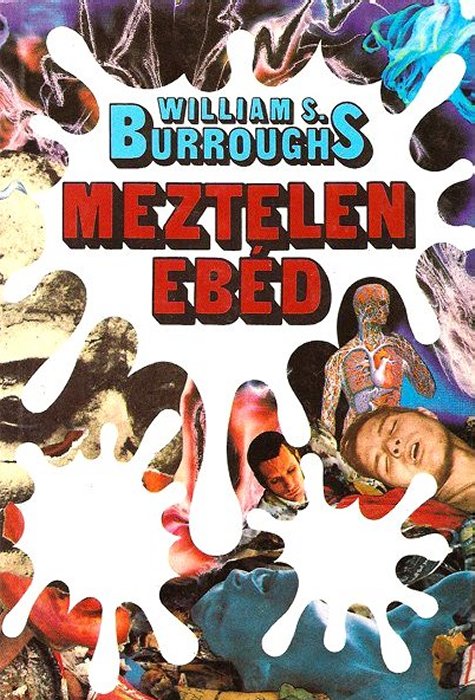
William S. Burroughs has shown generations of readers that the written word can provide experiences they’d never before imagined. But to get to Burroughs’ written words, most of those readers have entered through his covers—or rather, through the covers that a host of publishers, all over the world and for over sixty years now—have considered sufficiently appealing representations of Burroughs’ daring, experimental, and not-especially-representable literary work. You can see over 500 of these efforts at the Burroughs page of beatbookcovers.com.
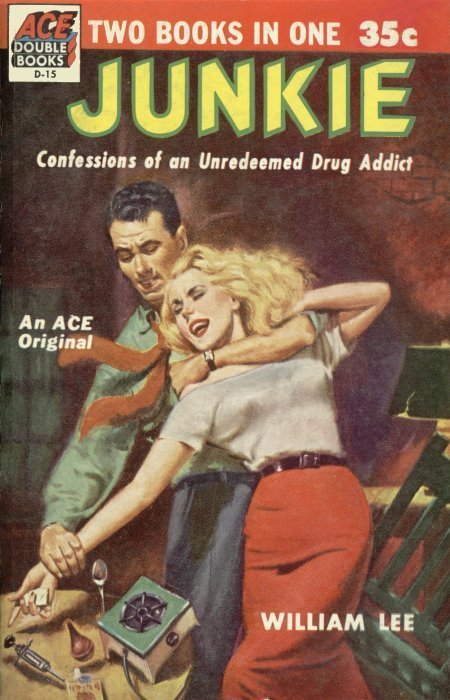
As mild-mannered as he could seem in person, Burroughs’ life and work, what with the drugs, the acquaintance with the homosexual underworld, and the reckless gunplay, has always attracted an air of the sordid and sensational. Publishers didn’t hesitate to exploit that, as we can see in the first edition of Burroughs’ first published work Junkie just above. Not only did it come out as a 35-cent mass-market two-in-one paperback, it promised the “confessions of an unredeemed drug addict,” and with that lurid illustration implied so much more besides. No matter how much readerly curiosity it piqued, how much of an artistic future could someone impulse-buying it at the drugstore have imagined for this “William Lee” fellow?
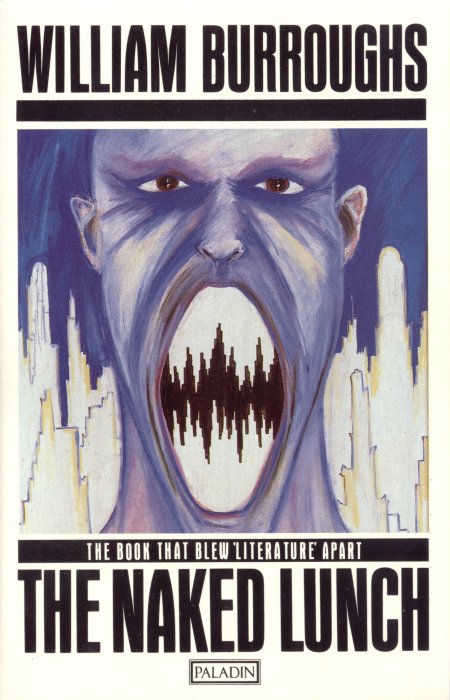
More curious readers have probably become Burroughs fans by picking up The Naked Lunch, his best-known novel but a more controversial and much less conventionally composed one than Junkie. This story of William Lee (now just the name of the protagonist, not an authorial pseudonym) and his substance-fueled odyssey through America, Mexico, Morocco, the fictional Annexia and far beyond has had many and varied visual representations, all of which try to convey how strenuously the text struggles against the strictures of traditional forms of writing. Sometimes, as in the 1986 U.K. edition from Paladin above, they resort to telling rather than just showing you that you hold in your hands “the book that blew ‘literature’ apart.”
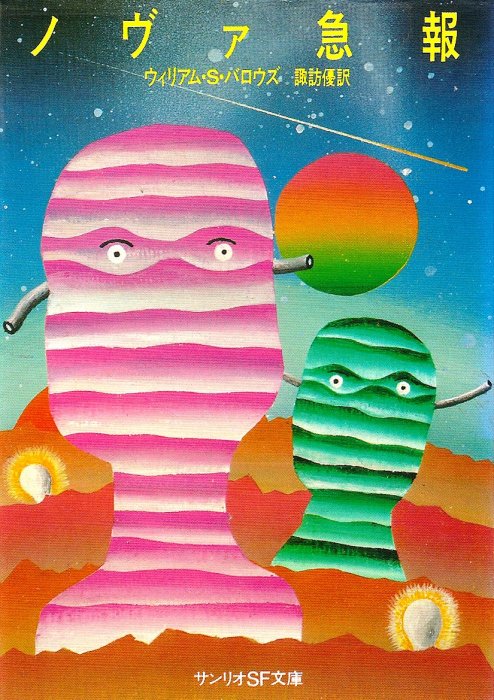
Those of us who get deep into Burroughs’ work often do so because it transcends genre. Still, that hasn’t stopped marketing departments from trying to place him in one genre or another, or at least to sell certain of his books as if they belonged in one genre or another. The “Nova trilogy” with which Burroughs followed up Naked Lunch, has tended to appear on the science-fiction shelves of bookstores around the world, not completely without reason. Still, the sensibilities of the sci-fi world and Burroughs’ mind do clash somewhat, producing such intriguing results as the 1978 Japanese edition of Nova Express above.
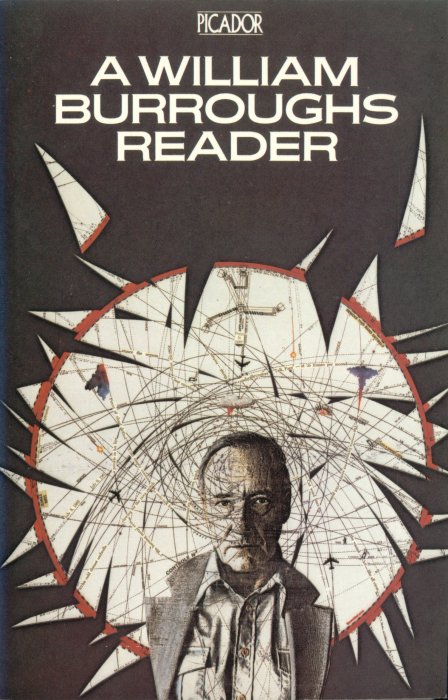
Ultimately, the only image that reliably conveys the work of William S. Burroughs is the image of William S. Burroughs, which appears on the cover of this 1982 Picador William Burroughs Reader as well as many other books besides. As anyone who’s gone deep into his bibliography knows, the work and the man don’t come separately, but they’ll surely always remember the cover that led them into his world in the first place, whether it bore images subdued or sensationalistic, a design grimly real or forbiddingly abstract, or a proper warning about just what it was they were getting into.
Visit all 500+ William S. Burroughs books covers here.
Related Content:
The Visual Art of William S. Burroughs: Book Covers, Portraits, Collage, Shotgun Art & More
Lolita Book Covers: 100+ Designs From 37 Countries (Plus Nabokov’s Favorite Design)
Hear a Great Radio Documentary on William S. Burroughs Narrated by Iggy Pop
83 Years of Great Gatsby Book Cover Designs: A Photo Gallery
600+ Covers of Philip K. Dick Novels from Around the World: Greece, Japan, Poland & Beyond
Download 650 Soviet Book Covers, Many Sporting Wonderful Avant-Garde Designs (1917–1942)
The Art of the Book Cover Explained at TED
Based in Seoul, Colin Marshall writes and broadcasts on cities and culture. He’s at work on a book about Los Angeles, A Los Angeles Primer, the video series The City in Cinema, the crowdfunded journalism project Where Is the City of the Future?, and the Los Angeles Review of Books’ Korea Blog. Follow him on Twitter at @colinmarshall or on Facebook.
Read More...George Orwell Tries to Identify Who Is Really a “Fascist” and Define the Meaning of This “Much-Abused Word” (1944)
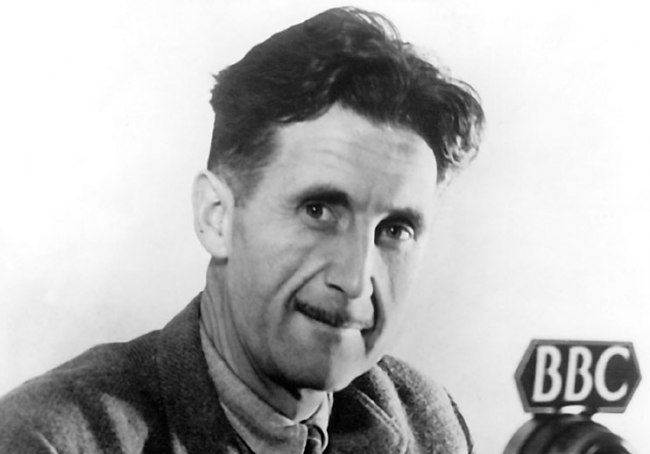
Image via Wikimedia Commons
Two neologisms, “Post-truth” and “Alt-right,” have entered political discourse in this year of turmoil and upheaval, words so notorious they were chosen as the winner and runner-up, respectively, for Oxford Dictionaries’ word of the year. These “Orwellian euphemisms,” argues Noah Berlatsky “conceal old evils” and “whitewash fascism,” recalling “in form and content… Orwell’s old words—specifically some of the newspeak from 1984. ‘Crimethink,’ ‘thoughtcrime,’ and ‘unperson’.… They even sound the same, with their simple, thunk-thunk construction of single syllables mashed together.”
“The sheer ugly clumsiness is supposed to make the language seem futuristic and cutting edge,” Berlatsky writes, “The world to come will be utilitarian, slangy, and up-to-the-minute in its inelegance. So the future was in Orwell’s day; so it is in 2016.” As in Orwell’s day, our current jargon gets mobilized in “defense of the indefensible”—as the novelist, journalist, and revolutionary fighter wrote in his 1946 essay “Politics and the English Language.” And just as in his day, the euphemisms pretty up constant, blatant lying and racist ideologies. We can also draw another linguistic comparison to Orwell’s time: the widespread use of the word “fascism.”
Berlatsky uses the word without defining it (when he talks about “whitewashing fascism”), except to say that “fascism thrives on falsehoods.” That may well be the case, but is it enough of a criterion for an entire political and economic system? The word begs for a cogent analysis. Even Umberto Eco, who grew up under Mussolini’s rule, felt the need for clarity, given that “American radicals,” he wrote in 1995, abused the phrase “fascist pig” as a pejorative for any authority, such that the word hardly meant anything thirty years after World War II.
But surely Orwell—who fought fascism in Spain in 1936, and whose ominous postwar dystopian novels have done more than any literary work to illustrate its menace—could define the word with confidence? Alas, when we look to his work, even before the war had ended, we find him writing, “‘Fascism,’ is almost entirely meaningless.” His short 1944 essay, “What is Fascism?” does not, however, push to abolish the word. He calls instead for “a clear and generally accepted definition of it” against the tendency to “degrade it to the level of a swearword.”
But Orwell (being Orwell) is not optimistic. One reason a definition had been so difficult to come by, he writes, is that any group to whom it is applied would have to make “admissions” most of them are not “willing to make”—admissions as to the real nature of their ideology and objectives, behind the euphemisms, lies, and double-speak. If no one is a fascist, then everyone potentially is. Even in the 40s, Orwell wrote, “if you examine the press you will find that there is almost no set of people—certainly no political party or organized body of any kind—which has not been denounced as Fascist.”
He enumerates those so accused: “Conservatives, Socialists, Communists, Trotskyists, Catholics, War Resisters, Supporters of the war, Nationalists.…” What of the textbook examples just on the other side of the front lines? “When we apply the term ‘Fascism’ to Germany or Japan or Mussolini’s Italy,” Orwell concedes, “we know broadly what we mean.” But appealing to these extreme governments does little good, “because even the major Fascist states differ from one another a good deal in structure and ideology.” Umberto Eco is content to say that fascism adopts the cultural trappings of the nations in which it arises, yet still shares several constant, if contradictory, ideological traits. Orwell isn’t so sure he knows what those are.
So what can Orwell say about the word, one he is eager to hold on to but at a loss to pin down? Though he believes it must name a “political and economic” system as well, Orwell finally opts for an ordinary language definition, to which we “attach at any rate an emotional significance.” Whether we “recklessly fling” the word “in every direction” or use it in more precise ways, we always mean “roughly speaking, something cruel, unscrupulous, arrogant, obscurantist, anti-liberal, and anti-working class. Except for the relatively small number of Fascist sympathizers, almost any English person would accept ‘bully’ as a synonym for ‘Fascist.’” Those today who are not bullies—or unapologetic fascist sympathizers—and who don’t need euphemisms for these words, would likely agree.
You can read “What is Fascism?” here. You can find the short essay published in this volume, The Collected Essays, Journalism and Letters of George Orwell.
Related Content:
Umberto Eco Makes a List of the 14 Common Features of Fascism
George Orwell Reviews Mein Kampf: “He Envisages a Horrible Brainless Empire” (1940)
George Orwell Explains in a Revealing 1944 Letter Why He’d Write 1984
Josh Jones is a writer and musician based in Durham, NC. Follow him at @jdmagness
Read More...Bruce Springsteen Narrates Audiobook Version of His New Memoir (and How to Download It for Free)
In September, Bruce Springsteen published his new autobiography, Born to Run. Patiently I’ve been awaiting the audiobook version, which came out today. And, to my surprise, I discovered that it’s narrated by Springsteen himself. All 18 hours of it.
You can hear him read Chapter 41 (called “Hitsville”) above. Plus Chapter 53 below. And if you want to hear the whole shebang, you can purchase it online. Or download the audiobook for free by signing up for Audible’s 30-day free trial. As I’ve mentioned before, if you register for Audible’s free trial program, they let you download two free audiobooks. At the end of 30 days, you can decide whether you want to become an Audible subscriber (as I have) or not. No matter what you decide, you get to keep the two free audiobooks. Springsteen’s memoir can be one of them.
Learn more about Audible’s free trial program here.
NB: Audible is an Amazon.com subsidiary, and we’re a member of their affiliate program.
Related Content:
1,000 Free Audio Books: Download Great Books for Free
Download a Free Course from “The Great Courses” Through Audible.com’s Free Trial Program
Heat Mapping the Rise of Bruce Springsteen: How the Boss Went Viral in a Pre-Internet Era
Bruce Springsteen Picks His Top 5 Favorite Springsteen Songs
Read More...The Science of Why We Laugh
Laughter is universal. And yet strange when you think about it. One moment we’re doing nothing particularly noteworthy. The next moment we’re convulsing and making these loud staccato guffaws. Odd that.
So why do we laugh? It’s a question that Robert Provine, a professor at the University of Maryland, Baltimore, has been studying for 20+ years, trying to understand laughter’s social, neurological, and evolutionary roots. In the video above, he gives you a sense of the “sidewalk” research he conducts, and some of the conclusions he has drawn–e.g., laughter is often not a reaction to something funny per se; it’s something that helps build social relationships with others. And it’s a reaction that’s hardwired in the brain.
At the video’s end, Provine tells us that the study of laughter has just begun. But, if you’re interested in what we know so far, see his two books: Laughter: A Scientific Investigation and Behavior: Yawning, Laughing, Hiccupping, and Beyond, an exploration of neglected human instincts.
If you would like to support the mission of Open Culture, consider making a donation to our site. It’s hard to rely 100% on ads, and your contributions will help us continue providing the best free cultural and educational materials to learners everywhere. You can contribute through PayPal, Patreon, and Venmo (@openculture). Thanks!
Related Content:
John Cleese Explores the Health Benefits of Laughter
Charlie Chaplin Finds Comedy Even in the Brutality of WWI: A Scene from Shoulder Arms (1918)
Chris Rock Creates a List of His 13 Favorite Standup Comedy Specials
Read More...Support Us
We're hoping to rely on loyal readers, rather than erratic ads. Please click the Donate button and support Open Culture. You can use Paypal, Venmo, Patreon, even Crypto! We thank you!

About Us

Open Culture scours the web for the best educational media. We find the free courses and audio books you need, the language lessons & educational videos you want, and plenty of enlightenment in between.
Advertise With Us

FREE UPDATES!
GET OUR DAILY EMAIL
Get the best cultural and educational resources on the web curated for you in a daily email. We never spam. Unsubscribe at any time.
FOLLOW ON SOCIAL MEDIA

Open Culture editor Dan Colman scours the web for the best educational media. He finds the free courses and audio books you need, the language lessons & movies you want, and plenty of enlightenment in between.
Advertise With Us


