A Lccokrkow Garneo: All 245,000 Frames of Kubrick’s A Clockwork Orange Randomized.
Watch with caution if you’re sensitive to flashing lights and fast moving images.
Stanley Kubrick films take a while to unpack. Watch his A Clockwork Orange once, you’ll see one thing. Watch it again, you’ll notice details you didn’t get the first time. Ditto the third time, and beyond.
Think you know A Clockwork Orange backwards and forwards? Good. Now check out A Lccokrkow Garneo, which takes all 245,000 frames of the 1971 dystopian film and randomizes them. You might see something you’ve never seen before.
If you’re prone to epilepsy, beware. If you’re not, good luck getting very far.
A Lccokrkow Garneo was arranged by Andrew Filippone Jr. (who gave us “Charlie Rose” by Samuel Beckett, a piece of comical absurdist theater we featured earlier this fall). The score for this randomized film is “an improvised work, recorded in one take while the movie played on a nearby monitor.” That you can watch unfold below.
If you would like to support the mission of Open Culture, consider making a donation to our site. It’s hard to rely 100% on ads, and your contributions will help us continue providing the best free cultural and educational materials to learners everywhere. You can contribute through PayPal, Patreon, and Venmo (@openculture). Thanks!
Related Content:
The Making of Stanley Kubrick’s A Clockwork Orange
Read More...Ansel Adams, Photographer: 1958 Documentary Captures the Creative Process of the Iconic American Photographer
America has specialized in both the beautiful and the terrible, inspiring awe of every positive and negative variety. That goes for both the human achievements that have happened there as well of the natural environments they’ve happened in and around, both of which define America equally and have made it the kind of place the word sublime, mixing in as it does a tinge of fear with admiration, was coined to describe. Ansel Adams, who ascended to the top of the photographic pantheon with his career spent shooting the 20th-century American West, seemed born to capture that sublimity.
How did he do it? The 1958 documentary Ansel Adams, Photographer (also available on Archive.org) offers a twenty-minute look into the life and work of the man whose name has become a byword for the majestic black-and-white American landscape. We also hear a few of his philosophical positions on his work. “Perhaps music is the most expressive of the arts,” says Adams himself after a few minutes at the piano. “However, as a photographer, I believe that creative photography, when practiced in terms of its inherent qualities, may also reveal endless horizons of meaning.”
We then see and hear about all the (highly pre-digital) cameras and associated tools with which Adams engaged in that practice before heading out to the coast to watch him in action. “Like every good photographer,” says the narrator, Adams “pre-visualizes his final print right there,” a technique we’ve previously covered here on Open Culture. Then out comes the light meter, in order to “estimate what exposure he needs now and what development he needs later.” Every choice Adams made — about “film, lens, filter, lens extension, lens aperture, shutter setting,” and more — he meticulously recorded in his notebook.
After developing and examining the negative in his lab, he tries out a “test exposure,” which pleasingly turns out as a “quite well-balanced” image, but one that nevertheless suggests improving tweaks for the next one. (Color film’s relative lack of flexibility in this part of the process kept black-and-white Adams’ photographic form of choice.) “Once Adams has achieved the print he wants,” the narrator tells us, “he is able, simply by controlling exposure and processing, to make from one negative hundreds of fine prints in a day. By this technique, he can produce portfolios of original prints which are in themselves works of art.”
Much has changed about photography since Adams did it, of course, though mostly in the technical sense. As the process of simply making a photograph becomes ever faster and easier, the discipline, concentration, and appetite for rigor of a photographer like Adams, whose “standards are as high as those of an architect or an engineer,” become ever rarer and more valuable. Like all of the most important artists, his process in combination with his very nature transcended the limitations of his time, resulting in images of America that, to this day, still look not just as if we could step right into them, but realer, somehow, than reality itself.
Ansel Adams, Photographer has been added to our collection, 4,000+ Free Movies Online: Great Classics, Indies, Noir, Westerns, Documentaries & More.
Related Content:
How to Take Photographs Like Ansel Adams: The Master Explains The Art of “Visualization”
200 Ansel Adams Photographs Expose the Rigors of Life in Japanese Internment Camps During WW II
Alfred Stieglitz: The Eloquent Eye, a Revealing Look at “The Father of Modern Photography”
1972 Diane Arbus Documentary Interviews Those Who Knew the American Photographer Best
Henri Cartier-Bresson and the Decisive Moment
Based in Seoul, Colin Marshall writes and broadcasts on cities and culture. He’s at work on a book about Los Angeles, A Los Angeles Primer, the video series The City in Cinema, the crowdfunded journalism project Where Is the City of the Future?, and the Los Angeles Review of Books’ Korea Blog. Follow him on Twitter at @colinmarshall or on Facebook.
Read More...Hear Controversial Versions of “The Star Spangled Banner” by Igor Stravinsky, Jimi Hendrix, José Feliciano & John Philip Sousa
Debates over whether or not we should destroy or alter U.S. icons seem to turn on a critical question: are national symbols quasi-religious totems of some transcendent sacred order? The kind of imperial project likely to end up a collection of crumbling monuments with every other empire of the past? Or are they living emblems of a secular republic whose primary embodiment is its people? A country, like its people, that must reconstitute itself with each generation in order to survive?
Either way, the nation’s symbols have always withstood creative destruction, détournement, and recontextualization. Subjecting national iconography to the interventions of artists and activists restores a sense of proportion, showing us that our government and its symbols belong to the people, rather than the other way around. The idea is a powerful one. So much so that its expression never fails to excite controversy. And few expressions have provoked more ire than performances of (or responses to) the national anthem that deviate from the staid traditional arrangement.
We could point to very obvious anthem controversies, like Roseanne Barr’s irreverent 1990 rendition. But certain other interpretations have had much more serious artistic intent, like that of naturalized citizen Igor Stravinsky, whose 1944 version (top) came from his “desire to do my bit in these grievous times toward fostering and preserving the spirit of patriotism in this country.” Stravinsky’s earnest ambition was thwarted. He couldn’t help but add his signature, in this case a dominant seventh chord, to the arrangement.
If you would like to support the mission of Open Culture, consider making a donation to our site. It’s hard to rely 100% on ads, and your contributions will help us continue providing the best free cultural and educational materials to learners everywhere. You can contribute through PayPal, Patreon, and Venmo (@openculture). Thanks!
The Boston police responded by issuing him a warning, claiming, we noted in a previous post, “there was a law against tampering with the national anthem” (there wasn’t). Stravinsky “grudgingly” pulled the anthem from his Boston Symphony bill. Over twenty years later, the blind Puerto Rican folk singer José Feliciano played the anthem before the 1968 World Series in his own emotionally-charged style. And like Stravinsky, he was motivated by love of country. “I had set out to sing an anthem of gratitude to a country that had given me a chance,” he later recalled, “that had allowed me, a blind kid from Puerto Rico—a kid with a dream—to reach far above my own limitations.”
Much of the country did not respond in kind. Even during the performance, Feliciano could “feel the discontent within the waves of cheers and applause that spurred on the first pitch.” Afterwards, he learned that “a great controversy was exploding across the country because I had chosen to alter my rendition.… Veterans, I was being told, had thrown their shoes at the television as I sang; others questioned my right to stay in the United States.” Feliciano admits, “yes, it was different but I promise you,” he says, “it was sincere.” So was the most radical of “Star-Spangled Banner” interpretations, Jimi Hendrix’s feedback-laden version at Woodstock the following year.
A veteran himself, Hendrix wasn’t motivated by wartime patriotism or personal gratitude, but by a desire, perhaps, to tell the truth about what his country was doing to thousands of people in Southeast Asia—“Napalm bombs,” as he said at the time, “people getting burned up on TV.” It’s a subject he occasionally touched on lyrically; here he let the guitar tell it, “turning the music to a literal interpretation of the lyrics: bombs bursting in air, rockets lighting up the night,” writes Andy Cush at Spin, “Hendrix began to slyly use the music’s own martial bombast to reflect the violence carried out under his nation’s flag.” He was hardly the first to exploit the song’s inherent bombast.
Almost 100 years before Woodstock—before the national anthem was even the national anthem—one of the most iconic of American of composers re-arranged “The Star Spangled Banner.” John Philip Sousa (who would go on to write “Stars and Stripes Forever”) conceived the song in the “manner of Wagner’s Tannhäuser Overture,” New Yorker music critic Alex Ross tells us. (You can stream the Wagnerian adaptation of “The Star Spangled Banner” here.) He was “young and little known at that time,” Ross remarks, “and his slyly Wagnerian take on the future national anthem was eclipsed by the famously mediocre and expensive Centennial March that Wagner himself penned for the occasion.” There’s no indication Sousa’s arrangement provoked a national upset. But it did set a precedent for what we might as well call an American tradition of musicians altering the anthem, using it to speak not to Francis Scott Key’s America, but to their own.
Related Content:
Isaac Asimov: “I Am Crazy, Absolutely Nuts, About our National Anthem” (1991)
William Shatner Sings O Canada (and Happy Canada Day)
Slavoj Žižek Examines the Perverse Ideology of Beethoven’s Ode to Joy
Josh Jones is a writer and musician based in Durham, NC. Follow him at @jdmagness
Read More...Woody: A Prize-Winning Short Animation About a Wooden Man’s Dream of Becoming a Concert Pianist
“Ever since he was a child, Woody has dreamt of playing piano. The problem is that he only has wooden paddles for hands. Stuck in a job he doesn’t want, Woody spends his days dreaming of being a concert pianist. His dreams are big…but they’re about to get out of hand.”
That’s how animator Stuart Bowen sets up the short animated film, simply called “Woody.”
Bowen shot the film on a pretty tight budget, with money raised largely through crowdfunding. The director notes: “We built the sets out of paper, foam-core, & cardboard so we could achieve an ‘in-camera’ look while keeping costs down. We shot black and white because coloured ink was too expensive. We sourced hundreds of Barbie clothes through Facebook to dress the crowd and were extremely fortunate to have a large group of volunteers keen to help make the film.”
Screened at countless film festivals in 2013 and 2014, “Woody” won the award for best animated short at the Seattle Film Festival and received an AACTA award for best short animation (among other accolades).
You can find many other creative animations in our collection, 4,000+ Free Movies Online: Great Classics, Indies, Noir, Westerns, Documentaries & More.
If you would like to support the mission of Open Culture, consider making a donation to our site. It’s hard to rely 100% on ads, and your contributions will help us continue providing the best free cultural and educational materials to learners everywhere. You can contribute through PayPal, Patreon, and Venmo (@openculture). Thanks!
Related Content:
Why You Can Never Tune a Piano
The Making of a Steinway Grand Piano, From Start to Finish
Read More...
Medieval Doodler Draws a “Rockstar Lady” in a Manuscript of Boethius’ The Consolation of Philosophy (Circa 1500)
By the early 6th century, the Western Roman Empire had effectively come to an end after the deposition of the final emperor and the installation of Germanic kings. Under the second such ruler, Theodoric the Great, emerged one of the most influential works of literature of the European Middle Ages: The Consolation of Philosophy. Its author, senator and philosopher Boethius, wrote the text while imprisoned and awaiting execution.
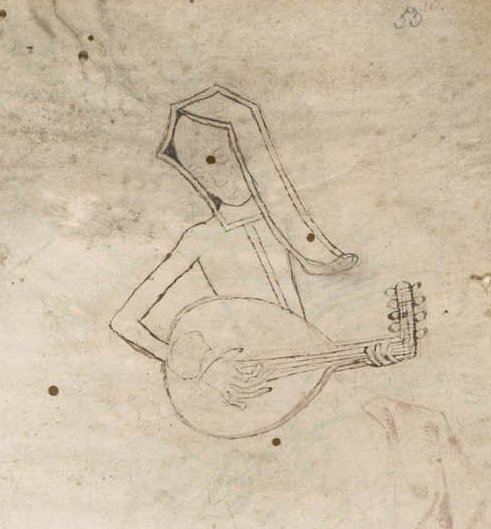
A conversation the despondent author has with his muse, Lady Philosophy, the book seeks the nature of happiness and the nature of God, in the midst of great loss, disgrace, and tyranny. The Consolation of Philosophy belongs to a long tradition of prison literature that extends to Don Quixote, “Civil Disobedience,” and “Letter from a Birmingham Jail.” Almost a thousand years after Boethius’s 524 execution, one late Medieval reader of his book—perhaps inspired by the text, or not—left the drawing you see above on the last page of a 15th century English illuminated manuscript.
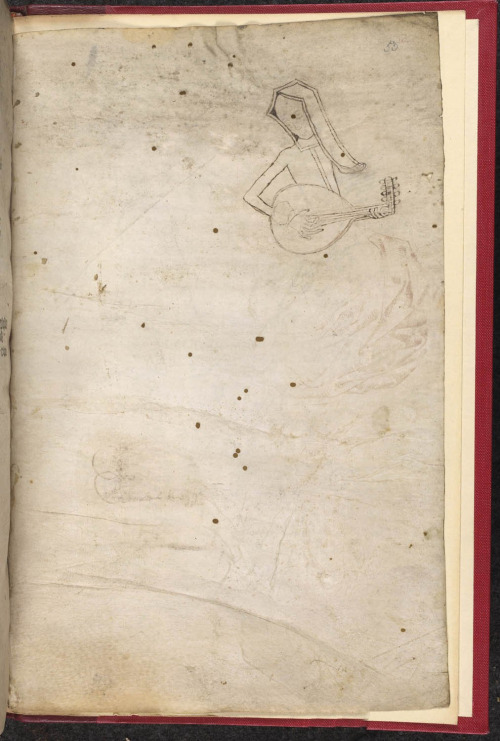
Such doodling was common practice at the time, notes Medieval book historian Erik Kwakkel. Blank pages in manuscripts “often filled up with pen trials, notes, doodles, or drawings.” But this particular doodle “is not what you’d expect: a full-on drawing of a maiden playing the lute, which she holds just like a guitar.” Boethius may have dismissed poetry in his search for happiness in the midst of despair, but his literary efforts might put us in mind of poet Berthold Brecht, who famously wrote while in exile from Germany in the 1930s, “In the dark times/Will there also be singing? Yes, there will also be singing/About the dark times.”
As if to remind us of the necessity not only of philosophy, but also of song in dark times, our anonymous reader drew a “rockstar lady,” whose pose connotes nothing but pure joy. We could juxtapose her with the joyful guitar poses of any number of modern blues and rock stars, who have played through any number of dark times. The drawing appears in a translation by John Walton dating from between 1410 and 1500, a century in Europe with no shortage of its own political crises and tyrannical rulers. “Even in the darkest of times,” wrote Hannah Arendt in her essay collection profiling artists and writers like Boethius and Brecht, “we have the right to expect some illumination,” whether from philosophy or poetry. We also have the right—the medieval doodler in Boethius’ book seemed to suggest some 500-odd years ago—to rock out.
via Erik Kwakkel
Related Content:
Wearable Books: In Medieval Times, They Took Old Manuscripts & Turned Them into Clothes
Wonderfully Weird & Ingenious Medieval Books
Josh Jones is a writer and musician based in Durham, NC. Follow him at @jdmagness
Read More...Italian Pianist Ludovico Einaudi Plays a Grand Piano While Floating in the Middle of the Arctic Ocean
Above, watch Italian pianist and composer Ludovico Einaudi perform an original composition, “Elegy for the Arctic,” on a grand piano, floating right in the middle of the Arctic Ocean. In one of his most challenging performances, Einaudi played “Elegy for the Arctic” for the very first time–a piece dedicated to the preservation of the Arctic. The home of endangered wildlife, the region also helps regulate our fragile climate. And our future depends partly on whether we keep it intact.
To pull off this production, a Greenpeace ship transported Einaudi and his grand piano to the seas north of Norway, and put them on a large platform. Says Greenpeace:
The massive early retreat of sea ice due to the effects of climate change allowed the construction of a 2.6 x 10 metre artificial iceberg, made from more than 300 triangles of wood attached together and weighing a total of nearly two tonnes. A grand piano was then placed on top of the platform.
You can see Einaudi performing right in front of a large glacier, while ice sheets fall aways as he plays. It’s a sight to behold.
If you would like to help protect the Arctic, you can donate to Greenpeace here.
If you would like to support the mission of Open Culture, consider making a donation to our site. It’s hard to rely 100% on ads, and your contributions will help us continue providing the best free cultural and educational materials to learners everywhere. You can contribute through PayPal, Patreon, and Venmo (@openculture). Thanks!
Related Content:
Global Warming: A Free Course from UChicago Explains Climate Change
A Beautiful Drone’s Eye View of Antarctica
The Making of a Steinway Grand Piano, From Start to Finish
Read More...How To Understand a Picasso Painting: A Video Primer
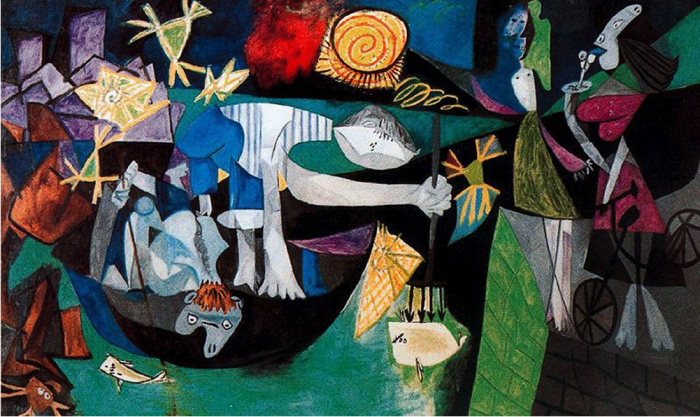
Sometimes it’s hard for the untrained eye to figure out what exactly is going on in a Picasso.
Fortunately, the artist leaned toward informative, workmanlike titles.
Had he titled “Night Fishing at Antibes,” below, something a bit more opaque—“Untitled No. 2,” say—the uneducated eye might well perceive the narrative as something closer to “Drunken Night in a Conveyer Belt Sushi Joint.”
Even knowing the correct title, my gut still argues that the boomerang-headed lady with boobs like lips is singing karaoke…
But after watching the above video by Evan Puschak, aka The Nerdwriter, I’m willing to concede that she’s standing on a jetty, a likely amalgamation of two of Picasso’s lovers.
(The less voluptuous creature standing next to her is his wife, and my gut is eager to know why it looks like she’s topless, a point on which Pushak is frustratingly mum.)
His process for understanding a Picasso takes the gut response into account, but then fleshes things out with four additional steps. You can apply them to many other artists’ work too.
- First reaction
- Content
- Form
- Historical context
- Personal context
It’s certainly helpful to know that the painting was made in 1939.
You probably don’t need the Internet to guess what world events were likely a source of preoccupation for the artist, whose “Guernica” was completed just two years earlier.
Content-wise, Puschak truffles up some interesting geographical references that elude most online analysis of the work. For instance, those purple blocks in the upper left corner now house the Musée Picasso.
There may well be a sixth step. Earlier, when a fan of the Nerdwriter’s weekly video essay series asked Puschak how to understand art, he responded:
All good art is trying to tell you something about your life. Your life… specifically. So understanding art is a process of understanding yourself, and vice versa. In both cases, you only learn by engaging. Watching isn’t enough, neither is reading or listening or thinking for that matter. From my perspective, engagement means writing. An idea that’s been snaking around in my videos for a long time is that we learn by saying, not thinking. You know something when you can articulate it, and for that you need words and sentences and paragraphs. So introspect, write down what your mind is doing. And when you watch a movie or look at a painting, write down how you feel about it. You’ll be amazed how one informs the other, and before long you’ll see some beautiful sparks.
Below are some of the resources Puschak credits with informing this Nerdwriter episode:
Rudolf Arnheim, “Picasso’s Night Fishing at Antibes” The Journal of Aesthetics and Art Criticism — Vol. 22, No. 2 (Winter, 1963), pp. 165–167
Douglas N. Morgan, “Picasso’s People: A Lesson in Making Sense” The Journal of Aesthetics and Art Criticism Vol. 22, No. 2 (Winter, 1963), pp. 167–171
Nina Corazzo, “Picasso’s ‘Night Fishing at Antibes’: A New Source” The Burlington Magazine Vol. 132, No. 1043 (Feb., 1990), pp. 99–101
Mark Rosenthal, “Picasso’s Night Fishing at Antibes: A Meditation on Death” The Art Bulletin Vol. 65, No. 4 (Dec., 1983), pp. 649–658
Albert Boime, “Picasso’s “Night Fishing at Antibes”: One More Try” The Journal of Aesthetics and Art Criticism Vol. 29, No. 2 (Winter, 1970), pp. 223–226
Timothy Anglin Burgard, “Picasso’s Night Fishing at Antibes: Autobiography, Apocalypse, and the Spanish Civil War” The Art Bulletin Vol. 68, No. 4 (Dec., 1986), pp. 657–672
Lawrence D. Steefel, Jr., “Body Imagery in Picasso’s “Night Fishing at Antibes” Art Journal Vol. 25, No. 4 (Summer, 1966), pp. 356–363+376
You can view the Nerdwriter’s other videos on his website or subscribe to his YouTube channel where a new video is published every Wednesday.
Related Content:
Watch Picasso Create Entire Paintings in Magnificent Time-Lapse Film (1956)
The Mystery of Picasso: Landmark Film of a Legendary Artist at Work, by Henri-Georges Clouzot
How to Look at Art: A Short Visual Guide by Cartoonist Lynda Barry
Ayun Halliday is an author, illustrator, theater maker and Chief Primatologist of the East Village Inky zine. Her play Zamboni Godot is opening in New York City in March 2017. Follow her @AyunHalliday.
Read More...Discover Lincos, the Language a Dutch Mathematician Invented Just to Talk to Extraterrestrials (1960)
The recent hit film Arrival took on a question that has, in recent decades, deeply concerned those involved in the search for intelligent life elsewhere in the universe. Say we locate that intelligent life. Say we decide what we want to say. On what basis, then, do we figure out how to say it? Aliens, while they may well have evolved certain qualities in common with us humans, probably haven’t happened to come up with any of the same spoken or written languages we have.
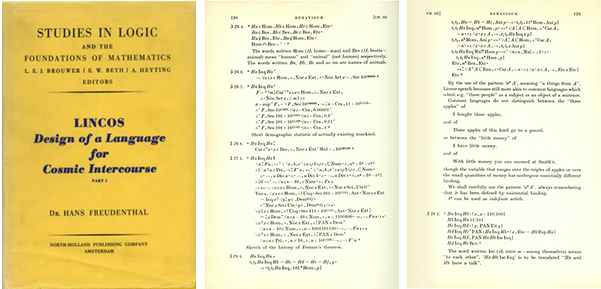
In 1960, the Dutch mathematician Hans Freudenthal came up with a solution: why not create a language they could learn? The efforts came published in the book Lincos: Design of a Language for Cosmic Intercourse. In it, writes The Atlantic’s Daniel Oberhaus, “Freudenthal announced that his primary purpose ‘is to design a language that can be understood by a person not acquainted with any of our natural languages, or even their syntactic structures … The messages communicated by means of this language [contain] not only mathematics, but in principle the whole bulk of our knowledge.’ ”
Freudenthal created Lincos as a kind of spoken language “made up of unmodulated radio waves of varying length and duration, encoded with a hodgepodge of symbols borrowed from mathematics, science, symbolic logic, and Latin. In their various combinations, these waves can be used to communicate anything from basic mathematical equations to explanations for abstract concepts like death and love.” You can read Lincos: Design of a Language for Cosmic Intercourse (PDF), over at Monoskop, and even though it constitutes only the first of a planned series of books Freudenthal never finished, you can still learn the basics of Lincos from it.
Be warned, however, of the intellectual challenge ahead: Freudenthal just plows ahead without even defining many of the concepts, which readers without a background in mathematics or logic will likely need explained, and Oberhaus quotes even one astrophysicist as calling Freudenthal’s book “the most boring I have ever read. Logarithm tables are cool compared to it.” Still, 56 years on from its creation, this intergalactic Esperanto has had a kind of influence: Freudenthal demonstrated the idea of including an intuitively understandable dictionary in the spaceward-sent message itself, an idea Carl Sagan went on to use in his novel Contact, in which extraterrestrial intelligence-seeking astronomers receive a signal from elsewhere that considerately does the same.
Contact became a major motion picture, something of the Arrival of its day, in 1997. Two years later, a couple of Canadian Defense Research Establishment astrophysicists used a radio telescope to beam out a Lincos-encoded message toward a few close stars. Like any enthusiastic member of their profession would, they sent out information about math, physics, and astronomy. They have yet to hear back from any residents, fellow astrophysicists or otherwise, of those distant neighborhoods. But if any extraterrestrials did hear the message, and even if they have yet to fully grasp Lincos, I have to believe they feel at least a little grateful that, unlike some humans attempting to communicate with others unlike them here on Earth, we didn’t just start yammering in English and hope for the best.
via Monoskop
Related Content:
Free NASA eBook Theorizes How We Will Communicate with Aliens
An Animated Carl Sagan Talks with Studs Terkel About Finding Extraterrestrial Life (1985)
Animated Video Explores the Invented Languages of Lord of the Rings, Game of Thrones & Star Trek
Klingon for English Speakers: Sign Up for a Free Course Coming Soon
Based in Seoul, Colin Marshall writes and broadcasts on cities and culture. He’s at work on a book about Los Angeles, A Los Angeles Primer, the video series The City in Cinema, the crowdfunded journalism project Where Is the City of the Future?, and the Los Angeles Review of Books’ Korea Blog. Follow him on Twitter at @colinmarshall or on Facebook.
Read More...200,000 Years of Staggering Human Population Growth Shown in an Animated Map
Last night, during a talk on his new book Raising the Floor, longtime labor leader and current senior fellow at Columbia University Andy Stern told the story of a king and a chessmaster engaged in pitched battle. “If you win,” said the overconfident king, “you may have anything you desire.” Lo, the chessmaster wins the game, but being a humble man asks the king only to provide him with some rice. The king smugly agrees to his eccentric conditions: he must place a grain of rice on the first square of the chessboard, then double the amount of each successive square. Once he reaches the middle, the king stops and has the chessmaster executed. The request would have cost him his entire kingdom and more.
Stern used the story to illustrate the exponential growth of technology, which now advances at a rate we can neither confidently predict nor control. Something very similar has happened to the human population in the past two-hundred years, as you can see illustrated in the video above from the American Museum of Natural History.
Evolving some 200,000 years ago in Sub-Saharan Africa, and migrating across the globe some 100,000 years ago, modern humans remained relatively few in number for several thousand years. That is, until the technological breakthrough of agriculture. “By AD 1,” the video text tells us, “world population reached approximately 170 million people.”
After a very rapid expansion, the numbers rose and fell slowly in the ensuing centuries as wars, disease, and famines decimated populations. World population reached only 180 million by the year 200 AD, then dwindled through the Middle Ages, only picking up again slowly around 700. Throughout this historiographic model of population growth, the video infographic provides helpful symbols and legends that chart historic centers like the Roman Empire and Han Dynasty, and show major world events like the Bubonic plague.
Then we reach the world-shaking disruptions that were the birth of Capitalism, the Atlantic slave trade, and the Scientific and Industrial Revolutions, when “modern technology and medicine bring faster growth.”
That’s quite the understatement. The growth, like the grains of rice on the chessboard, proceeded exponentially, reaching 1 billion people around 1800, then exploding to over 7 billion today. As the yellow dots—each representing a node of 1 million people—take over the map, the video quickly becomes an alarming call to action. While the numbers are leveling off, and fertility has dropped, “if current trends continue,” we’re told, “global population will peak at 11 billion around 2100.” Peak numbers could be lower, or substantially higher, depending on the predictive value of the models and any number of unknowable variables.
Andy Stern’s research has focused on how we build economies that support our massive global population—as machines stand poised in the next decade or so to edge millions of blue and white collar workers out of an already precarious labor market. The American Museum of Natural History asks some different, but no less urgent questions that take us even farther into the future. How can the planet’s finite, and dwindling, resources, with our current abuse and misuse of them, support such large and growing numbers of people?
It may take another technological breakthrough to mitigate the damage caused by previous technological breakthroughs. Or it may take an enormous, revolutionary political shift. In either case, the “choices we make today” about family planning, consumption, environmental regulation, and conservation “affect the future of our species—and all life on Earth.”
Related Content:
Crowded House: How the World’s Population Grew to 7 Billion People
Hans Rosling Uses Ikea Props to Explain World of 7 Billion People
Josh Jones is a writer and musician based in Durham, NC. Follow him at @jdmagness
Read More...Organization Guru Marie Kondo’s Tips for Dealing with Your Massive Piles of Unread Books (or What They Call in Japan “Tsundoku”)
“Eats, Shoots, and Leaves is Britain’s number-one best seller at the moment, and it’s about punctuation, and no, I don’t get it either,” writes Nick Hornby in his February 2004 “Stuff I’ve Been Reading” column for the Believer. What explains how Lynne Truss’ guide to the proper use of commas, semicolons, and dashes became such a publishing phenomenon those thirteen holiday seasons ago? Hornby theorizes that everyone had someone in mind to give a copy, whether a punctuation pedant themselves or someone whose skills in the area could use a sharpening, ultimately predicting that “in the end the book will sell a quarter-million copies, but only two hundred people will own them.”
Something similar may have happened with Marie Kondo’s book The Life-Changing Magic of Tidying Up, first published in Japan in 2011 and in English in 2014. Now people all over the world have read it to learn the simple secrets of Kondo’s “KonMari method” of decluttering — or have given it to friends and relatives they see as badly in need of such a method. Still, all but the most ascetic of us occasionally bend to the hoarder’s instinct in certain areas of life, and it would surely surprise none of us to find out that Open Culture readers have, on occasion, been known to let their bookshelves run over.
Hence the popularity of Jonathan Crow’s post on tsundoku, the Japanese word for the unread books that pile up unread in our homes. Japan, a land of small domestic spaces but a great deal of stuff, has paid special attention to the problem of hoarders and the gomi yashiki (or “trash mansions”) in which they sometimes end up. Some observers, like photographer Kyoichi Tsuzuki, celebrate the ever-present threat of total disorder; others, like Kondo, go on not just to attain guru status by selling books, but then to show fans how to tidy up all those books they’ve accumulated.
“Many people say that books are one thing they just can’t part with regardless of whether they are avid readers or not,” Kondo writes, “but the real problem is actually the way in which they part with them.” The way she offers requires adherence to certain practices and beliefs, including the following:
Take your books off the shelves. Kondo recommends–often against the objections of her clients–first de-shelving all their books and piling them on the floor (that is, the books that haven’t spent their entire lives in such a state). “Like clothes or any other belongings, books that have been left untouched on the shelf for a long time are dormant. Or perhaps I should say that they’re ‘invisible.’ ” Possibly drawing on what she learned from five years spent as an attendant maiden at a Shinto shrine, she renders them visible again, as you can see in the video above, “by physically moving them, exposing them to air and making them ‘conscious.’ ”
Make sure to touch each one. Only with your books conscious can you “take them in your hand one by one and decide whether you want to keep or discard each one. The criterion is, of course, whether or not it gives you a thrill of pleasure when you touch it.” Not when you read it (starting to read or even opening any of them can, she warns, derail the entire project) but when you touch it.
“Sometime” means “never.” We all own books we tell ourselves we’ll get around to one day (a habit which must have led Hornby to rigorously separate “Books Read” from mere “Books Bought” in his column), but Kondo suggests that the accumulation of books with only an intent to read them in the non-immediate future lessens the impact of the books you do read. “Timing is everything,” she writes. “The moment you first encounter a book is the right time to read it. To avoid missing that moment, I recommend you keep your collection small.”
Lithub’s Summer Brennan recently wrote up her own experience of weeding out her personal library the KonMari way. Brennan breaks the do-not-open rule and finds letters, lists, tickets (both flight and traffic), photos, bills, receipts, and even a high-school hall pass stuffed between their pages. Contra Kondo, she argues that our books “are not impersonal units of knowledge, interchangeable and replaceable, but rather receptacles for the moments of our lives, whose pages have sopped up morning hopes and late-night sorrows, carried in honeymoon suitcases or clutched to broken hearts. They are mementos, which [Kondo] cautions readers not to even attempt to contemplate getting rid of until the very last.”
Some of the books we own may spark joy, in other words, but almost all of them spark a range of other feelings besides. Even so, the holiday season having come upon us again, we’ve got no choice but to make at least a little room on our shelves — or our floors — to accommodate the new books we’ll no doubt receive as gifts. Farewell, then, to all those extra copies of bestselling punctuation guides. Only after they’ve gone will we see about breathing some life into the volumes to which we’ve grown more deeply attached. After all, a year’s end, as many a writer knows, provides the ideal time for reflection.
Related Content:
Change Your Life! Learn the Japanese Art of Decluttering, Organizing & Tidying Things Up
7 Tips for Reading More Books in a Year
What’s the Fastest Way to Alphabetize Your Bookshelf?
Based in Seoul, Colin Marshall writes and broadcasts on cities and culture. He’s at work on a book about Los Angeles, A Los Angeles Primer, the video series The City in Cinema, the crowdfunded journalism project Where Is the City of the Future?, and the Los Angeles Review of Books’ Korea Blog. Follow him on Twitter at @colinmarshall or on Facebook.
Read More...Support Us
We're hoping to rely on loyal readers, rather than erratic ads. Please click the Donate button and support Open Culture. You can use Paypal, Venmo, Patreon, even Crypto! We thank you!

About Us

Open Culture scours the web for the best educational media. We find the free courses and audio books you need, the language lessons & educational videos you want, and plenty of enlightenment in between.
Advertise With Us

FREE UPDATES!
GET OUR DAILY EMAIL
Get the best cultural and educational resources on the web curated for you in a daily email. We never spam. Unsubscribe at any time.
FOLLOW ON SOCIAL MEDIA

Open Culture editor Dan Colman scours the web for the best educational media. He finds the free courses and audio books you need, the language lessons & movies you want, and plenty of enlightenment in between.
Advertise With Us

