Hear Igor Stravinsky’s Symphonies & Ballets in a Complete, 32-Hour, Chronological Playlist
Those who know the work of Igor Stravinsky will be familiar with the reception the Russian composer’s The Rite of Spring received during its first performance in Paris in 1913. The typical description for what happened is that the ballet caused a “riot,” though given our usual associations with that word, it hardly seems like the appropriate term. As The Telegraph’s Ivan Hewett notes, the responses, though bemused and irate, were genteel by most standards of civil unrest. But there was violence and the threat of violence.
According to a member of the orchestra, “many a gentleman’s shiny top hat or soft fedora was ignominiously pulled down by an opponent over his eyes and ears, and canes were brandished like menacing implements of combat all over the theatre.” What could cause such a scandal? Hearing the piece, above, it’s perhaps not obvious why “people started to whisper and joke almost immediately.” Both Stravinsky and Russian ballet impresario Sergei Diaghilev sought to provoke the audience, but both were taken aback by the vehemence of the reactions. As audience members began to shout, “I left the hall in a rage,” Stravinsky later wrote. “I have never again been that angry.”
Of course, the music alone, without Vaslav Nijinsky’s choreography, only gives us half the story. Onstage, writes Hewitt, “there’s no sign that any of the creatures in the Rite of Spring has a soul, and there’s certainly no sense of a recognizable human culture. The dancers are like automata.” And yet, Stravinsky seems to have intended his music to alienate listeners as well: “there are simply no regions for soul-searching,” he said, “in The Rite of Spring.” It’s a comment that succinctly sums up the composer’s iconoclasm and defiance of sacred musical norms.
Stravinsky’s first ballet, 1910’s The Firebird, followed Debussy in recuperating the so-called “Devil’s Interval,” a tonal figure avoided for hundreds of years in religious music for its sinister sound. But The Firebird’s exotic beauty charmed audiences, as did his next ballet Petrushka. And despite the Rite of Spring controversy, many of Stravinsky’s symphonies are quite traditional next to the avant-gardism of his peers. His tendencies of “regression and restauration,” writes classical site CMUSE, “an amalgam of the archaic and the modern,” caused Theodor Adorno to describe Stravinsky as schizophrenic in Philosophy of Modern Music.
Unlike his modernist rival Arnold Schoenberg, Stravinsky is “in the same category as T.S. Eliot, as both were well-versed in literary/musical tradition and well aware of the current avant-garde movements, but maintained quite a conservative approach to novelty.” Stravinsky’s conservative modernism had a profound effect on another form of 20th century music that looked both backward and forward: jazz. Artists like Charlie Parker paid tribute to him, and the composer very much appreciated it. “This cat,” said Parker, “he’s kind of cool, you know.”
In the chronological playlist above from Ulysses Classical, hear the early symphonies and sonatas that inspired Diaghilev to hire him as the Ballets Russes first composer, and many of the ballets that enraged the Parisian elite, delighted Charlie Parker, and repelled Adorno. And find out why, as CMUSE argues, Stravinsky may be “the greatest composer of the 20th century.”
The playlist runs 32 hours. If you need Spotify’s software, download it here.
Related Content:
The Night When Charlie Parker Played for Igor Stravinsky (1951)
Stravinsky’s “Illegal” Arrangement of “The Star Spangled Banner” (1944)
Josh Jones is a writer and musician based in Durham, NC. Follow him at @jdmagness
Read More...Watch a 27-Year-Old Glenn Gould Play Bach & Put His Musical Genius on Display (1959)
Glenn Gould died young, in 1982 at the age of 50, but the Canadian classical pianist made great contributions to the world of music in his short life. He did it in part by starting young — so young, in fact, that he first felt the vibrations of music played for him while still in the womb by his mother. She’d decided even then to raise a successful musician, and her plan surely worked better than she could ever have expected. Young Glenn had perfect pitch, learned to read notes before he learned to read words, entered Toronto’s Royal Conservatory of Music at age ten, and grew into the very archetypal image of a musical genius: eccentric and often difficult, but possessed of almost otherworldly skill and distinctiveness.
Those qualities came out nowhere more clearly than in Gould’s relationship with the music of Johann Sebastian Bach, whom he described as “beyond a doubt the greatest architect of sound who ever lived.” Even listeners only casually acquainted with Gould’s work will know his recordings of Bach’s Goldberg Variations, the first of which, recorded in 1955, shot him to stardom and became one of the best-selling classical albums of all time.
Four years after that, the National Film Board of Canada documentary Off the Record, just above, captured his playing on film in the clips at the top of the post. “When Gould is not on tour or recording,” he spends most of his time at his retreat, a cottage on the Shore of Lake Simcoe 90 miles north of Toronto. Here he works on the piano he favors above all others for practicing: a 70-year-old Chickering with a resonant, harpsichord quality recalling the instruments of the time of Bach.”
There, in that cottage in the small community of Uptergrove, we see the 27-year-old Gould play Bach’s Partita No. 2, vocalizing along with the distinctive mix of forcefulness and delicacy issuing from the instrument that he never chose, but mastered to a degree few had before or have since. “His ambition,” the narrator says, “is to make enough money by the time he is 35 to retire from the concert stage and devote himself to composing.” In fact Gould put live performance behind him just five years later in order to pursue with more focus his own kind of pianistic perfection, which he continued to do for the rest of his life.
Related Content:
Watch Glenn Gould Perform His Last Great Studio Recording of Bach’s Goldberg Variations (1981)
Glenn Gould Explains the Genius of Johann Sebastian Bach (1962)
The Art of Fugue: Gould Plays Bach
Glenn Gould Gives Us a Tour of Toronto, His Beloved Hometown (1979)
Based in Seoul, Colin Marshall writes and broadcasts on cities and culture. He’s at work on a book about Los Angeles, A Los Angeles Primer, the video series The City in Cinema, the crowdfunded journalism project Where Is the City of the Future?, and the Los Angeles Review of Books’ Korea Blog. Follow him on Twitter at @colinmarshall or on Facebook.
Read More...Watch Helen Keller & Teacher Annie Sullivan Demonstrate How Helen Learned to Speak (1930)
Knowing the transformative effect an inspired teacher can have on an “unreachable” student, one can only hope that geography and luck will conspire to bring the two together at an early point in the child’s development.
Helen Keller, author, activist, and poster girl for surmounting near-impossible odds, certainly lucked out in the teacher department. Rendered deaf and blind by a fever contracted at 19 months, Keller earned a reputation as a holy terror in a family ill-equipped to understand what her wild rages might signify.
Her well-connected parents consulted various experts, including soon-to-be-friend, inventor Alexander Graham Bell, a trail that ultimately led to the Perkins School for the Blind and the 20-year-old Annie Sullivan.
Within a few short months of her arrival at the Keller family home, Sullivan led the nearly-seven-year-old Keller to her famous breakthrough at the water pump.
In a more conventional arrangement, the student would eventually leave her teacher for further educational pursuits, but Keller depended on Sullivan to translate other teachers’ lectures and classroom interactions. Sullivan accompanied her to Perkins School for the Blind, the Wright-Humason School for the Deaf, the Cambridge School for Young Ladies, and finally Radcliffe College, where Keller earned her BA.
The unusual boundaries of their teacher-student bond meant Keller lived with Sullivan and her husband in their Forest Hills home, a move that hastened the marriage’s unofficial but permanent end, according to Sullivan’s biographer, Kim Nielsen. It likely thwarted Keller’s single attempt at romance, with her temporary secretary, writer Peter Fagan, too.
For better and worse, their lives were forever entwined, each made more extraordinary by the presence of the other.
Their appearance in the 1930 Vitaphone newsreel, above, highlights the mandatory physical closeness they shared, as they demonstrate the process by which Keller learned to speak. Having learned to communicate via letters Sullivan finger spelled into her palm, Keller placed her fingers against Sullivan’s lips, throat and nose, to feeling the vibrations made when these familiar letters were spoken aloud.
Sullivan died six years after the newsreel was filmed, at which point, Polly Thomson, originally engaged as the ladies’ housekeeper, took over, serving as Keller’s interpreter and traveling companion for the next twenty years.
Related Content:
Helen Keller Had Impeccable Handwriting: See a Collection of Her Childhood Letters
Helen Keller Speaks About Her Greatest Regret — Never Mastering Speech
Ayun Halliday is an author, illustrator, theater maker and Chief Primatologist of the East Village Inky zine. Her play Zamboni Godot is opening in New York City in March 2017. Follow her @AyunHalliday.
Read More...The Ukulele Orchestra of Great Britain Performs Great Covers of Nirvana’s “Smells Like Teen Spirit,” Talking Heads’ “Psycho Killer” & More
To the very end of his life, no less an authority on good musical vibes than George Harrison praised and played the ukulele, interpreting many classic tunes on the instrument, penning an enthusiastic endorsement, and supposedly buying ukes in bulk to give away at his home in Hawaii. As Harrison recognized, there is something special about the role of the ukulele in western pop, and that has been true since Hawaiian music exploded onto the mainland in the early 20th century.
So there’s no reason why the ukulele shouldn’t be a serious interpreter of modern hits from Nirvana, Talking Heads, The Who, David Bowie, etc. And also no reason those interpretations shouldn’t be played on stages like the Royal Albert Hall by men and women in formal wear, befitting the seriousness with which they take the cheerful-sounding instrument. The Ukulele Orchestra of Great Britain is so serious, in fact, that they filed and won a lawsuit last year against an alleged copycat group in Germany, claiming their “reputation as performers” and “international and celebrity fan base” were at stake.
Indeed, the UOGB isn’t shy about self-promotion, describing themselves as “a national institution.” But despite their thoroughgoing professionalism, their act is still in good fun. (They also, with humor, note they “are often blamed for the current Ukulele revival which is sweeping the globe.”) And the orchestra’s reputation is more than well-earned. Their site features quotes from luminaries like Bowie and Brian Eno, and endorsements from NME and the Financial Times, who aptly describe them as “both hilarious and heartfelt.” Their winning stage banter gives way to stunning renditions of popular songs that all of the members—including at times a double bass player who goes by the name “David Bowie”—sing in harmony. (They perform their take on “Pinball Wizard,” below, entirely acapella.)
In performances of “Smells Like Teen Spirit,” at the top,” “Psycho Killer,” further down, and, just below, “Life on Mars” the orchestra not only demonstrates how much great musical comedy depends upon great musicianship, they also show the incredible range of the diminutive Polynesian instrument. That’s especially the case in their act of Bowie “plagiarism,” in which six uke players pick out delicate, classical guitar-like arpeggios in the verses, then strum reggae-like percussive attacks under the complex vocal harmonies in the chorus.
The seventh member on stage plays an acoustic bass guitar—the only concession to an additional rhythm instrument, but even in these four anthemic rock songs, you won’t bemoan the lack of drums. As The New York Times remarks, the Ukulele Orchestra of Great Britain “extracts more than seems humanly possible from so small and so modest an instrument.” See them play a version of The Good, The Bad, and The Ugly theme at our previous post, and see many more videos and live performances at the orchestra’s YouTube channel.
Related Content:
George Harrison Explains Why Everyone Should Play the Ukulele, With Words and Music
Musicians Re-Imagine the Complete Songbook of the Beatles on the Ukulele
Josh Jones is a writer and musician based in Durham, NC. Follow him at @jdmagness
Read More...The History of Europe: 5,000 Years Animated in a Timelapse Map
If you’re an Open Culture old timer, you know the work of EmperorTigerstar–a Youtuber who specializes (to quote myself) “in documenting the unfolding of world historical events by stitching together hundreds of maps into timelapse films”. We’ve previously featured his “map animations” of the U.S. Civil War (1861–1865), World War I (1914–1918), and World War II (1939–1945) and also the History of Rome. This week, the map animator released The History of Europe: Every Year. In ten minutes, he takes us from The Minoan civilization that arose on the Greek island of Crete (3650 to 1400 BC), down to our modern times. About 5,000 years of history gets covered before you can boil a pot of pasta. Enjoy.
If you would like to support the mission of Open Culture, consider making a donation to our site. It’s hard to rely 100% on ads, and your contributions will help us continue providing the best free cultural and educational materials to learners everywhere. You can contribute through PayPal, Patreon, and Venmo (@openculture). Thanks!
Related Content:
The Rise & Fall of the Romans: Every Year Shown in a Timelapse Map Animation (753 BC ‑1479 AD)
Animated Map Lets You Watch the Unfolding of Every Day of the U.S. Civil War (1861–1865)
Watch World War I Unfold in a 6 Minute Time-Lapse Film: Every Day From 1914 to 1918
Watch World War II Rage Across Europe in a 7 Minute Time-Lapse Film: Every Day From 1939 to 1945
Read More...Hear Raymond Chandler & Ian Fleming–Two Masters of Suspense–Talk with One Another in Rare 1958 Audio
In the mid-20th century, the red-blooded reading man in America and Britain each had a character on whom he could rely to have vivid, in their separate ways exotic, and on a certain level somehow relatable adventures on the page: Philip Marlowe in the former, and James Bond in the latter. Raymond Chandler’s luckless Los Angeles private detective and Ian Fleming’s always impeccably kitted-out agent on Her Majesty’s Secret Service would seem at first to have little in common, but when their creators got together on the BBC’s Third Programme in 1958, they had a lot to talk about.
Chandler, two decades Fleming’s senior and then in the final year of his life, had seen better days. “This once-handsome man was, at the age of 66, a wreck,” says the announcer in a preface to this 1988 re-broadcast, “depressed, alcoholic, written out. But he was lionized, and one of his new friends was Ian Fleming, whose Bond novels he’d been the first to appreciate. He reviewed Diamonds Are Forever in the Sunday Times, providing the kind of serious criticism he wanted himself, and in 1956, in a letter to Fleming, Chandler said, ‘I did not think that I did quite do you justice in my review of your book, because anyone who writes as dashingly as you ought, I think, to try for a little higher grade.”
This mix of praise and criticism from the elder writer invigorated Fleming, who promptly redoubled his efforts in Bondcraft. Two years later, ostensibly to promote his seventh novel (and, it turned out, his last) Playback, the London-raised Chandler joined Fleming on the air to talk about British and American thrillers. “In America, a thriller or mystery story writer is slightly below the salt,” complains Chandler, who’d preceded this morning recording session with whisky. “You can write a very lousy, long historical novel full of sex and it can be a bestseller, it can be treated respectfully. But a very good thriller writer who writes far, far better just gets a little paragraph — that’s all.”
The two go on to discuss where they get their material, how to write villains (“I don’t think I ever in my own mind think anybody is a villain,” says Chandler when Fleming brings up the difficulty of creating such characters), the emergence of heroes (Fleming first intended Bond as “a sort of blank instrument wielded by a government department”), the secrets of literary productivity (Fleming took two months off in Jamaica from his Sunday Times job each year to write another book), the mechanics of gangland killings, and whether they have anybody they personally want to shoot (Chandler does, replying only that “I just thought they’d be better dead,” when Fleming asks why).
And what, at bottom, does Diamonds Are Forever’s kind of writing and The Big Sleep’s kind of writing really have in common? “We both like making funny jokes,” says Fleming. Toward the end of this broadcast, now the sole extant recording of Chandler’s voice, the creator of Philip Marlowe leaves us with some wise words in addition: “A solemn thriller is really rather a bore.”
Related Content:
Raymond Chandler’s Ten Commandments for Writing a Detective Novel
Raymond Chandler Denounces Strangers on a Train in Sharply-Worded Letter to Alfred Hitchcock
Raymond Chandler: There’s No Art of the Screenplay in Hollywood
Watch Raymond Chandler’s Long-Unnoticed Cameo in Double Indemnity
James Bond: 50 Years in Film (and a Big Blu-Ray Release)
Based in Seoul, Colin Marshall writes and broadcasts on cities and culture. He’s at work on a book about Los Angeles, A Los Angeles Primer, the video series The City in Cinema, the crowdfunded journalism project Where Is the City of the Future?, and the Los Angeles Review of Books’ Korea Blog. Follow him on Twitter at @colinmarshall or on Facebook.
Read More...The Best Commercial Ever? James Brown Sells Miso Soup (1992)
Most stars are understandably choosy about what products, if any, they’re willing to endorse. Serious artists are mindful about their reputations.
The late great Godfather of Soul James Brown lent his prodigious talents to McDonalds (for a price), but it’s worth noting that most of the heavy lifting was done by a cast of unknowns playing ticket holders fortifying themselves before a hotly anticipated concert. Brown arrives at the end, to bedazzle everyone in the restaurant with his fancy footwork, sequined suit, and sheer proximity.
Clearly, the Hardest Working Man in Show Business had standards.
(Since his death in 2006, his hits have been used to sell athletic wear, gin, beer, and pork tenderloin, proof that these things are harder to control from beyond the grave.)
Japanese television is one arena where many Western celebrities are willing to relax their usual policies. The prospect of an enormous paycheck for so little work is hard to beat, though in the age of Youtube, there’s a far greater likelihood that their core fans will see the results.
Youtube was not a concern in 1992, when Brown filmed the above 15-second spot for Nissin Cup Noodles. No one can accuse him of phoning it in. He dances, lip synchs soup-centric Japanese lyrics to the tune of Sex Machine, and even—in a longer version on a kitchen set—pours boiling water into the cup, just like millions of budget-conscious artists and students the world over.
What he doesn’t do is “bite and smile,” a staple of commercial acting. He raises a forkful of product to his mouth with an obliging grin, but doesn’t ingest so much as a noodle.
For that, we must turn to former bodybuilder and Governor of California Arnold Schwarzenegger, who supplemented his movie career as Nissin Cup Noodles’ previous Japanese TV pitchman. Not only did he consent to funny costumes, he pile drives that ramen like a World Record in Competitive Eating depends on it. None of that clowning for Brown!
Readers, we invite you to contribute to our scholarship of Western celebs’ Japanese TV commercials in the comments section below.
Related Content:
James Brown Gives You Dancing Lessons: From The Funky Chicken to The Boogaloo
Jim Henson’s Violent Wilkins Coffee Commercials (1957–1961)
Ayun Halliday is an author, illustrator, theater maker, and Chief Primatologist of the East Village Inky zine. Her play Zamboni Godot is opening in New York City in March 2017. Follow her @AyunHalliday.
Read More...Bob Dylan Wins Nobel Prize in Literature for Creating “New Poetic Expressions within the Great American Song Tradition”
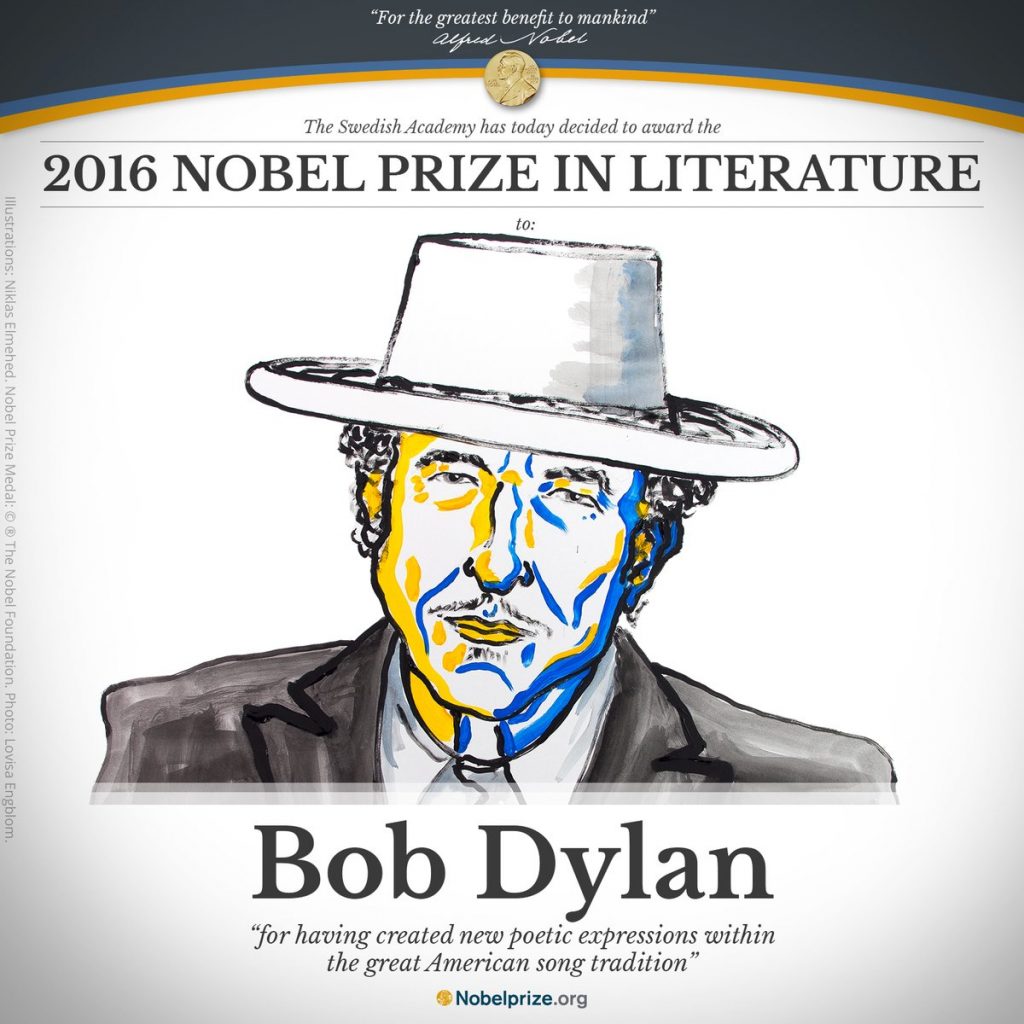
Image courtesy of The Nobel Prize’s Twitter stream.
His apocalyptic poetry plucks images and forms from the blues, the Bible, the Beats, Symbolists, William Blake, T.S. Eliot, and a balladeer tradition dating from medieval French and English minstrelsy to Appalachian settlement to Woody Guthrie, his first muse. His narrative voice shifts from work to work as he has fully embodied various American characters for over half a century—folk troubadour, rock and roll trickster, earnest country crooner, evangelist, weary bluesman, starry-eyed jazz singer. “There is no systematic way of analyzing Dylan’s song lyrics or poems,” writes Julia Callaway at the Oxford Dictionaries blog; “they span more than five decades of historical context and musical style. But perhaps one of the most interesting sides of Dylan is how he uses language and his lyrics to project certain identities, including folksinger and protest-musician.”
Dylan began in that tradition with songs like “The Times They Are A‑Changin’” and “A Hard Rains A‑Gonna Fall”—picking up Guthrie’s inflections and mannerisms in ballads much more sophisticated than they seemed at first listen. “A Hard Rain’s A‑Gonna Fall” is a “seven minute epic,” writes Rolling Stone, “that warns against a coming apocalypse while cataloging horrific visions—gun-toting children, a tree dripping blood—with the wide-eyed fervor of John the Revelator.” The song “began life as a poem, which Dylan likely banged out on a typewriter owned by his buddy… Wavy Gravy.” Dylan has been ambivalent about whether or not we should call him a poet, but this is how so much of his work took shape—banged out on typewriters in New York apartments—as poetry set to music. “Every line in [A Hard Rain’s A‑Gonna Fall] is actually the start of a whole song,” said Dylan, “but when I wrote it, I thought I wouldn’t have enough time alive to write all those songs, so I put all I could into this one.”
After over five decades of lyrics packed with allusion and densely woven themes and meanings, Dylan has had time to write those songs—several more apocalyptic epics set to a few chords on the acoustic guitar. “There are some novels, some trilogies, in fact, with less actual content than Bob Dylan’s ‘All Along the Watchtower,’” says the Nerdwriter in the analysis of that cryptic John Wesley Harding song above. One could say the same about certain songs that appear on nearly every Dylan record, like the 11-minute “Desolation Row,” below. Amid only a few missteps, Dylan has released album after album, decade after decade, that showcase his unparalleled wordcraft in various song forms. And some of his finest work has appeared only in recent years, when it seems his career might have come to a close. Despite some mixed reactions—and some concern for Philip Roth—most people have responded to news this morning of his win for the Nobel Prize in Literature with a decided, “yes, of course.”
Dylan’s recognition by the Nobel Committee validates not only the songwriter himself, but the form he embraced and shaped. As permanent secretary of the Swedish Academy Sara Danius remarked in her announcement, Dylan “created new poetic expressions within the American song tradition.” The award represents “a recognition of the whole tradition that Bob Dylan represents,” says critic David Hadju, “so it’s partly a retroactive award for Robert Johnson and Hank Williams and Smokey Robinson and the Beatles. It should have been taken seriously as an art form a long time ago.” One could argue that American song has already been taken as seriously as any art form, but that it isn’t literature.
Several people have done so. As New York Times writer Hiroko Tabuchi put it, “this might be a disappointing day for booksellers and publishers.” Hardly. Not only does Dylan have a memoir out, Chronicles: Volume One, the first of a planned trilogy, but we may also find renewed appreciation for his first book, 1966’s Tarantula. Dylan’s songs and drawings have been turned into picture books, published in collections, and pored over in biography after biography, commentary after commentary. And next month, Dylan himself will release The Lyrics: Since 1962, a comprehensive, definitive collection of the songwriter’s lyrics, complete with expert annotations. You can pre-order a copy here.
The literary output by and about Dylan should keep booksellers busy for many months after this announcement. But Dylan’s is primarily a living, bardic tradition, lest we forget that all literature began as song. So congratulations to Dylan and for perhaps long-overdue recognition of American songcraft as a genuinely literary art form.
Related Content:
Josh Jones is a writer and musician based in Durham, NC. Follow him at @jdmagness
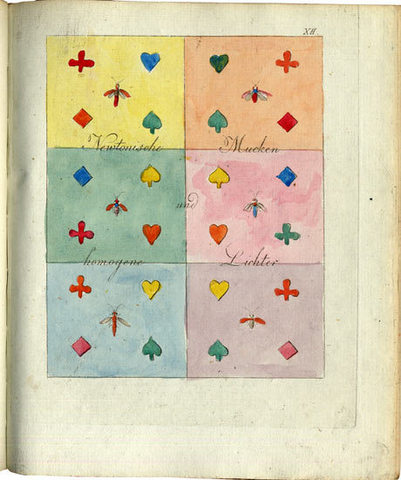
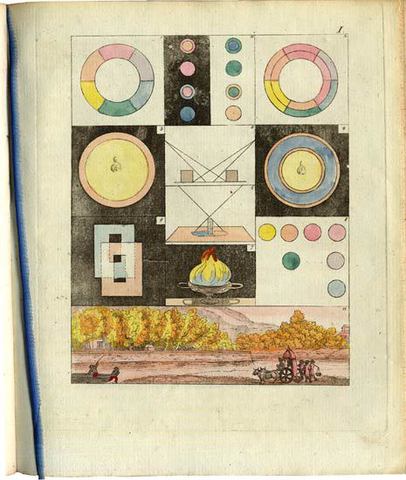
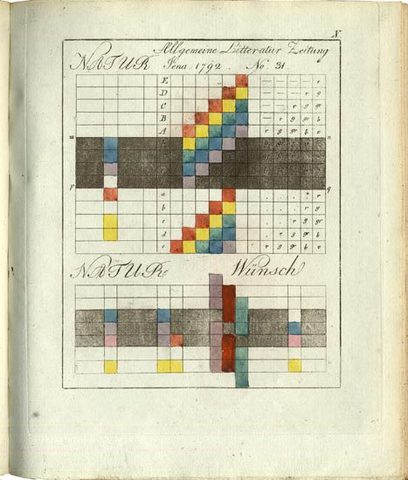
Read More...Goethe’s Colorful & Abstract Illustrations for His 1810 Treatise, Theory of Colors: Scans of the First Edition
The great Jewish philosopher Baruch Spinoza, it is said, drew his conceptions of god and the universe from his work as an optician, grinding lenses day after day. He lived a life singularly devoted to glass, in which his “evenings to evenings are equal.” So wrote Jorge Luis Borges in a poetic appreciation of Spinoza, of which he later commented, “[Spinoza] is polishing crystal lenses and is polishing a rather vast crystal philosophy of the universe. I think we might consider those tasks parallel. Spinoza is polishing his lenses, Spinoza is polishing vast diamonds, his ethics.”
The polishing of lenses, and work in optics generally, has a long philosophical pedigree, from the experiments of Renaissance artists and scholars, to the natural philosophers of the Scientific Revolution who made their own microscopes and pondered the nature of light. Over a century after Spinoza’s birth, polymath artist and thinker Johann Wolfgang von Goethe published his great work on optics, just one of many directions he turned his gaze. Unlike Spinoza, Goethe had little use for concepts of divinity or for systematic thinking.
But unlike many freethinking aristocratic dilettantes who were a fixture of his age, Goethe–-writes poet Philip Brantingham—“was a universal genius, one of those talents whose works transcend race, nation, language-and even time.” It’s a dated concept, for sure, but when we think of genius in the old Romantic sense, we most often think of Goethe, as a poet, philosopher, and scientist. When he turned his attention to optics and the science of color, Goethe refuted the theories of Newton and created some enduring scientific art, which would later inspire philosophical iconoclasts like Wittgenstein and expressionist painters like Wassily Kandinsky.
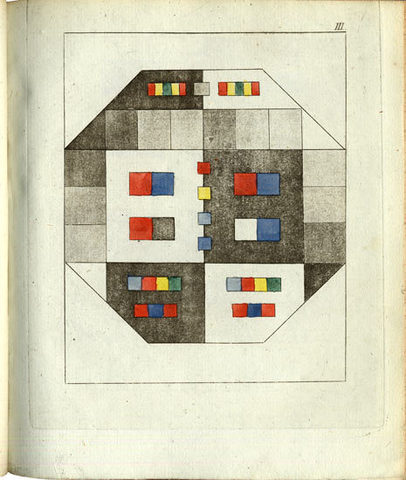
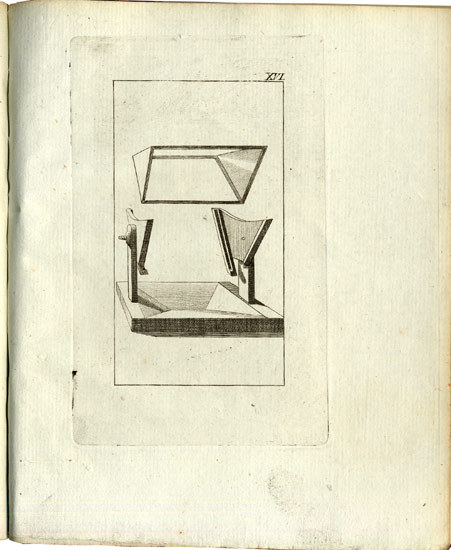
We’ve featured Goethe’s most important scientific work, Zur Farbenlehre (Theory of Colors), in a previous post. Now we can bring you the superior images above, from a first edition scan at Stockholm’s Hagerstromer Medical Library, who host a collection of scanned illustrations from dozens of first editions of naturalist texts. The collection spans a once suppressed physiology text by Descartes—another optics theorist—to Rachel Carson’s 1962 Silent Spring, the book that “launched the modern conservationist movement.” In-between, find scans of illustrations and photographs from the works of Carl Linnaeus, Charles Darwin, Louis Pasteur, and dozens of other natural philosophers and scientists who made significant contributions to medical science.
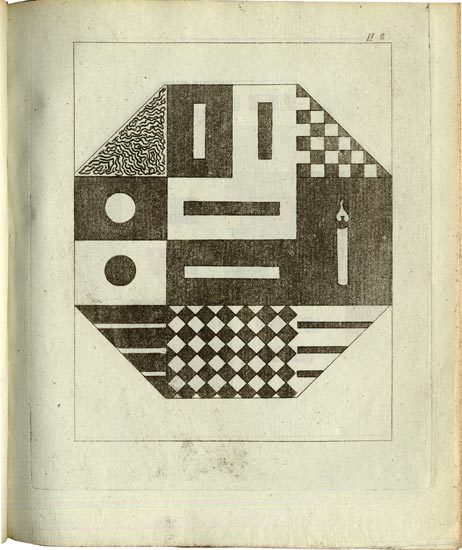
In the case of Goethe’s Theory of Colors (1810), we get a high-quality look at the images in what the author himself considered his best work. “Known as a fierce attack on Newton’s demonstration that white light is composite,” writes the Hagerstromer Library, “Goethe’s colour theory remains an epochmaking work.” Goethe’s illustrations came directly from “a large number of observations of subjective colour-perceptions, recorded with all the exactness of a scientist and the keen insight of an artist.” It’s partly the bridging of sciences and the arts—of Enlightenment and Romanticism—that has made Goethe such a remarkable figure in European intellectual history. But as many of the finely illustrated, carefully observed texts at the Hagerstromer Medical Library show, he wasn’t alone in that regard.
In addition to these classic texts, the Hagerstromer also hosts the Wunderkammer, an eclectic archive of (often quite bizarre) naturalist images and illustrations from the 16th to the 20th centuries. One MetaFilter user describes the collection thus:
Wunderkammer is a collection of high resolution images from old books in the Hagströmer Medical Library. Some of my favorites are sea anemones, nerve cells, rooster chasing off a monster, 16th Century eye surgery, muscles and bones of the hand and arm, elephant-headed humanoid and cupping. It can also be browsed by tag, broken up into subject (e.g. beast), emotion (e.g. strange), technique (e.g. chromolithography) and era (e.g. 18th Century).
Related Content:
Josh Jones is a writer and musician based in Durham, NC. Follow him at @jdmagness
How to Break Open a Big Wheel of Parmesan Cheese: A Delightful, 15-Minute Primer
It takes a year to age a wheel of fine parmesan cheese. And about 4 minutes, of good hard work, to break it open. Above, cheese expert Carlo Guffanti walks us through the process. The first incision comes at the 3 minute mark. Various knives come into play. Until we reach the seven minute mark, when the wheel of cheese finally breaks open. All the while, Guffanti talks about the cheese as if it’s a living, breathing person with volition and feelings. Maybe that’s what happens when you spend your life making fine cheeses. Or, maybe he’s just translating Italian expressions directly into English. Either way, it’s endearing.
Note: According to The Cheese Channel, which produced this video, what we’re actually seeing is “a wheel of Trentingrana – a parmesan-style cheese that’s from Trentino. The quality of Trentingrana is tightly controlled by appellation law, which states that it can only be made with raw milk from cows grazing on pastures or hay (silage is banned).” View more of The Cheese Channel’s videos here.
If you would like to support the mission of Open Culture, consider making a donation to our site. It’s hard to rely 100% on ads, and your contributions will help us continue providing the best free cultural and educational materials to learners everywhere. You can contribute through PayPal, Patreon, and Venmo (@openculture). Thanks!
Related Content:
MIT Teaches You How to Speak Italian & Cook Italian Food All at Once (Free Online Course)
Leo Tolstoy’s Family Recipe for Macaroni and Cheese
Salvador Dalí’s 1973 Cookbook Gets Reissued: Surrealist Art Meets Haute Cuisine
Read More...
Support Us
We're hoping to rely on loyal readers, rather than erratic ads. Please click the Donate button and support Open Culture. You can use Paypal, Venmo, Patreon, even Crypto! We thank you!

About Us

Open Culture scours the web for the best educational media. We find the free courses and audio books you need, the language lessons & educational videos you want, and plenty of enlightenment in between.
Advertise With Us

FREE UPDATES!
GET OUR DAILY EMAIL
Get the best cultural and educational resources on the web curated for you in a daily email. We never spam. Unsubscribe at any time.
FOLLOW ON SOCIAL MEDIA

Open Culture editor Dan Colman scours the web for the best educational media. He finds the free courses and audio books you need, the language lessons & movies you want, and plenty of enlightenment in between.
Advertise With Us

